7 - 1 
Product 
• Anything that can be offered to a 
market for attention, acquisition, use, or 
consumption that might satisfy a want 
or need 
Service 
• An activity, benefit, or satisfaction 
offered for sale that is essentially 
intangible and does not result in the 
ownership of anything
7 - 2 
What Is a Product? 
• Tangible objects, 
services, events, 
persons, organizations, 
places, ideas, or a 
mixture of these
7 - 3 
What Is a Product? 
• Services are a form of product 
• Activities, benefits, or 
satisfactions offered for sale 
• Essentially intangible 
• Do not result in the ownership 
of anything
7 - 4 
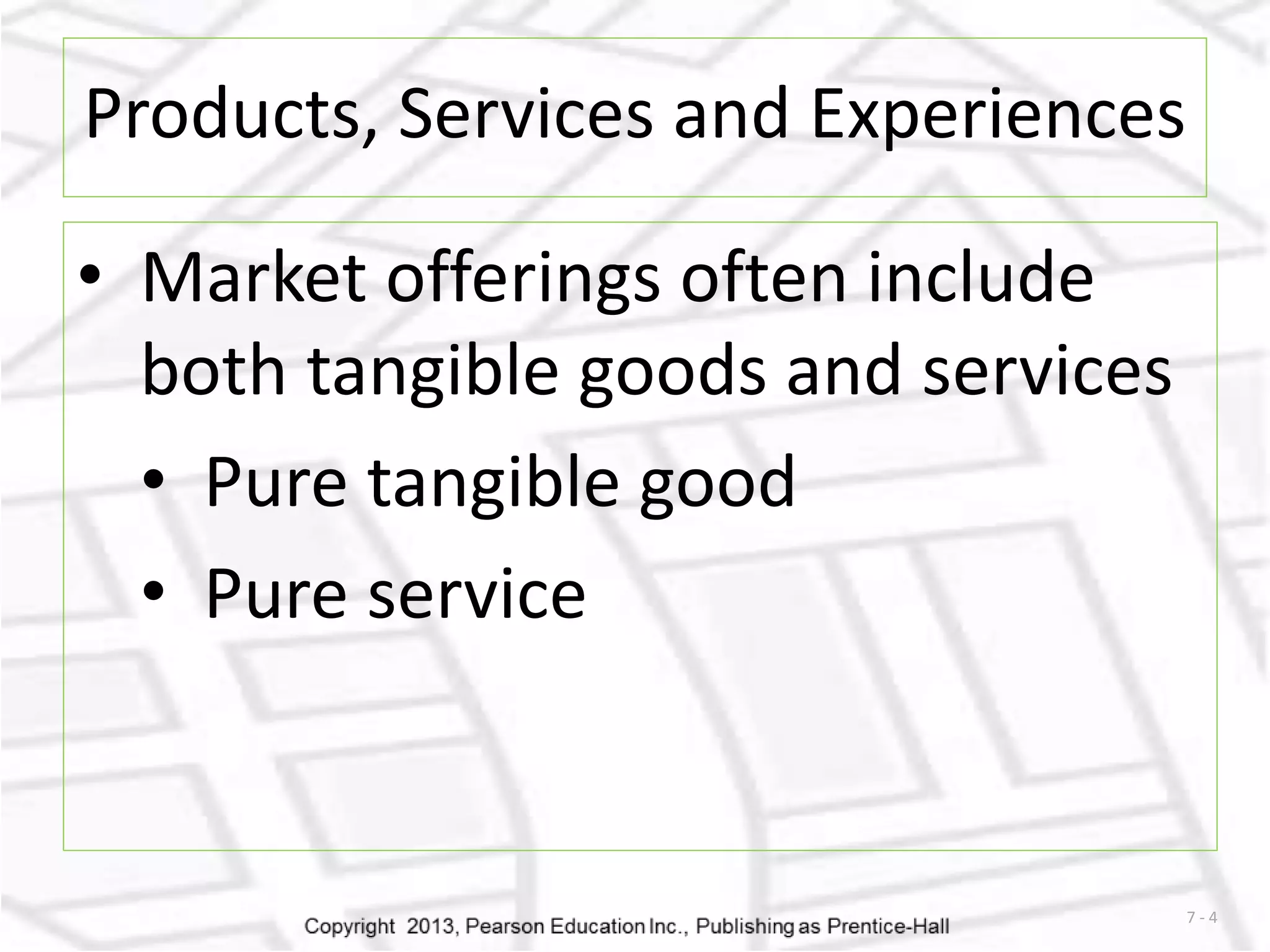
Products, Services and Experiences 
• Market offerings often include 
both tangible goods and services 
• Pure tangible good 
• Pure service
7 - 5 
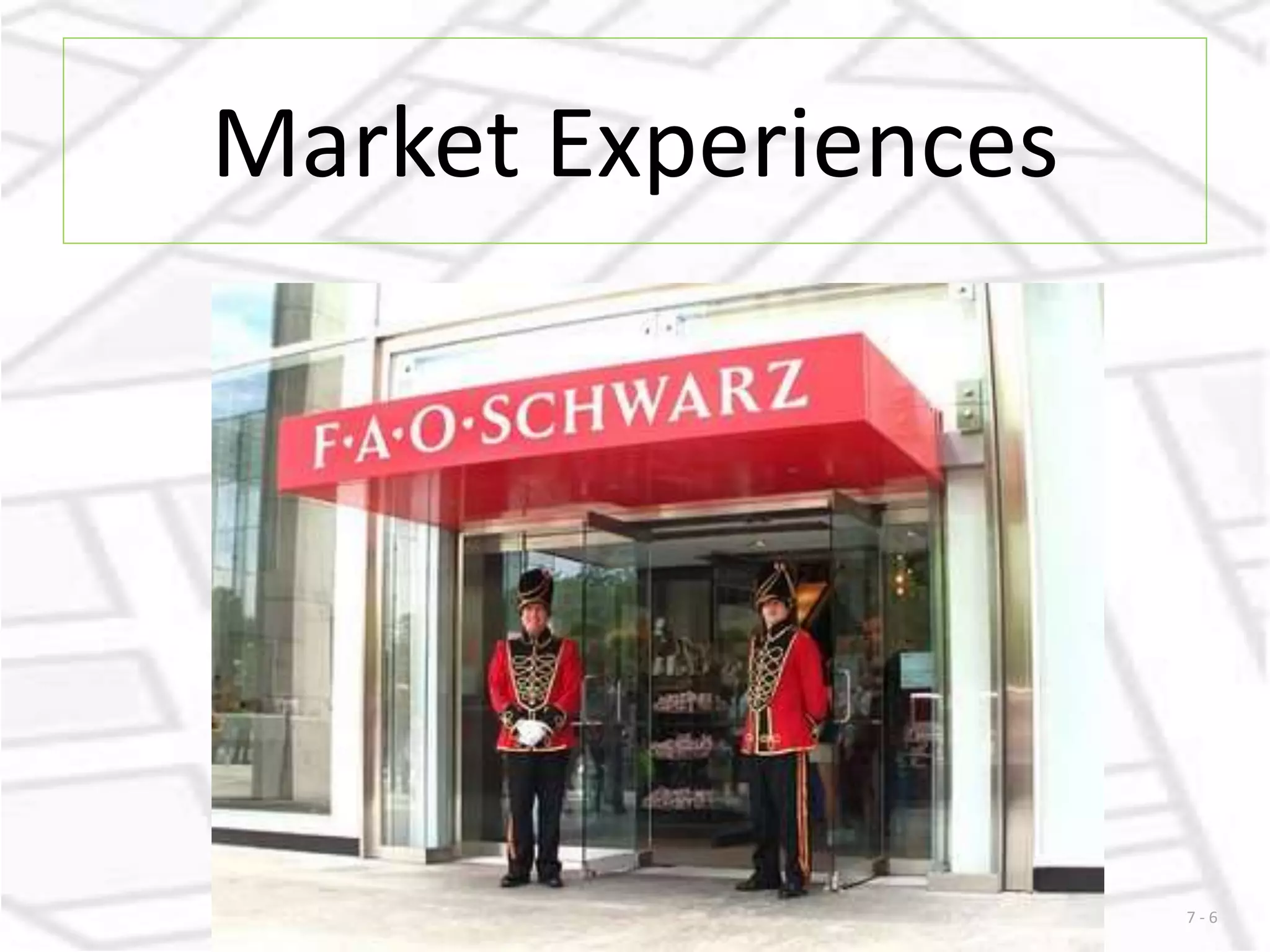
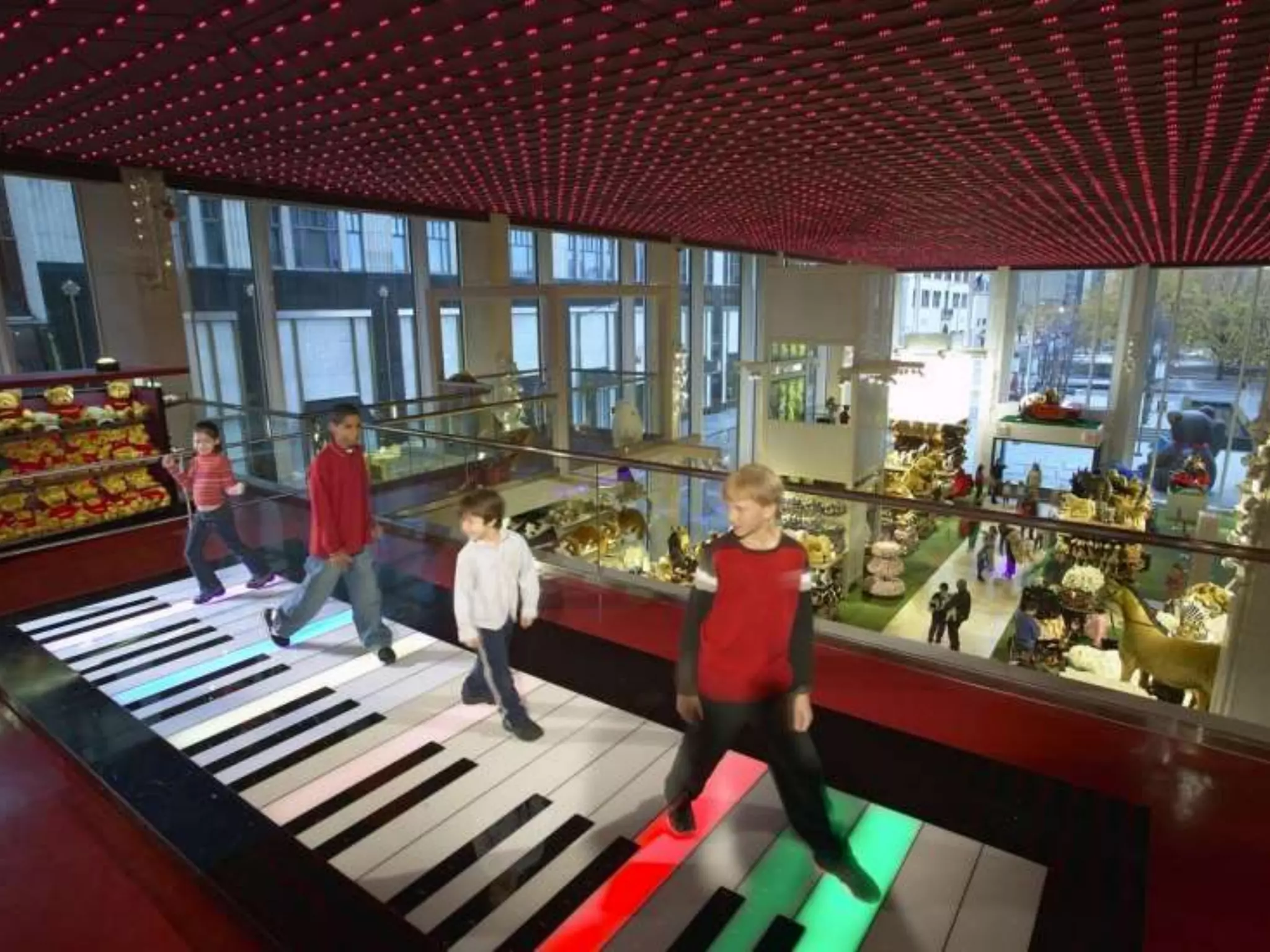
Many companies offer 
marketing experiences
7 - 6 
Market Experiences
7 - 7 
Many companies now 
marketing experiences
7 - 8
7 - 9
7 - 10
7 - 11 
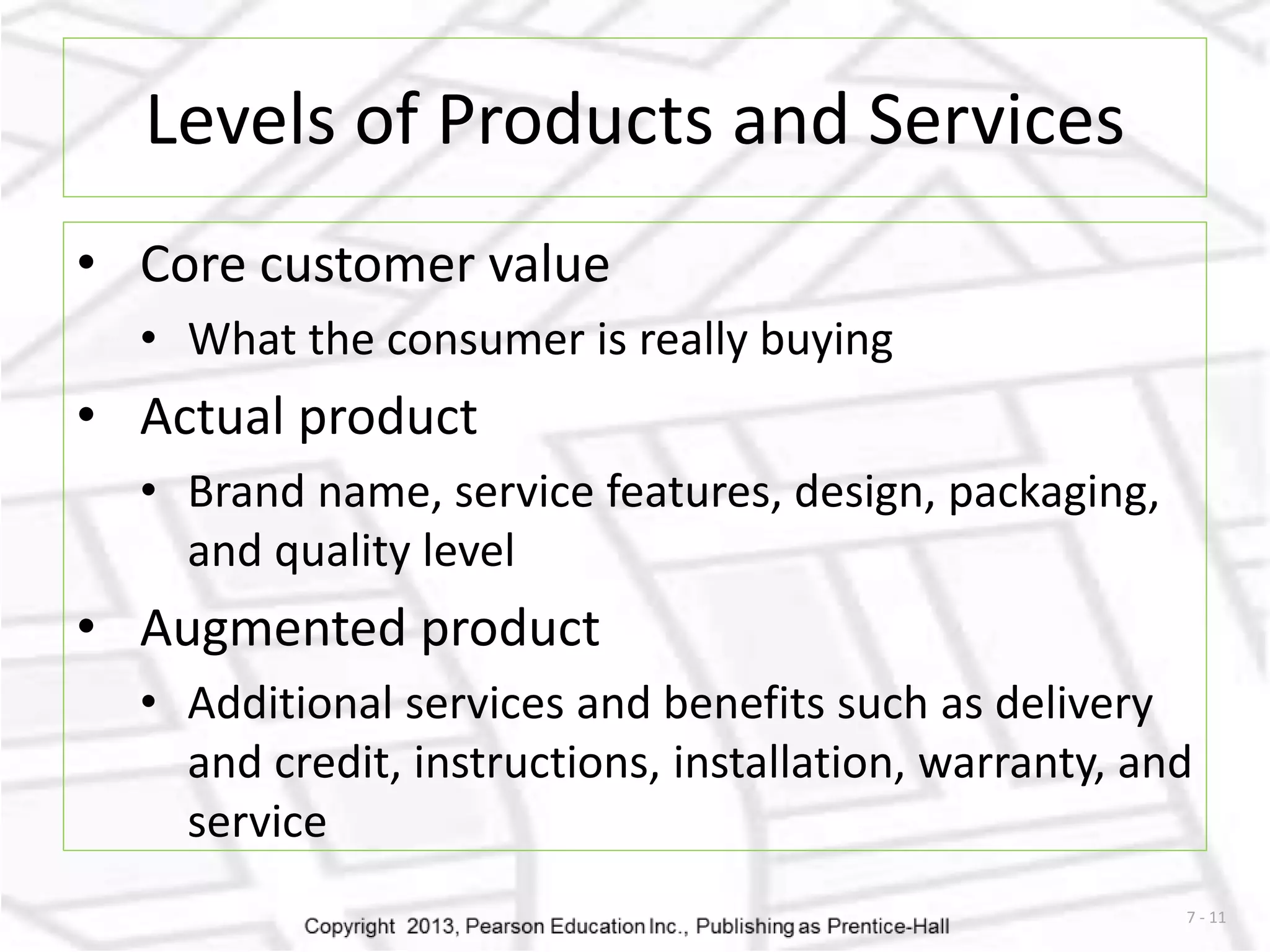
Levels of Products and Services 
• Core customer value 
• What the consumer is really buying 
• Actual product 
• Brand name, service features, design, packaging, 
and quality level 
• Augmented product 
• Additional services and benefits such as delivery 
and credit, instructions, installation, warranty, and 
service
7 - 12 
Consumer Products 
• A product bought by final consumers for 
personal consumption 
• Classified by how consumers buy them 
Convenience 
products 
Shopping 
products 
Specialty 
products 
Unsought 
products
7 - 13 
Convenience Products 
• Consumer products that customers usually 
buy frequently, immediately, and with 
minimal comparison and buying effort 
• Low priced 
• Placed in many locations to make them readily 
available 
• E.g. Laundry detergent, candy, magazines, and 
fast food
7 - 14 
Convenience Products
7 - 15 
Shopping products 
• Consumer products that the customer, in the 
process of selecting and purchasing, usually 
compare on such attributes as suitability, 
quality, price, and style 
• Less frequently purchased 
• Distributed through fewer outlets 
• Greater sales support
7 - 16 
Shopping Products
7 - 17 
Specialty products 
• Consumer products with unique 
characteristics or brand identification for 
which a significant group of buyers is willing 
to make a special purchase effort 
• Different brands are not usually compared 
• E.g. Specific brands of cars, high-priced 
photographic equipment, designer clothes, and 
the services of medical or legal specialists
7 - 18 
Specialty products
7 - 19 
Specialty Products
7 - 20 
Unsought Products 
• Consumer products that the consumer either 
does not know about or knows about but 
does not normally consider buying 
• Require a lot of advertising, personal selling, and 
other marketing efforts 
• New innovations are generally unsought till 
advertised 
• Known but unsought products and services are 
life insurance, preplanned funeral services
7 - 21
7 - 22 
Industrial Products 
• Products bought by individuals and 
organizations for further processing or for use 
in conducting a business 
Materials 
and Parts 
Capital 
items 
Supplies and 
services
7 - 23 
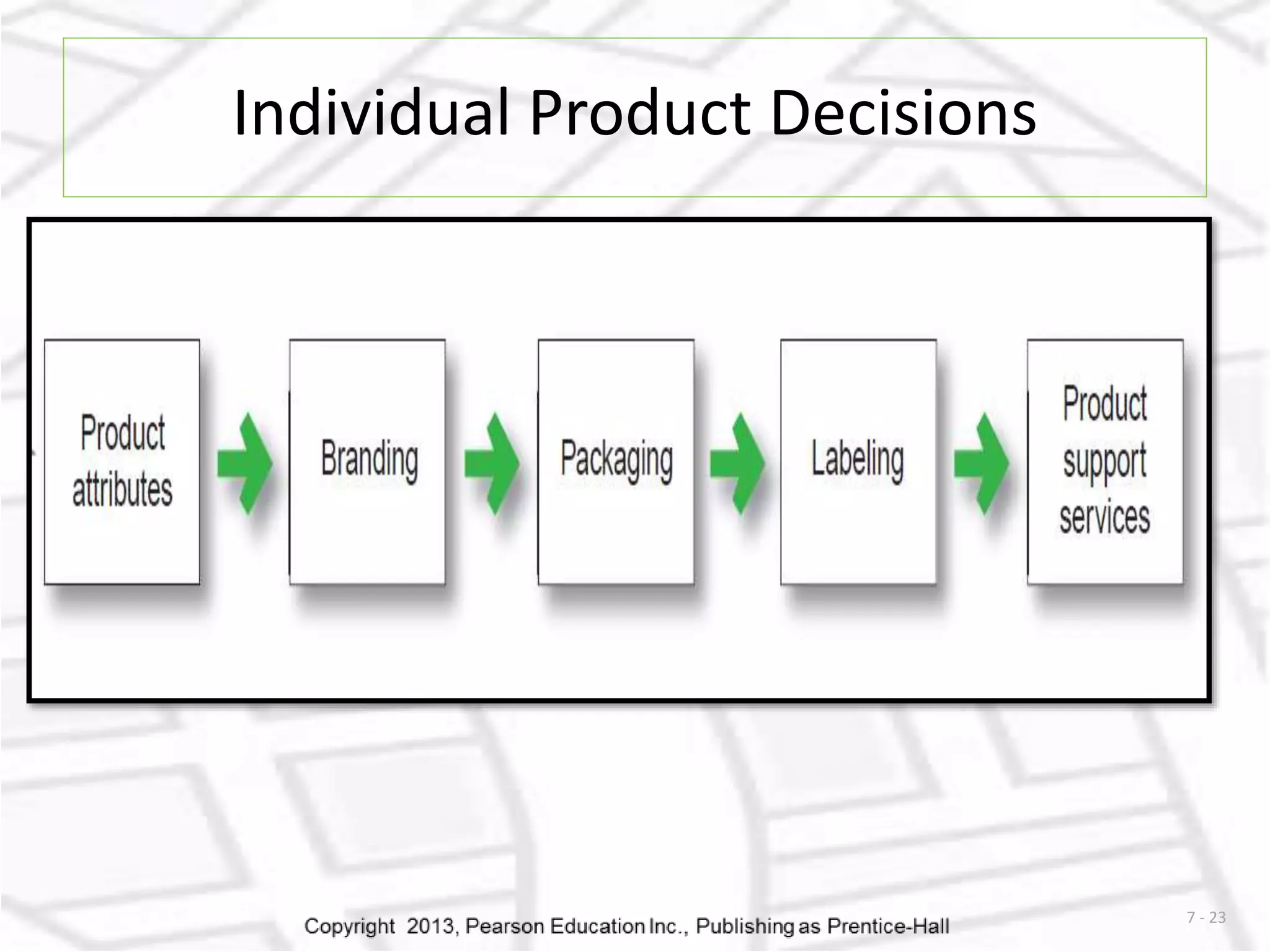
Individual Product Decisions
7 - 24 
Product and Service Attributes 
• Product quality: The characteristics of a 
product or service that bear on its ability to 
satisfy stated or implied customer needs 
• Product features 
• Differentiate the company’s product from 
competitors’ products 
• Product style and design
7 - 25 
Branding 
• A name, term, sign, symbol, or design, or a 
combination of these, that identifies the 
products or services of one seller or group of 
sellers and differentiates them from those of 
competitors 
• Customers attach meanings to brands and 
develop brand relationships
7 - 26 
Packaging and Labeling 
• Packaging: Designing and producing the 
container or wrapper for a product 
• Protects the product 
• Attracts customers and closes the sale 
• Labels 
• Identify the product 
• Describe the product 
• Promote the brand
7 - 27 
Product Support Services 
• An important part of 
the customer’s overall 
brand experience 
• Firms must survey 
customers to assess the 
value of current 
services and obtain 
ideas for new ones 
Nordstrom thrives on stories about its 
after-sale service. It wants to “Take care 
of customers, no matter what it takes,” 
before, during, and after the sale
7 - 28 
Product line 
• A group of products that are 
closely related because they 
function in a similar manner, are 
sold to the same customer 
groups, are marketed through 
the same types of outlets, or fall 
within given price ranges
7 - 29 
Kellogg’s Product Lines
7 - 30 
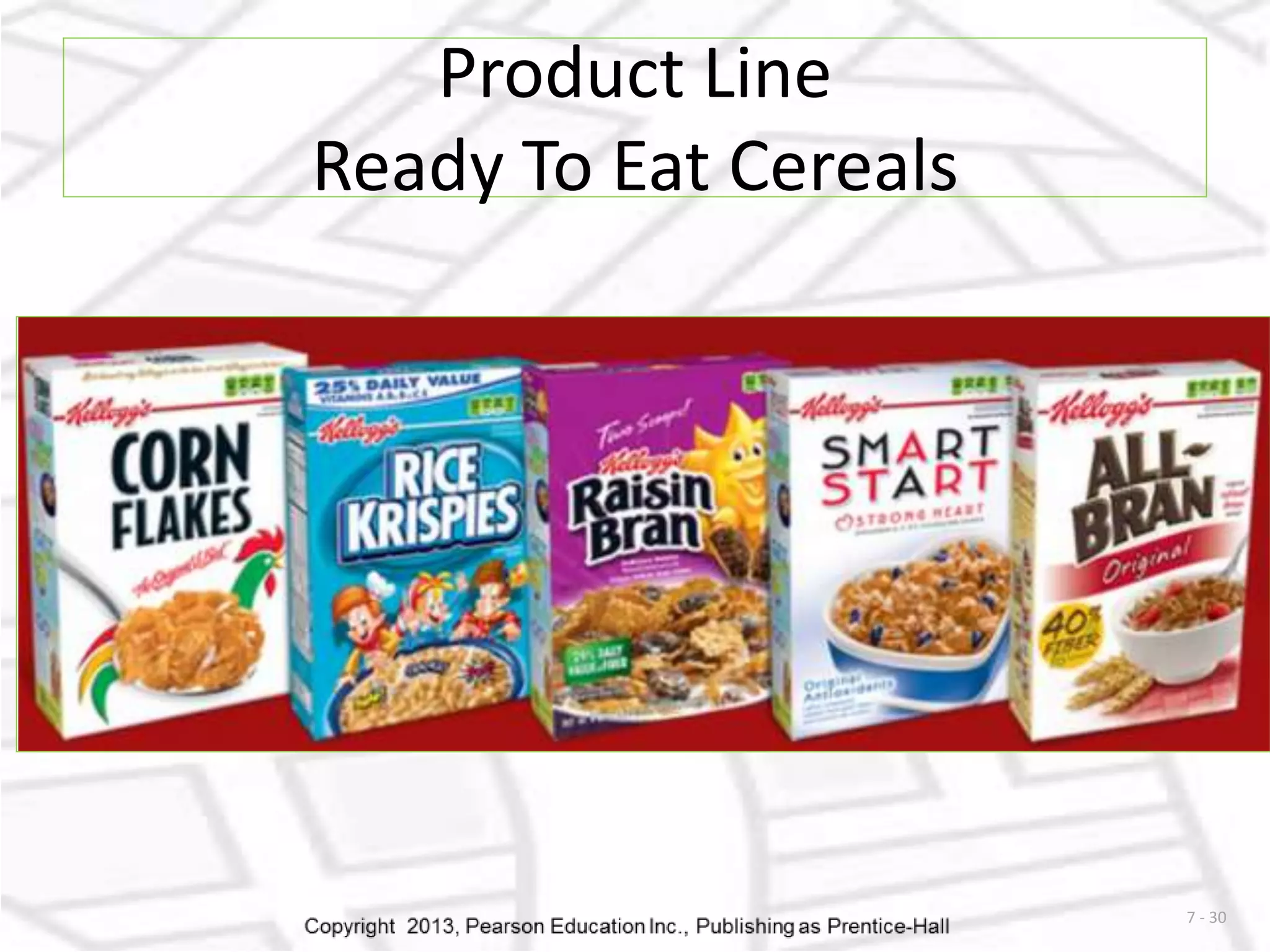
Product Line 
Ready To Eat Cereals
7 - 31 
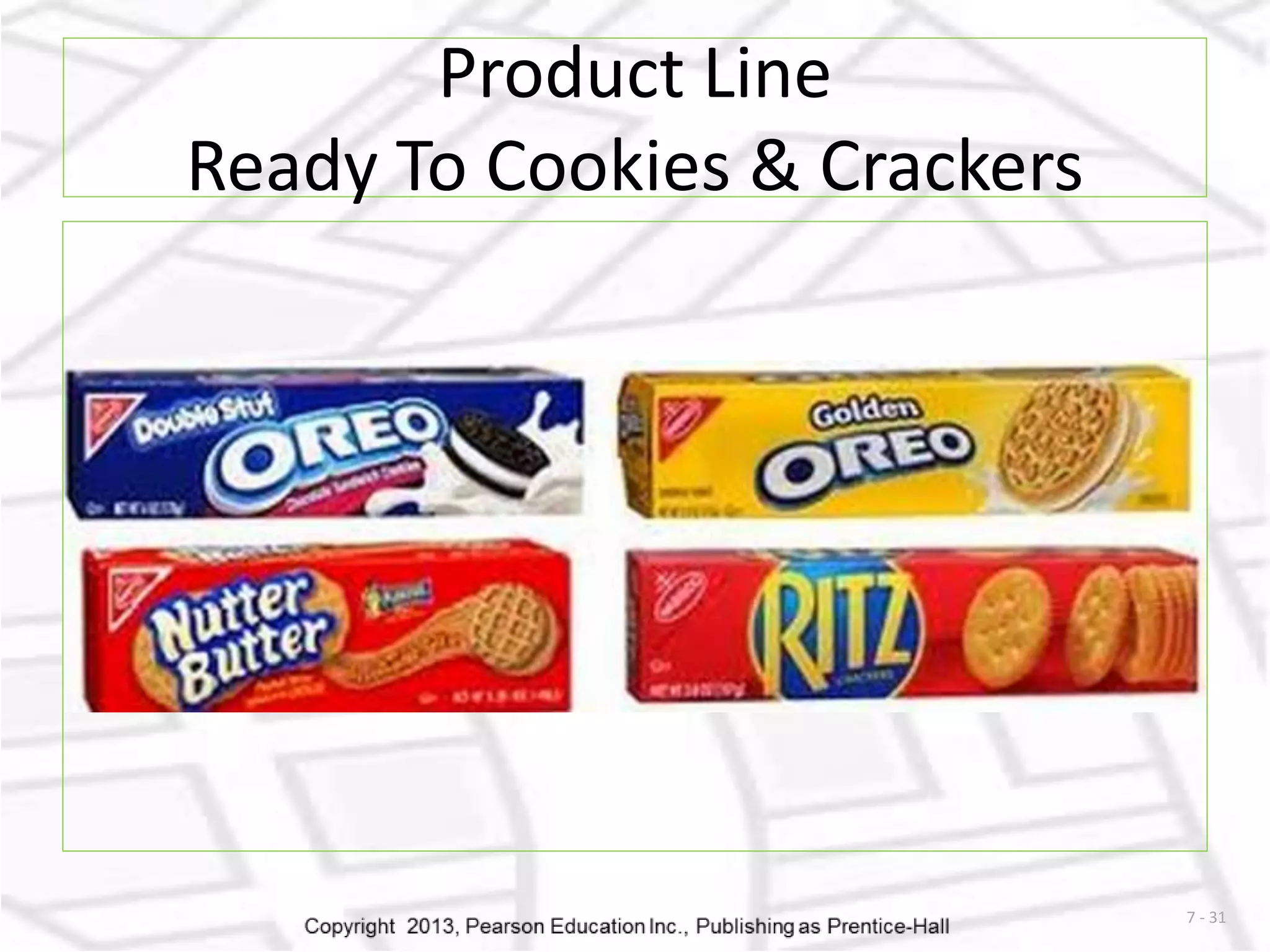
Product Line 
Ready To Cookies & Crackers
7 - 32 
Product Line Decisions 
Adding more items within the present range of 
the line 
Line filling 
• Reaching for extra profits 
• Satisfying dealers 
• Using excess capacity 
• Keeping out competitors 
Lengthening the product line beyond the 
current range 
Line stretching 
• Downward, to cater to lower-end segments 
• Upward, to add prestige to existing products
7 - 33 
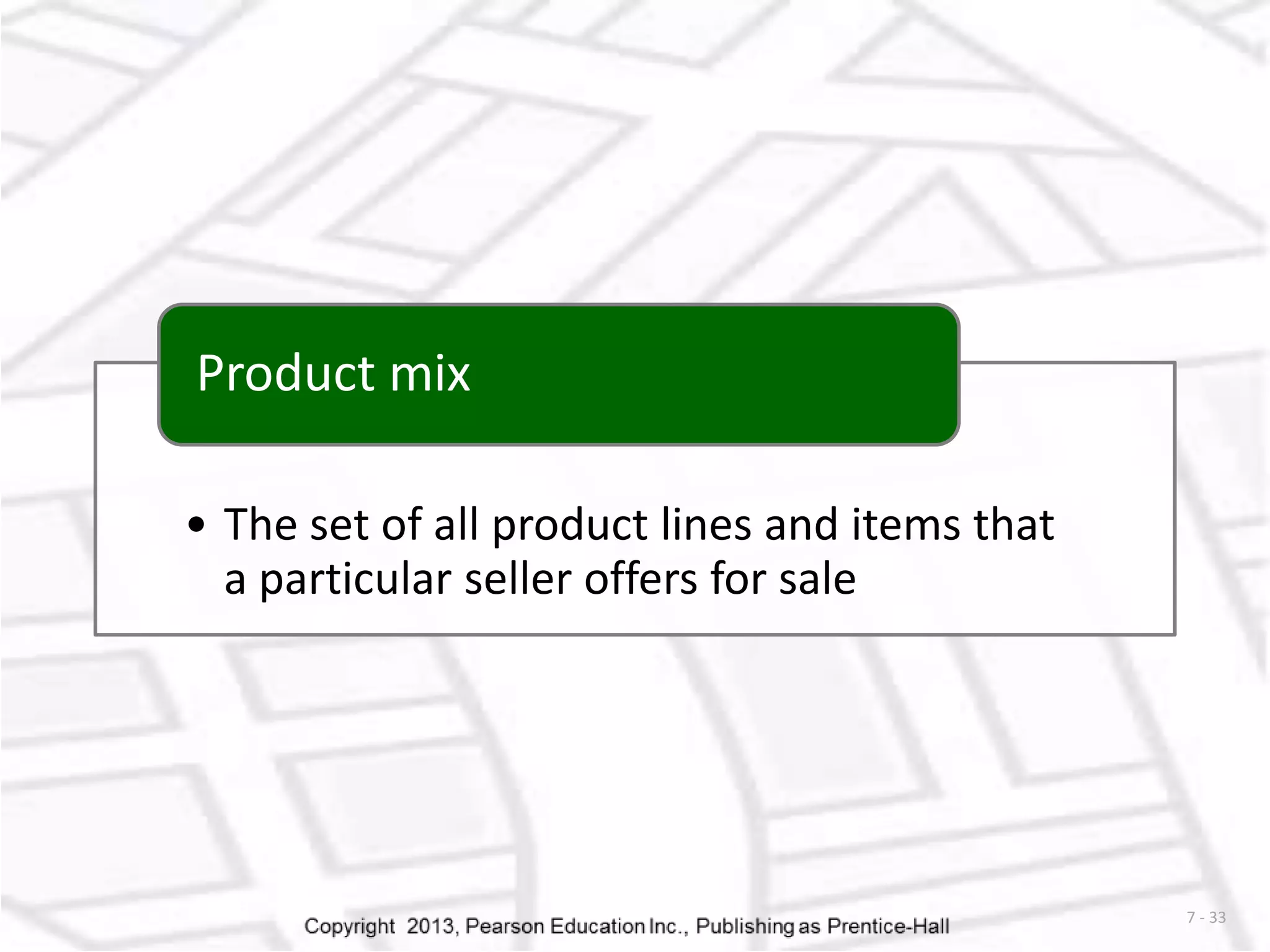
Product mix 
• The set of all product lines and items that 
a particular seller offers for sale
7 - 34
7 - 35 
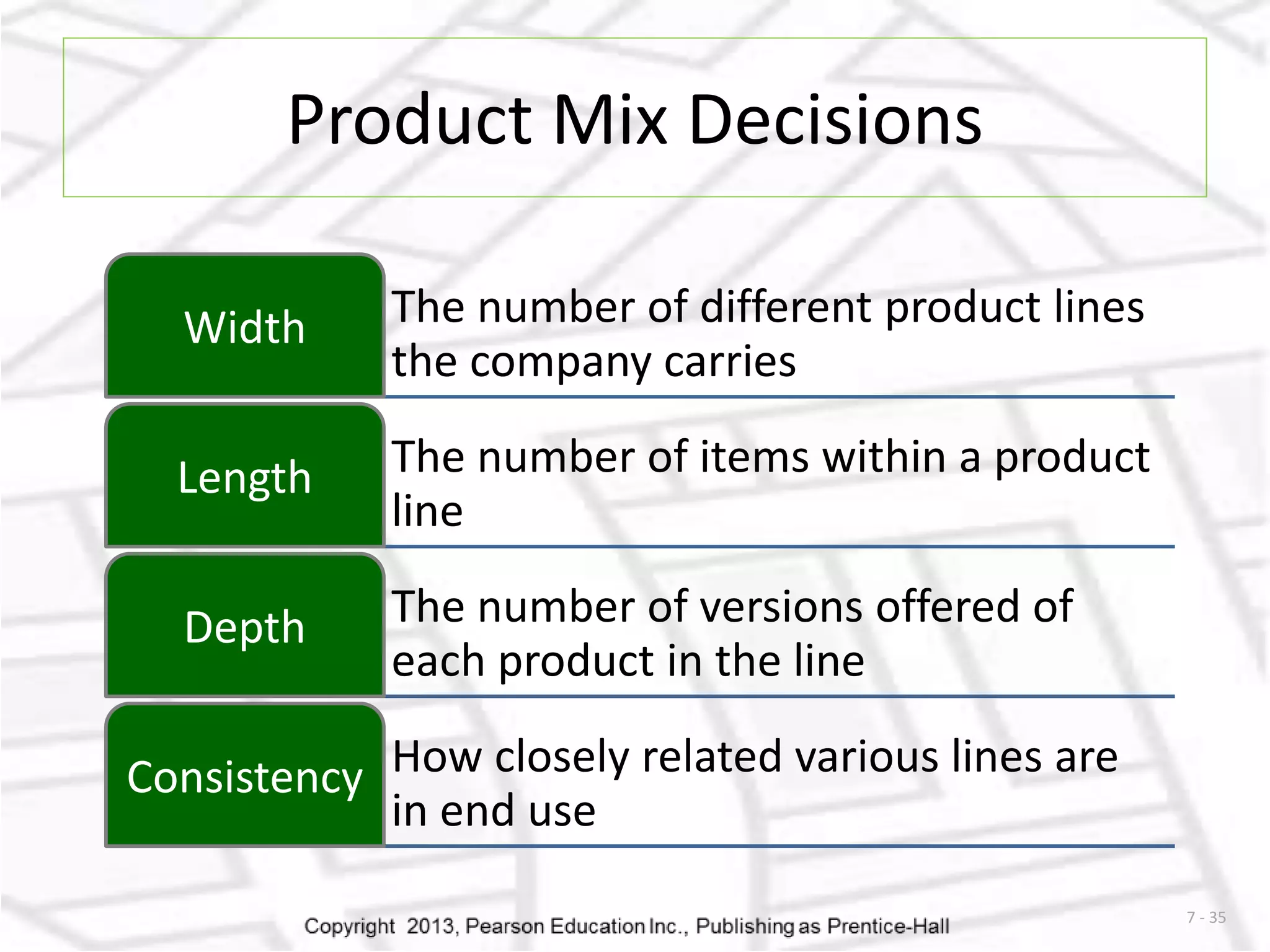
Product Mix Decisions 
The number of different product lines 
the company carries 
Width 
The number of items within a product 
line 
Length 
The number of versions offered of 
each product in the line 
Depth 
How closely related various lines are 
in end use 
Consistency
7 - 36 
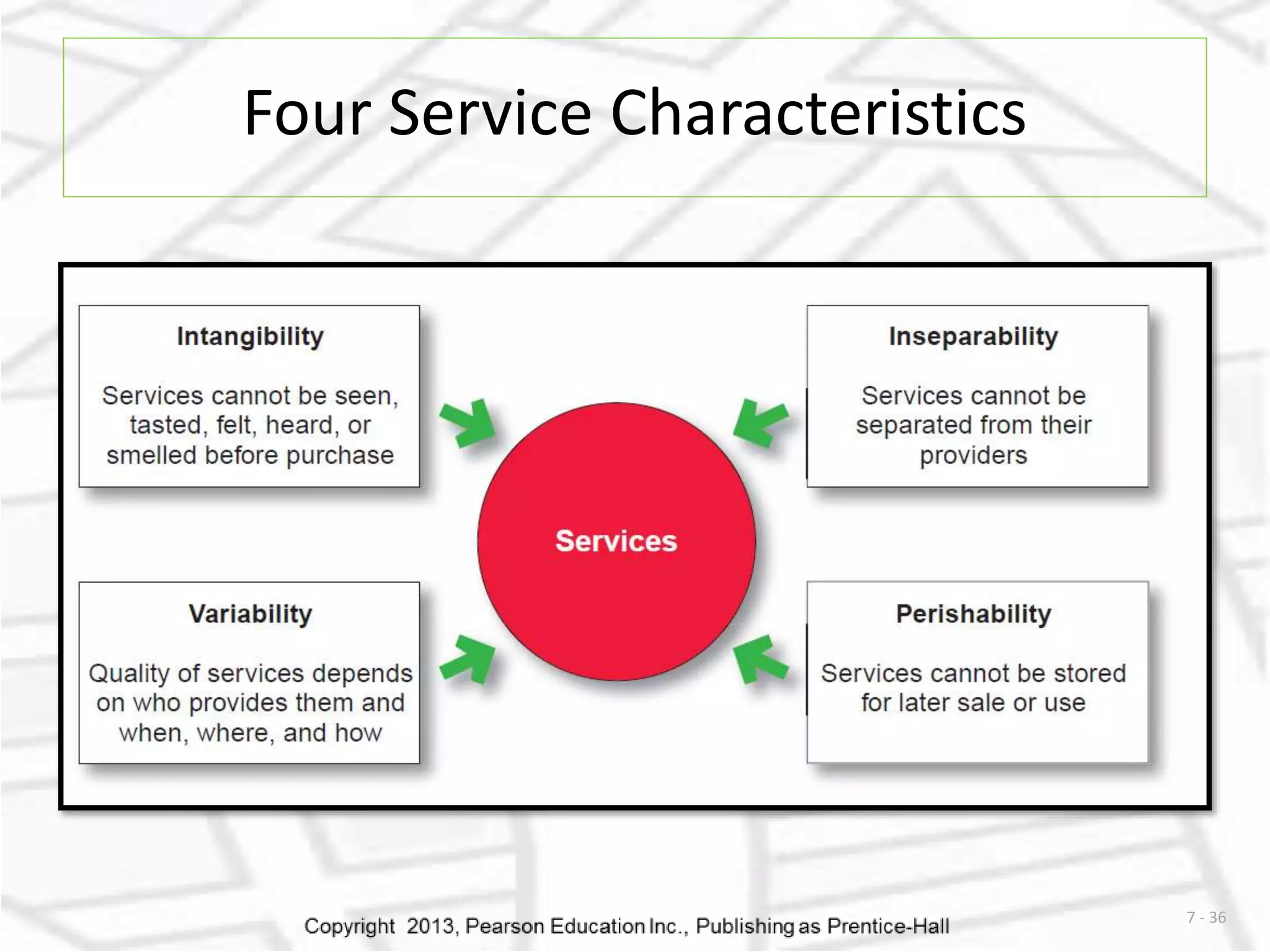
Four Service Characteristics
7 - 37 
InPIVseneartpiarsianhargabaibibbliiiiltlliyiitttyyy
7 - 38 
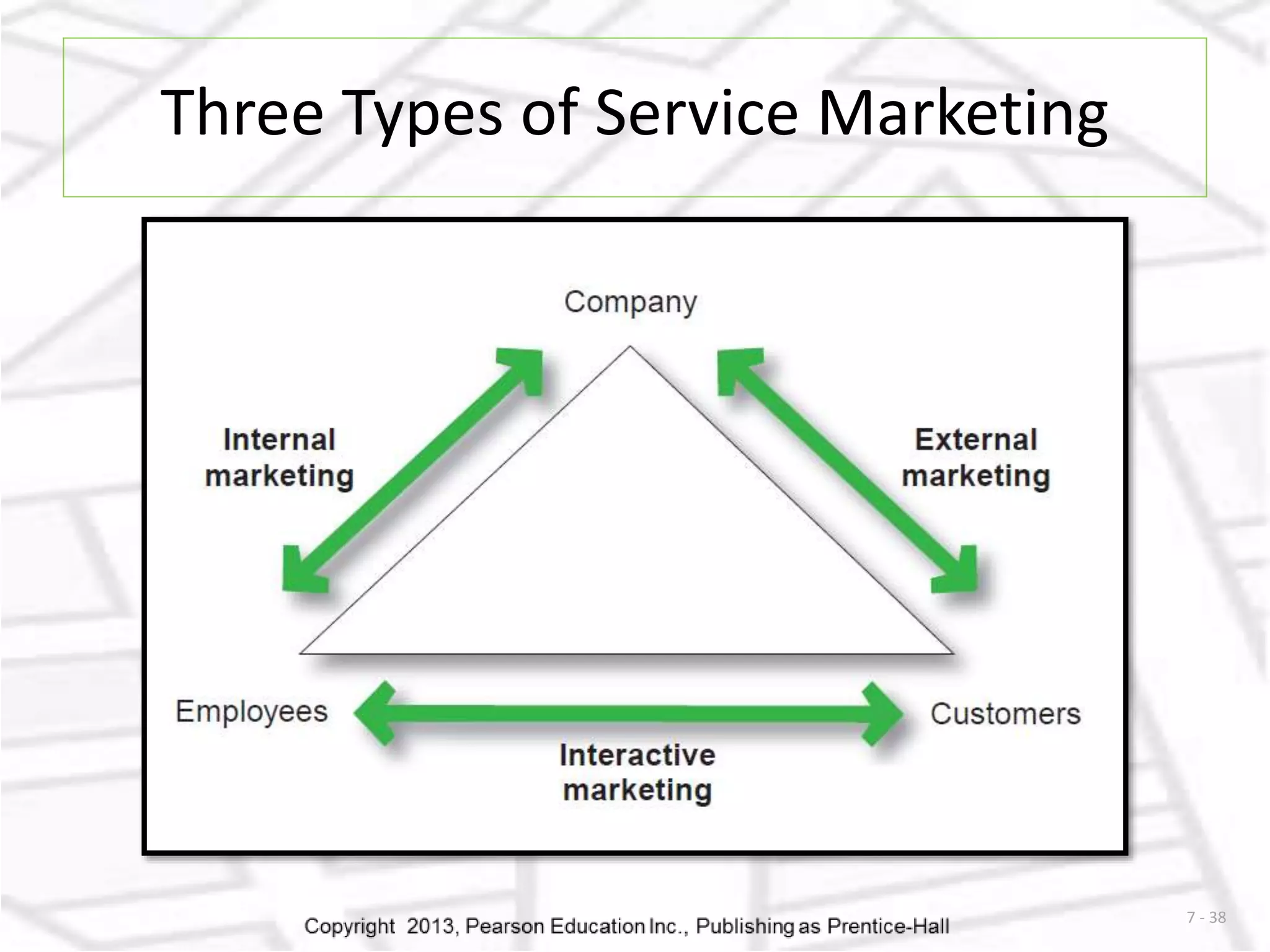
Three Types of Service Marketing
7 - 39 
Services Marketing 
Traditional marketing via the 4 “Ps” 
External 
marketing 
Orienting and motivating customer-contact 
employees and the supporting service people to 
work as a team to provide customer satisfaction 
Internal 
marketing 
Training service employees in the fine art of 
interacting with customers to satisfy their needs 
Interactive 
marketing
7 - 40 
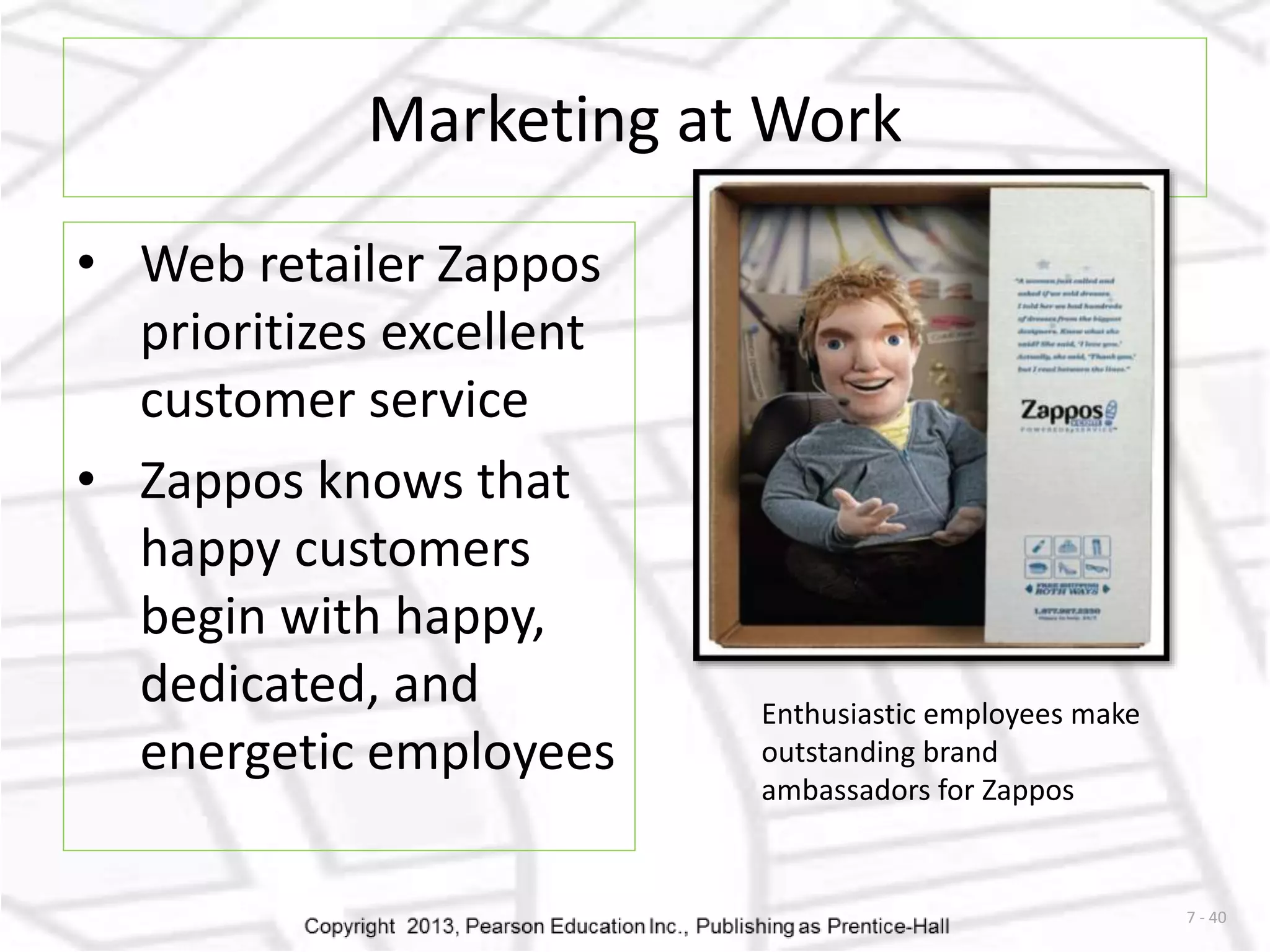
Marketing at Work 
• Web retailer Zappos 
prioritizes excellent 
customer service 
• Zappos knows that 
happy customers 
begin with happy, 
dedicated, and 
energetic employees 
Enthusiastic employees make 
outstanding brand 
ambassadors for Zappos
7 - 41 
Brand Positioning 
• Marketers can position brands 
clearly in customers’ minds at 
any of three levels 
• Product attributes 
• Product benefits 
• Beliefs and values
7 - 42 
Brand Positioning
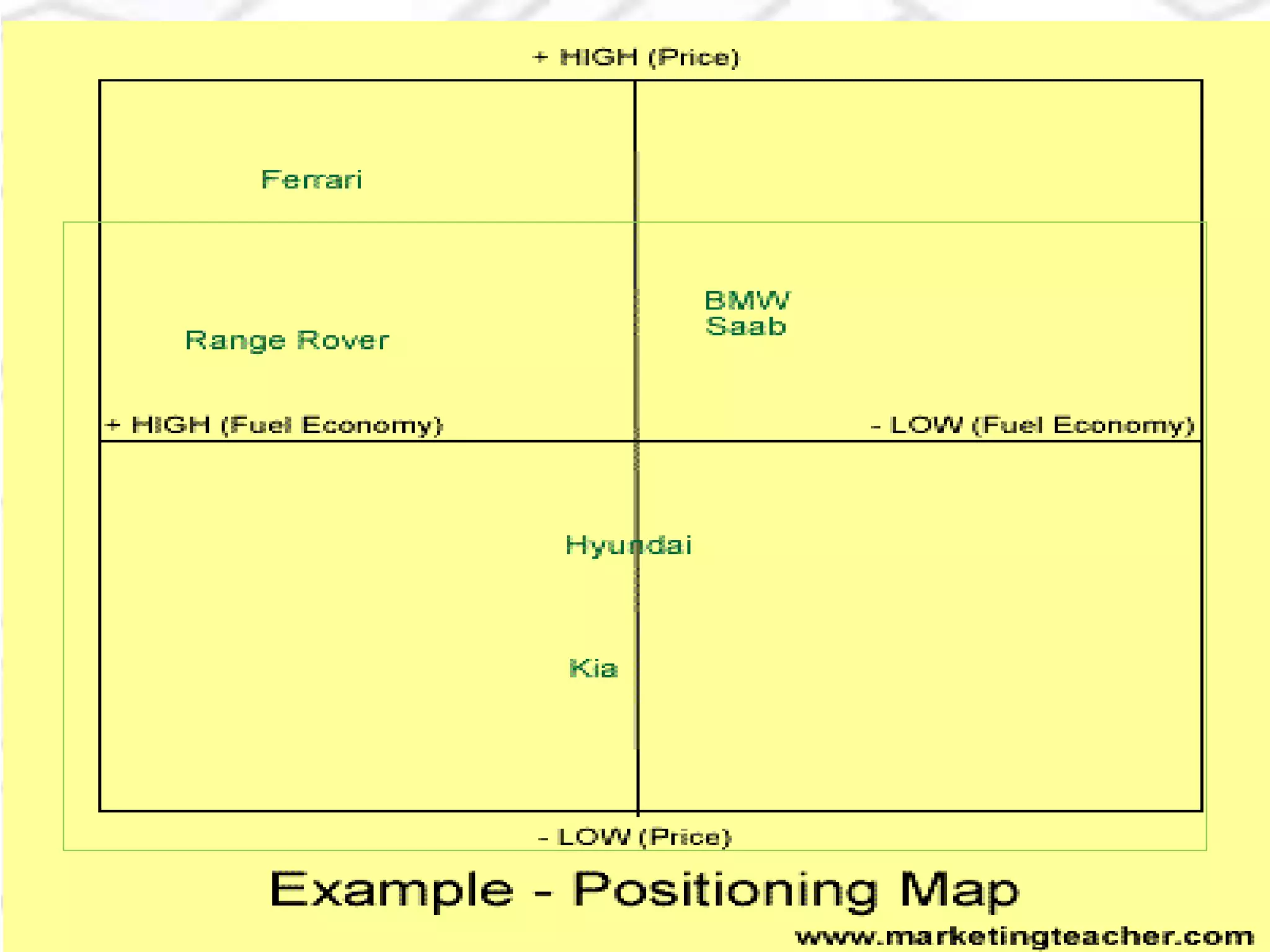
7 - 43 
Brand Positioning
7 - 44 
Brand Positioning
7 - 45 
Brand Positioning
7 - 46 
Brand Positioning
7 - 47 
Brand Positioning
7 - 48

Marketing chpt 7

  • 1.
    7 - 1 Product • Anything that can be offered to a market for attention, acquisition, use, or consumption that might satisfy a want or need Service • An activity, benefit, or satisfaction offered for sale that is essentially intangible and does not result in the ownership of anything
  • 2.
    7 - 2 What Is a Product? • Tangible objects, services, events, persons, organizations, places, ideas, or a mixture of these
  • 3.
    7 - 3 What Is a Product? • Services are a form of product • Activities, benefits, or satisfactions offered for sale • Essentially intangible • Do not result in the ownership of anything
  • 4.
    7 - 4 Products, Services and Experiences • Market offerings often include both tangible goods and services • Pure tangible good • Pure service
  • 5.
    7 - 5 Many companies offer marketing experiences
  • 6.
    7 - 6 Market Experiences
  • 7.
    7 - 7 Many companies now marketing experiences
  • 8.
  • 9.
  • 10.
  • 11.
    7 - 11 Levels of Products and Services • Core customer value • What the consumer is really buying • Actual product • Brand name, service features, design, packaging, and quality level • Augmented product • Additional services and benefits such as delivery and credit, instructions, installation, warranty, and service
  • 12.
    7 - 12 Consumer Products • A product bought by final consumers for personal consumption • Classified by how consumers buy them Convenience products Shopping products Specialty products Unsought products
  • 13.
    7 - 13 Convenience Products • Consumer products that customers usually buy frequently, immediately, and with minimal comparison and buying effort • Low priced • Placed in many locations to make them readily available • E.g. Laundry detergent, candy, magazines, and fast food
  • 14.
    7 - 14 Convenience Products
  • 15.
    7 - 15 Shopping products • Consumer products that the customer, in the process of selecting and purchasing, usually compare on such attributes as suitability, quality, price, and style • Less frequently purchased • Distributed through fewer outlets • Greater sales support
  • 16.
    7 - 16 Shopping Products
  • 17.
    7 - 17 Specialty products • Consumer products with unique characteristics or brand identification for which a significant group of buyers is willing to make a special purchase effort • Different brands are not usually compared • E.g. Specific brands of cars, high-priced photographic equipment, designer clothes, and the services of medical or legal specialists
  • 18.
    7 - 18 Specialty products
  • 19.
    7 - 19 Specialty Products
  • 20.
    7 - 20 Unsought Products • Consumer products that the consumer either does not know about or knows about but does not normally consider buying • Require a lot of advertising, personal selling, and other marketing efforts • New innovations are generally unsought till advertised • Known but unsought products and services are life insurance, preplanned funeral services
  • 21.
  • 22.
    7 - 22 Industrial Products • Products bought by individuals and organizations for further processing or for use in conducting a business Materials and Parts Capital items Supplies and services
  • 23.
    7 - 23 Individual Product Decisions
  • 24.
    7 - 24 Product and Service Attributes • Product quality: The characteristics of a product or service that bear on its ability to satisfy stated or implied customer needs • Product features • Differentiate the company’s product from competitors’ products • Product style and design
  • 25.
    7 - 25 Branding • A name, term, sign, symbol, or design, or a combination of these, that identifies the products or services of one seller or group of sellers and differentiates them from those of competitors • Customers attach meanings to brands and develop brand relationships
  • 26.
    7 - 26 Packaging and Labeling • Packaging: Designing and producing the container or wrapper for a product • Protects the product • Attracts customers and closes the sale • Labels • Identify the product • Describe the product • Promote the brand
  • 27.
    7 - 27 Product Support Services • An important part of the customer’s overall brand experience • Firms must survey customers to assess the value of current services and obtain ideas for new ones Nordstrom thrives on stories about its after-sale service. It wants to “Take care of customers, no matter what it takes,” before, during, and after the sale
  • 28.
    7 - 28 Product line • A group of products that are closely related because they function in a similar manner, are sold to the same customer groups, are marketed through the same types of outlets, or fall within given price ranges
  • 29.
    7 - 29 Kellogg’s Product Lines
  • 30.
    7 - 30 Product Line Ready To Eat Cereals
  • 31.
    7 - 31 Product Line Ready To Cookies & Crackers
  • 32.
    7 - 32 Product Line Decisions Adding more items within the present range of the line Line filling • Reaching for extra profits • Satisfying dealers • Using excess capacity • Keeping out competitors Lengthening the product line beyond the current range Line stretching • Downward, to cater to lower-end segments • Upward, to add prestige to existing products
  • 33.
    7 - 33 Product mix • The set of all product lines and items that a particular seller offers for sale
  • 34.
  • 35.
    7 - 35 Product Mix Decisions The number of different product lines the company carries Width The number of items within a product line Length The number of versions offered of each product in the line Depth How closely related various lines are in end use Consistency
  • 36.
    7 - 36 Four Service Characteristics
  • 37.
    7 - 37 InPIVseneartpiarsianhargabaibibbliiiiltlliyiitttyyy
  • 38.
    7 - 38 Three Types of Service Marketing
  • 39.
    7 - 39 Services Marketing Traditional marketing via the 4 “Ps” External marketing Orienting and motivating customer-contact employees and the supporting service people to work as a team to provide customer satisfaction Internal marketing Training service employees in the fine art of interacting with customers to satisfy their needs Interactive marketing
  • 40.
    7 - 40 Marketing at Work • Web retailer Zappos prioritizes excellent customer service • Zappos knows that happy customers begin with happy, dedicated, and energetic employees Enthusiastic employees make outstanding brand ambassadors for Zappos
  • 41.
    7 - 41 Brand Positioning • Marketers can position brands clearly in customers’ minds at any of three levels • Product attributes • Product benefits • Beliefs and values
  • 42.
    7 - 42 Brand Positioning
  • 43.
    7 - 43 Brand Positioning
  • 44.
    7 - 44 Brand Positioning
  • 45.
    7 - 45 Brand Positioning
  • 46.
    7 - 46 Brand Positioning
  • 47.
    7 - 47 Brand Positioning
  • 48.

Editor's Notes

  • #5 Note to Instructor: A company’s market offering often includes both tangible goods and services. At one extreme, the market offer may consist of a pure tangible good, such as soap, toothpaste, or salt; no services accompany the product. At the other extreme are pure services, for which the market offer consists primarily of a service. Examples include a doctor’s exam or financial services. Between these two extremes, however, many goods-and-services combinations are possible. Today, as products and services become more commoditized, many companies are moving to a new level in creating value for their customers. To differentiate their offers, beyond simply making products and delivering services, they are creating and managing customer experiences with their brands or company.

  • #6 Note to Instructor: A company’s market offering often includes both tangible goods and services. At one extreme, the market offer may consist of a pure tangible good, such as soap, toothpaste, or salt; no services accompany the product. At the other extreme are pure services, for which the market offer consists primarily of a service. Examples include a doctor’s exam or financial services. Between these two extremes, however, many goods-and-services combinations are possible. Today, as products and services become more commoditized, many companies are moving to a new level in creating value for their customers. To differentiate their offers, beyond simply making products and delivering services, they are creating and managing customer experiences with their brands or company.
  • #7 Note to Instructor: A company’s market offering often includes both tangible goods and services. At one extreme, the market offer may consist of a pure tangible good, such as soap, toothpaste, or salt; no services accompany the product. At the other extreme are pure services, for which the market offer consists primarily of a service. Examples include a doctor’s exam or financial services. Between these two extremes, however, many goods-and-services combinations are possible. Today, as products and services become more commoditized, many companies are moving to a new level in creating value for their customers. To differentiate their offers, beyond simply making products and delivering services, they are creating and managing customer experiences with their brands or company.
  • #8 Note to Instructor: A company’s market offering often includes both tangible goods and services. At one extreme, the market offer may consist of a pure tangible good, such as soap, toothpaste, or salt; no services accompany the product. At the other extreme are pure services, for which the market offer consists primarily of a service. Examples include a doctor’s exam or financial services. Between these two extremes, however, many goods-and-services combinations are possible. Today, as products and services become more commoditized, many companies are moving to a new level in creating value for their customers. To differentiate their offers, beyond simply making products and delivering services, they are creating and managing customer experiences with their brands or company.
  • #9 Note to Instructor: A company’s market offering often includes both tangible goods and services. At one extreme, the market offer may consist of a pure tangible good, such as soap, toothpaste, or salt; no services accompany the product. At the other extreme are pure services, for which the market offer consists primarily of a service. Examples include a doctor’s exam or financial services. Between these two extremes, however, many goods-and-services combinations are possible. Today, as products and services become more commoditized, many companies are moving to a new level in creating value for their customers. To differentiate their offers, beyond simply making products and delivering services, they are creating and managing customer experiences with their brands or company.
  • #10 Note to Instructor: A company’s market offering often includes both tangible goods and services. At one extreme, the market offer may consist of a pure tangible good, such as soap, toothpaste, or salt; no services accompany the product. At the other extreme are pure services, for which the market offer consists primarily of a service. Examples include a doctor’s exam or financial services. Between these two extremes, however, many goods-and-services combinations are possible. Today, as products and services become more commoditized, many companies are moving to a new level in creating value for their customers. To differentiate their offers, beyond simply making products and delivering services, they are creating and managing customer experiences with their brands or company.
  • #12 Note to Instructor: Consumers see products as complex bundles of benefits that satisfy their needs. When developing products, marketers first must identify the core customer value that consumers seek from the product. They must then design the actual product and find ways to augment it to create this customer value and the most satisfying customer experience.
  • #23 Note to Instructor: The distinction between a consumer product and an industrial product is based on the purpose for which the product is purchased. If a consumer buys a lawn mower for use around home, the lawn mower is a consumer product. If the same consumer buys the same lawn mower for use in a landscaping business, the lawn mower is an industrial product.
  • #24 Note to Instructor: The figure shows the important decisions in the development and marketing of individual products and services. The focus of all decisions is to create core customer value.
  • #25 Note to Instructor: Developing a product or service involves defining the benefits that it will offer. These benefits are communicated and delivered by product attributes such as quality, features, and style and design. Product quality has two dimensions: level and consistency. In developing a product, the marketer must first choose a quality level that will support the product’s positioning. Here, product quality means performance quality —the product’s ability to perform its functions. Beyond quality level, high quality also can mean high levels of quality consistency. Here, product quality means conformance quality—freedom from defects and consistency in delivering a targeted level of performance.
  • #26 Note to Instructor: Consumers view a brand as an important part of a product, and branding can add value to a consumer’s purchase. Customers attach meanings to brands and develop brand relationships. As a result, brands have meaning well beyond a product’s physical attributes. Branding helps buyers in many ways. Brand names help consumers identify products that might benefit them. Brands also say something about product quality and consistency— buyers who always buy the same brand know that they will get the same features, benefits, and quality each time they buy. Branding also gives the seller several advantages. The seller’s brand name and trademark provide legal protection for unique product features that otherwise might be copied by competitors. Branding helps the seller to segment markets. For example, rather than offering just one general product to all consumers, Toyota can offer the different Lexus, Toyota, and Scion brands, each with numerous sub-brands—such as Camry, Corolla, Prius, Matrix, Yaris, Tundra, and Land Cruiser.
  • #27 Note to Instructor: There has been a long history of legal concerns about packaging and labels. The Federal Trade Commission Act of 1914 held that false, misleading, or deceptive labels or packages constitute unfair competition. Labels can mislead customers, fail to describe important ingredients, or fail to include needed safety warnings. As a result, several federal and state laws regulate labeling. The most prominent is the Fair Packaging and Labeling Act of 1966, which set mandatory labeling requirements, encouraged voluntary industry packaging standards, and allowed federal agencies to set packaging regulations in specific industries.
  • #33 Note to Instructor: Product line filling is overdone if it results in cannibalization and customer confusion. The company should ensure that new items are noticeably different from existing ones. Product line stretching occurs when a company lengthens its product line beyond its current range. The company can stretch its line downward, upward, or both ways. Companies located at the upper end of the market can stretch their lines downward. A company may stretch downward to plug a market hole that otherwise would attract a new competitor or respond to a competitor’s attack on the upper end. Or it may add low-end products because it finds faster growth taking place in the low-end segments. Companies can also stretch their product lines upward. Sometimes, companies stretch upward to add prestige to their current products. Or they may be attracted by a faster growth rate or higher margins at the higher end.
  • #37 Note to Instructor: Although services are “products” in a general sense, they have special characteristics and marketing needs. The biggest differences come from the fact that services are essentially intangible and that they are created through direct interactions with customers. Think about your experiences with an airline versus Nike or Apple.
  • #39 Note to Instructor: Service marketing requires more than just traditional external marketing using the four Ps. The figure shows that service marketing also requires internal marketing and interactive marketing.
  • #42 Note to Instructor: Compare the different positioning adopted by well-known products in the same categories, e.g., Apple and Microsoft, Coke and Pepsi. Discuss how this positioning influences all brand decisions.