DEFINITION
 Market segmentation means sub-division of entire
market ,each segment consist of groups of buyer
who have identical or similar wants.
Or
Market segmentation consists of taking the total
heterogeneous market for the product and dividing
into several sub market in all significant
characteristics is called as market segmentation.
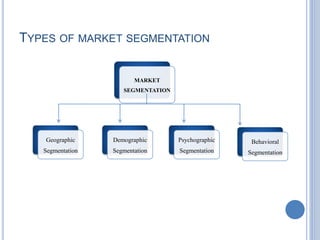
TYPES OF MARKET SEGMENTATION
MARKET
SEGMENTATION
Geographic
Segmentation
Demographic
Segmentation
Psychographic
Segmentation
Behavioral
Segmentation
1. GEOGRAPHIC SEGMENTATION
 Segmenting the consumer according to the geographical
factor like climatic zone , region , district , state etc.
1. Region – North , East , South , West
2. Climatic Zone – Moderate , temperate , dry
3. District – Pune , Ahmednagar , Nasik , Amravati
4. State – Maharashtra , Gujarat , Rajasthan
2.DEMOGRAPHIC SEGMENTATION
 A Segmentation based on demographic factor like age , gender , status ,
occupation , education , caste , language , income and purchasing power.
1. Age – Under 6 year age , 6-11 year , 12-19 year , 20 -34 year & above 35
2. Family – 1-2 member , 3-4 , 5+…….
3. Gender – Male & Female
4. Income – Greater than 2000 , 5 to 10000 , 10 to 50,000 and 50,000 above
5. Occupation – Agricultural, Non-Agricultural , Doctor , Teacher
,Businessman.
6. Education – Literate , Semi-literate , illiterate
7. Caste – Upper , Lower & Middle Class.
3.PSYCHOGRAPHIC SEGMENTATION
 The elements those are included in personality traits ,
attitudes , life styles and value system.
1. Psychographic lifestyle – Cultural oriented , sport
oriented.
2. Personality – compulsive , ambitious , positive &
negative attitude , openness , extraversion etc.
4.BEHAVIOURAL SEGMENTATION
 All variables in segmentation related to buyers behavior which
often very conclusive buyer behavior involves many elements
like purchasing occasion , benefits , user rate , loyalty rate and
attitude towards the product.
1. Occasion – Diwali , dashara , Gudi – padawa
2. Benefits – Discounts free , off-price , gifts , price services ,
exchange offer , free home delivery , buy 1 get 1 free.
3. User status – Non-user, medium-user , ex-user , heavy user.
4. Loyalty rate – Consumer who buy shifting a brand from one
brand to another
5. Attitude – Positive or negative , way of thinking
ADVANTAGES
1. The marketer can modify his product/service and
marketing appeals to suit the target segment.
2. Segmentation facilitates setting up of realistic selling
targets and priorities.
3. Management can identify new profitable segments
which deserves special attention.
4. It is possible to deal with competition more effectively
by using resources more effectively.
DISADVANTAGES
1. More time , efforts , expenses to develop
individual messages and strategies.
2. If a brand is associated with one subgroup it may
be shunned by other subgroups.
3. Micro marketing can be costly.
4. Promotion and distribution expenditures increase
when separate programme are used for different
market segments.
Market segmentation

Market segmentation

  • 4.
    DEFINITION  Market segmentationmeans sub-division of entire market ,each segment consist of groups of buyer who have identical or similar wants. Or Market segmentation consists of taking the total heterogeneous market for the product and dividing into several sub market in all significant characteristics is called as market segmentation.
  • 5.
    TYPES OF MARKETSEGMENTATION MARKET SEGMENTATION Geographic Segmentation Demographic Segmentation Psychographic Segmentation Behavioral Segmentation
  • 6.
    1. GEOGRAPHIC SEGMENTATION Segmenting the consumer according to the geographical factor like climatic zone , region , district , state etc. 1. Region – North , East , South , West 2. Climatic Zone – Moderate , temperate , dry 3. District – Pune , Ahmednagar , Nasik , Amravati 4. State – Maharashtra , Gujarat , Rajasthan
  • 7.
    2.DEMOGRAPHIC SEGMENTATION  ASegmentation based on demographic factor like age , gender , status , occupation , education , caste , language , income and purchasing power. 1. Age – Under 6 year age , 6-11 year , 12-19 year , 20 -34 year & above 35 2. Family – 1-2 member , 3-4 , 5+……. 3. Gender – Male & Female 4. Income – Greater than 2000 , 5 to 10000 , 10 to 50,000 and 50,000 above 5. Occupation – Agricultural, Non-Agricultural , Doctor , Teacher ,Businessman. 6. Education – Literate , Semi-literate , illiterate 7. Caste – Upper , Lower & Middle Class.
  • 8.
    3.PSYCHOGRAPHIC SEGMENTATION  Theelements those are included in personality traits , attitudes , life styles and value system. 1. Psychographic lifestyle – Cultural oriented , sport oriented. 2. Personality – compulsive , ambitious , positive & negative attitude , openness , extraversion etc.
  • 9.
    4.BEHAVIOURAL SEGMENTATION  Allvariables in segmentation related to buyers behavior which often very conclusive buyer behavior involves many elements like purchasing occasion , benefits , user rate , loyalty rate and attitude towards the product. 1. Occasion – Diwali , dashara , Gudi – padawa 2. Benefits – Discounts free , off-price , gifts , price services , exchange offer , free home delivery , buy 1 get 1 free. 3. User status – Non-user, medium-user , ex-user , heavy user. 4. Loyalty rate – Consumer who buy shifting a brand from one brand to another 5. Attitude – Positive or negative , way of thinking
  • 10.
    ADVANTAGES 1. The marketercan modify his product/service and marketing appeals to suit the target segment. 2. Segmentation facilitates setting up of realistic selling targets and priorities. 3. Management can identify new profitable segments which deserves special attention. 4. It is possible to deal with competition more effectively by using resources more effectively.
  • 11.
    DISADVANTAGES 1. More time, efforts , expenses to develop individual messages and strategies. 2. If a brand is associated with one subgroup it may be shunned by other subgroups. 3. Micro marketing can be costly. 4. Promotion and distribution expenditures increase when separate programme are used for different market segments.