Market Perspectives
Feb 2014
January 31st, 2014
www.finlightresearch.com
Eh Janet! Pause the taper…
MACRO VIEW
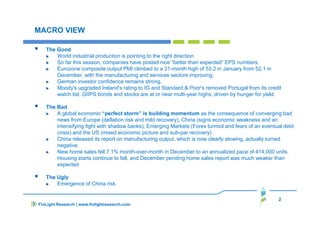
The Good
World industrial production is pointing to the right direction
So far this season, companies have posted nice “better than expected” EPS numbers.
Eurozone composite output PMI climbed to a 31-month high of 53.2 in January from 52.1 in
December, with the manufacturing and services sectors improving.
German investor confidence remains strong.
Moody's upgraded Ireland's rating to IG and Standard & Poor's removed Portugal from its credit
watch list. GIIPS bonds and stocks are at or near multi-year highs, driven by hunger for yield.
The Bad
A global economic “perfect storm” is building momentum as the consequence of converging bad
news from Europe (deflation risk and mild recovery), China (signs economic weakness and an
intensifying fight with shadow banks), Emerging Markets (Forex turmoil and fears of an eventual debt
crisis) and the US (mixed economic picture and sub-par recovery)
China released its report on manufacturing output, which is now clearly slowing, actually turned
negative.
New home sales fell 7.1% month-over-month in December to an annualized pace of 414,000 units.
Housing starts continue to fall, and December pending home sales report was much weaker than
expected
The Ugly
Emergence of China risk.
2
FinLight Research | www.finlightresearch.com
3
FinLight Research | www.finlightresearch.com
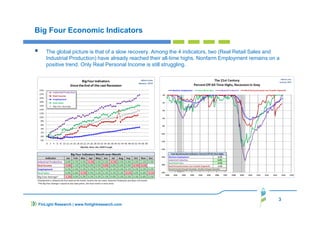
Big Four Economic Indicators
The global picture is that of a slow recovery. Among the 4 indicators, two (Real Retail Sales and
Industrial Production) have already reached their all-time highs. Nonfarm Employment remains on a
positive trend. Only Real Personal Income is still struggling.
4
FinLight Research | www.finlightresearch.com
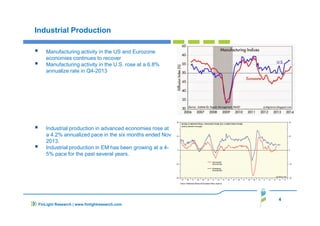
Industrial Production
Manufacturing activity in the US and Eurozone
economies continues to recover
Manufacturing activity in the U.S. rose at a 6.8%
annualize rate in Q4-2013
Industrial production in advanced economies rose at
a 4.2% annualized pace in the six months ended Nov
2013.
Industrial production in EM has been growing at a 4-
5% pace for the past several years.
5
FinLight Research | www.finlightresearch.com
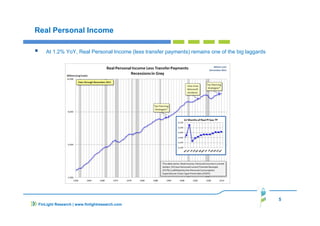
Real Personal Income
At 1.2% YoY, Real Personal Income (less transfer payments) remains one of the big laggards
6
FinLight Research | www.finlightresearch.com
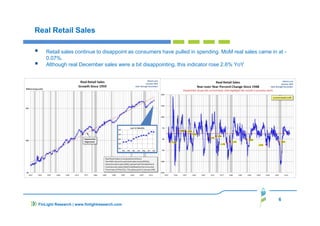
Real Retail Sales
Retail sales continue to disappoint as consumers have pulled in spending. MoM real sales came in at -
0.07%.
Although real December sales were a bit disappointing, this indicator rose 2.6% YoY
7
FinLight Research | www.finlightresearch.com
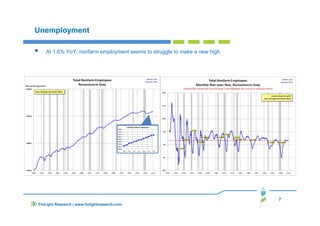
Unemployment
At 1.6% YoY, nonfarm employment seems to struggle to make a new high
8
FinLight Research | www.finlightresearch.com
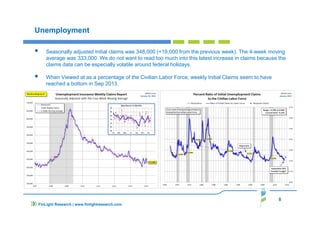
Unemployment
Seasonally adjusted initial claims was 348,000 (+19,000 from the previous week). The 4-week moving
average was 333,000. We do not want to read too much into this latest increase in claims because the
claims data can be especially volatile around federal holidays.
When Viewed at as a percentage of the Civilian Labor Force, weekly Initial Claims seem to have
reached a bottom in Sep 2013.
9
FinLight Research | www.finlightresearch.com
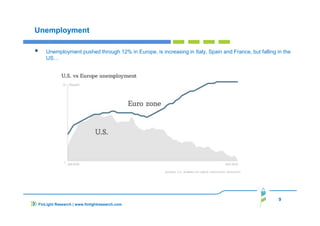
Unemployment
Unemployment pushed through 12% in Europe, is increasing in Italy, Spain and France, but falling in the
US…
10
FinLight Research | www.finlightresearch.com
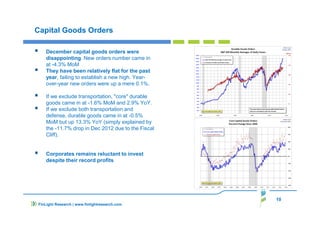
Capital Goods Orders
December capital goods orders were
disappointing. New orders number came in
at -4.3% MoM
They have been relatively flat for the past
year, failing to establish a new high. Year-
over-year new orders were up a mere 0.1%.
If we exclude transportation, "core" durable
goods came in at -1.6% MoM and 2.9% YoY.
If we exclude both transportation and
defense, durable goods came in at -0.5%
MoM but up 13.3% YoY (simply explained by
the -11.7% drop in Dec 2012 due to the Fiscal
Cliff).
Corporates remains reluctant to invest
despite their record profits
11
FinLight Research | www.finlightresearch.com
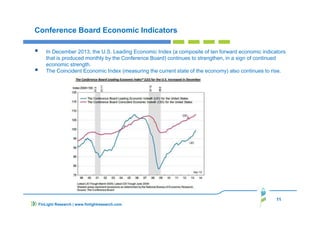
Conference Board Economic Indicators
In December 2013, the U.S. Leading Economic Index (a composite of ten forward economic indicators
that is produced monthly by the Conference Board) continues to strengthen, in a sign of continued
economic strength.
The Coincident Economic Index (measuring the current state of the economy) also continues to rise.
12
FinLight Research | www.finlightresearch.com
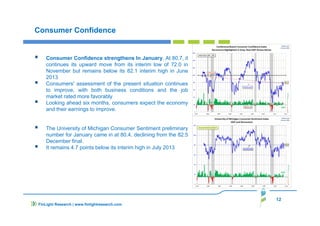
Consumer Confidence
Consumer Confidence strengthens In January. At 80.7, it
continues its upward move from its interim low of 72.0 in
November but remains below its 82.1 interim high in June
2013
Consumers' assessment of the present situation continues
to improve, with both business conditions and the job
market rated more favorably
Looking ahead six months, consumers expect the economy
and their earnings to improve.
The University of Michigan Consumer Sentiment preliminary
number for January came in at 80.4, declining from the 82.5
December final.
It remains 4.7 points below its interim high in July 2013
13
FinLight Research | www.finlightresearch.com
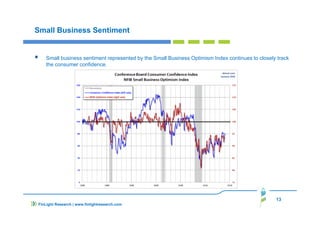
Small Business Sentiment
Small business sentiment represented by the Small Business Optimism Index continues to closely track
the consumer confidence.
14
FinLight Research | www.finlightresearch.com
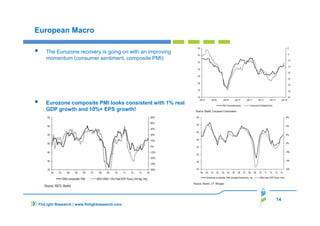
European Macro
The Eurozone recovery is going on with an improving
momentum (consumer sentiment, composite PMI)
Eurozone composite PMI looks consistent with 1% real
GDP growth and 10%+ EPS growth!
15
FinLight Research | www.finlightresearch.com
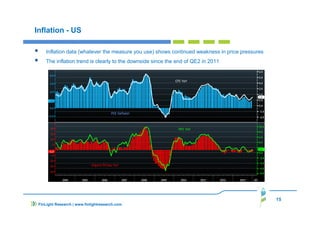
Inflation - US
Inflation data (whatever the measure you use) shows continued weakness in price pressures
The inflation trend is clearly to the downside since the end of QE2 in 2011
16
FinLight Research | www.finlightresearch.com
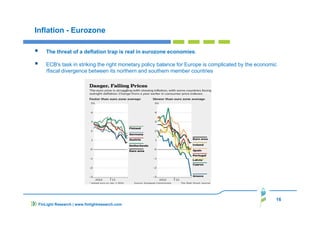
Inflation - Eurozone
The threat of a deflation trap is real in eurozone economies.
ECB's task in striking the right monetary policy balance for Europe is complicated by the economic
/fiscal divergence between its northern and southern member countries
17
FinLight Research | www.finlightresearch.com
Housing: Is Bear Market Back?
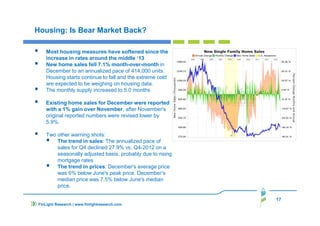
Most housing measures have softened since the
increase in rates around the middle ‘13
New home sales fell 7.1% month-over-month in
December to an annualized pace of 414,000 units.
Housing starts continue to fall and the extreme cold
are expected to be weighing on housing data.
The monthly supply increased to 5.0 months
Existing home sales for December were reported
with a 1% gain over November, after November's
original reported numbers were revised lower by
5.9%.
Two other warning shots:
The trend in sales: The annualized pace of
sales for Q4 declined 27.9% vs. Q4-2012 on a
seasonally adjusted basis, probably due to rising
mortgage rates
The trend in prices: December's average price
was 6% below June's peak price. December’s
median price was 7.5% below June's median
price.
18
FinLight Research | www.finlightresearch.com
Housing: Is Bear Market Back?
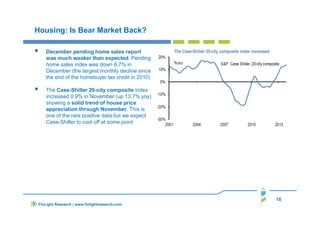
December pending home sales report
was much weaker than expected: Pending
home sales index was down 8.7% in
December (the largest monthly decline since
the end of the homebuyer tax credit in 2010)
The Case-Shiller 20-city composite index
increased 0.9% in November (up 13.7% yoy)
showing a solid trend of house price
appreciation through November. This is
one of the rare positive data but we expect
Case-Shiller to cool off at some point
19
FinLight Research | www.finlightresearch.com
China’s PMI
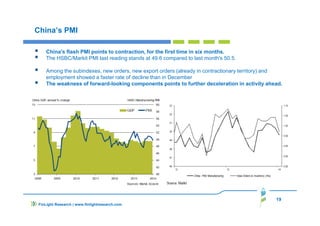
China's flash PMI points to contraction, for the first time in six months.
The HSBC/Markit PMI last reading stands at 49.6 compared to last month's 50.5.
Among the subindexes, new orders, new export orders (already in contractionary territory) and
employment showed a faster rate of decline than in December
The weakness of forward-looking components points to further deceleration in activity ahead.
20
FinLight Research | www.finlightresearch.com
Is that really an EM Crisis?
At this stage, contagion is not yet a real
concern. We are still dealing with domestic
debt problems
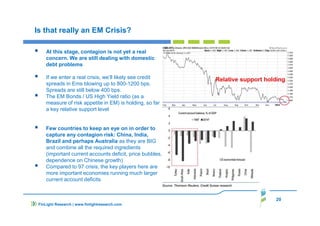
If we enter a real crisis, we’ll likely see credit
spreads in Ems blowing up to 800-1200 bps.
Spreads are still below 400 bps.
The EM Bonds / US High Yield ratio (as a
measure of risk appetite in EM) is holding, so far,
a key relative support level
Few countries to keep an eye on in order to
capture any contagion risk: China, India,
Brazil and perhaps Australia as they are BIG
and combine all the required ingredients
(important current accounts deficit, price bubbles,
dependence on Chinese growth)
Compared to 97 crisis, the key players here are
more important economies running much larger
current account deficits
21
FinLight Research | www.finlightresearch.com
EQUITY
We have been for a limited correction (5% to 10%) on equities.
A healthy correction is under way, driven by a combination of Fed's tapering, emerging market currency
crisis and the clouds over China.
Thus far, the pullback is a normal bull market correction until new evidence appears
Current valuation appears lofty both for the aggregate market as well as the median stock
From here, any further upside on the S&P 500 should be driven by profit growth rather than P/E
expansion
Bottom line (and for the same reasons than a month ago):
We keep our bet on a limited correction (and move our target region up), with a test of 1757 - 1722
(the former seems more reasonable!) level on the S&P 500
We keep our UW (deflationary) Europe and EM vs. US and Japan (even if we expect EM weakness
to favor lower US yields, stronger JPY and weaker Nikkei).
We still prefer more defensive high-yielding stocks.
22
FinLight Research | www.finlightresearch.com
Equity Earnings
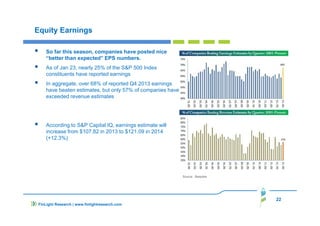
So far this season, companies have posted nice
“better than expected” EPS numbers.
As of Jan 23, nearly 25% of the S&P 500 Index
constituents have reported earnings
In aggregate, over 68% of reported Q4 2013 earnings
have beaten estimates, but only 57% of companies have
exceeded revenue estimates
According to S&P Capital IQ, earnings estimate will
increase from $107.82 in 2013 to $121.09 in 2014
(+12.3%)
Source: Bespoke
23
FinLight Research | www.finlightresearch.com
Equity Earnings
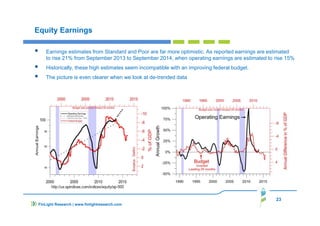
Earnings estimates from Standard and Poor are far more optimistic. As reported earnings are estimated
to rise 21% from September 2013 to September 2014, when operating earnings are estimated to rise 15%
Historically, these high estimates seem incompatible with an improving federal budget.
The picture is even clearer when we look at de-trended data
24
FinLight Research | www.finlightresearch.com
Equity Earnings
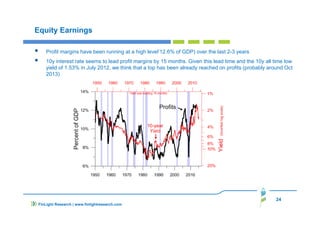
Profit margins have been running at a high level’12.6% of GDP) over the last 2-3 years
10y interest rate seems to lead profit margins by 15 months. Given this lead time and the 10y all time low
yield of 1.53% in July 2012, we think that a top has been already reached on profits (probably around Oct
2013)
25
FinLight Research | www.finlightresearch.com
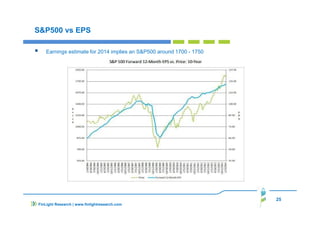
S&P500 vs EPS
Earnings estimate for 2014 implies an S&P500 around 1700 - 1750
26
FinLight Research | www.finlightresearch.com
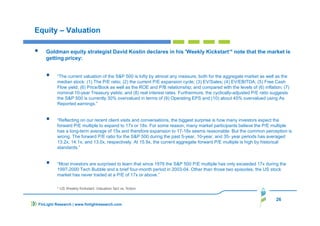
Equity – Valuation
Goldman equity strategist David Kostin declares in his 'Weekly Kickstart‘* note that the market is
getting pricey:
“The current valuation of the S&P 500 is lofty by almost any measure, both for the aggregate market as well as the
median stock: (1) The P/E ratio; (2) the current P/E expansion cycle; (3) EV/Sales; (4) EV/EBITDA; (5) Free Cash
Flow yield; (6) Price/Book as well as the ROE and P/B relationship; and compared with the levels of (6) inflation; (7)
nominal 10-year Treasury yields; and (8) real interest rates. Furthermore, the cyclically-adjusted P/E ratio suggests
the S&P 500 is currently 30% overvalued in terms of (9) Operating EPS and (10) about 45% overvalued using As
Reported earnings.”
“Reflecting on our recent client visits and conversations, the biggest surprise is how many investors expect the
forward P/E multiple to expand to 17x or 18x. For some reason, many market participants believe the P/E multiple
has a long-term average of 15x and therefore expansion to 17-18x seems reasonable. But the common perception is
wrong. The forward P/E ratio for the S&P 500 during the past 5-year, 10-year, and 35- year periods has averaged
13.2x, 14.1x, and 13.0x, respectively. At 15.9x, the current aggregate forward P/E multiple is high by historical
standards.”
“Most investors are surprised to learn that since 1976 the S&P 500 P/E multiple has only exceeded 17x during the
1997-2000 Tech Bubble and a brief four-month period in 2003-04. Other than those two episodes, the US stock
market has never traded at a P/E of 17x or above.”
* US Weekly Kickstart: Valuation fact vs. fiction
27
FinLight Research | www.finlightresearch.com
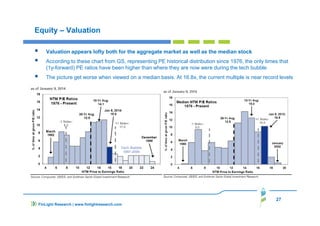
Equity – Valuation
Valuation appears lofty both for the aggregate market as well as the median stock
According to these chart from GS, representing PE historical distribution since 1976, the only times that
(1y-forward) PE ratios have been higher than where they are now were during the tech bubble.
The picture get worse when viewed on a median basis. At 16.8x, the current multiple is near record levels
28
FinLight Research | www.finlightresearch.com
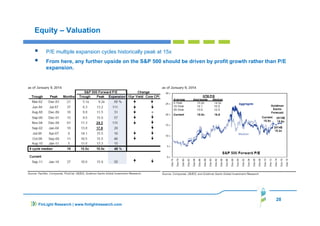
Equity – Valuation
P/E multiple expansion cycles historically peak at 15x
From here, any further upside on the S&P 500 should be driven by profit growth rather than P/E
expansion.
29
FinLight Research | www.finlightresearch.com
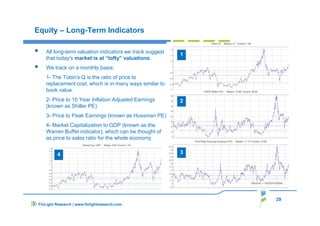
Equity – Long-Term Indicators
All long-term valuation indicators we track suggest
that today's market is at “lofty” valuations.
We track on a monthly basis:
1- The Tobin's Q is the ratio of price to
replacement cost, which is in many ways similar to
book value.
2- Price to 10 Year Inflation Adjusted Earnings
(known as Shiller PE)
3- Price to Peak Earnings (known as Hussman PE)
4- Market Capitalization to GDP (known as the
Warren Buffet indicator), which can be thought of
as price to sales ratio for the whole economy.
Source – VectorGrader
1
2
34
30
FinLight Research | www.finlightresearch.com
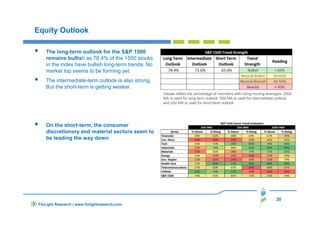
Equity Outlook
The long-term outlook for the S&P 1500
remains bullish as 78.4% of the 1500 stocks
in the index have bullish long-term trends. No
market top seems to be forming yet.
The intermediate-term outlook is also strong.
But the short-term is getting weaker.
On the short-term, the consumer
discretionary and material sectors seem to
be leading the way down.
Values reflect the percentage of members with rising moving averages: 200d
MA is used for long-term outlook, 50d MA is used for intermediate outlook,
and 20d MA is used for short-term outlook.
31
FinLight Research | www.finlightresearch.com
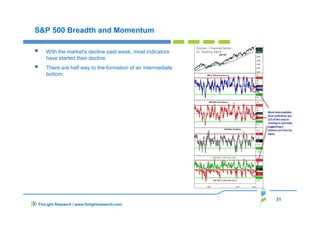
S&P 500 Breadth and Momentum
With the market's decline past week, most indicators
have started their decline.
There are half way to the formation of an intermediate
bottom.
Source – Financial Sense
on Seeking Alpha
32
FinLight Research | www.finlightresearch.com
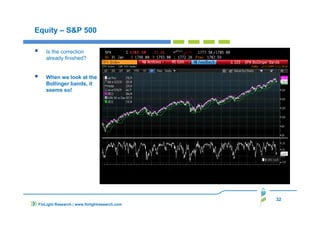
Equity – S&P 500
Is the correction
already finished?
When we look at the
Bollinger bands, it
seems so!
33
FinLight Research | www.finlightresearch.com
Equity – S&P 500
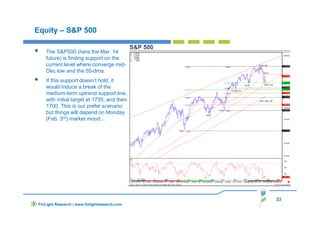
The S&P500 (here the Mar. 14
future) is finding support on the
current level where converge mid-
Dec low and the 55-dma.
If this support doesn’t hold, it
would induce a break of the
medium-term uptrend support line,
with initial target at 1735, and then
1700. This is our prefer scenario
but things will depend on Monday
(Feb. 3rd) market mood…
34
FinLight Research
Trading Model - SPX
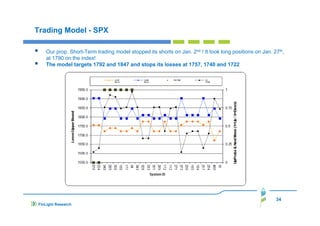
Our prop. Short-Term trading model stopped its shorts on Jan. 2nd ! It took long positions on Jan. 27th,
at 1790 on the index!
The model targets 1792 and 1847 and stops its losses at 1757, 1740 and 1722
35
FinLight Research
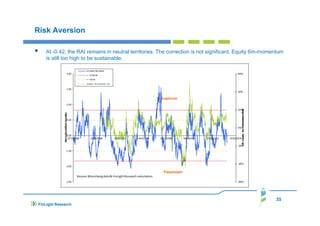
Risk Aversion
At -0.42, the RAI remains in neutral territories. The correction is not significant. Equity 6m-momentum
is still too high to be sustainable.
36
FinLight Research | www.finlightresearch.com
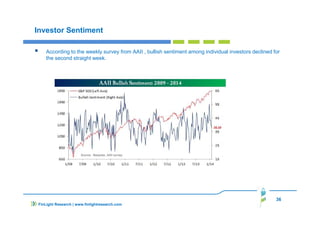
Investor Sentiment
According to the weekly survey from AAII , bullish sentiment among individual investors declined for
the second straight week.
Source: Bespoke, AAII survey
37
FinLight Research | www.finlightresearch.com
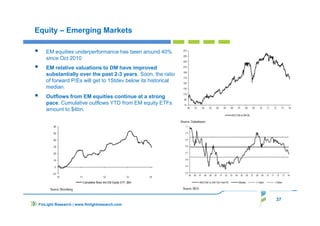
Equity – Emerging Markets
EM equities underperformance has been around 40%
since Oct 2010
EM relative valuations to DM have improved
substantially over the past 2-3 years. Soon, the ratio
of forward P/Es will get to 1Stdev below its historical
median.
Outflows from EM equities continue at a strong
pace. Cumulative outflows YTD from EM equity ETFs
amount to $4bn.
38
FinLight Research | www.finlightresearch.com
Chinese WMPs
A wave Of Chinese Trust defaults may be underway…
Wealth management products (WMPs) are off-balance-sheet vehicles invested in a pool of
securities like trust products, bonds, stocks that offer higher yields than bank deposits.
WMPs are sold to provide credit for local governments and raise funds for other economic actors
(coal-miners…).
WMPs are sold by private investment firms and marketed by banks as low-risk investments
On Jan 16, Reuters reported that Industrial & Commercial Bank of China (ICBC, China’s largest
state-owned bank and the world's largest bank by assets) said that it has no plans to use its own
money to repay investors in a troubled off-balance-sheet investment product (WMP) that it helped
to market
This a 3 billion yuan ($495 million) trust product (expected to mature on Jan. 31) sold to raise funds
for coal-miner Shanxi Zhenfu Energy Group which is now unable to repay the debt that funds the
payments on that WMP.
As of today Jan 29th, this default seems to be avoided as ICBC invited investors to sell their rights
to unidentified buyers to recoup the principal (and only the principal).
39
FinLight Research | www.finlightresearch.com
Chinese Banks
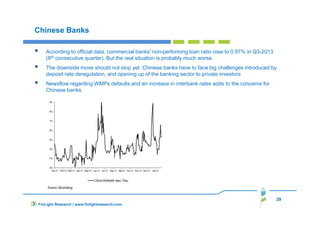
According to official data, commercial banks' non-performing loan ratio rose to 0.97% in Q3-2013
(8th consecutive quarter). But the real situation is probably much worse.
The downside move should not stop yet. Chinese banks have to face big challenges introduced by
deposit rate deregulation, and opening up of the banking sector to private investors
Newsflow regarding WMPs defaults and an increase in interbank rates adds to the concerns for
Chinese banks.
40
FinLight Research | www.finlightresearch.com
China Banks & Sovereign CDS
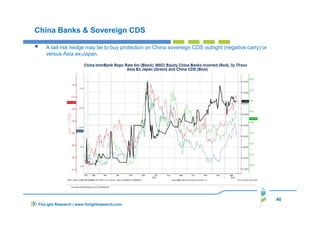
A tail risk hedge may be to buy protection on China sovereign CDS outright (negative carry) or
versus Asia ex-Japan.
41
FIXED INCOME & CREDIT
We keep our core strategic view for higher long-end yields going forward.
Turmoil in Emerging Markets continued to provide support for DM fixed income through flight to quality
flows. But, we expect the selloff on Treasuries to resume very soon.
Last month, we said “But given the sharp upward move in treasury yields over the past month, we
tactically stay neutral govies (but keep an eye on the 3.00% threshold on 10y UST) on the short-term and
wait for a better spot to go short / UW”. Our tactical view has payed: 10 UST yield ended Jan. at 2.64
which is an important support.
But given the continued downside pressure we see on this level, we prefer to wait either for a
clean breakdown (targeting 2.54) or for a clear rebound (to put on our short positions).
We continue to OW Eurozone vs. US and UK given disinflationary risks in Europe.
We are neutral on TIPS
As a tail hedge, we suggest receiving the 10y bund swap spread
Last month, and in order to express our short duration bias, we took 2y/10s curve steepeners. We prefer
to realize our profit as the curve slope is beginning to turn after it reached its limit range (around 260 bps)
We’ve been overweight peripheral vs. core govies. We take profit and switch to neutral as we see lasting
spread compression to be very limited if any.
We’ve been OW EM sovereigns vs High Grade. We stop losses and switch to neutral.
FinLight Research | www.finlightresearch.com
42
FIXED INCOME & CREDIT
Fund flows data show continued inflows into both high yield and investment grade retail funds over the
past week
We stay neutral on credit as a whole
European HY has been hit hard this month. Although spreads could widen further (we target 340 bps on
iTraxx Xover, 90bps on iTraxx Main), we remain constructive on the short-term.
We are OW High-Yield (BB and B) vs Investment Grade, and more specifically OW European HY vs
US High Yield
Bottom line : neutral Govies, Neutral credit, neutral TIPS, keep our OW High Yield vs High Grade
FinLight Research | www.finlightresearch.com
43
FinLight Research | www.finlightresearch.com
US Treasuries
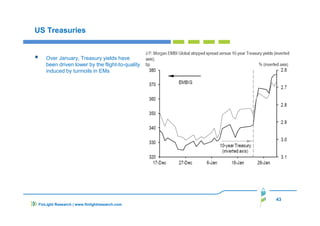
Over January, Treasury yields have
been driven lower by the flight-to-quality
induced by turmoils in EMs
44
FinLight Research | www.finlightresearch.com
US Treasuries – Investor Positioning
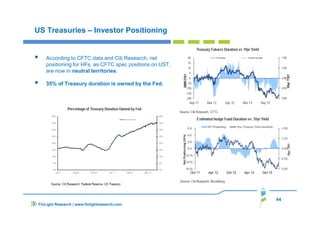
According to CFTC data and Citi Research, net
positioning for HFs, as CFTC spec positions on UST,
are now in neutral territories.
35% of Treasury duration is owned by the Fed.
45
FinLight Research | www.finlightresearch.com
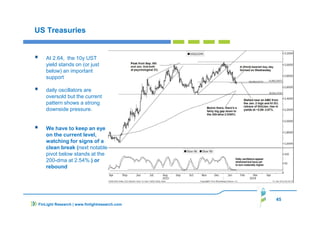
US Treasuries
At 2.64, the 10y UST
yield stands on (or just
below) an important
support
daily oscillators are
oversold but the current
pattern shows a strong
downside pressure.
We have to keep an eye
on the current level,
watching for signs of a
clean break (next notable
pivot below stands at the
200-dma at 2.54%.) or
rebound
46
FinLight Research | www.finlightresearch.com
TIPS
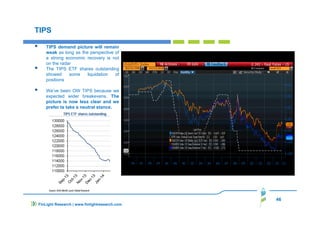
TIPS demand picture will remain
weak as long as the perspective of
a strong economic recovery is not
on the radar
The TIPS ETF shares outstanding
showed some liquidation of
positions
We’ve been OW TIPS because we
expected wider breakevens. The
picture is now less clear and we
prefer ta take a neutral stance.
47
FinLight Research | www.finlightresearch.com
Sovereign Spreads in Europe
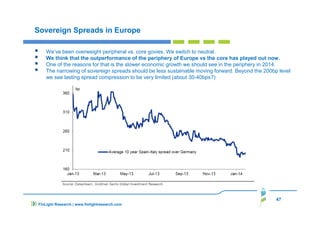
We’ve been overweight peripheral vs. core govies. We switch to neutral.
We think that the outperformance of the periphery of Europe vs the core has played out now.
One of the reasons for that is the slower economic growth we should see in the periphery in 2014.
The narrowing of sovereign spreads should be less sustainable moving forward. Beyond the 200bp level
we see lasting spread compression to be very limited (about 30-40bps?)
48
FinLight Research | www.finlightresearch.com
Corporate Credit - US
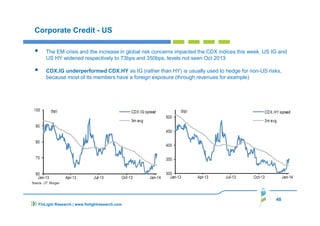
The EM crisis and the increase in global risk concerns impacted the CDX indices this week. US IG and
US HY widened respectively to 73bps and 350bps, levels not seen Oct 2013
CDX.IG underperformed CDX.HY as IG (rather than HY) is usually used to hedge for non-US risks,
because most of its members have a foreign exposure (through revenues for example)
49
FinLight Research | www.finlightresearch.com
Corporate Credit - US
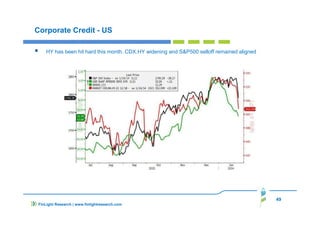
HY has been hit hard this month. CDX.HY widening and S&P500 selloff remained aligned
50
FinLight Research | www.finlightresearch.com
Corporate Credit - Europe
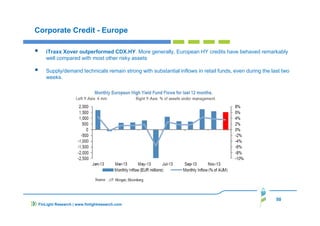
iTraxx Xover outperformed CDX.HY. More generally, European HY credits have behaved remarkably
well compared with most other risky assets
Supply/demand technicals remain strong with substantial inflows in retail funds, even during the last two
weeks.
51
FinLight Research | www.finlightresearch.com
High Yield: Is Risk-Off showing up again?
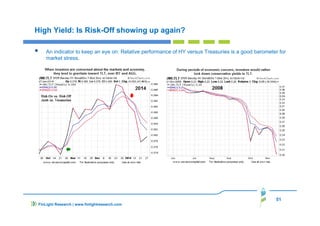
An indicator to keep an eye on: Relative performance of HY versus Treasuries is a good barometer for
market stress.
52
FinLight Research | www.finlightresearch.com
Emerging Sovereigns
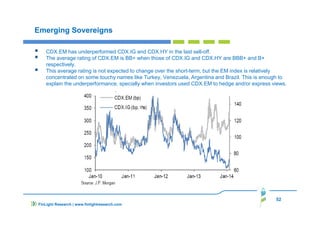
CDX.EM has underperformed CDX.IG and CDX.HY in the last sell-off.
The average rating of CDX.EM is BB+ when those of CDX.IG and CDX.HY are BBB+ and B+
respectively.
This average rating is not expected to change over the short-term, but the EM index is relatively
concentrated on some touchy names like Turkey, Venezuela, Argentina and Brazil. This is enough to
explain the underperformance, specially when investors used CDX.EM to hedge and/or express views.
53
EXCHANGE RATES
We keep our view for a stronger USD index in 2014 based on higher US rates and non-US
fundamental weakness Add to dollar longs.
Stresses emanating from EM extended the dollar rally and induced the underperformance of EM and
commodity-linked currencies.
JPY continuous strengthening versus USD, over the last few weeks, seems to be the new theme to
follow.
On the EUR, we still target a pull back to 1.31-1.25.
On USDJPY, we have to keep an eye on the current level (102.04), watching for signs of a clean break
(next target would be 105.50) or a rebound .
FinLight Research | www.finlightresearch.com
54
FinLight Research | www.finlightresearch.com
EUR-USD
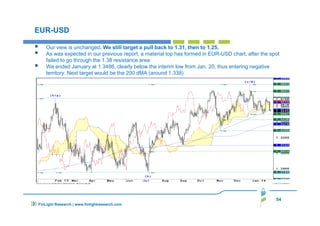
Our view is unchanged. We still target a pull back to 1.31, then to 1.25.
As was expected in our previous report, a material top has formed in EUR-USD chart, after the spot
failed to go through the 1.38 resistance area
We ended January at 1.3486, clearly below the interim low from Jan. 20, thus entering negative
territory. Next target would be the 200 dMA (around 1.338)
55
FinLight Research | www.finlightresearch.com
EUR-USD
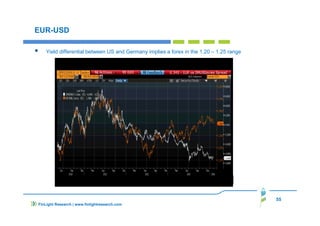
Yield differential between US and Germany implies a forex in the 1.20 – 1.25 range
56
FinLight Research | www.finlightresearch.com
USD-JPY
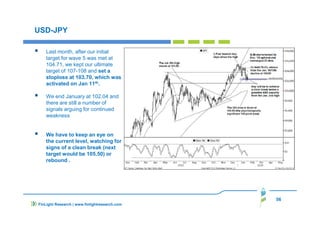
Last month, after our initial
target for wave 5 was met at
104.71, we kept our ultimate
target of 107-108 and set a
stoploss at 103.70, which was
activated on Jan 11th.
We end January at 102.04 and
there are still a number of
signals arguing for continued
weakness
We have to keep an eye on
the current level, watching for
signs of a clean break (next
target would be 105.50) or
rebound .
57
FinLight Research | www.finlightresearch.com
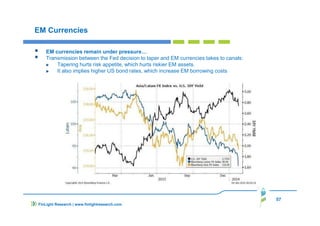
EM Currencies
EM currencies remain under pressure…
Transmission between the Fed decision to taper and EM currencies takes to canals:
Tapering hurts risk appetite, which hurts riskier EM assets.
It also implies higher US bond rates, which increase EM borrowing costs
58
FinLight Research | www.finlightresearch.com
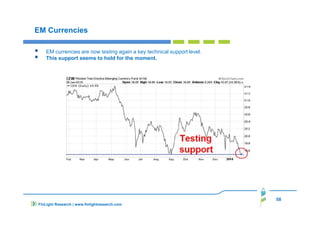
EM Currencies
EM currencies are now testing again a key technical support level.
This support seems to hold for the moment.
59
COMMODITY
We started 2014 by going OW on commodities, as we think that a more positive fundamental picture is
gradually developing. Commodities are outperforming other assets so far this year, despite the difficult
macro-economic environment (China, EMs, higher US$…).
We expect the GSCI index to deliver 5% to 10% thanks mainly to backwardation (of the 24 major
commodity markets, ten are now in backwardation); institutional money, higher prices on energy and a
stabilization in precious metals. Agriculture prices should trend modestly lower on higher supply
Over the short run,
We remain OW on commodities
Risks are skewed to the downside for energy markets. We switch from OW to Neutral.
We stay UW precious metals (targeting 1180-1150 on gold and 18-17 on silver) because of rising
real interest rates. Technically, the bias seems skewed to another significant move lower.
Reaching a base will give a buying signal not only on physical gold but also on gold miners.
On MT, we stay UW copper. The downside risk due to increasing supply is too significant to be ignored.
We target 6600, and ultimately 6000.
COMEX gold inventories should be watched very closely given the stunning move we witness on
COMEX registered gold stocks. Today, if less than 1% of COMEX outstanding contracts go to delivery
there will not be enough gold to meet the delivery requirements!
FinLight Research | www.finlightresearch.com
60
FinLight Research | www.finlightresearch.com
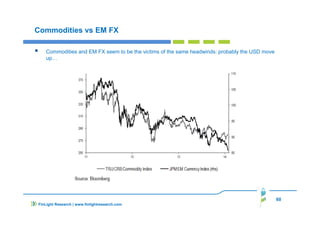
Commodities vs EM FX
Commodities and EM FX seem to be the victims of the same headwinds: probably the USD move
up…
61
FinLight Research | www.finlightresearch.com
Crude Oil
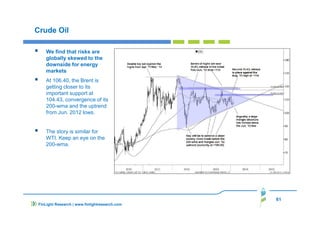
We find that risks are
globally skewed to the
downside for energy
markets
At 106.40, the Brent is
getting closer to its
important support at
104.43, convergence of its
200-wma and the uptrend
from Jun. 2012 lows.
The story is similar for
WTI. Keep an eye on the
200-wma.
62
FinLight Research | www.finlightresearch.com
Comex Gold Stocks
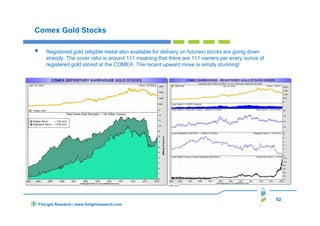
Registered gold (eligible metal also available for delivery on futures) stocks are going down
sharply. The cover ratio is around 111 meaning that there are 111 owners per every ounce of
registered gold stored at the COMEX. The recent upward move is simply stunning!
63
FinLight Research | www.finlightresearch.com
Gold
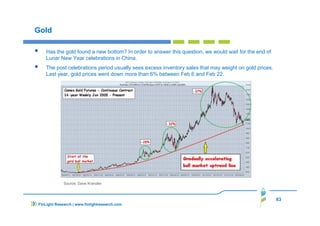
Has the gold found a new bottom? In order to answer this question, we would wait for the end of
Lunar New Year celebrations in China.
The post celebrations period usually sees excess inventory sales that may weight on gold prices.
Last year, gold prices went down more than 6% between Feb 6 and Feb 22.
Source: Dave Kranzler
64
FinLight Research | www.finlightresearch.com
Precious Metals - Gold
Our theoretical price (implied by US$, sovereign CDS and Real Rates) stands now at 1135, versus a
market price at 1241 (as of Jan. 31). Our fair price should continue its downward movement as US$
and real rates go up.
65
FinLight Research | www.finlightresearch.com
Gold
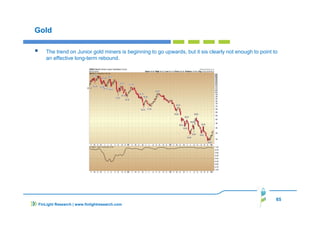
The trend on Junior gold miners is beginning to go upwards, but it sis clearly not enough to point to
an effective long-term rebound.
66
FinLight Research | www.finlightresearch.com
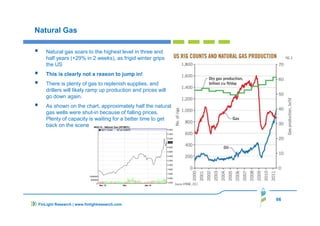
Natural Gas
Natural gas soars to the highest level in three and
half years (+29% in 2 weeks), as frigid winter grips
the US
This is clearly not a reason to jump in!
There is plenty of gas to replenish supplies, and
drillers will likely ramp up production and prices will
go down again.
As shown on the chart, approximately half the natural
gas wells were shut-in because of falling prices.
Plenty of capacity is waiting for a better time to get
back on the scene.
67
FinLight Research | www.finlightresearch.com
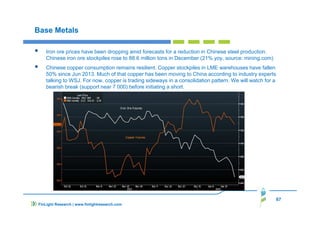
Base Metals
Iron ore prices have been dropping amid forecasts for a reduction in Chinese steel production.
Chinese iron ore stockpiles rose to 88.6 million tons in December (21% yoy, source: mining.com)
Chinese copper consumption remains resilient. Copper stockpiles in LME warehouses have fallen
50% since Jun 2013. Much of that copper has been moving to China according to industry experts
talking to WSJ. For now, copper is trading sideways in a consolidation pattern. We will watch for a
bearish break (support near 7 000) before initiating a short.
68
ALTERNATIVE INVESTMENTS
We are always OW on AI as we expect a 10% return in the coming year versus 5% on a traditional
balanced portfolio (stocks + bonds+ cash).
Our overweight position focuses on Commercial Real Estate (even if the current message is still mixed)
We are OW Equity long-short market-neutral, Convertible arbitrage, CTA’s and Global Macro
FinLight Research | www.finlightresearch.com
69
FinLight Research | www.finlightresearch.com
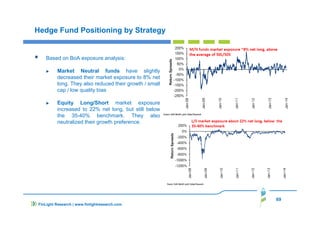
Hedge Fund Positioning by Strategy
Based on BoA exposure analysis:
Market Neutral funds have slightly
decreased their market exposure to 8% net
long. They also reduced their growth / small
cap / low quality bias
Equity Long/Short market exposure
increased to 22% net long, but still below
the 35-40% benchmark. They also
neutralized their growth preference.
70
FinLight Research | www.finlightresearch.com
Hedge Fund Positioning by Strategy
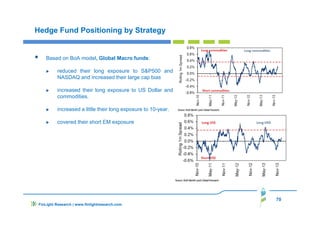
Based on BoA model, Global Macro funds:
reduced their long exposure to S&P500 and
NASDAQ and increased their large cap bias
increased their long exposure to US Dollar and
commodities.
increased a little their long exposure to 10-year.
covered their short EM exposure
71
FinLight Research | www.finlightresearch.com
Hedge Fund Positioning by Asset Class
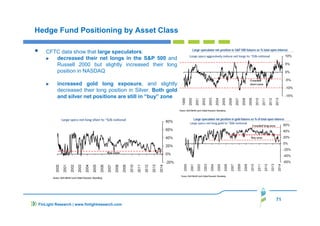
CFTC data show that large speculators:
decreased their net longs in the S&P 500 and
Russell 2000 but slightly increased their long
position in NASDAQ
increased gold long exposure, and slightly
decreased their long position in Silver. Both gold
and silver net positions are still in “buy” zone
72
FinLight Research | www.finlightresearch.com
Hedge Fund Positioning by Asset Class
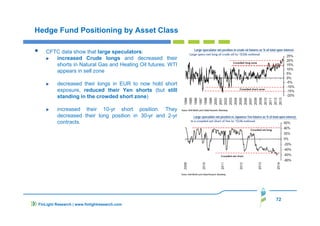
CFTC data show that large speculators:
increased Crude longs and decreased their
shorts in Natural Gas and Heating Oil futures. WTI
appears in sell zone
decreased their longs in EUR to now hold short
exposure, reduced their Yen shorts (but still
standing in the crowded short zone)
increased their 10-yr short position. They
decreased their long position in 30-yr and 2-yr
contracts.
73
FinLight Research | www.finlightresearch.com
Bottom Line : Global Asset Allocation
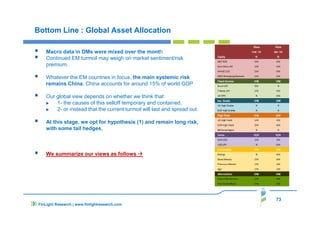
Macro data in DMs were mixed over the month
Continued EM turmoil may weigh on market sentiment/risk
premium.
Whatever the EM countries in focus, the main systemic risk
remains China. China accounts for around 15% of world GDP
Our global view depends on whether we think that:
1- the causes of this selloff temporary and contained,
2- or instead that the current turmoil will last and spread out.
At this stage, we opt for hypothesis (1) and remain long risk,
with some tail hedges.
We summarize our views as follows

FinLight Research - Market perspectives Feb 2014

  • 1.
    Market Perspectives Feb 2014 January31st, 2014 www.finlightresearch.com Eh Janet! Pause the taper…
  • 2.
    MACRO VIEW The Good Worldindustrial production is pointing to the right direction So far this season, companies have posted nice “better than expected” EPS numbers. Eurozone composite output PMI climbed to a 31-month high of 53.2 in January from 52.1 in December, with the manufacturing and services sectors improving. German investor confidence remains strong. Moody's upgraded Ireland's rating to IG and Standard & Poor's removed Portugal from its credit watch list. GIIPS bonds and stocks are at or near multi-year highs, driven by hunger for yield. The Bad A global economic “perfect storm” is building momentum as the consequence of converging bad news from Europe (deflation risk and mild recovery), China (signs economic weakness and an intensifying fight with shadow banks), Emerging Markets (Forex turmoil and fears of an eventual debt crisis) and the US (mixed economic picture and sub-par recovery) China released its report on manufacturing output, which is now clearly slowing, actually turned negative. New home sales fell 7.1% month-over-month in December to an annualized pace of 414,000 units. Housing starts continue to fall, and December pending home sales report was much weaker than expected The Ugly Emergence of China risk. 2 FinLight Research | www.finlightresearch.com
  • 3.
    3 FinLight Research |www.finlightresearch.com Big Four Economic Indicators The global picture is that of a slow recovery. Among the 4 indicators, two (Real Retail Sales and Industrial Production) have already reached their all-time highs. Nonfarm Employment remains on a positive trend. Only Real Personal Income is still struggling.
  • 4.
    4 FinLight Research |www.finlightresearch.com Industrial Production Manufacturing activity in the US and Eurozone economies continues to recover Manufacturing activity in the U.S. rose at a 6.8% annualize rate in Q4-2013 Industrial production in advanced economies rose at a 4.2% annualized pace in the six months ended Nov 2013. Industrial production in EM has been growing at a 4- 5% pace for the past several years.
  • 5.
    5 FinLight Research |www.finlightresearch.com Real Personal Income At 1.2% YoY, Real Personal Income (less transfer payments) remains one of the big laggards
  • 6.
    6 FinLight Research |www.finlightresearch.com Real Retail Sales Retail sales continue to disappoint as consumers have pulled in spending. MoM real sales came in at - 0.07%. Although real December sales were a bit disappointing, this indicator rose 2.6% YoY
  • 7.
    7 FinLight Research |www.finlightresearch.com Unemployment At 1.6% YoY, nonfarm employment seems to struggle to make a new high
  • 8.
    8 FinLight Research |www.finlightresearch.com Unemployment Seasonally adjusted initial claims was 348,000 (+19,000 from the previous week). The 4-week moving average was 333,000. We do not want to read too much into this latest increase in claims because the claims data can be especially volatile around federal holidays. When Viewed at as a percentage of the Civilian Labor Force, weekly Initial Claims seem to have reached a bottom in Sep 2013.
  • 9.
    9 FinLight Research |www.finlightresearch.com Unemployment Unemployment pushed through 12% in Europe, is increasing in Italy, Spain and France, but falling in the US…
  • 10.
    10 FinLight Research |www.finlightresearch.com Capital Goods Orders December capital goods orders were disappointing. New orders number came in at -4.3% MoM They have been relatively flat for the past year, failing to establish a new high. Year- over-year new orders were up a mere 0.1%. If we exclude transportation, "core" durable goods came in at -1.6% MoM and 2.9% YoY. If we exclude both transportation and defense, durable goods came in at -0.5% MoM but up 13.3% YoY (simply explained by the -11.7% drop in Dec 2012 due to the Fiscal Cliff). Corporates remains reluctant to invest despite their record profits
  • 11.
    11 FinLight Research |www.finlightresearch.com Conference Board Economic Indicators In December 2013, the U.S. Leading Economic Index (a composite of ten forward economic indicators that is produced monthly by the Conference Board) continues to strengthen, in a sign of continued economic strength. The Coincident Economic Index (measuring the current state of the economy) also continues to rise.
  • 12.
    12 FinLight Research |www.finlightresearch.com Consumer Confidence Consumer Confidence strengthens In January. At 80.7, it continues its upward move from its interim low of 72.0 in November but remains below its 82.1 interim high in June 2013 Consumers' assessment of the present situation continues to improve, with both business conditions and the job market rated more favorably Looking ahead six months, consumers expect the economy and their earnings to improve. The University of Michigan Consumer Sentiment preliminary number for January came in at 80.4, declining from the 82.5 December final. It remains 4.7 points below its interim high in July 2013
  • 13.
    13 FinLight Research |www.finlightresearch.com Small Business Sentiment Small business sentiment represented by the Small Business Optimism Index continues to closely track the consumer confidence.
  • 14.
    14 FinLight Research |www.finlightresearch.com European Macro The Eurozone recovery is going on with an improving momentum (consumer sentiment, composite PMI) Eurozone composite PMI looks consistent with 1% real GDP growth and 10%+ EPS growth!
  • 15.
    15 FinLight Research |www.finlightresearch.com Inflation - US Inflation data (whatever the measure you use) shows continued weakness in price pressures The inflation trend is clearly to the downside since the end of QE2 in 2011
  • 16.
    16 FinLight Research |www.finlightresearch.com Inflation - Eurozone The threat of a deflation trap is real in eurozone economies. ECB's task in striking the right monetary policy balance for Europe is complicated by the economic /fiscal divergence between its northern and southern member countries
  • 17.
    17 FinLight Research |www.finlightresearch.com Housing: Is Bear Market Back? Most housing measures have softened since the increase in rates around the middle ‘13 New home sales fell 7.1% month-over-month in December to an annualized pace of 414,000 units. Housing starts continue to fall and the extreme cold are expected to be weighing on housing data. The monthly supply increased to 5.0 months Existing home sales for December were reported with a 1% gain over November, after November's original reported numbers were revised lower by 5.9%. Two other warning shots: The trend in sales: The annualized pace of sales for Q4 declined 27.9% vs. Q4-2012 on a seasonally adjusted basis, probably due to rising mortgage rates The trend in prices: December's average price was 6% below June's peak price. December’s median price was 7.5% below June's median price.
  • 18.
    18 FinLight Research |www.finlightresearch.com Housing: Is Bear Market Back? December pending home sales report was much weaker than expected: Pending home sales index was down 8.7% in December (the largest monthly decline since the end of the homebuyer tax credit in 2010) The Case-Shiller 20-city composite index increased 0.9% in November (up 13.7% yoy) showing a solid trend of house price appreciation through November. This is one of the rare positive data but we expect Case-Shiller to cool off at some point
  • 19.
    19 FinLight Research |www.finlightresearch.com China’s PMI China's flash PMI points to contraction, for the first time in six months. The HSBC/Markit PMI last reading stands at 49.6 compared to last month's 50.5. Among the subindexes, new orders, new export orders (already in contractionary territory) and employment showed a faster rate of decline than in December The weakness of forward-looking components points to further deceleration in activity ahead.
  • 20.
    20 FinLight Research |www.finlightresearch.com Is that really an EM Crisis? At this stage, contagion is not yet a real concern. We are still dealing with domestic debt problems If we enter a real crisis, we’ll likely see credit spreads in Ems blowing up to 800-1200 bps. Spreads are still below 400 bps. The EM Bonds / US High Yield ratio (as a measure of risk appetite in EM) is holding, so far, a key relative support level Few countries to keep an eye on in order to capture any contagion risk: China, India, Brazil and perhaps Australia as they are BIG and combine all the required ingredients (important current accounts deficit, price bubbles, dependence on Chinese growth) Compared to 97 crisis, the key players here are more important economies running much larger current account deficits
  • 21.
    21 FinLight Research |www.finlightresearch.com EQUITY We have been for a limited correction (5% to 10%) on equities. A healthy correction is under way, driven by a combination of Fed's tapering, emerging market currency crisis and the clouds over China. Thus far, the pullback is a normal bull market correction until new evidence appears Current valuation appears lofty both for the aggregate market as well as the median stock From here, any further upside on the S&P 500 should be driven by profit growth rather than P/E expansion Bottom line (and for the same reasons than a month ago): We keep our bet on a limited correction (and move our target region up), with a test of 1757 - 1722 (the former seems more reasonable!) level on the S&P 500 We keep our UW (deflationary) Europe and EM vs. US and Japan (even if we expect EM weakness to favor lower US yields, stronger JPY and weaker Nikkei). We still prefer more defensive high-yielding stocks.
  • 22.
    22 FinLight Research |www.finlightresearch.com Equity Earnings So far this season, companies have posted nice “better than expected” EPS numbers. As of Jan 23, nearly 25% of the S&P 500 Index constituents have reported earnings In aggregate, over 68% of reported Q4 2013 earnings have beaten estimates, but only 57% of companies have exceeded revenue estimates According to S&P Capital IQ, earnings estimate will increase from $107.82 in 2013 to $121.09 in 2014 (+12.3%) Source: Bespoke
  • 23.
    23 FinLight Research |www.finlightresearch.com Equity Earnings Earnings estimates from Standard and Poor are far more optimistic. As reported earnings are estimated to rise 21% from September 2013 to September 2014, when operating earnings are estimated to rise 15% Historically, these high estimates seem incompatible with an improving federal budget. The picture is even clearer when we look at de-trended data
  • 24.
    24 FinLight Research |www.finlightresearch.com Equity Earnings Profit margins have been running at a high level’12.6% of GDP) over the last 2-3 years 10y interest rate seems to lead profit margins by 15 months. Given this lead time and the 10y all time low yield of 1.53% in July 2012, we think that a top has been already reached on profits (probably around Oct 2013)
  • 25.
    25 FinLight Research |www.finlightresearch.com S&P500 vs EPS Earnings estimate for 2014 implies an S&P500 around 1700 - 1750
  • 26.
    26 FinLight Research |www.finlightresearch.com Equity – Valuation Goldman equity strategist David Kostin declares in his 'Weekly Kickstart‘* note that the market is getting pricey: “The current valuation of the S&P 500 is lofty by almost any measure, both for the aggregate market as well as the median stock: (1) The P/E ratio; (2) the current P/E expansion cycle; (3) EV/Sales; (4) EV/EBITDA; (5) Free Cash Flow yield; (6) Price/Book as well as the ROE and P/B relationship; and compared with the levels of (6) inflation; (7) nominal 10-year Treasury yields; and (8) real interest rates. Furthermore, the cyclically-adjusted P/E ratio suggests the S&P 500 is currently 30% overvalued in terms of (9) Operating EPS and (10) about 45% overvalued using As Reported earnings.” “Reflecting on our recent client visits and conversations, the biggest surprise is how many investors expect the forward P/E multiple to expand to 17x or 18x. For some reason, many market participants believe the P/E multiple has a long-term average of 15x and therefore expansion to 17-18x seems reasonable. But the common perception is wrong. The forward P/E ratio for the S&P 500 during the past 5-year, 10-year, and 35- year periods has averaged 13.2x, 14.1x, and 13.0x, respectively. At 15.9x, the current aggregate forward P/E multiple is high by historical standards.” “Most investors are surprised to learn that since 1976 the S&P 500 P/E multiple has only exceeded 17x during the 1997-2000 Tech Bubble and a brief four-month period in 2003-04. Other than those two episodes, the US stock market has never traded at a P/E of 17x or above.” * US Weekly Kickstart: Valuation fact vs. fiction
  • 27.
    27 FinLight Research |www.finlightresearch.com Equity – Valuation Valuation appears lofty both for the aggregate market as well as the median stock According to these chart from GS, representing PE historical distribution since 1976, the only times that (1y-forward) PE ratios have been higher than where they are now were during the tech bubble. The picture get worse when viewed on a median basis. At 16.8x, the current multiple is near record levels
  • 28.
    28 FinLight Research |www.finlightresearch.com Equity – Valuation P/E multiple expansion cycles historically peak at 15x From here, any further upside on the S&P 500 should be driven by profit growth rather than P/E expansion.
  • 29.
    29 FinLight Research |www.finlightresearch.com Equity – Long-Term Indicators All long-term valuation indicators we track suggest that today's market is at “lofty” valuations. We track on a monthly basis: 1- The Tobin's Q is the ratio of price to replacement cost, which is in many ways similar to book value. 2- Price to 10 Year Inflation Adjusted Earnings (known as Shiller PE) 3- Price to Peak Earnings (known as Hussman PE) 4- Market Capitalization to GDP (known as the Warren Buffet indicator), which can be thought of as price to sales ratio for the whole economy. Source – VectorGrader 1 2 34
  • 30.
    30 FinLight Research |www.finlightresearch.com Equity Outlook The long-term outlook for the S&P 1500 remains bullish as 78.4% of the 1500 stocks in the index have bullish long-term trends. No market top seems to be forming yet. The intermediate-term outlook is also strong. But the short-term is getting weaker. On the short-term, the consumer discretionary and material sectors seem to be leading the way down. Values reflect the percentage of members with rising moving averages: 200d MA is used for long-term outlook, 50d MA is used for intermediate outlook, and 20d MA is used for short-term outlook.
  • 31.
    31 FinLight Research |www.finlightresearch.com S&P 500 Breadth and Momentum With the market's decline past week, most indicators have started their decline. There are half way to the formation of an intermediate bottom. Source – Financial Sense on Seeking Alpha
  • 32.
    32 FinLight Research |www.finlightresearch.com Equity – S&P 500 Is the correction already finished? When we look at the Bollinger bands, it seems so!
  • 33.
    33 FinLight Research |www.finlightresearch.com Equity – S&P 500 The S&P500 (here the Mar. 14 future) is finding support on the current level where converge mid- Dec low and the 55-dma. If this support doesn’t hold, it would induce a break of the medium-term uptrend support line, with initial target at 1735, and then 1700. This is our prefer scenario but things will depend on Monday (Feb. 3rd) market mood…
  • 34.
    34 FinLight Research Trading Model- SPX Our prop. Short-Term trading model stopped its shorts on Jan. 2nd ! It took long positions on Jan. 27th, at 1790 on the index! The model targets 1792 and 1847 and stops its losses at 1757, 1740 and 1722
  • 35.
    35 FinLight Research Risk Aversion At-0.42, the RAI remains in neutral territories. The correction is not significant. Equity 6m-momentum is still too high to be sustainable.
  • 36.
    36 FinLight Research |www.finlightresearch.com Investor Sentiment According to the weekly survey from AAII , bullish sentiment among individual investors declined for the second straight week. Source: Bespoke, AAII survey
  • 37.
    37 FinLight Research |www.finlightresearch.com Equity – Emerging Markets EM equities underperformance has been around 40% since Oct 2010 EM relative valuations to DM have improved substantially over the past 2-3 years. Soon, the ratio of forward P/Es will get to 1Stdev below its historical median. Outflows from EM equities continue at a strong pace. Cumulative outflows YTD from EM equity ETFs amount to $4bn.
  • 38.
    38 FinLight Research |www.finlightresearch.com Chinese WMPs A wave Of Chinese Trust defaults may be underway… Wealth management products (WMPs) are off-balance-sheet vehicles invested in a pool of securities like trust products, bonds, stocks that offer higher yields than bank deposits. WMPs are sold to provide credit for local governments and raise funds for other economic actors (coal-miners…). WMPs are sold by private investment firms and marketed by banks as low-risk investments On Jan 16, Reuters reported that Industrial & Commercial Bank of China (ICBC, China’s largest state-owned bank and the world's largest bank by assets) said that it has no plans to use its own money to repay investors in a troubled off-balance-sheet investment product (WMP) that it helped to market This a 3 billion yuan ($495 million) trust product (expected to mature on Jan. 31) sold to raise funds for coal-miner Shanxi Zhenfu Energy Group which is now unable to repay the debt that funds the payments on that WMP. As of today Jan 29th, this default seems to be avoided as ICBC invited investors to sell their rights to unidentified buyers to recoup the principal (and only the principal).
  • 39.
    39 FinLight Research |www.finlightresearch.com Chinese Banks According to official data, commercial banks' non-performing loan ratio rose to 0.97% in Q3-2013 (8th consecutive quarter). But the real situation is probably much worse. The downside move should not stop yet. Chinese banks have to face big challenges introduced by deposit rate deregulation, and opening up of the banking sector to private investors Newsflow regarding WMPs defaults and an increase in interbank rates adds to the concerns for Chinese banks.
  • 40.
    40 FinLight Research |www.finlightresearch.com China Banks & Sovereign CDS A tail risk hedge may be to buy protection on China sovereign CDS outright (negative carry) or versus Asia ex-Japan.
  • 41.
    41 FIXED INCOME &CREDIT We keep our core strategic view for higher long-end yields going forward. Turmoil in Emerging Markets continued to provide support for DM fixed income through flight to quality flows. But, we expect the selloff on Treasuries to resume very soon. Last month, we said “But given the sharp upward move in treasury yields over the past month, we tactically stay neutral govies (but keep an eye on the 3.00% threshold on 10y UST) on the short-term and wait for a better spot to go short / UW”. Our tactical view has payed: 10 UST yield ended Jan. at 2.64 which is an important support. But given the continued downside pressure we see on this level, we prefer to wait either for a clean breakdown (targeting 2.54) or for a clear rebound (to put on our short positions). We continue to OW Eurozone vs. US and UK given disinflationary risks in Europe. We are neutral on TIPS As a tail hedge, we suggest receiving the 10y bund swap spread Last month, and in order to express our short duration bias, we took 2y/10s curve steepeners. We prefer to realize our profit as the curve slope is beginning to turn after it reached its limit range (around 260 bps) We’ve been overweight peripheral vs. core govies. We take profit and switch to neutral as we see lasting spread compression to be very limited if any. We’ve been OW EM sovereigns vs High Grade. We stop losses and switch to neutral. FinLight Research | www.finlightresearch.com
  • 42.
    42 FIXED INCOME &CREDIT Fund flows data show continued inflows into both high yield and investment grade retail funds over the past week We stay neutral on credit as a whole European HY has been hit hard this month. Although spreads could widen further (we target 340 bps on iTraxx Xover, 90bps on iTraxx Main), we remain constructive on the short-term. We are OW High-Yield (BB and B) vs Investment Grade, and more specifically OW European HY vs US High Yield Bottom line : neutral Govies, Neutral credit, neutral TIPS, keep our OW High Yield vs High Grade FinLight Research | www.finlightresearch.com
  • 43.
    43 FinLight Research |www.finlightresearch.com US Treasuries Over January, Treasury yields have been driven lower by the flight-to-quality induced by turmoils in EMs
  • 44.
    44 FinLight Research |www.finlightresearch.com US Treasuries – Investor Positioning According to CFTC data and Citi Research, net positioning for HFs, as CFTC spec positions on UST, are now in neutral territories. 35% of Treasury duration is owned by the Fed.
  • 45.
    45 FinLight Research |www.finlightresearch.com US Treasuries At 2.64, the 10y UST yield stands on (or just below) an important support daily oscillators are oversold but the current pattern shows a strong downside pressure. We have to keep an eye on the current level, watching for signs of a clean break (next notable pivot below stands at the 200-dma at 2.54%.) or rebound
  • 46.
    46 FinLight Research |www.finlightresearch.com TIPS TIPS demand picture will remain weak as long as the perspective of a strong economic recovery is not on the radar The TIPS ETF shares outstanding showed some liquidation of positions We’ve been OW TIPS because we expected wider breakevens. The picture is now less clear and we prefer ta take a neutral stance.
  • 47.
    47 FinLight Research |www.finlightresearch.com Sovereign Spreads in Europe We’ve been overweight peripheral vs. core govies. We switch to neutral. We think that the outperformance of the periphery of Europe vs the core has played out now. One of the reasons for that is the slower economic growth we should see in the periphery in 2014. The narrowing of sovereign spreads should be less sustainable moving forward. Beyond the 200bp level we see lasting spread compression to be very limited (about 30-40bps?)
  • 48.
    48 FinLight Research |www.finlightresearch.com Corporate Credit - US The EM crisis and the increase in global risk concerns impacted the CDX indices this week. US IG and US HY widened respectively to 73bps and 350bps, levels not seen Oct 2013 CDX.IG underperformed CDX.HY as IG (rather than HY) is usually used to hedge for non-US risks, because most of its members have a foreign exposure (through revenues for example)
  • 49.
    49 FinLight Research |www.finlightresearch.com Corporate Credit - US HY has been hit hard this month. CDX.HY widening and S&P500 selloff remained aligned
  • 50.
    50 FinLight Research |www.finlightresearch.com Corporate Credit - Europe iTraxx Xover outperformed CDX.HY. More generally, European HY credits have behaved remarkably well compared with most other risky assets Supply/demand technicals remain strong with substantial inflows in retail funds, even during the last two weeks.
  • 51.
    51 FinLight Research |www.finlightresearch.com High Yield: Is Risk-Off showing up again? An indicator to keep an eye on: Relative performance of HY versus Treasuries is a good barometer for market stress.
  • 52.
    52 FinLight Research |www.finlightresearch.com Emerging Sovereigns CDX.EM has underperformed CDX.IG and CDX.HY in the last sell-off. The average rating of CDX.EM is BB+ when those of CDX.IG and CDX.HY are BBB+ and B+ respectively. This average rating is not expected to change over the short-term, but the EM index is relatively concentrated on some touchy names like Turkey, Venezuela, Argentina and Brazil. This is enough to explain the underperformance, specially when investors used CDX.EM to hedge and/or express views.
  • 53.
    53 EXCHANGE RATES We keepour view for a stronger USD index in 2014 based on higher US rates and non-US fundamental weakness Add to dollar longs. Stresses emanating from EM extended the dollar rally and induced the underperformance of EM and commodity-linked currencies. JPY continuous strengthening versus USD, over the last few weeks, seems to be the new theme to follow. On the EUR, we still target a pull back to 1.31-1.25. On USDJPY, we have to keep an eye on the current level (102.04), watching for signs of a clean break (next target would be 105.50) or a rebound . FinLight Research | www.finlightresearch.com
  • 54.
    54 FinLight Research |www.finlightresearch.com EUR-USD Our view is unchanged. We still target a pull back to 1.31, then to 1.25. As was expected in our previous report, a material top has formed in EUR-USD chart, after the spot failed to go through the 1.38 resistance area We ended January at 1.3486, clearly below the interim low from Jan. 20, thus entering negative territory. Next target would be the 200 dMA (around 1.338)
  • 55.
    55 FinLight Research |www.finlightresearch.com EUR-USD Yield differential between US and Germany implies a forex in the 1.20 – 1.25 range
  • 56.
    56 FinLight Research |www.finlightresearch.com USD-JPY Last month, after our initial target for wave 5 was met at 104.71, we kept our ultimate target of 107-108 and set a stoploss at 103.70, which was activated on Jan 11th. We end January at 102.04 and there are still a number of signals arguing for continued weakness We have to keep an eye on the current level, watching for signs of a clean break (next target would be 105.50) or rebound .
  • 57.
    57 FinLight Research |www.finlightresearch.com EM Currencies EM currencies remain under pressure… Transmission between the Fed decision to taper and EM currencies takes to canals: Tapering hurts risk appetite, which hurts riskier EM assets. It also implies higher US bond rates, which increase EM borrowing costs
  • 58.
    58 FinLight Research |www.finlightresearch.com EM Currencies EM currencies are now testing again a key technical support level. This support seems to hold for the moment.
  • 59.
    59 COMMODITY We started 2014by going OW on commodities, as we think that a more positive fundamental picture is gradually developing. Commodities are outperforming other assets so far this year, despite the difficult macro-economic environment (China, EMs, higher US$…). We expect the GSCI index to deliver 5% to 10% thanks mainly to backwardation (of the 24 major commodity markets, ten are now in backwardation); institutional money, higher prices on energy and a stabilization in precious metals. Agriculture prices should trend modestly lower on higher supply Over the short run, We remain OW on commodities Risks are skewed to the downside for energy markets. We switch from OW to Neutral. We stay UW precious metals (targeting 1180-1150 on gold and 18-17 on silver) because of rising real interest rates. Technically, the bias seems skewed to another significant move lower. Reaching a base will give a buying signal not only on physical gold but also on gold miners. On MT, we stay UW copper. The downside risk due to increasing supply is too significant to be ignored. We target 6600, and ultimately 6000. COMEX gold inventories should be watched very closely given the stunning move we witness on COMEX registered gold stocks. Today, if less than 1% of COMEX outstanding contracts go to delivery there will not be enough gold to meet the delivery requirements! FinLight Research | www.finlightresearch.com
  • 60.
    60 FinLight Research |www.finlightresearch.com Commodities vs EM FX Commodities and EM FX seem to be the victims of the same headwinds: probably the USD move up…
  • 61.
    61 FinLight Research |www.finlightresearch.com Crude Oil We find that risks are globally skewed to the downside for energy markets At 106.40, the Brent is getting closer to its important support at 104.43, convergence of its 200-wma and the uptrend from Jun. 2012 lows. The story is similar for WTI. Keep an eye on the 200-wma.
  • 62.
    62 FinLight Research |www.finlightresearch.com Comex Gold Stocks Registered gold (eligible metal also available for delivery on futures) stocks are going down sharply. The cover ratio is around 111 meaning that there are 111 owners per every ounce of registered gold stored at the COMEX. The recent upward move is simply stunning!
  • 63.
    63 FinLight Research |www.finlightresearch.com Gold Has the gold found a new bottom? In order to answer this question, we would wait for the end of Lunar New Year celebrations in China. The post celebrations period usually sees excess inventory sales that may weight on gold prices. Last year, gold prices went down more than 6% between Feb 6 and Feb 22. Source: Dave Kranzler
  • 64.
    64 FinLight Research |www.finlightresearch.com Precious Metals - Gold Our theoretical price (implied by US$, sovereign CDS and Real Rates) stands now at 1135, versus a market price at 1241 (as of Jan. 31). Our fair price should continue its downward movement as US$ and real rates go up.
  • 65.
    65 FinLight Research |www.finlightresearch.com Gold The trend on Junior gold miners is beginning to go upwards, but it sis clearly not enough to point to an effective long-term rebound.
  • 66.
    66 FinLight Research |www.finlightresearch.com Natural Gas Natural gas soars to the highest level in three and half years (+29% in 2 weeks), as frigid winter grips the US This is clearly not a reason to jump in! There is plenty of gas to replenish supplies, and drillers will likely ramp up production and prices will go down again. As shown on the chart, approximately half the natural gas wells were shut-in because of falling prices. Plenty of capacity is waiting for a better time to get back on the scene.
  • 67.
    67 FinLight Research |www.finlightresearch.com Base Metals Iron ore prices have been dropping amid forecasts for a reduction in Chinese steel production. Chinese iron ore stockpiles rose to 88.6 million tons in December (21% yoy, source: mining.com) Chinese copper consumption remains resilient. Copper stockpiles in LME warehouses have fallen 50% since Jun 2013. Much of that copper has been moving to China according to industry experts talking to WSJ. For now, copper is trading sideways in a consolidation pattern. We will watch for a bearish break (support near 7 000) before initiating a short.
  • 68.
    68 ALTERNATIVE INVESTMENTS We arealways OW on AI as we expect a 10% return in the coming year versus 5% on a traditional balanced portfolio (stocks + bonds+ cash). Our overweight position focuses on Commercial Real Estate (even if the current message is still mixed) We are OW Equity long-short market-neutral, Convertible arbitrage, CTA’s and Global Macro FinLight Research | www.finlightresearch.com
  • 69.
    69 FinLight Research |www.finlightresearch.com Hedge Fund Positioning by Strategy Based on BoA exposure analysis: Market Neutral funds have slightly decreased their market exposure to 8% net long. They also reduced their growth / small cap / low quality bias Equity Long/Short market exposure increased to 22% net long, but still below the 35-40% benchmark. They also neutralized their growth preference.
  • 70.
    70 FinLight Research |www.finlightresearch.com Hedge Fund Positioning by Strategy Based on BoA model, Global Macro funds: reduced their long exposure to S&P500 and NASDAQ and increased their large cap bias increased their long exposure to US Dollar and commodities. increased a little their long exposure to 10-year. covered their short EM exposure
  • 71.
    71 FinLight Research |www.finlightresearch.com Hedge Fund Positioning by Asset Class CFTC data show that large speculators: decreased their net longs in the S&P 500 and Russell 2000 but slightly increased their long position in NASDAQ increased gold long exposure, and slightly decreased their long position in Silver. Both gold and silver net positions are still in “buy” zone
  • 72.
    72 FinLight Research |www.finlightresearch.com Hedge Fund Positioning by Asset Class CFTC data show that large speculators: increased Crude longs and decreased their shorts in Natural Gas and Heating Oil futures. WTI appears in sell zone decreased their longs in EUR to now hold short exposure, reduced their Yen shorts (but still standing in the crowded short zone) increased their 10-yr short position. They decreased their long position in 30-yr and 2-yr contracts.
  • 73.
    73 FinLight Research |www.finlightresearch.com Bottom Line : Global Asset Allocation Macro data in DMs were mixed over the month Continued EM turmoil may weigh on market sentiment/risk premium. Whatever the EM countries in focus, the main systemic risk remains China. China accounts for around 15% of world GDP Our global view depends on whether we think that: 1- the causes of this selloff temporary and contained, 2- or instead that the current turmoil will last and spread out. At this stage, we opt for hypothesis (1) and remain long risk, with some tail hedges. We summarize our views as follows