Cloud Platform DesignGoals:
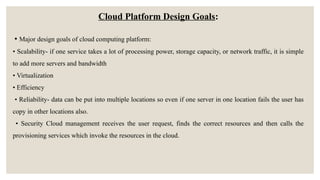
• Major design goals of cloud computing platform:
• Scalability- if one service takes a lot of processing power, storage capacity, or network traffic, it is simple
to add more servers and bandwidth
• Virtualization
• Efficiency
• Reliability- data can be put into multiple locations so even if one server in one location fails the user has
copy in other locations also.
• Security Cloud management receives the user request, finds the correct resources and then calls the
provisioning services which invoke the resources in the cloud.
3.
Enabling Technologies forClouds
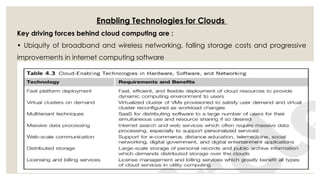
Key driving forces behind cloud computing are :
• Ubiquity of broadband and wireless networking, falling storage costs and progressive
improvements in internet computing software
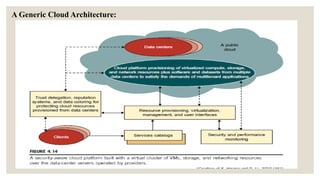
• The internetcloud is envisioned as massive cluster of servers.
• The servers provide collective web services or distributed applications using data-center resources on
demand.
• Servers in the cloud may be physical or VMs.
• User interfaces are applied to request services.
• Cloud computing resources in data centers are owned and operated by third-party provider.
• Monitoring and metering units are used to track the usage and performance of provisioned resources.
• The software infrastructure of a cloud platform must handle all resource mgt and do most of the maintenance
automatically.
• Private clouds are easy to manage and public clouds are easy to access.
• Now the trend is more towards hybrid cloud.
• Security becomes a critical issue.
6.
Layered Cloud ArchitecturalDevelopment:
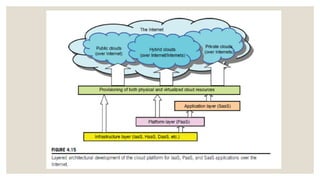
The architecture of a cloud is developed at three layers:
• Infrastructure
• Platform
• Application
• Infrastructure layer is deployed first to support IaaS services.- built with virtualized compute, storage,
network resources.
• Based on infrastructure layer, platform layer is build-this provides users with an environment to develop their
applications , to test operation flows and to monitor execution results and performance.
• Based on platform layer application layer is built.- formed with a collection of all needed s/w modules for
SaaS applications. Ex office mgt work tools (for information retrieval, document processing, calendar and
authentication services, CRM, financial transactions, supply chain management.
• Services at the application layer demand more work from providers.
8.
Market-Oriented Cloud Architecture
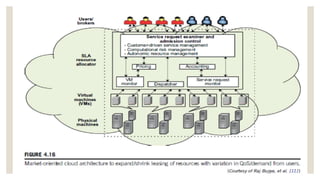
•Each customer is to be satisfied with a special or customised QoS level according to the specific SLA.
(Service Level Agreement)
• The providers cannot deploy traditional system-centric resource management architecture, they must
deploy market-oriented resource mgt to regulate the supply and demand of cloud resources.
• Feedback on service can be obtained from customers for improvement.
• Cost can be reduced which increases the profit of cloud providers.
• Users or brokers submit service requests .
• The SLA resource allocator acts as the interface between the provider and user/brokers.
• The decision to accept or reject is taken based on submitted request by service request examiner by
ensuring there is no overloading of resources.
The following mechanism helps in doing this efficiently
9.
• It getsthe latest status information regarding resource availability –from VM Monitor mechanism and
workload processing as well as progressing of work– from Service Request Monitor mechanism
• Dispatcher mechanism- starts the execution of accepted service requests on allocated VM
• Pricing mechanism decides on charging of service requests. Eg based on submission time (peak/off-peak),
pricing rates (fixed/changing), or availability of resources(supply / demand)
• This helps in prioritizing resource allocations effectively.
Accounting mechanism- maintains the actual usage of resources for final charging
11.
Quality of ServiceFactors
• The data center comprises multiple computing servers that provide resources to meet service
demands.
• Some of QoS parameters are time, cost, reliability, trust/security etc.,
• QoS requirements cannot be static and may change based on business operation and operating
environment changes.
• More importance should be given to customers as they pay for what they use.
• Commercial clouds define computational risk mgt tactics to identify, assess, and manage risks
involved in the execution of applications with regard to service requirements and customer needs.
The system must incorporate autonomic resource mgt models that effectively self-manage changes in
service requirements to satisfy both new service demands and existing service obligations and
leverage VM
12.
Virtualization Support andDisaster Recovery
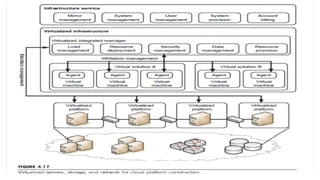
• Cloud users do not need to know and have no way to discover physical resources that are
involved while processing a service request.
• Hardware virtualization- virtualization s/w is used as a platform for developing new cloud
applications that enable developers to use any operating systems and programming environments
they like. The development environment and deployment environment can now be the same,
which eliminates some runtime problems.
• In traditional environment sharing of cluster resources depends on user and group mechanism on
a system. Sharing is not flexible. An environment that meets one user’s requirement often cannot
satisfy another user. Virtualization allows users to have full privileges while keeping them
separate.
14.
Virtualization Support inPublic Clouds
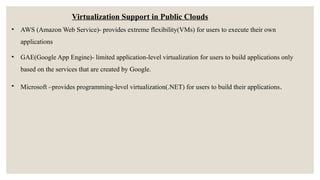
• AWS (Amazon Web Service)- provides extreme flexibility(VMs) for users to execute their own
applications
• GAE(Google App Engine)- limited application-level virtualization for users to build applications only
based on the services that are created by Google.
• Microsoft –provides programming-level virtualization(.NET) for users to build their applications.
16.
• IT powerconsumption in the US has more than doubled to 3 percent of the total energy consumed in the
country.
• Storage virtualization for green data centers.- virtualization leads to less power consumption.
• Virtualization for IaaS-use of VMs in cloud has the following benefits
• System administrators consolidate workloads of underutilized servers in fewer servers
• VMs have the ability to run legacy code without interfering with other APIs (Legacy code is source code that
relates to a no-longer supported or manufactured operating system or other computer technology. ... When
the manufacturer upgrades a platform
• VMs can be used to improve security through creation of sandboxes (is a security mechanism for separating
running programs, usually in an effort to mitigate system failures or software vulnerabilities from spreading.
It is often used to execute untested or untrusted programs or code, possibly from unverified or untrusted third
parties, suppliers, users or websites, without risking harm to the host machine or operating system) for running
applications with questionable reliability
• Virtualized cloud platforms can apply performance isolation, letting providers offer some guarantees and
better QoS to customer applications
17.
VM Cloning forDisaster Recovery
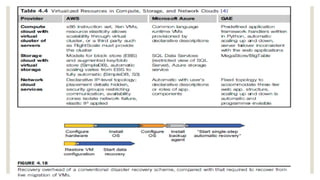
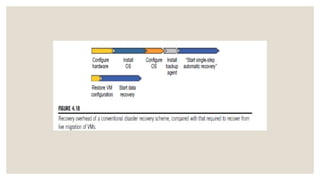
• Scheme 1-Recover one physical machine by another physical machine
• Scheme 2- Recover one VM by another VM
• Scheme1- traditional disaster recovery is rather slow, complex and expensive. Total recovery time is
attributed to the hardware conf, installing and config OS, installing backup agent, and long time to restart
the physical machine.
• Scheme2- in this the steps installation and configuration of OS and backup agents are eliminated which
greatly reduces the recovery time.
• Cloning of VM is another solution make a clone on a remote server for every running VM on a local server.
At a time only one needs to be active. A cloud center should be able to activate this clone VM in case of
failure of the original VM, taking a snapshot of the VM to enable live migration in a minimal time. Only
updated and modified states are sent to the suspended VM to update its state
19.
Architectural Design Challenges
Challenge1- Service Availability and Data Lock-in Problem
• The management of a cloud service by a single company is often the source of single points of failure.
Using of multiple cloud providers, the company has multiple data centers located in different
geographic regions which may have common s/w infrastructure and accounting systems. It gives more
protection from failures.
• Another threat is distributed denial of service(DDoS) attacks.
Criminals threaten to cut off the incomes of SaaS providers by making their services unavailable.
• Provide common standardised API so that the SaaS developer can deploy services and data across
multiple cloud providers. This will rescue the loss of all data due to the failure of a single company.
This will eliminate data-lock-in problem. This enable “surge computing” in which the public cloud is
used to capture the extra tasks that cannot be easily run in the data center of a private cloud.
20.
Challenge 2- DataPrivacy and Security Concerns
• Current cloud offerings are public networks, exposing the system to more attacks. These can be overcome
by encrypted storage, virtual LANs, and network middleboxes(firewalls, packet filters)
• Laws are levied by countries to keep the data within their boundaries
• In traditional network attacks include buffer overflows, DoS attacks, spyware, malware etc
• In a cloud environment, the attacks are hypervisor malware, guest hopping and hijacking or VM rootkits,
man-in-the-middle attack for VM migration
• Passive attacks- steal sensitive data or passwords
• Active attacks- manipulation of kernel data structures which cause major damage
21.
Challenge 3- UnpredictablePerformance and Bottlenecks
• Sharing of CPU, Memory is ok but I/O sharing is problematic
• Applications are “pulled apart” across the boundaries of clouds which complicate data placement and
transport.
• Cloud users and providers have to think about the implications of placement and traffic at every level of the
system, if they want to minimize cost.
• Data transfer bottlenecks must be removed, bottleneck links must be widened, and weak servers should be
removed.
Challenge 4- Distributed Storage and Widespread Software Bugs
• The database is always growing.
• Opportunity is to create a storage system which scales up and down on demand.
• This demands the design of efficient distributed SANs(storage area network)- in this data consistency
checking is a big challenge
22.
Challenge 5-Cloud Scalability,Interoperability, and Standardization
• The pay-as-you-go model applies to storage and network bandwidth.
• GAE-automatically scales up and down to load increase and decrease and users are charged by the cycles
used
• AWS-charges by the hour for the number of VM instances used.
• OVF(open Virtualization Format)-describes an open, secure, portable, efficient, and extensible format for the
packaging and distribution of VMs. This format does not rely on the use of a specific host platform,
virtualization platform or guest os.
OVF also defines a transport mechanism for VM templates, and can apply to different virtualization platforms
with different levels of virtualization. Virtual appliances must run on any virtual platform
23.
Challenge 6-Software Licensingand Reputation Sharing
• Many cloud computing providers rely on open source software as it is ideal for utility computing.
• The company’s can consider using both pay-for-use and bulk-use licensing schemes to widen the business
coverage.
• One customer’s bad behaviour can affect the reputation of entire cloud. For instance, black-listing of EC2 IP
address by spamprevention services may limit smooth VM installation.
• Another legal issue is transfer of legal liability. Cloud providers want legal liability to remain with the
customer and vice-versa. This has to be solved at SLA level