Module 5: CriticalTheory
and Education
Critical Theory, developed by the Frankfurt School, views
education not just as a means of transferring knowledge but as a
powerful tool for social transformation.
It encourages educators and learners to critically examine
society, challenge injustice, and empower marginalized voices.
5.
Meaning
• Critical Theoryand Education is an approach that
views education as a tool for questioning power,
promoting equity, and transforming society. means
that education should not just be about memorizing facts or passing exams—
it should help students and teachers:
• It challenges the idea that schools are neutral spaces
and instead sees them as places where social values,
ideologies, and inequalities are reproduced—or
resisted.
6.
• Core Ideasof Critical Theory in Education
• Education is Political
• Teaching always reflects values and beliefs. It can either support
the status quo or challenge injustice
• Power and Inequality
• Schools may reinforce social hierarchies (e.g., class, race, gender)
through curriculum, discipline, and access to resources.
7.
• Critical Consciousness
•Students and teachers are encouraged to reflect on their
experiences and recognize how systems of power affect their lives.
• Dialogue and Empowerment
• Learning is a shared process. Teachers and students engage
in open dialogue to co-create knowledge and promote
change
8.
•Examples in Practice
•InclusiveCurriculum: Teaching diverse
histories and perspectives, including those of
marginalized groups. regardless of their race, gender,
culture, religion, ability, or socioeconomic background
•Social Justice Projects: Encouraging students
to research and act on issues like poverty,
discrimination, or environmental justice.
•. with the goal of promoting fairness, inclusion, and positive
change in their communities.
9.
• Critical Discussions:Analyzing media, textbooks, and
policies to uncover bias and promote fairness
• What It Means
• Instead of just accepting information, students are
encouraged to:
• Ask why something is the way it is.
• Explore multiple perspectives.
• Challenge biases, stereotypes, or unfair systems.
• Connect learning to real-world issues.
10.
What is FrankfurtSchool and education
• Frankfurt School and Education:
• The Frankfurt School was a group of German philosophers
and social theorists (including Max Horkheimer, Theodor
Adorno, Herbert Marcuse, and later Jürgen Habermas)
who developed Critical Theory.
• This theory critiques society, culture, and institutions—
including education—with the goal of promoting human
emancipation, social justice, and critical consciousness.
11.
Key Educational Conceptsfrom the Frankfurt
School
•Education as Emancipation (the freeing of
someone from slavery)
• Learners should be empowered to think
independently and act against oppression.
• Education should help students become agents of
change.
• Example : Recognize and challenge unfair systems (e.g., discrimination,
inequality).
12.
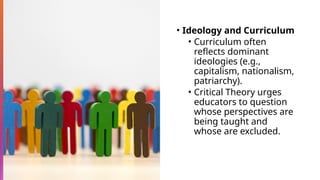
• Ideology andCurriculum
• Curriculum often
reflects dominant
ideologies (e.g.,
capitalism, nationalism,
patriarchy).
• Critical Theory urges
educators to question
whose perspectives are
being taught and
whose are excluded.
•Teacher as Facilitatorof Critical
Thinking
•Teachers are not just knowledge
providers but guides who help
students analyze, question, and
reflect
15.
• Praxis (Reflection+ Action)
• Learning should lead to action—students apply what they learn to
real-world issues and work toward solutions.
• Student-Centered Learning
• Encourages collaboration, reflection, and active
participation rather than passive learning.
16.
🧠 Frankfurt Schooland Education
Key Educational Contributions of the Frankfurt School
• 1. Education as a Tool for Social Change
• Education should not just transmit knowledge but empower
learners to critique society and work toward equity and
justice.
• Encourages students to question dominant ideologies and
power structures
17.
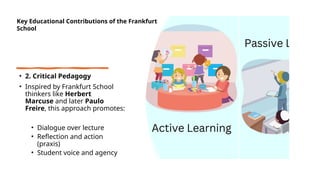
• 2. CriticalPedagogy
• Inspired by Frankfurt School
thinkers like Herbert
Marcuse and later Paulo
Freire, this approach promotes:
• Dialogue over lecture
• Reflection and action
(praxis)
• Student voice and agency
Key Educational Contributions of the Frankfurt
School
18.
•3. Ideology and
Curriculum
•TheFrankfurt School
critiques how education
can reproduce social
inequalities by embedding
dominant ideologies in the
curriculum.
•Advocates for inclusive
and diverse content that
reflects multiple
perspectives.
Key Educational Contributions of the Frankfurt
School
19.
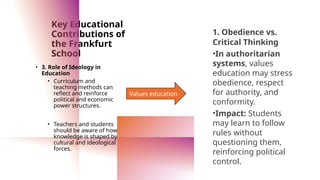
Key Educational
Contributions of
theFrankfurt
School
• 3. Role of Ideology in
Education
• Curriculum and
teaching methods can
reflect and reinforce
political and economic
power structures.
• Teachers and students
should be aware of how
knowledge is shaped by
cultural and ideological
forces.
1. Obedience vs.
Critical Thinking
•In authoritarian
systems, values
education may stress
obedience, respect
for authority, and
conformity.
•Impact: Students
may learn to follow
rules without
questioning them,
reinforcing political
control.
Values education
20.
Key Educational Contributionsof the Frankfurt School
•Encouraging Critical Thinking
•Students should be taught to analyze media,
history, and social systems critically.
•Education should
foster dialogue, reflection,
and action (praxis).
21.
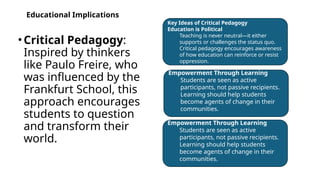
Educational Implications
• CriticalPedagogy:
Inspired by thinkers
like Paulo Freire, who
was influenced by the
Frankfurt School, this
approach encourages
students to question
and transform their
world.
Key Ideas of Critical Pedagogy
Education is Political
Teaching is never neutral—it either
supports or challenges the status quo.
Critical pedagogy encourages awareness
of how education can reinforce or resist
oppression.
Empowerment Through Learning
Students are seen as active
participants, not passive recipients.
Learning should help students
become agents of change in their
communities.
Empowerment Through Learning
Students are seen as active
participants, not passive recipients.
Learning should help students
become agents of change in their
communities.
22.
Dialogue and Reflection
Teachersand students engage in
meaningful conversations.
Reflection is used to connect
personal experiences with broader
social issues.
Social Justice Focus
Topics like inequality, racism,
poverty, and gender are explored in
the classroom.
The goal is to promote equity and
human rights.
23.
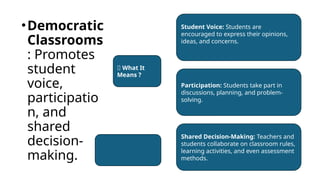
•Democratic
Classrooms
: Promotes
student
voice,
participatio
n, and
shared
decision-
making.
🧠What It
Means ?
Student Voice: Students are
encouraged to express their opinions,
ideas, and concerns.
Participation: Students take part in
discussions, planning, and problem-
solving.
Shared Decision-Making: Teachers and
students collaborate on classroom rules,
learning activities, and even assessment
methods.
24.
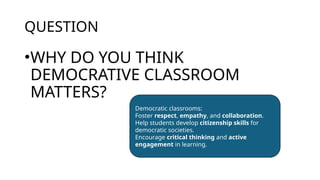
QUESTION
•WHY DO YOUTHINK
DEMOCRATIVE CLASSROOM
MATTERS?
Democratic classrooms:
Foster respect, empathy, and collaboration.
Help students develop citizenship skills for
democratic societies.
Encourage critical thinking and active
engagement in learning.
25.
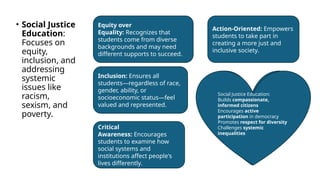
• Social Justice
Education:
Focuseson
equity,
inclusion, and
addressing
systemic
issues like
racism,
sexism, and
poverty.
Equity over
Equality: Recognizes that
students come from diverse
backgrounds and may need
different supports to succeed.
Inclusion: Ensures all
students—regardless of race,
gender, ability, or
socioeconomic status—feel
valued and represented.
Critical
Awareness: Encourages
students to examine how
social systems and
institutions affect people's
lives differently.
Action-Oriented: Empowers
students to take part in
creating a more just and
inclusive society.
WHY IT MATTERS?
Social Justice Education:
Builds compassionate,
informed citizens
Encourages active
participation in democracy
Promotes respect for diversity
Challenges systemic
inequalities
26.
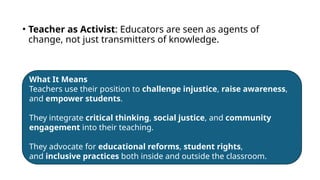
• Teacher asActivist: Educators are seen as agents of
change, not just transmitters of knowledge.
What It Means
Teachers use their position to challenge injustice, raise awareness,
and empower students.
They integrate critical thinking, social justice, and community
engagement into their teaching.
They advocate for educational reforms, student rights,
and inclusive practices both inside and outside the classroom.
27.
Examples of FrankfurtSchool Ideas in Education
✅ Student-Centered Learning
• Application: Students analyze advertisements, news, and social
media to uncover hidden messages and biases.
• Connection: Reflects Adorno’s critique of the “culture industry” and
its role in shaping public opinion.
✅ Example 2: Inclusive Curriculum
• Application: Lessons include diverse voices (e.g., indigenous
history, feminist literature, global perspectives).
• Connection: Challenges dominant ideologies and promotes equity
28.
Examples of FrankfurtSchool Ideas in Education
• ✅ Example 3: Dialogic Teaching
• Application: Teachers encourage open-ended discussions
where students question and reflect on societal issues.
• Connection: Aligns with Habermas’s emphasis on
communicative action and democratic dialogue.
• ✅ Example 4: Social Justice Projects
• Application: Students engage in community service or
advocacy projects addressing real-world problems.
• Connection: Supports Marcuse’s idea of education as a tool for
liberation and activism.
29.
2ND
TOPIC: Gender, Race,and Class in Educational
Discourse
•Educational discourse refers to the
way we talk about and structure
education—through policies,
curriculum, classroom practices, and
cultural norms. Critical Theory helps
us analyze how gender, race, and
class shape this discourse.
30.
•Gender
•Hidden curriculum mayreinforce gender
roles (e.g., boys praised for leadership, girls for
neatness).
•Textbooks often underrepresent women in
history, science, and leadership.
•Critical pedagogy challenges these norms and
promotes gender equity.
31.
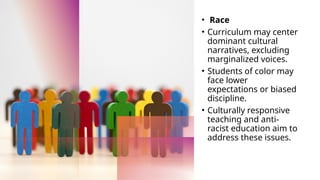
• Race
• Curriculummay center
dominant cultural
narratives, excluding
marginalized voices.
• Students of color may
face lower
expectations or biased
discipline.
• Culturally responsive
teaching and anti-
racist education aim to
address these issues.
32.
•💰 Class
•Access toquality education often depends
on socioeconomic status.
•Schools in wealthier areas tend to have
better resources and opportunities.
•Critical Theory questions why education
reproduces social inequality and
advocates for systemic change.
33.
🧩 Example ClassroomActivities:
• Textbook Audit:
Students analyze who is represented in their textbooks (gender, race,
class).
• Voice Mapping:
Discuss whose voices are heard in school decisions and whose are
missing.
• Story Rewrite:
Take a common story or lesson and rewrite it from a marginalized
perspective.
• Community Interview Project:
Students interview people from different backgrounds about their
school experiences.
34.
• Critical Theoryand Education
• challenges the traditional view of schooling as a neutral
space. It reveals how education can reproduce social
inequalities by reflecting dominant ideologies—such as
capitalism, patriarchy, and nationalism—while excluding
marginalized voices. Through critical theory, educators and
students are encouraged to question whose knowledge is
being taught, whose stories are being silenced, and how
power operates in the classroom.
Editor's Notes
#5 means that education should not just be about memorizing facts or passing exams—it should help students and teachers:
#31 Activity sa mga bata about PAANO PANGANGALAGAAN ANG DIGNIDAD NG ISANG TAO?
INCLUDE : LGBTQ





![[Mark olssen] michel_foucault_materialism_and_edu(book_fi.org)](https://cdn.slidesharecdn.com/ss_thumbnails/markolssenmichelfoucaultmaterialismandedubookfi-org-130507155509-phpapp02-thumbnail.jpg?width=640&height=640&fit=bounds)


