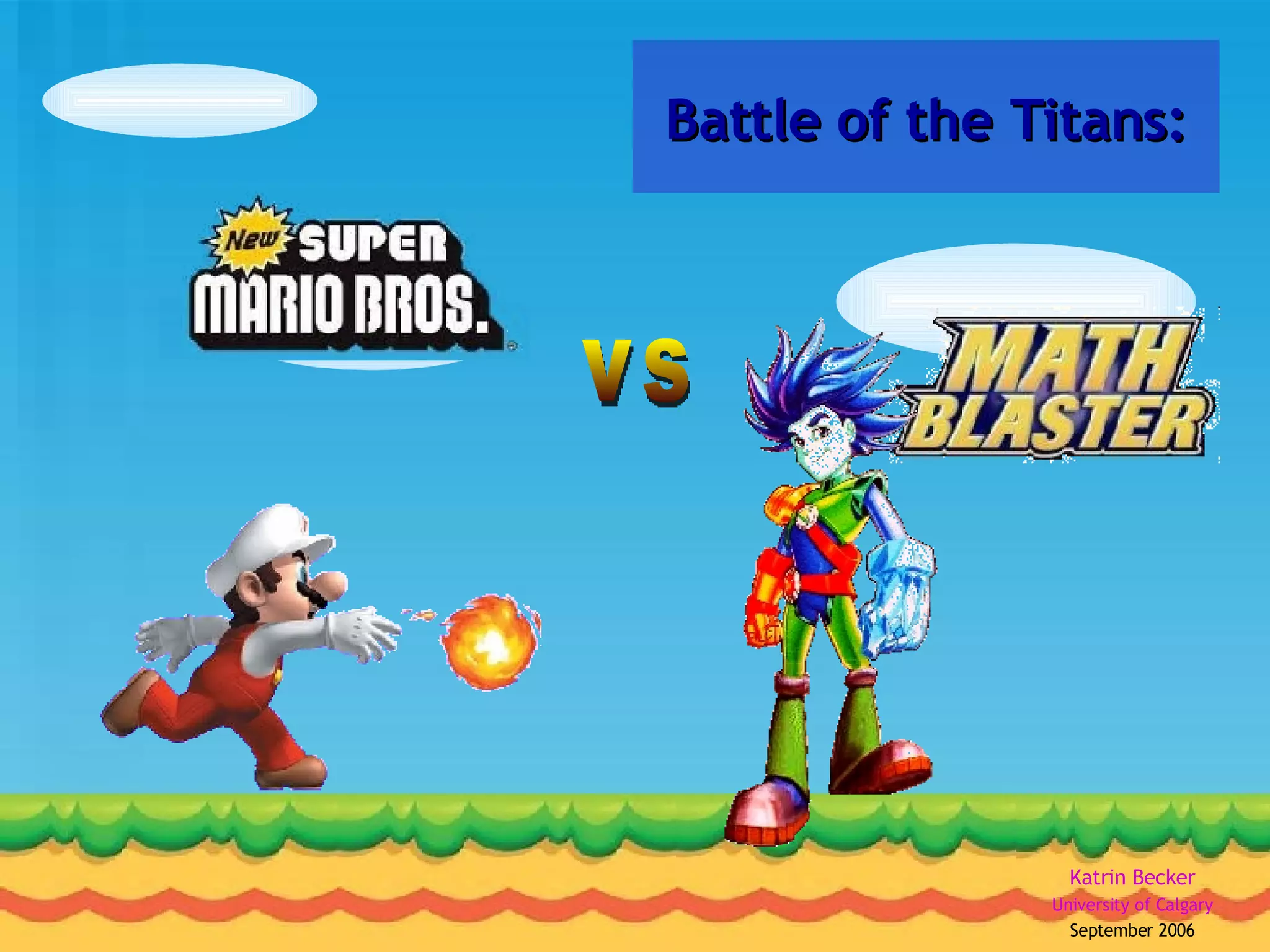
Battle of the Titans: Katrin Becker University of Calgary September 2006 vs
REMEMBER :  Table of findings
Overview 1. Why Do This? 8. Next Steps 7. What I Learned 6. Game Play Experience 2. How? 3. What is a “good” game? 4. Why  these  games? 5. The Games Mario / Math Blaster
0. Introduction Games teach. People learn from games. Are Games Educational? (I don’t care)
0b. What are the Questions? What must be learned to get through this game? How does this game facilitate that learning?
1. Why Do This? Ultimate goal: Design good instructional games (GIG) Teach people how design GIG IF  good games teach, then we can learn how by studying the masters.
2. How To Do This? (methodology) Most good games were not designed to be educational….. at least not on purpose. SO,  their designs are not framed in educational terms. BUT, to design instructional games, we need that……
2. How To Do This? (methodology) One Answer: PRETEND it was designed that way. Can re-capture design through reverse engineering.
3. What is a “good” game? Popular: good sales (really good) Critical acclaim That makes it good because: - don’t get awards & sustained sales if the game is frustrating; no fun; too easy; too hard; annoying; too predictable…..
4. Why  these  Games? All the teachers love  Math Blaster (don’t ask the kids…..) Mario Same genre & style Small console (handicapped graphics & power) Good Game
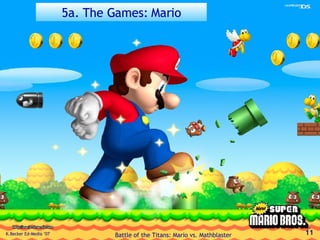
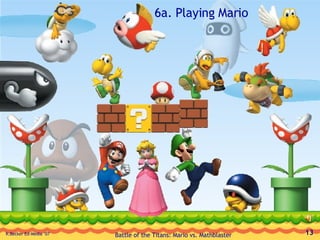
5a. The Games: Mario
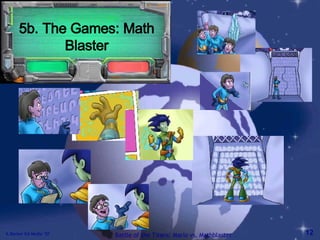
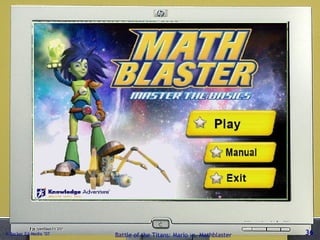
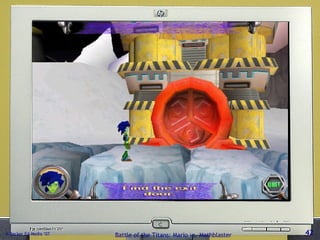
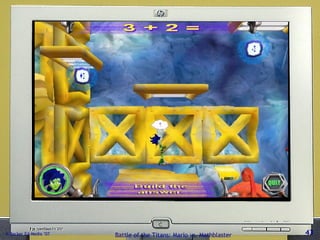
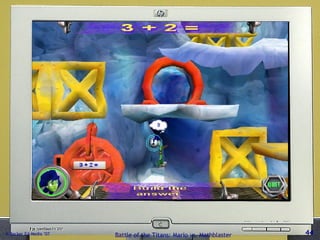
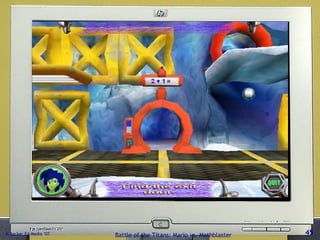
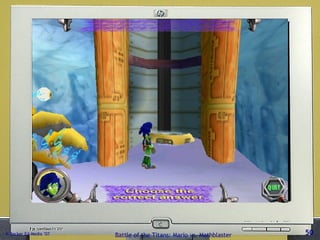
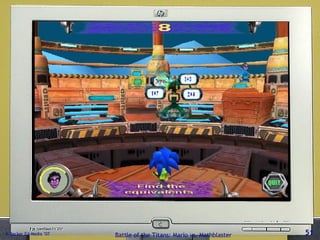
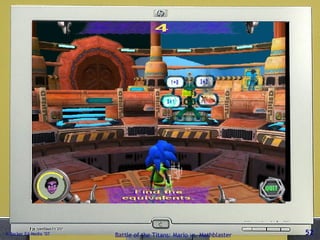
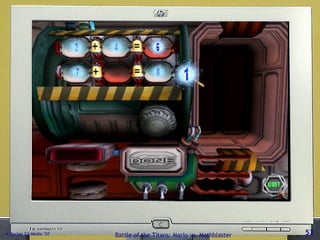
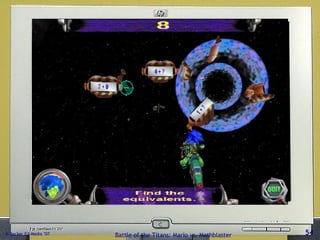
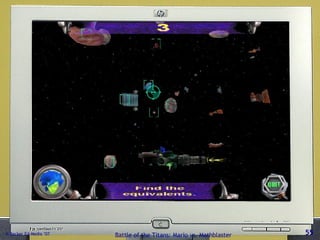
5b. The Games: Math Blaster
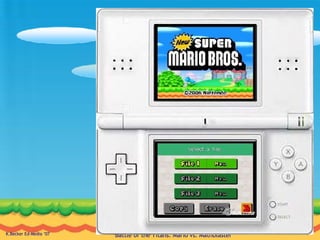
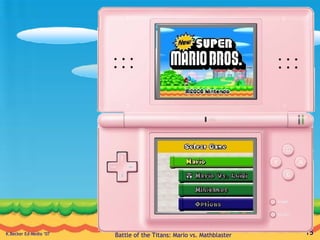
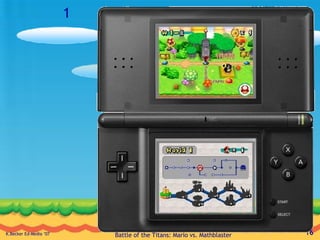
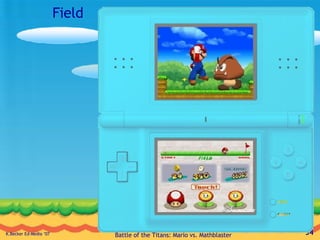
6a. Playing Mario
 
 
1
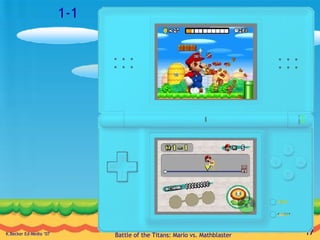
1-1
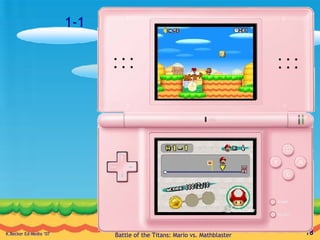
1-1
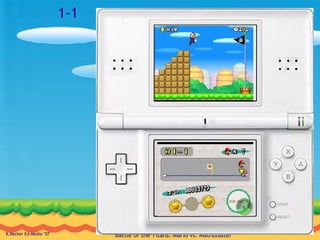
1-1
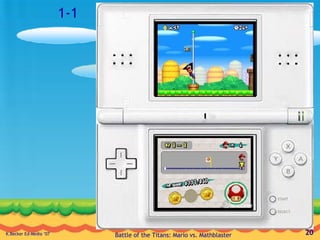
1-1
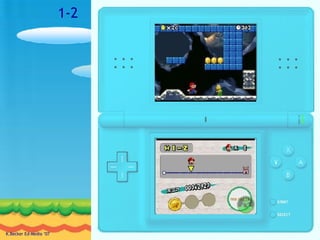
1-2
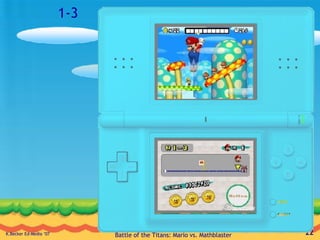
1-3
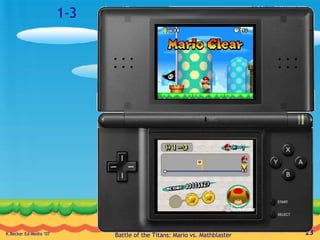
1-3
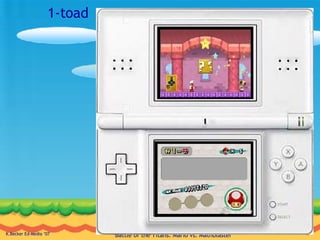
1-toad
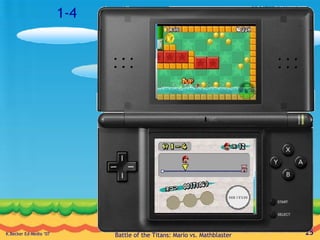
1-4
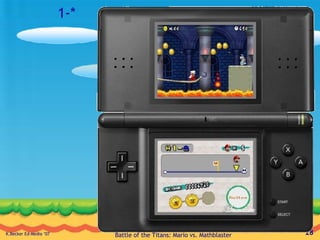
1-*
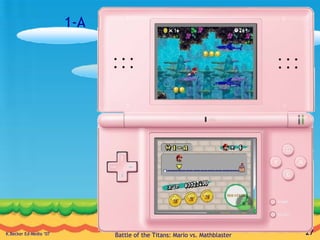
1-A
1-*
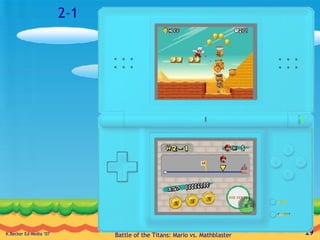
2-1
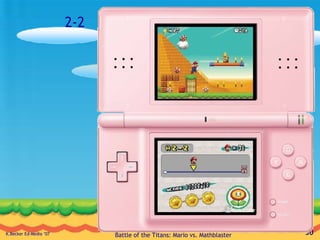
2-2
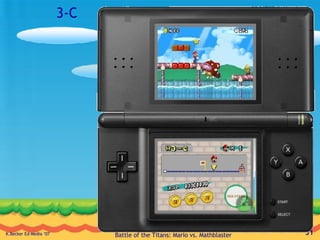
3-C
 
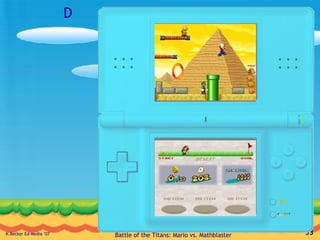
D
Field
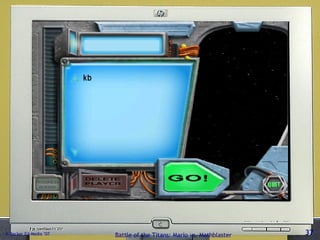
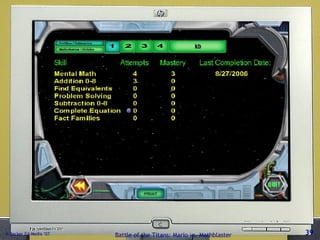
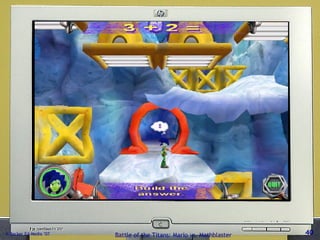
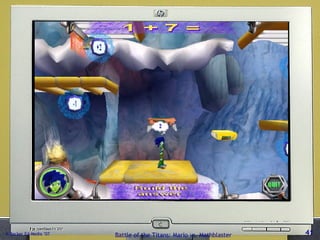
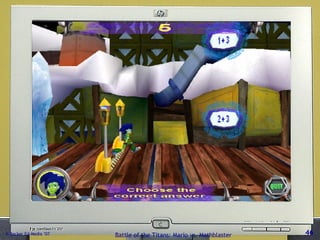
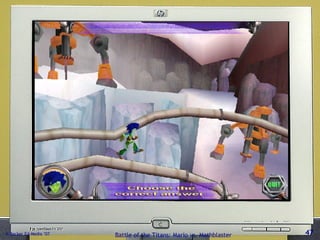
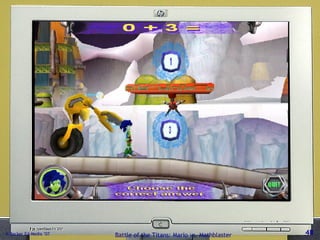
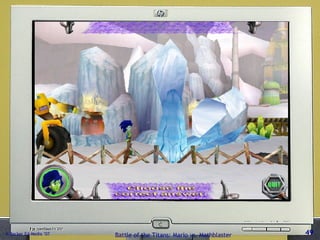
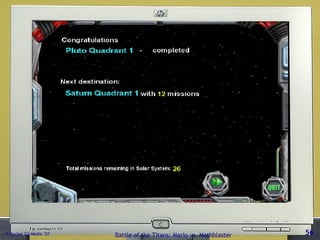
6b. Playing Math Blaster


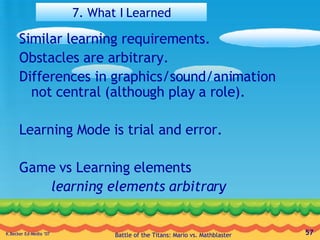
7. What I Learned Similar learning requirements. Obstacles are arbitrary. Differences in graphics/sound/animation not central (although play a role). Learning Mode is trial and error. Game vs Learning elements learning elements arbitrary
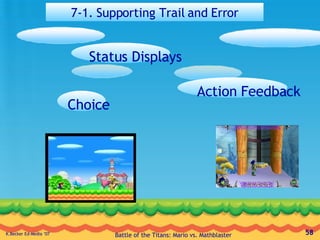
7-1. Supporting Trail and Error Status Displays Action Feedback Choice
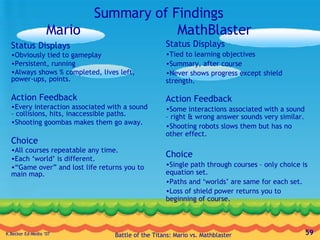
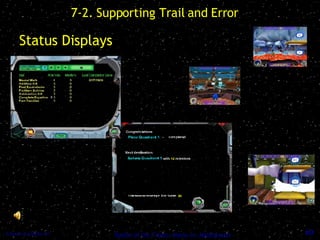
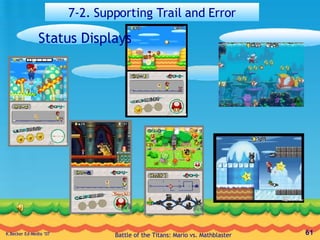
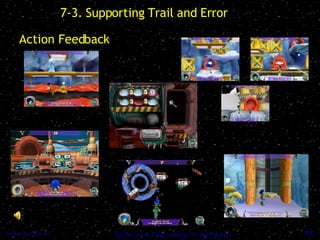
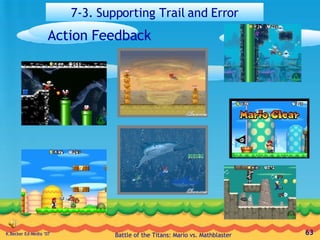
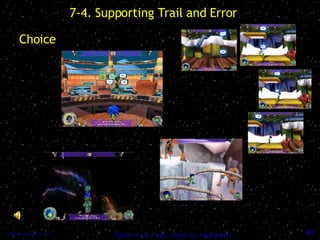
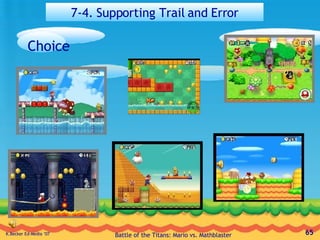
Summary of Findings Status Displays Obviously tied to gameplay Persistent, running Always shows % completed, lives left, power-ups, points. Action Feedback Every interaction associated with a sound – collisions, hits, inaccessible paths. Shooting goombas makes them go away. Choice All courses repeatable any time. Each ‘world’ is different. “ Game over” and lost life returns you to main map. Status Displays Tied to learning objectives Summary, after course Never shows progress except shield strength. Action Feedback Some interactions associated with a sound – right & wrong answer sounds very similar. Shooting robots slows them but has no other effect. Choice Single path through courses – only choice is equation set. Paths and ‘worlds’ are same for each set.  Loss of shield power returns you to beginning of course. Mario MathBlaster
7-2. Supporting Trail and Error Status Displays
7-3. Supporting Trail and Error Action Feedback
7-4. Supporting Trail and Error Choice
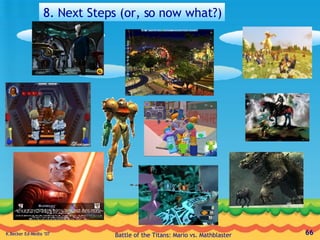
8. Next Steps (or, so now what?)
Image / sound Credits: Super Mario Bros. http://www.gamespot.com http://www.gamespy.cim http://www.ign.com   http://mario.nintendo.com/   http://marioevolution.free.fr http://www.infendo.com http://forums.nintendo.com/ Sound captures from  http:// mario.nintendo.com /   by SoundForge 4.5 Math Blaster K. Becker  (screen captures by  Screen Shot Deluxe 7.0 http://www.broderbund.com/  ) Sound captures by SoundForge 4.5 Nintendo DS http://www.nintendo.com/ http://www.gameinformer.com   Monitor Screen  http://www.hp.com

Battle of the Titans: Super Mario Bros. Vs Math Blaster

  • 1.
    Battle of theTitans: Katrin Becker University of Calgary September 2006 vs
  • 2.
    REMEMBER : Table of findings
  • 3.
    Overview 1. WhyDo This? 8. Next Steps 7. What I Learned 6. Game Play Experience 2. How? 3. What is a “good” game? 4. Why these games? 5. The Games Mario / Math Blaster
  • 4.
    0. Introduction Gamesteach. People learn from games. Are Games Educational? (I don’t care)
  • 5.
    0b. What arethe Questions? What must be learned to get through this game? How does this game facilitate that learning?
  • 6.
    1. Why DoThis? Ultimate goal: Design good instructional games (GIG) Teach people how design GIG IF good games teach, then we can learn how by studying the masters.
  • 7.
    2. How ToDo This? (methodology) Most good games were not designed to be educational….. at least not on purpose. SO, their designs are not framed in educational terms. BUT, to design instructional games, we need that……
  • 8.
    2. How ToDo This? (methodology) One Answer: PRETEND it was designed that way. Can re-capture design through reverse engineering.
  • 9.
    3. What isa “good” game? Popular: good sales (really good) Critical acclaim That makes it good because: - don’t get awards & sustained sales if the game is frustrating; no fun; too easy; too hard; annoying; too predictable…..
  • 10.
    4. Why these Games? All the teachers love Math Blaster (don’t ask the kids…..) Mario Same genre & style Small console (handicapped graphics & power) Good Game
  • 11.
  • 12.
    5b. The Games:Math Blaster
  • 13.
  • 14.
  • 15.
  • 16.
  • 17.
  • 18.
  • 19.
  • 20.
  • 21.
  • 22.
  • 23.
  • 24.
  • 25.
  • 26.
  • 27.
  • 28.
  • 29.
  • 30.
  • 31.
  • 32.
  • 33.
  • 34.
  • 35.
  • 36.
  • 37.
  • 38.
  • 39.
  • 40.
  • 41.
  • 42.
  • 43.
  • 44.
  • 45.
  • 46.
  • 47.
  • 48.
  • 49.
  • 50.
  • 51.
  • 52.
  • 53.
  • 54.
  • 55.
  • 56.
  • 57.
    7. What ILearned Similar learning requirements. Obstacles are arbitrary. Differences in graphics/sound/animation not central (although play a role). Learning Mode is trial and error. Game vs Learning elements learning elements arbitrary
  • 58.
    7-1. Supporting Trailand Error Status Displays Action Feedback Choice
  • 59.
    Summary of FindingsStatus Displays Obviously tied to gameplay Persistent, running Always shows % completed, lives left, power-ups, points. Action Feedback Every interaction associated with a sound – collisions, hits, inaccessible paths. Shooting goombas makes them go away. Choice All courses repeatable any time. Each ‘world’ is different. “ Game over” and lost life returns you to main map. Status Displays Tied to learning objectives Summary, after course Never shows progress except shield strength. Action Feedback Some interactions associated with a sound – right & wrong answer sounds very similar. Shooting robots slows them but has no other effect. Choice Single path through courses – only choice is equation set. Paths and ‘worlds’ are same for each set. Loss of shield power returns you to beginning of course. Mario MathBlaster
  • 60.
    7-2. Supporting Trailand Error Status Displays
  • 61.
    7-2. Supporting Trailand Error Status Displays
  • 62.
    7-3. Supporting Trailand Error Action Feedback
  • 63.
    7-3. Supporting Trailand Error Action Feedback
  • 64.
    7-4. Supporting Trailand Error Choice
  • 65.
    7-4. Supporting Trailand Error Choice
  • 66.
    8. Next Steps(or, so now what?)
  • 67.
    Image / soundCredits: Super Mario Bros. http://www.gamespot.com http://www.gamespy.cim http://www.ign.com http://mario.nintendo.com/ http://marioevolution.free.fr http://www.infendo.com http://forums.nintendo.com/ Sound captures from http:// mario.nintendo.com / by SoundForge 4.5 Math Blaster K. Becker (screen captures by Screen Shot Deluxe 7.0 http://www.broderbund.com/ ) Sound captures by SoundForge 4.5 Nintendo DS http://www.nintendo.com/ http://www.gameinformer.com Monitor Screen http://www.hp.com

Editor's Notes

  • #2 Partly a report on a work in progress Partly an introduction to a new discipline Partly intended to provoke a reaction