SHORT GAME “To have a desire to be better is not a guarantee of getting better.  Work smarter (not harder) and you’ll reach your goals”  Mark Spencer
Golf Improvement Priorities When you practice your game in an effort to improve, you should always focus on getting better ‘from the hole to the tee’.The biggest misconception on how to shoot lower scores is the perception that hitting better full shots = lower scores.  Until this perception is broken, golfers will continue (and grow!) their frustration.
Evaluate Your Game AccuratelyThe best way to evaluate the status of your golf game and the effects a better short game will have:Play 9 holes.  On each 1st shot, you can pick up and ‘throw’ the ball without adding a stroke.  Also, do not count strokes for shots in hazards.  You can ‘throw’ the ball back into play.  Then, finish out the hole traditionally, and completely ‘hole out’.  This will show you how ‘much’ (or little) hitting it longer and straighter will help your score. Play the same 9 holes as above. Play by traditional rules, until you reach 15 yds from the green. Once you are within 15 yds of the green, add two strokes (up/down) and head to the  next tee. If your score is lower with automatic up/down, then you need a better short game!
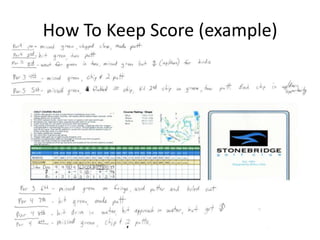
What is good enough?Whenever you are within a 15 yd circumference of the green, it should be expected to get up/down in 2 shots.  Knowing the fact that not even the best in the world are 100%, an initial goal is to at least convert 50% of your opportunities.  When you keep score, in the squares below your scores, you need to place “+” and “-” symbols to track if you did or didn’t get up/down.
Perception Is A LiarThe most difficult task in golf is to fight emotion.  There is substantial time between shots to ‘self discuss’ what has just happened and what still needs to happen.  With this comes “ego” and its baggage of expectations.  When any full shot is not struck perfectly, our “ego” takes a hit, and after 18 holes of getting ‘gut punched’, the item at the top of our mind is the desire to eliminate further shots to the ego.  This pattern of thinking puts the PRIMARY goal of SCORING on the backburner.  This pattern of thinking is the #1 REASON golfers rarely improve, in spite of their efforts to work on their full swing.  Breaking the perception that you need to hit full shots better to score better is your first goal.  There are a FEW exceptions to this rule, but adhering to it helps ALL.
How To Track Your GameWhen you keep score, you need to track how many times (vs. not) you get up/down, and how many putts you have.  Depending on your skill level, you should adjust your distance requirement as such. EVERY PLAYER should at least expect to get up/down within 15 paces of the green.  Competitive Amateurs should consider everything inside 50 yards, and Professionals: 100 yards and in.
How To Keep Score (example)
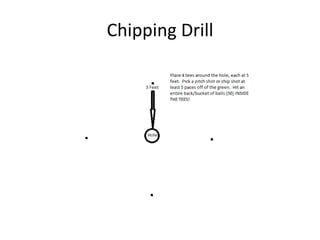
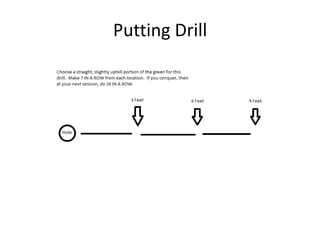
What/How To PracticeKeeping in line with the principle of improving your game ‘from the hole, back’, you first need to improve your putting from inside 10ft.  You will need to work on chipping and pitching from AT LEAST 5 paces from a fringe.  Only on every THIRD practice should you work on Full Swing. The following slides describe the practice drills to follow.
Chipping Drill
Putting Drill

Short game manifesto

  • 1.
    SHORT GAME “Tohave a desire to be better is not a guarantee of getting better. Work smarter (not harder) and you’ll reach your goals” Mark Spencer
  • 2.
    Golf Improvement PrioritiesWhen you practice your game in an effort to improve, you should always focus on getting better ‘from the hole to the tee’.The biggest misconception on how to shoot lower scores is the perception that hitting better full shots = lower scores. Until this perception is broken, golfers will continue (and grow!) their frustration.
  • 3.
    Evaluate Your GameAccuratelyThe best way to evaluate the status of your golf game and the effects a better short game will have:Play 9 holes. On each 1st shot, you can pick up and ‘throw’ the ball without adding a stroke. Also, do not count strokes for shots in hazards. You can ‘throw’ the ball back into play. Then, finish out the hole traditionally, and completely ‘hole out’. This will show you how ‘much’ (or little) hitting it longer and straighter will help your score. Play the same 9 holes as above. Play by traditional rules, until you reach 15 yds from the green. Once you are within 15 yds of the green, add two strokes (up/down) and head to the next tee. If your score is lower with automatic up/down, then you need a better short game!
  • 4.
    What is goodenough?Whenever you are within a 15 yd circumference of the green, it should be expected to get up/down in 2 shots. Knowing the fact that not even the best in the world are 100%, an initial goal is to at least convert 50% of your opportunities. When you keep score, in the squares below your scores, you need to place “+” and “-” symbols to track if you did or didn’t get up/down.
  • 5.
    Perception Is ALiarThe most difficult task in golf is to fight emotion. There is substantial time between shots to ‘self discuss’ what has just happened and what still needs to happen. With this comes “ego” and its baggage of expectations. When any full shot is not struck perfectly, our “ego” takes a hit, and after 18 holes of getting ‘gut punched’, the item at the top of our mind is the desire to eliminate further shots to the ego. This pattern of thinking puts the PRIMARY goal of SCORING on the backburner. This pattern of thinking is the #1 REASON golfers rarely improve, in spite of their efforts to work on their full swing. Breaking the perception that you need to hit full shots better to score better is your first goal. There are a FEW exceptions to this rule, but adhering to it helps ALL.
  • 6.
    How To TrackYour GameWhen you keep score, you need to track how many times (vs. not) you get up/down, and how many putts you have. Depending on your skill level, you should adjust your distance requirement as such. EVERY PLAYER should at least expect to get up/down within 15 paces of the green. Competitive Amateurs should consider everything inside 50 yards, and Professionals: 100 yards and in.
  • 7.
    How To KeepScore (example)
  • 8.
    What/How To PracticeKeepingin line with the principle of improving your game ‘from the hole, back’, you first need to improve your putting from inside 10ft. You will need to work on chipping and pitching from AT LEAST 5 paces from a fringe. Only on every THIRD practice should you work on Full Swing. The following slides describe the practice drills to follow.
  • 9.
  • 10.