Marine and Coastal applications
of LoRa wireless technology
This presentation was given to the Everynet project group on March 30th 2020
30/03/2020 Author: Bill Harpley 2
Here is what you will learn today
• Traditional approaches to monitoring coastal and marine
environments
• Why harsh marine conditions place design constraints on equipment
• How emerging technologies such as LoRa and UAVs provide new
possibilities for monitoring
• Why transmission of RF signals over surface of sea limits range
• New types of Satellite services for LoRaWAN
• Say hello to the ‘Living Coast’ programme
• Showcase of commercial maritime applications for LoRaWAN
30/03/2020 Author: Bill Harpley 3
Monitoring the marine
environment
Let’s look at current approaches and consider the emerging role for LoRaWAN
30/03/2020 Author: Bill Harpley 4
Hello ducky
• In 1992 a cargo container was
washed off a freighter in the Pacific
ocean
• It was travelling from Hong Kong to
the United States
• It contained 28,000 plastic ducks
which over the course of a few
years were dispersed by winds and
currents
• Studying their dispersal pattern has
revolutionised our understanding
of ocean currents in the Pacific
30/03/2020 Author: Bill Harpley 5
Conventional approaches to monitoring
• There are strong economic and ecological
reasons for monitoring what goes on in our
oceans
• Weather, atmospheric conditions and acidification
• Understanding seasonal variations of factors such as
water temperature and salinity
• Measuring and tracking marine pollution
• Help to understand changes in fish stocks and
migration patterns
• Monitoring has traditionally been performed
using Satellite imagery, underwater devices
equipped with sensors and marine buoys
• New technologies such as drones ( UAVs) and
LoRa are opening up new possibilities
30/03/2020 Author: Bill Harpley 6
Operating in the harsh maritime environment
• Enclosures must protect against ingress of saline water
• Hardware, sensors and any electromechanical devices must be
designed to wide variations in temperature, humidity and constant
wave motion
• Retrieving data from buoys and underwater sensors is a costly and
time-consuming exercise
30/03/2020 Author: Bill Harpley 7
Buoys for coastal and ocean monitoring
Fixed buoys: anchored to known location Drift buoys: travel with wind and currents
30/03/2020 Author: Bill Harpley 8
Global deployments: National Data Buoy Center
Fixed Buoys are used worldwide
to collect data for a variety of
purposes:
• Weather forecasting
• Tsunami warning
• Marine environment
monitoring
30/03/2020 Author: Bill Harpley 9
Global Deployments: drift buoys
• These drift with the currents and
are scattered widely across the
world’s oceans
30/03/2020 Author: Bill Harpley 10
The problem with buoys
• Current methods of collecting data from buoys includes:
• Long-range communications: this could be either close-shore or satellite
communications
• Short-range communications between groups of buoys in a defined
geographical area, with one buoy acting as a ground station
• Dispatch of a vessel and crew to collect data from the buoys ( which may
involve physical collection of the actual buoys )
• All the above methods involved considerable effort, time and cost
30/03/2020 Author: Bill Harpley 11
New approaches to the problem
• Last few years has seen both academic research projects and commercial solutions which
aim to harness LoRa for maritime applications
• Some of these have used drones to ‘harvest’ data from groups of buoys
30/03/2020 Author: Bill Harpley 12
Sample research projects
Origin Summary Reference
University of Zaragoza (2017) Employs a UAV as a mobile data collector, low-power long-
range communications and sensing buoys as part of a
single WSN
[1]
University of Trieste (2018) Development of a low-cost LoRa enabled drift buoy for
coastal monitoring
[2]
University of Belgrade (2018) Transmission of LoRa signals over sea-water [3]
University of Murcia (2018) Use of LoRa for tracking and monitoring of near-shore
boats
[4]
NTNU Norway (2019) Design of LoRa-enabled buoy for underwater acoustic
receiver
[5]
30/03/2020 Author: Bill Harpley 13
Transmission of LoRa signals over water
• Academic research has shown that:
• LoRa links are fully feasible over seawater at distances of at least 22 km,
using only low-cost off-the-shelf rubber duck antennas in LOS path condition
in both ISM bands ( 863 MHz and 434 Mhz)
• LoRa links can be established over a 28 km obstructed LOS oversea path in
ISM 434 MHz band, but this required the use of more expensive high-gain
antennas
• Why is this significant?
• Radio engineers have long known fact that radio waves travelling over the
surface of the sea are attenuated ( due to temperature and salinity factors)
• You need to bear this in mind when designing any monitoring solution which
involves buoys
30/03/2020 Author: Bill Harpley 14
Satellite services for LoRaWAN
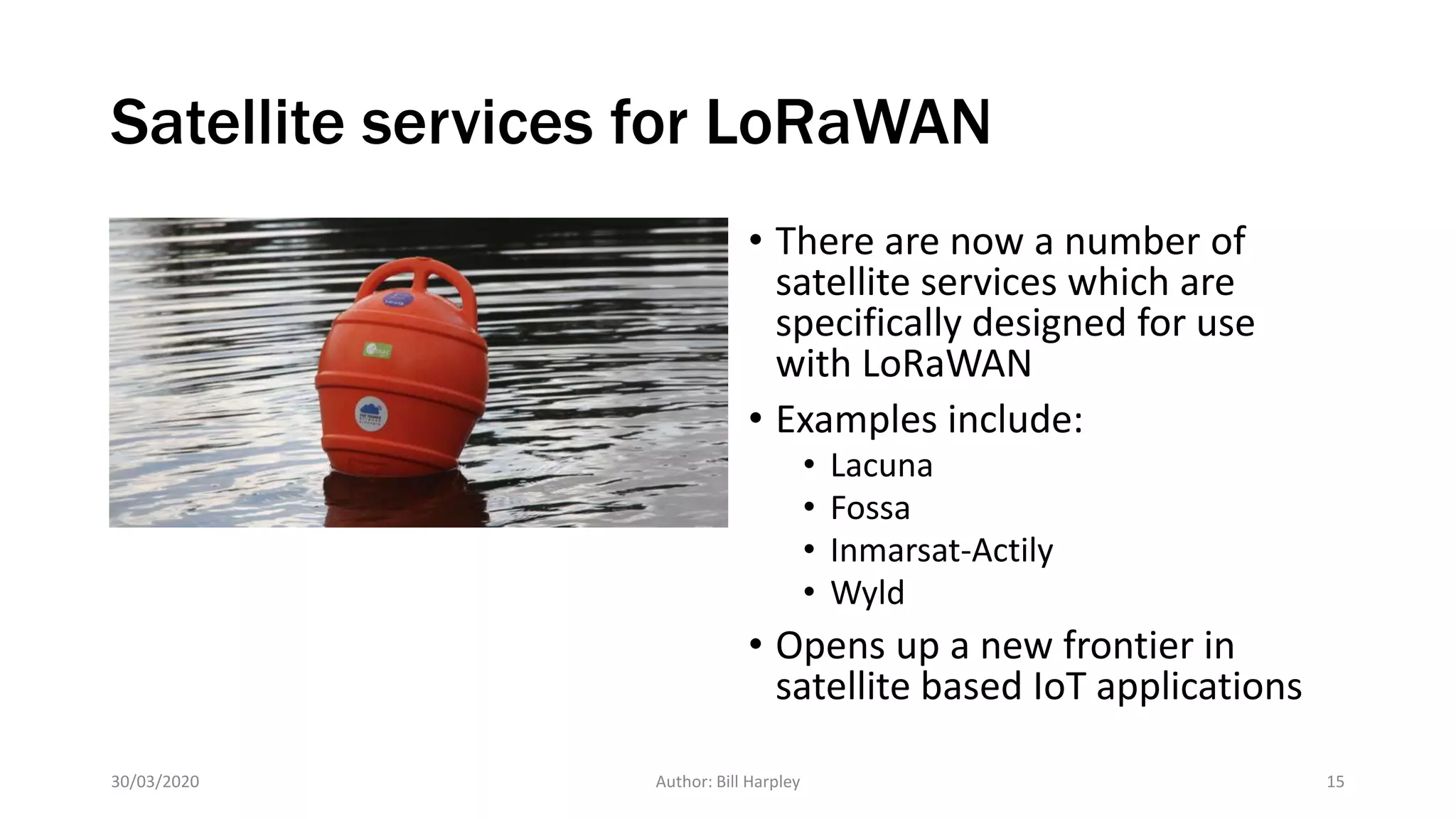
• There are now a number of
satellite services which are
specifically designed for use
with LoRaWAN
• Examples include:
• Lacuna
• Fossa
• Inmarsat-Actily
• Wyld
• Opens up a new frontier in
satellite based IoT applications
30/03/2020 Author: Bill Harpley 15
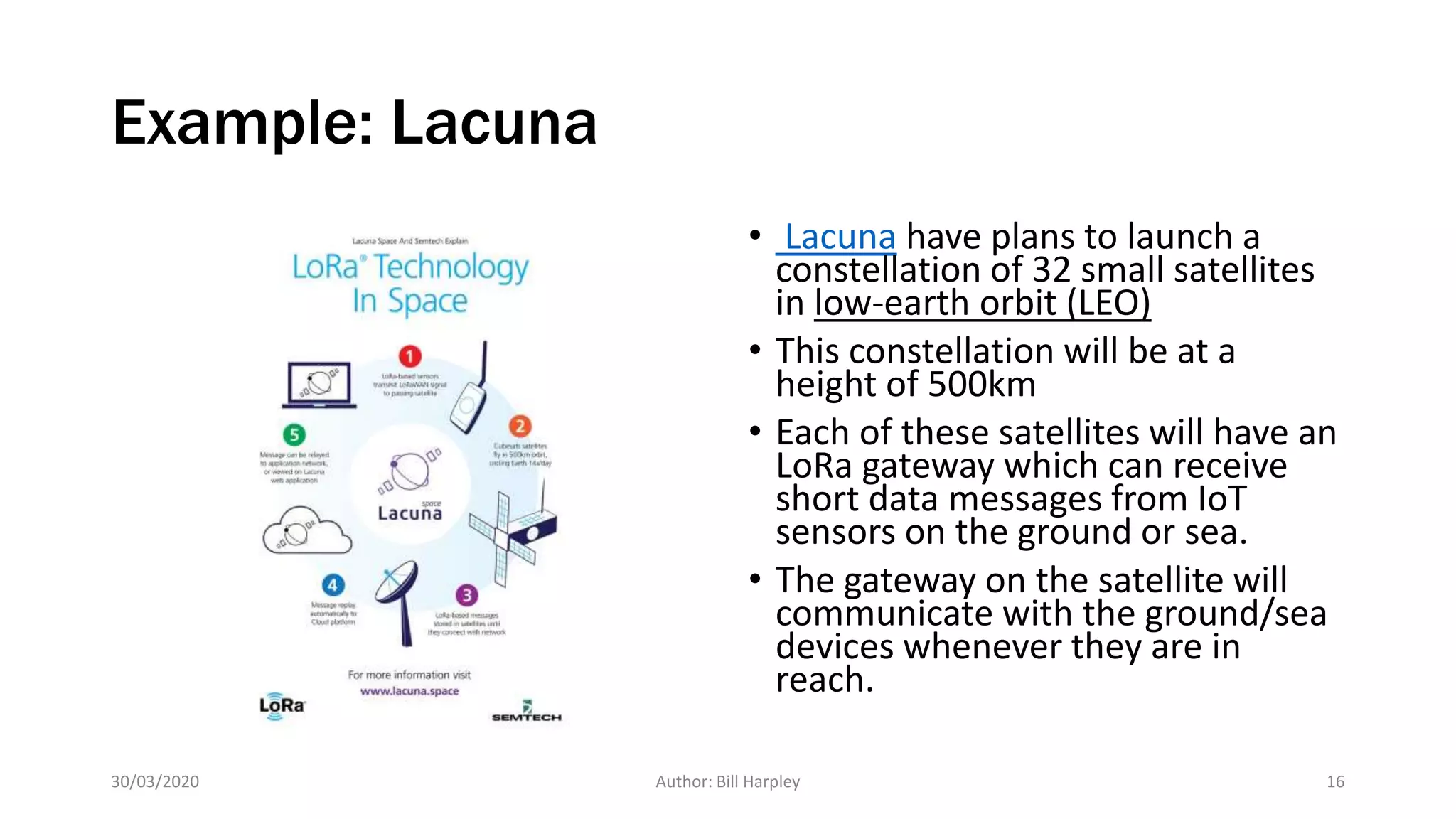
Example: Lacuna
• Lacuna have plans to launch a
constellation of 32 small satellites
in low-earth orbit (LEO)
• This constellation will be at a
height of 500km
• Each of these satellites will have an
LoRa gateway which can receive
short data messages from IoT
sensors on the ground or sea.
• The gateway on the satellite will
communicate with the ground/sea
devices whenever they are in
reach.
30/03/2020 Author: Bill Harpley 16
The Living Coast
Let’s talk about Biosphere monitoring in Sussex
30/03/2020 Author: Bill Harpley 17
Welcome to the biosphere
• Did you know that the area between the Adur and the Ouse rivers is a
designated UNESCO biosphere zone?
30/03/2020 Author: Bill Harpley 18
We can help
• I have described the use of buoys for environmental monitoring and
explained how LoRa technology could simplify the process of
collecting data
• We would need to have LoRa base stations located at strategic points
along the coast
• It would help the Living Coast programme reach its goal of improving
knowledge and management of marine ecosystems
• Take a look at their strategy document for more details
• This is something that we can take a closer look at in Q3/Q4 of 2020
30/03/2020 Author: Bill Harpley 19
Commercial applications
Let’s take a look at some LoRa-WAN use cases in the coastal and maritime arena
30/03/2020 Author: Bill Harpley 20
Monitoring the health of fish farms
• Fish farms pump a lot of nutrients,
‘slurry’ and chemicals into the sea
• LoRaWan provides a way to monitor
the health of the immediate marine
environment
• May reduce negative impact of fish
farming and save the operator money
• Example: Libellium offer a LoRaWAN
based monitoring solution for fish
farms
30/03/2020 Author: Bill Harpley 21
Smart Harbours
• This harbour in Estonia uses
LoRaWAN to monitor harbour
lighting, security and berthing
facilities
30/03/2020 Author: Bill Harpley 22
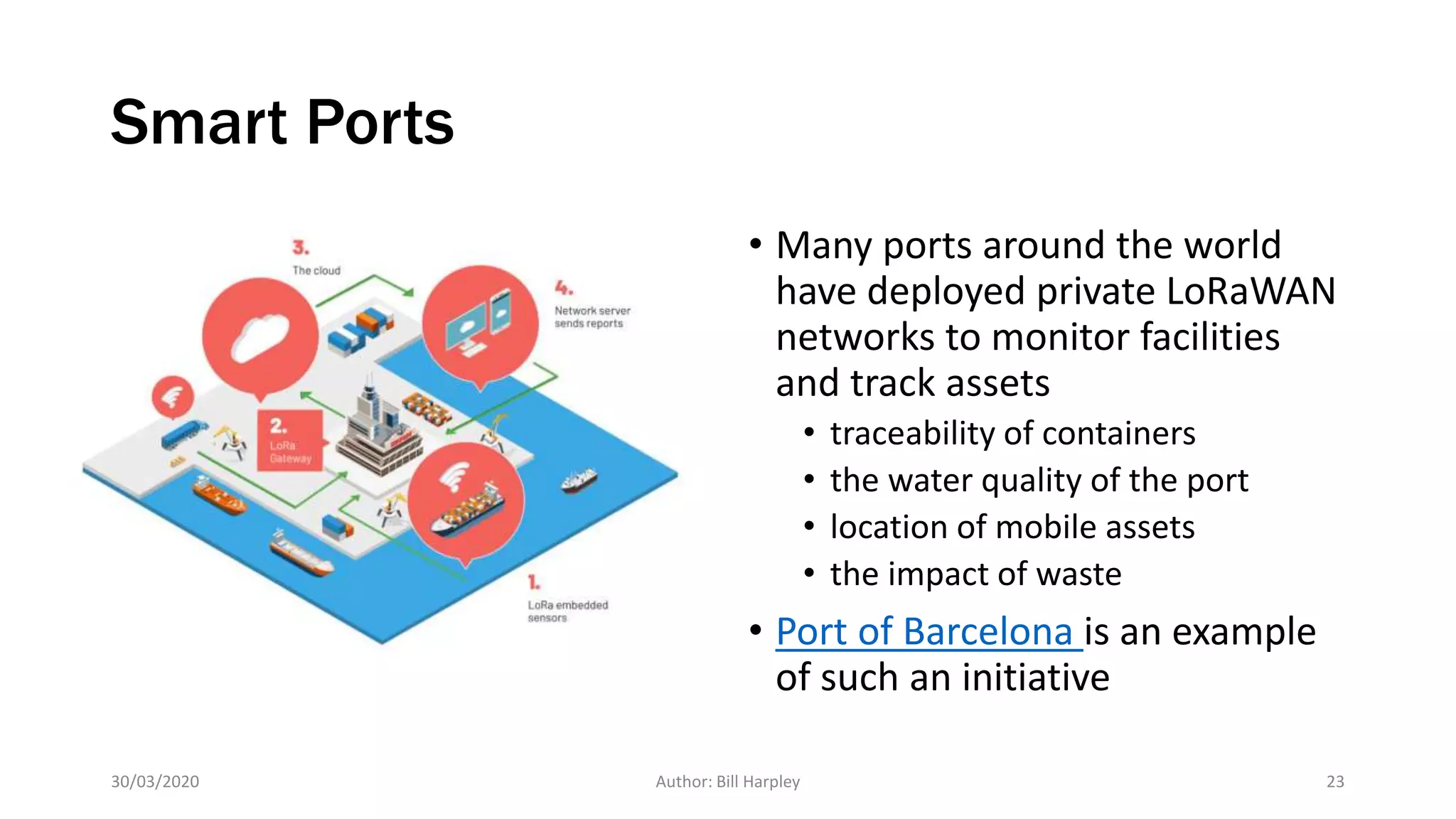
Smart Ports
• Many ports around the world
have deployed private LoRaWAN
networks to monitor facilities
and track assets
• traceability of containers
• the water quality of the port
• location of mobile assets
• the impact of waste
• Port of Barcelona is an example
of such an initiative
30/03/2020 Author: Bill Harpley 23
Monitoring coastal flooding
• Many coastal communities are
are risk of flooding during
periods of high tides and heavy
rains
• Semtech have documented a use
cases which uses LoRaWAN
gateways in combination with
off the shelf ultrasonic sensors
• This can provide near real-time
information about the extent of
flooding
30/03/2020 Author: Bill Harpley 24
References
[1] https://www.mdpi.com/1424-8220/17/3/460
[2] http://wireless.ictp.it/Papers/Drifter.pdf
[3] https://www.mdpi.com/1424-8220/18/9/2853/htm
[4] https://www.researchgate.net/publication/329899474_Tracking_and_Monitoring_System_Based_on_LoRa_Technology_for_Lightweight_Boats
[5] http://folk.ntnu.no/alfredse/Forslag%20til%20prosjektoppgaver%20hoesten%202019.htm
30/03/2020 Author: Bill Harpley 25
That’s all folks
30/03/2020 Author: Bill Harpley 26

Marine and coastal applications of LoRa wireless technology

  • 1.
    Marine and Coastalapplications of LoRa wireless technology
  • 2.
    This presentation wasgiven to the Everynet project group on March 30th 2020 30/03/2020 Author: Bill Harpley 2
  • 3.
    Here is whatyou will learn today • Traditional approaches to monitoring coastal and marine environments • Why harsh marine conditions place design constraints on equipment • How emerging technologies such as LoRa and UAVs provide new possibilities for monitoring • Why transmission of RF signals over surface of sea limits range • New types of Satellite services for LoRaWAN • Say hello to the ‘Living Coast’ programme • Showcase of commercial maritime applications for LoRaWAN 30/03/2020 Author: Bill Harpley 3
  • 4.
    Monitoring the marine environment Let’slook at current approaches and consider the emerging role for LoRaWAN 30/03/2020 Author: Bill Harpley 4
  • 5.
    Hello ducky • In1992 a cargo container was washed off a freighter in the Pacific ocean • It was travelling from Hong Kong to the United States • It contained 28,000 plastic ducks which over the course of a few years were dispersed by winds and currents • Studying their dispersal pattern has revolutionised our understanding of ocean currents in the Pacific 30/03/2020 Author: Bill Harpley 5
  • 6.
    Conventional approaches tomonitoring • There are strong economic and ecological reasons for monitoring what goes on in our oceans • Weather, atmospheric conditions and acidification • Understanding seasonal variations of factors such as water temperature and salinity • Measuring and tracking marine pollution • Help to understand changes in fish stocks and migration patterns • Monitoring has traditionally been performed using Satellite imagery, underwater devices equipped with sensors and marine buoys • New technologies such as drones ( UAVs) and LoRa are opening up new possibilities 30/03/2020 Author: Bill Harpley 6
  • 7.
    Operating in theharsh maritime environment • Enclosures must protect against ingress of saline water • Hardware, sensors and any electromechanical devices must be designed to wide variations in temperature, humidity and constant wave motion • Retrieving data from buoys and underwater sensors is a costly and time-consuming exercise 30/03/2020 Author: Bill Harpley 7
  • 8.
    Buoys for coastaland ocean monitoring Fixed buoys: anchored to known location Drift buoys: travel with wind and currents 30/03/2020 Author: Bill Harpley 8
  • 9.
    Global deployments: NationalData Buoy Center Fixed Buoys are used worldwide to collect data for a variety of purposes: • Weather forecasting • Tsunami warning • Marine environment monitoring 30/03/2020 Author: Bill Harpley 9
  • 10.
    Global Deployments: driftbuoys • These drift with the currents and are scattered widely across the world’s oceans 30/03/2020 Author: Bill Harpley 10
  • 11.
    The problem withbuoys • Current methods of collecting data from buoys includes: • Long-range communications: this could be either close-shore or satellite communications • Short-range communications between groups of buoys in a defined geographical area, with one buoy acting as a ground station • Dispatch of a vessel and crew to collect data from the buoys ( which may involve physical collection of the actual buoys ) • All the above methods involved considerable effort, time and cost 30/03/2020 Author: Bill Harpley 11
  • 12.
    New approaches tothe problem • Last few years has seen both academic research projects and commercial solutions which aim to harness LoRa for maritime applications • Some of these have used drones to ‘harvest’ data from groups of buoys 30/03/2020 Author: Bill Harpley 12
  • 13.
    Sample research projects OriginSummary Reference University of Zaragoza (2017) Employs a UAV as a mobile data collector, low-power long- range communications and sensing buoys as part of a single WSN [1] University of Trieste (2018) Development of a low-cost LoRa enabled drift buoy for coastal monitoring [2] University of Belgrade (2018) Transmission of LoRa signals over sea-water [3] University of Murcia (2018) Use of LoRa for tracking and monitoring of near-shore boats [4] NTNU Norway (2019) Design of LoRa-enabled buoy for underwater acoustic receiver [5] 30/03/2020 Author: Bill Harpley 13
  • 14.
    Transmission of LoRasignals over water • Academic research has shown that: • LoRa links are fully feasible over seawater at distances of at least 22 km, using only low-cost off-the-shelf rubber duck antennas in LOS path condition in both ISM bands ( 863 MHz and 434 Mhz) • LoRa links can be established over a 28 km obstructed LOS oversea path in ISM 434 MHz band, but this required the use of more expensive high-gain antennas • Why is this significant? • Radio engineers have long known fact that radio waves travelling over the surface of the sea are attenuated ( due to temperature and salinity factors) • You need to bear this in mind when designing any monitoring solution which involves buoys 30/03/2020 Author: Bill Harpley 14
  • 15.
    Satellite services forLoRaWAN • There are now a number of satellite services which are specifically designed for use with LoRaWAN • Examples include: • Lacuna • Fossa • Inmarsat-Actily • Wyld • Opens up a new frontier in satellite based IoT applications 30/03/2020 Author: Bill Harpley 15
  • 16.
    Example: Lacuna • Lacunahave plans to launch a constellation of 32 small satellites in low-earth orbit (LEO) • This constellation will be at a height of 500km • Each of these satellites will have an LoRa gateway which can receive short data messages from IoT sensors on the ground or sea. • The gateway on the satellite will communicate with the ground/sea devices whenever they are in reach. 30/03/2020 Author: Bill Harpley 16
  • 17.
    The Living Coast Let’stalk about Biosphere monitoring in Sussex 30/03/2020 Author: Bill Harpley 17
  • 18.
    Welcome to thebiosphere • Did you know that the area between the Adur and the Ouse rivers is a designated UNESCO biosphere zone? 30/03/2020 Author: Bill Harpley 18
  • 19.
    We can help •I have described the use of buoys for environmental monitoring and explained how LoRa technology could simplify the process of collecting data • We would need to have LoRa base stations located at strategic points along the coast • It would help the Living Coast programme reach its goal of improving knowledge and management of marine ecosystems • Take a look at their strategy document for more details • This is something that we can take a closer look at in Q3/Q4 of 2020 30/03/2020 Author: Bill Harpley 19
  • 20.
    Commercial applications Let’s takea look at some LoRa-WAN use cases in the coastal and maritime arena 30/03/2020 Author: Bill Harpley 20
  • 21.
    Monitoring the healthof fish farms • Fish farms pump a lot of nutrients, ‘slurry’ and chemicals into the sea • LoRaWan provides a way to monitor the health of the immediate marine environment • May reduce negative impact of fish farming and save the operator money • Example: Libellium offer a LoRaWAN based monitoring solution for fish farms 30/03/2020 Author: Bill Harpley 21
  • 22.
    Smart Harbours • Thisharbour in Estonia uses LoRaWAN to monitor harbour lighting, security and berthing facilities 30/03/2020 Author: Bill Harpley 22
  • 23.
    Smart Ports • Manyports around the world have deployed private LoRaWAN networks to monitor facilities and track assets • traceability of containers • the water quality of the port • location of mobile assets • the impact of waste • Port of Barcelona is an example of such an initiative 30/03/2020 Author: Bill Harpley 23
  • 24.
    Monitoring coastal flooding •Many coastal communities are are risk of flooding during periods of high tides and heavy rains • Semtech have documented a use cases which uses LoRaWAN gateways in combination with off the shelf ultrasonic sensors • This can provide near real-time information about the extent of flooding 30/03/2020 Author: Bill Harpley 24
  • 25.
    References [1] https://www.mdpi.com/1424-8220/17/3/460 [2] http://wireless.ictp.it/Papers/Drifter.pdf [3]https://www.mdpi.com/1424-8220/18/9/2853/htm [4] https://www.researchgate.net/publication/329899474_Tracking_and_Monitoring_System_Based_on_LoRa_Technology_for_Lightweight_Boats [5] http://folk.ntnu.no/alfredse/Forslag%20til%20prosjektoppgaver%20hoesten%202019.htm 30/03/2020 Author: Bill Harpley 25
  • 26.
    That’s all folks 30/03/2020Author: Bill Harpley 26