TeraWatt
a collaborative research project funded under the EPSRC
                    Grand Challenge

                Mike by DHI 15th UK User Group Meeting
                Lion Quays Waterside Resort, Shropshire

                        Talk by Arne Vӧgler, CI
                        arne.vogler@uhi.ac.uk
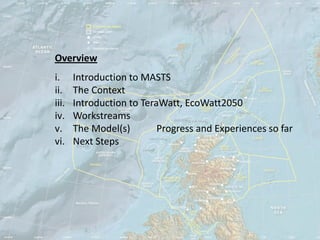
Overview
i.     Introduction to MASTS
ii.    The Context
iii.   Introduction to TeraWatt, EcoWatt2050
iv.    Workstreams
v.     The Model(s)        Progress and Experiences so far
vi.    Next Steps
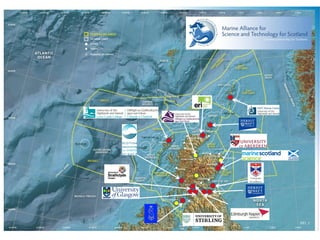
Marine Alliance for Science and Technology
              for Scotland - Overview


•   ~700 researchers across 10 key partner institutions
•   Initial investment from Scottish Funding Council and partners:
    £75m [2009-2016, £34m investments in new appointments and infrastructure]
•   Majority of new money – 34 staff – 48 studentships
•   Integration of science with policy and regulation
•   High level representation
•   Promotes and facilitates collaboration and co-operation
    - nationally and internationally
•   Drives scientific excellence in research and training
•   Provides critical mass
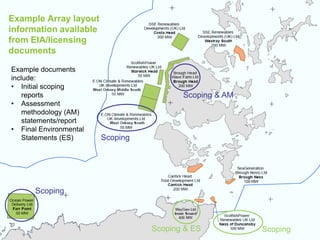
Example Array layout
information available
from EIA/licensing
documents

Example documents
include:
• Initial scoping
    reports                              Scoping & AM
• Assessment
    methodology (AM)
    statements/report
• Final Environmental
    Statements (ES)     Scoping


      Scoping


                                  Scoping & ES          Scoping
Challenges

1. How do near field physical processes change
   post array development?
2. What are the consequences of marine energy
   extraction on array scale to the benthic habitat?
TeraWatt
Large scale InTERActive coupled 3D modelling for WAve
 and Tidal energy resource and environmental impacT
                                 2012 – 2015
Multi-institution EPSRC research project established under the Marine Alliance
for Science and Technology Scotland (MASTS), involving the Universities of

    o   Heriot-Watt (ICIT Orkney Campus, PI Jon Side)
    o   Edinburgh
    o   Highlands and Islands (Lews Castle College and SAMS)
    o   Strathclyde
    o   Swansea
    o   and with Marine Scotland Science as full consortium partners
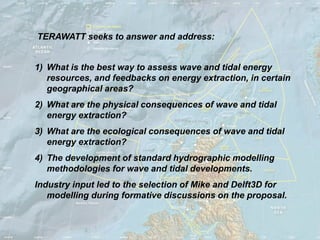
TERAWATT seeks to answer and address:


1) What is the best way to assess wave and tidal energy
   resources, and feedbacks on energy extraction, in certain
   geographical areas?
2) What are the physical consequences of wave and tidal
   energy extraction?
3) What are the ecological consequences of wave and tidal
   energy extraction?
4) The development of standard hydrographic modelling
   methodologies for wave and tidal developments.
Industry input led to the selection of Mike and Delft3D for
   modelling during formative discussions on the proposal.
EcoWatt 2050
                    Supplementary to TeraWatt
         To follow up on findings of TeraWatt on larger scale
                                 2013 – 2016
Multi-institution EPSRC research project established under the Marine Alliance
for Science and Technology Scotland (MASTS), involving the Universities of

    o   Heriot-Watt (ICIT Orkney Campus, PI Jon Side)
    o   Edinburgh
    o   Highlands and Islands (Lews Castle College and SAMS)
    o   Strathclyde
    o   Swansea
    o   Marine Scotland Science
    o   National Oceanographic Centre
    o   University of Aberdeen
EcoWatt 2050

1) How can marine planning be used to lay the foundation for the sustainable
   development of very large scale arrays of marine renewable energy devices?
2) What criteria should be used to determine the ecological limits to marine
   renewable energy extraction, and what are the implications for very large
   scale array characteristics?
3) How can we differentiate between the effects of climate change and of energy
   extraction on the marine ecosystem?
4) Are there ways in which marine renewables development may ameliorate or
   exacerbate the predicted effects of climate change on marine ecosystems?
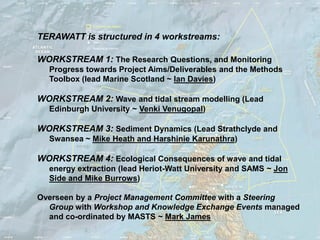
TERAWATT is structured in 4 workstreams:

WORKSTREAM 1: The Research Questions, and Monitoring
  Progress towards Project Aims/Deliverables and the Methods
  Toolbox (lead Marine Scotland ~ Ian Davies)

WORKSTREAM 2: Wave and tidal stream modelling (Lead
  Edinburgh University ~ Venki Venugopal)

WORKSTREAM 3: Sediment Dynamics (Lead Strathclyde and
  Swansea ~ Mike Heath and Harshinie Karunathra)

WORKSTREAM 4: Ecological Consequences of wave and tidal
  energy extraction (lead Heriot-Watt University and SAMS ~ Jon
  Side and Mike Burrows)

Overseen by a Project Management Committee with a Steering
  Group with Workshop and Knowledge Exchange Events managed
  and co-ordinated by MASTS ~ Mark James
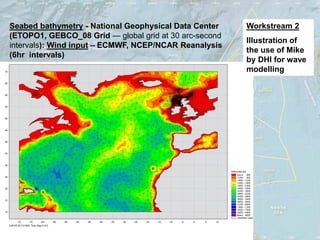
Seabed bathymetry - National Geophysical Data Center    Workstream 2
(ETOPO1, GEBCO_08 Grid — global grid at 30 arc-second
                                                        Illustration of
intervals): Wind input – ECMWF, NCEP/NCAR Reanalysis
                                                        the use of Mike
(6hr intervals)
                                                        by DHI for wave
                                                        modelling
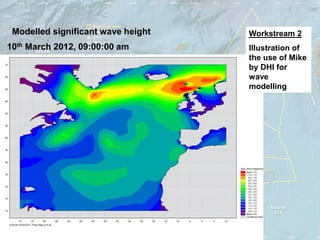
Modelled significant wave height   Workstream 2
10th March 2012, 09:00:00 am        Illustration of
                                    the use of Mike
                                    by DHI for
                                    wave
                                    modelling
Significant wave height – Model Validation
 with CEFAS Buoy @ 57°17'.52N and 07°54'.84W in 103m of water

     Cefas Buoy: Sign. Wave Height [m]
     Sig Wave Ht                   [m]


                                                                                                         D:Hebrideswave_dataCefas BuoyMarch 2012Cefas March 2012.dfs0
                                                                     odel InputsHebridean_final_OperationalData.sw - Result FilesPoint_0_125deg_March2012_operational.dfs0
12

11

10

9

8

7

6

5

4

3

2

   00:00             00:00           00:00   00:00   00:00   00:00
 2012-03-02          03-07           03-12   03-17   03-22   03-27
Zero Crossing Period – Model Validation
  with CEFAS Buoy @ 57°17'.52N and 07°54'.84W in 103m of water

       Cefas Buoy: Wave Period, T02 [sec]
       Tz                           [sec]


                                                                                                             D:Hebrideswave_dataCefas BuoyMarch 2012Cefas March 2012.dfs0
                                                                      lModel InputsHebridean_final_OperationalData.sw - Result FilesPoint_0_125deg_March2012_operational.dfs0
13.0


12.0


11.0


10.0


 9.0


 8.0


 7.0


 6.0


     00:00             00:00          00:00   00:00   00:00   00:00
   2012-03-02          03-07          03-12   03-17   03-22   03-27
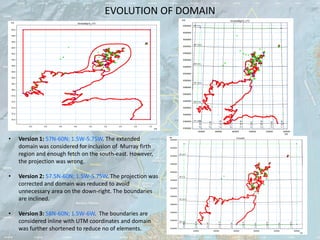
EVOLUTION OF DOMAIN


•   Version 1: 57N-60N; 1.5W-5.75W. The extended
    domain was considered for inclusion of Murray firth
    region and enough fetch on the south-east. However,
    the projection was wrong.

•   Version 2: 57.5N-60N; 1.5W-5.75W. The projection was
    corrected and domain was reduced to avoid
    unnecessary area on the down-right. The boundaries
    are inclined.

•   Version 3: 58N-60N; 1.5W-6W. The boundaries are
    considered inline with UTM coordinates and domain
    was further shortened to reduce no of elements.
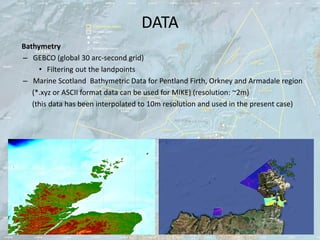
DATA
Bathymetry
– GEBCO (global 30 arc-second grid)
     • Filtering out the landpoints
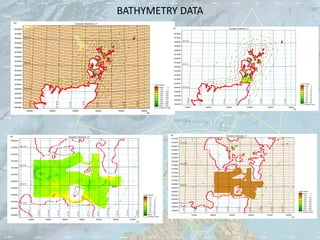
– Marine Scotland Bathymetric Data for Pentland Firth, Orkney and Armadale region
   (*.xyz or ASCII format data can be used for MIKE) (resolution: ~2m)
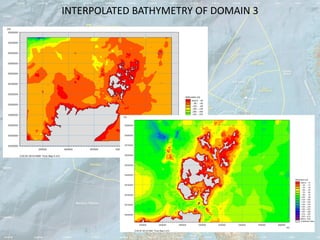
   (this data has been interpolated to 10m resolution and used in the present case)
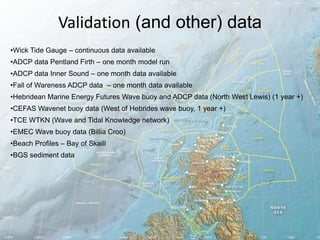
Validation (and other) data
•Wick Tide Gauge – continuous data available
•ADCP data Pentland Firth – one month model run
•ADCP data Inner Sound – one month data available
•Fall of Wareness ADCP data – one month data available
•Hebridean Marine Energy Futures Wave buoy and ADCP data (North West Lewis) (1 year +)
•CEFAS Wavenet buoy data (West of Hebrides wave buoy, 1 year +)
•TCE WTKN (Wave and Tidal Knowledge network)
•EMEC Wave buoy data (Billia Croo)
•Beach Profiles – Bay of Skaill
•BGS sediment data
BATHYMETRY DATA
INTERPOLATED BATHYMETRY OF DOMAIN 3
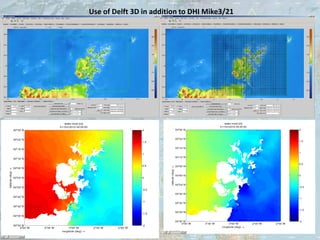
Use of Delft 3D in addition to DHI Mike3/21
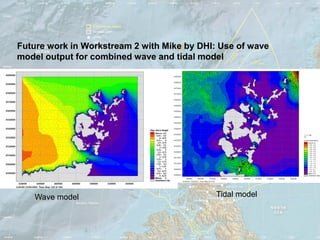
Future work in Workstream 2 with Mike by DHI: Use of wave
model output for combined wave and tidal model


   Wave model                                Tidal model
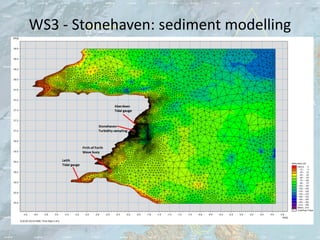
WS3 - Stonehaven: sediment modelling
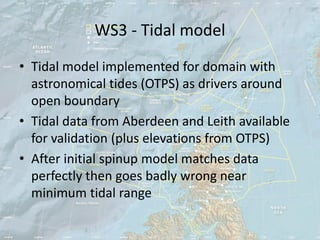
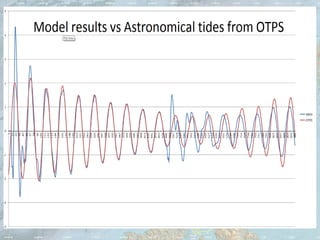
WS3 - Tidal model
• Tidal model implemented for domain with
  astronomical tides (OTPS) as drivers around
  open boundary
• Tidal data from Aberdeen and Leith available
  for validation (plus elevations from OTPS)
• After initial spinup model matches data
  perfectly then goes badly wrong near
  minimum tidal range
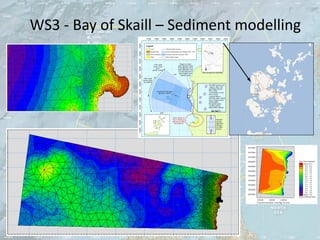
WS3 - Bay of Skaill – Sediment modelling
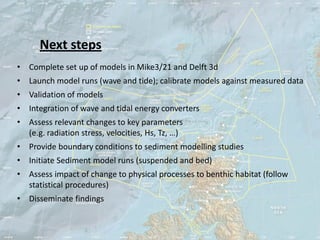
Next steps
• Complete set up of models in Mike3/21 and Delft 3d
• Launch model runs (wave and tide); calibrate models against measured data
• Validation of models
• Integration of wave and tidal energy converters
• Assess relevant changes to key parameters
  (e.g. radiation stress, velocities, Hs, Tz, …)
• Provide boundary conditions to sediment modelling studies
• Initiate Sediment model runs (suspended and bed)
• Assess impact of change to physical processes to benthic habitat (follow
  statistical procedures)
• Disseminate findings
Thank you!
Many thanks to Jon Side, Venki Venugopal, Chris McCaig, Rory O’Hara Murray,
Susanna Baston and MASTS for providing slides for this presentation.

TeraWatt Project

  • 1.
    TeraWatt a collaborative researchproject funded under the EPSRC Grand Challenge Mike by DHI 15th UK User Group Meeting Lion Quays Waterside Resort, Shropshire Talk by Arne Vӧgler, CI arne.vogler@uhi.ac.uk
  • 2.
    Overview i. Introduction to MASTS ii. The Context iii. Introduction to TeraWatt, EcoWatt2050 iv. Workstreams v. The Model(s) Progress and Experiences so far vi. Next Steps
  • 3.
    Marine Alliance forScience and Technology for Scotland - Overview • ~700 researchers across 10 key partner institutions • Initial investment from Scottish Funding Council and partners: £75m [2009-2016, £34m investments in new appointments and infrastructure] • Majority of new money – 34 staff – 48 studentships • Integration of science with policy and regulation • High level representation • Promotes and facilitates collaboration and co-operation - nationally and internationally • Drives scientific excellence in research and training • Provides critical mass
  • 6.
    Example Array layout informationavailable from EIA/licensing documents Example documents include: • Initial scoping reports Scoping & AM • Assessment methodology (AM) statements/report • Final Environmental Statements (ES) Scoping Scoping Scoping & ES Scoping
  • 7.
    Challenges 1. How donear field physical processes change post array development? 2. What are the consequences of marine energy extraction on array scale to the benthic habitat?
  • 8.
    TeraWatt Large scale InTERActivecoupled 3D modelling for WAve and Tidal energy resource and environmental impacT 2012 – 2015 Multi-institution EPSRC research project established under the Marine Alliance for Science and Technology Scotland (MASTS), involving the Universities of o Heriot-Watt (ICIT Orkney Campus, PI Jon Side) o Edinburgh o Highlands and Islands (Lews Castle College and SAMS) o Strathclyde o Swansea o and with Marine Scotland Science as full consortium partners
  • 9.
    TERAWATT seeks toanswer and address: 1) What is the best way to assess wave and tidal energy resources, and feedbacks on energy extraction, in certain geographical areas? 2) What are the physical consequences of wave and tidal energy extraction? 3) What are the ecological consequences of wave and tidal energy extraction? 4) The development of standard hydrographic modelling methodologies for wave and tidal developments. Industry input led to the selection of Mike and Delft3D for modelling during formative discussions on the proposal.
  • 10.
    EcoWatt 2050 Supplementary to TeraWatt To follow up on findings of TeraWatt on larger scale 2013 – 2016 Multi-institution EPSRC research project established under the Marine Alliance for Science and Technology Scotland (MASTS), involving the Universities of o Heriot-Watt (ICIT Orkney Campus, PI Jon Side) o Edinburgh o Highlands and Islands (Lews Castle College and SAMS) o Strathclyde o Swansea o Marine Scotland Science o National Oceanographic Centre o University of Aberdeen
  • 11.
    EcoWatt 2050 1) Howcan marine planning be used to lay the foundation for the sustainable development of very large scale arrays of marine renewable energy devices? 2) What criteria should be used to determine the ecological limits to marine renewable energy extraction, and what are the implications for very large scale array characteristics? 3) How can we differentiate between the effects of climate change and of energy extraction on the marine ecosystem? 4) Are there ways in which marine renewables development may ameliorate or exacerbate the predicted effects of climate change on marine ecosystems?
  • 12.
    TERAWATT is structuredin 4 workstreams: WORKSTREAM 1: The Research Questions, and Monitoring Progress towards Project Aims/Deliverables and the Methods Toolbox (lead Marine Scotland ~ Ian Davies) WORKSTREAM 2: Wave and tidal stream modelling (Lead Edinburgh University ~ Venki Venugopal) WORKSTREAM 3: Sediment Dynamics (Lead Strathclyde and Swansea ~ Mike Heath and Harshinie Karunathra) WORKSTREAM 4: Ecological Consequences of wave and tidal energy extraction (lead Heriot-Watt University and SAMS ~ Jon Side and Mike Burrows) Overseen by a Project Management Committee with a Steering Group with Workshop and Knowledge Exchange Events managed and co-ordinated by MASTS ~ Mark James
  • 13.
    Seabed bathymetry -National Geophysical Data Center Workstream 2 (ETOPO1, GEBCO_08 Grid — global grid at 30 arc-second Illustration of intervals): Wind input – ECMWF, NCEP/NCAR Reanalysis the use of Mike (6hr intervals) by DHI for wave modelling
  • 14.
    Modelled significant waveheight Workstream 2 10th March 2012, 09:00:00 am Illustration of the use of Mike by DHI for wave modelling
  • 15.
    Significant wave height– Model Validation with CEFAS Buoy @ 57°17'.52N and 07°54'.84W in 103m of water Cefas Buoy: Sign. Wave Height [m] Sig Wave Ht [m] D:Hebrideswave_dataCefas BuoyMarch 2012Cefas March 2012.dfs0 odel InputsHebridean_final_OperationalData.sw - Result FilesPoint_0_125deg_March2012_operational.dfs0 12 11 10 9 8 7 6 5 4 3 2 00:00 00:00 00:00 00:00 00:00 00:00 2012-03-02 03-07 03-12 03-17 03-22 03-27
  • 16.
    Zero Crossing Period– Model Validation with CEFAS Buoy @ 57°17'.52N and 07°54'.84W in 103m of water Cefas Buoy: Wave Period, T02 [sec] Tz [sec] D:Hebrideswave_dataCefas BuoyMarch 2012Cefas March 2012.dfs0 lModel InputsHebridean_final_OperationalData.sw - Result FilesPoint_0_125deg_March2012_operational.dfs0 13.0 12.0 11.0 10.0 9.0 8.0 7.0 6.0 00:00 00:00 00:00 00:00 00:00 00:00 2012-03-02 03-07 03-12 03-17 03-22 03-27
  • 17.
    EVOLUTION OF DOMAIN • Version 1: 57N-60N; 1.5W-5.75W. The extended domain was considered for inclusion of Murray firth region and enough fetch on the south-east. However, the projection was wrong. • Version 2: 57.5N-60N; 1.5W-5.75W. The projection was corrected and domain was reduced to avoid unnecessary area on the down-right. The boundaries are inclined. • Version 3: 58N-60N; 1.5W-6W. The boundaries are considered inline with UTM coordinates and domain was further shortened to reduce no of elements.
  • 18.
    DATA Bathymetry – GEBCO (global30 arc-second grid) • Filtering out the landpoints – Marine Scotland Bathymetric Data for Pentland Firth, Orkney and Armadale region (*.xyz or ASCII format data can be used for MIKE) (resolution: ~2m) (this data has been interpolated to 10m resolution and used in the present case)
  • 19.
    Validation (and other)data •Wick Tide Gauge – continuous data available •ADCP data Pentland Firth – one month model run •ADCP data Inner Sound – one month data available •Fall of Wareness ADCP data – one month data available •Hebridean Marine Energy Futures Wave buoy and ADCP data (North West Lewis) (1 year +) •CEFAS Wavenet buoy data (West of Hebrides wave buoy, 1 year +) •TCE WTKN (Wave and Tidal Knowledge network) •EMEC Wave buoy data (Billia Croo) •Beach Profiles – Bay of Skaill •BGS sediment data
  • 20.
  • 21.
  • 22.
    Use of Delft3D in addition to DHI Mike3/21
  • 23.
    Future work inWorkstream 2 with Mike by DHI: Use of wave model output for combined wave and tidal model Wave model Tidal model
  • 24.
    WS3 - Stonehaven:sediment modelling
  • 25.
    WS3 - Tidalmodel • Tidal model implemented for domain with astronomical tides (OTPS) as drivers around open boundary • Tidal data from Aberdeen and Leith available for validation (plus elevations from OTPS) • After initial spinup model matches data perfectly then goes badly wrong near minimum tidal range
  • 27.
    WS3 - Bayof Skaill – Sediment modelling
  • 28.
    Next steps • Completeset up of models in Mike3/21 and Delft 3d • Launch model runs (wave and tide); calibrate models against measured data • Validation of models • Integration of wave and tidal energy converters • Assess relevant changes to key parameters (e.g. radiation stress, velocities, Hs, Tz, …) • Provide boundary conditions to sediment modelling studies • Initiate Sediment model runs (suspended and bed) • Assess impact of change to physical processes to benthic habitat (follow statistical procedures) • Disseminate findings
  • 29.
    Thank you! Many thanksto Jon Side, Venki Venugopal, Chris McCaig, Rory O’Hara Murray, Susanna Baston and MASTS for providing slides for this presentation.