Optical Engineering 49͑1͒, 015001 ͑January 2010͒


Underwater optical wireless communication
network
Shlomi Arnon, MEMBER SPIE                                         Abstract. The growing need for underwater observation and subsea
Ben-Gurion University of the Negev                                monitoring systems has stimulated considerable interest in advancing
Electrical and Computer Engineering Department                    the enabling technologies of underwater wireless communication and
Satellite and Wireless Communications                             underwater sensor networks. This communication technology is ex-
   Laboratory                                                     pected to play an important role in investigating climate change, in moni-
P.O. Box 653                                                      toring biological, biogeochemical, evolutionary, and ecological changes
Beer-Sheva, IL-84105, Israel                                      in the sea, ocean, and lake environments, and in helping to control and
E-mail: shlomi@ee.bgu.ac.il                                       maintain oil production facilities and harbors using unmanned underwa-
                                                                  ter vehicles ͑UUVs͒, submarines, ships, buoys, and divers. However, the
                                                                  present technology of underwater acoustic communication cannot pro-
                                                                  vide the high data rate required to investigate and monitor these envi-
                                                                  ronments and facilities. Optical wireless communication has been pro-
                                                                  posed as the best alternative to meet this challenge. Models are
                                                                  presented for three kinds of optical wireless communication links: ͑a͒ a
                                                                  line-of-sight link, ͑b͒ a modulating retroreflector link, and ͑c͒ a reflective
                                                                  link, all of which can provide the required data rate. We analyze the link
                                                                  performance based on these models. From the analysis, it is clear that
                                                                  as the water absorption increases, the communication performance de-
                                                                  creases dramatically for the three link types. However, by using the scat-
                                                                  tered light it was possible to mitigate this decrease in some cases. It is
                                                                  concluded from the analysis that a high-data-rate underwater optical
                                                                  wireless network is a feasible solution for emerging applications such as
                                                                  UUV-to-UUV links and networks of sensors, and extended ranges in
                                                                  these applications could be achieved by applying a multi-hop concept.
                                                                  © 2010 Society of Photo-Optical Instrumentation Engineers. ͓DOI: 10.1117/1.3280288͔

                                                                  Subject terms: optical communication; underwater; subsea; FSO; ocean.
                                                                  Paper 090580PR received Jul. 30, 2009; revised manuscript received Nov. 8,
                                                                  2009; accepted for publication Nov. 11, 2009; published online Jan. 15, 2010.
                                                                  This paper is a revision of a paper presented at the SPIE conference on
                                                                  Free-Space Laser Communications IX, August 2009, San Diego, California. The
                                                                  paper presented there appears ͑unrefereed͒ in SPIE Proceedings Vol. 7464.


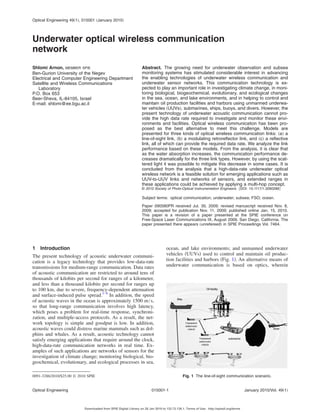
1 Introduction                                                                    ocean, and lake environments; and unmanned underwater
The present technology of acoustic underwater communi-                            vehicles ͑UUVs͒ used to control and maintain oil produc-
cation is a legacy technology that provides low-data-rate                         tion facilities and harbors ͑Fig. 1͒. An alternative means of
transmissions for medium-range communication. Data rates                          underwater communication is based on optics, wherein
of acoustic communication are restricted to around tens of
thousands of kilobits per second for ranges of a kilometer,
and less than a thousand kilobits per second for ranges up
to 100 km, due to severe, frequency-dependent attenuation
and surface-induced pulse spread.1–4 In addition, the speed
of acoustic waves in the ocean is approximately 1500 m / s,
so that long-range communication involves high latency,
which poses a problem for real-time response, synchroni-
zation, and multiple-access protocols. As a result, the net-
work topology is simple and goodput is low. In addition,
acoustic waves could distress marine mammals such as dol-
phins and whales. As a result, acoustic technology cannot
satisfy emerging applications that require around the clock,
high-data-rate communication networks in real time. Ex-
amples of such applications are networks of sensors for the
investigation of climate change; monitoring biological, bio-
geochemical, evolutionary, and ecological processes in sea,

0091-3286/2010/$25.00 © 2010 SPIE                                                            Fig. 1 The line-of-sight communication scenario.


Optical Engineering                                                     015001-1                                                        January 2010/Vol. 49͑1͒


                           Downloaded from SPIE Digital Library on 28 Jan 2010 to 132.72.138.1. Terms of Use: http://spiedl.org/terms
Arnon: Underwater optical wireless communication network


high data rates are possible. However, the distance between
the transmitter and the receiver must be short, due to the
extremely challenging underwater environment, which is
                                                                                                               Extinction coefficient
characterized by high multiscattering and absorption. Mul-                                                              (m-1)
tiscattering causes the optical pulse to widen in the spatial,                                                Clean Ocean
                                                                                                              Coastal Ocean
                                                                                                                              0.15
                                                                                                                              0.30
temporal, angular, and polarization domains.                                                                  Turbid Harbor    2.19

    Although high data rates are threatened by extremely
high absorption and scattering, there is evidence that broad-
band links can be achieved over moderate ranges. Hanson
and Radic5 demonstrated 1-Gbit/ s transmissions in a labo-
ratory experiment with a simulated aquatic medium with
scattering characteristics similar to oceanic waters.
    Cochenour, Mullen, and Laux6 measure both the spatial
and temporal effects of scattering on a laser link in turbid
underwater environments. Using Monte Carlo simulations
and measurement results, they predict longer-range under-
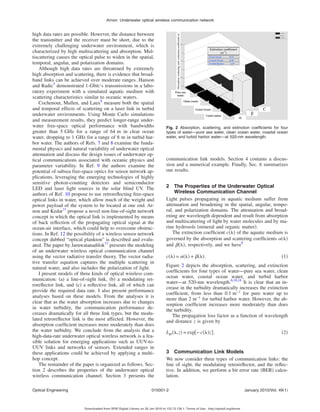
water free-space optical performance with bandwidths                             Fig. 2 Absorption, scattering, and extinction coefficients for four
greater than 5 GHz for a range of 64 m in clear ocean                            types of water—pure sea water, clean ocean water, coastal ocean
water, dropping to 1 GHz for a range of 8 m in turbid har-                       water, and turbid harbor water—at 520-nm wavelength.
bor water. The authors of Refs. 7 and 8 examine the funda-
mental physics and natural variability of underwater optical
attenuation and discuss the design issues of underwater op-
tical communications associated with oceanic physics and                         communication link models. Section 4 contains a discus-
parameter variability. In Ref. 9 the authors examine the                         sion and a numerical example. Finally, Sec. 6 summarizes
potential of subsea free-space optics for sensor network ap-                     our results.
plications, leveraging the emerging technologies of highly
sensitive photon-counting detectors and semiconductor
LED and laser light sources in the solar blind UV. The                           2    The Properties of the Underwater Optical
authors of Ref. 10 propose to use retroreflecting free-space                           Wireless Communication Channel
optical links in water, which allow much of the weight and                       Light pulses propagating in aquatic medium suffer from
power payload of the system to be located at one end. Ar-                        attenuation and broadening in the spatial, angular, tempo-
non and Kedar11 propose a novel non-line-of-sight network                        ral, and polarization domains. The attenuation and broad-
concept in which the optical link is implemented by means                        ening are wavelength dependent and result from absorption
of back reflection of the propagating optical signal at the                       and multiscattering of light by water molecules and by ma-
ocean-air interface, which could help to overcome obstruc-                       rine hydrosols ͑mineral and organic matter͒.
tions. In Ref. 12 the possibility of a wireless sensor network                       The extinction coefficient c͑␭͒ of the aquatic medium is
concept dubbed “optical plankton” is described and evalu-                        governed by the absorption and scattering coefficients ␣͑␭͒
ated. The paper by Jaruwatanadilok13 presents the modeling                       and ␤͑␭͒, respectively, and we have9
of an underwater wireless optical communication channel
using the vector radiative transfer theory. The vector radia-                    c͑␭͒ = ␣͑␭͒ + ␤͑␭͒.                                                       ͑1͒
tive transfer equation captures the multiple scattering in
natural water, and also includes the polarization of light.                      Figure 2 depicts the absorption, scattering, and extinction
                                                                                 coefficients for four types of water—pure sea water, clean
    I present models of three kinds of optical wireless com-
                                                                                 ocean water, coastal ocean water, and turbid harbor
munication: ͑a͒ a line-of-sight link, ͑b͒ a modulating ret-
                                                                                 water—at 520-nm wavelength.6,10,14 It is clear that an in-
roreflector link, and ͑c͒ a reflective link, all of which can
                                                                                 crease in the turbidity dramatically increases the extinction
provide the required data rate. I also present performance
                                                                                 coefficient, from less than 0.1 m−1 for pure water up to
analyses based on these models. From the analyses it is
                                                                                 more than 2 m−1 for turbid harbor water. However, the ab-
clear that as the water absorption increases due to changes
                                                                                 sorption coefficient increases more moderately than does
in water turbidity, the communication performance de-                            the turbidity.
creases dramatically for all three link types, but the modu-                        The propagation loss factor as a function of wavelength
lated retroreflector link is the most affected. However, the                      and distance z is given by
absorption coefficient increases more moderately than does
the water turbidity. We conclude from the analysis that a                        Lpr͑␭,z͒ = exp͓− c͑␭͒z͔.                                                  ͑2͒
high-data-rate underwater optical wireless network is a fea-
sible solution for emerging applications such as UUV-to-
UUV links and networks of sensors. Extended ranges in
these applications could be achieved by applying a multi-                        3 Communication Link Models
hop concept.                                                                     We now consider three types of communication links: the
    The remainder of the paper is organized as follows. Sec-                     line of sight, the modulating retroreflector, and the reflec-
tion 2 describes the properties of the underwater optical                        tive. In addition, we perform a bit error rate ͑BER͒ calcu-
wireless communication channel. Section 3 presents the                           lation.

Optical Engineering                                                    015001-2                                                         January 2010/Vol. 49͑1͒


                          Downloaded from SPIE Digital Library on 28 Jan 2010 to 132.72.138.1. Terms of Use: http://spiedl.org/terms
Arnon: Underwater optical wireless communication network


                                                                                    PRគlos = PT␩T␩RLpr ␭,     ͩ      d
                                                                                                                           ͪ
                                                                                                                          ARec cos ␪
                                                                                                                   cos ␪ ␲͑d tan ␪0͒2
                                                                                                                                      .                           ͑4͒


                                                                                    3.2 Modulating Retroreflector Communication
                                                                                           Link
                                                                                    The modulating retroreflector link10 is used when one party
                                                                                    ͑for example, a submarine͒ has more resources another one
                                                                                    ͑for example, a diver͒, as in Fig. 3͑b͒. In this case, the
                                                                                    submarine has more energy, payload, and lifting capacity
                                                                                    than the diver. Therefore it would be wise to put most of
                                                                                    the complexity and power requirement of the communica-
                                                                                    tion system into the submarine. In a modulating retroreflec-
                                                                                    tor link, the interrogator sits at one end ͑in our case, in the
                                                                                    submarine͒, and a small modulating optical retroreflector
                                                                                    sits at the remote end. In operation, the interrogator illumi-
                                                                                    nates the retroreflecting end of the link with a continuous-
                                                                                    wave beam. The retroreflector inactively reflects this beam
                                                                                    back to the interrogator while modulating the information
                                                                                    on it. The received power in this scenario is given by

                                                                                    PRគRetro = PT␩T␩Rec␩RetroLpr ␭,       ͩ        2d
                                                                                                                                  cos ␪
                                                                                                                                          ͪͫ     ARetro cos ␪
                                                                                                                                               2␲d2͑1 − cos ␪0͒
                                                                                                                                                                  ͬ
                                                                                                 ϫ   ͫ     ARec cos ␪
                                                                                                         ␲͑d tan ␪0retro͒2
                                                                                                                           ,  ͬ                                   ͑5͒

                                                                                    where ␩Retro is the optical efficiency of the retroreflector, ␪
                                                                                    is the angle between the perpendicular to the receiver plane
                                                                                    and the transmitter-receiver trajectory, ARetro is the retrore-
                                                                                    flector’s aperture area, and ␪0retro is the retroreflector’s
                                                                                    beam divergence angle.

Fig. 3 ͑a͒ The line-of-sight communication scenario. ͑b͒ The modu-                  3.3 Reflective Communication Link
lating retroreflector communication scenario. ͑c͒ The reflection com-                 In some communication scenarios the line of sight is not
munication scenario.
                                                                                    available due to obstructions, misalignment, or random ori-
                                                                                    entation of the transceivers.11 To address this problem a
                                                                                    reflective communication link could be used. In this case,
                                                                                    the laser transmitter emits a cone of light, defined by inner
3.1 Line-of-Sight Communication Link                                                and outer angles ␪min and ␪max, in the upward direction
The most common link between two points in optical wire-                            ͓Fig. 3͑c͔͒. Here ␪i and ␪t are the angles of incidence and of
less communication systems is a line-of-sight ͑LOS͒ link as                         transmission, respectively. ͑The latter is derived from the
illustrated in Fig. 3͑a͒. In this scenario, the transmitter di-                     former using Snell’s law.͒
rects the light beam in the direction of the receiver. The                             The light reaching the ocean-air surface illuminates an
optical signal reaching the receiver is obtained by multiply-                       annular area and is partially bounced back in accordance
ing the transmitter power, telescope gain, and losses and is                        with the reflectivity. Since the refractive index of air is
given by Ref. 11 as                                                                 lower than that of water, total internal reflection ͑TIR͒ can
                                                                                    be achieved above a critical incidence angle. When the

                      ͩ         ͪ
                                                                                    transmitter is at depth h, the illuminated annular surface
                            d     ARec cos ␪
PRគlos = PT␩T␩RLpr ␭,                            ,                      ͑3͒         with equal power density at depth x is given by
                          cos ␪ 2␲d2͑1 − cos ␪0͒
                                                                                    Aann = 2␲͑h + x͒2͑1 − cos ␪max − 1 + cos ␪min͒
where PT is the average transmitter optical power, ␩T is the                              = 2␲͑h + x͒2͑cos ␪min − cos ␪max͒.                                      ͑6͒
optical efficiency of the transmitter, ␩R is the optical effi-
ciency of the receiver, d is the perpendicular distance be-                         Equation ͑6͒ describes an annular area taken from a sphere
tween the transmitter and the receiver plane, ␪ is the angle                        of radius h + x, which would have uniform power density in
between the perpendicular to the receiver plane and the                             free space.
transmitter-receiver trajectory, ARec is the receiver aperture                         If we model the ocean-air surface as smooth, then ␪
area, and ␪0 is the laser beam divergence angle. When the                           = ␪i, and we can derive the link budget by using the vari-
transmitter beam divergence angle is very narrow                                    ables defined in Eq. ͑3͒. Then we can define the auxiliary
͑␪0 ␲ / 20͒, Eq. ͑3͒ can be approximated as                                         function and calculate the received power as

Optical Engineering                                                       015001-3                                                         January 2010/Vol. 49͑1͒


                             Downloaded from SPIE Digital Library on 28 Jan 2010 to 132.72.138.1. Terms of Use: http://spiedl.org/terms
Arnon: Underwater optical wireless communication network


                                         ͩ            ͪ ͭͫ                    ͬ ͫ                     ͬͮ
                             Ά                                                                                                      ·
                                               h+x 1           tan͑␪t − ␪͒      2
                                                                                        sin͑␪ − ␪t͒    2
                                 ␩T␩RLpr ␭,                                         +                      , ␪min ഛ ␪ Ͻ ␪c ,
               PT cos ␪                        cos ␪ 2         tan͑␪t + ␪͒              sin͑␪ + ␪t͒

                                         ͩ            ͪ
f Rគref͑␪͒ =                                                                                                                                                         ͑7͒
                 Aann                           h+x
                                 ␩T␩RLpr     ␭,       ,                                                        ␪c ഛ ␪ Ͻ ␪max .
                                                cos ␪


At the plane of the receiving sensor, node coverage is pro-                                 the receiver results in a considerably higher photon count
vided within an annular area bounded by radii ͑h + x͒                                       for a given sensor node separation than a reflective or ret-
tan ␪min and ͑h + x͒tan ␪max. Equation ͑7͒ can be simplified                                 roreflector link. For instance, for a node separation of 30 m,
on the assumption that the receiver aperture is small rela-                                 8,000 photons would be received from a signal in a LOS
tive to h + x, yielding the approximate received power as                                   link, 2 photons would be received from a retroreflector link,
                                                                                            and only 10 would be received in a reflective link where the
PRគref͑␪͒ Ϸ ARec f Rគref͑␪͒.                                                    ͑8͒         transmitter depth is 20 m and the receiving nodes are also
                                                                                            at a depth of 20 m. However, if a single point-to-point link
                                                                                            were to fail, the transmitted signal would be lost, while in
3.4 Bit Error Rate Calculation                                                              the reflective underwater network solution a number of
The simplest and most widespread modulation technique in                                    nodes would be expected to receive the signal. Even in the
optical wireless communication is intensity-modulation,                                     severe case where several nodes fail, with sufficient node
direct-detection on-off keying ͑OOK͒. In this technique, the                                redundancy there would still be additional nodes that could
receiver is based on the emerging technology of silicon                                     relay the signal further.
photomultipliers ͑SiPMs͒.15 These photodetector devices                                        In Fig. 5 we can see that BER values of 10−4 are ob-
are fabricated in the form of arrays of photodiodes that are                                tained for a reflective link when the node separation is
operated in Geiger mode to create a photon-counting de-                                     40 m, while a BER of 10−4 could be achieved in a LOS link
vice. If we assume that a large number of photons are re-                                   and a retroreflector link when the node separation is 60 m
ceived, then according to the central limit theorem, the                                    and 50 m, respectively. From this result it is easy to under-
Poisson distribution can be approximated by a Gaussian                                      stand that acceptable BER performance could be achieved
distribution and the BER is given by11                                                      for short ranges on the order of tens of meters for all three


                    ͭ                                ͮ
                                                                                            models.
         1                       r 1T − r 0T                                                   In Fig. 6 we compare the numbers of photons received
BER =      erfc                                          .                      ͑9͒
         2              ͱ2͓͑r1T͒1/2 + ͑r2T͒1/2͔                                             for a link operated in turbid harbor water for two cases: ͑a͒
                                                                                            when only absorption is considered and ͑b͒ when absorp-
Here r1 = rd + rbg + rs and r0 = rd + rbg, where rd and rbg repre-                          tion and scattering are considered. From this figure it is
sent the sources of additive noise due to dark counts and                                   easy to see that in the absorption case the number of re-
background illumination, respectively, and                                                  ceived photons reduces from 105 to 1 for increases in dis-
                                                                                            tance separation from 1 to 65 m, while in the case of ab-
erfc͑␺͒ =
               2
               ͱ␲   ͵
                    ␺
                        ϱ
                            exp͑− ␥2͒d␥ .                                     ͑10͒


4 Discussion and Numerical Example
The three types of link models could be used to design
sophisticated networks. It is clear that line of sight using
narrow beam divergence provides the maximum range;
however, in this case the precise locations of the two plat-
forms are required. On the other hand, when it is required
to simultaneously broadcast ͑for example͒ from a subma-
rine to several platforms ͑UUVs or divers, for example͒,
the best option is to use LOS with a wide beam divergence.
However, if obstructions between the two platforms block
the line of sight, a reflective communication link is pre-
ferred. When one party has more resources than the other
one in the link, the modulated retroreflector is the best op-
tion.
    In this section we simulate the performance of the three
links, using practical values for clean ocean water with an
extinction coefficient of 0.15 m−1. The values of the simu-
lation parameters are given in Table 1. It is evident from                                  Fig. 4 Graph showing number of received photons as a function of
Fig. 4 that a single LOS underwater link using a pulse-                                     transmitter-receiver separation for clean ocean water with extinction
modulated laser transmitter and a SiPM detector array in                                    coefficient equal to 0.15 m−1.


Optical Engineering                                                                 015001-4                                                      January 2010/Vol. 49͑1͒


                                     Downloaded from SPIE Digital Library on 28 Jan 2010 to 132.72.138.1. Terms of Use: http://spiedl.org/terms
Arnon: Underwater optical wireless communication network


Table 1 Parameters used in numerical calculations. We assume
⌰retro is much greater than the diffraction-limited divergence angle.


   Parameter                                             Typical value

   Extinction coefficient, clear ocean                       0.1514
   ͑m−1͒

   Refractive index                                         1.33643

   Critical angle ͑deg͒                                      48.44

   Transmission wavelength ͑nm͒                               532

   Optical efficiency of retroreflector                          0.9

   Optical efficiency of transmitter                            0.9

   Optical efficiency of receiver                               0.9

   Average transmitter power ͑W͒                               10
                                                                                     Fig. 5 Graph showing BER as a function of transmitter-receiver
   Pulse duration ͑ns͒                                          1                    separation for clean ocean water with extinction coefficient equal to
                                                                                     0.15 m−1.
   Data rate ͑Mbit/s͒                                          0.5

   Receiver aperture area ͑m2͒                                0.01
                                                                                     transceiver and an acoustical transceiver. A hybrid commu-
   Retroreflector aperture area ͑m ͒   2                       0.01
                                                                                     nication system can provide high-data-rate transmission by
                                                                                     using the optical transceiver. When the water turbidity is
   Retroreflector beam divergence ⌰retro                        10                    high or the distance between the terminals is large, the sys-
   ͑deg͒                                                                             tem can switch to a low data rate using the acoustic trans-
                                                                                     ceiver, thereby increasing the average data rate and avail-
   Laser beam divergence angle ␪0 ͑deg͒                        68                    ability. However, the complexity and cost of the system are
   Transmitter inclination angles ␪min, ␪max                 0, 68
                                                                                     increased. In this kind of system, smart buffering and pri-
   ͑deg͒                                                                             oritization could help to mitigate short-term data rate reduc-
                                                                                     tion.
   Dark counting rate ͑MHz͒                                     1                       Many aspects of the proposed system remain to be in-
                                                                                     vestigated; for example, rigorous modeling of the reflective
   Background counting rate ͑MHz͒                               1                    nature of the ocean-air surface, including ocean surface
   Counting efficiency ͑%͒                                      16
                                                                                     roughness, as well as solar radiance penetration. Extensive
                                                                                     studies should be made of the nature of multiple scattering
   Transmitter depth h ͑m͒                                     20                    in different oceanic channels and the limitation of the

   Receiver depth x ͑m͒                                        20


sorption and scattering the number of received photons
reduces from 105 to 1 for increases in distance separation
from 1 to 8 m This result indicates that receiving more
scattered light and performing the required signal process-
ing in the time domain could dramatically improve the per-
formance of an optical wireless system in turbid water.

5 Summary and Conclusions
The results presented indicate that networks based on un-
derwater optical wireless links are feasible at high data
rates for medium distances, up to a hundred meters. Such
networks could serve subsea wireless mobile users. In ad-
dition, by placing multiple relay nodes between the chief
network nodes, messages could traverse very long distances
despite severe medium-induced limitations on the transmis-
sion ranges of individual links. Additional improvements to                          Fig. 6 Graph showing number of received photons for line-of-sight
the availability of the network could be achieved by a hy-                           scenario as a function of transmitter-receiver separation for two
brid communication system that would include an optical                              cases: absorption and extinction.


Optical Engineering                                                        015001-5                                                        January 2010/Vol. 49͑1͒


                              Downloaded from SPIE Digital Library on 28 Jan 2010 to 132.72.138.1. Terms of Use: http://spiedl.org/terms
Arnon: Underwater optical wireless communication network


modulating retroreflector range due to light backscattered                                scheme,” J. Appl. Remote Sensing 1, 013541 ͑2007͒.
                                                                                     13. S. Jaruwatanadilok, “Underwater wireless optical communication
into the receiver before reaching the retroreflector. Some                                channel modeling and performance evaluation using vector radiative
seminal theory necessary to describe spatial spreading of an                             transfer theory,” IEEE J. Sel. Areas Commun. 26͑9͒, 1620–1627
optical beam in the presence of scattering agents under wa-                              ͑2008͒.
                                                                                     14. R. P. Bukata, J. H. Jerome, K. Y. Kondratyev, and D. V. Pozdnyakov,
ter was presented in Ref. 16.                                                            Optical Properties and Remote Sensing of Inland and Coastal Wa-
   Future work on these subjects should refine the analysis                               ters, CRC Press, Boca Raton, FL ͑1995͒.
and yield more accurate numerical results. Additional open                           15. P. Eraerds, M. Legre, A. Rochas, H. Zbinden, and N. Gisin, “SiPM
                                                                                         for fast photon-counting and multiphoton detection,” Opt. Express
issues to be addressed at higher layers of the network de-                               15͑22͒, 14539—14549 ͑2007͒.
sign include multiple access, such as wavelength division                            16. B. M. Cochenour, L. J. Mullen, and A. E. Laux, “Characterization of
multiplexing ͑WDM͒ at blue-green wavelengths, and code                                   the beam-spread function for underwater wireless optical communi-
                                                                                         cations links,” IEEE J. Ocean. Eng. 33͑4͒, 513–521 ͑2008͒.
division multiple access ͑CDMA͒ or clustering. However,
the fundamental concept has been shown to be feasible and
practical.                                                                                                    Shlomi Arnon is a faculty member in the
                                                                                                              Department of Electrical and Computer En-
References                                                                                                    gineering at Ben-Gurion University, Israel.
                                                                                                              There, in 2000, he established the Satellite
 1. I. F. Akyildiz, D. Pompili, and T. Melodia, “Underwater acoustic                                          and Wireless Communication Laboratory,
    sensor networks: research challenges,” Ad Hoc Networks 3͑3͒, 255–                                         which has been under his directorship since
    256 ͑2005͒.                                                                                               then. During 1998–1999 Professor Arnon
 2. J. Heidemann, W. Ye, J. Wills, A. Syed, and Y. Li, “Research chal-                                        was a postdoctoral associate ͑Fulbright Fel-
    lenges and applications for underwater sensor networking,” in Proc.
    IEEE Wireless Communications and Networking Conf., pp. 228–235                                            low͒ at LIDS, Massachusetts Institute of
    ͑2006͒.                                                                                                   Technology ͑MIT͒, Cambridge, USA. His re-
 3. T. Dickey, M. Lewis, and G. Chang, “Optical oceanography; recent                                          search has produced more than fifty journal
    advances and future directions using global remote sensing and in                papers in the area of satellite, optical, and wireless communication.
    situ observations,” Rev. Geophys. 44͑1͒, RG1001 ͑2006͒.                          During part of the summer of 2007, he worked at TU/e and Philips
 4. C. Detweiller, I. Vasilescu, and D. Rus, “AquaNodes: an underwater               Lab, Eindhoven, Nederland, on a novel concept of a dual commu-
    sensor network,” in Proc. Second Int. Workshop on Underwater Net-                nication and illumination system. He was a visiting professor during
    works, pp. 85–88, IEEE ͑2007͒.
 5. F. Hanson and S. Radic, “High bandwidth underwater optical com-                  the summer of 2008 at TU Delft, Nederland. Professor Arnon is a
    munication,” Appl. Opt. 47͑2͒, 277—283 ͑2008͒.                                   frequent invited speaker and program committee member at major
 6. B. Cochenour, L. Mullen, and A. Laux, “Spatial and temporal disper-              IEEE and SPIE conferences in the USA and Europe. He was an
    sion in high bandwidth underwater laser communication links,” in                 associate editor for the Optical Society of America’s Journal of Op-
    Proc. IEEE Military Communications Conf., pp. 1–7 ͑2008͒.                        tical Networks for a special issue on optical wireless communication
 7. J. H. Smart, “Underwater optical communication systems part 1: vari-             that appeared in 2006, and is now on the editorial board for the
    ability of water optical parameters,” in Proc. IEEE Military Commu-              IEEE Journal on Selected Areas in Communications for a special
    nications Conf., pp. 1140–1146 ͑2005͒.                                           issue on optical wireless communication. Professor Arnon continu-
 8. J. W. Giles and I. N. Bankman, “Underwater optical communications
    systems part 2: basic design considerations,” in Proc. IEEE Military             ously takes part in many national and international projects in the
    Communications Conf., pp. 1140–1146 ͑2005͒.                                      areas of satellite communication, remote sensing, and cellular and
 9. D. Kedar and S. Arnon, “Subsea ultraviolet solar-blind broadband                 mobile wireless communication. He consults regularly with start-up
    free-space optics communication,” Opt. Eng. 48͑4͒, 046001 ͑2009͒.                and well-established companies in optical, wireless, and satellite
10. L. Mullen, B. Cochenour, W. Rabinovich, R. Mahon, and J. Muth,                   communication. In addition to research, Professor Arnon and his
    “Backscatter suppression for underwater modulating retroreflector                 students work on many challenging engineering projects with espe-
    links using polarization discrimination,” Appl. Opt. 48͑2͒, 328–337              cial emphasis on the humanitarian dimension. For instance, a long-
    ͑2009͒.
11. S. Arnon and D. Kedar, “Non-line-of-sight underwater optical wire-               standing project has dealt with developing a system to detect human
    less communication network,” J. Opt. Soc. Am. A 26͑3͒, 530–539                   survival after earthquakes, with an infant respiration monitoring sys-
    ͑2009͒.                                                                          tem to prevent cardiac arrest and apnea, and with detection of falls
12. D. Kedar and S. Arnon, “Optical plankton: an optical oceanic probing             in the case of epilepsy sufferers and elderly people.


Optical Engineering                                                        015001-6                                                        January 2010/Vol. 49͑1͒


                              Downloaded from SPIE Digital Library on 28 Jan 2010 to 132.72.138.1. Terms of Use: http://spiedl.org/terms

57

  • 1.
    Optical Engineering 49͑1͒,015001 ͑January 2010͒ Underwater optical wireless communication network Shlomi Arnon, MEMBER SPIE Abstract. The growing need for underwater observation and subsea Ben-Gurion University of the Negev monitoring systems has stimulated considerable interest in advancing Electrical and Computer Engineering Department the enabling technologies of underwater wireless communication and Satellite and Wireless Communications underwater sensor networks. This communication technology is ex- Laboratory pected to play an important role in investigating climate change, in moni- P.O. Box 653 toring biological, biogeochemical, evolutionary, and ecological changes Beer-Sheva, IL-84105, Israel in the sea, ocean, and lake environments, and in helping to control and E-mail: shlomi@ee.bgu.ac.il maintain oil production facilities and harbors using unmanned underwa- ter vehicles ͑UUVs͒, submarines, ships, buoys, and divers. However, the present technology of underwater acoustic communication cannot pro- vide the high data rate required to investigate and monitor these envi- ronments and facilities. Optical wireless communication has been pro- posed as the best alternative to meet this challenge. Models are presented for three kinds of optical wireless communication links: ͑a͒ a line-of-sight link, ͑b͒ a modulating retroreflector link, and ͑c͒ a reflective link, all of which can provide the required data rate. We analyze the link performance based on these models. From the analysis, it is clear that as the water absorption increases, the communication performance de- creases dramatically for the three link types. However, by using the scat- tered light it was possible to mitigate this decrease in some cases. It is concluded from the analysis that a high-data-rate underwater optical wireless network is a feasible solution for emerging applications such as UUV-to-UUV links and networks of sensors, and extended ranges in these applications could be achieved by applying a multi-hop concept. © 2010 Society of Photo-Optical Instrumentation Engineers. ͓DOI: 10.1117/1.3280288͔ Subject terms: optical communication; underwater; subsea; FSO; ocean. Paper 090580PR received Jul. 30, 2009; revised manuscript received Nov. 8, 2009; accepted for publication Nov. 11, 2009; published online Jan. 15, 2010. This paper is a revision of a paper presented at the SPIE conference on Free-Space Laser Communications IX, August 2009, San Diego, California. The paper presented there appears ͑unrefereed͒ in SPIE Proceedings Vol. 7464. 1 Introduction ocean, and lake environments; and unmanned underwater The present technology of acoustic underwater communi- vehicles ͑UUVs͒ used to control and maintain oil produc- cation is a legacy technology that provides low-data-rate tion facilities and harbors ͑Fig. 1͒. An alternative means of transmissions for medium-range communication. Data rates underwater communication is based on optics, wherein of acoustic communication are restricted to around tens of thousands of kilobits per second for ranges of a kilometer, and less than a thousand kilobits per second for ranges up to 100 km, due to severe, frequency-dependent attenuation and surface-induced pulse spread.1–4 In addition, the speed of acoustic waves in the ocean is approximately 1500 m / s, so that long-range communication involves high latency, which poses a problem for real-time response, synchroni- zation, and multiple-access protocols. As a result, the net- work topology is simple and goodput is low. In addition, acoustic waves could distress marine mammals such as dol- phins and whales. As a result, acoustic technology cannot satisfy emerging applications that require around the clock, high-data-rate communication networks in real time. Ex- amples of such applications are networks of sensors for the investigation of climate change; monitoring biological, bio- geochemical, evolutionary, and ecological processes in sea, 0091-3286/2010/$25.00 © 2010 SPIE Fig. 1 The line-of-sight communication scenario. Optical Engineering 015001-1 January 2010/Vol. 49͑1͒ Downloaded from SPIE Digital Library on 28 Jan 2010 to 132.72.138.1. Terms of Use: http://spiedl.org/terms
  • 2.
    Arnon: Underwater opticalwireless communication network high data rates are possible. However, the distance between the transmitter and the receiver must be short, due to the extremely challenging underwater environment, which is Extinction coefficient characterized by high multiscattering and absorption. Mul- (m-1) tiscattering causes the optical pulse to widen in the spatial, Clean Ocean Coastal Ocean 0.15 0.30 temporal, angular, and polarization domains. Turbid Harbor 2.19 Although high data rates are threatened by extremely high absorption and scattering, there is evidence that broad- band links can be achieved over moderate ranges. Hanson and Radic5 demonstrated 1-Gbit/ s transmissions in a labo- ratory experiment with a simulated aquatic medium with scattering characteristics similar to oceanic waters. Cochenour, Mullen, and Laux6 measure both the spatial and temporal effects of scattering on a laser link in turbid underwater environments. Using Monte Carlo simulations and measurement results, they predict longer-range under- water free-space optical performance with bandwidths Fig. 2 Absorption, scattering, and extinction coefficients for four greater than 5 GHz for a range of 64 m in clear ocean types of water—pure sea water, clean ocean water, coastal ocean water, dropping to 1 GHz for a range of 8 m in turbid har- water, and turbid harbor water—at 520-nm wavelength. bor water. The authors of Refs. 7 and 8 examine the funda- mental physics and natural variability of underwater optical attenuation and discuss the design issues of underwater op- tical communications associated with oceanic physics and communication link models. Section 4 contains a discus- parameter variability. In Ref. 9 the authors examine the sion and a numerical example. Finally, Sec. 6 summarizes potential of subsea free-space optics for sensor network ap- our results. plications, leveraging the emerging technologies of highly sensitive photon-counting detectors and semiconductor LED and laser light sources in the solar blind UV. The 2 The Properties of the Underwater Optical authors of Ref. 10 propose to use retroreflecting free-space Wireless Communication Channel optical links in water, which allow much of the weight and Light pulses propagating in aquatic medium suffer from power payload of the system to be located at one end. Ar- attenuation and broadening in the spatial, angular, tempo- non and Kedar11 propose a novel non-line-of-sight network ral, and polarization domains. The attenuation and broad- concept in which the optical link is implemented by means ening are wavelength dependent and result from absorption of back reflection of the propagating optical signal at the and multiscattering of light by water molecules and by ma- ocean-air interface, which could help to overcome obstruc- rine hydrosols ͑mineral and organic matter͒. tions. In Ref. 12 the possibility of a wireless sensor network The extinction coefficient c͑␭͒ of the aquatic medium is concept dubbed “optical plankton” is described and evalu- governed by the absorption and scattering coefficients ␣͑␭͒ ated. The paper by Jaruwatanadilok13 presents the modeling and ␤͑␭͒, respectively, and we have9 of an underwater wireless optical communication channel using the vector radiative transfer theory. The vector radia- c͑␭͒ = ␣͑␭͒ + ␤͑␭͒. ͑1͒ tive transfer equation captures the multiple scattering in natural water, and also includes the polarization of light. Figure 2 depicts the absorption, scattering, and extinction coefficients for four types of water—pure sea water, clean I present models of three kinds of optical wireless com- ocean water, coastal ocean water, and turbid harbor munication: ͑a͒ a line-of-sight link, ͑b͒ a modulating ret- water—at 520-nm wavelength.6,10,14 It is clear that an in- roreflector link, and ͑c͒ a reflective link, all of which can crease in the turbidity dramatically increases the extinction provide the required data rate. I also present performance coefficient, from less than 0.1 m−1 for pure water up to analyses based on these models. From the analyses it is more than 2 m−1 for turbid harbor water. However, the ab- clear that as the water absorption increases due to changes sorption coefficient increases more moderately than does in water turbidity, the communication performance de- the turbidity. creases dramatically for all three link types, but the modu- The propagation loss factor as a function of wavelength lated retroreflector link is the most affected. However, the and distance z is given by absorption coefficient increases more moderately than does the water turbidity. We conclude from the analysis that a Lpr͑␭,z͒ = exp͓− c͑␭͒z͔. ͑2͒ high-data-rate underwater optical wireless network is a fea- sible solution for emerging applications such as UUV-to- UUV links and networks of sensors. Extended ranges in these applications could be achieved by applying a multi- 3 Communication Link Models hop concept. We now consider three types of communication links: the The remainder of the paper is organized as follows. Sec- line of sight, the modulating retroreflector, and the reflec- tion 2 describes the properties of the underwater optical tive. In addition, we perform a bit error rate ͑BER͒ calcu- wireless communication channel. Section 3 presents the lation. Optical Engineering 015001-2 January 2010/Vol. 49͑1͒ Downloaded from SPIE Digital Library on 28 Jan 2010 to 132.72.138.1. Terms of Use: http://spiedl.org/terms
  • 3.
    Arnon: Underwater opticalwireless communication network PRគlos = PT␩T␩RLpr ␭, ͩ d ͪ ARec cos ␪ cos ␪ ␲͑d tan ␪0͒2 . ͑4͒ 3.2 Modulating Retroreflector Communication Link The modulating retroreflector link10 is used when one party ͑for example, a submarine͒ has more resources another one ͑for example, a diver͒, as in Fig. 3͑b͒. In this case, the submarine has more energy, payload, and lifting capacity than the diver. Therefore it would be wise to put most of the complexity and power requirement of the communica- tion system into the submarine. In a modulating retroreflec- tor link, the interrogator sits at one end ͑in our case, in the submarine͒, and a small modulating optical retroreflector sits at the remote end. In operation, the interrogator illumi- nates the retroreflecting end of the link with a continuous- wave beam. The retroreflector inactively reflects this beam back to the interrogator while modulating the information on it. The received power in this scenario is given by PRគRetro = PT␩T␩Rec␩RetroLpr ␭, ͩ 2d cos ␪ ͪͫ ARetro cos ␪ 2␲d2͑1 − cos ␪0͒ ͬ ϫ ͫ ARec cos ␪ ␲͑d tan ␪0retro͒2 , ͬ ͑5͒ where ␩Retro is the optical efficiency of the retroreflector, ␪ is the angle between the perpendicular to the receiver plane and the transmitter-receiver trajectory, ARetro is the retrore- flector’s aperture area, and ␪0retro is the retroreflector’s beam divergence angle. Fig. 3 ͑a͒ The line-of-sight communication scenario. ͑b͒ The modu- 3.3 Reflective Communication Link lating retroreflector communication scenario. ͑c͒ The reflection com- In some communication scenarios the line of sight is not munication scenario. available due to obstructions, misalignment, or random ori- entation of the transceivers.11 To address this problem a reflective communication link could be used. In this case, the laser transmitter emits a cone of light, defined by inner 3.1 Line-of-Sight Communication Link and outer angles ␪min and ␪max, in the upward direction The most common link between two points in optical wire- ͓Fig. 3͑c͔͒. Here ␪i and ␪t are the angles of incidence and of less communication systems is a line-of-sight ͑LOS͒ link as transmission, respectively. ͑The latter is derived from the illustrated in Fig. 3͑a͒. In this scenario, the transmitter di- former using Snell’s law.͒ rects the light beam in the direction of the receiver. The The light reaching the ocean-air surface illuminates an optical signal reaching the receiver is obtained by multiply- annular area and is partially bounced back in accordance ing the transmitter power, telescope gain, and losses and is with the reflectivity. Since the refractive index of air is given by Ref. 11 as lower than that of water, total internal reflection ͑TIR͒ can be achieved above a critical incidence angle. When the ͩ ͪ transmitter is at depth h, the illuminated annular surface d ARec cos ␪ PRគlos = PT␩T␩RLpr ␭, , ͑3͒ with equal power density at depth x is given by cos ␪ 2␲d2͑1 − cos ␪0͒ Aann = 2␲͑h + x͒2͑1 − cos ␪max − 1 + cos ␪min͒ where PT is the average transmitter optical power, ␩T is the = 2␲͑h + x͒2͑cos ␪min − cos ␪max͒. ͑6͒ optical efficiency of the transmitter, ␩R is the optical effi- ciency of the receiver, d is the perpendicular distance be- Equation ͑6͒ describes an annular area taken from a sphere tween the transmitter and the receiver plane, ␪ is the angle of radius h + x, which would have uniform power density in between the perpendicular to the receiver plane and the free space. transmitter-receiver trajectory, ARec is the receiver aperture If we model the ocean-air surface as smooth, then ␪ area, and ␪0 is the laser beam divergence angle. When the = ␪i, and we can derive the link budget by using the vari- transmitter beam divergence angle is very narrow ables defined in Eq. ͑3͒. Then we can define the auxiliary ͑␪0 ␲ / 20͒, Eq. ͑3͒ can be approximated as function and calculate the received power as Optical Engineering 015001-3 January 2010/Vol. 49͑1͒ Downloaded from SPIE Digital Library on 28 Jan 2010 to 132.72.138.1. Terms of Use: http://spiedl.org/terms
  • 4.
    Arnon: Underwater opticalwireless communication network ͩ ͪ ͭͫ ͬ ͫ ͬͮ Ά · h+x 1 tan͑␪t − ␪͒ 2 sin͑␪ − ␪t͒ 2 ␩T␩RLpr ␭, + , ␪min ഛ ␪ Ͻ ␪c , PT cos ␪ cos ␪ 2 tan͑␪t + ␪͒ sin͑␪ + ␪t͒ ͩ ͪ f Rគref͑␪͒ = ͑7͒ Aann h+x ␩T␩RLpr ␭, , ␪c ഛ ␪ Ͻ ␪max . cos ␪ At the plane of the receiving sensor, node coverage is pro- the receiver results in a considerably higher photon count vided within an annular area bounded by radii ͑h + x͒ for a given sensor node separation than a reflective or ret- tan ␪min and ͑h + x͒tan ␪max. Equation ͑7͒ can be simplified roreflector link. For instance, for a node separation of 30 m, on the assumption that the receiver aperture is small rela- 8,000 photons would be received from a signal in a LOS tive to h + x, yielding the approximate received power as link, 2 photons would be received from a retroreflector link, and only 10 would be received in a reflective link where the PRគref͑␪͒ Ϸ ARec f Rគref͑␪͒. ͑8͒ transmitter depth is 20 m and the receiving nodes are also at a depth of 20 m. However, if a single point-to-point link were to fail, the transmitted signal would be lost, while in 3.4 Bit Error Rate Calculation the reflective underwater network solution a number of The simplest and most widespread modulation technique in nodes would be expected to receive the signal. Even in the optical wireless communication is intensity-modulation, severe case where several nodes fail, with sufficient node direct-detection on-off keying ͑OOK͒. In this technique, the redundancy there would still be additional nodes that could receiver is based on the emerging technology of silicon relay the signal further. photomultipliers ͑SiPMs͒.15 These photodetector devices In Fig. 5 we can see that BER values of 10−4 are ob- are fabricated in the form of arrays of photodiodes that are tained for a reflective link when the node separation is operated in Geiger mode to create a photon-counting de- 40 m, while a BER of 10−4 could be achieved in a LOS link vice. If we assume that a large number of photons are re- and a retroreflector link when the node separation is 60 m ceived, then according to the central limit theorem, the and 50 m, respectively. From this result it is easy to under- Poisson distribution can be approximated by a Gaussian stand that acceptable BER performance could be achieved distribution and the BER is given by11 for short ranges on the order of tens of meters for all three ͭ ͮ models. 1 r 1T − r 0T In Fig. 6 we compare the numbers of photons received BER = erfc . ͑9͒ 2 ͱ2͓͑r1T͒1/2 + ͑r2T͒1/2͔ for a link operated in turbid harbor water for two cases: ͑a͒ when only absorption is considered and ͑b͒ when absorp- Here r1 = rd + rbg + rs and r0 = rd + rbg, where rd and rbg repre- tion and scattering are considered. From this figure it is sent the sources of additive noise due to dark counts and easy to see that in the absorption case the number of re- background illumination, respectively, and ceived photons reduces from 105 to 1 for increases in dis- tance separation from 1 to 65 m, while in the case of ab- erfc͑␺͒ = 2 ͱ␲ ͵ ␺ ϱ exp͑− ␥2͒d␥ . ͑10͒ 4 Discussion and Numerical Example The three types of link models could be used to design sophisticated networks. It is clear that line of sight using narrow beam divergence provides the maximum range; however, in this case the precise locations of the two plat- forms are required. On the other hand, when it is required to simultaneously broadcast ͑for example͒ from a subma- rine to several platforms ͑UUVs or divers, for example͒, the best option is to use LOS with a wide beam divergence. However, if obstructions between the two platforms block the line of sight, a reflective communication link is pre- ferred. When one party has more resources than the other one in the link, the modulated retroreflector is the best op- tion. In this section we simulate the performance of the three links, using practical values for clean ocean water with an extinction coefficient of 0.15 m−1. The values of the simu- lation parameters are given in Table 1. It is evident from Fig. 4 Graph showing number of received photons as a function of Fig. 4 that a single LOS underwater link using a pulse- transmitter-receiver separation for clean ocean water with extinction modulated laser transmitter and a SiPM detector array in coefficient equal to 0.15 m−1. Optical Engineering 015001-4 January 2010/Vol. 49͑1͒ Downloaded from SPIE Digital Library on 28 Jan 2010 to 132.72.138.1. Terms of Use: http://spiedl.org/terms
  • 5.
    Arnon: Underwater opticalwireless communication network Table 1 Parameters used in numerical calculations. We assume ⌰retro is much greater than the diffraction-limited divergence angle. Parameter Typical value Extinction coefficient, clear ocean 0.1514 ͑m−1͒ Refractive index 1.33643 Critical angle ͑deg͒ 48.44 Transmission wavelength ͑nm͒ 532 Optical efficiency of retroreflector 0.9 Optical efficiency of transmitter 0.9 Optical efficiency of receiver 0.9 Average transmitter power ͑W͒ 10 Fig. 5 Graph showing BER as a function of transmitter-receiver Pulse duration ͑ns͒ 1 separation for clean ocean water with extinction coefficient equal to 0.15 m−1. Data rate ͑Mbit/s͒ 0.5 Receiver aperture area ͑m2͒ 0.01 transceiver and an acoustical transceiver. A hybrid commu- Retroreflector aperture area ͑m ͒ 2 0.01 nication system can provide high-data-rate transmission by using the optical transceiver. When the water turbidity is Retroreflector beam divergence ⌰retro 10 high or the distance between the terminals is large, the sys- ͑deg͒ tem can switch to a low data rate using the acoustic trans- ceiver, thereby increasing the average data rate and avail- Laser beam divergence angle ␪0 ͑deg͒ 68 ability. However, the complexity and cost of the system are Transmitter inclination angles ␪min, ␪max 0, 68 increased. In this kind of system, smart buffering and pri- ͑deg͒ oritization could help to mitigate short-term data rate reduc- tion. Dark counting rate ͑MHz͒ 1 Many aspects of the proposed system remain to be in- vestigated; for example, rigorous modeling of the reflective Background counting rate ͑MHz͒ 1 nature of the ocean-air surface, including ocean surface Counting efficiency ͑%͒ 16 roughness, as well as solar radiance penetration. Extensive studies should be made of the nature of multiple scattering Transmitter depth h ͑m͒ 20 in different oceanic channels and the limitation of the Receiver depth x ͑m͒ 20 sorption and scattering the number of received photons reduces from 105 to 1 for increases in distance separation from 1 to 8 m This result indicates that receiving more scattered light and performing the required signal process- ing in the time domain could dramatically improve the per- formance of an optical wireless system in turbid water. 5 Summary and Conclusions The results presented indicate that networks based on un- derwater optical wireless links are feasible at high data rates for medium distances, up to a hundred meters. Such networks could serve subsea wireless mobile users. In ad- dition, by placing multiple relay nodes between the chief network nodes, messages could traverse very long distances despite severe medium-induced limitations on the transmis- sion ranges of individual links. Additional improvements to Fig. 6 Graph showing number of received photons for line-of-sight the availability of the network could be achieved by a hy- scenario as a function of transmitter-receiver separation for two brid communication system that would include an optical cases: absorption and extinction. Optical Engineering 015001-5 January 2010/Vol. 49͑1͒ Downloaded from SPIE Digital Library on 28 Jan 2010 to 132.72.138.1. Terms of Use: http://spiedl.org/terms
  • 6.
    Arnon: Underwater opticalwireless communication network modulating retroreflector range due to light backscattered scheme,” J. Appl. Remote Sensing 1, 013541 ͑2007͒. 13. S. Jaruwatanadilok, “Underwater wireless optical communication into the receiver before reaching the retroreflector. Some channel modeling and performance evaluation using vector radiative seminal theory necessary to describe spatial spreading of an transfer theory,” IEEE J. Sel. Areas Commun. 26͑9͒, 1620–1627 optical beam in the presence of scattering agents under wa- ͑2008͒. 14. R. P. Bukata, J. H. Jerome, K. Y. Kondratyev, and D. V. Pozdnyakov, ter was presented in Ref. 16. Optical Properties and Remote Sensing of Inland and Coastal Wa- Future work on these subjects should refine the analysis ters, CRC Press, Boca Raton, FL ͑1995͒. and yield more accurate numerical results. Additional open 15. P. Eraerds, M. Legre, A. Rochas, H. Zbinden, and N. Gisin, “SiPM for fast photon-counting and multiphoton detection,” Opt. Express issues to be addressed at higher layers of the network de- 15͑22͒, 14539—14549 ͑2007͒. sign include multiple access, such as wavelength division 16. B. M. Cochenour, L. J. Mullen, and A. E. Laux, “Characterization of multiplexing ͑WDM͒ at blue-green wavelengths, and code the beam-spread function for underwater wireless optical communi- cations links,” IEEE J. Ocean. Eng. 33͑4͒, 513–521 ͑2008͒. division multiple access ͑CDMA͒ or clustering. However, the fundamental concept has been shown to be feasible and practical. Shlomi Arnon is a faculty member in the Department of Electrical and Computer En- References gineering at Ben-Gurion University, Israel. There, in 2000, he established the Satellite 1. I. F. Akyildiz, D. Pompili, and T. Melodia, “Underwater acoustic and Wireless Communication Laboratory, sensor networks: research challenges,” Ad Hoc Networks 3͑3͒, 255– which has been under his directorship since 256 ͑2005͒. then. During 1998–1999 Professor Arnon 2. J. Heidemann, W. Ye, J. Wills, A. Syed, and Y. Li, “Research chal- was a postdoctoral associate ͑Fulbright Fel- lenges and applications for underwater sensor networking,” in Proc. IEEE Wireless Communications and Networking Conf., pp. 228–235 low͒ at LIDS, Massachusetts Institute of ͑2006͒. Technology ͑MIT͒, Cambridge, USA. His re- 3. T. Dickey, M. Lewis, and G. Chang, “Optical oceanography; recent search has produced more than fifty journal advances and future directions using global remote sensing and in papers in the area of satellite, optical, and wireless communication. situ observations,” Rev. Geophys. 44͑1͒, RG1001 ͑2006͒. During part of the summer of 2007, he worked at TU/e and Philips 4. C. Detweiller, I. Vasilescu, and D. Rus, “AquaNodes: an underwater Lab, Eindhoven, Nederland, on a novel concept of a dual commu- sensor network,” in Proc. Second Int. Workshop on Underwater Net- nication and illumination system. He was a visiting professor during works, pp. 85–88, IEEE ͑2007͒. 5. F. Hanson and S. Radic, “High bandwidth underwater optical com- the summer of 2008 at TU Delft, Nederland. Professor Arnon is a munication,” Appl. Opt. 47͑2͒, 277—283 ͑2008͒. frequent invited speaker and program committee member at major 6. B. Cochenour, L. Mullen, and A. Laux, “Spatial and temporal disper- IEEE and SPIE conferences in the USA and Europe. He was an sion in high bandwidth underwater laser communication links,” in associate editor for the Optical Society of America’s Journal of Op- Proc. IEEE Military Communications Conf., pp. 1–7 ͑2008͒. tical Networks for a special issue on optical wireless communication 7. J. H. Smart, “Underwater optical communication systems part 1: vari- that appeared in 2006, and is now on the editorial board for the ability of water optical parameters,” in Proc. IEEE Military Commu- IEEE Journal on Selected Areas in Communications for a special nications Conf., pp. 1140–1146 ͑2005͒. issue on optical wireless communication. Professor Arnon continu- 8. J. W. Giles and I. N. Bankman, “Underwater optical communications systems part 2: basic design considerations,” in Proc. IEEE Military ously takes part in many national and international projects in the Communications Conf., pp. 1140–1146 ͑2005͒. areas of satellite communication, remote sensing, and cellular and 9. D. Kedar and S. Arnon, “Subsea ultraviolet solar-blind broadband mobile wireless communication. He consults regularly with start-up free-space optics communication,” Opt. Eng. 48͑4͒, 046001 ͑2009͒. and well-established companies in optical, wireless, and satellite 10. L. Mullen, B. Cochenour, W. Rabinovich, R. Mahon, and J. Muth, communication. In addition to research, Professor Arnon and his “Backscatter suppression for underwater modulating retroreflector students work on many challenging engineering projects with espe- links using polarization discrimination,” Appl. Opt. 48͑2͒, 328–337 cial emphasis on the humanitarian dimension. For instance, a long- ͑2009͒. 11. S. Arnon and D. Kedar, “Non-line-of-sight underwater optical wire- standing project has dealt with developing a system to detect human less communication network,” J. Opt. Soc. Am. A 26͑3͒, 530–539 survival after earthquakes, with an infant respiration monitoring sys- ͑2009͒. tem to prevent cardiac arrest and apnea, and with detection of falls 12. D. Kedar and S. Arnon, “Optical plankton: an optical oceanic probing in the case of epilepsy sufferers and elderly people. Optical Engineering 015001-6 January 2010/Vol. 49͑1͒ Downloaded from SPIE Digital Library on 28 Jan 2010 to 132.72.138.1. Terms of Use: http://spiedl.org/terms