Supply chain management in
        Asian Paints
Introduction
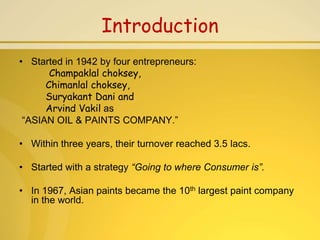
• Started in 1942 by four entrepreneurs:
       Champaklal choksey,
      Chimanlal choksey,
      Suryakant Dani and
      Arvind Vakil as
 “ASIAN OIL & PAINTS COMPANY.”

• Within three years, their turnover reached 3.5 lacs.

• Started with a strategy “Going to where Consumer is”.

• In 1967, Asian paints became the 10th largest paint company
  in the world.
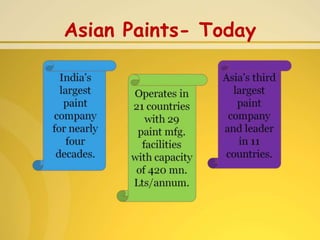
Asian Paints- Today
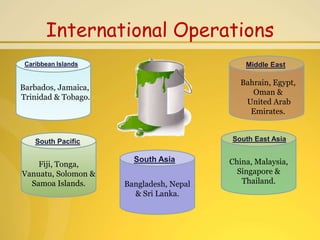
International Operations
 Caribbean Islands                           Middle East

                                            Bahrain, Egypt,
Barbados, Jamaica,
                                               Oman &
Trinidad & Tobago.
                                             United Arab
                                              Emirates.


    South Pacific                        South East Asia

                       South Asia        China, Malaysia,
    Fiji, Tonga,
Vanuatu, Solomon &                         Singapore &
  Samoa Islands.     Bangladesh, Nepal      Thailand.
                       & Sri Lanka.
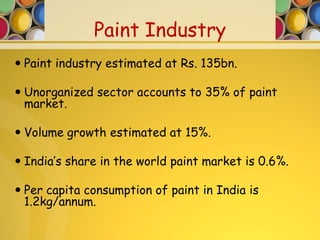
Paint Industry
 Paint industry estimated at Rs. 135bn.

 Unorganized sector accounts to 35% of paint
  market.

 Volume growth estimated at 15%.

 India’s share in the world paint market is 0.6%.

 Per capita consumption of paint in India is
  1.2kg/annum.
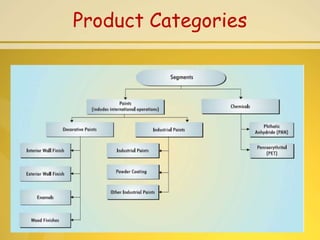
Product Categories
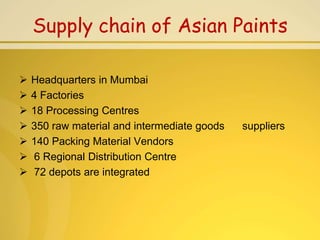
Supply chain of Asian Paints

   Headquarters in Mumbai
   4 Factories
   18 Processing Centres
   350 raw material and intermediate goods   suppliers
   140 Packing Material Vendors
   6 Regional Distribution Centre
   72 depots are integrated
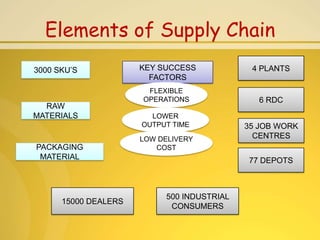
Elements of Supply Chain
3000 SKU’S            KEY SUCCESS            4 PLANTS
                        FACTORS
                       FLEXIBLE
                      OPERATIONS               6 RDC
  RAW
MATERIALS               LOWER
                      OUTPUT TIME           35 JOB WORK
                      LOW DELIVERY            CENTRES
PACKAGING                COST
 MATERIAL                                   77 DEPOTS


                           500 INDUSTRIAL
      15000 DEALERS
                            CONSUMERS
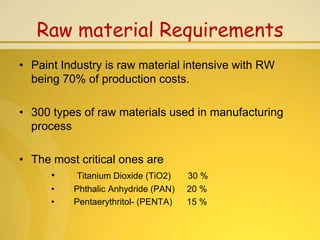
Raw material Requirements
• Paint Industry is raw material intensive with RW
  being 70% of production costs.

• 300 types of raw materials used in manufacturing
  process

• The most critical ones are
      •    Titanium Dioxide (TiO2)   30 %
      •   Phthalic Anhydride (PAN)   20 %
      •   Pentaerythritol- (PENTA)   15 %
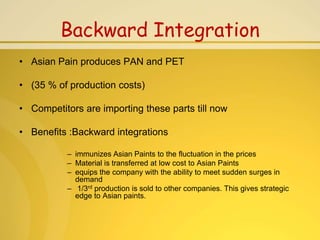
Backward Integration
• Asian Pain produces PAN and PET

• (35 % of production costs)

• Competitors are importing these parts till now

• Benefits :Backward integrations

           – immunizes Asian Paints to the fluctuation in the prices
           – Material is transferred at low cost to Asian Paints
           – equips the company with the ability to meet sudden surges in
             demand
           – 1/3rd production is sold to other companies. This gives strategic
             edge to Asian paints.
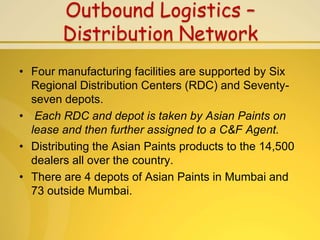
Outbound Logistics –
        Distribution Network
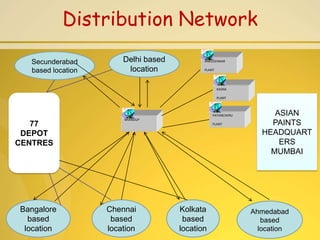
• Four manufacturing facilities are supported by Six
  Regional Distribution Centers (RDC) and Seventy-
  seven depots.
• Each RDC and depot is taken by Asian Paints on
  lease and then further assigned to a C&F Agent.
• Distributing the Asian Paints products to the 14,500
  dealers all over the country.
• There are 4 depots of Asian Paints in Mumbai and
  73 outside Mumbai.
Distribution Network
   Secunderabad         Delhi based          ANKLESHWAR

   based location        location            PLANT


                                                     KASNA

                                                     PLANT


                                                 PATANCHERU        ASIAN
                        BHANDUP
   77                                            PLANT            PAINTS
 DEPOT                                                          HEADQUART
CENTRES                                                             ERS
                                                                  MUMBAI


Bangalore           Chennai           Kolkata                 Ahmedabad
  based              based             based                     based
 location           location          location                  location
Certain Issues

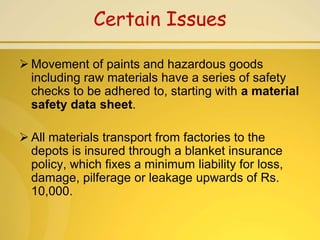
 Movement of paints and hazardous goods
  including raw materials have a series of safety
  checks to be adhered to, starting with a material
  safety data sheet.

 All materials transport from factories to the
  depots is insured through a blanket insurance
  policy, which fixes a minimum liability for loss,
  damage, pilferage or leakage upwards of Rs.
  10,000.
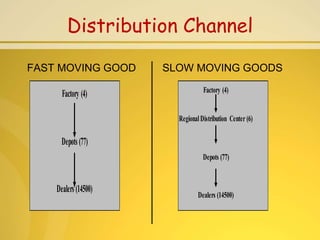
Distribution Channel

FAST MOVING GOOD      SLOW MOVING GOODS

      Factory (4)                 Factory (4)


                        Regional Distribution Center (6)

      Depots (77)
                                  Depots (77)


    Dealers (14500)
                                Dealers (14500)
Conditions
 Projected profitability of the proposed location
 The standing of the dealer in the local market
 The past records of the dealer (banking and
  trading history)
 The presence of other dealers in the vicinity and
  the projected impact on their volumes
 The competition scenario at the location
 The distance of the proposed location from the
  nearest factory etc.
Distribution Strategy

• AP bypassed the bulk buyer segment and went
  to individual consumers of paints.
• AP went slow on urban areas and concentrated
  on semi-urban and rural areas.
• AP went retail.
• AP went in for an open-door dealer policy.
• AP voted for nationwide marketing / distribution
Implications of Distribution
           Strategy
• Going to Individual Consumers Implied Wide
  Product Range and Complex Distribution
• Smaller Packs proliferated the product depth
  further
• Wide Product range Implied Expensive
  distribution
• Going retail Implied Deep Involvement in
  Channel Management
• National Marketing necessitated nationwide
  organization
Inventory Management

Facts:
• Lowest inventory cost in industry
• Avg inventory level of 28 days sales against
  industry avg of 51 days
• Translates into 45 % lower inventory costs
• Stock of finished goods is only 7% of net sales
  half the industry average
Inventory Management
Asian Paints allowed
•   15-21 days credit for dealers in major towns
•   22-30 days credit dealers in upcountry regions


Incentive schemes to reduce inventory
•    A special discount of 3.5 per cent - discount for perfection in payments.
    It was passed on at the end of the year, provided each and every payment throughout the
     year was made within the stipulated time norms.

•    A cash discount of 5 per cent. This was paid for all outright cash purchases.
    It was given whenever payments were received within 24 hours of the supply/invoice. In
     respect of outstation accounts, the payments have been
    made in advance by draft in order to be eligible for the cash discount
Supply Chain Re-engineering


• To deliver products efficiently to customers
  without holding large amount of inventory

• To manage cash cycle to free up funding for
  aggressive growth by acquisition strategy
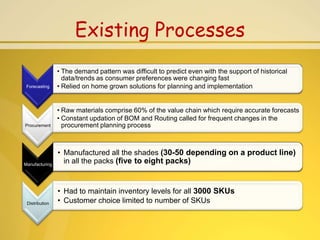
Existing Processes
                • The demand pattern was difficult to predict even with the support of historical
                  data/trends as consumer preferences were changing fast
 Forecasting    • Relied on home grown solutions for planning and implementation


                • Raw materials comprise 60% of the value chain which require accurate forecasts
                • Constant updation of BOM and Routing called for frequent changes in the
Procurement       procurement planning process


                • Manufactured all the shades (30-50 depending on a product line)
Manufacturing
                  in all the packs (five to eight packs)


                • Had to maintain inventory levels for all 3000 SKUs
 Distribution   • Customer choice limited to number of SKUs
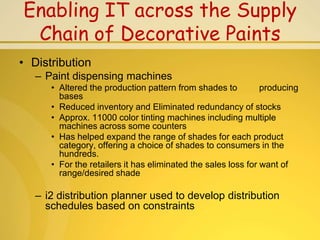
Enabling IT across the Supply
 Chain of Decorative Paints
• Distribution
   – Paint dispensing machines
      • Altered the production pattern from shades to          producing
        bases
      • Reduced inventory and Eliminated redundancy of stocks
      • Approx. 11000 color tinting machines including multiple
        machines across some counters
      • Has helped expand the range of shades for each product
        category, offering a choice of shades to consumers in the
        hundreds.
      • For the retailers it has eliminated the sales loss for want of
        range/desired shade

   – i2 distribution planner used to develop distribution
     schedules based on constraints
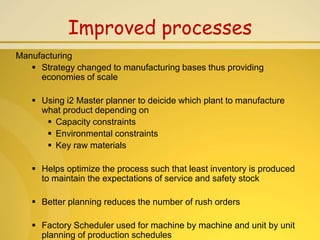
Improved processes
Manufacturing
    Strategy changed to manufacturing bases thus providing
     economies of scale

    Using i2 Master planner to deicide which plant to manufacture
     what product depending on
       Capacity constraints
       Environmental constraints
       Key raw materials

    Helps optimize the process such that least inventory is produced
     to maintain the expectations of service and safety stock

    Better planning reduces the number of rush orders

    Factory Scheduler used for machine by machine and unit by unit
     planning of production schedules
Improved processes
Procurement

   i2’s factory planner used to identify the raw material and
    packing materials and who to source it from

   Also provides the ideal formulations required for
    manufacturing products

   A better materials planning system allows the company to
    create more complex paint formulas

   Helps select the best vendor and manufacturing method
    for any given situation
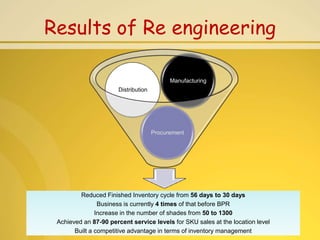
Results of Re engineering

                                            Manufacturing
                       Distribution


                                      Procurement


         Reduced Finished Inventory cycle from 56 days to 30 days
                Business is currently 4 times of that before BPR
               Increase in the number of shades from 50 to 1300
 Achieved an 87-90 percent service levels for SKU sales at the location level
       Built a competitive advantage in terms of inventory management
Thank You

44782537 asian-paints-final-ppt

  • 1.
    Supply chain managementin Asian Paints
  • 3.
    Introduction • Started in1942 by four entrepreneurs: Champaklal choksey, Chimanlal choksey, Suryakant Dani and Arvind Vakil as “ASIAN OIL & PAINTS COMPANY.” • Within three years, their turnover reached 3.5 lacs. • Started with a strategy “Going to where Consumer is”. • In 1967, Asian paints became the 10th largest paint company in the world.
  • 4.
  • 5.
    International Operations CaribbeanIslands Middle East Bahrain, Egypt, Barbados, Jamaica, Oman & Trinidad & Tobago. United Arab Emirates. South Pacific South East Asia South Asia China, Malaysia, Fiji, Tonga, Vanuatu, Solomon & Singapore & Samoa Islands. Bangladesh, Nepal Thailand. & Sri Lanka.
  • 6.
    Paint Industry  Paintindustry estimated at Rs. 135bn.  Unorganized sector accounts to 35% of paint market.  Volume growth estimated at 15%.  India’s share in the world paint market is 0.6%.  Per capita consumption of paint in India is 1.2kg/annum.
  • 7.
  • 8.
    Supply chain ofAsian Paints  Headquarters in Mumbai  4 Factories  18 Processing Centres  350 raw material and intermediate goods suppliers  140 Packing Material Vendors  6 Regional Distribution Centre  72 depots are integrated
  • 9.
    Elements of SupplyChain 3000 SKU’S KEY SUCCESS 4 PLANTS FACTORS FLEXIBLE OPERATIONS 6 RDC RAW MATERIALS LOWER OUTPUT TIME 35 JOB WORK LOW DELIVERY CENTRES PACKAGING COST MATERIAL 77 DEPOTS 500 INDUSTRIAL 15000 DEALERS CONSUMERS
  • 10.
    Raw material Requirements •Paint Industry is raw material intensive with RW being 70% of production costs. • 300 types of raw materials used in manufacturing process • The most critical ones are • Titanium Dioxide (TiO2) 30 % • Phthalic Anhydride (PAN) 20 % • Pentaerythritol- (PENTA) 15 %
  • 11.
    Backward Integration • AsianPain produces PAN and PET • (35 % of production costs) • Competitors are importing these parts till now • Benefits :Backward integrations – immunizes Asian Paints to the fluctuation in the prices – Material is transferred at low cost to Asian Paints – equips the company with the ability to meet sudden surges in demand – 1/3rd production is sold to other companies. This gives strategic edge to Asian paints.
  • 12.
    Outbound Logistics – Distribution Network • Four manufacturing facilities are supported by Six Regional Distribution Centers (RDC) and Seventy- seven depots. • Each RDC and depot is taken by Asian Paints on lease and then further assigned to a C&F Agent. • Distributing the Asian Paints products to the 14,500 dealers all over the country. • There are 4 depots of Asian Paints in Mumbai and 73 outside Mumbai.
  • 13.
    Distribution Network Secunderabad Delhi based ANKLESHWAR based location location PLANT KASNA PLANT PATANCHERU ASIAN BHANDUP 77 PLANT PAINTS DEPOT HEADQUART CENTRES ERS MUMBAI Bangalore Chennai Kolkata Ahmedabad based based based based location location location location
  • 14.
    Certain Issues  Movementof paints and hazardous goods including raw materials have a series of safety checks to be adhered to, starting with a material safety data sheet.  All materials transport from factories to the depots is insured through a blanket insurance policy, which fixes a minimum liability for loss, damage, pilferage or leakage upwards of Rs. 10,000.
  • 15.
    Distribution Channel FAST MOVINGGOOD SLOW MOVING GOODS Factory (4) Factory (4) Regional Distribution Center (6) Depots (77) Depots (77) Dealers (14500) Dealers (14500)
  • 16.
    Conditions  Projected profitabilityof the proposed location  The standing of the dealer in the local market  The past records of the dealer (banking and trading history)  The presence of other dealers in the vicinity and the projected impact on their volumes  The competition scenario at the location  The distance of the proposed location from the nearest factory etc.
  • 17.
    Distribution Strategy • APbypassed the bulk buyer segment and went to individual consumers of paints. • AP went slow on urban areas and concentrated on semi-urban and rural areas. • AP went retail. • AP went in for an open-door dealer policy. • AP voted for nationwide marketing / distribution
  • 18.
    Implications of Distribution Strategy • Going to Individual Consumers Implied Wide Product Range and Complex Distribution • Smaller Packs proliferated the product depth further • Wide Product range Implied Expensive distribution • Going retail Implied Deep Involvement in Channel Management • National Marketing necessitated nationwide organization
  • 19.
    Inventory Management Facts: • Lowestinventory cost in industry • Avg inventory level of 28 days sales against industry avg of 51 days • Translates into 45 % lower inventory costs • Stock of finished goods is only 7% of net sales half the industry average
  • 20.
    Inventory Management Asian Paintsallowed • 15-21 days credit for dealers in major towns • 22-30 days credit dealers in upcountry regions Incentive schemes to reduce inventory • A special discount of 3.5 per cent - discount for perfection in payments. It was passed on at the end of the year, provided each and every payment throughout the year was made within the stipulated time norms. • A cash discount of 5 per cent. This was paid for all outright cash purchases. It was given whenever payments were received within 24 hours of the supply/invoice. In respect of outstation accounts, the payments have been made in advance by draft in order to be eligible for the cash discount
  • 21.
    Supply Chain Re-engineering •To deliver products efficiently to customers without holding large amount of inventory • To manage cash cycle to free up funding for aggressive growth by acquisition strategy
  • 22.
    Existing Processes • The demand pattern was difficult to predict even with the support of historical data/trends as consumer preferences were changing fast Forecasting • Relied on home grown solutions for planning and implementation • Raw materials comprise 60% of the value chain which require accurate forecasts • Constant updation of BOM and Routing called for frequent changes in the Procurement procurement planning process • Manufactured all the shades (30-50 depending on a product line) Manufacturing in all the packs (five to eight packs) • Had to maintain inventory levels for all 3000 SKUs Distribution • Customer choice limited to number of SKUs
  • 23.
    Enabling IT acrossthe Supply Chain of Decorative Paints • Distribution – Paint dispensing machines • Altered the production pattern from shades to producing bases • Reduced inventory and Eliminated redundancy of stocks • Approx. 11000 color tinting machines including multiple machines across some counters • Has helped expand the range of shades for each product category, offering a choice of shades to consumers in the hundreds. • For the retailers it has eliminated the sales loss for want of range/desired shade – i2 distribution planner used to develop distribution schedules based on constraints
  • 24.
    Improved processes Manufacturing  Strategy changed to manufacturing bases thus providing economies of scale  Using i2 Master planner to deicide which plant to manufacture what product depending on  Capacity constraints  Environmental constraints  Key raw materials  Helps optimize the process such that least inventory is produced to maintain the expectations of service and safety stock  Better planning reduces the number of rush orders  Factory Scheduler used for machine by machine and unit by unit planning of production schedules
  • 25.
    Improved processes Procurement  i2’s factory planner used to identify the raw material and packing materials and who to source it from  Also provides the ideal formulations required for manufacturing products  A better materials planning system allows the company to create more complex paint formulas  Helps select the best vendor and manufacturing method for any given situation
  • 26.
    Results of Reengineering Manufacturing Distribution Procurement Reduced Finished Inventory cycle from 56 days to 30 days Business is currently 4 times of that before BPR Increase in the number of shades from 50 to 1300 Achieved an 87-90 percent service levels for SKU sales at the location level Built a competitive advantage in terms of inventory management
  • 27.