Prepared by -
Navneet Dwivedi (160120116019)
Guided By: Prof. Rohan Prajapati
GANDHINAGAR INSTITUTE OF
TECHNOLGY
Information Technology Department
Analysis and Design of Algorithms(2150703)
Merge Sort
MERGING
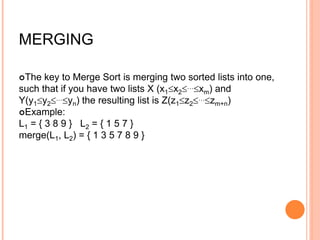
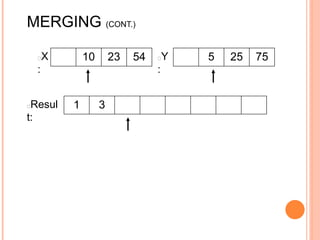
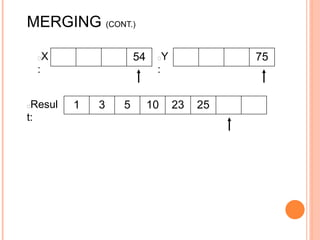
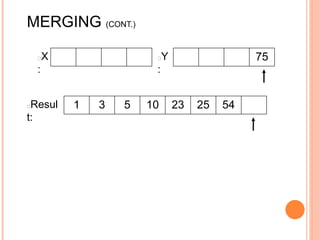
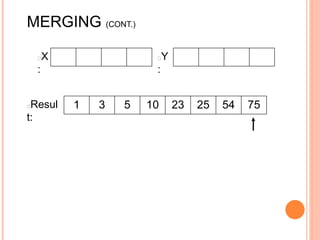
The key to Merge Sort is merging two sorted lists into one,
such that if you have two lists X (x1x2…xm) and
Y(y1y2…yn) the resulting list is Z(z1z2…zm+n)
Example:
L1 = { 3 8 9 } L2 = { 1 5 7 }
merge(L1, L2) = { 1 3 5 7 8 9 }
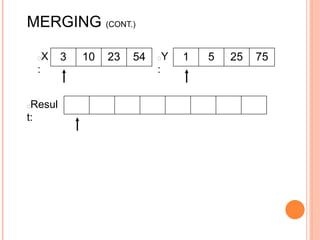
MERGING (CONT.)
3 10 23 54 1 5 25 75X
:
Y
:
Resul
t:
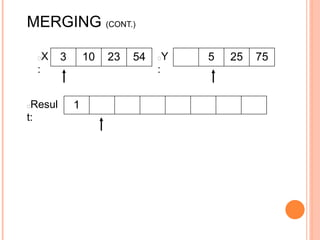
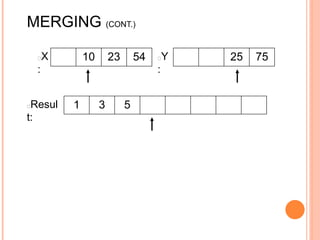
MERGING (CONT.)
3 10 23 54 5 25 75
1
X
:
Y
:
Resul
t:
MERGING (CONT.)
10 23 54 5 25 75
1 3
X
:
Y
:
Resul
t:
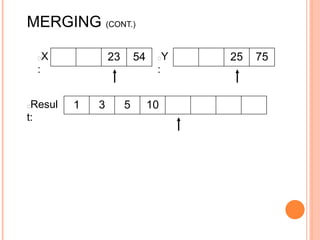
MERGING (CONT.)
10 23 54 25 75
1 3 5
X
:
Y
:
Resul
t:
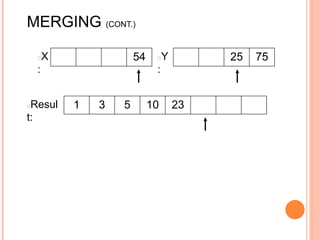
MERGING (CONT.)
23 54 25 75
1 3 5 10
X
:
Y
:
Resul
t:
MERGING (CONT.)
54 25 75
1 3 5 10 23
X
:
Y
:
Resul
t:
MERGING (CONT.)
54 75
1 3 5 10 23 25
X
:
Y
:
Resul
t:
MERGING (CONT.)
75
1 3 5 10 23 25 54
X
:
Y
:
Resul
t:
MERGING (CONT.)
1 3 5 10 23 25 54 75
X
:
Y
:
Resul
t:
DIVIDE AND CONQUER
Merging a two lists of one element each is the
same as sorting them.
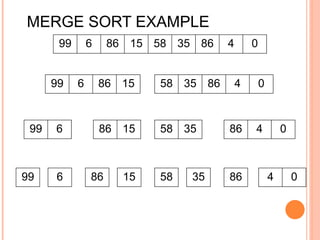
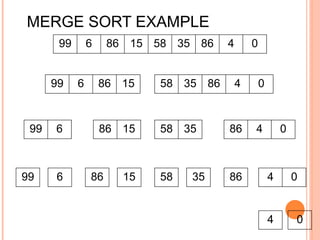
Merge sort divides up an unsorted list until the
above condition is met and then sorts the divided
parts back together in pairs.
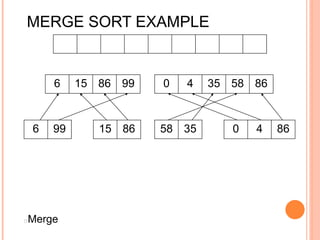
Specifically this can be done by recursively
dividing the unsorted list in half, merge sorting the
right side then the left side and then merging the
right and left back together.
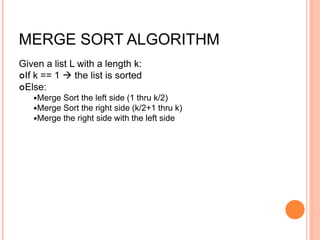
MERGE SORT ALGORITHM
Given a list L with a length k:
If k == 1  the list is sorted
Else:
Merge Sort the left side (1 thru k/2)
Merge Sort the right side (k/2+1 thru k)
Merge the right side with the left side
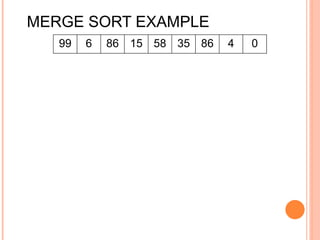
MERGE SORT EXAMPLE
99 6 86 15 58 35 86 4 0
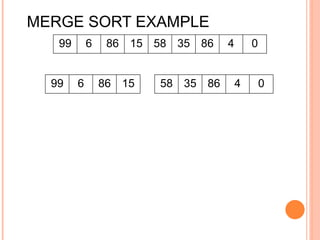
MERGE SORT EXAMPLE
99 6 86 15 58 35 86 4 0
99 6 86 15 58 35 86 4 0
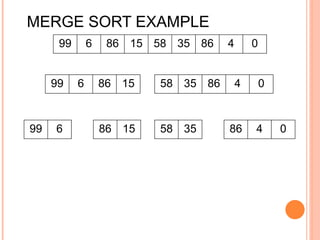
MERGE SORT EXAMPLE
99 6 86 15 58 35 86 4 0
99 6 86 15 58 35 86 4 0
86 1599 6 58 35 86 4 0
MERGE SORT EXAMPLE
99 6 86 15 58 35 86 4 0
99 6 86 15 58 35 86 4 0
86 1599 6 58 35 86 4 0
99 6 86 15 58 35 86 4 0
MERGE SORT EXAMPLE
99 6 86 15 58 35 86 4 0
99 6 86 15 58 35 86 4 0
86 1599 6 58 35 86 4 0
99 6 86 15 58 35 86 4 0
4 0
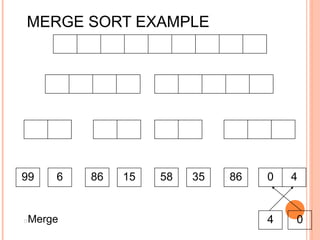
MERGE SORT EXAMPLE
99 6 86 15 58 35 86 0 4
4 0Merge
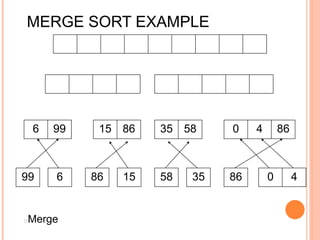
MERGE SORT EXAMPLE
15 866 99 35 58 0 4 86
99 6 86 15 58 35 86 0 4
Merge
MERGE SORT EXAMPLE
6 15 86 99 0 4 35 58 86
15 866 99 58 35 0 4 86
Merge
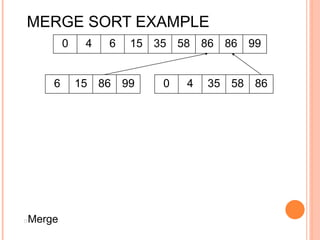
MERGE SORT EXAMPLE
0 4 6 15 35 58 86 86 99
6 15 86 99 0 4 35 58 86
Merge
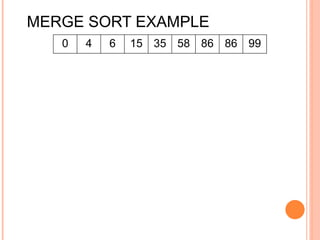
MERGE SORT EXAMPLE
0 4 6 15 35 58 86 86 99
IMPLEMENTING MERGE SORT
There are two basic ways to implement merge sort:
In Place: Merging is done with only the input array
Pro: Requires only the space needed to hold the array
Con: Takes longer to merge because if the next element is in the right side
then all of the elements must be moved down.
Double Storage: Merging is done with a temporary array of
the same size as the input array.
Pro: Faster than In Place since the temp array holds the resulting array
until both left and right sides are merged into the temp array, then the temp
array is appended over the input array.
Con: The memory requirement is doubled.
MERGE SORT ANALYSIS
The Double Memory Merge Sort runs O (N log N) for
all cases, because of its Divide and Conquer approach.
T(N) = 2T(N/2) + N = O(N logN)
FINALLY…
There are other variants of Merge Sorts including
k-way merge sorting, but the common variant is the
Double Memory Merge Sort. Though the running time is
O(N logN) and runs much faster than insertion sort and
bubble sort, merge sort’s large memory demands makes
it not very practical for main memory sorting.
THANK YOU
THANK YOU

Mergesort

  • 1.
    Prepared by - NavneetDwivedi (160120116019) Guided By: Prof. Rohan Prajapati GANDHINAGAR INSTITUTE OF TECHNOLGY Information Technology Department Analysis and Design of Algorithms(2150703) Merge Sort
  • 2.
    MERGING The key toMerge Sort is merging two sorted lists into one, such that if you have two lists X (x1x2…xm) and Y(y1y2…yn) the resulting list is Z(z1z2…zm+n) Example: L1 = { 3 8 9 } L2 = { 1 5 7 } merge(L1, L2) = { 1 3 5 7 8 9 }
  • 3.
    MERGING (CONT.) 3 1023 54 1 5 25 75X : Y : Resul t:
  • 4.
    MERGING (CONT.) 3 1023 54 5 25 75 1 X : Y : Resul t:
  • 5.
    MERGING (CONT.) 10 2354 5 25 75 1 3 X : Y : Resul t:
  • 6.
    MERGING (CONT.) 10 2354 25 75 1 3 5 X : Y : Resul t:
  • 7.
    MERGING (CONT.) 23 5425 75 1 3 5 10 X : Y : Resul t:
  • 8.
    MERGING (CONT.) 54 2575 1 3 5 10 23 X : Y : Resul t:
  • 9.
    MERGING (CONT.) 54 75 13 5 10 23 25 X : Y : Resul t:
  • 10.
    MERGING (CONT.) 75 1 35 10 23 25 54 X : Y : Resul t:
  • 11.
    MERGING (CONT.) 1 35 10 23 25 54 75 X : Y : Resul t:
  • 12.
    DIVIDE AND CONQUER Merginga two lists of one element each is the same as sorting them. Merge sort divides up an unsorted list until the above condition is met and then sorts the divided parts back together in pairs. Specifically this can be done by recursively dividing the unsorted list in half, merge sorting the right side then the left side and then merging the right and left back together.
  • 13.
    MERGE SORT ALGORITHM Givena list L with a length k: If k == 1  the list is sorted Else: Merge Sort the left side (1 thru k/2) Merge Sort the right side (k/2+1 thru k) Merge the right side with the left side
  • 14.
    MERGE SORT EXAMPLE 996 86 15 58 35 86 4 0
  • 15.
    MERGE SORT EXAMPLE 996 86 15 58 35 86 4 0 99 6 86 15 58 35 86 4 0
  • 16.
    MERGE SORT EXAMPLE 996 86 15 58 35 86 4 0 99 6 86 15 58 35 86 4 0 86 1599 6 58 35 86 4 0
  • 17.
    MERGE SORT EXAMPLE 996 86 15 58 35 86 4 0 99 6 86 15 58 35 86 4 0 86 1599 6 58 35 86 4 0 99 6 86 15 58 35 86 4 0
  • 18.
    MERGE SORT EXAMPLE 996 86 15 58 35 86 4 0 99 6 86 15 58 35 86 4 0 86 1599 6 58 35 86 4 0 99 6 86 15 58 35 86 4 0 4 0
  • 19.
    MERGE SORT EXAMPLE 996 86 15 58 35 86 0 4 4 0Merge
  • 20.
    MERGE SORT EXAMPLE 15866 99 35 58 0 4 86 99 6 86 15 58 35 86 0 4 Merge
  • 21.
    MERGE SORT EXAMPLE 615 86 99 0 4 35 58 86 15 866 99 58 35 0 4 86 Merge
  • 22.
    MERGE SORT EXAMPLE 04 6 15 35 58 86 86 99 6 15 86 99 0 4 35 58 86 Merge
  • 23.
    MERGE SORT EXAMPLE 04 6 15 35 58 86 86 99
  • 24.
    IMPLEMENTING MERGE SORT Thereare two basic ways to implement merge sort: In Place: Merging is done with only the input array Pro: Requires only the space needed to hold the array Con: Takes longer to merge because if the next element is in the right side then all of the elements must be moved down. Double Storage: Merging is done with a temporary array of the same size as the input array. Pro: Faster than In Place since the temp array holds the resulting array until both left and right sides are merged into the temp array, then the temp array is appended over the input array. Con: The memory requirement is doubled.
  • 25.
    MERGE SORT ANALYSIS TheDouble Memory Merge Sort runs O (N log N) for all cases, because of its Divide and Conquer approach. T(N) = 2T(N/2) + N = O(N logN)
  • 26.
    FINALLY… There are othervariants of Merge Sorts including k-way merge sorting, but the common variant is the Double Memory Merge Sort. Though the running time is O(N logN) and runs much faster than insertion sort and bubble sort, merge sort’s large memory demands makes it not very practical for main memory sorting.
  • 27.
  • 28.