Home Power Workshop
Agenda

6:30 Introduction/Purpose…………………5 min……...Alan Gibson
6:35 Energy Design ……………………...15min…..….Jeremy Neven
6:55 Solar Photovoltaic…………….…….40min……...Joshua Pearce

          Break……..…………15 min……

7:45 Wind………….…………….………40 min……..Jason Wamboldt
8:25 Closing……………………………..5 min ………....Alan Gibson
8:30 Networking………………………..30 min
Workshop Purpose
 To provide more indepth knowledge of
 solar photovoltaic and wind renewable
 clean technologies and the process to
 implement that will support participant
 home power project actions
 To provide points of contact and
 resource assistance to participants post
 workshop
Technical HOW TO Workshops
              -Outline-
Follow - up HOW TO workshops focused on :

       Home Heating : March 5 from 6:30-8:30 at SLC – Rm 01040
       Home Power : March 9 at SLC from 6:30-8:30 in Rm 01000
       Biomass and Conservation : March 10 from 6:30- 8:30 in Rm 01040


You will be able to :
      decide which system(s) is best for your purposes
      compare costs and understand more on grants
      evaluate whether you want to do it yourself or
      Interact one on one with qualified contractors and how to proceed with your
    project
Energy Efficient Design
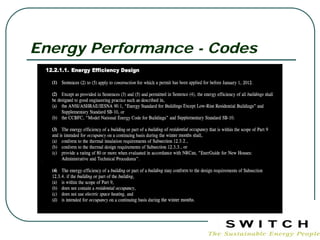
Energy Performance - Codes
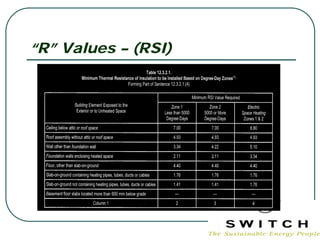
“R” Values – (RSI)
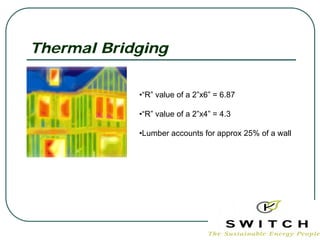
Thermal Bridging


            •“R” value of a 2”x6” = 6.87

            •“R” value of a 2”x4” = 4.3

            •Lumber accounts for approx 25% of a wall
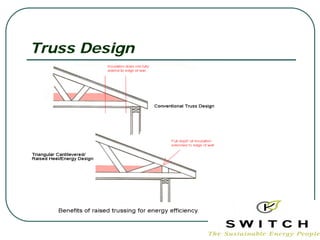
Truss Design
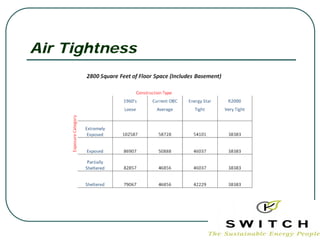
Air Tightness
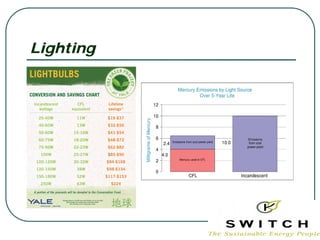
Lighting
Wiring


•Heavier gauge wires have less “Line Loss”

•Shortest distance traveled will have less “Line Loss”

•Minimized circuit loads will reduce “Line Loss”
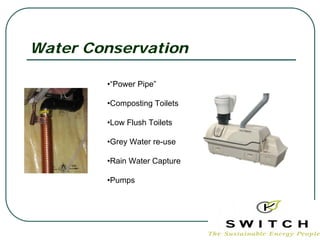
Water Conservation

        •“Power Pipe”

        •Composting Toilets

        •Low Flush Toilets

        •Grey Water re-use

        •Rain Water Capture

        •Pumps
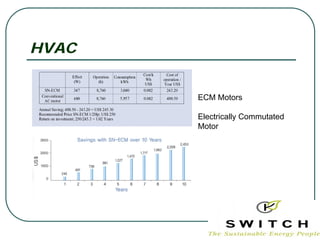
HVAC


       ECM Motors

       Electrically Commutated
       Motor
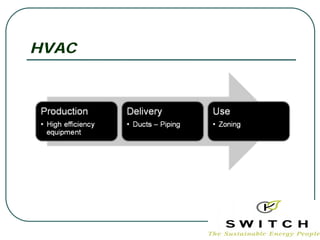
HVAC
Energy Efficiency

            •Site
         •Structure
         •Envelope
        •Mechanical
         •Electrical
            •Use
SOLAR PHOTOVOLTAIC
    WORKSHOP
Workshop outline

Introduction

Technology (available systems)‫‏‬

Installation Issues

Getting Your Project Done

Case Study

Cost Calculations & Financial Projections

Questions and Follow-up
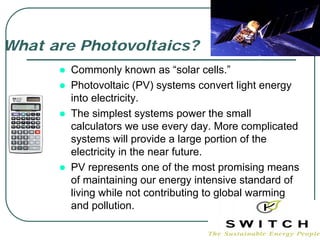
What are Photovoltaics?
       Commonly known as “solar cells.”
       Photovoltaic (PV) systems convert light energy
       into electricity.
       The simplest systems power the small
       calculators we use every day. More complicated
       systems will provide a large portion of the
       electricity in the near future.
       PV represents one of the most promising means
       of maintaining our energy intensive standard of
       living while not contributing to global warming
       and pollution.
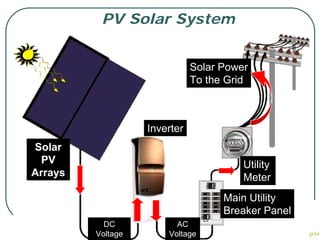
PV Solar System


                              Solar Power
                              To the Grid


                   Inverter
Solar
  PV                                    Utility
Arrays                                  Meter
                                    Main Utility
                                    Breaker Panel
           DC            AC
         Voltage       Voltage
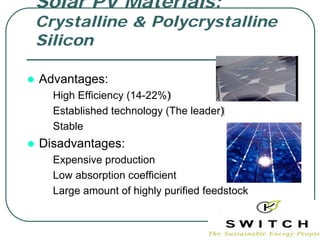
Solar PV Materials:
Crystalline & Polycrystalline
Silicon

Advantages:
• High Efficiency (14-22%)‫‏‬
• Established technology (The leader)‫‏‬
• Stable
Disadvantages:
• Expensive production
• Low absorption coefficient
• Large amount of highly purified feedstock
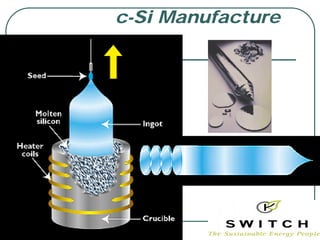
c-Si Manufacture
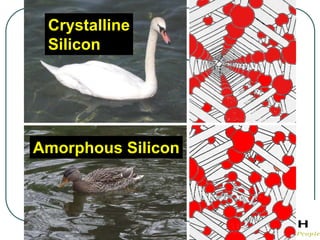
Crystalline
 Silicon


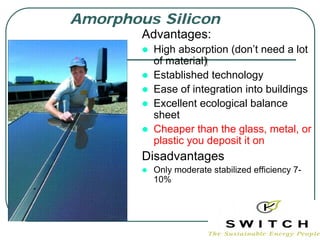
Amorphous Silicon
Amorphous Silicon
        Advantages:
         High absorption (don’t need a lot
         of material)‫‏‬
         Established technology
         Ease of integration into buildings
         Excellent ecological balance
         sheet
         Cheaper than the glass, metal, or
         plastic you deposit it on
        Disadvantages
         Only moderate stabilized efficiency 7-
         10%
Other thin film technologies
 Cd-Te – inexpensive, Cd
 CIGS – just starting mass production
 GaAs – expensive
 TiO2 dye sensitized
 **********************************************
 Many technologies all over 6% efficient
 Efficiency doesn't matter - $/W
Installation Issues

 Types of PV systems - aesthetics
 Modeling - RETScreen
 Building Codes, Inspections
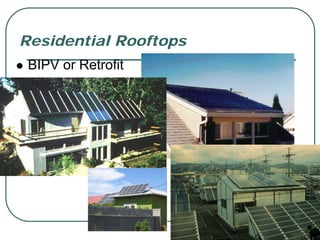
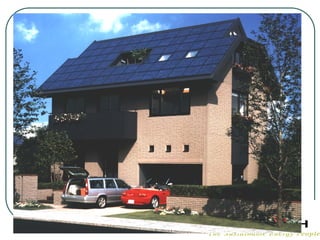
Residential Rooftops
 BIPV or Retrofit
Solar Shingles
Paperwork
 Leave it up to the installer
 Complete the application for SOC with the
 local utility as well as OPA.
 All the connections to an existing electric
 service without any scheduled service
 disconnect and reconnect
Getting Your Project Done
  Assessing Needs – 100% solar or fraction
  Specification of Equipment - $/Wp or
$/kW-hr
  Engaging Contractors – multiple quotes
  • Acquiring Approvals
  • Project Planning
 Follow-ups & Maintenance ~0
Case Study
PV Requirements
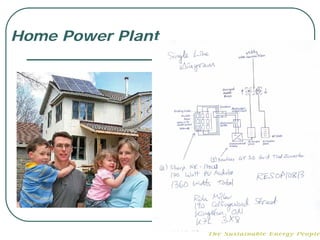
About $10,000 per kW (or $10/W)‫‏‬
South Facing Roof
Ontario Power Authority (OPA) Standard
Offer Contract (SOC) – on-line application
Kingston Electricity Distribution Limited
(KEDL) Connection Agreement
www.xantrex.com (Burnaby, BC)‫‏‬
Home Power Plant
PV – Inverter - Helpers

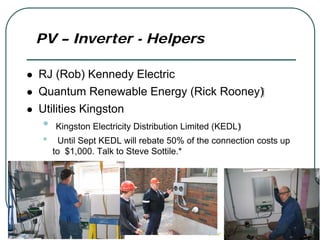
RJ (Rob) Kennedy Electric
Quantum Renewable Energy (Rick Rooney)‫‏‬
Utilities Kingston
•   Kingston Electricity Distribution Limited (KEDL)‫‏‬
•     Until Sept KEDL will rebate 50% of the connection costs up
    to $1,000. Talk to Steve Sottile.*
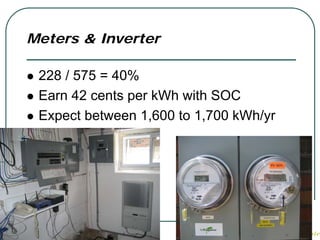
Meters & Inverter

 228 / 575 = 40%
 Earn 42 cents per kWh with SOC
 Expect between 1,600 to 1,700 kWh/yr
Economics

 @$10/Wp installed cost - payback is
 about 18-years
 Should not use payback time as decision
 making metric – use ROI and compare to
 cost of money
 Or opportunity cost of other investments –
 AFTER taxes
 Need lifetime – 25 – 30 years
Calculating ROI from Payback time and lifetime
                         50


                         45


                         40


                         35


                         30
Life time (T) [ Years]


                                                                                                                                       2.50%
                         25                                                                                                            3.00%
                                                                                                                                       4.00%

                         20


                         15


                         10


                          5


                          0
                              0   1   2   3   4   5   6   7   8   9   10 11 12 13 14 15 16 17 18 19 20 21 22 23 24 25 26 27 28 29 30

                                                                        Payback Time (P/S) [Years]
CONCLUDING REMARKS:
 PV provides green electricity for the
 home
 Simplest system uses grid for storage –
 two meters - $0.42/kW-hr feed in
 Long lifetime – 25+ year warranty
 Economic now, PV module prices
 dropping
Solar Photovoltaics
NOW!
Small Wind Power


Jason Wamboldt B.Sc. (Eng), MES
 Renewable Energy of Plum Hollow
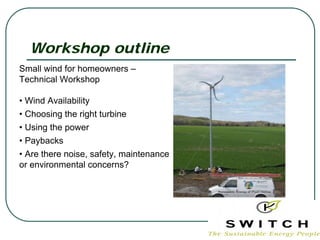
Workshop outline
Small wind for homeowners –
Technical Workshop

• Wind Availability
• Choosing the right turbine
• Using the power
• Paybacks
• Are there noise, safety, maintenance
or environmental concerns?
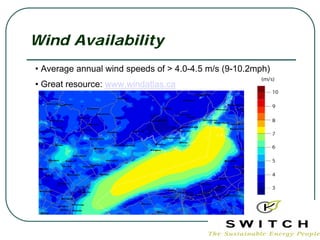
Wind Availability
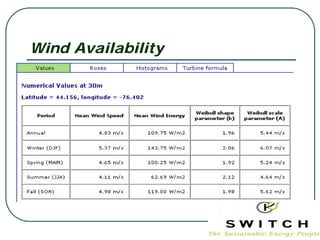
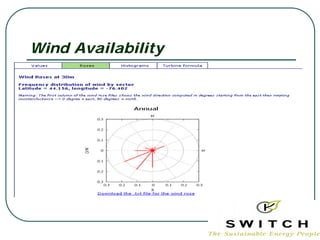
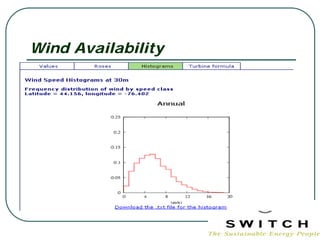
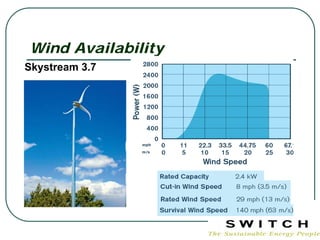
• Average annual wind speeds of > 4.0-4.5 m/s (9-10.2mph)
• Great resource: www.windatlas.ca
Wind Availability
Wind Availability
Wind Availability
Wind Availability
Wind Availability
Skystream 3.7
Siting Issues
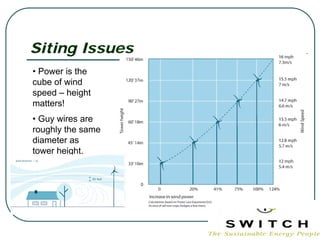
• Power is the
cube of wind
speed – height
matters!
• Guy wires are
roughly the same
diameter as
tower height.
How to choose the right turbine
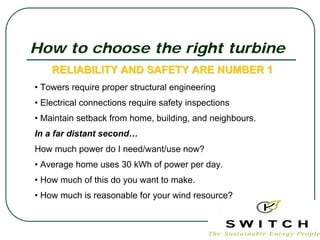
    RELIABILITY AND SAFETY ARE NUMBER 1
• Towers require proper structural engineering
• Electrical connections require safety inspections
• Maintain setback from home, building, and neighbours.
In a far distant second…
How much power do I need/want/use now?
• Average home uses 30 kWh of power per day.
• How much of this do you want to make.
• How much is reasonable for your wind resource?
How to choose the right turbine
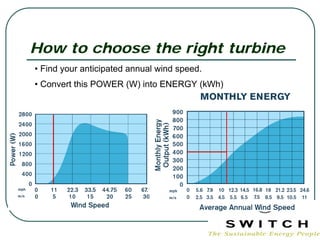
• Find your anticipated annual wind speed.
• Convert this POWER (W) into ENERGY (kWh)
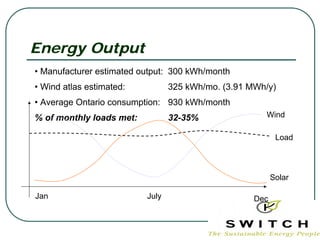
Energy Output
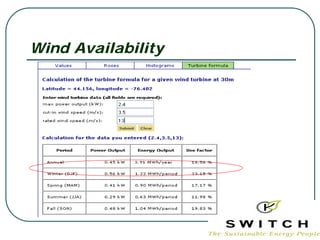
• Manufacturer estimated output: 300 kWh/month
• Wind atlas estimated:          325 kWh/mo. (3.91 MWh/y)
• Average Ontario consumption: 930 kWh/month
% of monthly loads met:          32-35%               Wind

                                                           Load


                                                          Solar

Jan                       July                      Dec
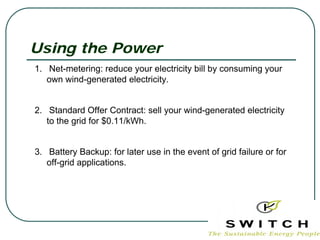
Using the Power
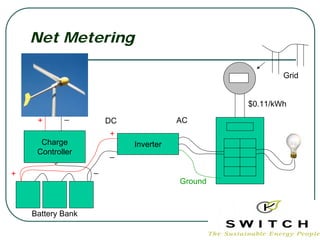
1. Net-metering: reduce your electricity bill by consuming your
   own wind-generated electricity.


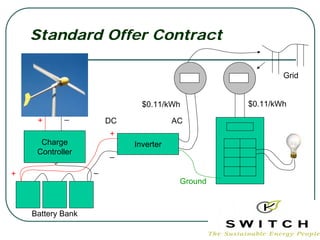
2. Standard Offer Contract: sell your wind-generated electricity
   to the grid for $0.11/kWh.


3. Battery Backup: for later use in the event of grid failure or for
   off-grid applications.
Net Metering

                                                        Grid


                                                $0.11/kWh
            _
     +                 DC              AC
                       +
      Charge                Inverter
     Controller        _

                   _
+
                                       Ground


    Battery Bank
Standard Offer Contract

                                                         Grid


                              $0.11/kWh          $0.11/kWh
            _
     +                 DC              AC
                       +
      Charge                Inverter
     Controller        _

                   _
+
                                        Ground


    Battery Bank
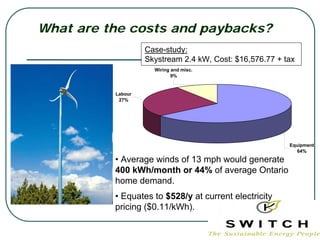
What are the costs and paybacks?
                   Case-study:
                   Skystream 2.4 kW, Cost: $16,576.77 + tax
                     Wiring and misc.
                            9%


          Labour
           27%


                                                         Equipment
                                                            64%

          • Average winds of 13 mph would generate
          400 kWh/month or 44% of average Ontario
          home demand.
          • Equates to $528/y at current electricity
          pricing ($0.11/kWh).
Maintenance and Warranty

• Annual inspection of bolts, guy wires, and electrical
connections.
• May require greasing of bearings.
• Blades need to be visually inspected for cracks or
stress signs.
•Warranties are typically 2-5 years.
Safety, Environmental, and
Noise Concerns
• Wind turbines DO generate noise and vibrations (be a
good neighbour)
• Check with local zoning and building code
requirements for safe installation of tower and
foundation
• Electrical permits must be taken and approved by the
Electrical Safety Authority
• All turbines have mechanisms to slow blades in high
winds
Conclusions
• Small wind turbines are less than 100 kW.
• Need good site with clean, strong, consistent wind
with buffers from buildings and neighbours.
• Power can be used to offset electricity bills or store in
batteries for later use.
• Costs are significantly tied to equipment costs and
expect long paybacks at current electricity prices.
• SAFETY IS PARAMOUNT.
Closing
 Purpose /products review
 Feedback forms please
 Further resource support requirements
 Our support
Brought to you by:


SWITCH - The Sustainable Energy People
 SWITCH thanks the Ontario Trillium Foundation for
  its Financial Support


_____________________________

March9 2009-workshop-slides

  • 1.
  • 2.
    Agenda 6:30 Introduction/Purpose…………………5 min……...AlanGibson 6:35 Energy Design ……………………...15min…..….Jeremy Neven 6:55 Solar Photovoltaic…………….…….40min……...Joshua Pearce Break……..…………15 min…… 7:45 Wind………….…………….………40 min……..Jason Wamboldt 8:25 Closing……………………………..5 min ………....Alan Gibson 8:30 Networking………………………..30 min
  • 3.
    Workshop Purpose Toprovide more indepth knowledge of solar photovoltaic and wind renewable clean technologies and the process to implement that will support participant home power project actions To provide points of contact and resource assistance to participants post workshop
  • 4.
    Technical HOW TOWorkshops -Outline- Follow - up HOW TO workshops focused on : Home Heating : March 5 from 6:30-8:30 at SLC – Rm 01040 Home Power : March 9 at SLC from 6:30-8:30 in Rm 01000 Biomass and Conservation : March 10 from 6:30- 8:30 in Rm 01040 You will be able to : decide which system(s) is best for your purposes compare costs and understand more on grants evaluate whether you want to do it yourself or Interact one on one with qualified contractors and how to proceed with your project
  • 5.
  • 7.
  • 8.
  • 9.
    Thermal Bridging •“R” value of a 2”x6” = 6.87 •“R” value of a 2”x4” = 4.3 •Lumber accounts for approx 25% of a wall
  • 10.
  • 11.
  • 12.
  • 13.
    Wiring •Heavier gauge wireshave less “Line Loss” •Shortest distance traveled will have less “Line Loss” •Minimized circuit loads will reduce “Line Loss”
  • 14.
    Water Conservation •“Power Pipe” •Composting Toilets •Low Flush Toilets •Grey Water re-use •Rain Water Capture •Pumps
  • 15.
    HVAC ECM Motors Electrically Commutated Motor
  • 16.
  • 17.
    Energy Efficiency •Site •Structure •Envelope •Mechanical •Electrical •Use
  • 18.
  • 19.
    Workshop outline Introduction Technology (availablesystems)‫‏‬ Installation Issues Getting Your Project Done Case Study Cost Calculations & Financial Projections Questions and Follow-up
  • 20.
    What are Photovoltaics? Commonly known as “solar cells.” Photovoltaic (PV) systems convert light energy into electricity. The simplest systems power the small calculators we use every day. More complicated systems will provide a large portion of the electricity in the near future. PV represents one of the most promising means of maintaining our energy intensive standard of living while not contributing to global warming and pollution.
  • 21.
    PV Solar System Solar Power To the Grid Inverter Solar PV Utility Arrays Meter Main Utility Breaker Panel DC AC Voltage Voltage
  • 22.
    Solar PV Materials: Crystalline& Polycrystalline Silicon Advantages: • High Efficiency (14-22%)‫‏‬ • Established technology (The leader)‫‏‬ • Stable Disadvantages: • Expensive production • Low absorption coefficient • Large amount of highly purified feedstock
  • 23.
  • 24.
  • 25.
    Amorphous Silicon Advantages: High absorption (don’t need a lot of material)‫‏‬ Established technology Ease of integration into buildings Excellent ecological balance sheet Cheaper than the glass, metal, or plastic you deposit it on Disadvantages Only moderate stabilized efficiency 7- 10%
  • 26.
    Other thin filmtechnologies Cd-Te – inexpensive, Cd CIGS – just starting mass production GaAs – expensive TiO2 dye sensitized ********************************************** Many technologies all over 6% efficient Efficiency doesn't matter - $/W
  • 27.
    Installation Issues Typesof PV systems - aesthetics Modeling - RETScreen Building Codes, Inspections
  • 28.
  • 30.
  • 31.
    Paperwork Leave itup to the installer Complete the application for SOC with the local utility as well as OPA. All the connections to an existing electric service without any scheduled service disconnect and reconnect
  • 32.
    Getting Your ProjectDone Assessing Needs – 100% solar or fraction Specification of Equipment - $/Wp or $/kW-hr Engaging Contractors – multiple quotes • Acquiring Approvals • Project Planning Follow-ups & Maintenance ~0
  • 33.
    Case Study PV Requirements About$10,000 per kW (or $10/W)‫‏‬ South Facing Roof Ontario Power Authority (OPA) Standard Offer Contract (SOC) – on-line application Kingston Electricity Distribution Limited (KEDL) Connection Agreement www.xantrex.com (Burnaby, BC)‫‏‬
  • 34.
  • 35.
    PV – Inverter- Helpers RJ (Rob) Kennedy Electric Quantum Renewable Energy (Rick Rooney)‫‏‬ Utilities Kingston • Kingston Electricity Distribution Limited (KEDL)‫‏‬ • Until Sept KEDL will rebate 50% of the connection costs up to $1,000. Talk to Steve Sottile.*
  • 36.
    Meters & Inverter 228 / 575 = 40% Earn 42 cents per kWh with SOC Expect between 1,600 to 1,700 kWh/yr
  • 37.
    Economics @$10/Wp installedcost - payback is about 18-years Should not use payback time as decision making metric – use ROI and compare to cost of money Or opportunity cost of other investments – AFTER taxes Need lifetime – 25 – 30 years
  • 38.
    Calculating ROI fromPayback time and lifetime 50 45 40 35 30 Life time (T) [ Years] 2.50% 25 3.00% 4.00% 20 15 10 5 0 0 1 2 3 4 5 6 7 8 9 10 11 12 13 14 15 16 17 18 19 20 21 22 23 24 25 26 27 28 29 30 Payback Time (P/S) [Years]
  • 39.
    CONCLUDING REMARKS: PVprovides green electricity for the home Simplest system uses grid for storage – two meters - $0.42/kW-hr feed in Long lifetime – 25+ year warranty Economic now, PV module prices dropping
  • 40.
  • 41.
    Small Wind Power JasonWamboldt B.Sc. (Eng), MES Renewable Energy of Plum Hollow
  • 42.
    Workshop outline Small windfor homeowners – Technical Workshop • Wind Availability • Choosing the right turbine • Using the power • Paybacks • Are there noise, safety, maintenance or environmental concerns?
  • 43.
    Wind Availability • Averageannual wind speeds of > 4.0-4.5 m/s (9-10.2mph) • Great resource: www.windatlas.ca
  • 44.
  • 45.
  • 46.
  • 47.
  • 48.
  • 49.
    Siting Issues • Poweris the cube of wind speed – height matters! • Guy wires are roughly the same diameter as tower height.
  • 50.
    How to choosethe right turbine RELIABILITY AND SAFETY ARE NUMBER 1 • Towers require proper structural engineering • Electrical connections require safety inspections • Maintain setback from home, building, and neighbours. In a far distant second… How much power do I need/want/use now? • Average home uses 30 kWh of power per day. • How much of this do you want to make. • How much is reasonable for your wind resource?
  • 51.
    How to choosethe right turbine • Find your anticipated annual wind speed. • Convert this POWER (W) into ENERGY (kWh)
  • 52.
    Energy Output • Manufacturerestimated output: 300 kWh/month • Wind atlas estimated: 325 kWh/mo. (3.91 MWh/y) • Average Ontario consumption: 930 kWh/month % of monthly loads met: 32-35% Wind Load Solar Jan July Dec
  • 53.
    Using the Power 1.Net-metering: reduce your electricity bill by consuming your own wind-generated electricity. 2. Standard Offer Contract: sell your wind-generated electricity to the grid for $0.11/kWh. 3. Battery Backup: for later use in the event of grid failure or for off-grid applications.
  • 54.
    Net Metering Grid $0.11/kWh _ + DC AC + Charge Inverter Controller _ _ + Ground Battery Bank
  • 55.
    Standard Offer Contract Grid $0.11/kWh $0.11/kWh _ + DC AC + Charge Inverter Controller _ _ + Ground Battery Bank
  • 56.
    What are thecosts and paybacks? Case-study: Skystream 2.4 kW, Cost: $16,576.77 + tax Wiring and misc. 9% Labour 27% Equipment 64% • Average winds of 13 mph would generate 400 kWh/month or 44% of average Ontario home demand. • Equates to $528/y at current electricity pricing ($0.11/kWh).
  • 57.
    Maintenance and Warranty •Annual inspection of bolts, guy wires, and electrical connections. • May require greasing of bearings. • Blades need to be visually inspected for cracks or stress signs. •Warranties are typically 2-5 years.
  • 58.
    Safety, Environmental, and NoiseConcerns • Wind turbines DO generate noise and vibrations (be a good neighbour) • Check with local zoning and building code requirements for safe installation of tower and foundation • Electrical permits must be taken and approved by the Electrical Safety Authority • All turbines have mechanisms to slow blades in high winds
  • 59.
    Conclusions • Small windturbines are less than 100 kW. • Need good site with clean, strong, consistent wind with buffers from buildings and neighbours. • Power can be used to offset electricity bills or store in batteries for later use. • Costs are significantly tied to equipment costs and expect long paybacks at current electricity prices. • SAFETY IS PARAMOUNT.
  • 60.
    Closing Purpose /productsreview Feedback forms please Further resource support requirements Our support
  • 61.
    Brought to youby: SWITCH - The Sustainable Energy People SWITCH thanks the Ontario Trillium Foundation for its Financial Support _____________________________