This presentation is protected by US and International copyright laws. Reproduction, distribution, display and use of the presentation without written permission of the speaker is prohibited. ©  Alteris Renewables Inc. - Earth Friendly Energy Group 2009 formerly SolarWrights, WindWrights and Solar Works, Inc. Copyright Materials
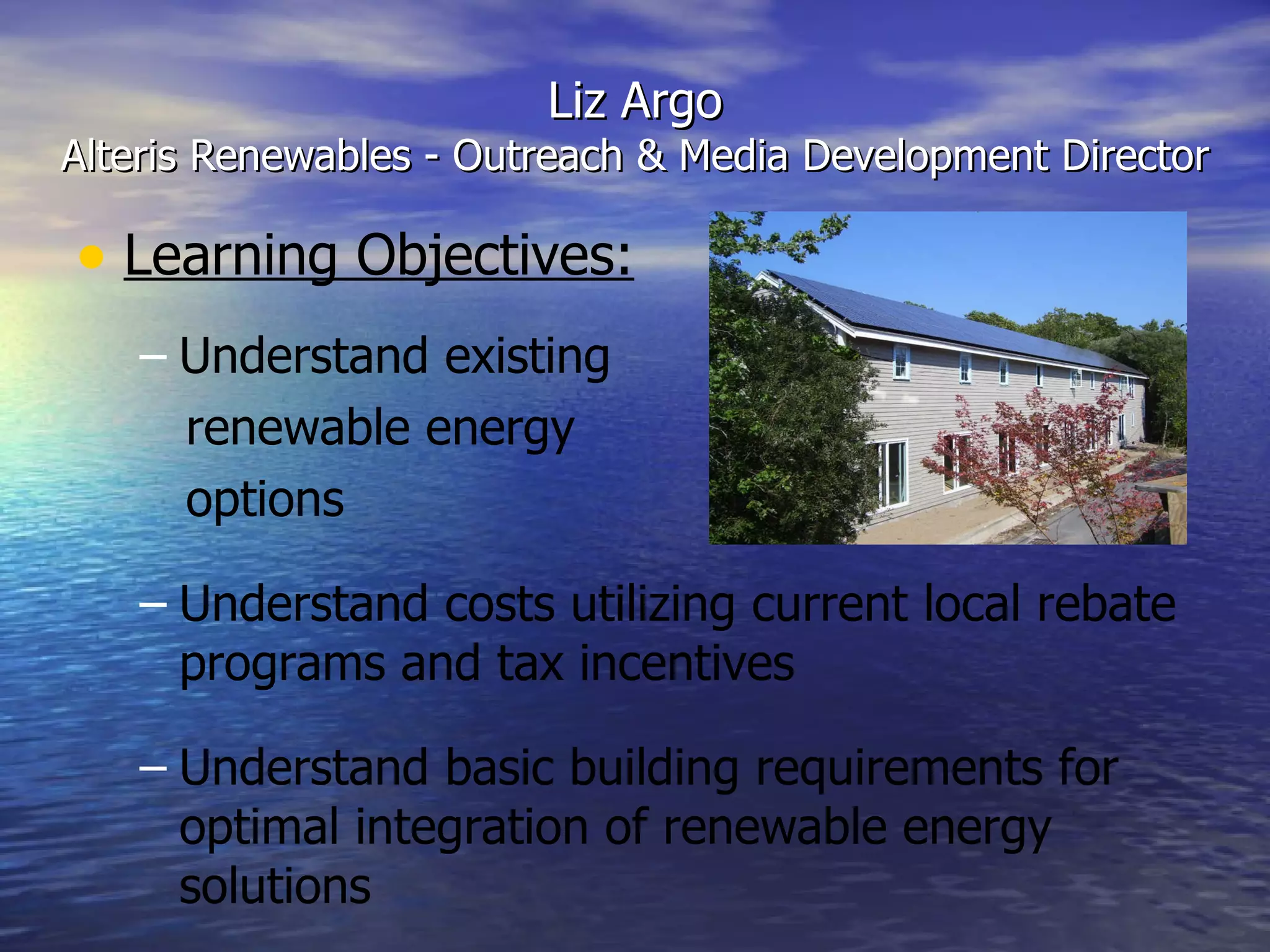
Liz Argo Alteris Renewables - Outreach & Media Development Director Learning Objectives: Understand existing  renewable energy  options Understand costs utilizing current local rebate programs and tax incentives Understand basic building requirements for optimal integration of renewable energy solutions
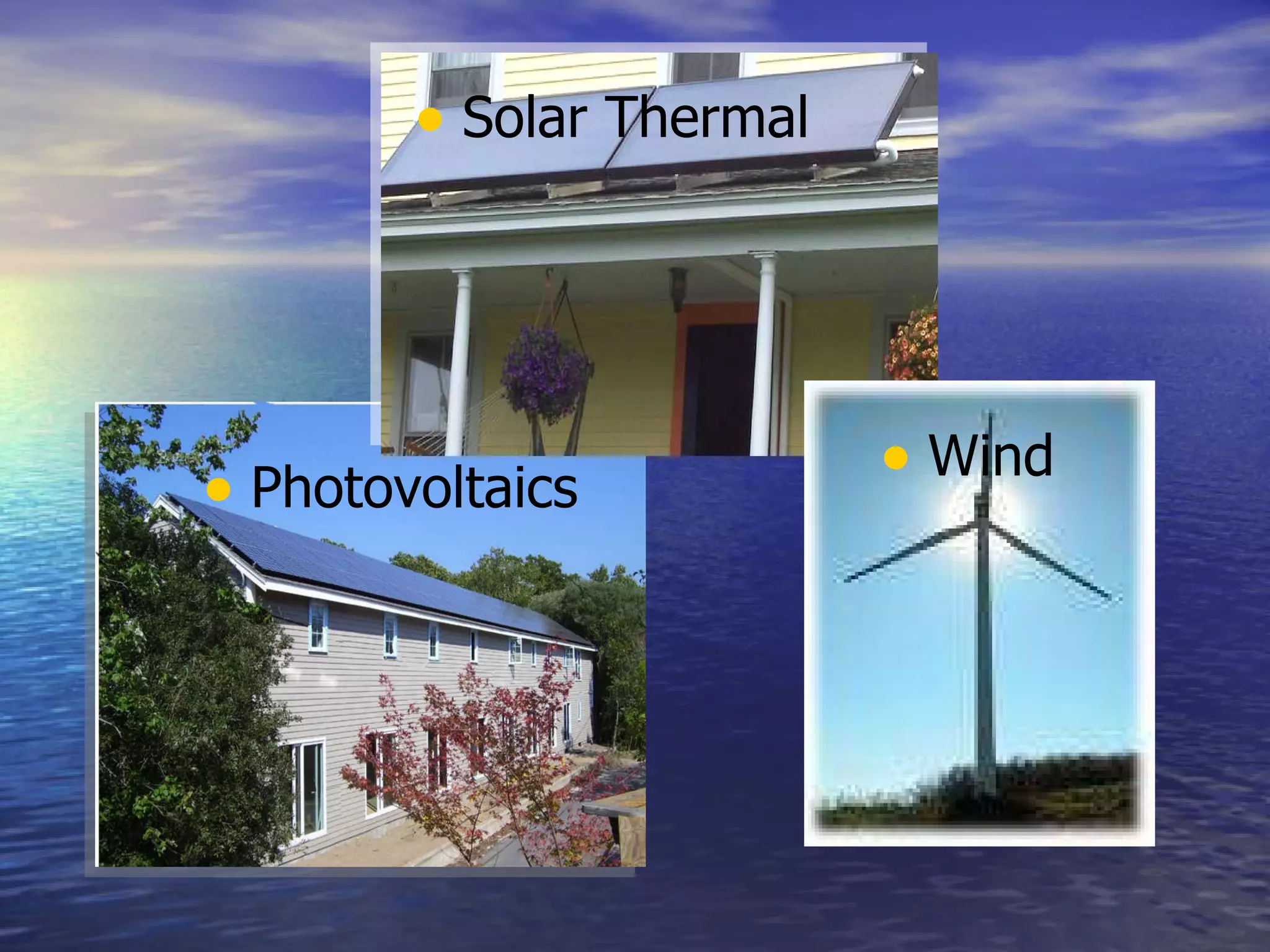
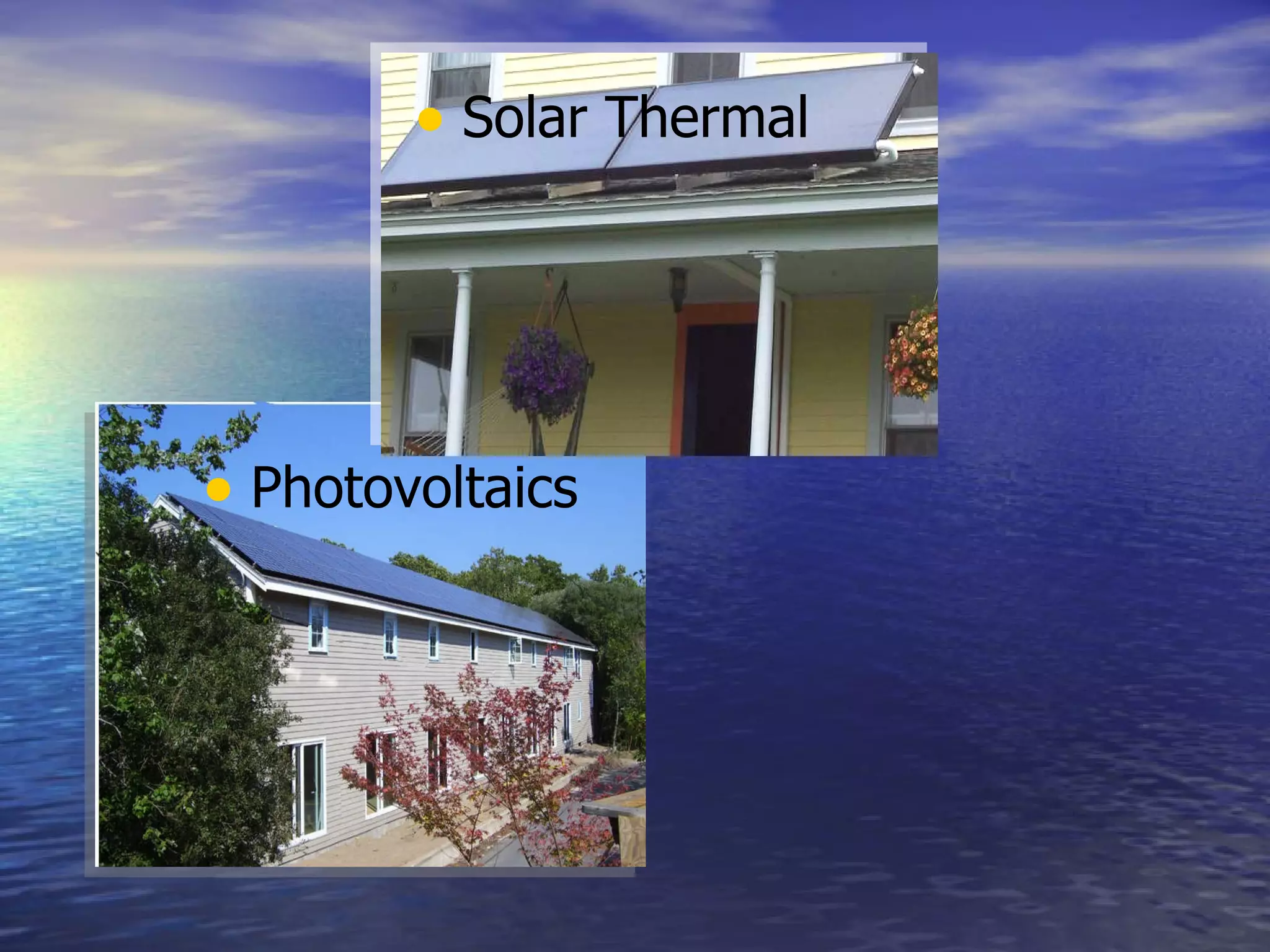
Solar Thermal Photovoltaics Wind
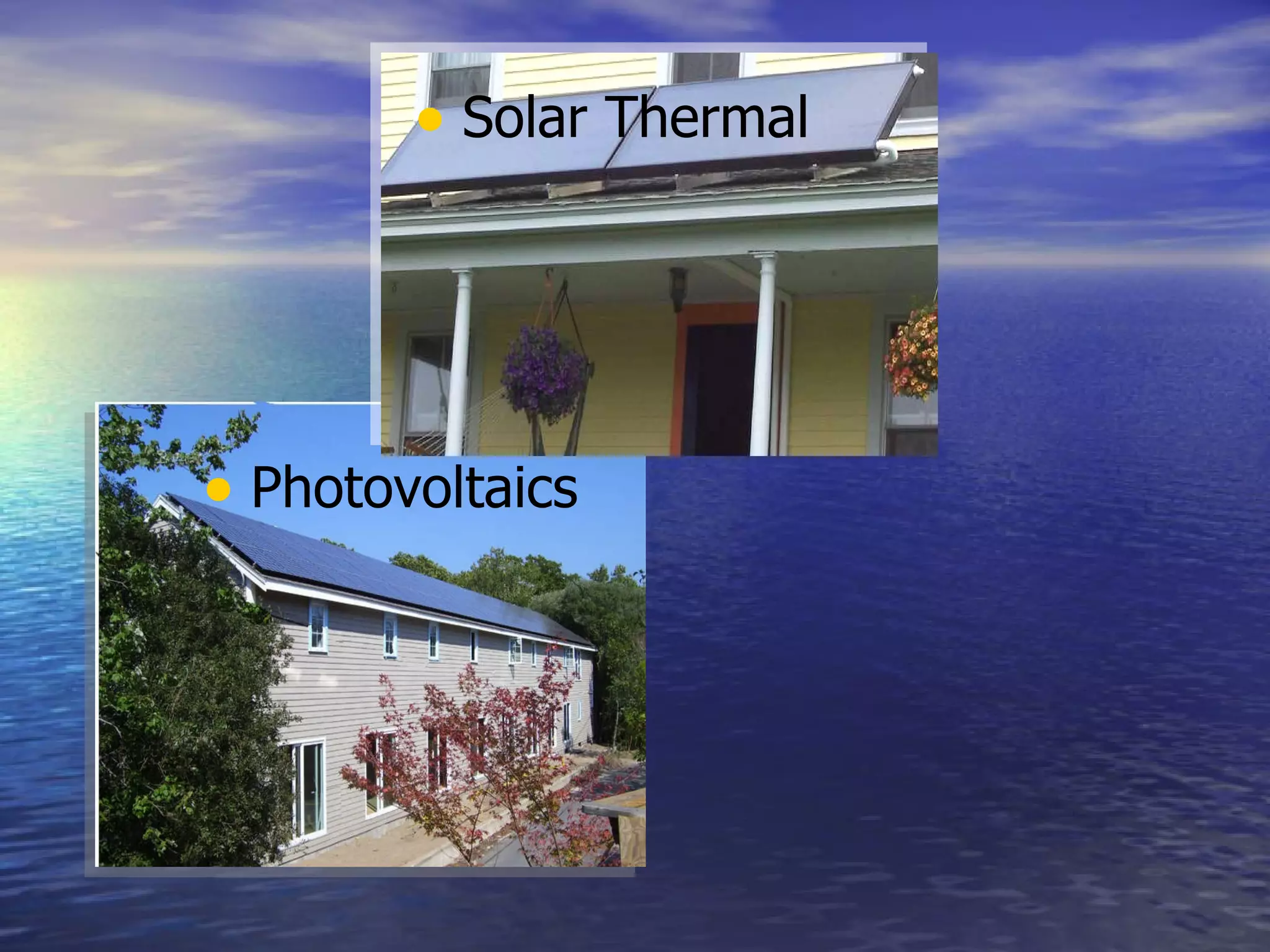
Solar Thermal Photovoltaics
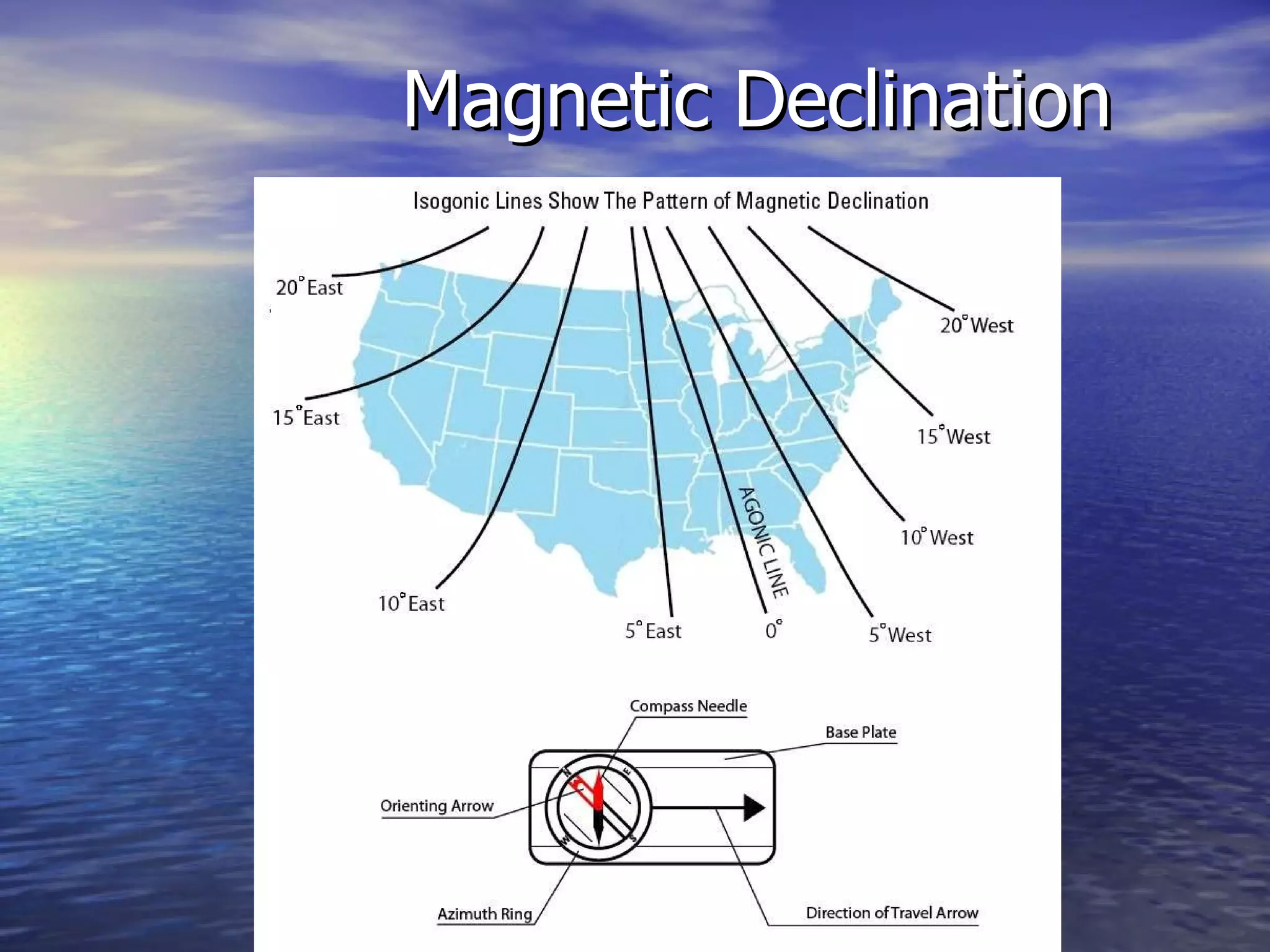
Magnetic Declination
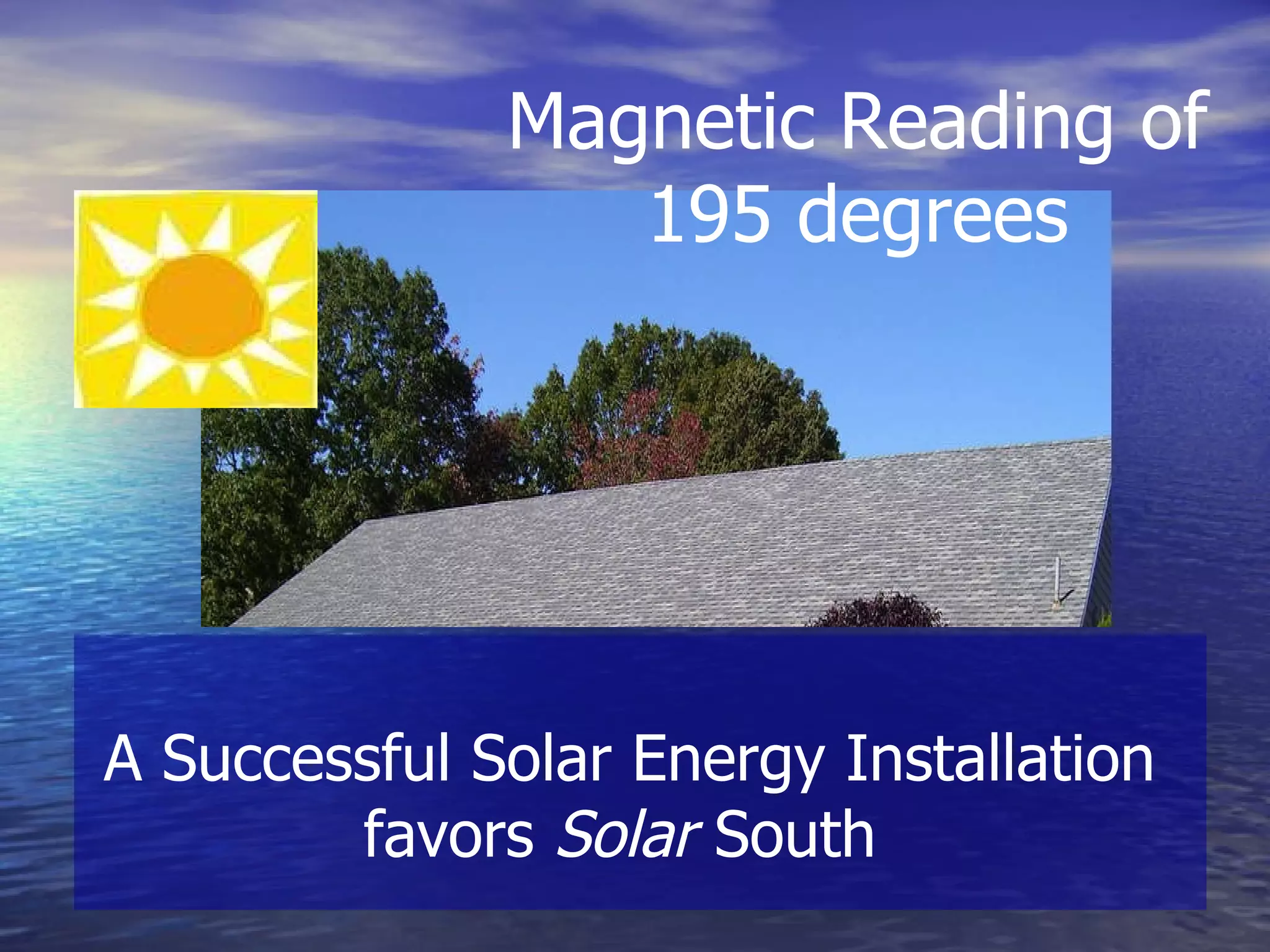
A Successful Solar Energy Installation favors  Solar  South  Magnetic Reading of 195 degrees
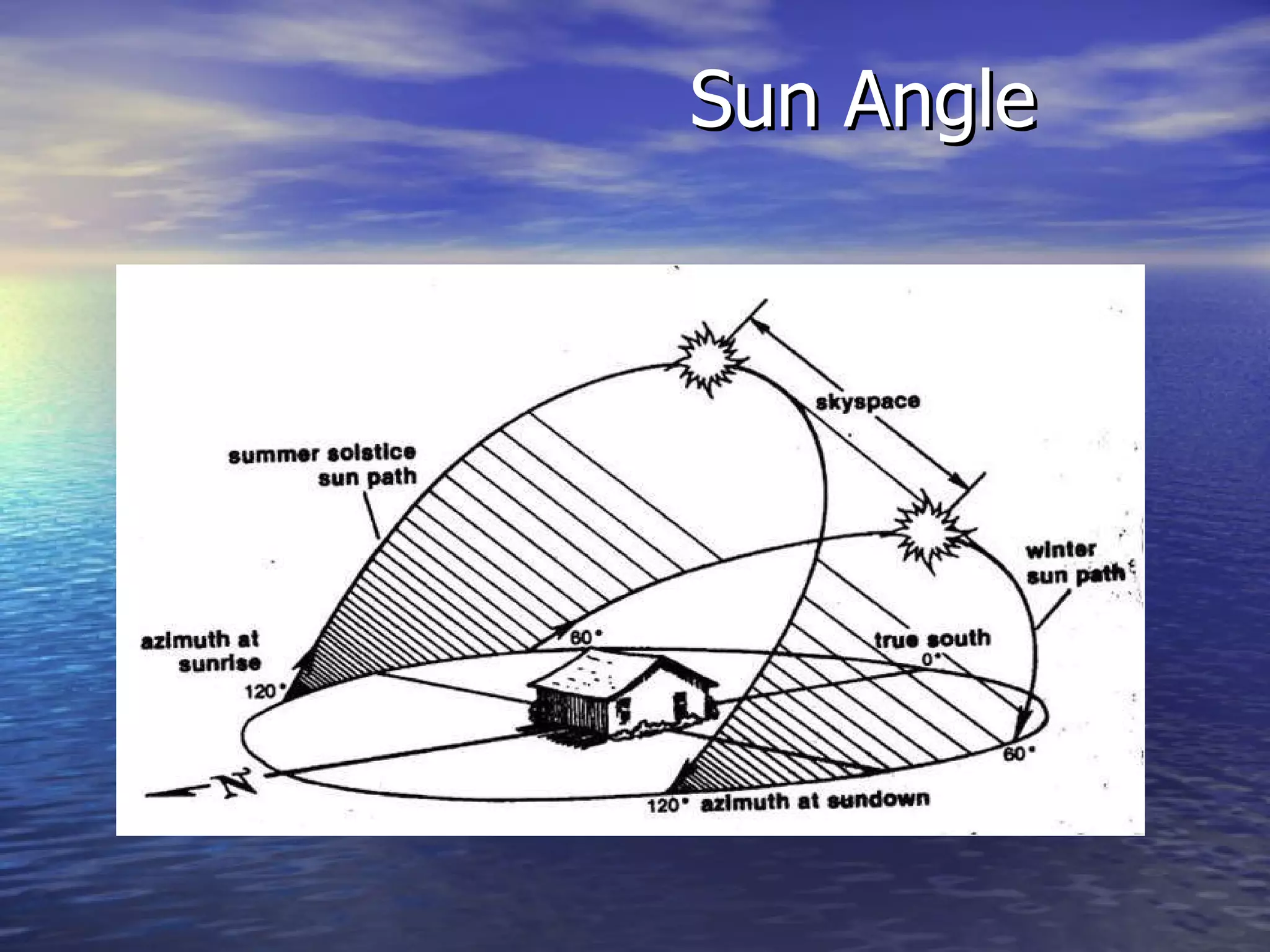
Sun Angle
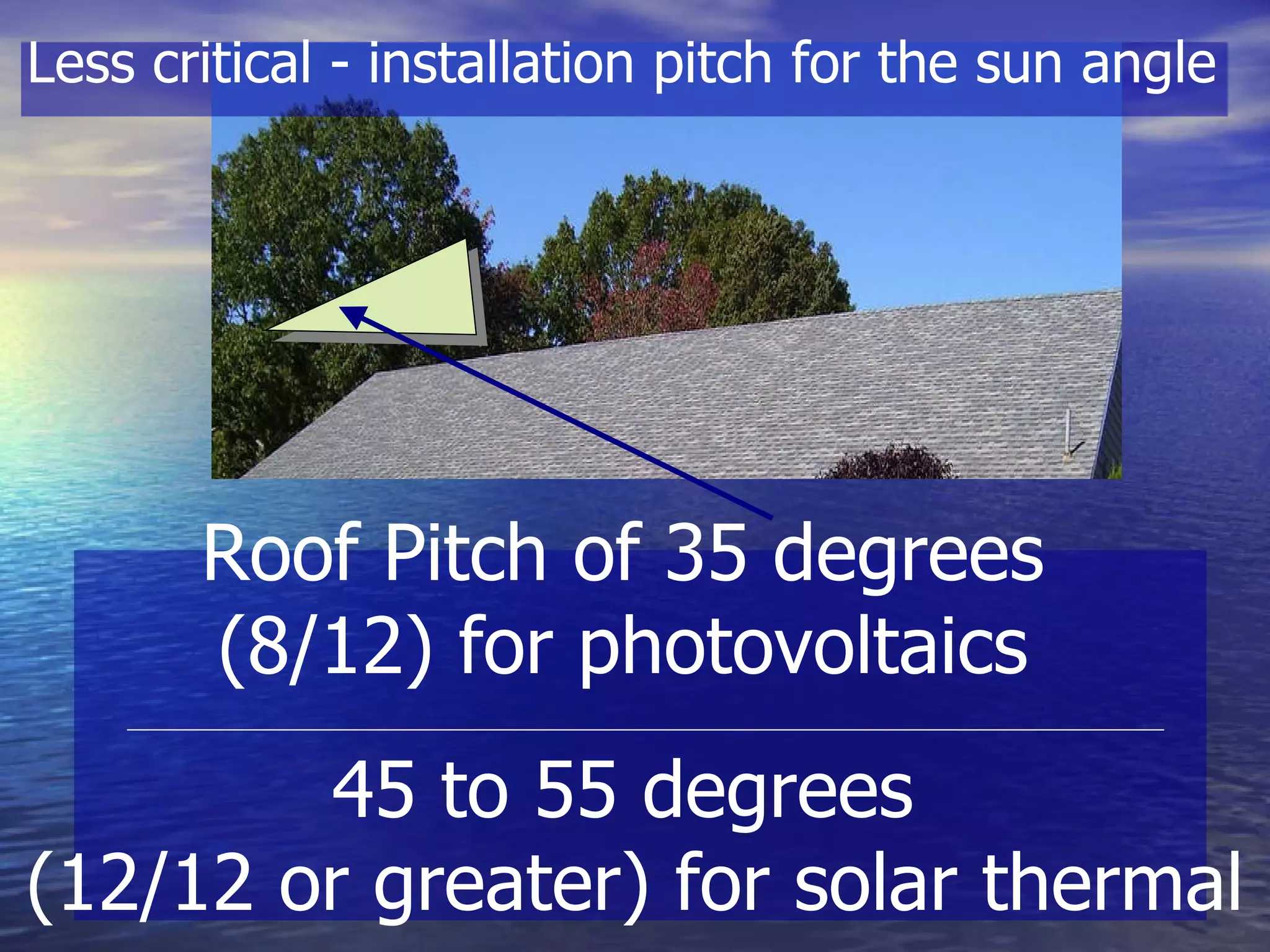
Roof Pitch of 35 degrees  (8/12) for photovoltaics    45 to 55 degrees  (12/12 or greater) for solar thermal Less critical - installation pitch for the sun angle
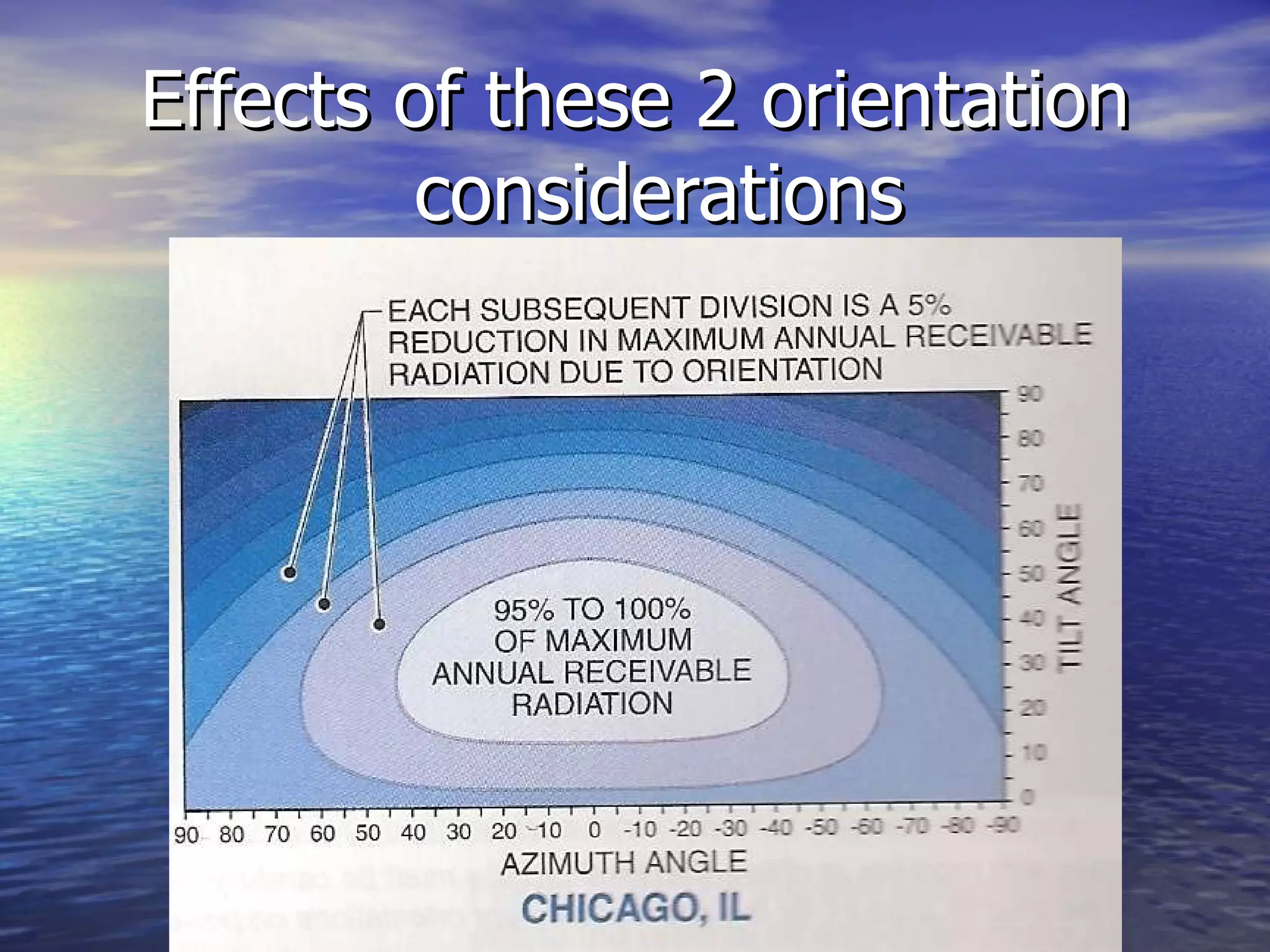
Effects of these 2 orientation considerations
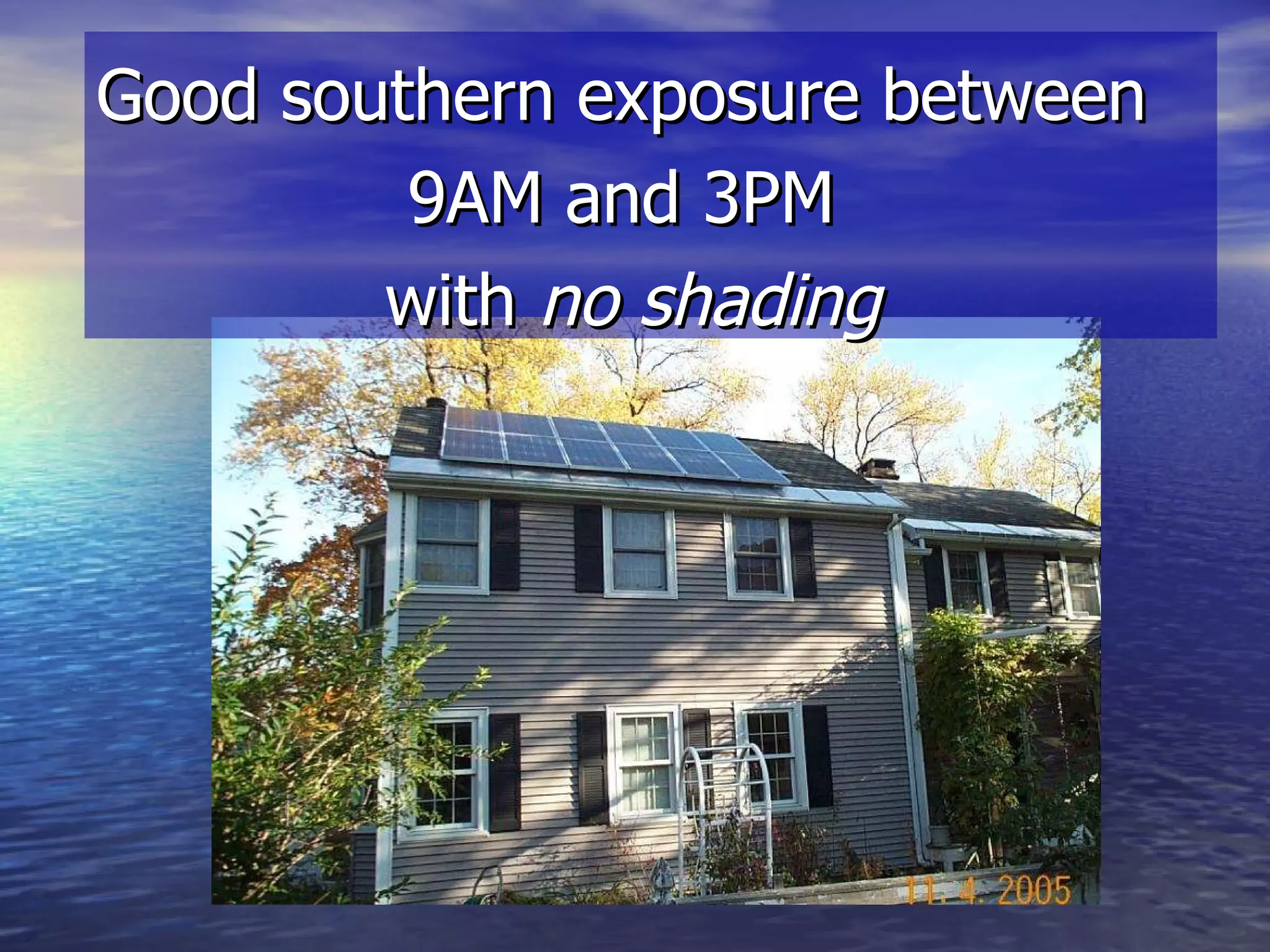
Good southern exposure between  9AM and 3PM  with  no shading
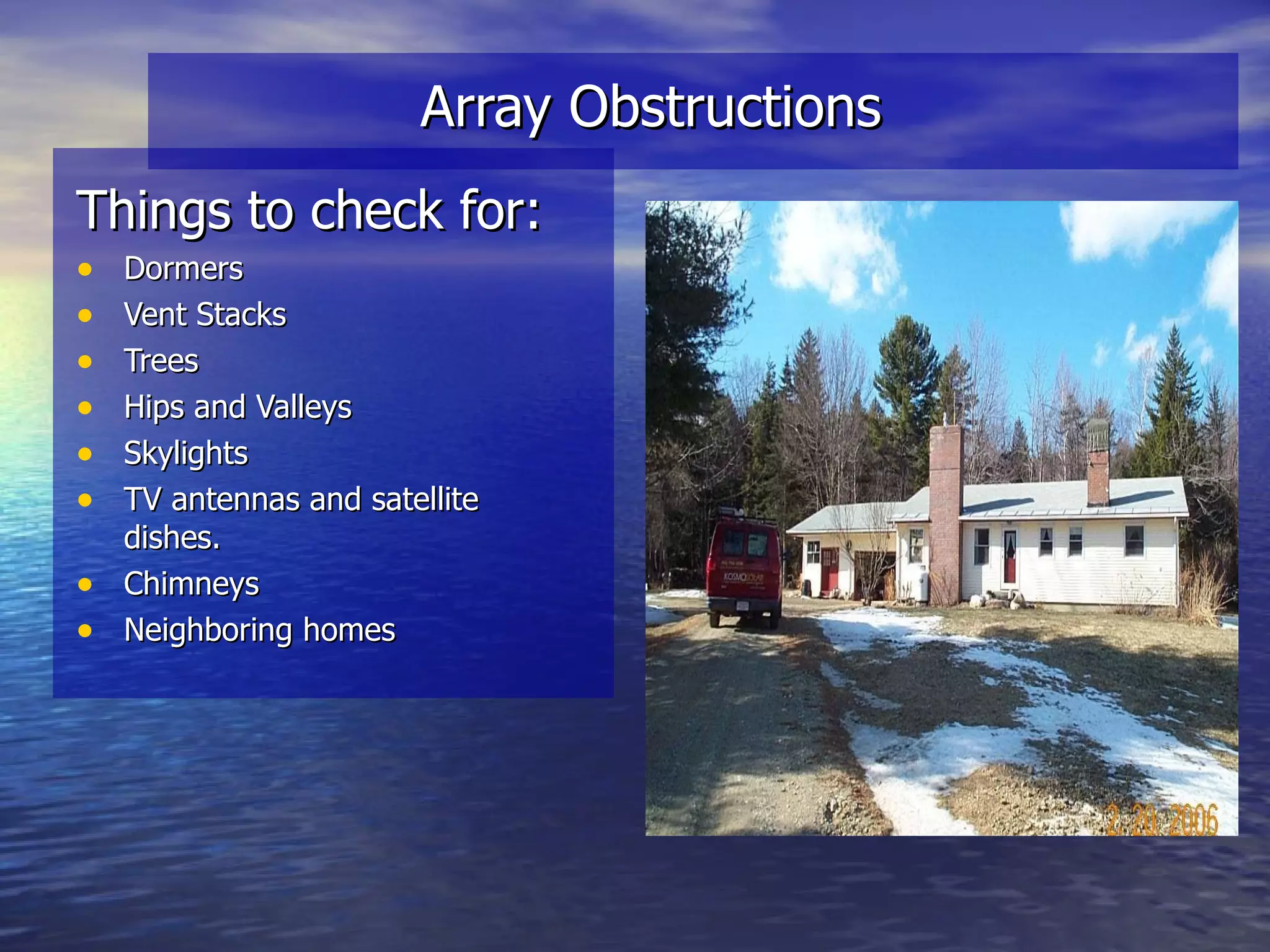
Things to check for: Dormers Vent Stacks Trees Hips and Valleys Skylights TV antennas and satellite dishes. Chimneys Neighboring homes Array Obstructions
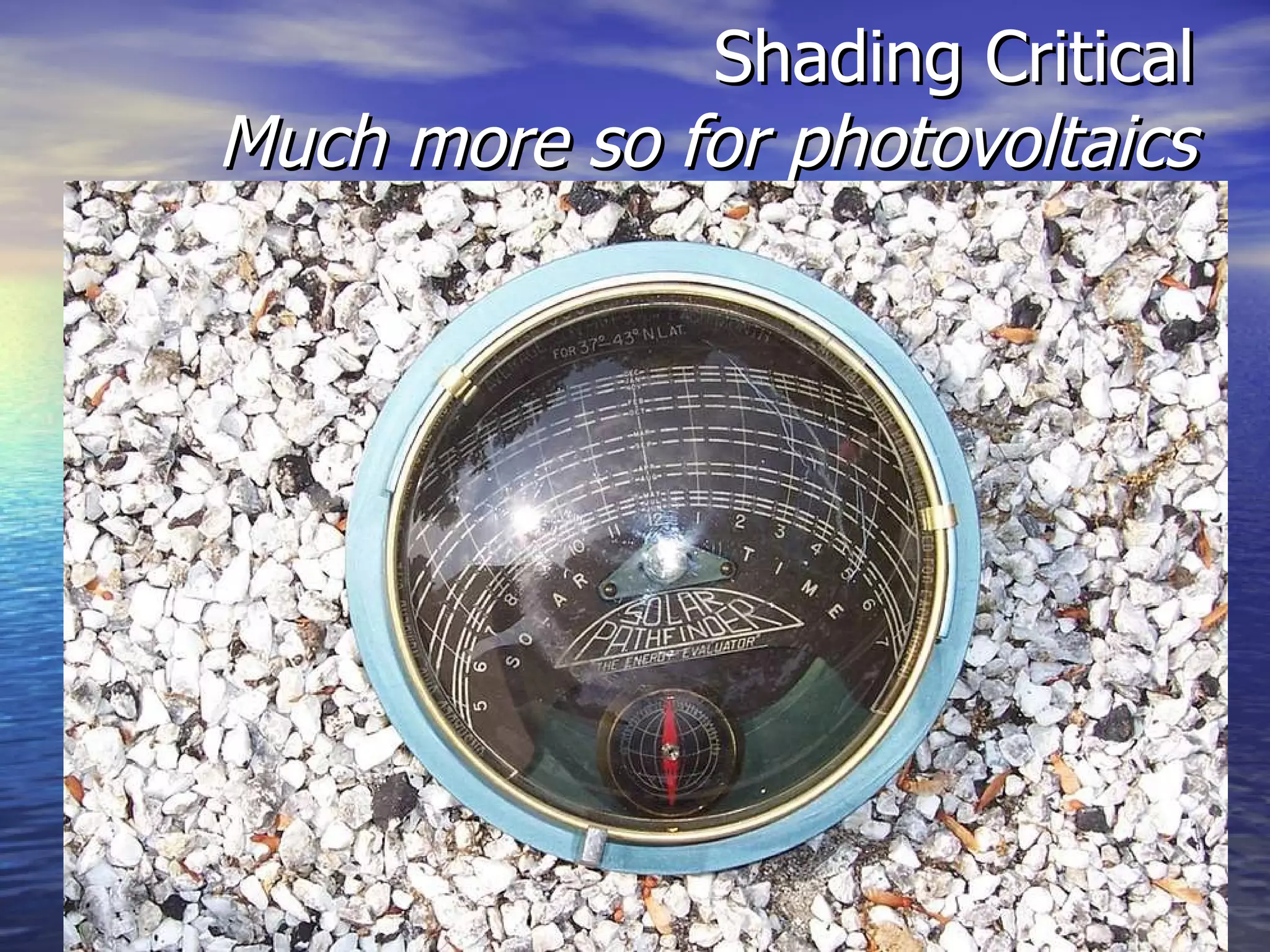
Shading Critical Much more so for photovoltaics
Solar Thermal Photovoltaics
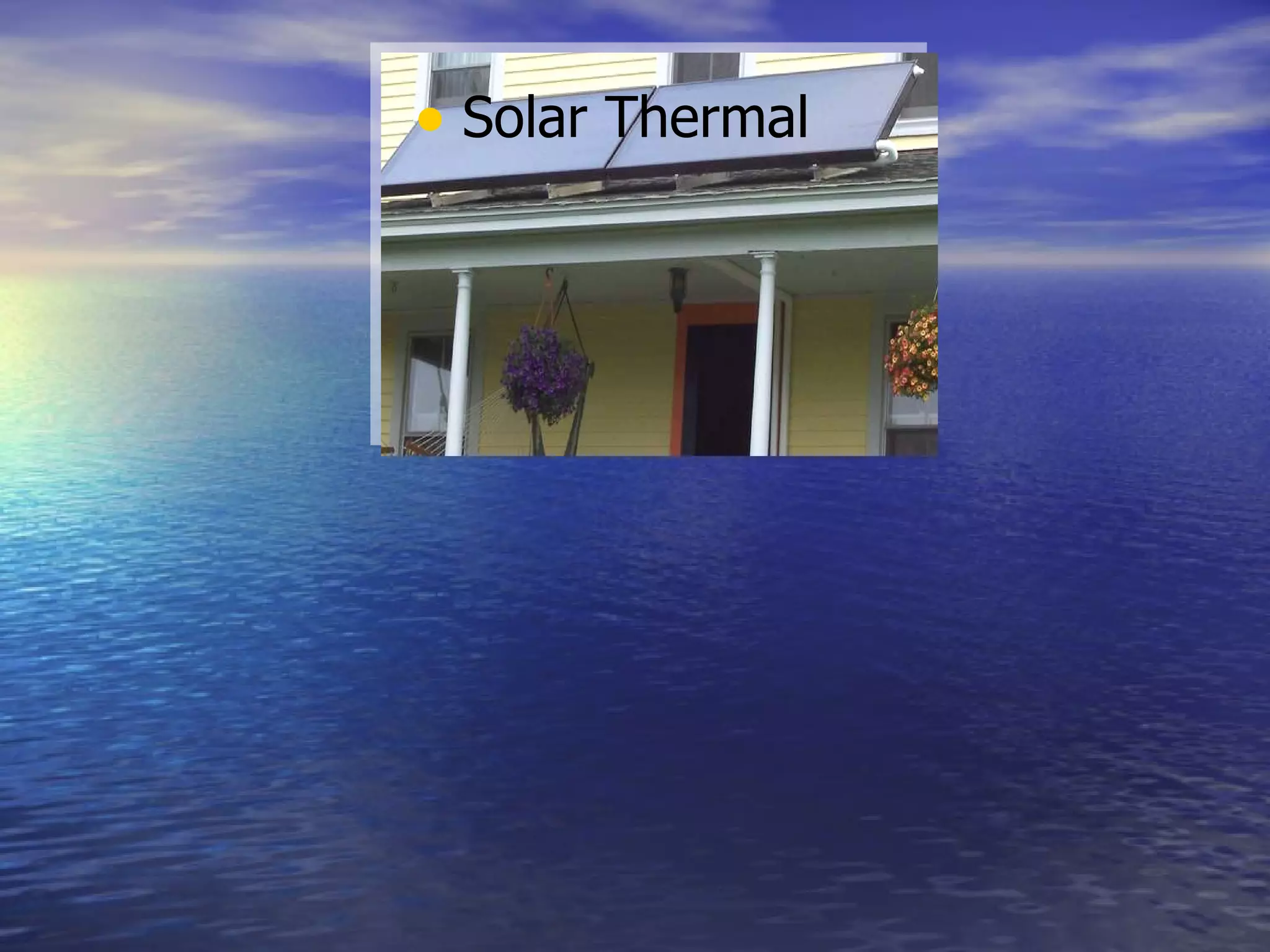
Solar Thermal
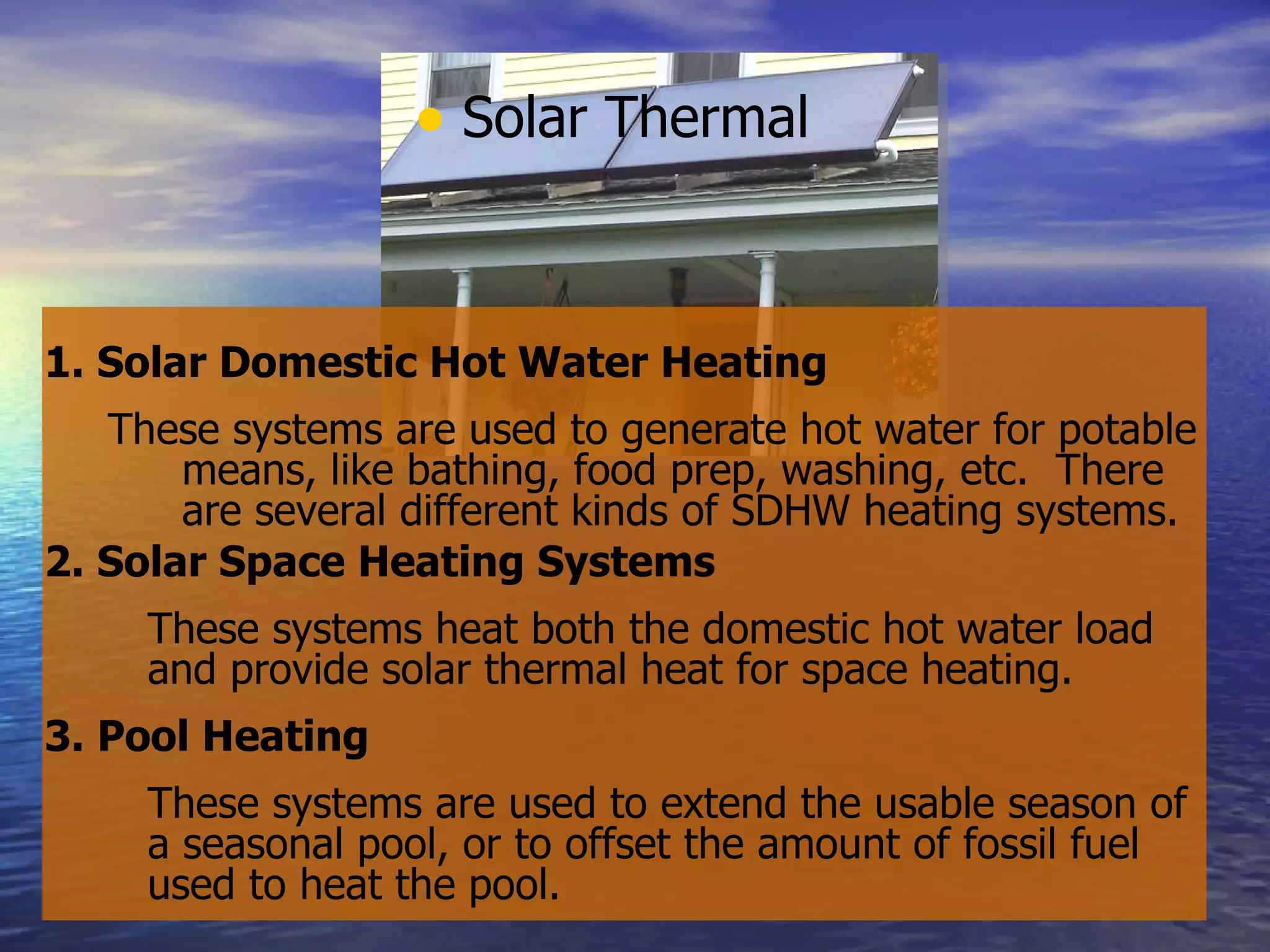
Solar Thermal 1. Solar Domestic Hot Water Heating These systems are used to generate hot water for potable means, like bathing, food prep, washing, etc.  There are several different kinds of SDHW heating systems. 2. Solar Space Heating Systems   These systems heat both the domestic hot water load and provide solar thermal heat for space heating. 3. Pool Heating These systems are used to extend the usable season of a seasonal pool, or to offset the amount of fossil fuel used to heat the pool.
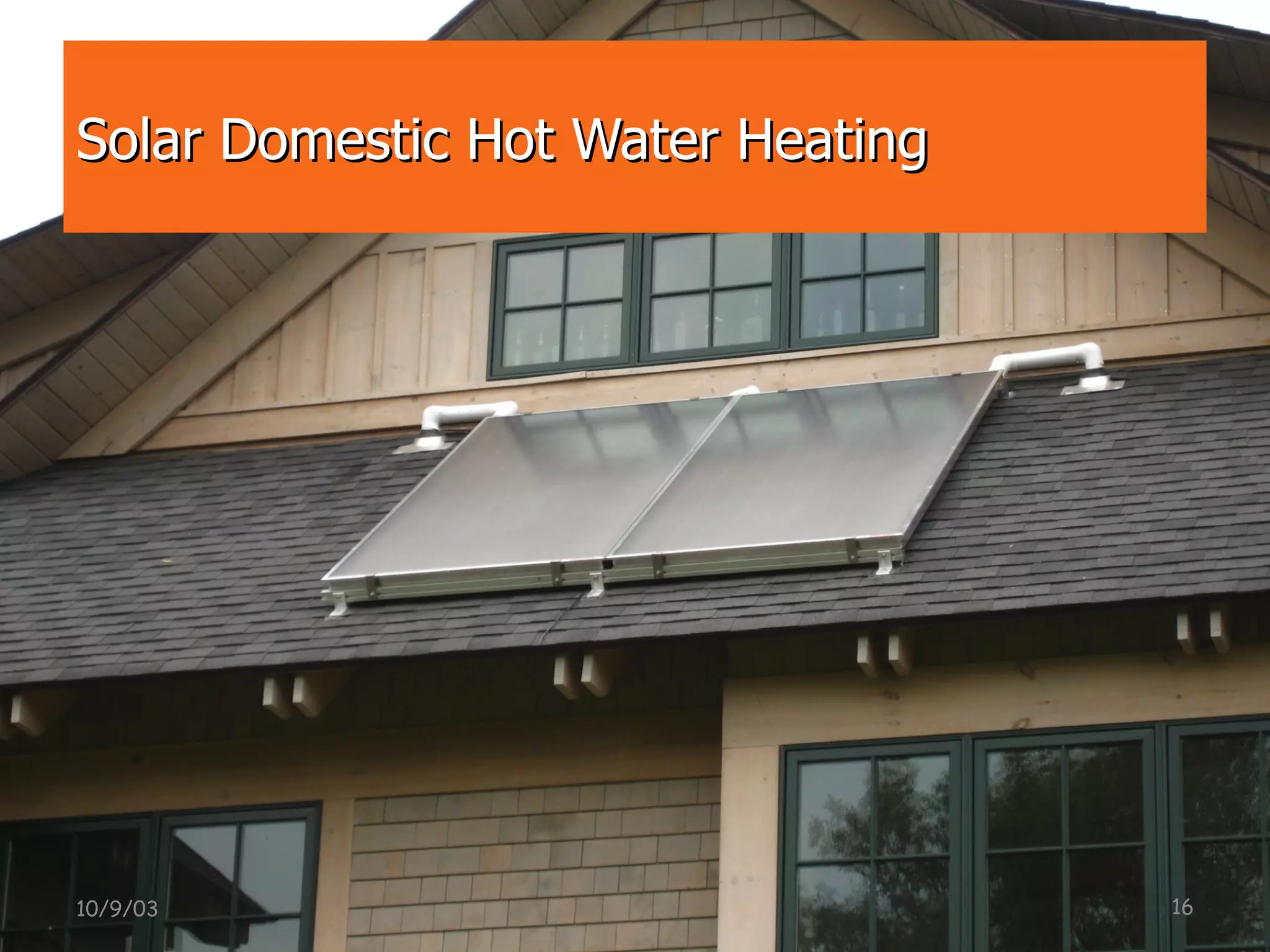
Solar Domestic Hot Water Heating 10/9/03
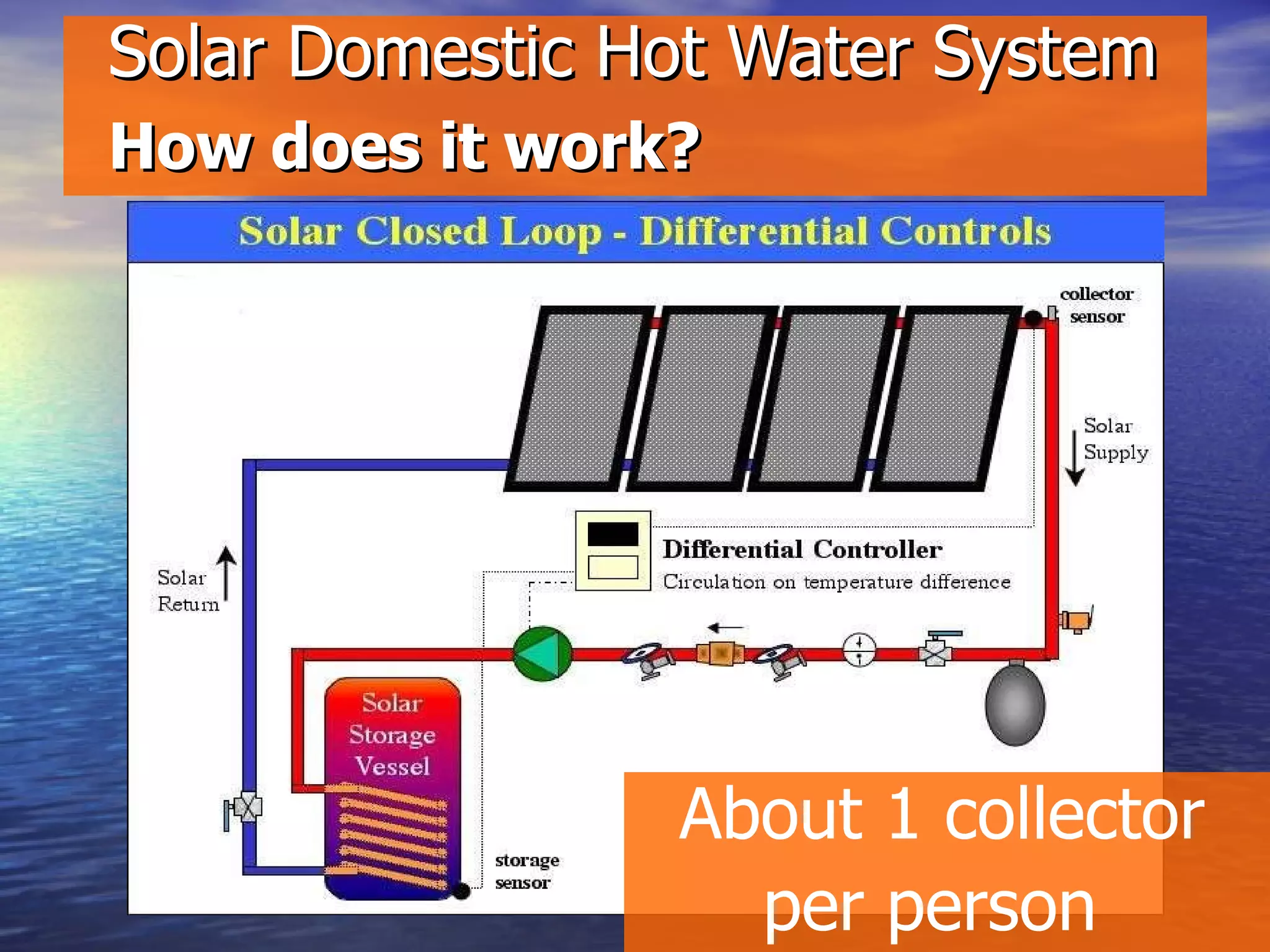
Solar Domestic Hot Water System  How does it work?   About 1 collector per person
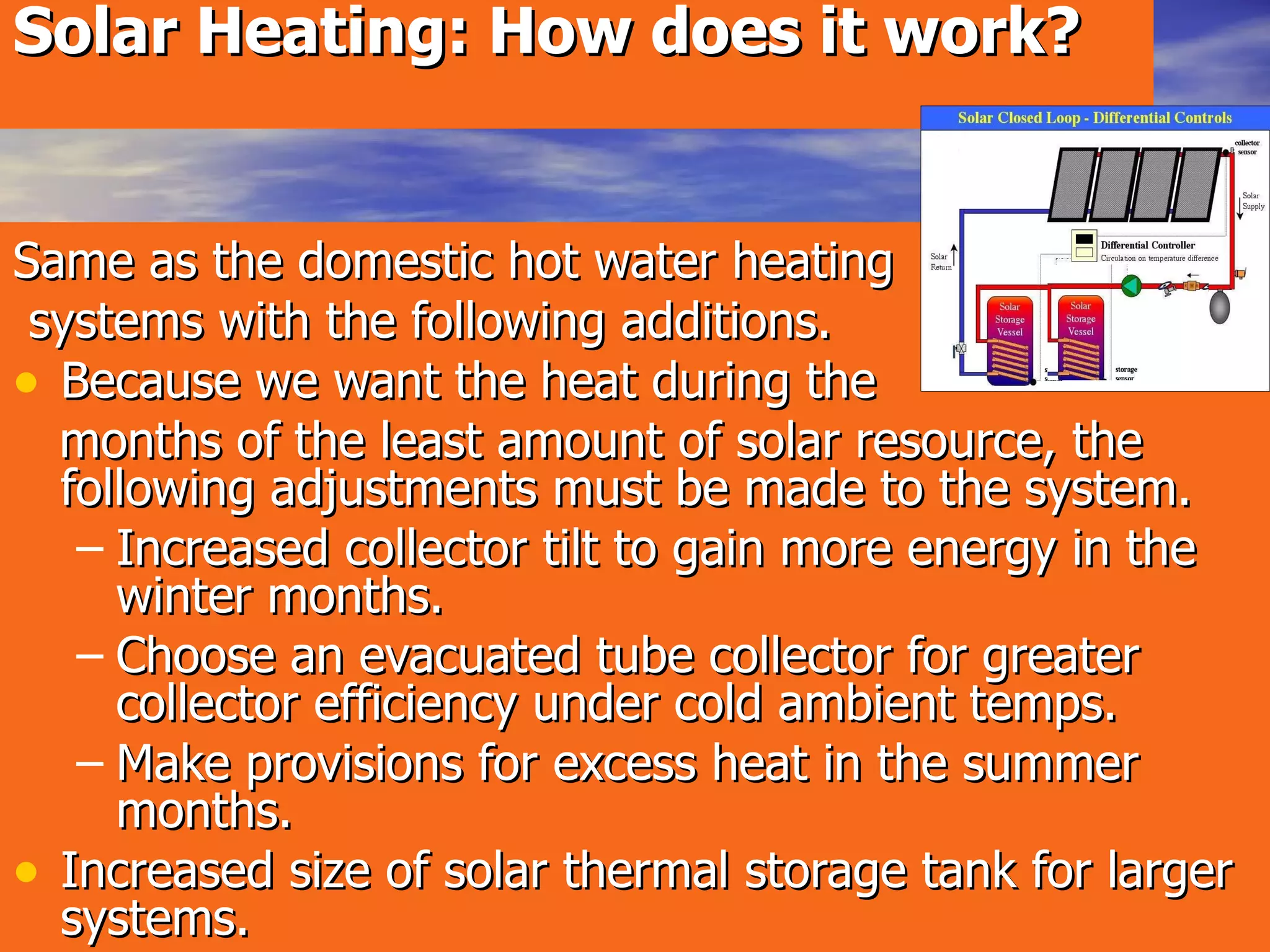
Solar Heating: How does it work?   Same as the domestic hot water heating systems with the following additions. Because we want the heat during the  months of the least amount of solar resource, the following adjustments must be made to the system. Increased collector tilt to gain more energy in the winter months. Choose an evacuated tube collector for greater collector efficiency under cold ambient temps. Make provisions for excess heat in the summer months. Increased size of solar thermal storage tank for larger systems.
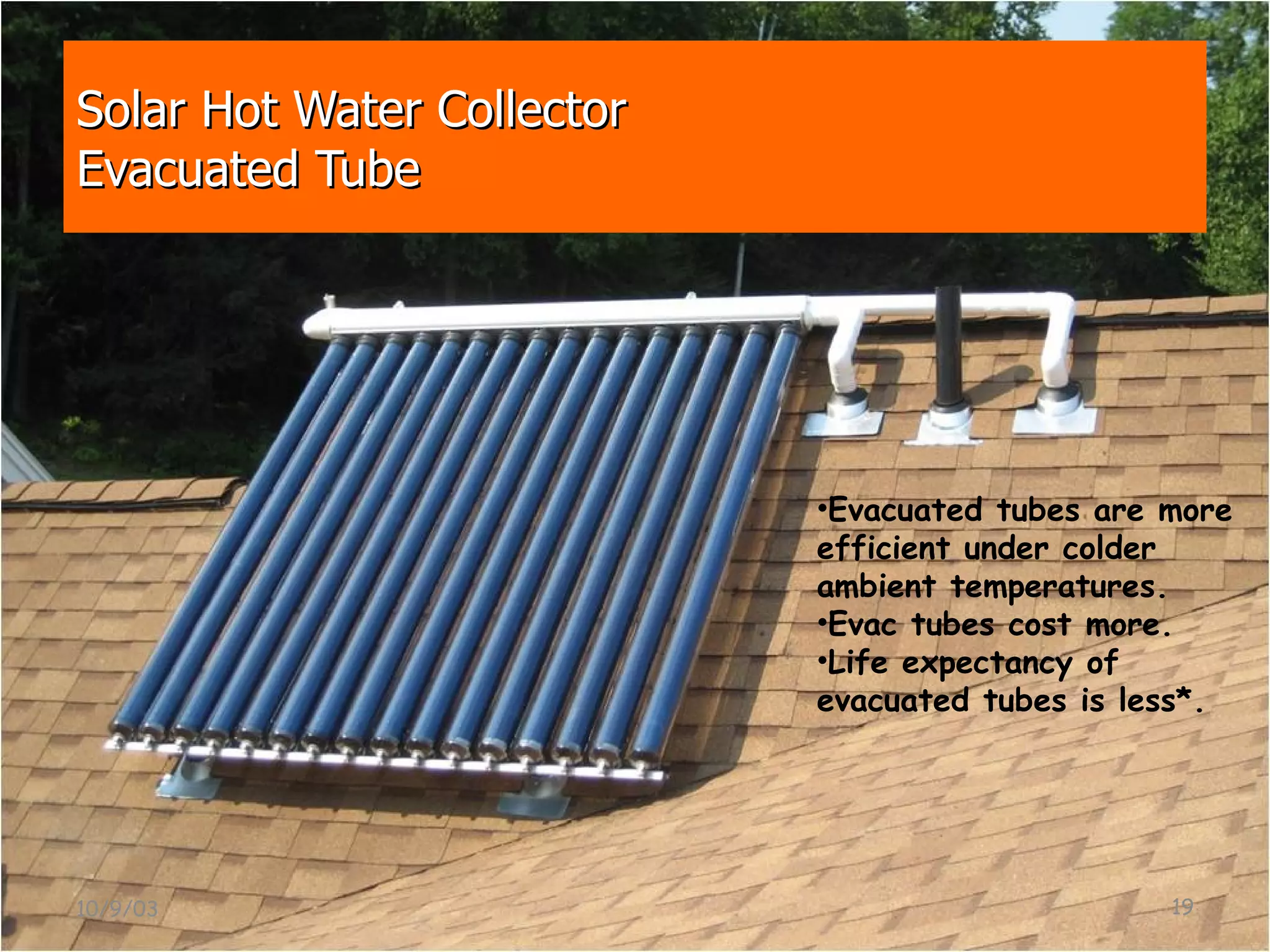
Solar Hot Water Collector Evacuated Tube 10/9/03 Evacuated tubes are more efficient under colder ambient temperatures. Evac tubes cost more. Life expectancy of evacuated tubes is less*.
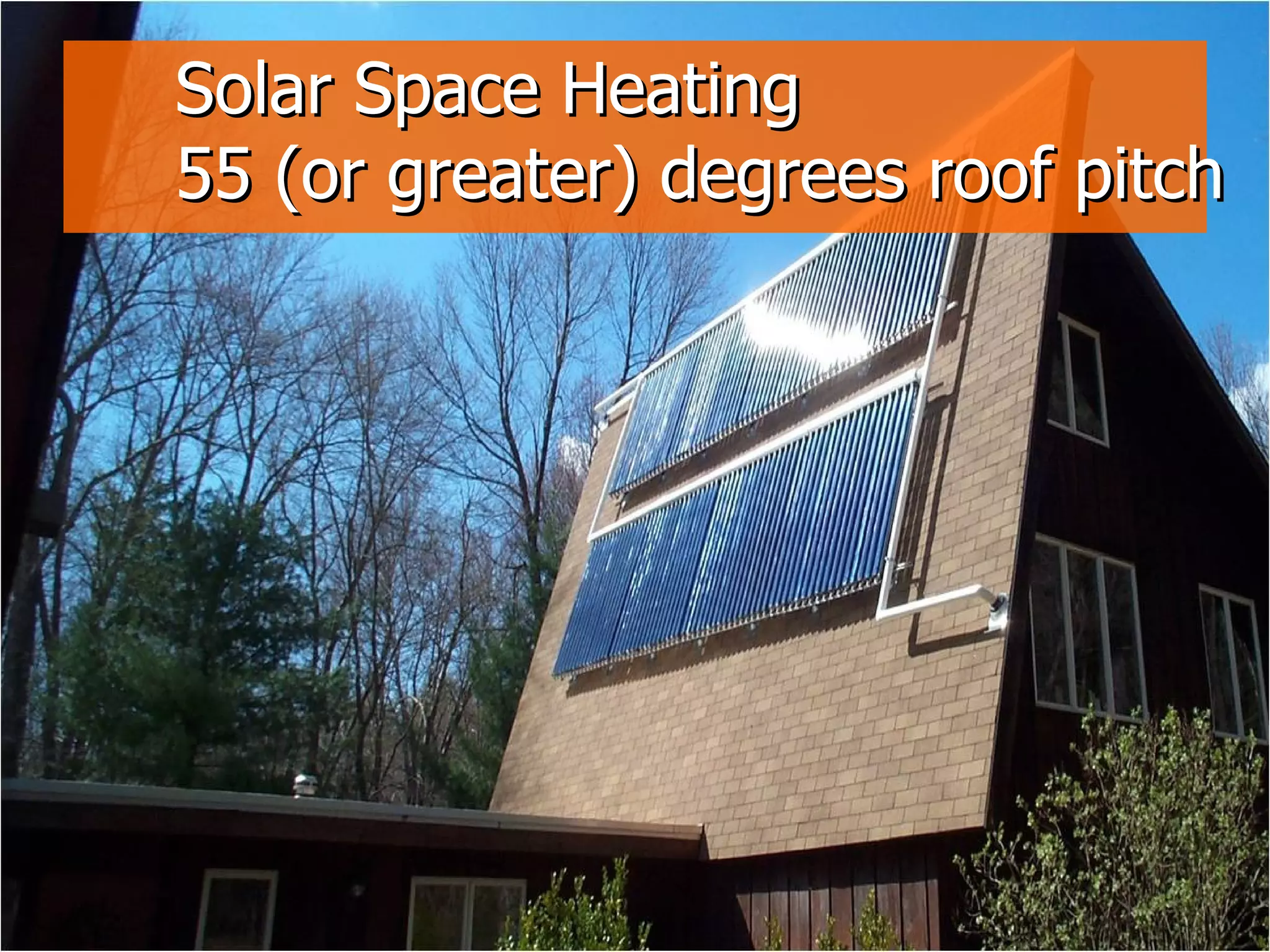
Solar Space Heating 55 (or greater) degrees roof pitch
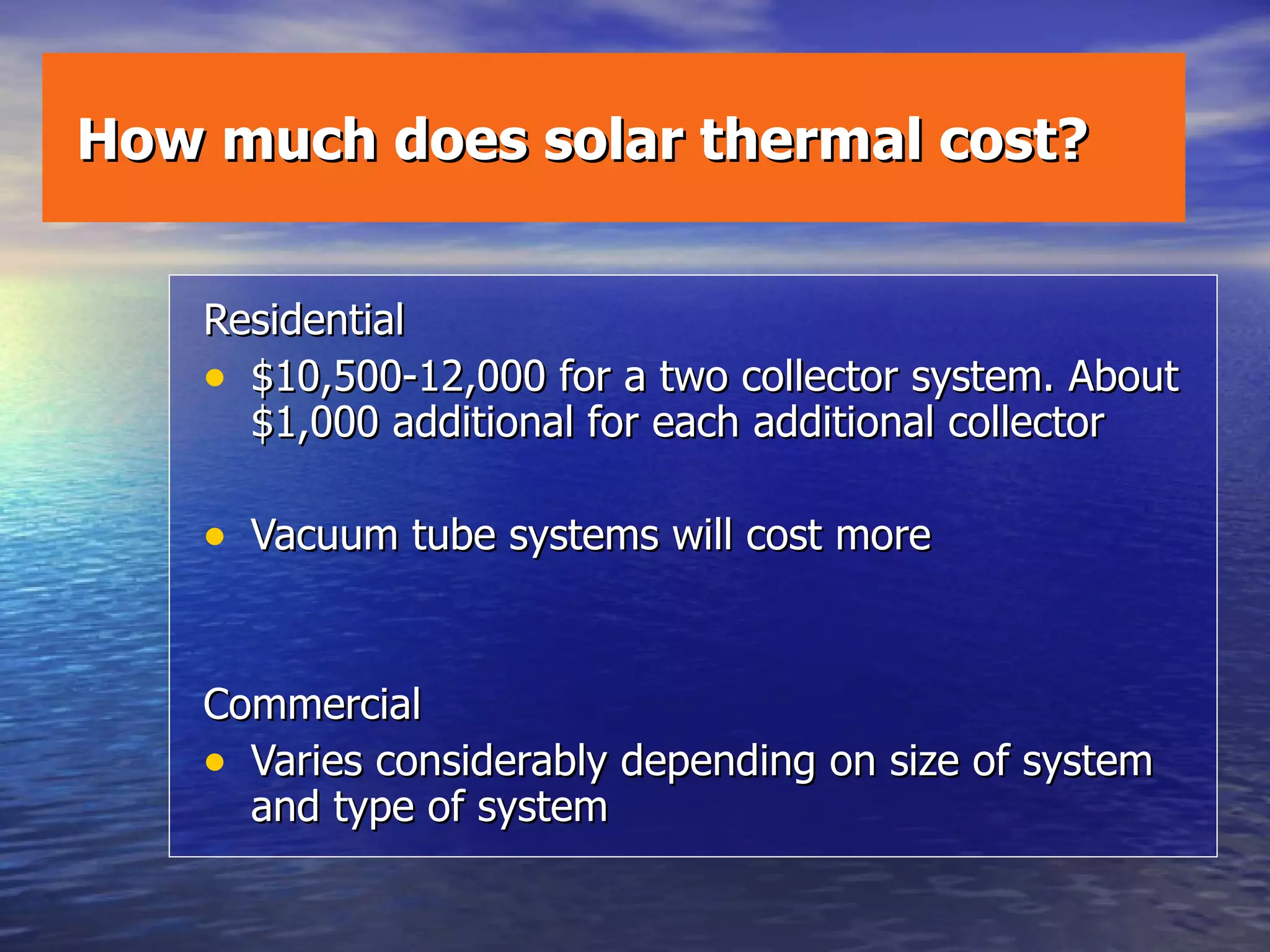
How much does solar thermal cost? Residential $10,500-12,000 for a two collector system. About $1,000 additional for each additional collector Vacuum tube systems will cost more Commercial Varies considerably depending on size of system and type of system
With the following financial assumptions: Federal government tax credit totaling $2,000.  National Grid rebate of up to $1,500.00 for its gas customers. Life expectancy of the solar thermal system 20 years (warrantees for 20 on modules/7 on tanks) $200 maintenance charge every 5 years. Will eliminate about 75% of current fossil fuel costs to heat water currently. What is the return on my solar domestic hot water investment?
With the following financial assumptions: Federal government tax credit totaling $2,000.  National Grid rebate of up to $1,500.00 for its gas customers. Life expectancy of the solar thermal system 20 years (warrantees for 20 on modules/7 on tanks) $200 maintenance charge every 5 years. Will eliminate about 75% of current fossil fuel costs to heat water currently. What is the return on my solar domestic hot water investment? From 5 – 7 year Payback
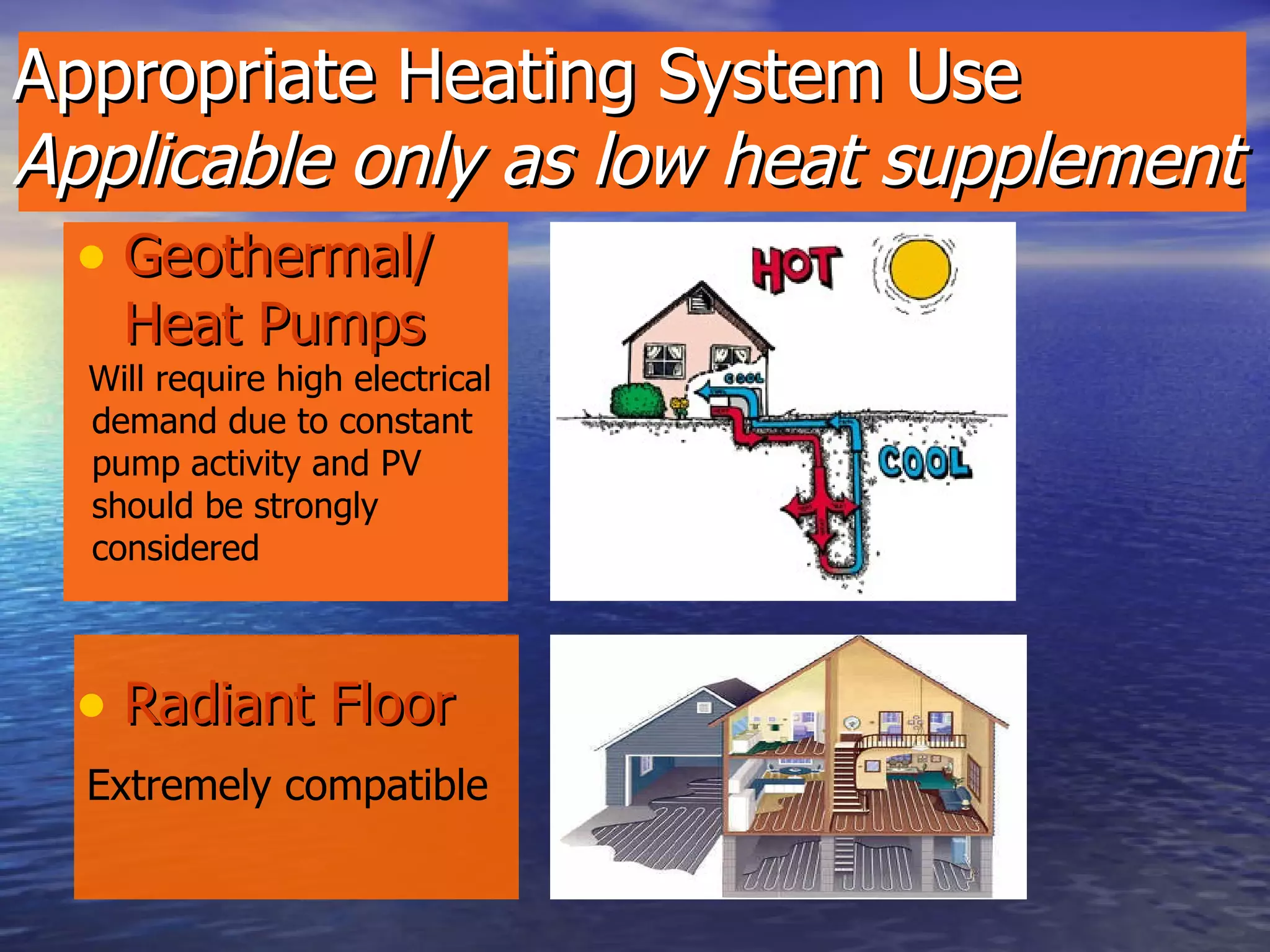
Appropriate Heating System Use Applicable only as low heat supplement   Geothermal/Heat Pumps Radiant Floor Will require high electrical demand due to constant pump activity and PV should be strongly considered Extremely compatible
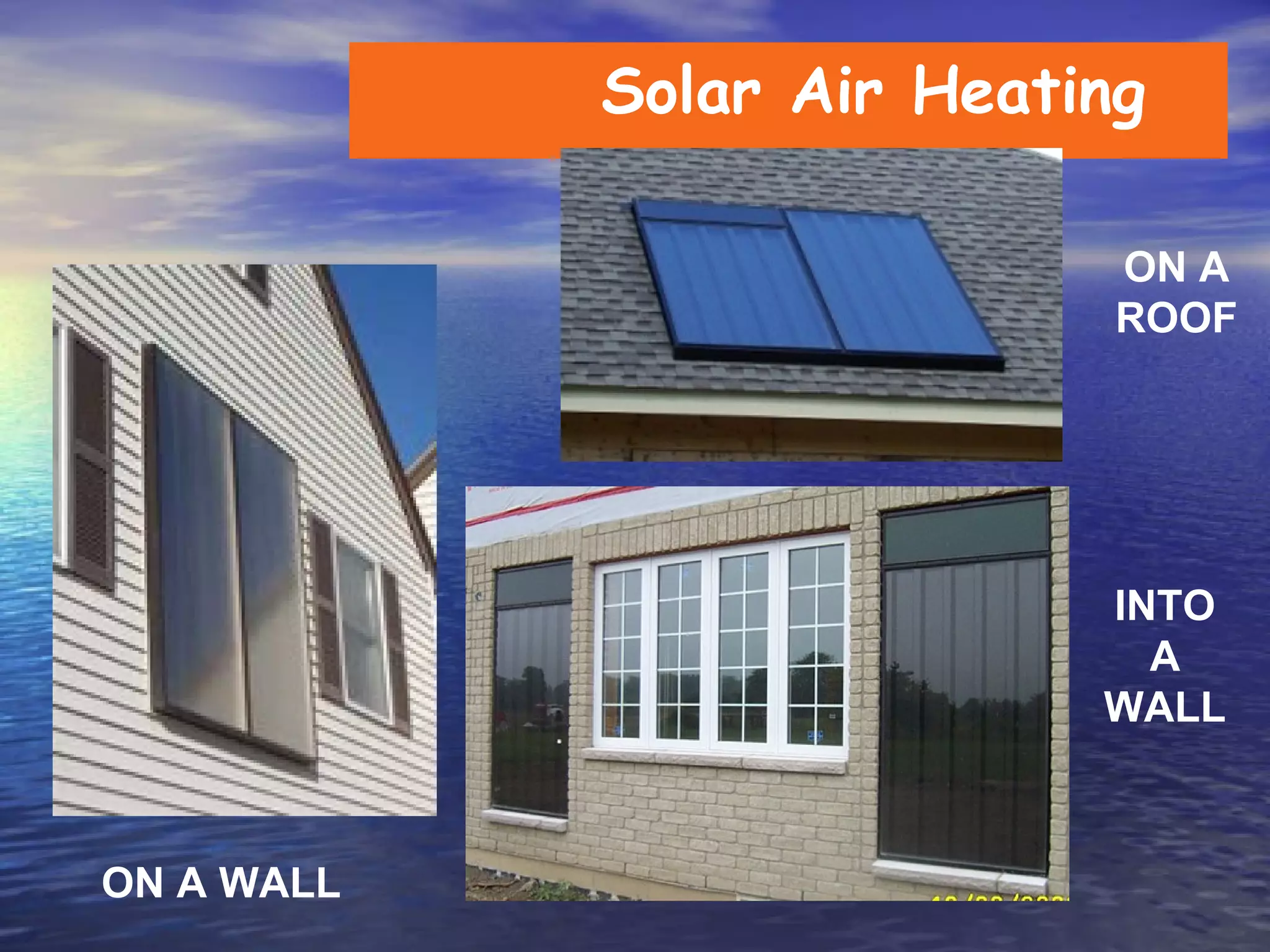
Solar Air Heating ON A ROOF INTO A WALL ON A WALL
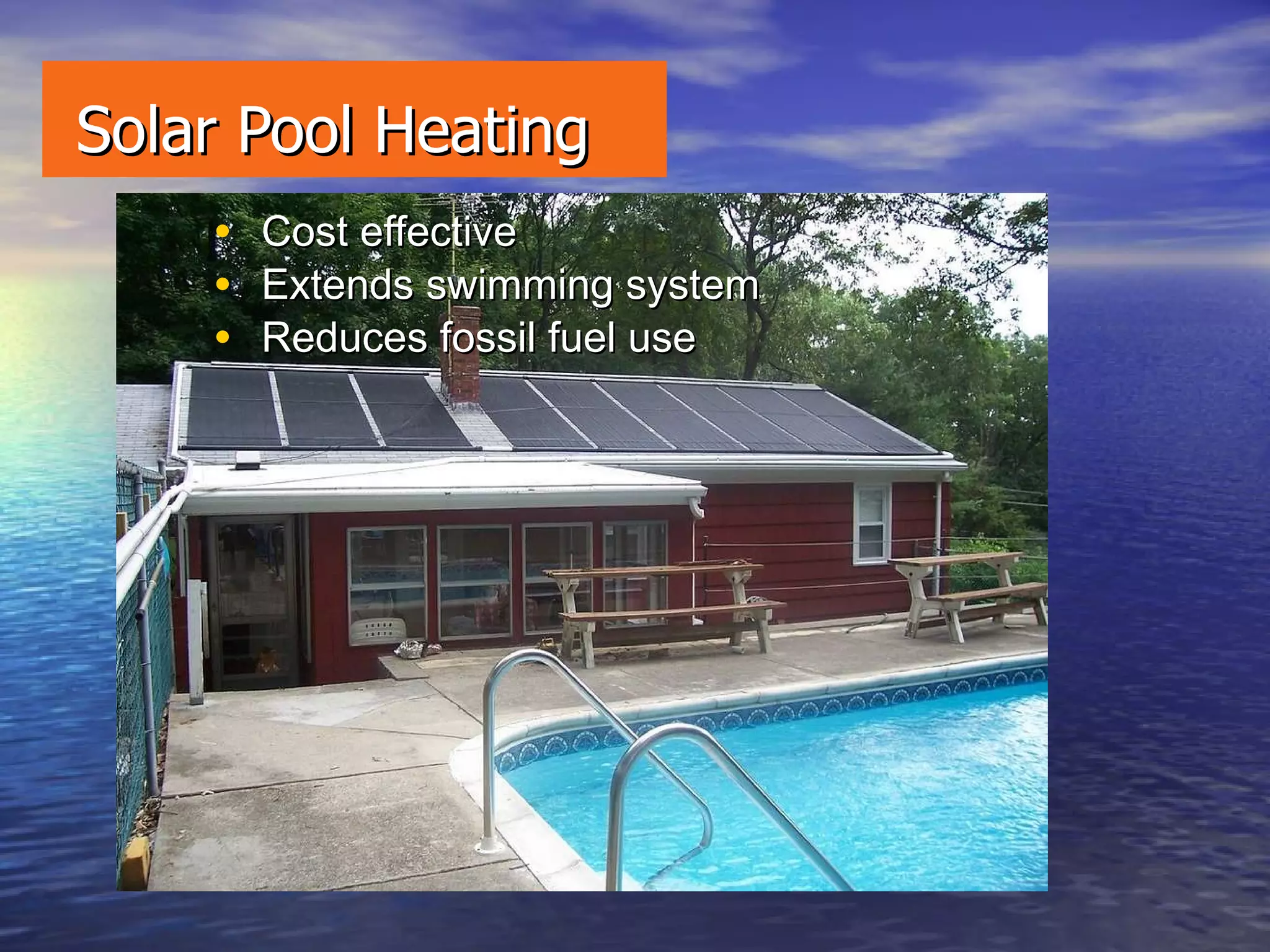
Solar Pool Heating Cost effective Extends swimming system Reduces fossil fuel use
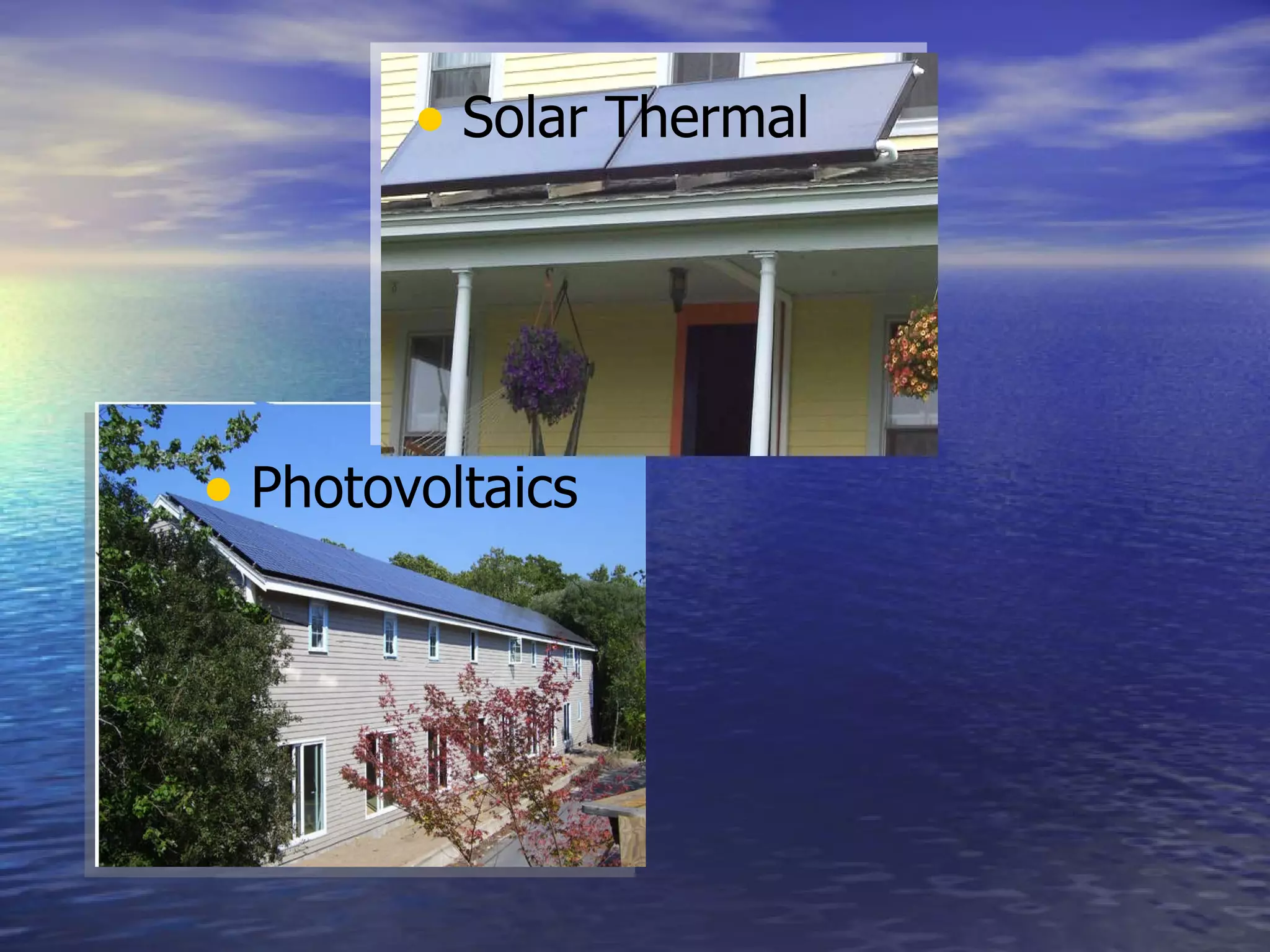
Solar Thermal Photovoltaics
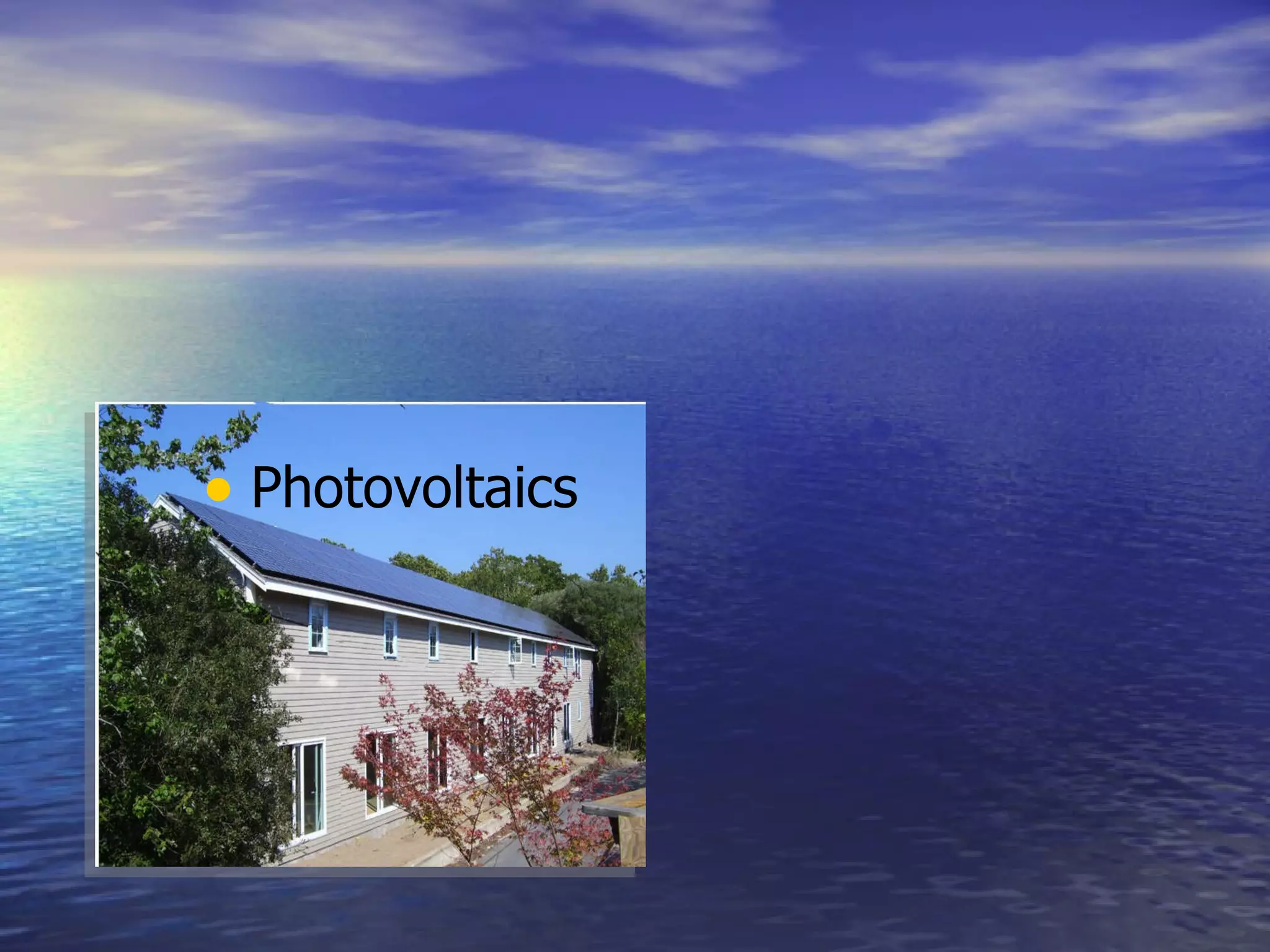
Photovoltaics
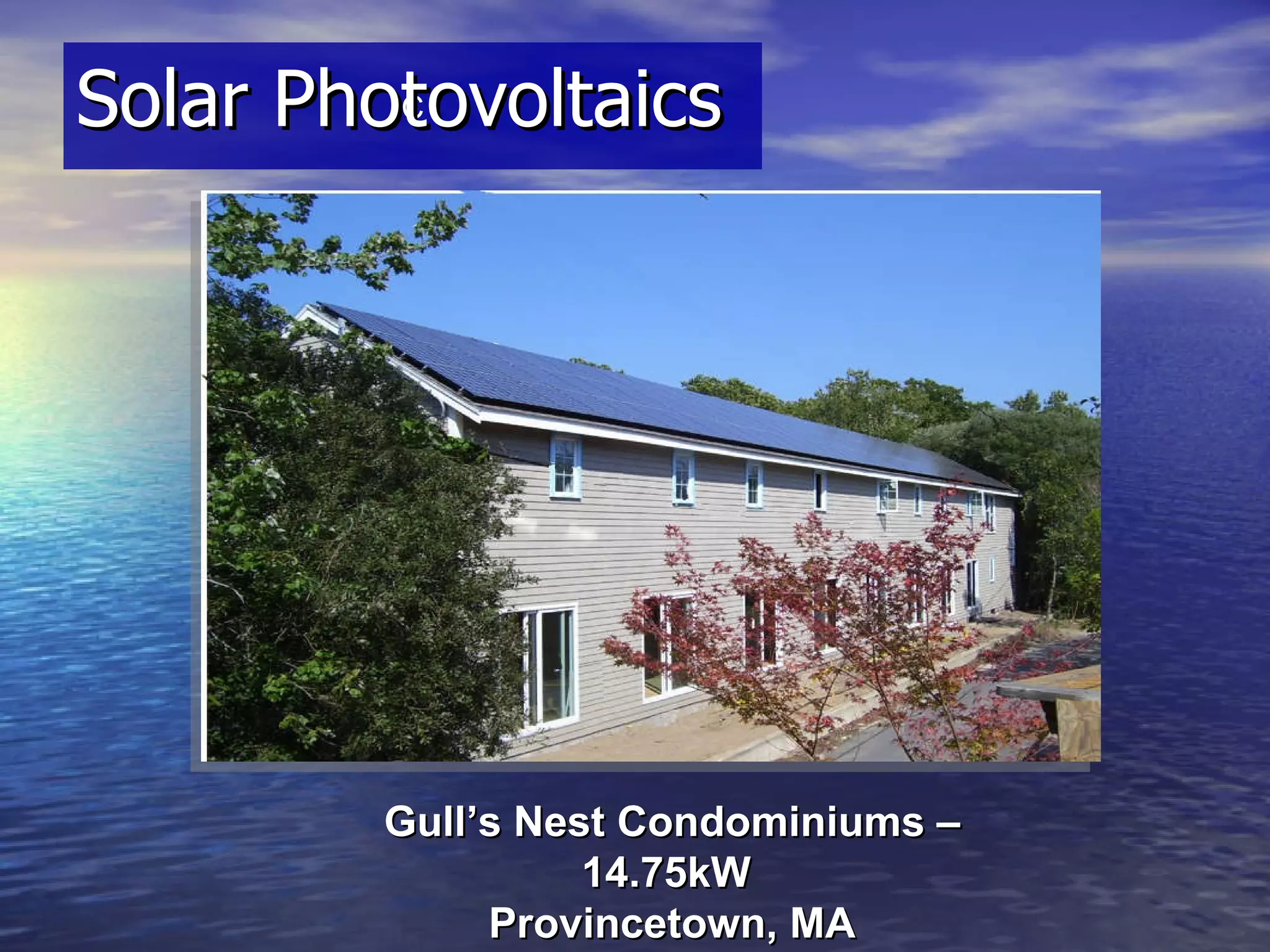
Solar Photovoltaics C Gull’s Nest Condominiums – 14.75kW  Provincetown, MA
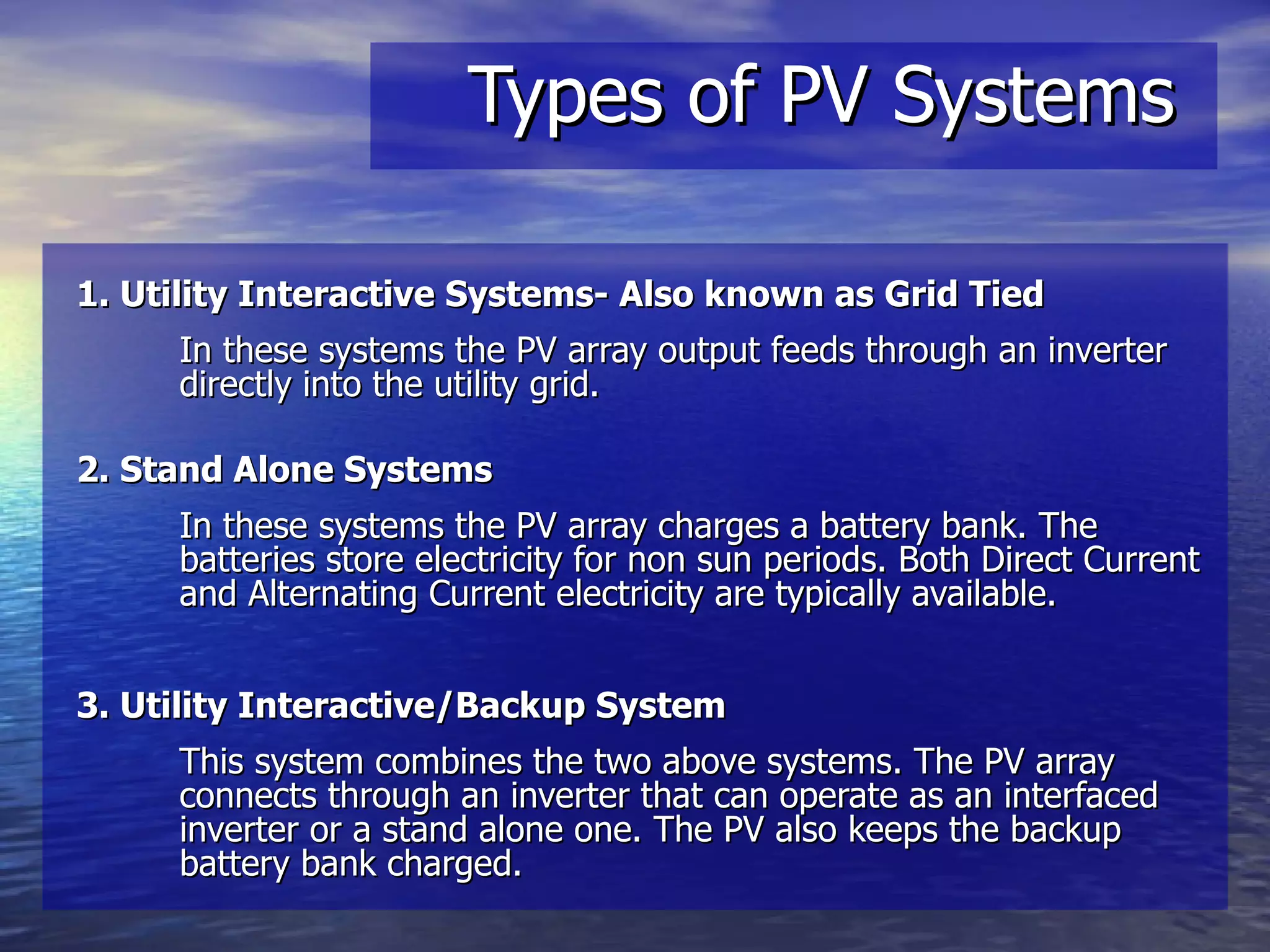
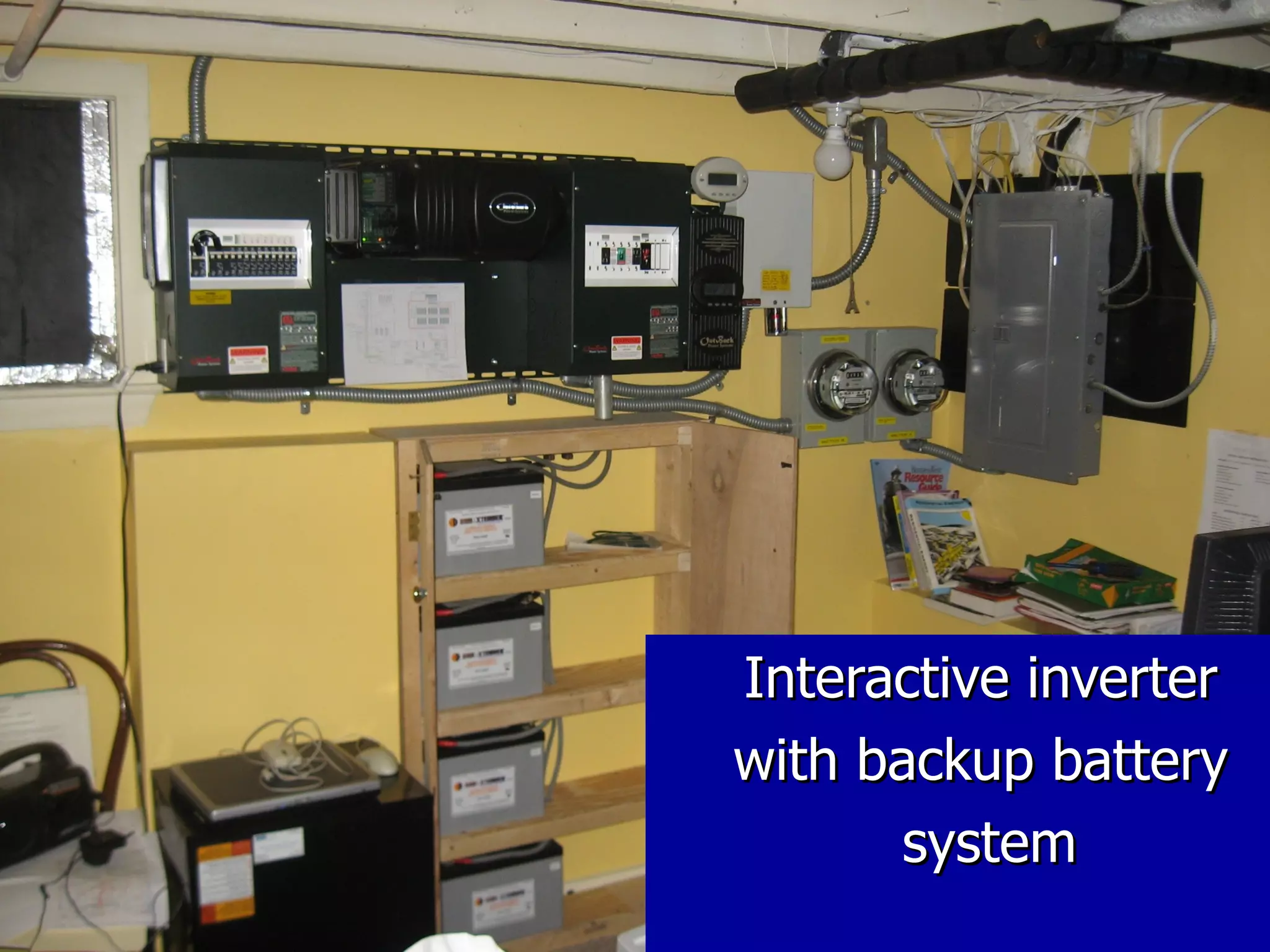
Types of PV Systems 1. Utility Interactive Systems- Also known as Grid Tied In these systems the PV array output feeds through an inverter directly into the utility grid.  2. Stand Alone Systems   In these systems the PV array charges a battery bank. The batteries store electricity for non sun periods. Both Direct Current and Alternating Current electricity are typically available. 3. Utility Interactive/Backup System This system combines the two above systems. The PV array connects through an inverter that can operate as an interfaced inverter or a stand alone one. The PV also keeps the backup battery bank charged.
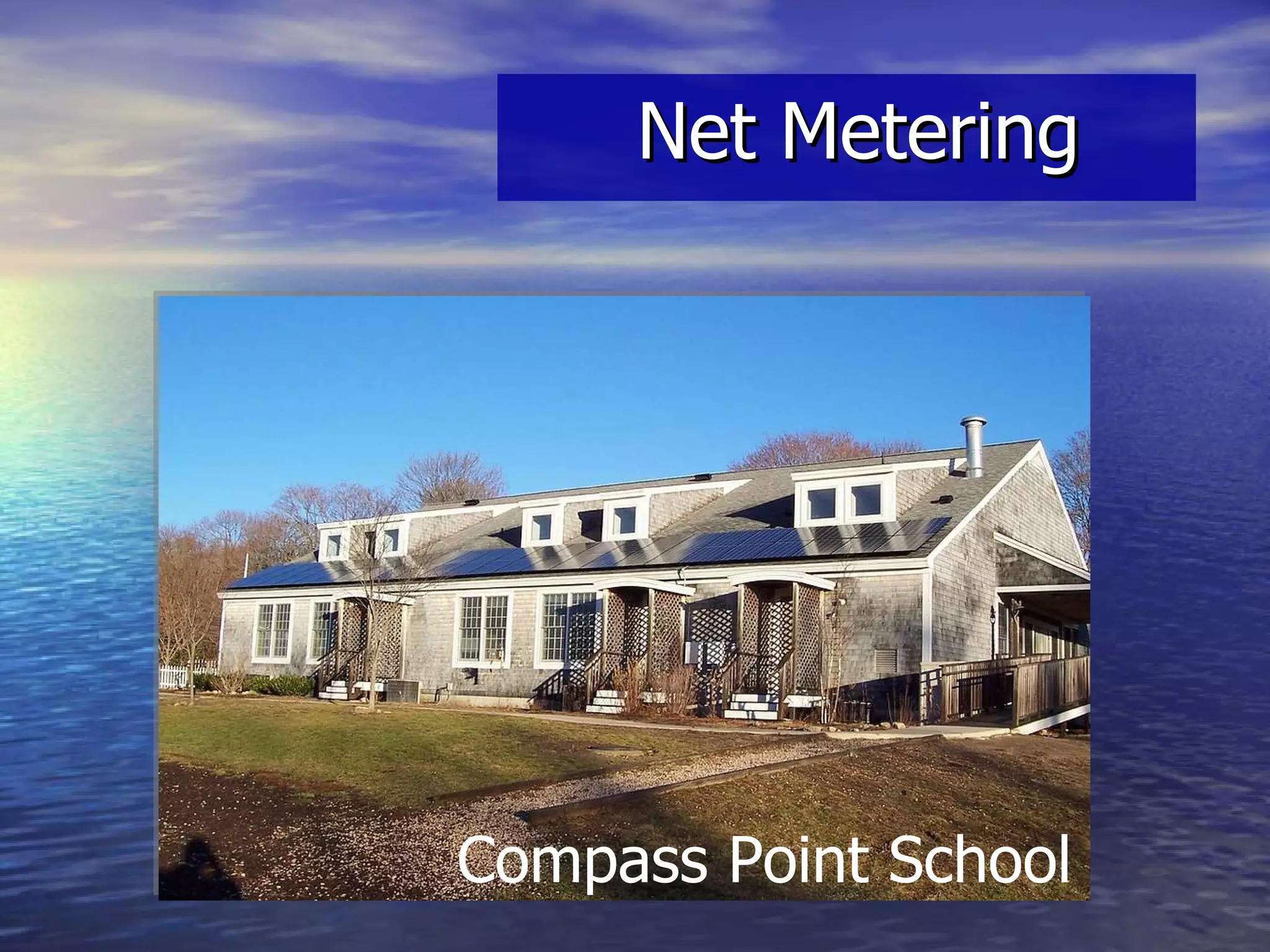
Net Metering Compass Point School
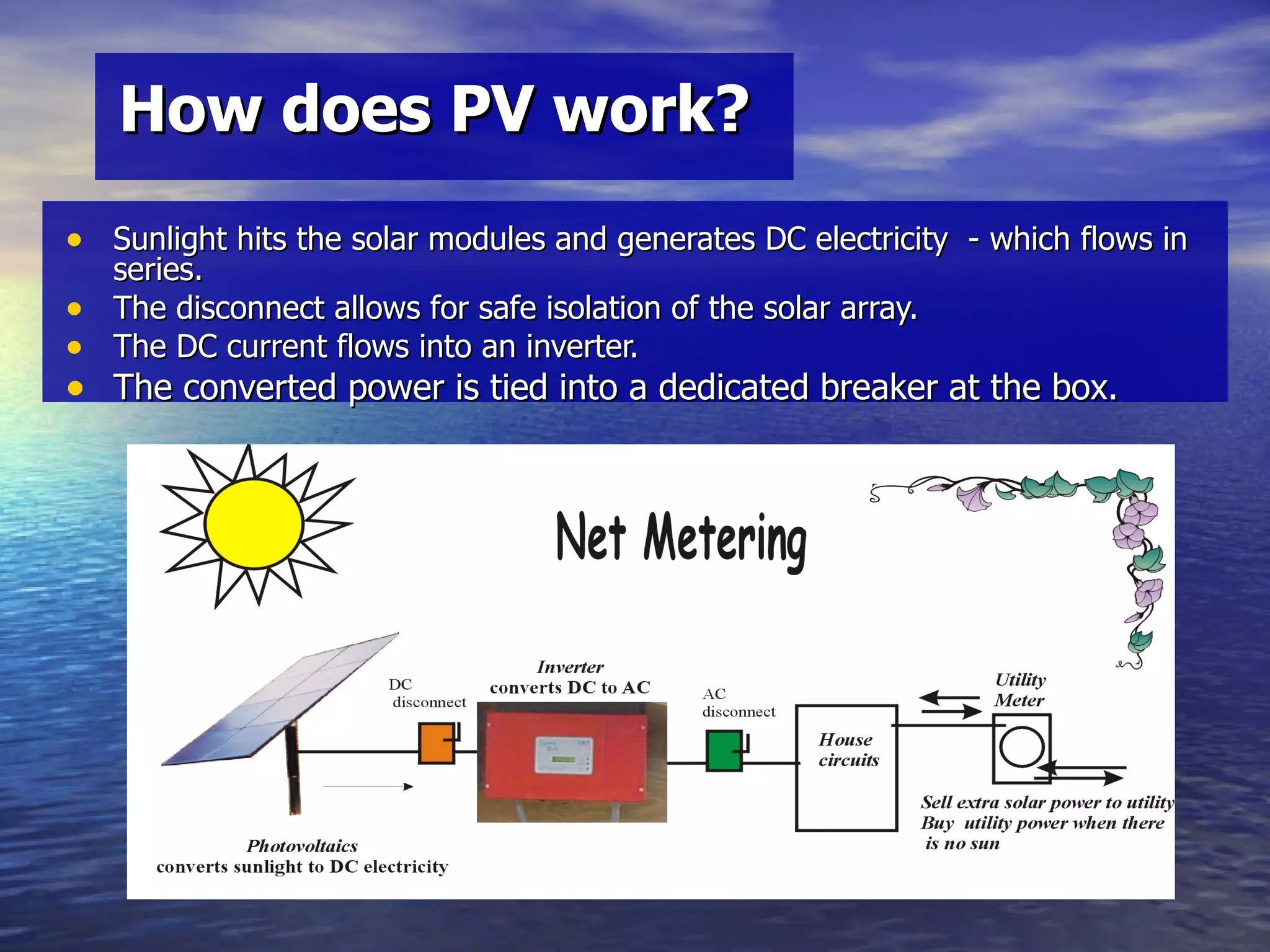
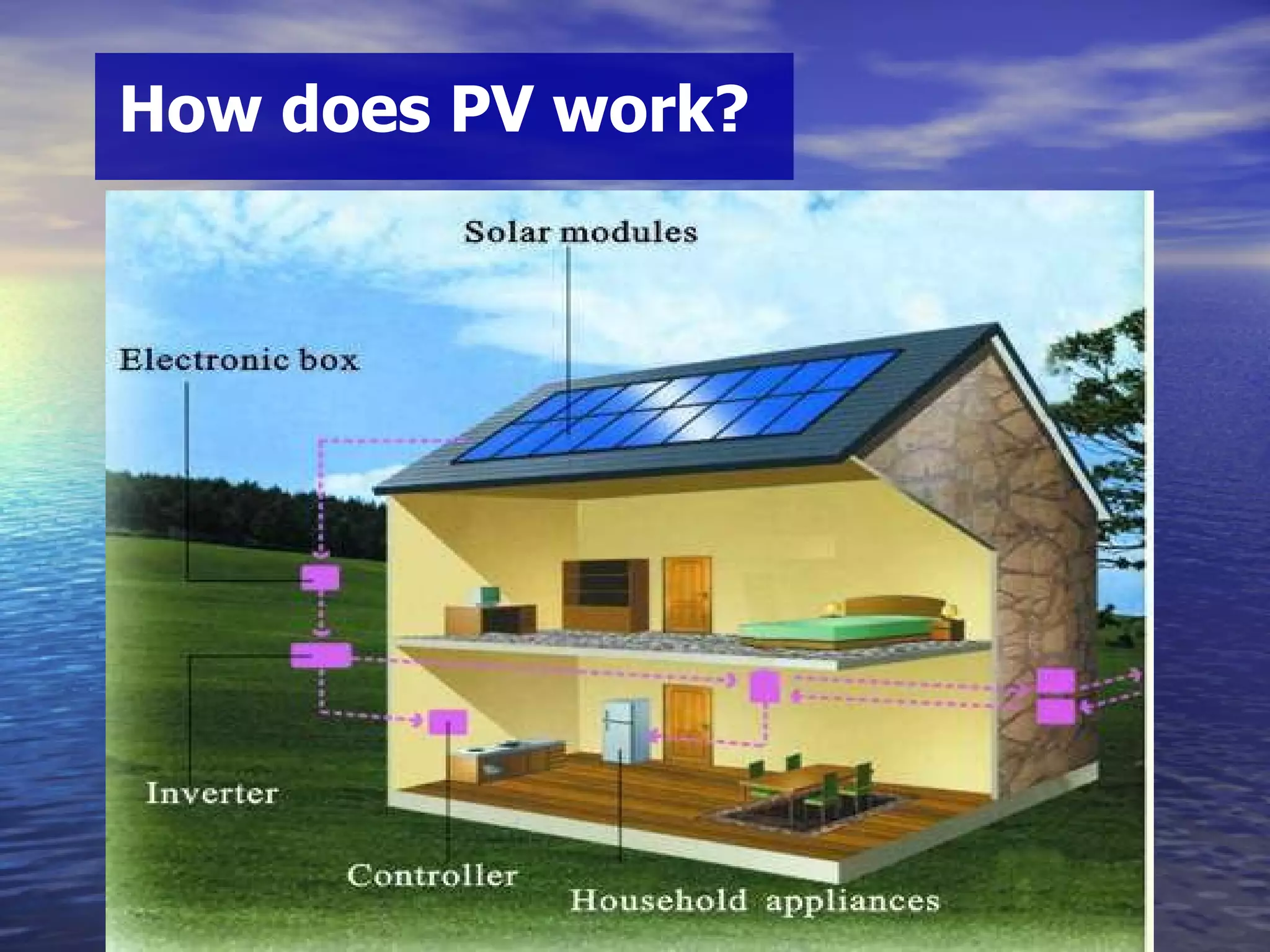
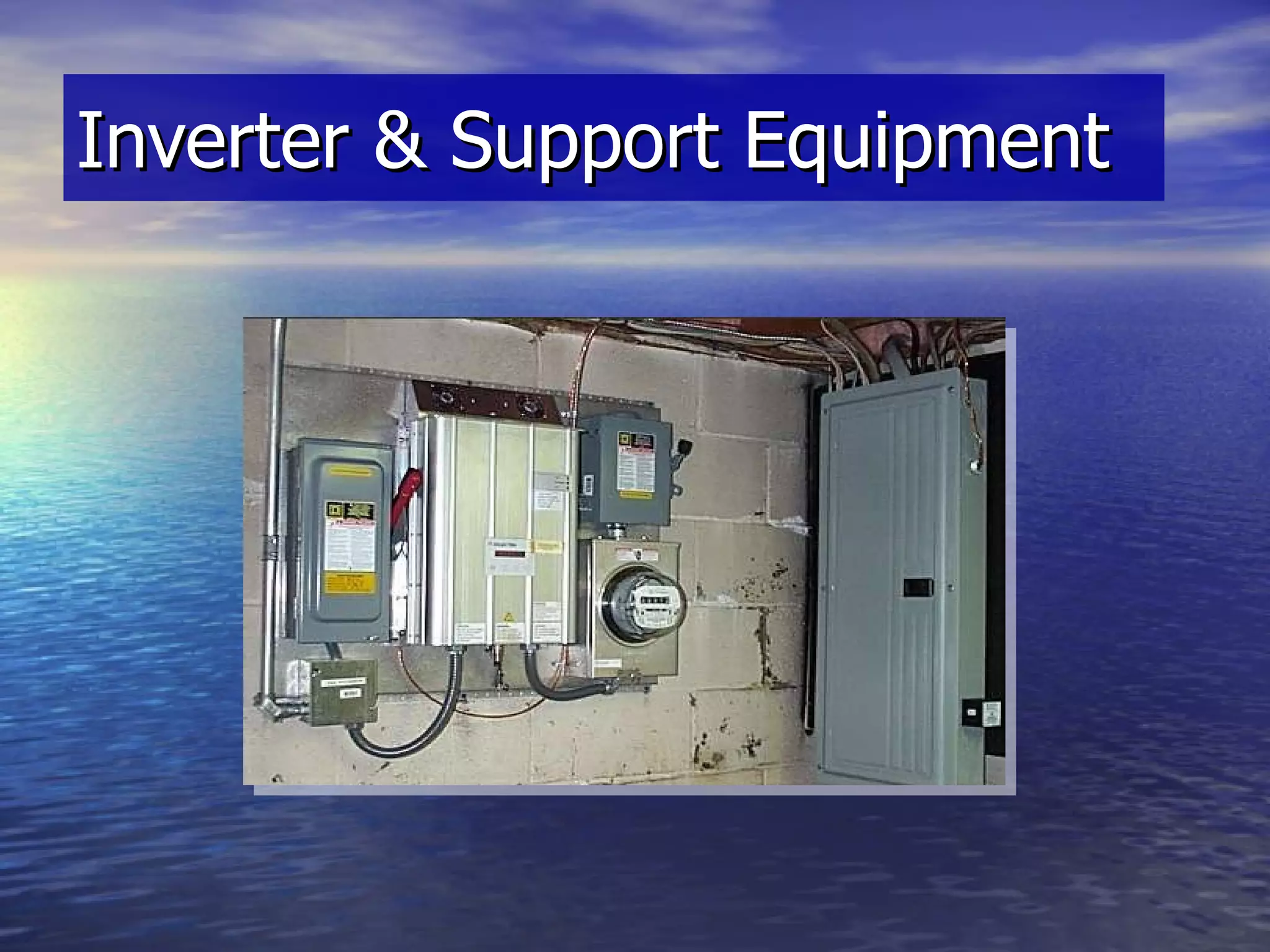
How does PV work?   Sunlight hits the solar modules and generates DC electricity  - which flows in series. The disconnect allows for safe isolation of the solar array. The DC current flows into an inverter.  The converted power is tied into a dedicated breaker at the box.
How does PV work?
Inverter & Support Equipment
Interactive inverter  with backup battery  system
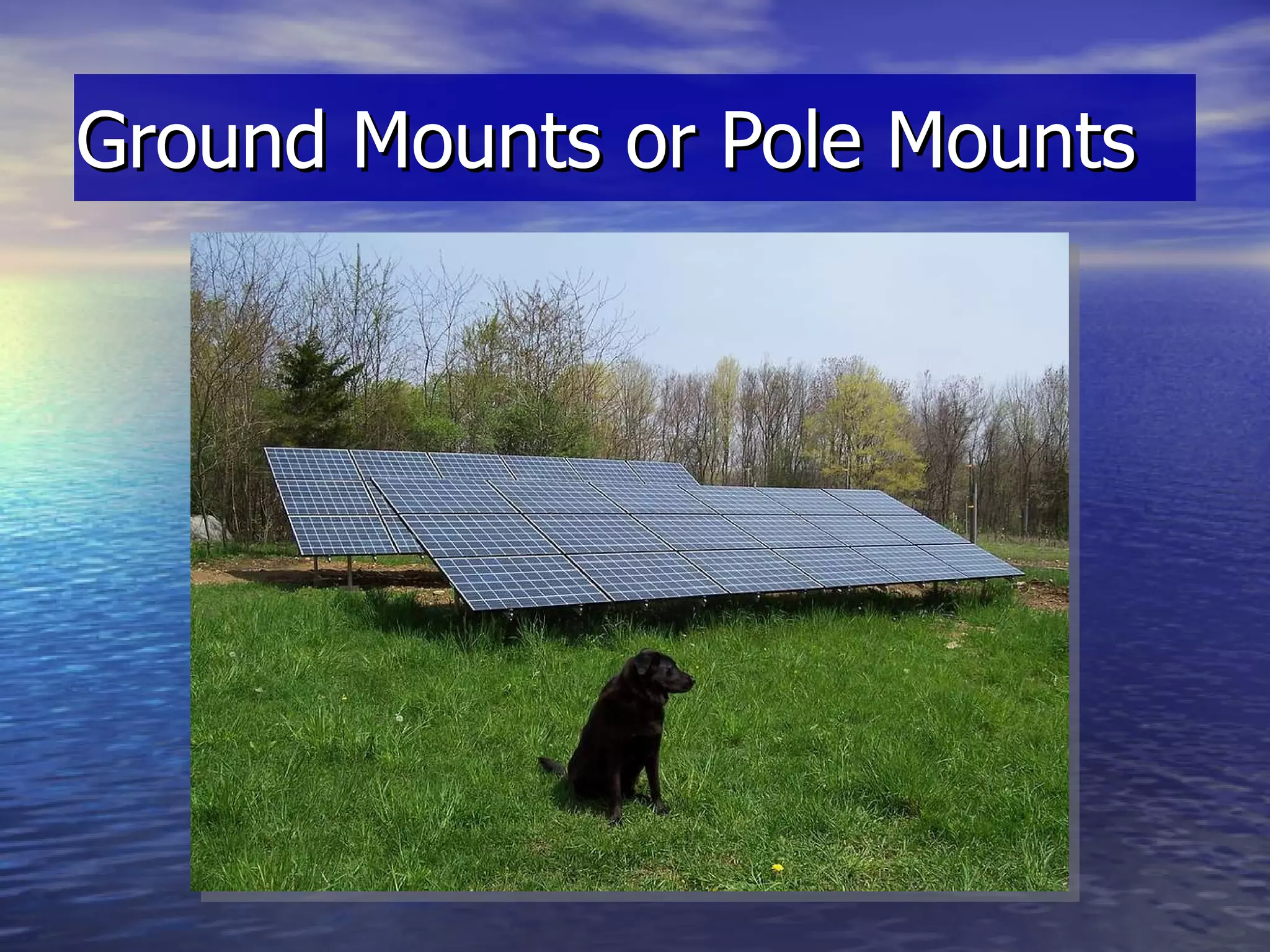
Ground Mounts or Pole Mounts
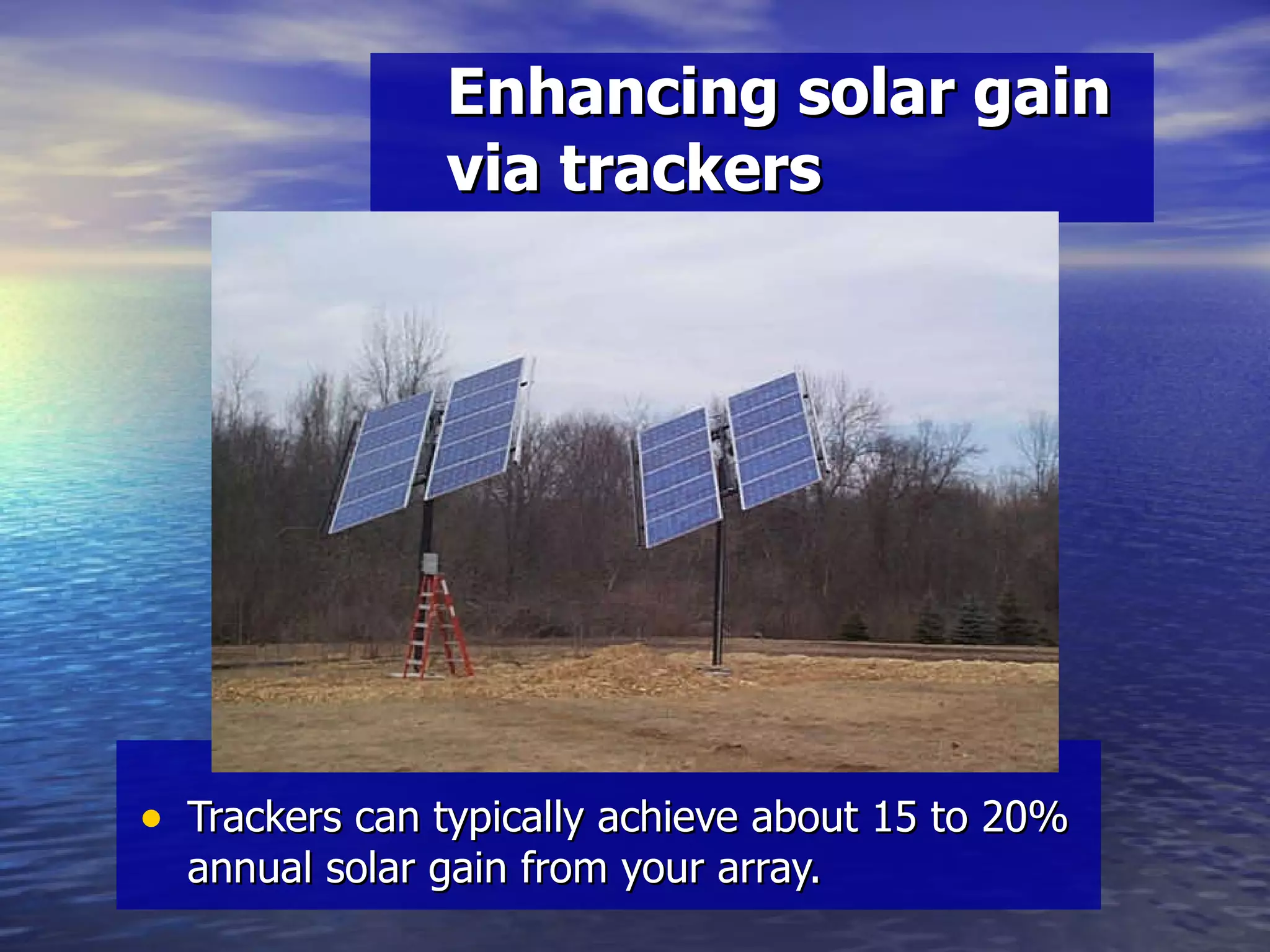
Enhancing solar gain via trackers Trackers can typically achieve about 15 to 20% annual solar gain from your array.
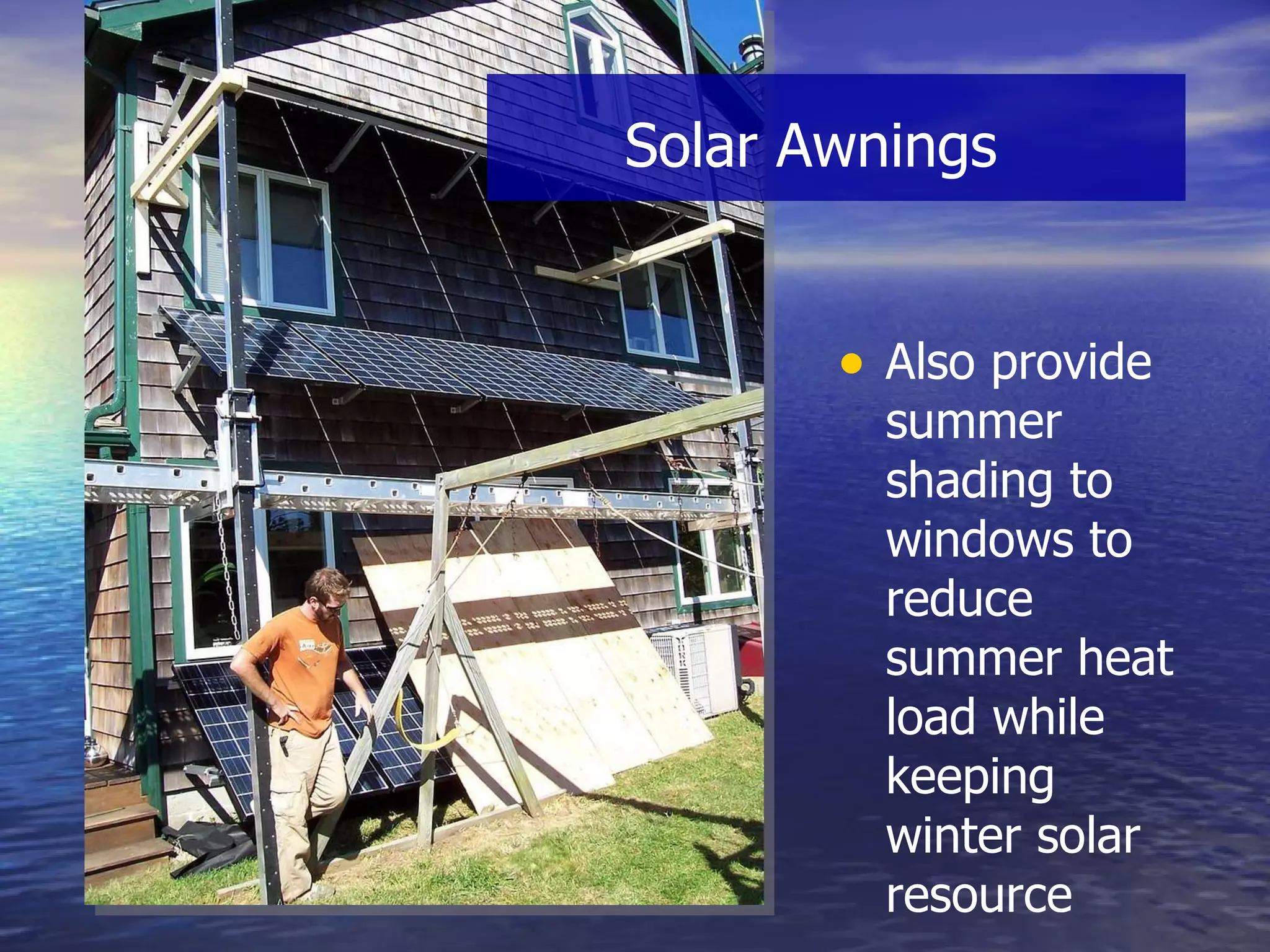
Also provide summer shading to windows to reduce summer heat load while keeping winter solar resource Solar Awnings
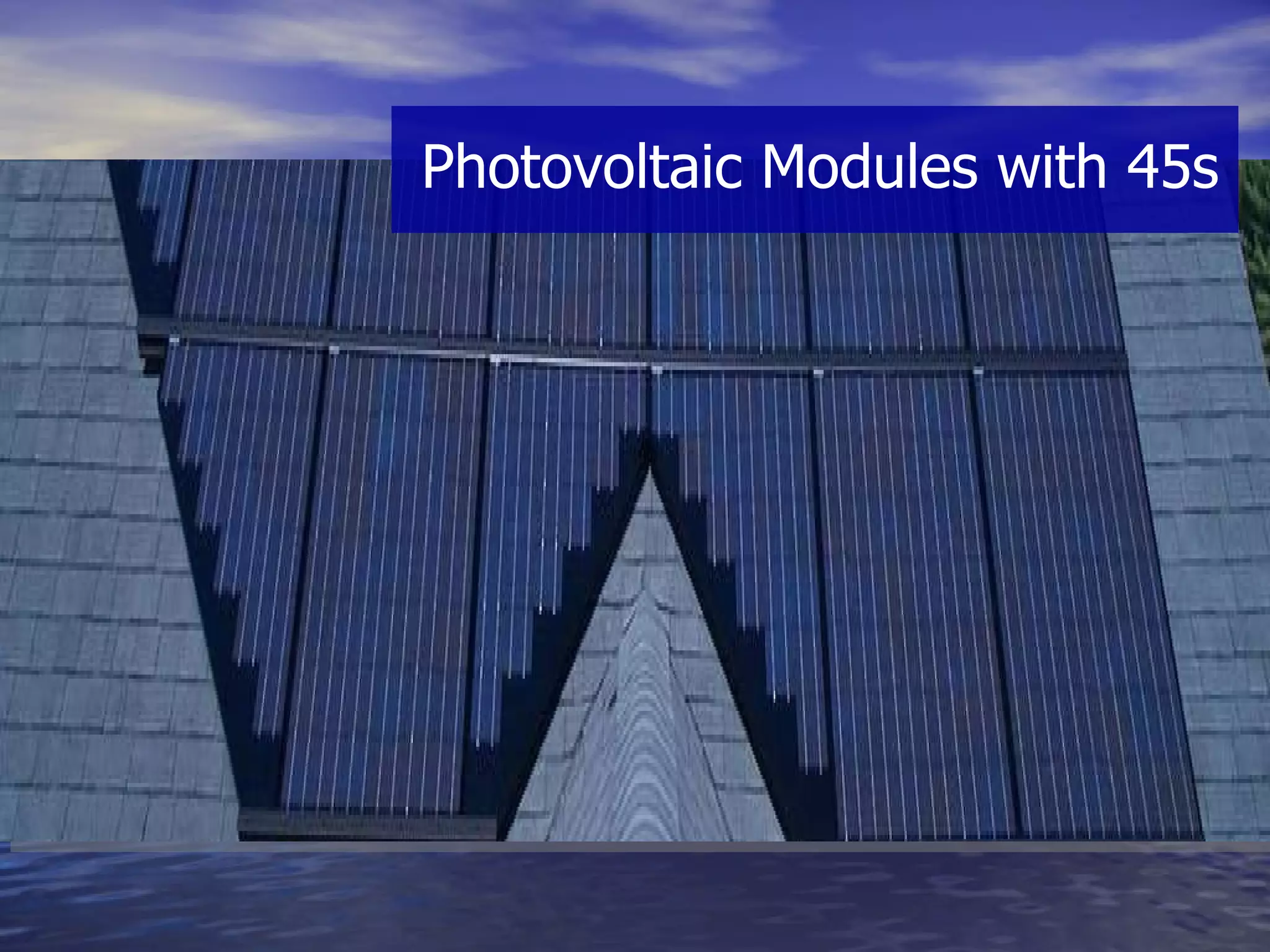
Photovoltaic Modules with 45s
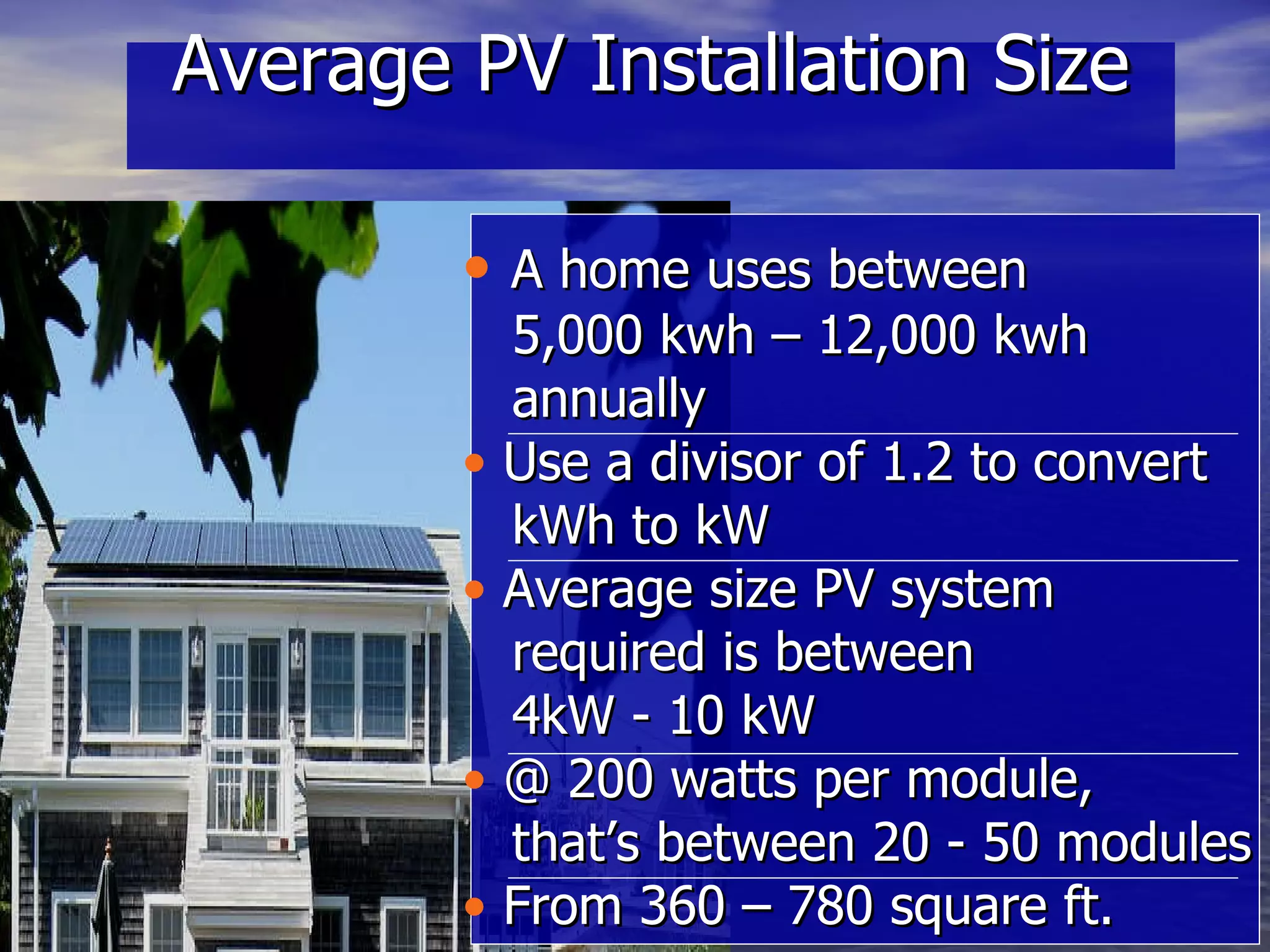
Average PV Installation Size A home uses between  5,000 kwh – 12,000 kwh  annually  Use a divisor of 1.2 to convert  kWh to kW Average size PV system  required is between  4kW - 10 kW @ 200 watts per module,  that’s between 20 - 50 modules From 360 – 780 square ft.
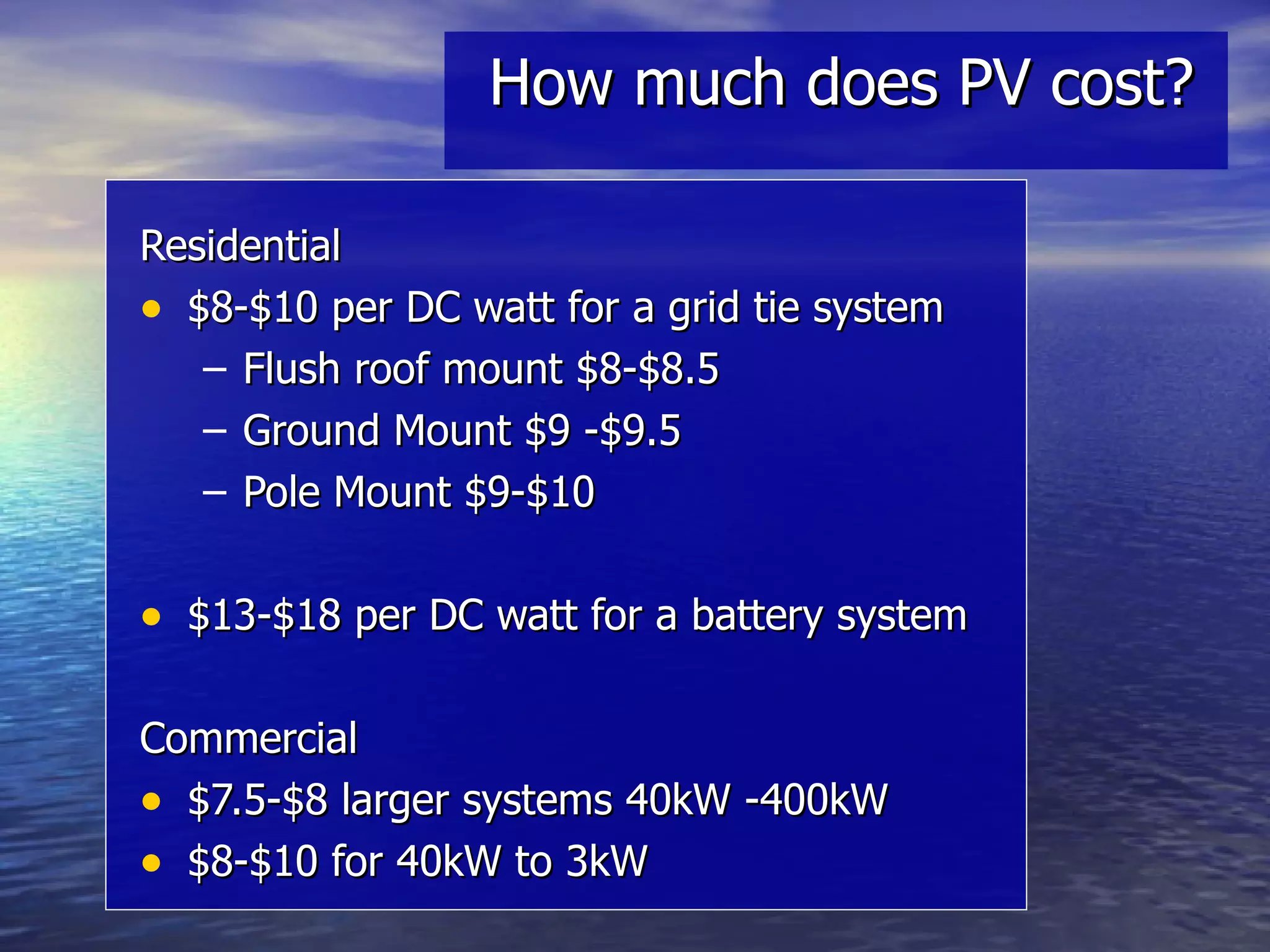
How much does PV cost? Residential $8-$10 per DC watt for a grid tie system Flush roof mount $8-$8.5 Ground Mount $9 -$9.5 Pole Mount $9-$10 $13-$18 per DC watt for a battery system Commercial $7.5-$8 larger systems 40kW -400kW $8-$10 for 40kW to 3kW
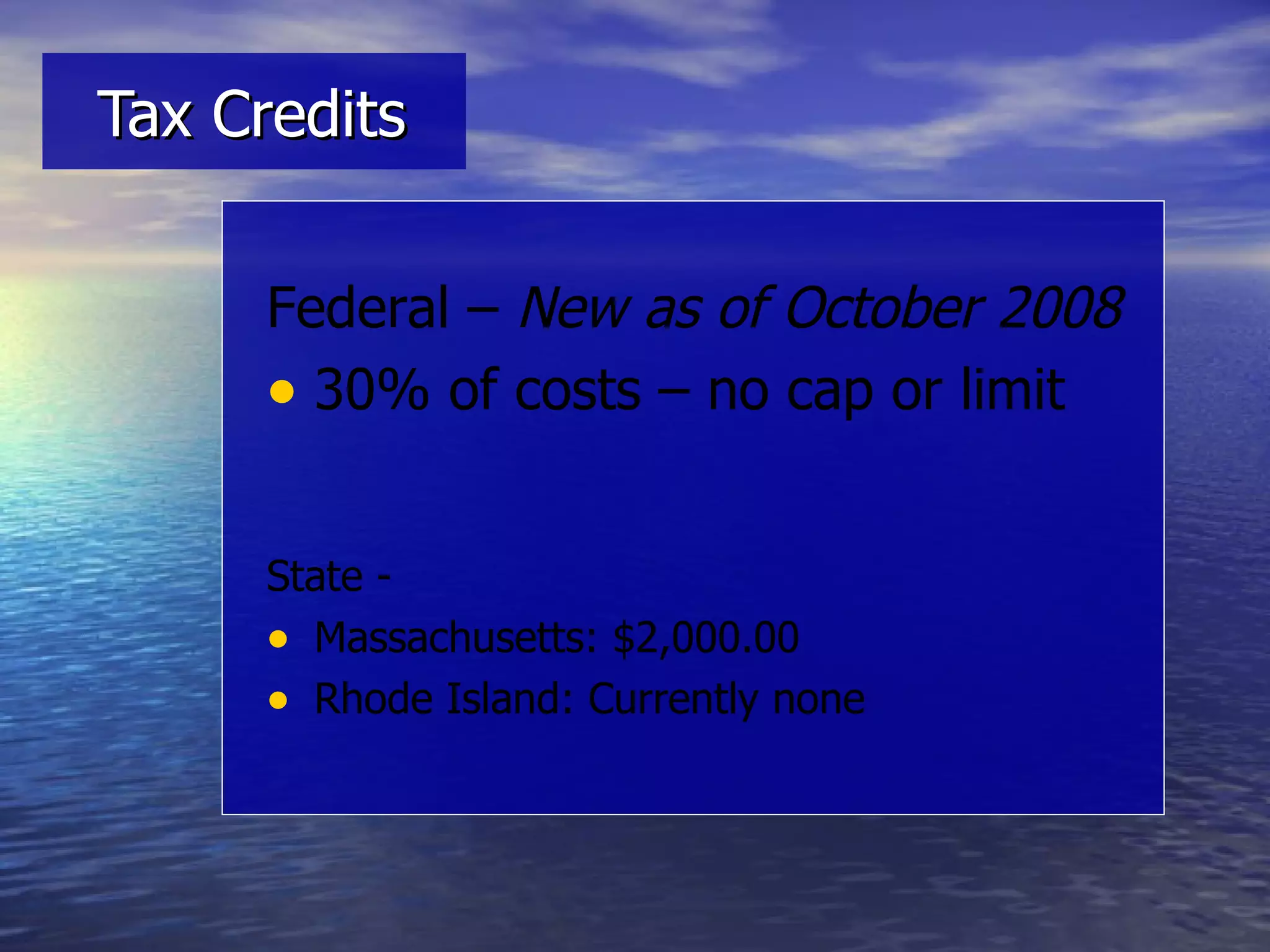
Tax Credits Federal –  New as of October 2008 30% of costs – no cap or limit State -  Massachusetts: $2,000.00 Rhode Island: Currently none
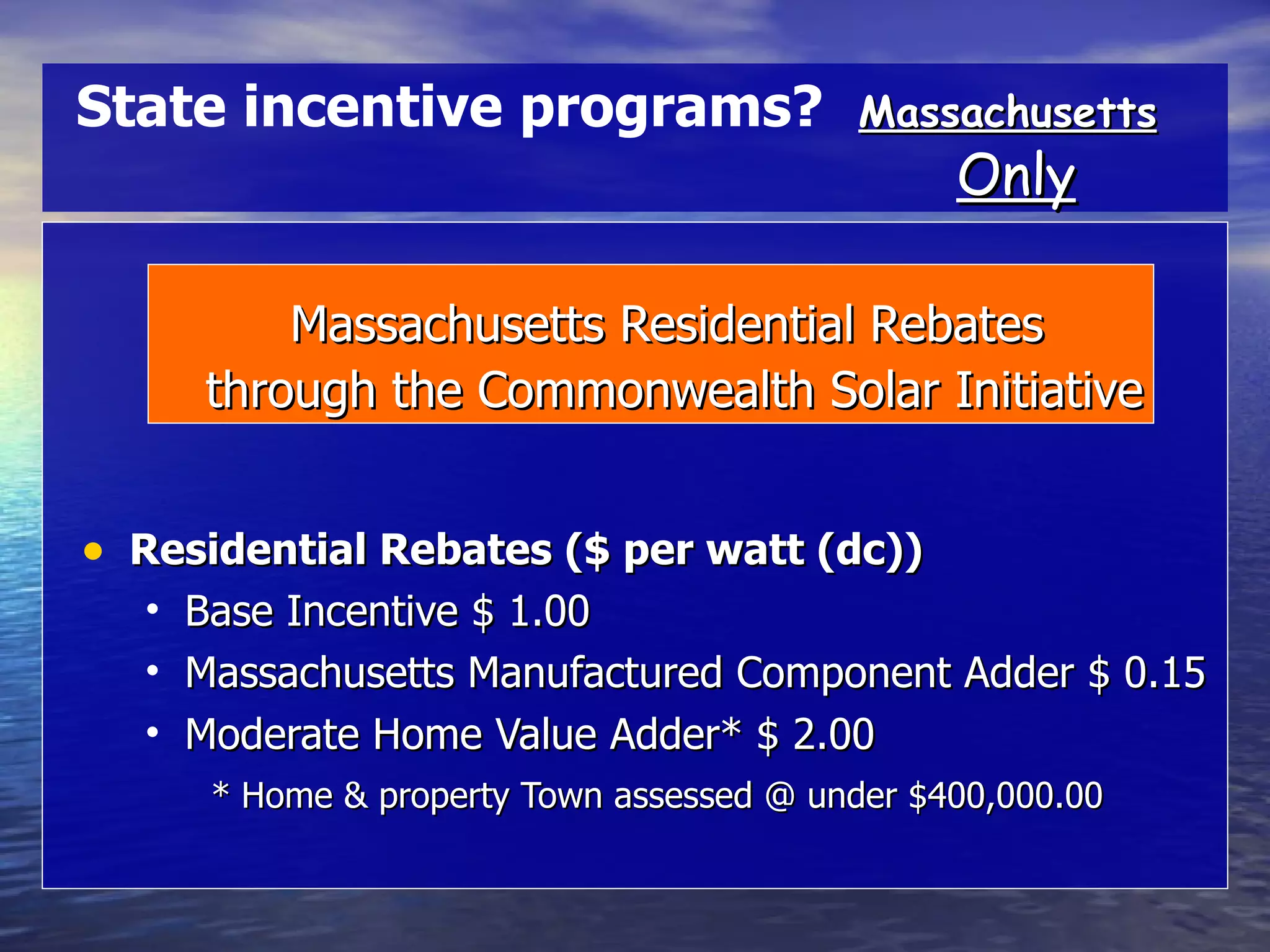
Massachusetts Residential Rebates through the Commonwealth Solar Initiative Residential Rebates ($ per watt (dc)) Base Incentive $ 1.00 Massachusetts Manufactured Component Adder $ 0.15 Moderate Home Value Adder* $ 2.00 * Home & property Town assessed @ under $400,000.00 Massachusetts   Only State incentive programs?
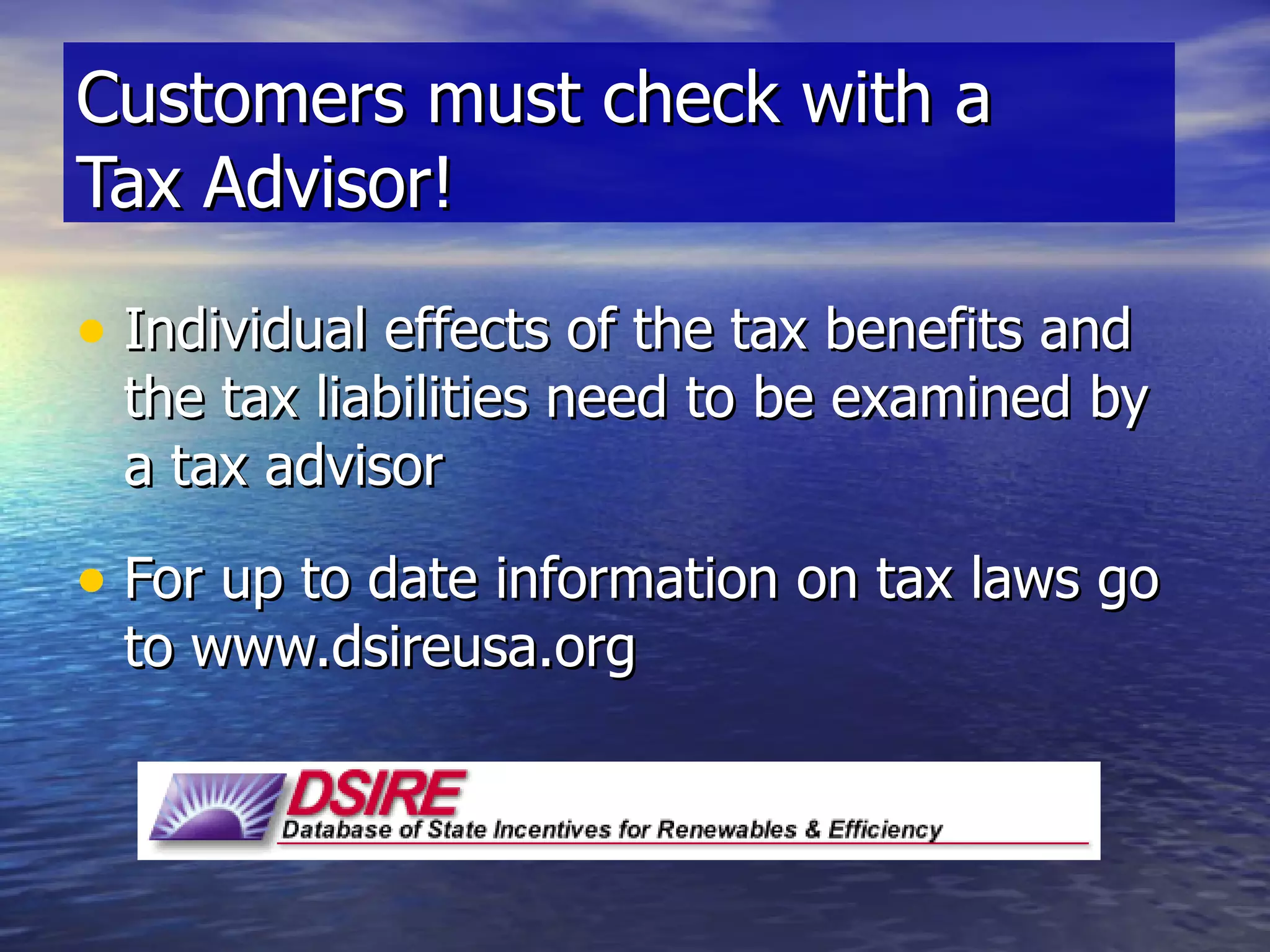
Individual effects of the tax benefits and the tax liabilities need to be examined by a tax advisor For up to date information on tax laws go to www.dsireusa.org Customers must check with a  Tax Advisor!
PV Maintenance None!
Life Expectancy 35 – 45 Years
Warranties Photovoltaic Modules: 20  - 25 Years Inverters: 10 Years
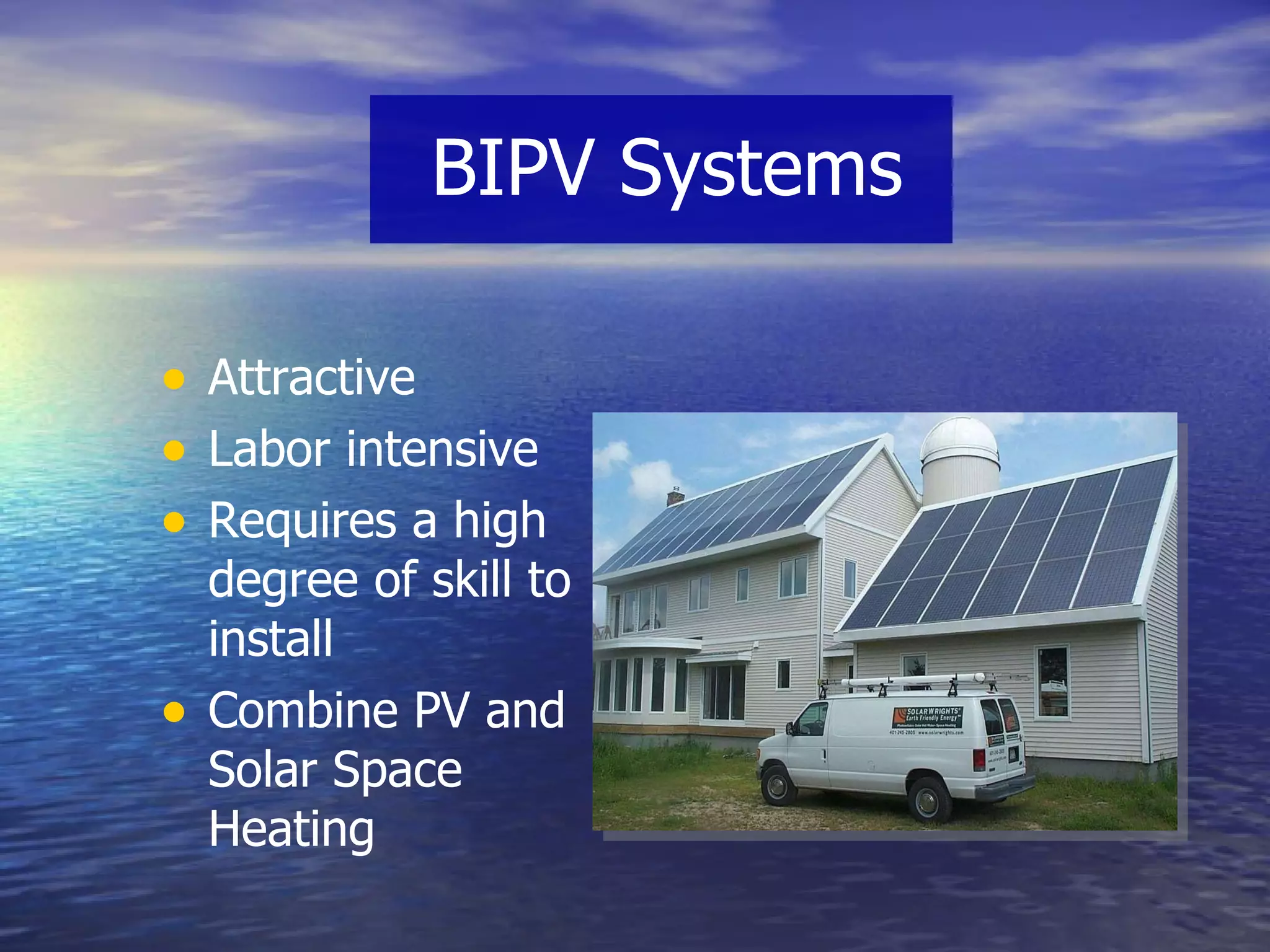
BIPV Systems Attractive Labor intensive Requires a high degree of skill to install Combine PV and Solar Space Heating
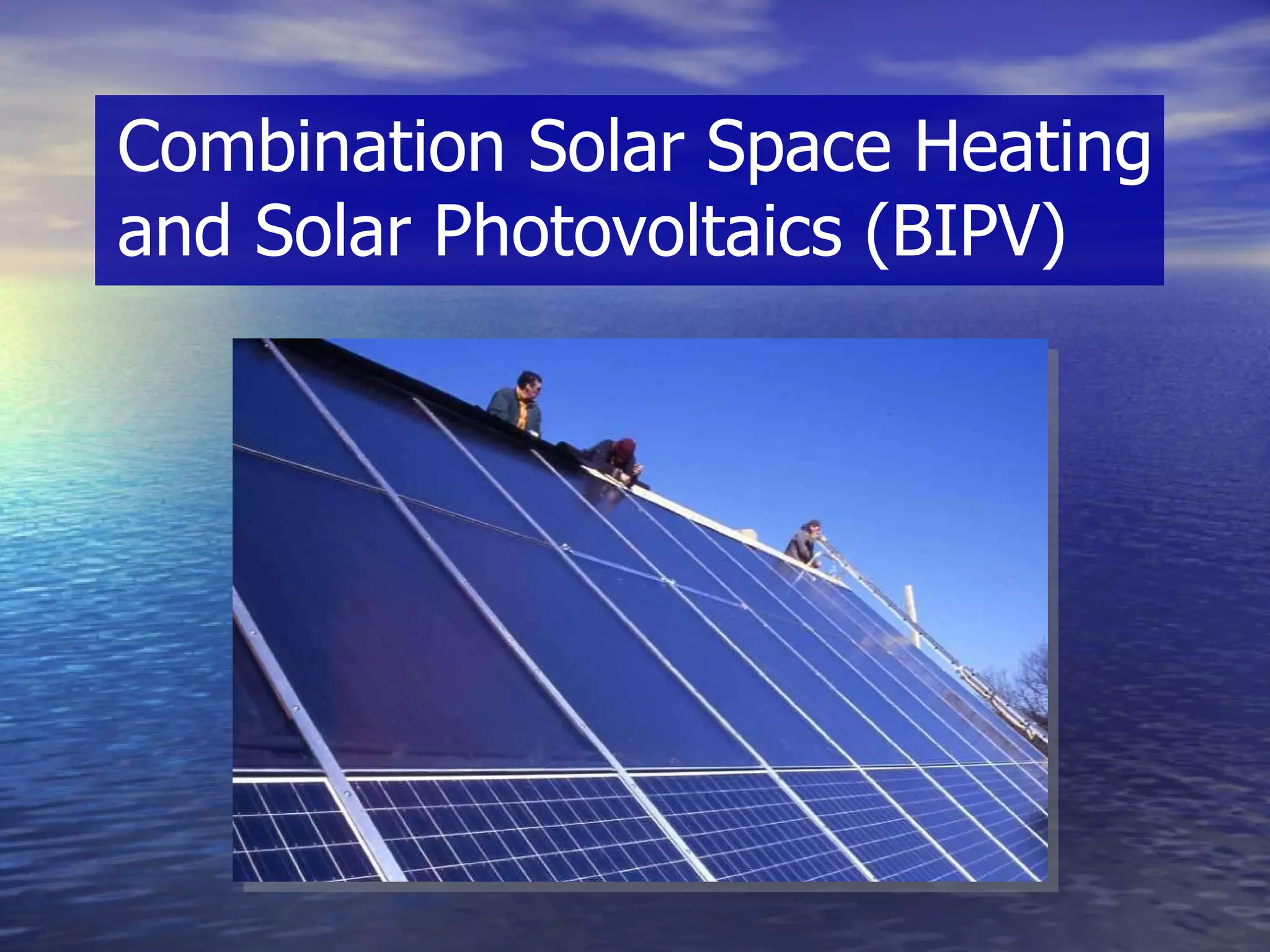
Combination Solar Space Heating and Solar Photovoltaics (BIPV)
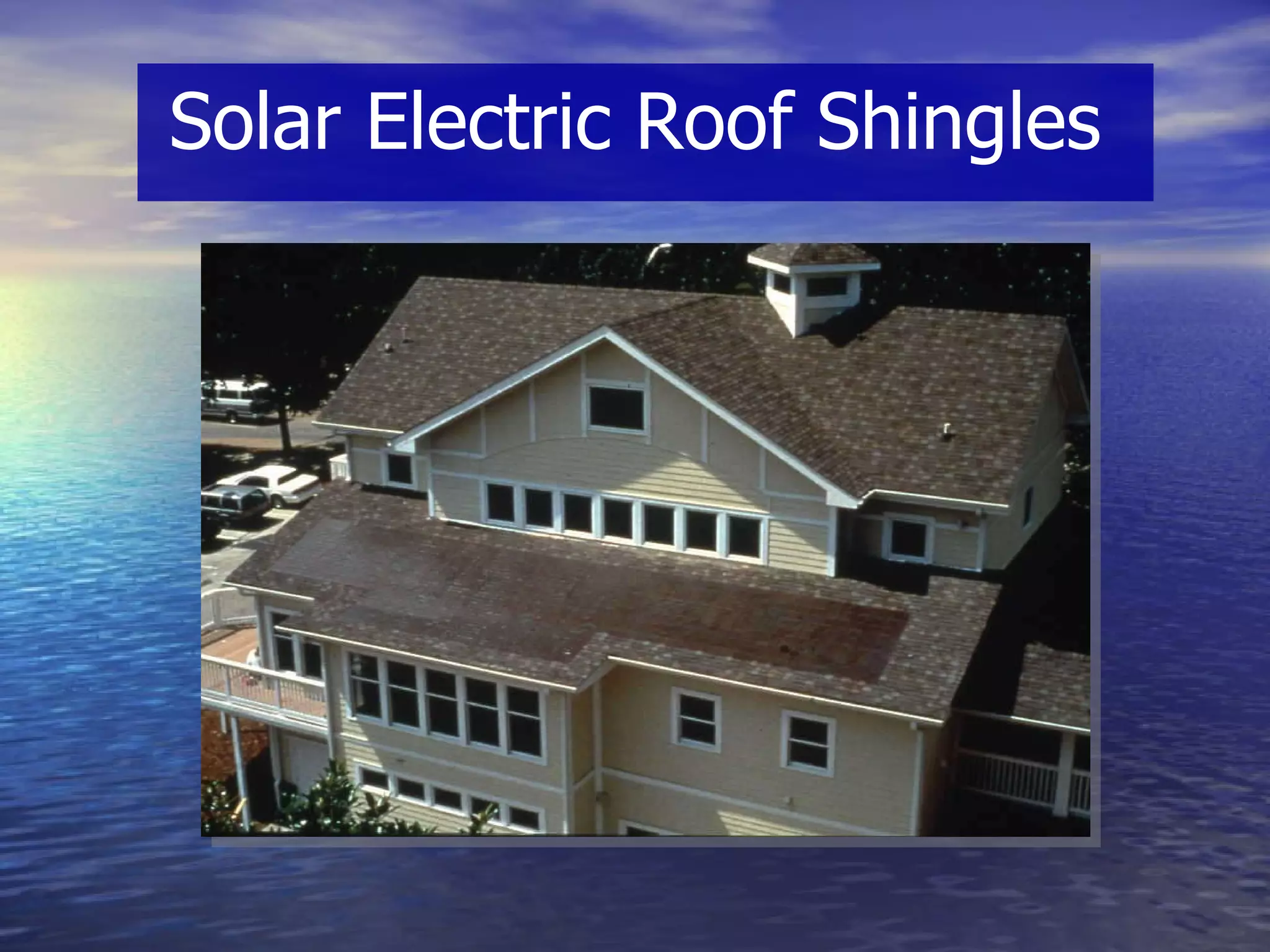
Solar Electric Roof Shingles
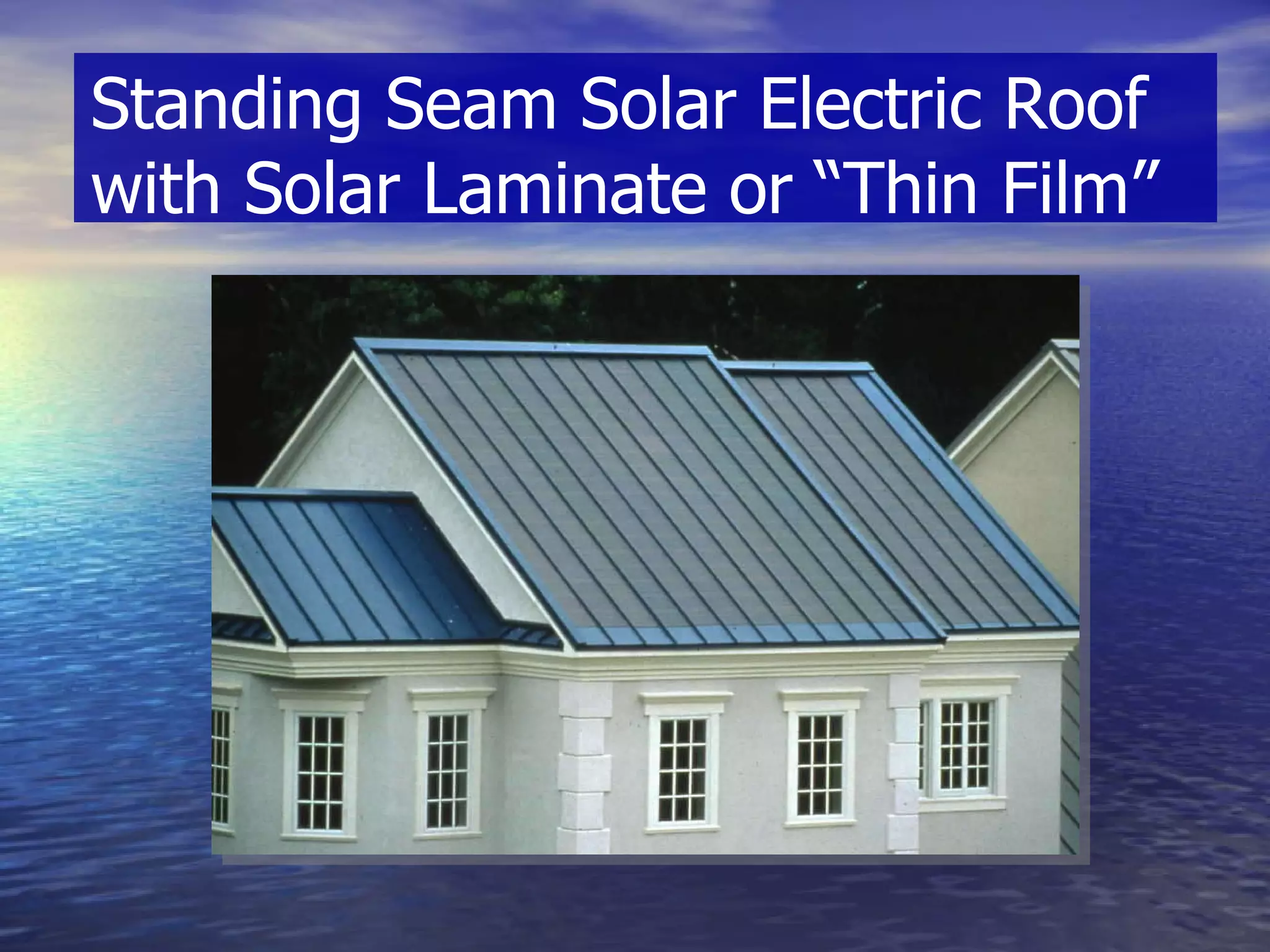
Standing Seam Solar Electric Roof with Solar Laminate or “Thin Film”
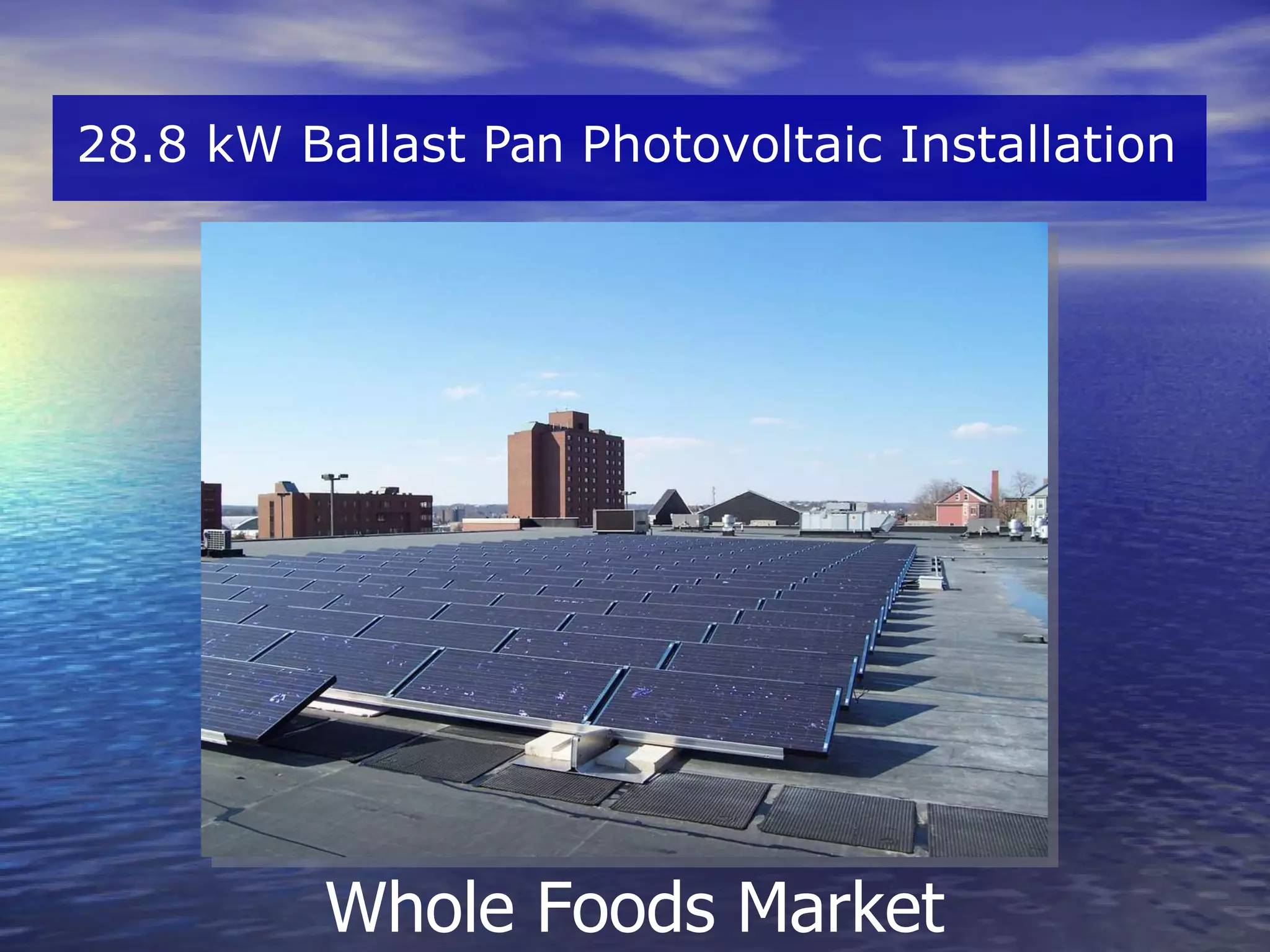
Whole Foods Market  28.8 kW Ballast  Pan  Photovoltaic Installation
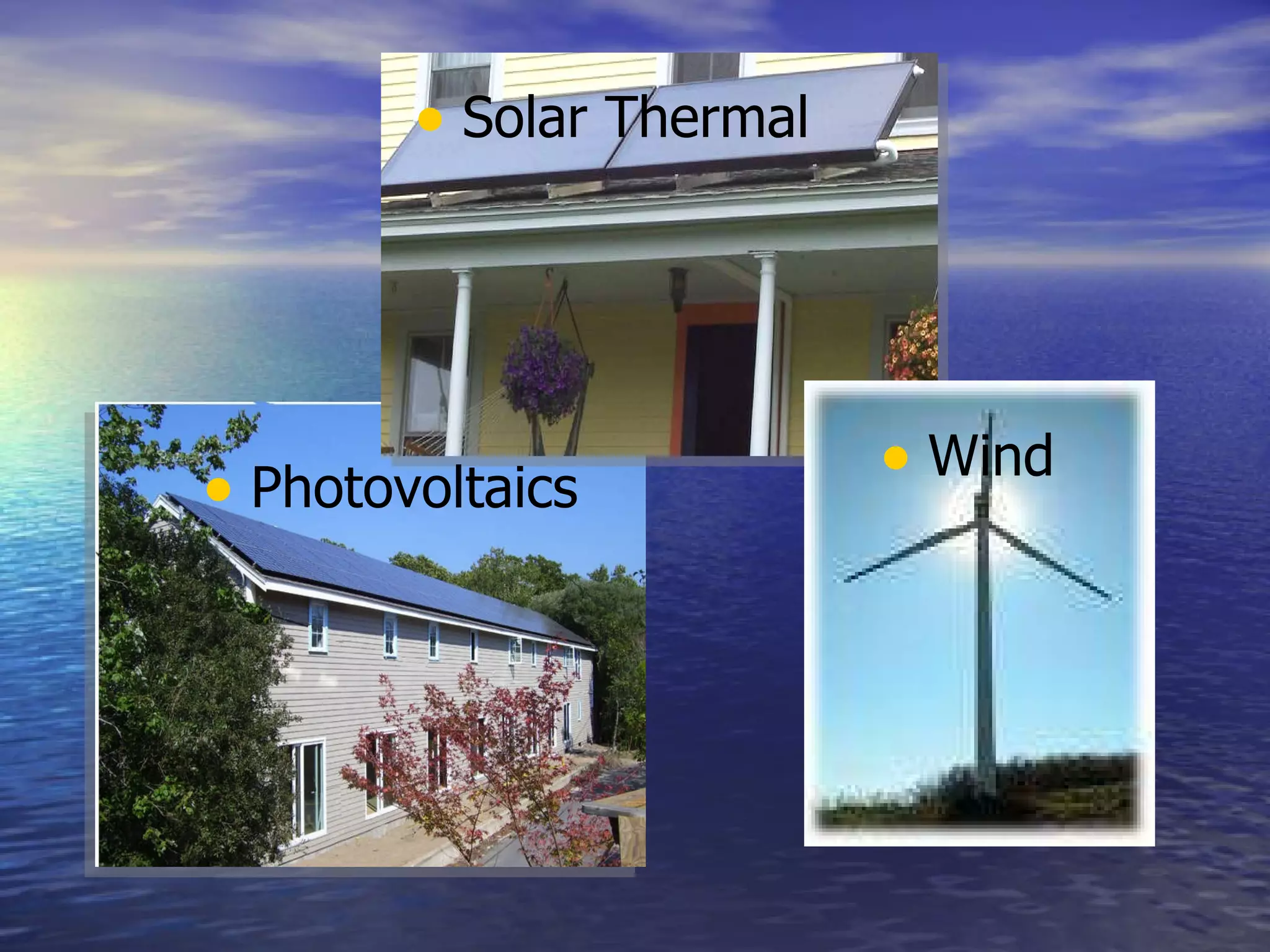
Solar Thermal Photovoltaics Wind
Wind
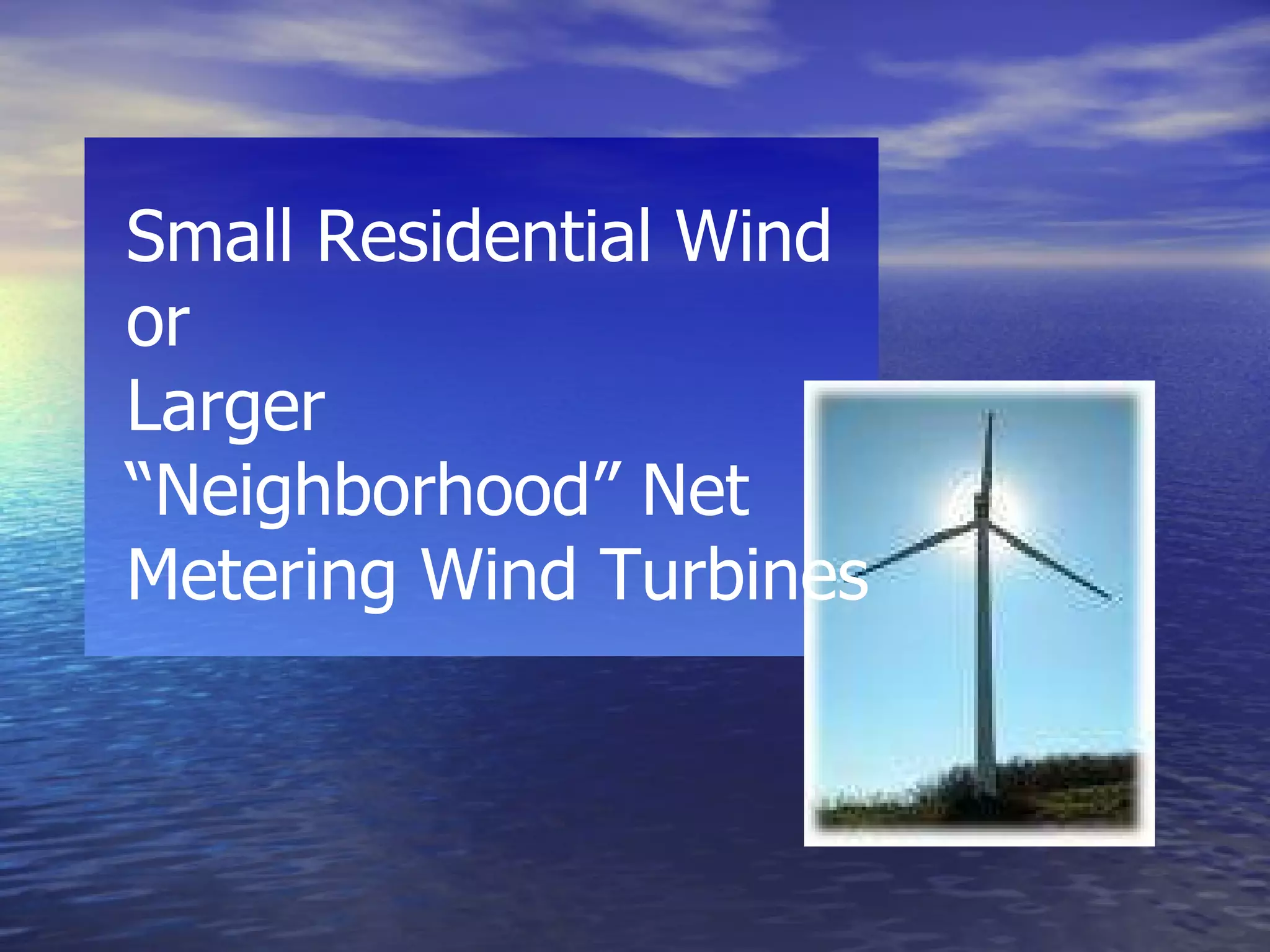
Wind Small Residential Wind or  Larger  “Neighborhood” Net Metering Wind Turbines
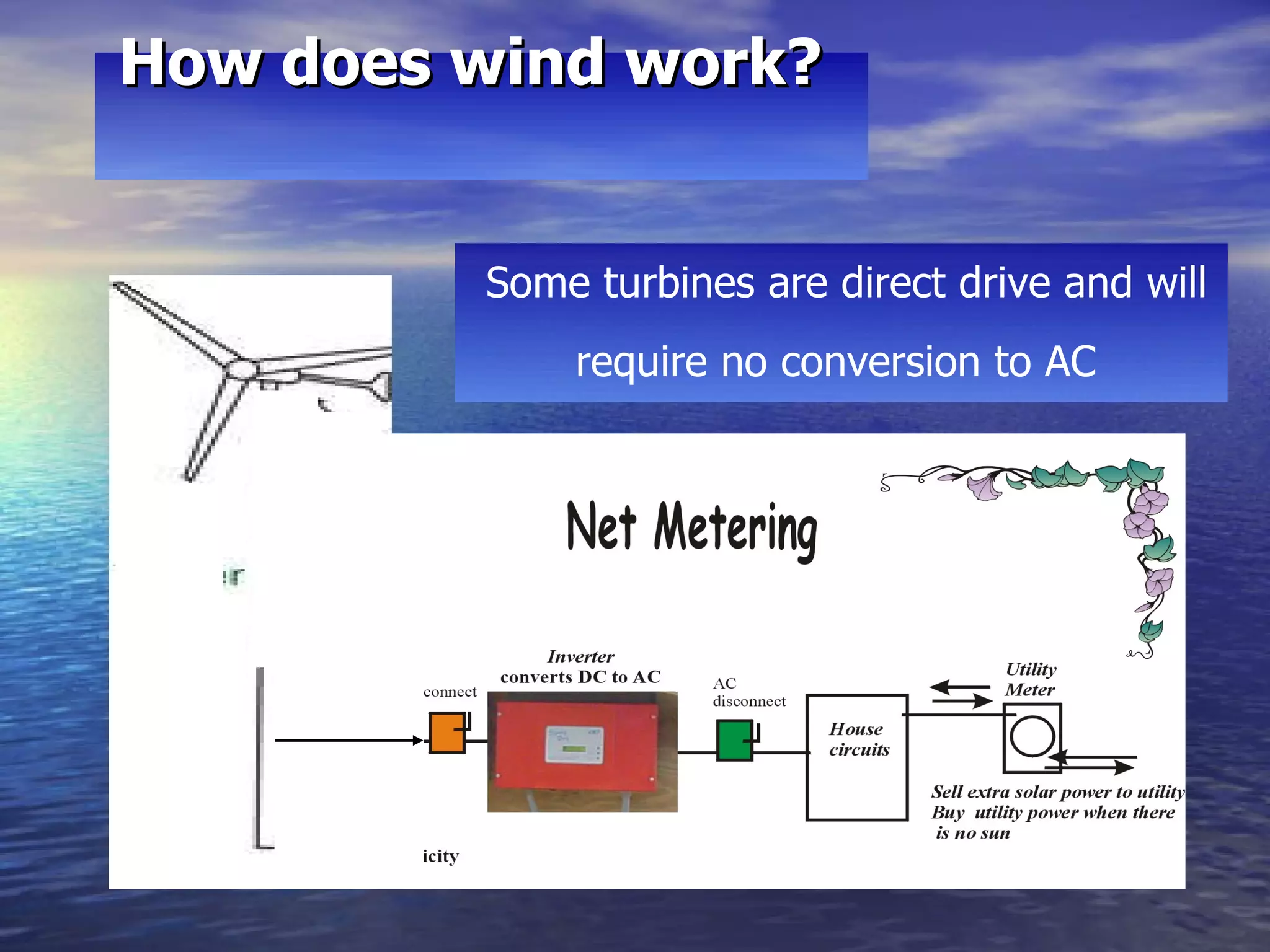
How does wind work?   Some turbines are direct drive and will require no conversion to AC
Recommendation for a wind solution is VERY dependent on site conditions. A professional will need to apprise. Neighborhood logistics are a greater consideration due  to noise, flicker, and visual considerations. Zoning restrictions can make wind a lengthy installation effort. A wind installation in the appropriate location can provide the quickest payback. A high maintenance profile accompanies a wind installation. Large community wind installations are most recommended. Wind Considerations
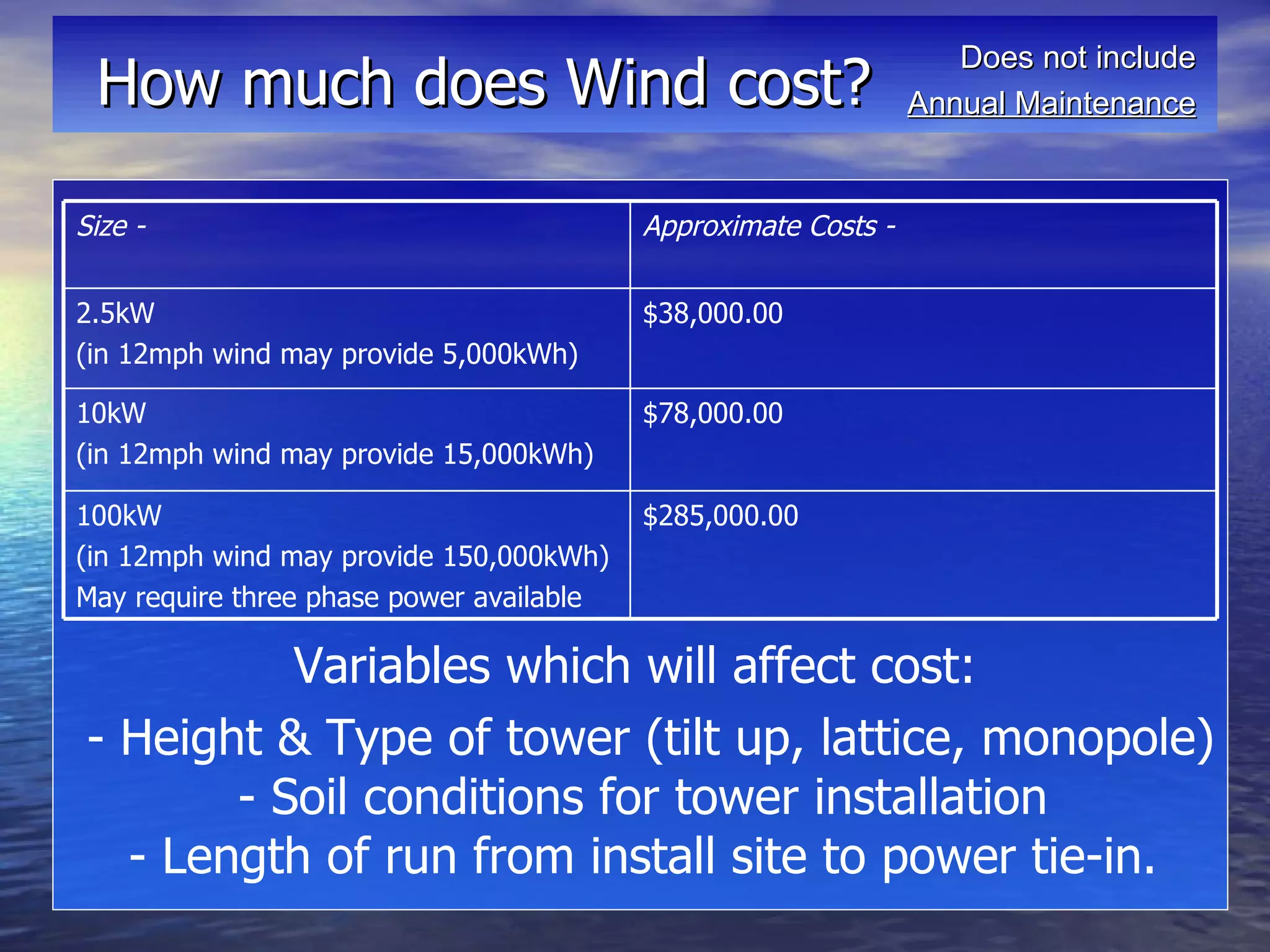
How much does Wind cost? Does not include  Annual Maintenance   Variables which will affect cost:   - Height & Type of tower (tilt up, lattice, monopole)  - Soil conditions for tower installation  - Length of run from install site to power tie-in. $285,000.00 100kW (in 12mph wind may provide 150,000kWh) May require three phase power available $78,000.00 10kW (in 12mph wind may provide 15,000kWh) $38,000.00 2.5kW (in 12mph wind may provide 5,000kWh) Approximate Costs - Size -
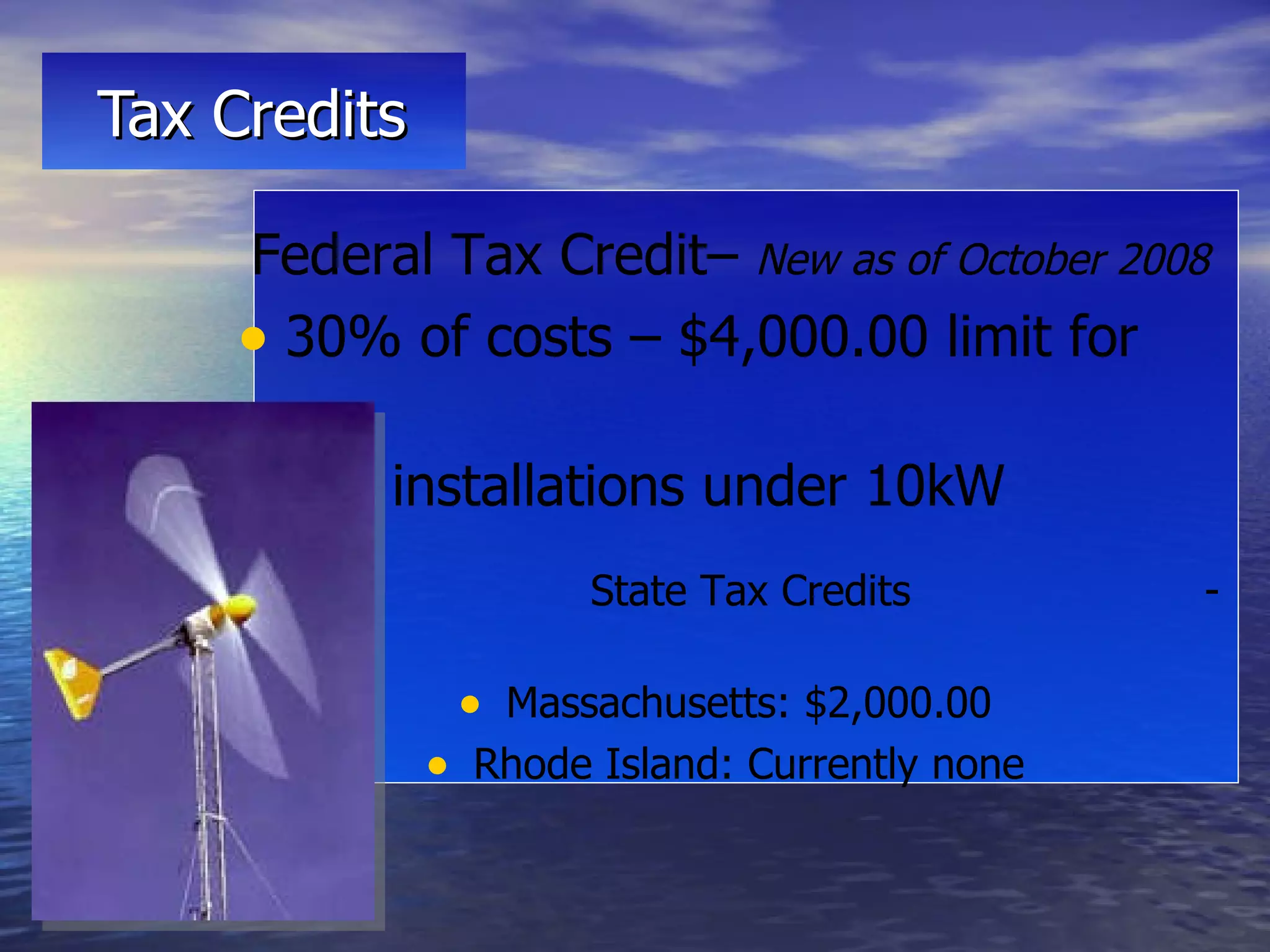
Tax Credits Federal Tax Credit–  New as of October 2008   30% of costs – $4,000.00 limit for  installations under 10kW  State Tax Credits  -  Massachusetts: $2,000.00 Rhode Island: Currently none
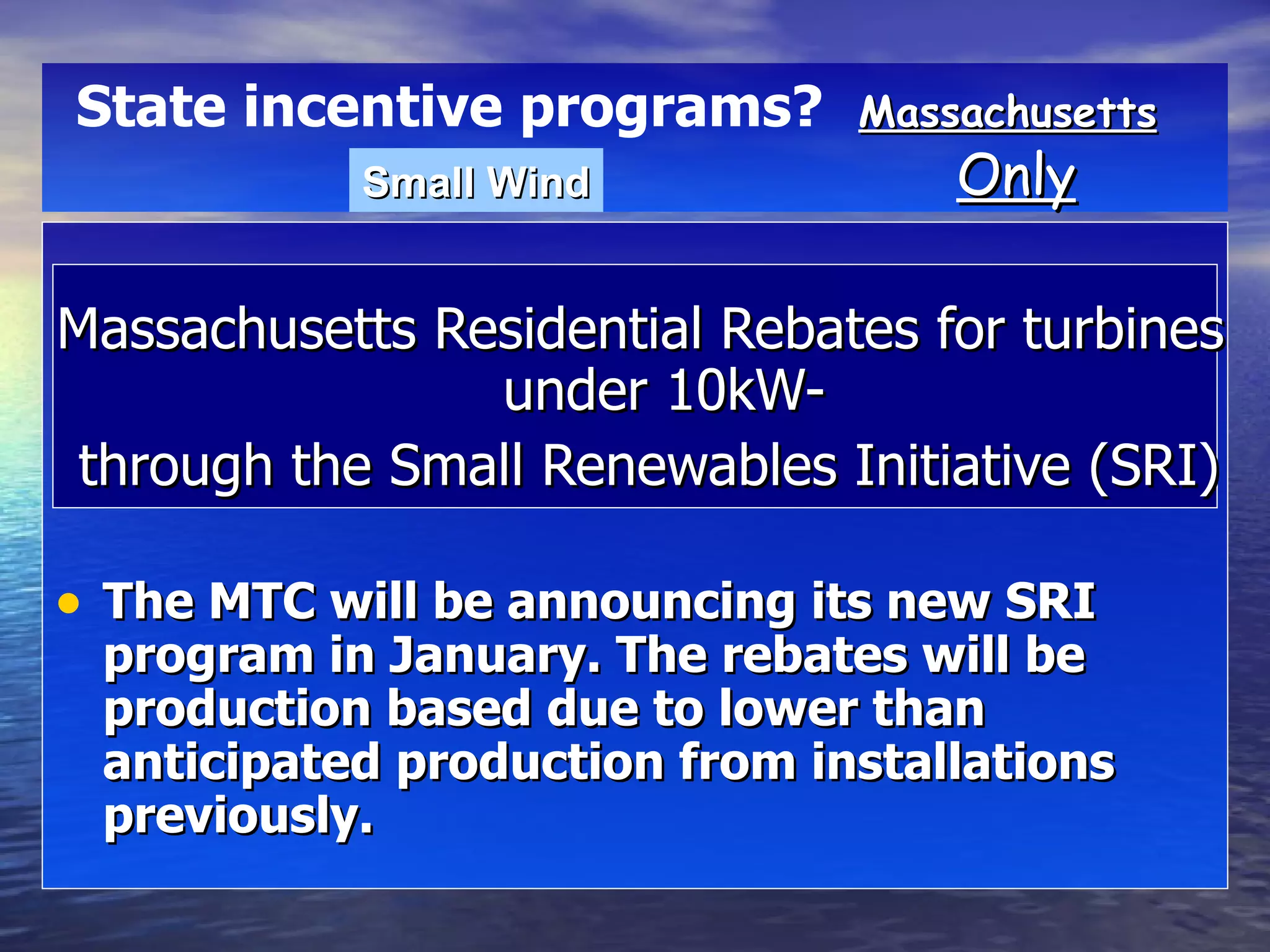
Massachusetts Residential Rebates for turbines under 10kW- through the Small Renewables Initiative (SRI) The MTC will be announcing its new SRI program in January. The rebates will be production based due to lower than anticipated production from installations previously.  Massachusetts   Only State incentive programs?   Small Wind
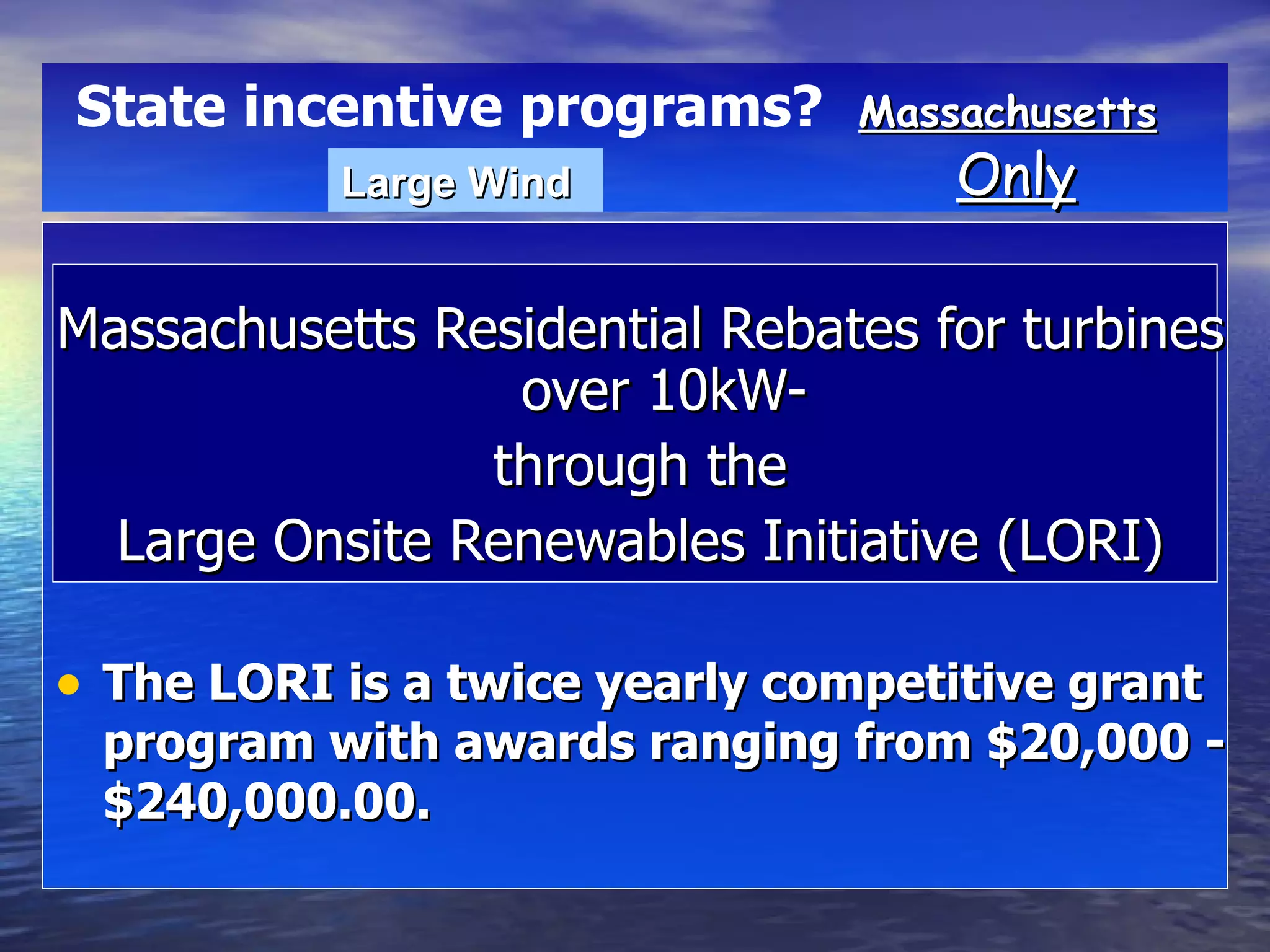
Massachusetts Residential Rebates for turbines over 10kW- through the  Large Onsite Renewables Initiative (LORI) The LORI is a twice yearly competitive grant program with awards ranging from $20,000 - $240,000.00. Massachusetts   Only State incentive programs?   Large Wind
Thank you for your time! Please contact Liz Argo for more information: 866-682-0514  [email_address] This concludes The American Institute of Architects Continuing Education Systems Program Questions?
Useful Websites www.dsireusa.org  -  List of all state and federal incentives www.nesea.org   - Site of the Northeast Sustainable Energy Association http:// www.masstech.org /solar  - MA state rebate program http:// www.sebane.org /  - Solar Energy Business Association of New England. http:// www.irecusa.org /  -  Interstate renewable energy council - market issues, restructuring, policies, incentives, and procurement. w ww.safeclimate.net   You can check out your environmental CO 2  impact.

Newport Collaborative Architects

  • 1.
    This presentation isprotected by US and International copyright laws. Reproduction, distribution, display and use of the presentation without written permission of the speaker is prohibited. © Alteris Renewables Inc. - Earth Friendly Energy Group 2009 formerly SolarWrights, WindWrights and Solar Works, Inc. Copyright Materials
  • 2.
    Liz Argo AlterisRenewables - Outreach & Media Development Director Learning Objectives: Understand existing renewable energy options Understand costs utilizing current local rebate programs and tax incentives Understand basic building requirements for optimal integration of renewable energy solutions
  • 3.
  • 4.
  • 5.
  • 6.
    A Successful SolarEnergy Installation favors Solar South Magnetic Reading of 195 degrees
  • 7.
  • 8.
    Roof Pitch of35 degrees (8/12) for photovoltaics 45 to 55 degrees (12/12 or greater) for solar thermal Less critical - installation pitch for the sun angle
  • 9.
    Effects of these2 orientation considerations
  • 10.
    Good southern exposurebetween 9AM and 3PM with no shading
  • 11.
    Things to checkfor: Dormers Vent Stacks Trees Hips and Valleys Skylights TV antennas and satellite dishes. Chimneys Neighboring homes Array Obstructions
  • 12.
    Shading Critical Muchmore so for photovoltaics
  • 13.
  • 14.
  • 15.
    Solar Thermal 1.Solar Domestic Hot Water Heating These systems are used to generate hot water for potable means, like bathing, food prep, washing, etc. There are several different kinds of SDHW heating systems. 2. Solar Space Heating Systems These systems heat both the domestic hot water load and provide solar thermal heat for space heating. 3. Pool Heating These systems are used to extend the usable season of a seasonal pool, or to offset the amount of fossil fuel used to heat the pool.
  • 16.
    Solar Domestic HotWater Heating 10/9/03
  • 17.
    Solar Domestic HotWater System How does it work? About 1 collector per person
  • 18.
    Solar Heating: Howdoes it work? Same as the domestic hot water heating systems with the following additions. Because we want the heat during the months of the least amount of solar resource, the following adjustments must be made to the system. Increased collector tilt to gain more energy in the winter months. Choose an evacuated tube collector for greater collector efficiency under cold ambient temps. Make provisions for excess heat in the summer months. Increased size of solar thermal storage tank for larger systems.
  • 19.
    Solar Hot WaterCollector Evacuated Tube 10/9/03 Evacuated tubes are more efficient under colder ambient temperatures. Evac tubes cost more. Life expectancy of evacuated tubes is less*.
  • 20.
    Solar Space Heating55 (or greater) degrees roof pitch
  • 21.
    How much doessolar thermal cost? Residential $10,500-12,000 for a two collector system. About $1,000 additional for each additional collector Vacuum tube systems will cost more Commercial Varies considerably depending on size of system and type of system
  • 22.
    With the followingfinancial assumptions: Federal government tax credit totaling $2,000. National Grid rebate of up to $1,500.00 for its gas customers. Life expectancy of the solar thermal system 20 years (warrantees for 20 on modules/7 on tanks) $200 maintenance charge every 5 years. Will eliminate about 75% of current fossil fuel costs to heat water currently. What is the return on my solar domestic hot water investment?
  • 23.
    With the followingfinancial assumptions: Federal government tax credit totaling $2,000. National Grid rebate of up to $1,500.00 for its gas customers. Life expectancy of the solar thermal system 20 years (warrantees for 20 on modules/7 on tanks) $200 maintenance charge every 5 years. Will eliminate about 75% of current fossil fuel costs to heat water currently. What is the return on my solar domestic hot water investment? From 5 – 7 year Payback
  • 24.
    Appropriate Heating SystemUse Applicable only as low heat supplement Geothermal/Heat Pumps Radiant Floor Will require high electrical demand due to constant pump activity and PV should be strongly considered Extremely compatible
  • 25.
    Solar Air HeatingON A ROOF INTO A WALL ON A WALL
  • 26.
    Solar Pool HeatingCost effective Extends swimming system Reduces fossil fuel use
  • 27.
  • 28.
  • 29.
    Solar Photovoltaics CGull’s Nest Condominiums – 14.75kW Provincetown, MA
  • 30.
    Types of PVSystems 1. Utility Interactive Systems- Also known as Grid Tied In these systems the PV array output feeds through an inverter directly into the utility grid. 2. Stand Alone Systems In these systems the PV array charges a battery bank. The batteries store electricity for non sun periods. Both Direct Current and Alternating Current electricity are typically available. 3. Utility Interactive/Backup System This system combines the two above systems. The PV array connects through an inverter that can operate as an interfaced inverter or a stand alone one. The PV also keeps the backup battery bank charged.
  • 31.
  • 32.
    How does PVwork? Sunlight hits the solar modules and generates DC electricity - which flows in series. The disconnect allows for safe isolation of the solar array. The DC current flows into an inverter. The converted power is tied into a dedicated breaker at the box.
  • 33.
  • 34.
  • 35.
    Interactive inverter with backup battery system
  • 36.
    Ground Mounts orPole Mounts
  • 37.
    Enhancing solar gainvia trackers Trackers can typically achieve about 15 to 20% annual solar gain from your array.
  • 38.
    Also provide summershading to windows to reduce summer heat load while keeping winter solar resource Solar Awnings
  • 39.
  • 40.
    Average PV InstallationSize A home uses between 5,000 kwh – 12,000 kwh annually Use a divisor of 1.2 to convert kWh to kW Average size PV system required is between 4kW - 10 kW @ 200 watts per module, that’s between 20 - 50 modules From 360 – 780 square ft.
  • 41.
    How much doesPV cost? Residential $8-$10 per DC watt for a grid tie system Flush roof mount $8-$8.5 Ground Mount $9 -$9.5 Pole Mount $9-$10 $13-$18 per DC watt for a battery system Commercial $7.5-$8 larger systems 40kW -400kW $8-$10 for 40kW to 3kW
  • 42.
    Tax Credits Federal– New as of October 2008 30% of costs – no cap or limit State - Massachusetts: $2,000.00 Rhode Island: Currently none
  • 43.
    Massachusetts Residential Rebatesthrough the Commonwealth Solar Initiative Residential Rebates ($ per watt (dc)) Base Incentive $ 1.00 Massachusetts Manufactured Component Adder $ 0.15 Moderate Home Value Adder* $ 2.00 * Home & property Town assessed @ under $400,000.00 Massachusetts Only State incentive programs?
  • 44.
    Individual effects ofthe tax benefits and the tax liabilities need to be examined by a tax advisor For up to date information on tax laws go to www.dsireusa.org Customers must check with a Tax Advisor!
  • 45.
  • 46.
    Life Expectancy 35– 45 Years
  • 47.
    Warranties Photovoltaic Modules:20 - 25 Years Inverters: 10 Years
  • 48.
    BIPV Systems AttractiveLabor intensive Requires a high degree of skill to install Combine PV and Solar Space Heating
  • 49.
    Combination Solar SpaceHeating and Solar Photovoltaics (BIPV)
  • 50.
  • 51.
    Standing Seam SolarElectric Roof with Solar Laminate or “Thin Film”
  • 52.
    Whole Foods Market 28.8 kW Ballast Pan Photovoltaic Installation
  • 53.
  • 54.
  • 55.
    Wind Small ResidentialWind or Larger “Neighborhood” Net Metering Wind Turbines
  • 56.
    How does windwork? Some turbines are direct drive and will require no conversion to AC
  • 57.
    Recommendation for awind solution is VERY dependent on site conditions. A professional will need to apprise. Neighborhood logistics are a greater consideration due to noise, flicker, and visual considerations. Zoning restrictions can make wind a lengthy installation effort. A wind installation in the appropriate location can provide the quickest payback. A high maintenance profile accompanies a wind installation. Large community wind installations are most recommended. Wind Considerations
  • 58.
    How much doesWind cost? Does not include Annual Maintenance Variables which will affect cost: - Height & Type of tower (tilt up, lattice, monopole) - Soil conditions for tower installation - Length of run from install site to power tie-in. $285,000.00 100kW (in 12mph wind may provide 150,000kWh) May require three phase power available $78,000.00 10kW (in 12mph wind may provide 15,000kWh) $38,000.00 2.5kW (in 12mph wind may provide 5,000kWh) Approximate Costs - Size -
  • 59.
    Tax Credits FederalTax Credit– New as of October 2008 30% of costs – $4,000.00 limit for installations under 10kW State Tax Credits - Massachusetts: $2,000.00 Rhode Island: Currently none
  • 60.
    Massachusetts Residential Rebatesfor turbines under 10kW- through the Small Renewables Initiative (SRI) The MTC will be announcing its new SRI program in January. The rebates will be production based due to lower than anticipated production from installations previously. Massachusetts Only State incentive programs? Small Wind
  • 61.
    Massachusetts Residential Rebatesfor turbines over 10kW- through the Large Onsite Renewables Initiative (LORI) The LORI is a twice yearly competitive grant program with awards ranging from $20,000 - $240,000.00. Massachusetts Only State incentive programs? Large Wind
  • 62.
    Thank you foryour time! Please contact Liz Argo for more information: 866-682-0514 [email_address] This concludes The American Institute of Architects Continuing Education Systems Program Questions?
  • 63.
    Useful Websites www.dsireusa.org - List of all state and federal incentives www.nesea.org - Site of the Northeast Sustainable Energy Association http:// www.masstech.org /solar - MA state rebate program http:// www.sebane.org / - Solar Energy Business Association of New England. http:// www.irecusa.org / - Interstate renewable energy council - market issues, restructuring, policies, incentives, and procurement. w ww.safeclimate.net You can check out your environmental CO 2 impact.

Editor's Notes

  • #6 These modules are at 45 deg tilt.
  • #8 Ideally this is the area that we want to have free of shade.
  • #17 Integral storage heating, not practical in cold climates.
  • #18 Picture from USA Solar
  • #33 Only with battery backup.
  • #44 Only with battery backup.
  • #57 Only with battery backup.
  • #61 Only with battery backup.
  • #62 Only with battery backup.