
Marathon One of Olympic Sports Exercise Science Jae Kim
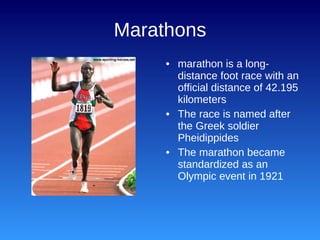
Marathons marathon is a long-distance foot race with an official distance of 42.195 kilometers The race is named after the Greek soldier Pheidippides The marathon became standardized as an Olympic event in 1921
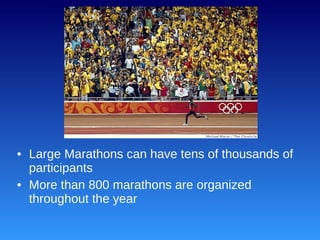
Large Marathons can have tens of thousands of participants More than 800 marathons are organized throughout the year
History of Marathon According to legend, Pheidippides was a Greek messenger who was sent from the town of Marathon to Athens to announce that the Persians has been defeated. The first Olympic marathon took place in 1896 The women’s marathon was introduced to the Olympics in 1984 It has been a tradition in the modern Olympics for the last event to be the running of the marathon
Training for a Marathon Most running coaches believe that the most important part of training is the long run Many runners try to reach 20 miles as their long run 40 miles a week is an average distance for runners that are training  Most training programs last around five to six months Consult your health professional regularly during your training
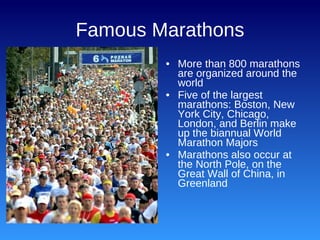
Famous Marathons More than 800 marathons are organized around the world Five of the largest marathons: Boston, New York City, Chicago, London, and Berlin make up the biannual World Marathon Majors Marathons also occur at the North Pole, on the Great Wall of China, in Greenland
World Records World records for marathons were not recognized until 2004 Before world records were recognized, the best times were referred to as “world best” The world record for men was set in Berlin by Haile Gebrselassie of Ethiopia with a time of 2 hours 3 minutes and 59 seconds The world record for women was set in London by Paula Radcliffe of Great Britain with a time of 2 hours 15 minutes and 25 seconds

marathon

  • 1.
    Marathon One ofOlympic Sports Exercise Science Jae Kim
  • 2.
    Marathons marathon isa long-distance foot race with an official distance of 42.195 kilometers The race is named after the Greek soldier Pheidippides The marathon became standardized as an Olympic event in 1921
  • 3.
    Large Marathons canhave tens of thousands of participants More than 800 marathons are organized throughout the year
  • 4.
    History of MarathonAccording to legend, Pheidippides was a Greek messenger who was sent from the town of Marathon to Athens to announce that the Persians has been defeated. The first Olympic marathon took place in 1896 The women’s marathon was introduced to the Olympics in 1984 It has been a tradition in the modern Olympics for the last event to be the running of the marathon
  • 5.
    Training for aMarathon Most running coaches believe that the most important part of training is the long run Many runners try to reach 20 miles as their long run 40 miles a week is an average distance for runners that are training Most training programs last around five to six months Consult your health professional regularly during your training
  • 6.
    Famous Marathons Morethan 800 marathons are organized around the world Five of the largest marathons: Boston, New York City, Chicago, London, and Berlin make up the biannual World Marathon Majors Marathons also occur at the North Pole, on the Great Wall of China, in Greenland
  • 7.
    World Records Worldrecords for marathons were not recognized until 2004 Before world records were recognized, the best times were referred to as “world best” The world record for men was set in Berlin by Haile Gebrselassie of Ethiopia with a time of 2 hours 3 minutes and 59 seconds The world record for women was set in London by Paula Radcliffe of Great Britain with a time of 2 hours 15 minutes and 25 seconds