Inequality in MarathonsSteve PilchCES 301 Conclusions
Topics to DiscussOverview of TopicHistorical Development of the MarathonIntro. of Running Cultures into Western CompetitionsRunning CulturesAn Understanding to Change Perceptions
Overview of Unequal RunningMarathons in Western Societies is relatively recent development in the History of Running.Long distance running has been practiced long before the Olympic MarathonSome cultures have retained this practice in:Persistence HuntingThe Marathon MonksThe TarahumaraRunning Societies have had their cultural practices used in Western Marathons
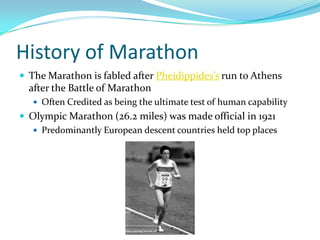
History of MarathonThe Marathon is fabled after Pheidippides’s run to Athens after the Battle of MarathonOften Credited as being the ultimate test of human capabilityOlympic Marathon (26.2 miles) was made official in 1921Predominantly European descent countries held top places
Running Cultures in MarathonsThe Introduction of Kenya into the World RacesCybernetics of Kenyan Running- R.E. Mayes1982: World Road Race Rankings- 2 of 10 top rankings were Kenyan1990: Kenya’s Commissioner of Sports lifted Travel and Agent restrictions1992: World Road Race Rankings- 9 of 10 top rankings were KenyanThe Marathon was established long before Agents could implement Kenyan Runners into competitions
Running Cultures in MarathonsDifferent perceptions of CompetitionAfrican Approach to Competition- Geoff Fenwick“Running is for capture or escape…It is difficult to explain to a tribesmen the purpose of running around an oval track…To lure him you need a cow for a prize or a bicycle. The pastoralist, for all his talent, has his own preconceived notions concerning the true nature of competition. (pg. 23)”Kenya has been one isolated instance that has been able to adapt its runners into the marathon competitionThere are other running cultures that do not compete in marathons because they have no reason to compete.
Running CulturesMarathon Monks53 mi/day for 100 days aspart of spiritual enlightenment questReasons for running have no 	connection to Marathon CompetitionTarahumara Culture, MexicoChampion Runner totaled 435mi run without restIsolated Culture/ Difference in Competitive Ideals has hindered inclusion in Marathons
A Change of PerspectiveThere is no single culture that is the Champion Running CultureHistorical transitions between record holdersCulture may define beneficial 	lifestyles but does not dictate	an advantageApplication:Cultural practices cannot be exploited for others competition
Works ReferencedData on Kenyan Running in World CompetitionsMayes, Randall E. The Cybernetics of Kenyan Running.		North Carolina: Carolina Academic Press, 2005. Print.Quotations on African Cultural Attitudes on CompetitionFenwick, Geoff. The African Approach to Competition.	Mountain View, CA: World Publications, 1975. Print.Data on Tarahumara RunningMcDougall, Christopher. Born to Run.		New York: Alfred A. Knopf, 2009. Print.

Inequality in Running

  • 1.
    Inequality in MarathonsStevePilchCES 301 Conclusions
  • 2.
    Topics to DiscussOverviewof TopicHistorical Development of the MarathonIntro. of Running Cultures into Western CompetitionsRunning CulturesAn Understanding to Change Perceptions
  • 3.
    Overview of UnequalRunningMarathons in Western Societies is relatively recent development in the History of Running.Long distance running has been practiced long before the Olympic MarathonSome cultures have retained this practice in:Persistence HuntingThe Marathon MonksThe TarahumaraRunning Societies have had their cultural practices used in Western Marathons
  • 4.
    History of MarathonTheMarathon is fabled after Pheidippides’s run to Athens after the Battle of MarathonOften Credited as being the ultimate test of human capabilityOlympic Marathon (26.2 miles) was made official in 1921Predominantly European descent countries held top places
  • 5.
    Running Cultures inMarathonsThe Introduction of Kenya into the World RacesCybernetics of Kenyan Running- R.E. Mayes1982: World Road Race Rankings- 2 of 10 top rankings were Kenyan1990: Kenya’s Commissioner of Sports lifted Travel and Agent restrictions1992: World Road Race Rankings- 9 of 10 top rankings were KenyanThe Marathon was established long before Agents could implement Kenyan Runners into competitions
  • 6.
    Running Cultures inMarathonsDifferent perceptions of CompetitionAfrican Approach to Competition- Geoff Fenwick“Running is for capture or escape…It is difficult to explain to a tribesmen the purpose of running around an oval track…To lure him you need a cow for a prize or a bicycle. The pastoralist, for all his talent, has his own preconceived notions concerning the true nature of competition. (pg. 23)”Kenya has been one isolated instance that has been able to adapt its runners into the marathon competitionThere are other running cultures that do not compete in marathons because they have no reason to compete.
  • 7.
    Running CulturesMarathon Monks53mi/day for 100 days aspart of spiritual enlightenment questReasons for running have no connection to Marathon CompetitionTarahumara Culture, MexicoChampion Runner totaled 435mi run without restIsolated Culture/ Difference in Competitive Ideals has hindered inclusion in Marathons
  • 8.
    A Change ofPerspectiveThere is no single culture that is the Champion Running CultureHistorical transitions between record holdersCulture may define beneficial lifestyles but does not dictate an advantageApplication:Cultural practices cannot be exploited for others competition
  • 9.
    Works ReferencedData onKenyan Running in World CompetitionsMayes, Randall E. The Cybernetics of Kenyan Running. North Carolina: Carolina Academic Press, 2005. Print.Quotations on African Cultural Attitudes on CompetitionFenwick, Geoff. The African Approach to Competition. Mountain View, CA: World Publications, 1975. Print.Data on Tarahumara RunningMcDougall, Christopher. Born to Run. New York: Alfred A. Knopf, 2009. Print.