Distinctions and analogies: 

mapping social system identity
(the regime shift canvas in theory and practice)
Howard Silverman and Crystal Rome
www.regimeshiftcanvas.org
RSD7
24-26 OCT 2018
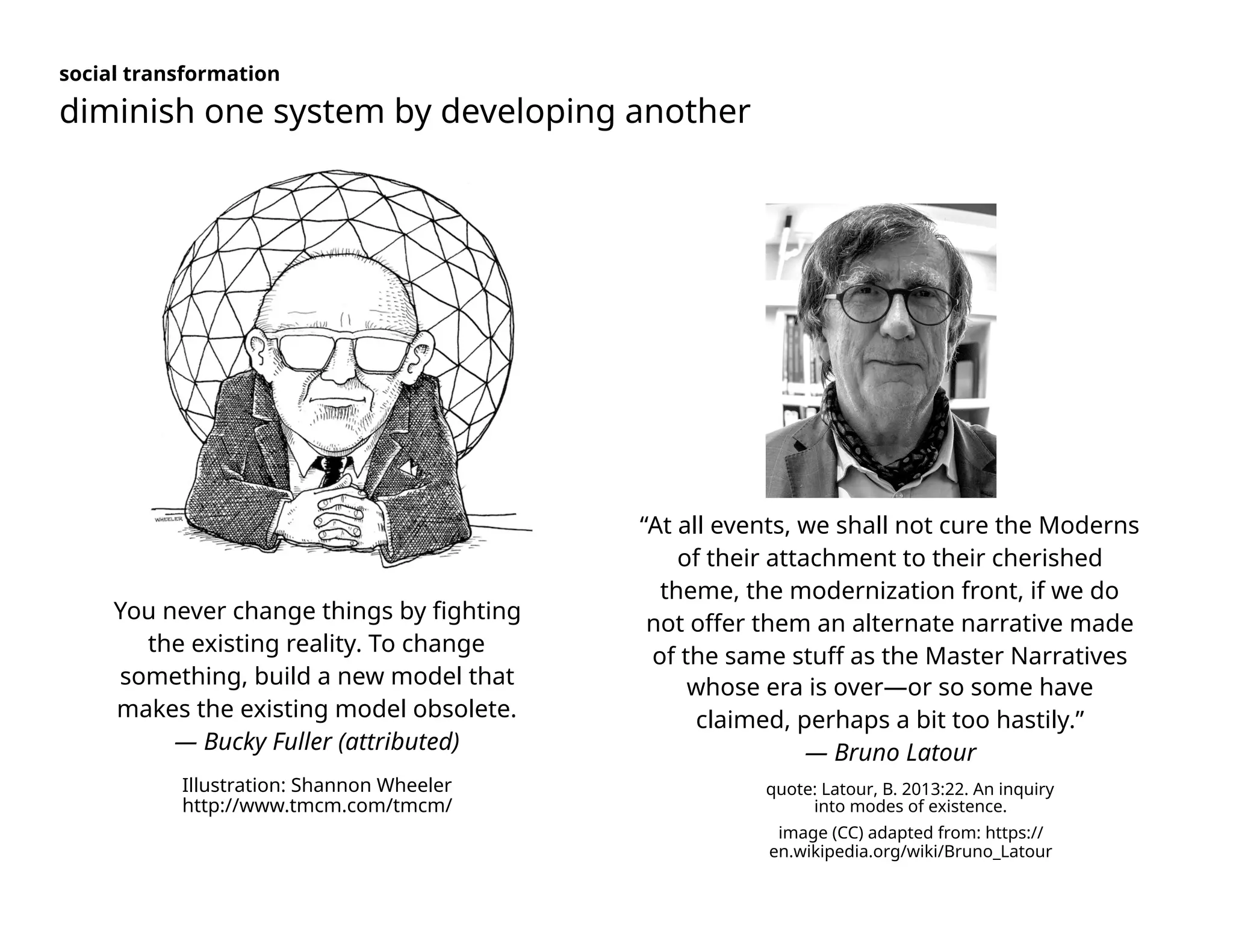
You never change things by fighting
the existing reality. To change
something, build a new model that
makes the existing model obsolete.
— Bucky Fuller (attributed)
“At all events, we shall not cure the Moderns
of their attachment to their cherished
theme, the modernization front, if we do
not offer them an alternate narrative made
of the same stuff as the Master Narratives
whose era is over—or so some have
claimed, perhaps a bit too hastily.”
— Bruno Latour
Illustration: Shannon Wheeler
http://www.tmcm.com/tmcm/
quote: Latour, B. 2013:22. An inquiry
into modes of existence.
image (CC) adapted from: https://
en.wikipedia.org/wiki/Bruno_Latour
social transformation
diminish one system by developing another
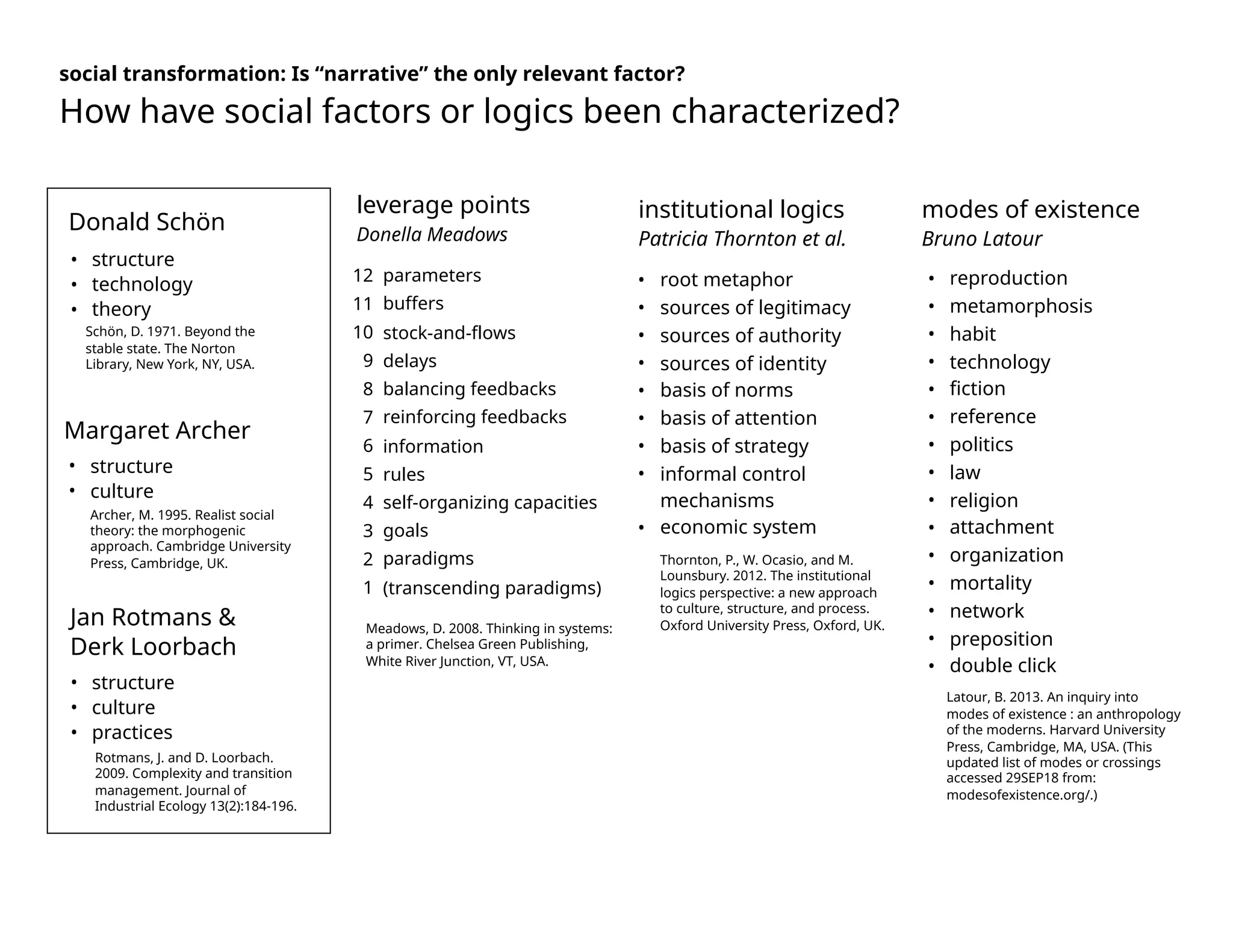
social transformation: Is “narrative” the only relevant factor?
How have social factors or logics been characterized?
• root metaphor
• sources of legitimacy
• sources of authority
• sources of identity
• basis of norms
• basis of attention
• basis of strategy
• informal control
mechanisms
• economic system
• reproduction
• metamorphosis
• habit
• technology
• fiction
• reference
• politics
• law
• religion
• attachment
• organization
• mortality
• network
• preposition
• double click
institutional logics
Patricia Thornton et al.
leverage points
Donella Meadows
modes of existence
Bruno Latour
Donald Schön
• structure
• technology
• theory
Schön, D. 1971. Beyond the
stable state. The Norton
Library, New York, NY, USA.
Meadows, D. 2008. Thinking in systems:
a primer. Chelsea Green Publishing,
White River Junction, VT, USA.
Thornton, P., W. Ocasio, and M.
Lounsbury. 2012. The institutional
logics perspective: a new approach
to culture, structure, and process.
Oxford University Press, Oxford, UK.
Latour, B. 2013. An inquiry into
modes of existence : an anthropology
of the moderns. Harvard University
Press, Cambridge, MA, USA. (This
updated list of modes or crossings
accessed 29SEP18 from:
modesofexistence.org/.)
• structure
• culture
Archer, M. 1995. Realist social
theory: the morphogenic
approach. Cambridge University
Press, Cambridge, UK.
Margaret Archer
• structure
• culture
• practices
Rotmans, J. and D. Loorbach.
2009. Complexity and transition
management. Journal of
Industrial Ecology 13(2):184-196.
Jan Rotmans & 

Derk Loorbach
12 parameters
11 buffers
10 stock-and-flows
9 delays
8 balancing feedbacks
7 reinforcing feedbacks
6 information
5 rules
4 self-organizing capacities
3 goals
2 paradigms
1 (transcending paradigms)
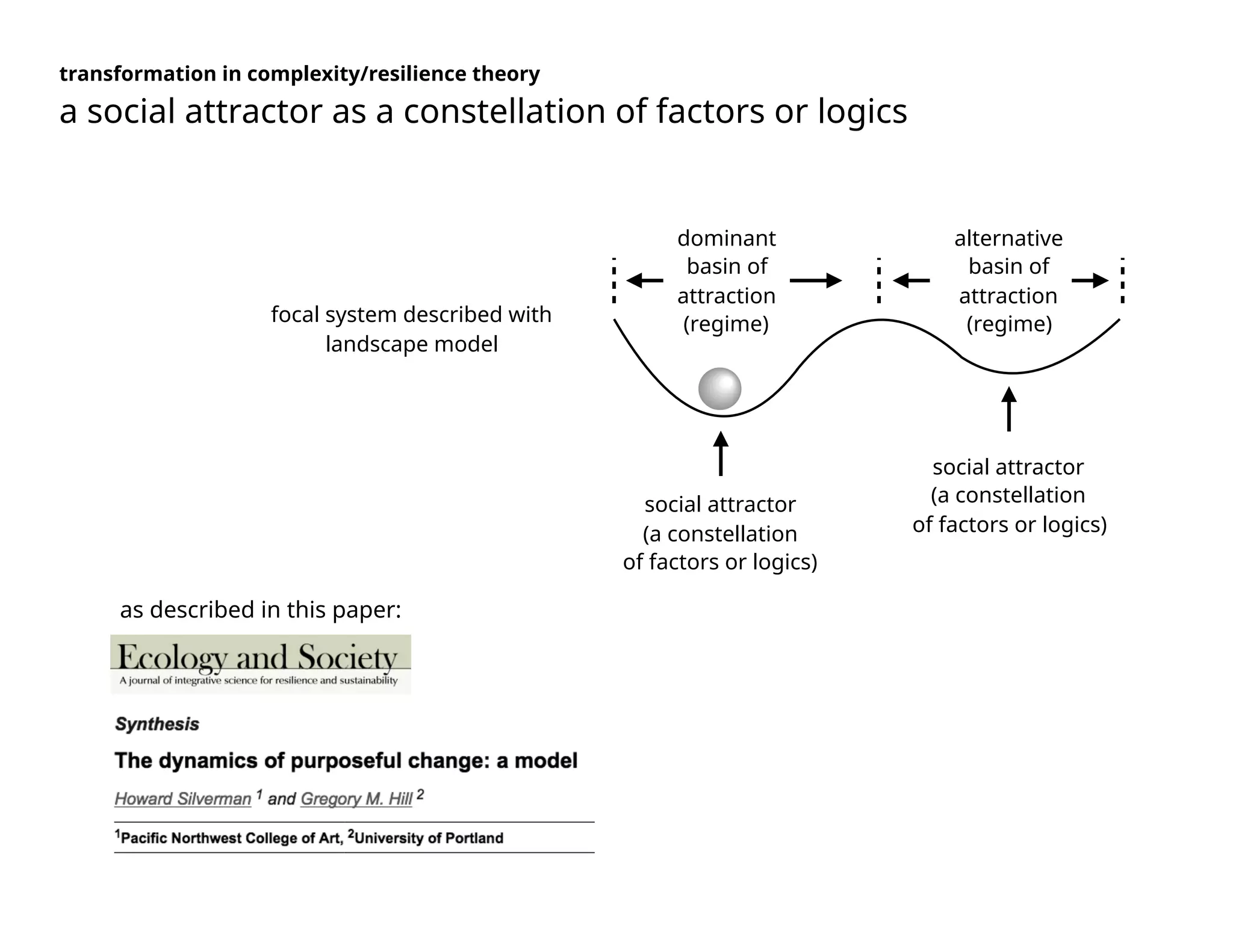
transformation in complexity/resilience theory
a social attractor as a constellation of factors or logics
social attractor
(a constellation
of factors or logics)
focal system described with
landscape model
alternative
basin of 

attraction 

(regime)
dominant
basin of 

attraction 

(regime)
social attractor
(a constellation
of factors or logics)
as described in this paper:
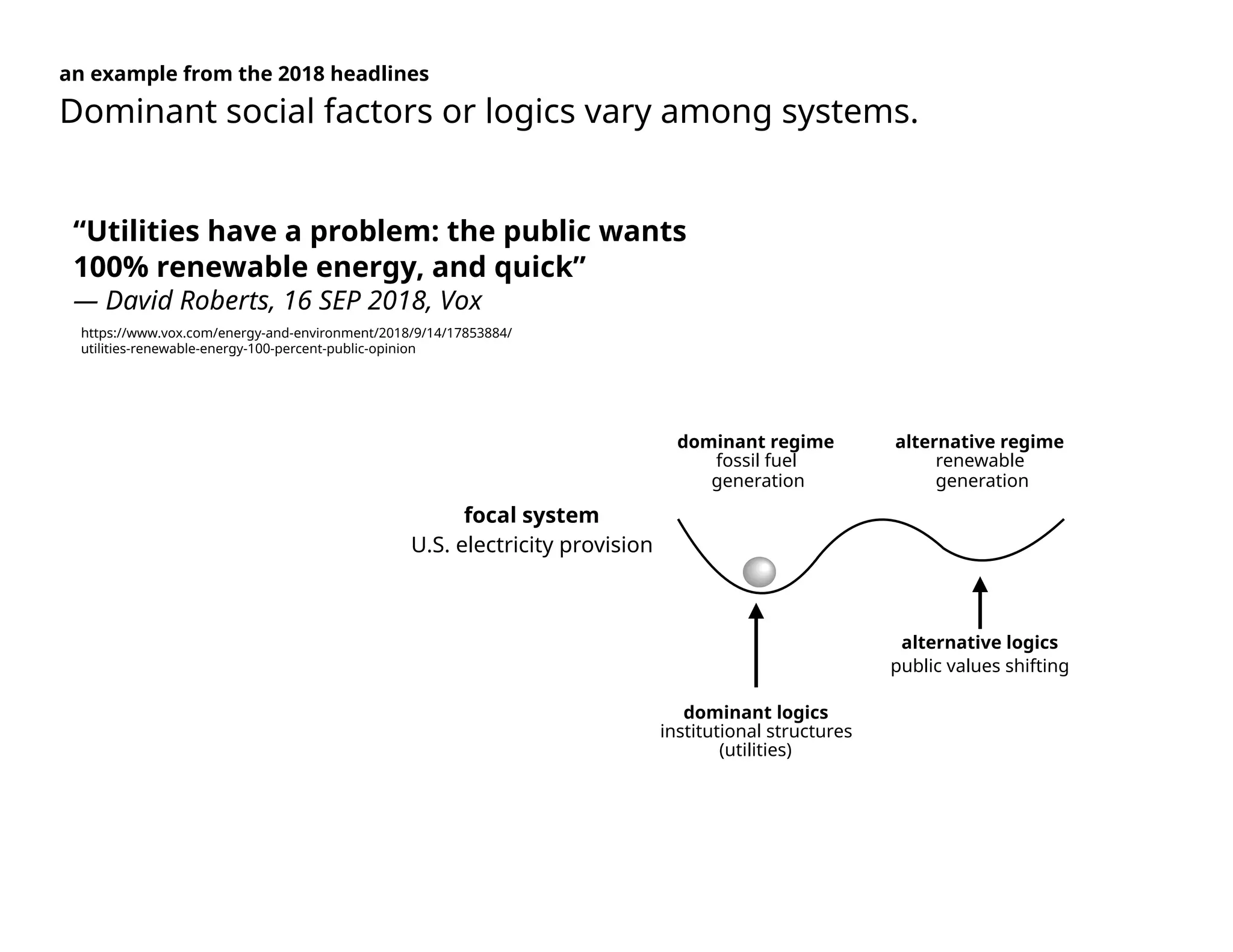
an example from the 2018 headlines
Dominant social factors or logics vary among systems.
https://www.vox.com/energy-and-environment/2018/9/14/17853884/
utilities-renewable-energy-100-percent-public-opinion
dominant logics
institutional structures 

(utilities)
focal system
U.S. electricity provision
alternative logics

public values shifting
dominant regime
fossil fuel

generation
alternative regime
renewable

generation
“Utilities have a problem: the public wants
100% renewable energy, and quick”
— David Roberts, 16 SEP 2018, Vox
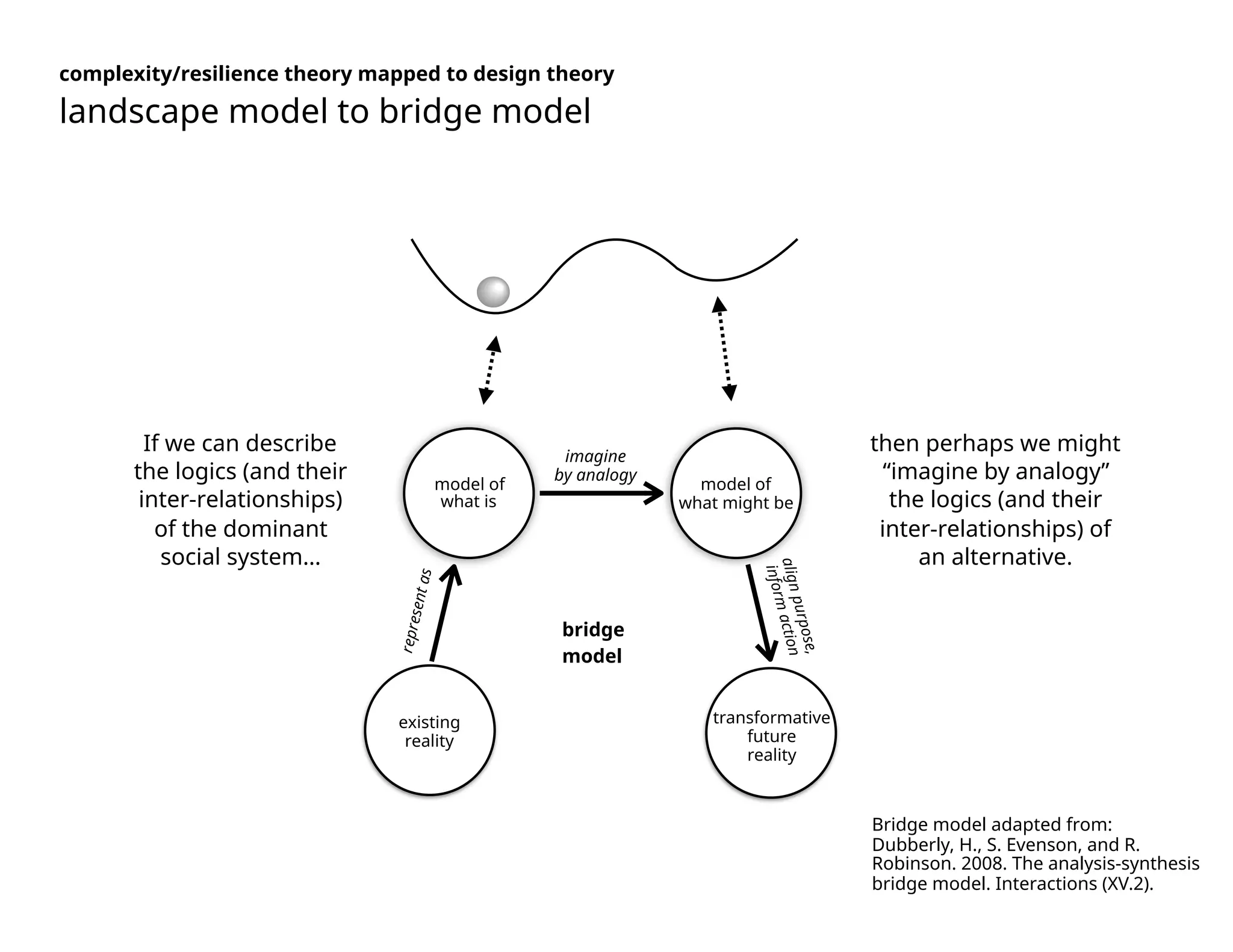
complexity/resilience theory mapped to design theory
landscape model to bridge model
imagine
by analogy
alignpurpose,
informaction
existing
reality
model of
what is
model of
what might be
bridge
model
If we can describe 

the logics (and their
inter-relationships) 

of the dominant 

social system…
then perhaps we might
“imagine by analogy”
the logics (and their
inter-relationships) of
an alternative.
transformative
future
reality
representas
Bridge model adapted from:
Dubberly, H., S. Evenson, and R.
Robinson. 2008. The analysis-synthesis
bridge model. Interactions (XV.2).
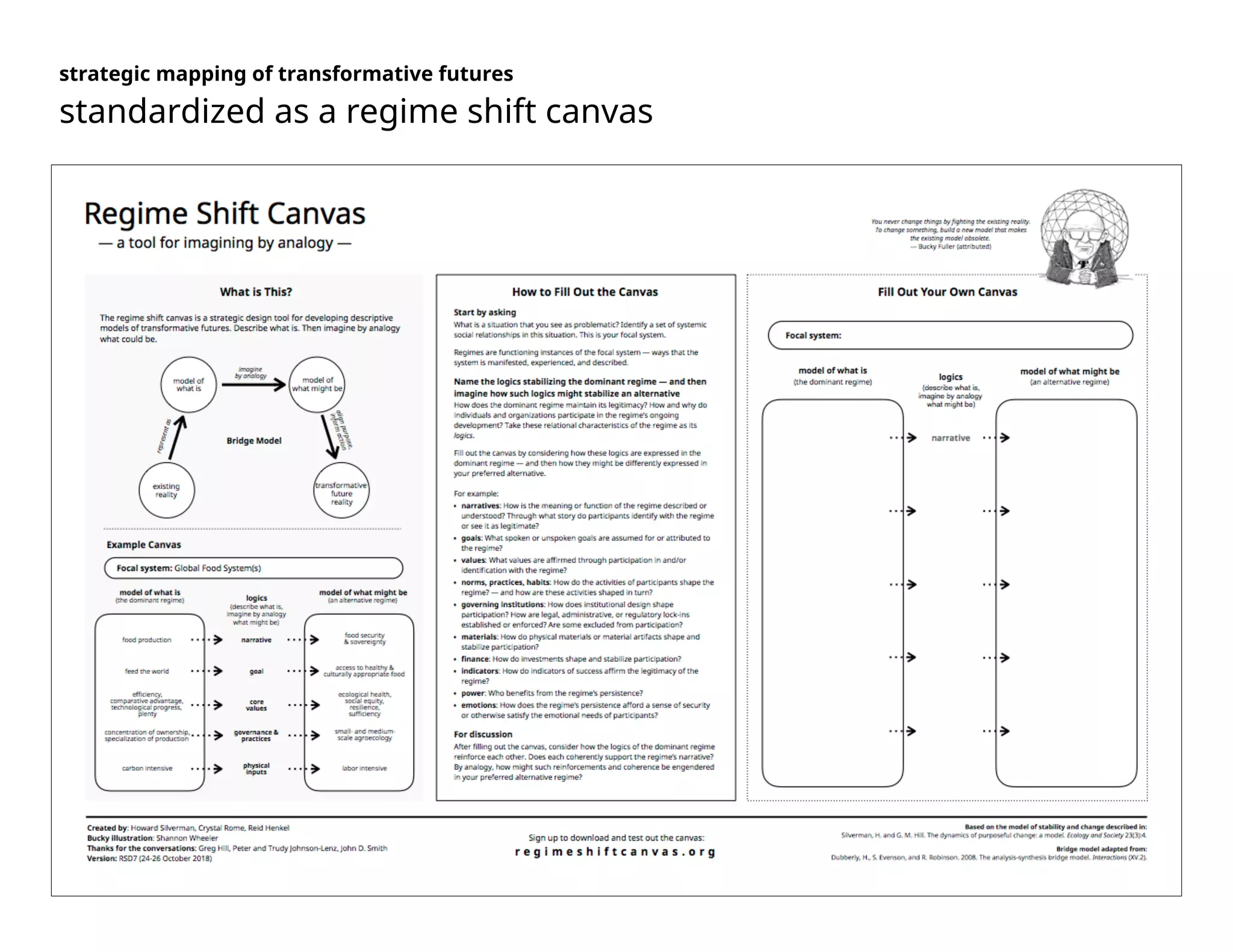
strategic mapping of transformative futures
standardized as a regime shift canvas
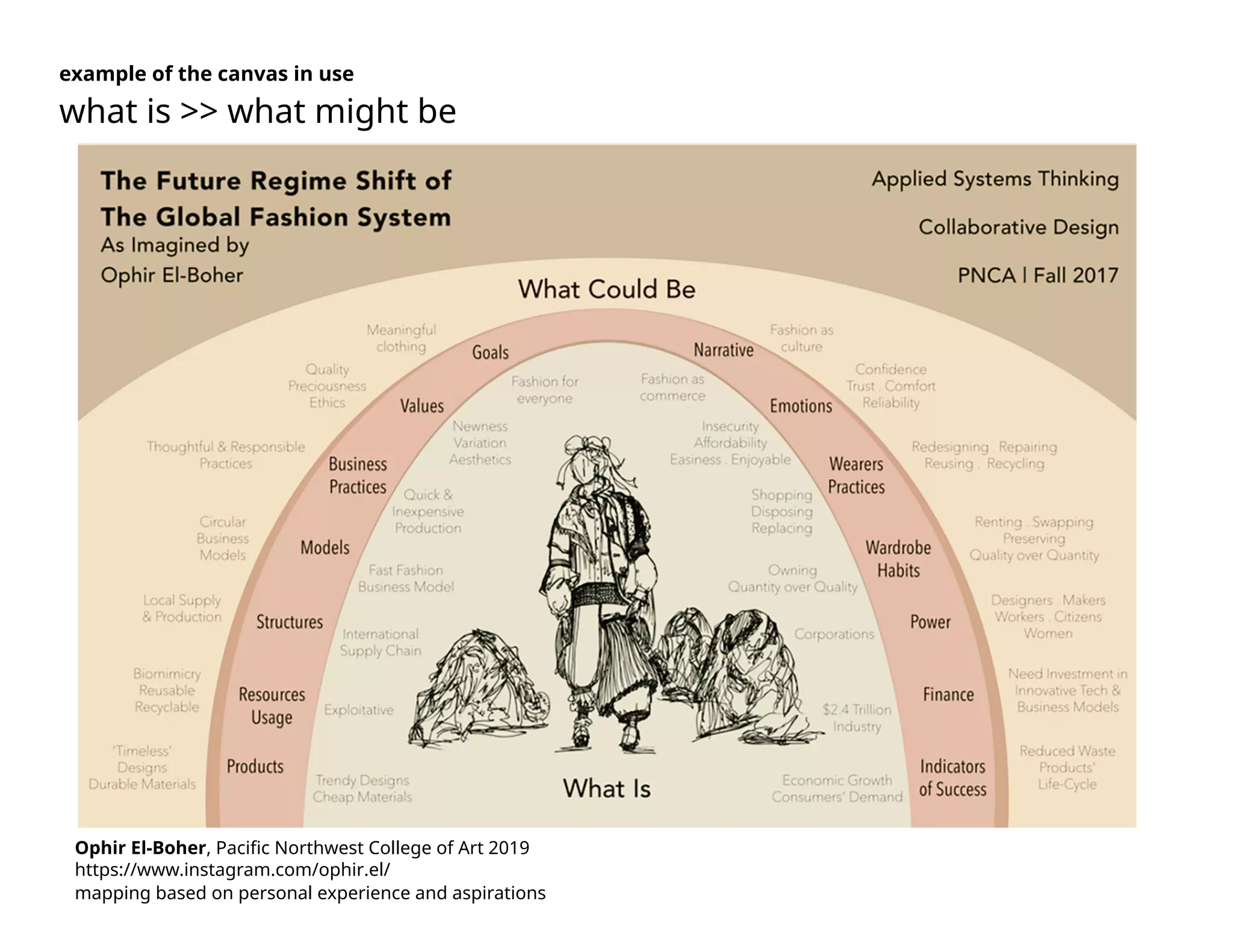
example of the canvas in use
what is >> what might be
Ophir El-Boher, Pacific Northwest College of Art 2019
https://www.instagram.com/ophir.el/
mapping based on personal experience and aspirations
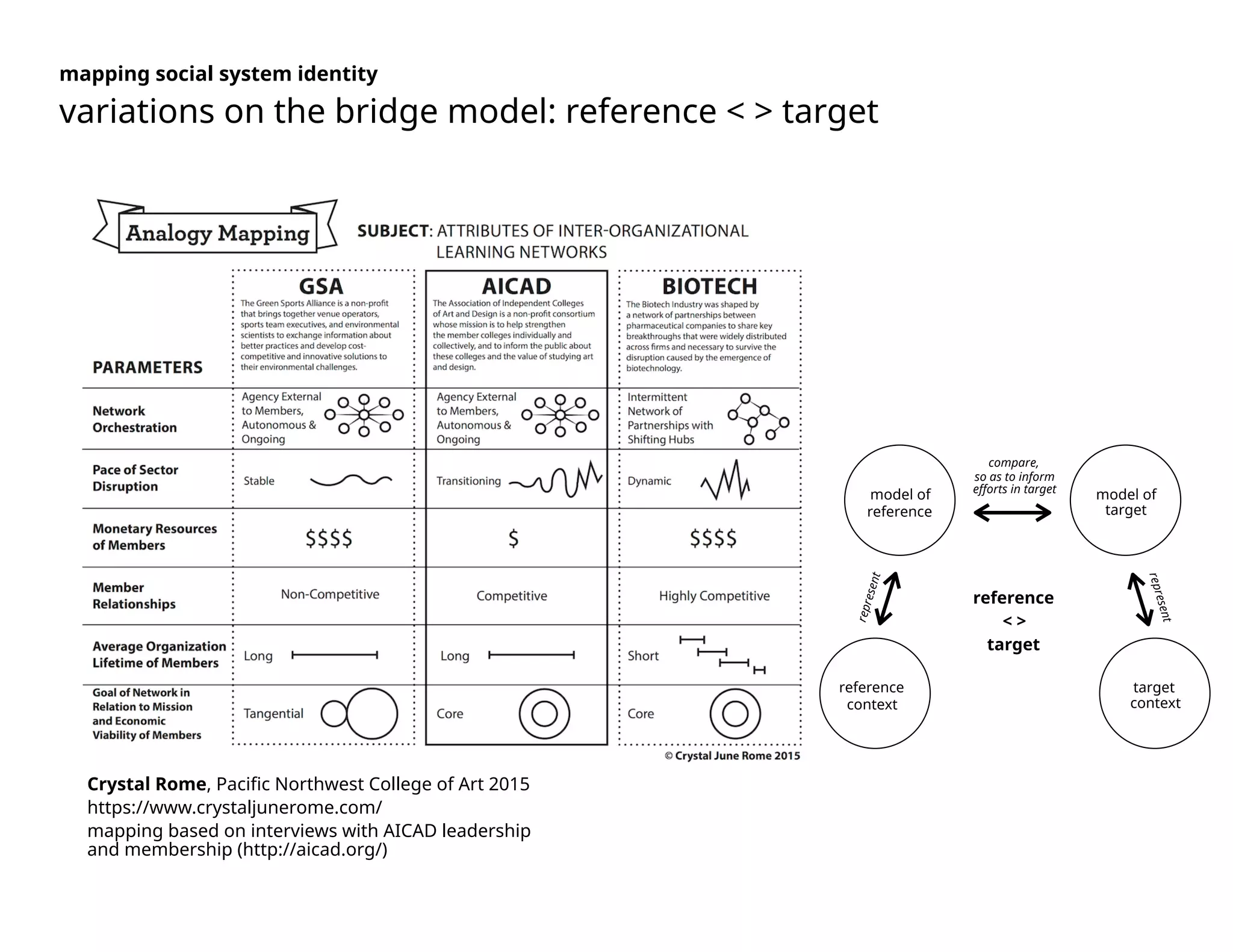
compare,
so as to inform 

efforts in target
represent
reference
context
model of
reference
model of
target
reference
< >
target
target
context
represent
mapping social system identity
variations on the bridge model: reference < > target
Crystal Rome, Pacific Northwest College of Art 2015
https://www.crystaljunerome.com/
mapping based on interviews with AICAD leadership
and membership (http://aicad.org/)
compare,
so as to inform 

efforts to reach
alignment
represent
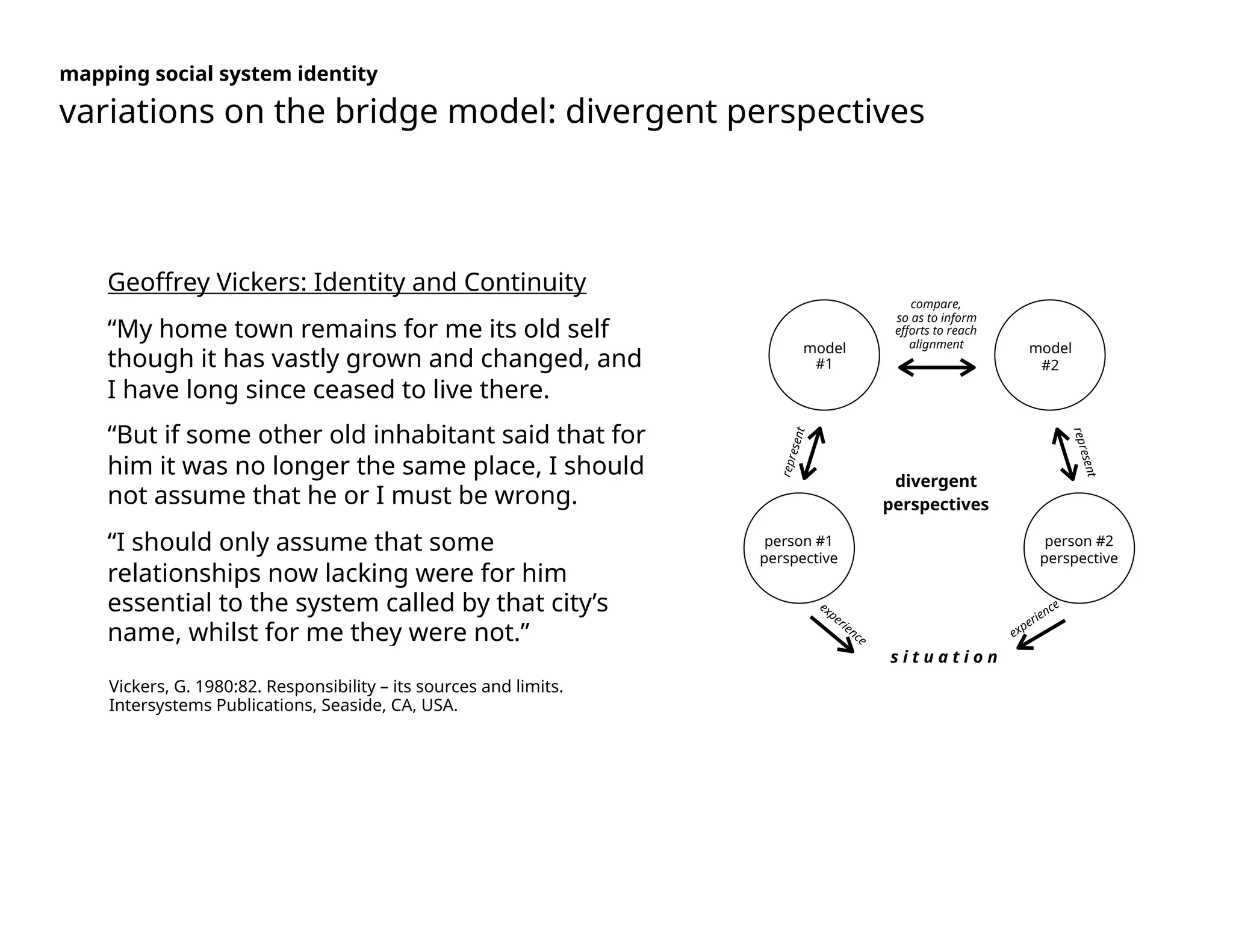
person #1
perspective
divergent
perspectives
person #2
perspective
represent
s i t u a t i o n
experience experience
model
#1
model
#2
mapping social system identity
variations on the bridge model: divergent perspectives
Geoffrey Vickers: Identity and Continuity
“My home town remains for me its old self
though it has vastly grown and changed, and
I have long since ceased to live there.
“But if some other old inhabitant said that for
him it was no longer the same place, I should
not assume that he or I must be wrong.
“I should only assume that some
relationships now lacking were for him
essential to the system called by that city’s
name, whilst for me they were not.”
Vickers, G. 1980:82. Responsibility – its sources and limits.
Intersystems Publications, Seaside, CA, USA.
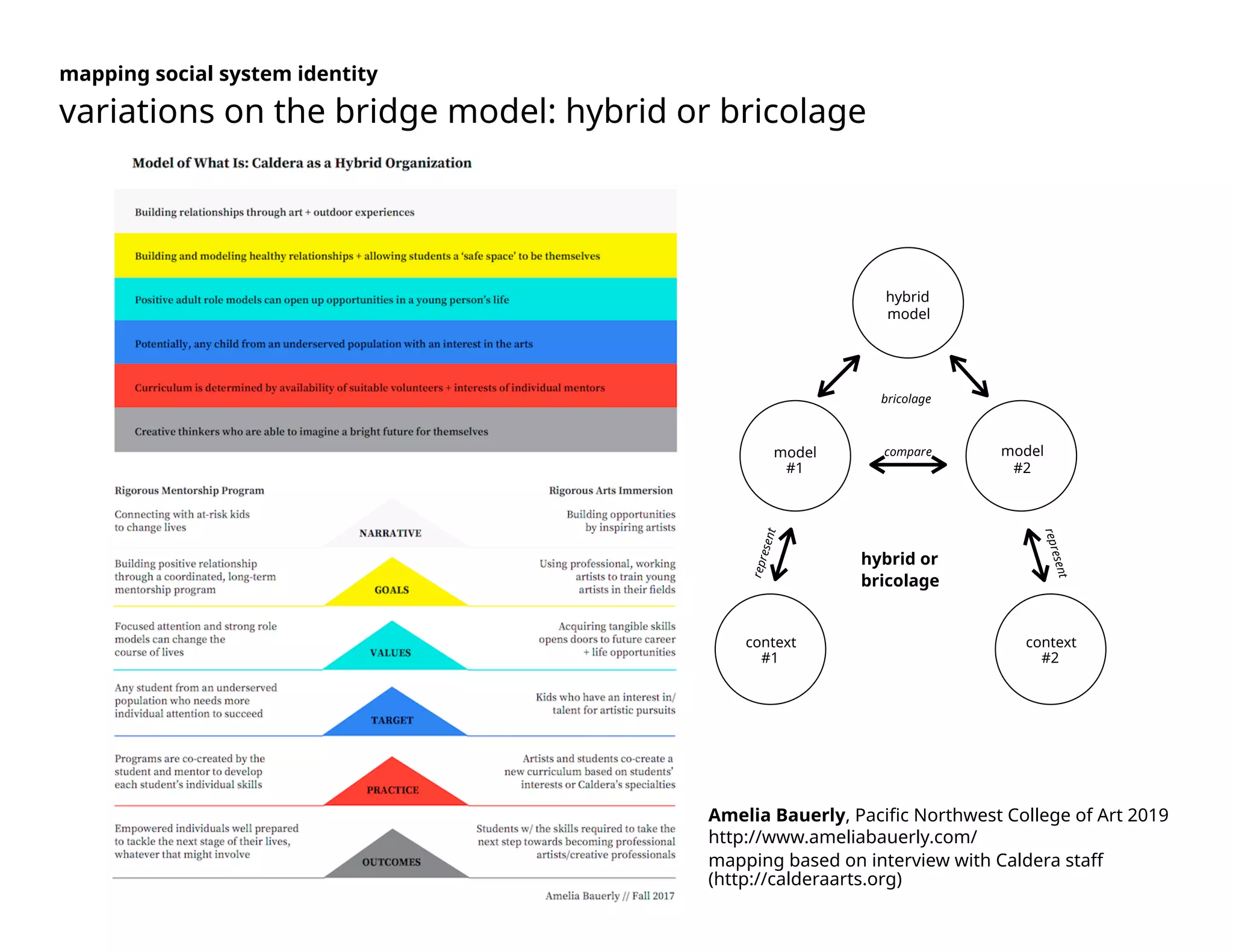
compare
represent
context
#1
model
#1
model
#2
hybrid or
bricolage
context
#2
represent
hybrid
model
bricolage
mapping social system identity
variations on the bridge model: hybrid or bricolage
Amelia Bauerly, Pacific Northwest College of Art 2019
http://www.ameliabauerly.com/
mapping based on interview with Caldera staff 

(http://calderaarts.org)
howard@solvingforpattern.org
www.regimeshiftcanvas.org
Distinctions and analogies: mapping social system identity
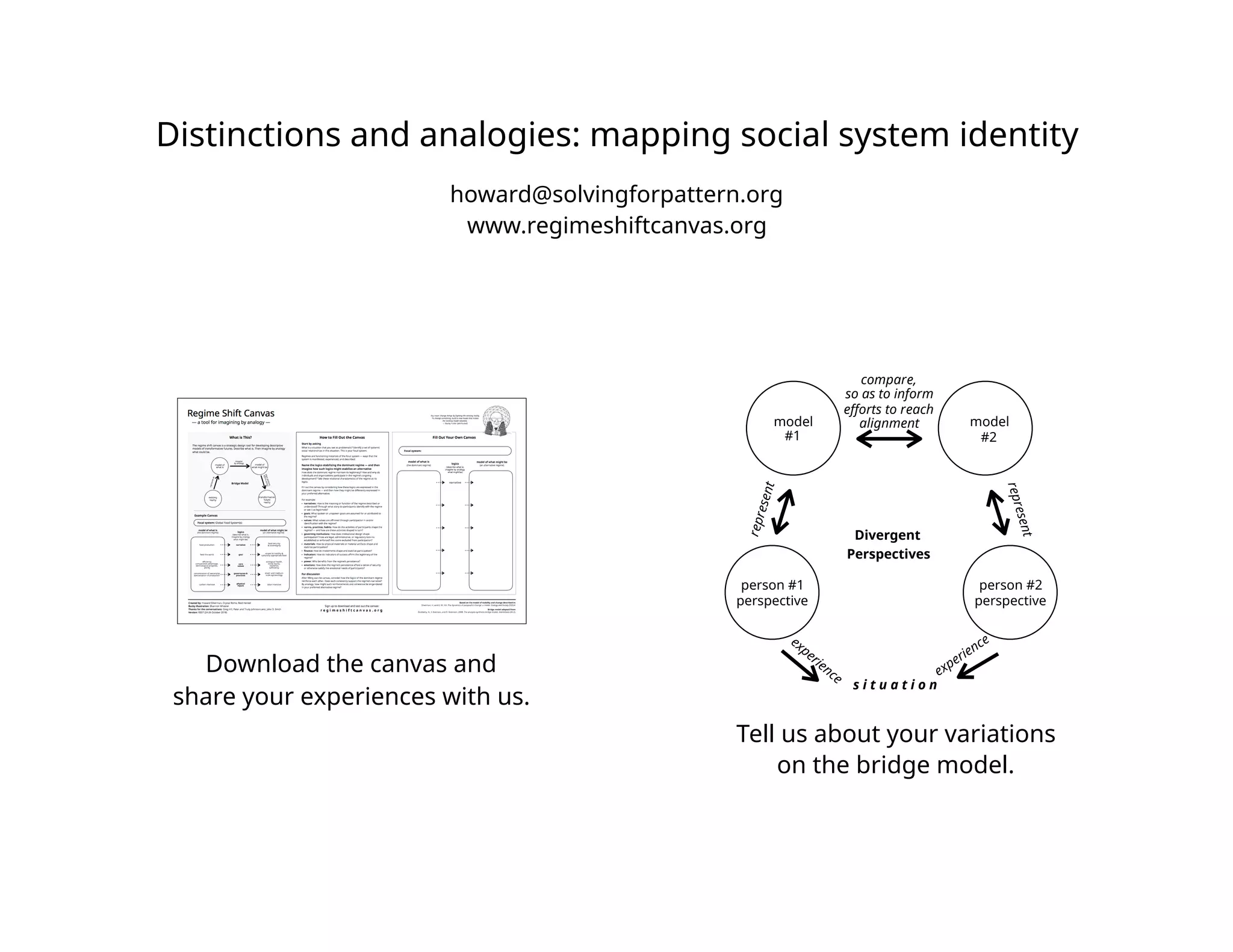
Download the canvas and 

share your experiences with us.
compare,
so as to inform 

efforts to reach
alignment
represent
person #1
perspective
Divergent
Perspectives
person #2
perspective
represent
s i t u a t i o n
experience experience
model
#1
model
#2
Tell us about your variations
on the bridge model.

Distinctions and Analogies: Mapping Social System Identity

  • 1.
    Distinctions and analogies:
 mapping social system identity (the regime shift canvas in theory and practice) Howard Silverman and Crystal Rome www.regimeshiftcanvas.org RSD7 24-26 OCT 2018
  • 2.
    You never changethings by fighting the existing reality. To change something, build a new model that makes the existing model obsolete. — Bucky Fuller (attributed) “At all events, we shall not cure the Moderns of their attachment to their cherished theme, the modernization front, if we do not offer them an alternate narrative made of the same stuff as the Master Narratives whose era is over—or so some have claimed, perhaps a bit too hastily.” — Bruno Latour Illustration: Shannon Wheeler http://www.tmcm.com/tmcm/ quote: Latour, B. 2013:22. An inquiry into modes of existence. image (CC) adapted from: https:// en.wikipedia.org/wiki/Bruno_Latour social transformation diminish one system by developing another
  • 3.
    social transformation: Is“narrative” the only relevant factor? How have social factors or logics been characterized? • root metaphor • sources of legitimacy • sources of authority • sources of identity • basis of norms • basis of attention • basis of strategy • informal control mechanisms • economic system • reproduction • metamorphosis • habit • technology • fiction • reference • politics • law • religion • attachment • organization • mortality • network • preposition • double click institutional logics Patricia Thornton et al. leverage points Donella Meadows modes of existence Bruno Latour Donald Schön • structure • technology • theory Schön, D. 1971. Beyond the stable state. The Norton Library, New York, NY, USA. Meadows, D. 2008. Thinking in systems: a primer. Chelsea Green Publishing, White River Junction, VT, USA. Thornton, P., W. Ocasio, and M. Lounsbury. 2012. The institutional logics perspective: a new approach to culture, structure, and process. Oxford University Press, Oxford, UK. Latour, B. 2013. An inquiry into modes of existence : an anthropology of the moderns. Harvard University Press, Cambridge, MA, USA. (This updated list of modes or crossings accessed 29SEP18 from: modesofexistence.org/.) • structure • culture Archer, M. 1995. Realist social theory: the morphogenic approach. Cambridge University Press, Cambridge, UK. Margaret Archer • structure • culture • practices Rotmans, J. and D. Loorbach. 2009. Complexity and transition management. Journal of Industrial Ecology 13(2):184-196. Jan Rotmans & 
 Derk Loorbach 12 parameters 11 buffers 10 stock-and-flows 9 delays 8 balancing feedbacks 7 reinforcing feedbacks 6 information 5 rules 4 self-organizing capacities 3 goals 2 paradigms 1 (transcending paradigms)
  • 4.
    transformation in complexity/resiliencetheory a social attractor as a constellation of factors or logics social attractor (a constellation of factors or logics) focal system described with landscape model alternative basin of 
 attraction 
 (regime) dominant basin of 
 attraction 
 (regime) social attractor (a constellation of factors or logics) as described in this paper:
  • 5.
    an example fromthe 2018 headlines Dominant social factors or logics vary among systems. https://www.vox.com/energy-and-environment/2018/9/14/17853884/ utilities-renewable-energy-100-percent-public-opinion dominant logics institutional structures 
 (utilities) focal system U.S. electricity provision alternative logics
 public values shifting dominant regime fossil fuel
 generation alternative regime renewable
 generation “Utilities have a problem: the public wants 100% renewable energy, and quick” — David Roberts, 16 SEP 2018, Vox
  • 6.
    complexity/resilience theory mappedto design theory landscape model to bridge model imagine by analogy alignpurpose, informaction existing reality model of what is model of what might be bridge model If we can describe 
 the logics (and their inter-relationships) 
 of the dominant 
 social system… then perhaps we might “imagine by analogy” the logics (and their inter-relationships) of an alternative. transformative future reality representas Bridge model adapted from: Dubberly, H., S. Evenson, and R. Robinson. 2008. The analysis-synthesis bridge model. Interactions (XV.2).
  • 7.
    strategic mapping oftransformative futures standardized as a regime shift canvas
  • 8.
    example of thecanvas in use what is >> what might be Ophir El-Boher, Pacific Northwest College of Art 2019 https://www.instagram.com/ophir.el/ mapping based on personal experience and aspirations
  • 9.
    compare, so as toinform 
 efforts in target represent reference context model of reference model of target reference < > target target context represent mapping social system identity variations on the bridge model: reference < > target Crystal Rome, Pacific Northwest College of Art 2015 https://www.crystaljunerome.com/ mapping based on interviews with AICAD leadership and membership (http://aicad.org/)
  • 10.
    compare, so as toinform 
 efforts to reach alignment represent person #1 perspective divergent perspectives person #2 perspective represent s i t u a t i o n experience experience model #1 model #2 mapping social system identity variations on the bridge model: divergent perspectives Geoffrey Vickers: Identity and Continuity “My home town remains for me its old self though it has vastly grown and changed, and I have long since ceased to live there. “But if some other old inhabitant said that for him it was no longer the same place, I should not assume that he or I must be wrong. “I should only assume that some relationships now lacking were for him essential to the system called by that city’s name, whilst for me they were not.” Vickers, G. 1980:82. Responsibility – its sources and limits. Intersystems Publications, Seaside, CA, USA.
  • 11.
    compare represent context #1 model #1 model #2 hybrid or bricolage context #2 represent hybrid model bricolage mapping socialsystem identity variations on the bridge model: hybrid or bricolage Amelia Bauerly, Pacific Northwest College of Art 2019 http://www.ameliabauerly.com/ mapping based on interview with Caldera staff 
 (http://calderaarts.org)
  • 12.
    howard@solvingforpattern.org www.regimeshiftcanvas.org Distinctions and analogies:mapping social system identity Download the canvas and 
 share your experiences with us. compare, so as to inform 
 efforts to reach alignment represent person #1 perspective Divergent Perspectives person #2 perspective represent s i t u a t i o n experience experience model #1 model #2 Tell us about your variations on the bridge model.