1
Convening
Collaboration for
Environmental
Conflict
Resolution
Soleeheen Bilanglod (Thailand)
Tim Workman (USA)
Friday, April 24, 15
Agenda
‣ Environmental Conflict Resolution - General
Principles
‣ Basic Framework for Analysis & Intervention
‣ Regional Trends, Southeast Asia
‣ Case Studies
‣ Scenario Exercise
‣ Debrief Synthesis/Group Presentations
2
Friday, April 24, 15
3
“CONFLICT IS INDISPENSABLE TO DEFINING, OVER TIME, A
SOCIALLY SUSTAINABLE ORDER, BECAUSE IT IMPELS
INSTITUTIONS TOWARD SUCH A SEARCH IN THE FIRST PLACE.”
K. LEE, 1993
Friday, April 24, 15
Conflict & Response
Conflict: “an expressed struggle between at least two
interdependent parties who perceive incompatible
goals, scare resources, and interference from others
in achieving their goals.”
Responses:
Denial/Avoidance/“Saving Face”
Accommodation/Compromise
Competition
Force/Violence
Negotiation
Collaboration
4
WHICH APPROACH IS MORE
COMMON TO YOUR COUNTRY?
Friday, April 24, 15
Environmental & Natural
Resource Conflicts
ISSUES
- Scientific Complexity
and Uncertainty
- Conflicting Values and
Ideologies
- Cross jurisdictional
boundaries
- Continuing and Evolving
- Varied Settings
5
PARTIES
- Diverse
- Differing Knowledge
Levels
- Differing Power and
Resources
- Challenges w/ engaging
un- and under-
represented parties.
Friday, April 24, 15
Distinctions and
Differences
6
CHRONIC CONFLICTS
W/ ENVIR. ELEMENTS
BOUNDED ENVIR.
DISPUTES
DEPTHOFDISPUTE
* NEED FOR MULTI-SCALAR RESPONSES?
COLLIER-HOEFFLER MODEL ON CAUSAL
FACTORS FOR SOCIAL CONFLICT:
๏ DISPARITY IN INCOME PER CAPITA
๏ RATE OF ECONOMIC DEVELOPMENT
๏ STRUCTURE OF THE ECONOMY (E.G.,
DEPENDENCE ON PRIMARY COMMODITY
EXPORTS)
๏ ETHNIC AND RELIGIOUS COMPOSITION ALSO
MATTERS
Friday, April 24, 15
Bounded Disputes: Key
Considerations
Adequate Representation of Stakeholders -
especially poor and marginalized communities for
sustainable decision making.
Availability of good science and information for
objective analysis and deliberation.
Supportive & effective legal and institutional
infrastructure.
Spill-Overs and Public Accountability
7
Friday, April 24, 15
*Special Subjects of
Concern
How do you engage indigenous stakeholders?
Long-standing connection with land; unique
institutions.
Free, Prior, and Informed Consent/Consultation.
E.g., Awas Tingni – Abutting Interests &
Customary Mediation.
8
Friday, April 24, 15
What is Environmental
Conflict Resolution?
• Any method of resolving environmental disputes
other than adjudication. “Alternative Dispute
Resolution.”
• A Collaborative Process to resolve disputes, create
plans, policies, and recommendations:
- All stakeholders participate
- May involve a “neutral third party”
- May or may not be a consensus process
- May or may not involve shared decision making
9
Friday, April 24, 15
Basic Collaborative Forms of
Dispute Resolution
1. Facilitation
Educational, exploratory facilitated dialogue among
stakeholders on public issues that builds understanding
short of agreement. Usually to prevent conflict.
2. Mediation
Two or more groups negotiating, with guidance from a third
party, in order to clarify, understand, and eventually agree
on a conflict issue.
3. Conciliation
Third party actively directs parties toward common
agreement, develops and proposes the terms of a
settlement to a conflict.
10
Friday, April 24, 15
What is Collaboration?
MARGERUM, 2011
Collaboration is an approach to solving complex
problems in which a diverse group of autonomous
stakeholders deliberates to build consensus and
develop networks for translating consensus into
results.
11
Friday, April 24, 15
What does
Collaboration look like?
Voluntary
Face-to-face
Has a Purpose
Cross-boundary (organizations, interests,
geography, jurisdictions, sectors)
12
Friday, April 24, 15
Why Collaborate?
Collaboration can lead to better decisions that are
more likely to be implemented and, at the same
time, better prepare agencies and communities for
future environmental challenges ... building
bridges between agencies, organizations, and
individuals in environmental management.
WONDOLLECK AND YAFFEE (2000)
13
Friday, April 24, 15
Roles in Collaboration
Sponsors
Give resources and staff to support convening
process.
Conveners
Identify stakeholders, bring to table, secure resources.
Neutrals
Third Party facilitator used in process to avoid
perception of bias.
Participants
Stakeholders - individuals, interest/civic groups,
public/private organizations.
MARGERUM, 2011
14
Friday, April 24, 15
Rules for Collaboration
1.Stakeholders are willing, able, and committed to
engage in the process.
2.All affected stakeholders are involved and
adequately represented.
3.Stakeholders empowered to determine process
procedures and select facilitator.
EMERSON, 2015
15
Friday, April 24, 15
Rules for Collaboration
No. 2
1.Stakeholders are ready to negotiate in good faith
and with accountability.
2.The process is timely.
3.The process is informed, with agreement on
sharing, testing, and applying relevant data.
16
EMERSON, 2015
Friday, April 24, 15
Circumstances Favoring
Collaboration
1. Resolution will not compromise stakeholders’
basic values.
2. Power symmetry among stakeholders.
3. Key parties are willing to participate.
4. Implementation of an agreement is likely.
17
EMERSON, 2015
Friday, April 24, 15
Circumstances Favoring
Collaboration No. 2
1. Communities have strong social capital, low
difference, and can build on common ground.
2. Facilitator is perceived as neutral.
3. There is adequate time and funding.
4. The process is insulated from politics.
5. Participants have a stake in resolving the
problem, not continuing stalemate.
18
EMERSON, 2015
Friday, April 24, 15
Constraints on
Collaboration/ECR
1.Participant reluctance due to time and resource
constraints.
2.Restrictions related to policy or law.
3.Agency resistance to ceding control/transparency.
4.High agency turn-over.
5.Participant subterfuge (litigation, lack of
engagement, use of media).
EMERSON, 2015
It can take months or even years to develop a collaborative
agreement or plan. Agencies and elected officials generally prefer
faster processes.
MARGERUM, 2011;
19
Friday, April 24, 15
Opportunities for
Collaboration
BROADER POLICY LEVEL
SPECIFIC APPLICATIONS
EMERSON, 2015
DEVELOP
PROPOSED
ACTIONS
REVIEW
PLANS
ALLOCATE
RESOURCES
LICENSE/
PERMIT
ENFORCE
REGULATIONS
IMPLEMENT
PROJECTS
SETTLE
DISPUTES
MONITOR
STUDY
RESOURCE
POTENTIAL
/RISKS
FRAME
POLICY
ISSUES
ANALYZE
POLICY
OPTIONS
DEVELOP
POLICY
CREATE
RULES/
INCENTIVES
DESIGN
DISPUTE
RESOLUTION
MECHANISM/
SYSTEM
20
Friday, April 24, 15
Evaluating Collaboration
21
I
M
P
A
C
T
S
?
Friday, April 24, 15
Does it “work”?
22
AT THIS POINT THE BURDEN IS ON THE PROMOTERS (OF
COLLABORATION) TO DEMONSTRATE THAT IT CAN
WORK; THAT IT CAN BE FAIR AND INVOLVE ALL
STAKEHOLDERS, ESPECIALLY WHERE BROAD ISSUES
ARE AT STAKE; THAT IT CAN RESPECT AGENCY
LEGITIMACY; THAT IT CAN GET BEYOND GOOD
FEELINGS TO PRODUCE MANAGEMENT SOLUTIONS;
AND THAT IT CAN BE WORTH THE TIME IT REQUIRES.
[M. McCloskey, as quoted in Harmon, W., “McCloskey on
Collaboration: The Conversation Continues, The Compass, Fall
1998.]
Friday, April 24, 15
Key Design Principles
➡The Importance of Assessment
➡The Importance of Creating a Process Roadmap
➡The Importance of Monitoring and Evaluation
23
Friday, April 24, 15
State of Conflict
24
Friday, April 24, 15
SE Asia & ENR Conflict
Global conflict areas
using academic (above)
and ENGO reports
(bottom). Dark areas
show the higher
concentration of forest
conflict. SE Asia is a
global “hotspot” for
forest and land-related
social conflict.
(Dhiaulhaq, et. al, 2015)
25
Friday, April 24, 15
Policy Developments
Decentralization & Opening Political Spaces for
Collaboration.
Changing Stakeholders: Ethnic vs. Class
Consciousness; Indigenous Rights.
Upstream and Downstream Expectations:
Corporate Social Responsibility, Trade
Associations, Conscientious Consumers.
26
Friday, April 24, 15
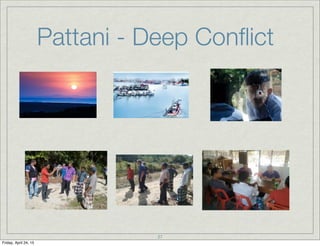
Pattani - Deep Conflict
27
Friday, April 24, 15
28
Kajang Conflict
Friday, April 24, 15
Kajang Conflict
29
Friday, April 24, 15
30
Friday, April 24, 15
Scenario Activity
Groups of 10-12
Read Scenario (5-10 minutes)
Answer Questions (20-30 minutes)
Note-taker will report to whole group
31
Friday, April 24, 15
32
ASSESSMENT FLOWCHART
Friday, April 24, 15
Debriefing/Reflection
33
CONTACT
TIM WORKMAN, MA CANDIDATE
JAMES E. ROGERS COLLEGE OF LAW
UNIVERSITY OF ARIZONA
TIM.WORKMAN.RULIT@GMAIL.COM
SOLEEHEEN BILANGLOD
SOLEEHEEN.B@GMAIL.COM
Friday, April 24, 15
34
Terima Kasih
Chữ nôm
ขอบคุณ
ឣរគុណ
!က#$ဇ&$တန)ပ+တယ)။
ຂອບໃຈSelamat
ThankYou
APRIL 22–25, 2015 SIEM REAP, CAMBODIA
#YSEALIGenEarth
Friday, April 24, 15

Convening Collaboration for Environmental Conflict Resolution

  • 1.
  • 2.
    Agenda ‣ Environmental ConflictResolution - General Principles ‣ Basic Framework for Analysis & Intervention ‣ Regional Trends, Southeast Asia ‣ Case Studies ‣ Scenario Exercise ‣ Debrief Synthesis/Group Presentations 2 Friday, April 24, 15
  • 3.
    3 “CONFLICT IS INDISPENSABLETO DEFINING, OVER TIME, A SOCIALLY SUSTAINABLE ORDER, BECAUSE IT IMPELS INSTITUTIONS TOWARD SUCH A SEARCH IN THE FIRST PLACE.” K. LEE, 1993 Friday, April 24, 15
  • 4.
    Conflict & Response Conflict:“an expressed struggle between at least two interdependent parties who perceive incompatible goals, scare resources, and interference from others in achieving their goals.” Responses: Denial/Avoidance/“Saving Face” Accommodation/Compromise Competition Force/Violence Negotiation Collaboration 4 WHICH APPROACH IS MORE COMMON TO YOUR COUNTRY? Friday, April 24, 15
  • 5.
    Environmental & Natural ResourceConflicts ISSUES - Scientific Complexity and Uncertainty - Conflicting Values and Ideologies - Cross jurisdictional boundaries - Continuing and Evolving - Varied Settings 5 PARTIES - Diverse - Differing Knowledge Levels - Differing Power and Resources - Challenges w/ engaging un- and under- represented parties. Friday, April 24, 15
  • 6.
    Distinctions and Differences 6 CHRONIC CONFLICTS W/ENVIR. ELEMENTS BOUNDED ENVIR. DISPUTES DEPTHOFDISPUTE * NEED FOR MULTI-SCALAR RESPONSES? COLLIER-HOEFFLER MODEL ON CAUSAL FACTORS FOR SOCIAL CONFLICT: ๏ DISPARITY IN INCOME PER CAPITA ๏ RATE OF ECONOMIC DEVELOPMENT ๏ STRUCTURE OF THE ECONOMY (E.G., DEPENDENCE ON PRIMARY COMMODITY EXPORTS) ๏ ETHNIC AND RELIGIOUS COMPOSITION ALSO MATTERS Friday, April 24, 15
  • 7.
    Bounded Disputes: Key Considerations AdequateRepresentation of Stakeholders - especially poor and marginalized communities for sustainable decision making. Availability of good science and information for objective analysis and deliberation. Supportive & effective legal and institutional infrastructure. Spill-Overs and Public Accountability 7 Friday, April 24, 15
  • 8.
    *Special Subjects of Concern Howdo you engage indigenous stakeholders? Long-standing connection with land; unique institutions. Free, Prior, and Informed Consent/Consultation. E.g., Awas Tingni – Abutting Interests & Customary Mediation. 8 Friday, April 24, 15
  • 9.
    What is Environmental ConflictResolution? • Any method of resolving environmental disputes other than adjudication. “Alternative Dispute Resolution.” • A Collaborative Process to resolve disputes, create plans, policies, and recommendations: - All stakeholders participate - May involve a “neutral third party” - May or may not be a consensus process - May or may not involve shared decision making 9 Friday, April 24, 15
  • 10.
    Basic Collaborative Formsof Dispute Resolution 1. Facilitation Educational, exploratory facilitated dialogue among stakeholders on public issues that builds understanding short of agreement. Usually to prevent conflict. 2. Mediation Two or more groups negotiating, with guidance from a third party, in order to clarify, understand, and eventually agree on a conflict issue. 3. Conciliation Third party actively directs parties toward common agreement, develops and proposes the terms of a settlement to a conflict. 10 Friday, April 24, 15
  • 11.
    What is Collaboration? MARGERUM,2011 Collaboration is an approach to solving complex problems in which a diverse group of autonomous stakeholders deliberates to build consensus and develop networks for translating consensus into results. 11 Friday, April 24, 15
  • 12.
    What does Collaboration looklike? Voluntary Face-to-face Has a Purpose Cross-boundary (organizations, interests, geography, jurisdictions, sectors) 12 Friday, April 24, 15
  • 13.
    Why Collaborate? Collaboration canlead to better decisions that are more likely to be implemented and, at the same time, better prepare agencies and communities for future environmental challenges ... building bridges between agencies, organizations, and individuals in environmental management. WONDOLLECK AND YAFFEE (2000) 13 Friday, April 24, 15
  • 14.
    Roles in Collaboration Sponsors Giveresources and staff to support convening process. Conveners Identify stakeholders, bring to table, secure resources. Neutrals Third Party facilitator used in process to avoid perception of bias. Participants Stakeholders - individuals, interest/civic groups, public/private organizations. MARGERUM, 2011 14 Friday, April 24, 15
  • 15.
    Rules for Collaboration 1.Stakeholdersare willing, able, and committed to engage in the process. 2.All affected stakeholders are involved and adequately represented. 3.Stakeholders empowered to determine process procedures and select facilitator. EMERSON, 2015 15 Friday, April 24, 15
  • 16.
    Rules for Collaboration No.2 1.Stakeholders are ready to negotiate in good faith and with accountability. 2.The process is timely. 3.The process is informed, with agreement on sharing, testing, and applying relevant data. 16 EMERSON, 2015 Friday, April 24, 15
  • 17.
    Circumstances Favoring Collaboration 1. Resolutionwill not compromise stakeholders’ basic values. 2. Power symmetry among stakeholders. 3. Key parties are willing to participate. 4. Implementation of an agreement is likely. 17 EMERSON, 2015 Friday, April 24, 15
  • 18.
    Circumstances Favoring Collaboration No.2 1. Communities have strong social capital, low difference, and can build on common ground. 2. Facilitator is perceived as neutral. 3. There is adequate time and funding. 4. The process is insulated from politics. 5. Participants have a stake in resolving the problem, not continuing stalemate. 18 EMERSON, 2015 Friday, April 24, 15
  • 19.
    Constraints on Collaboration/ECR 1.Participant reluctancedue to time and resource constraints. 2.Restrictions related to policy or law. 3.Agency resistance to ceding control/transparency. 4.High agency turn-over. 5.Participant subterfuge (litigation, lack of engagement, use of media). EMERSON, 2015 It can take months or even years to develop a collaborative agreement or plan. Agencies and elected officials generally prefer faster processes. MARGERUM, 2011; 19 Friday, April 24, 15
  • 20.
    Opportunities for Collaboration BROADER POLICYLEVEL SPECIFIC APPLICATIONS EMERSON, 2015 DEVELOP PROPOSED ACTIONS REVIEW PLANS ALLOCATE RESOURCES LICENSE/ PERMIT ENFORCE REGULATIONS IMPLEMENT PROJECTS SETTLE DISPUTES MONITOR STUDY RESOURCE POTENTIAL /RISKS FRAME POLICY ISSUES ANALYZE POLICY OPTIONS DEVELOP POLICY CREATE RULES/ INCENTIVES DESIGN DISPUTE RESOLUTION MECHANISM/ SYSTEM 20 Friday, April 24, 15
  • 21.
  • 22.
    Does it “work”? 22 ATTHIS POINT THE BURDEN IS ON THE PROMOTERS (OF COLLABORATION) TO DEMONSTRATE THAT IT CAN WORK; THAT IT CAN BE FAIR AND INVOLVE ALL STAKEHOLDERS, ESPECIALLY WHERE BROAD ISSUES ARE AT STAKE; THAT IT CAN RESPECT AGENCY LEGITIMACY; THAT IT CAN GET BEYOND GOOD FEELINGS TO PRODUCE MANAGEMENT SOLUTIONS; AND THAT IT CAN BE WORTH THE TIME IT REQUIRES. [M. McCloskey, as quoted in Harmon, W., “McCloskey on Collaboration: The Conversation Continues, The Compass, Fall 1998.] Friday, April 24, 15
  • 23.
    Key Design Principles ➡TheImportance of Assessment ➡The Importance of Creating a Process Roadmap ➡The Importance of Monitoring and Evaluation 23 Friday, April 24, 15
  • 24.
  • 25.
    SE Asia &ENR Conflict Global conflict areas using academic (above) and ENGO reports (bottom). Dark areas show the higher concentration of forest conflict. SE Asia is a global “hotspot” for forest and land-related social conflict. (Dhiaulhaq, et. al, 2015) 25 Friday, April 24, 15
  • 26.
    Policy Developments Decentralization &Opening Political Spaces for Collaboration. Changing Stakeholders: Ethnic vs. Class Consciousness; Indigenous Rights. Upstream and Downstream Expectations: Corporate Social Responsibility, Trade Associations, Conscientious Consumers. 26 Friday, April 24, 15
  • 27.
    Pattani - DeepConflict 27 Friday, April 24, 15
  • 28.
  • 29.
  • 30.
  • 31.
    Scenario Activity Groups of10-12 Read Scenario (5-10 minutes) Answer Questions (20-30 minutes) Note-taker will report to whole group 31 Friday, April 24, 15
  • 32.
  • 33.
    Debriefing/Reflection 33 CONTACT TIM WORKMAN, MACANDIDATE JAMES E. ROGERS COLLEGE OF LAW UNIVERSITY OF ARIZONA TIM.WORKMAN.RULIT@GMAIL.COM SOLEEHEEN BILANGLOD SOLEEHEEN.B@GMAIL.COM Friday, April 24, 15
  • 34.