This micro-course was created
   for the South Carolina Center
for Child Care Career Development.
help you reach your destination.

      show you the easiest way to get there.
help you reach your destination.

      show you the easiest way to get there.

             keep you on track so you don’t get lost.
help you reach your destination.

      show you the easiest way to get there.

             keep you on track so you don’t get lost.

                    show you where you are along the way.
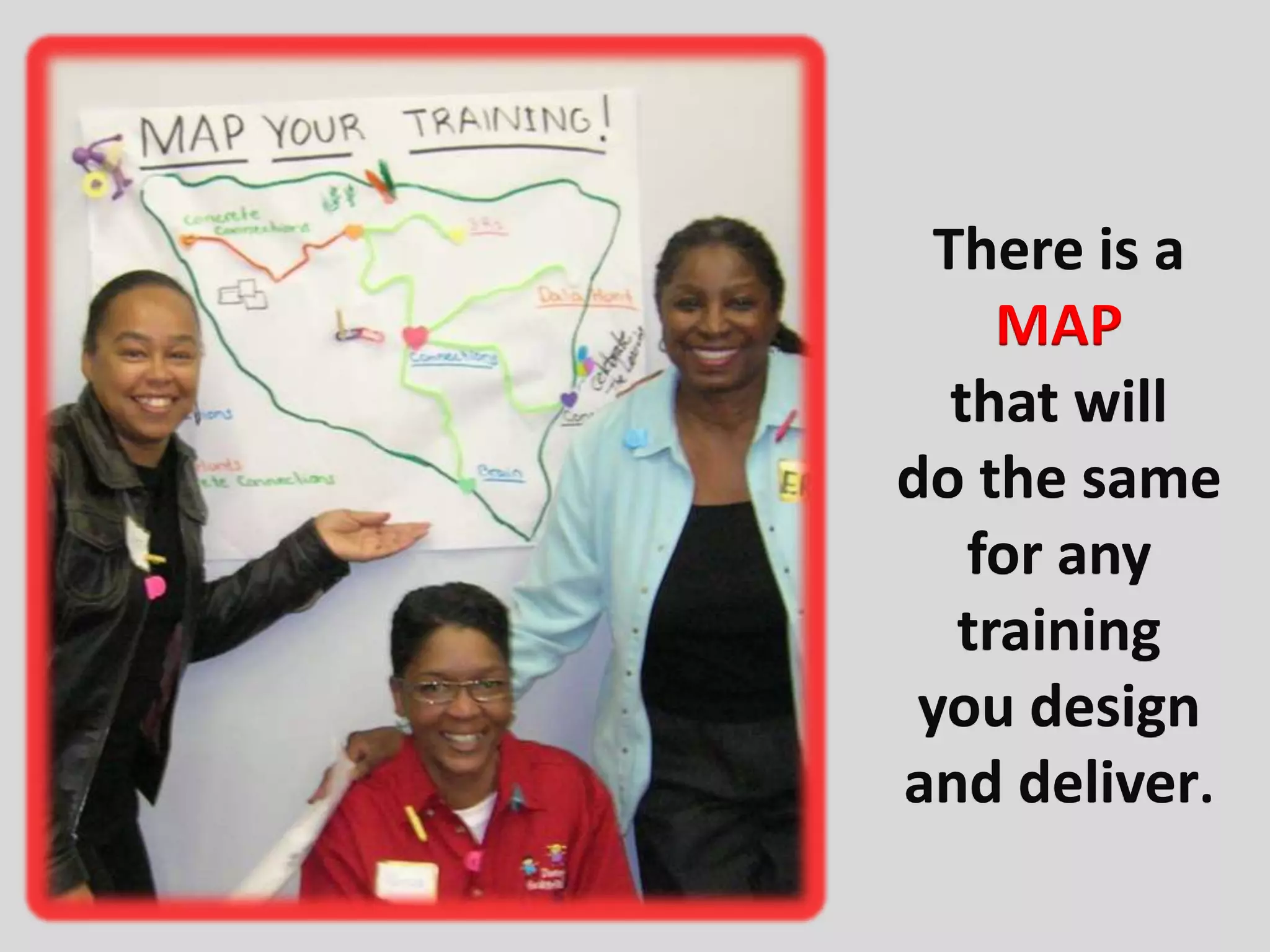
There is a
     MAP
   that will
do the same
    for any
   training
 you design
and deliver.
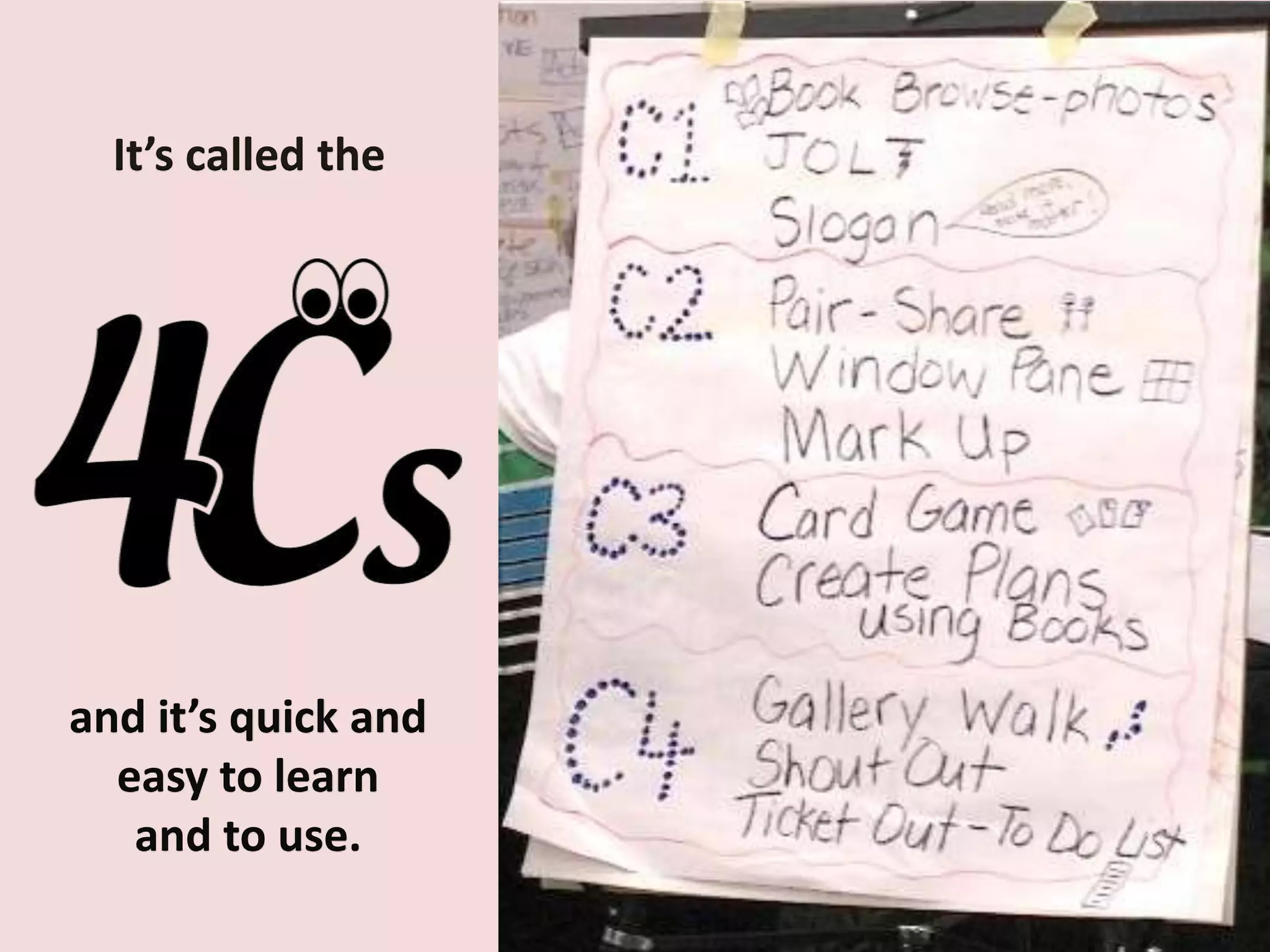
It’s called the


and it’s quick and
  easy to learn
   and to use.
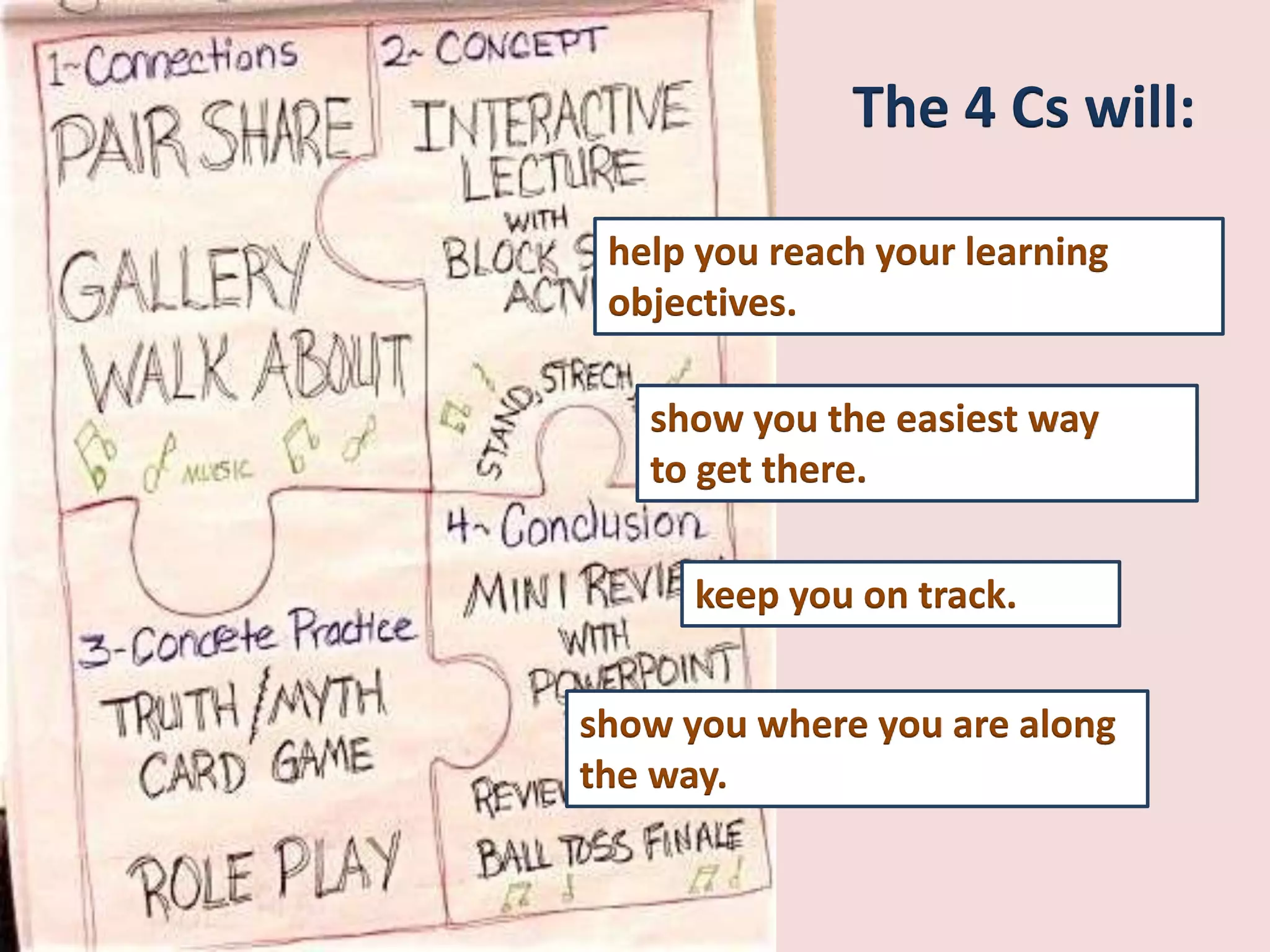
The 4 Cs will:

 help you reach your learning
 objectives.

   show you the easiest way
   to get there.

      keep you on track.


show you where you are along
the way.
Lines

and Signs
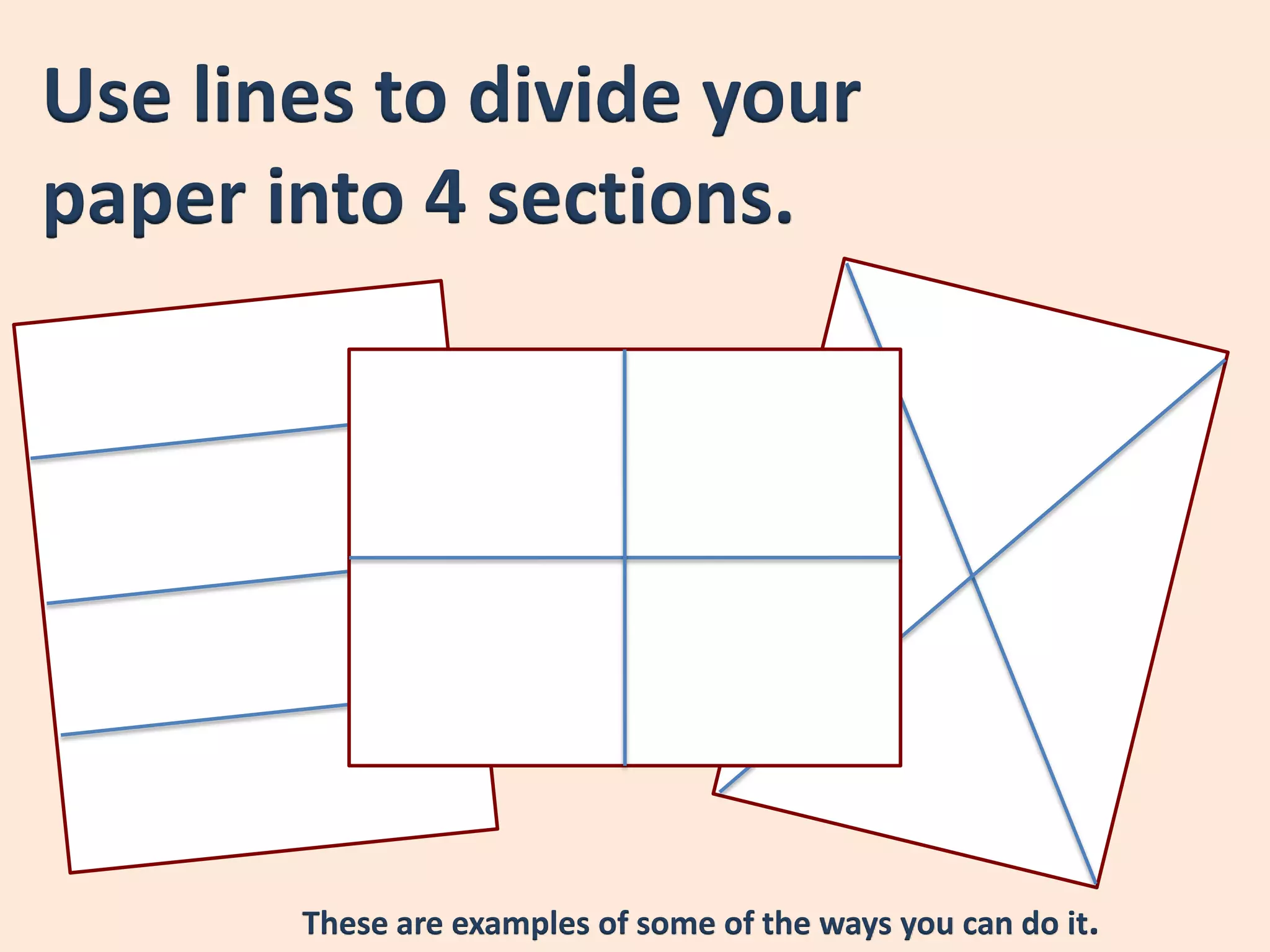
Use lines to divide your
paper into 4 sections.


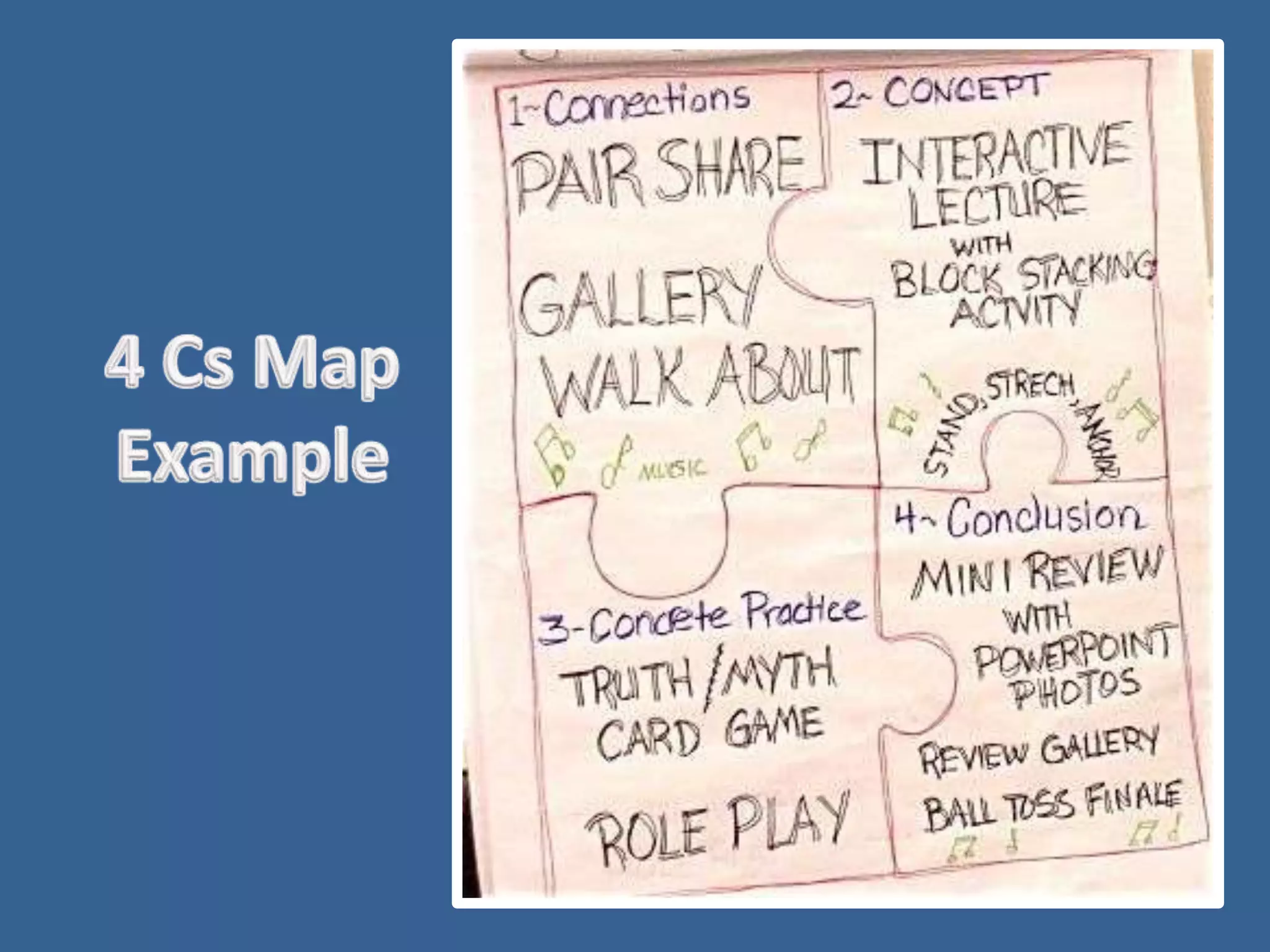
       These are examples of some of the ways you can do it.
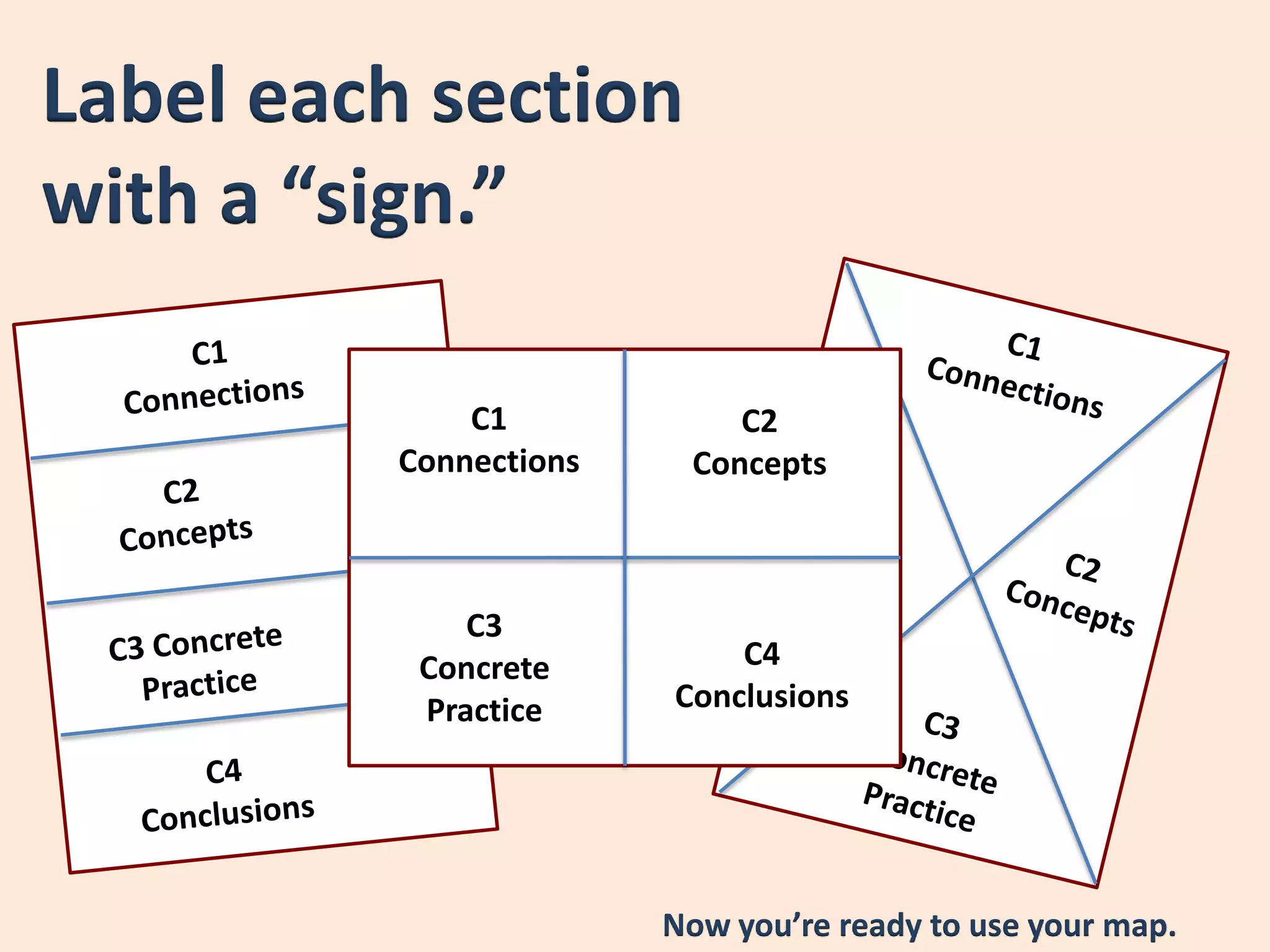
Label each section
with a “sign.”

              C1            C2
          Connections    Concepts


              C3
           Concrete         C4
           Practice     Conclusions


                        Now you’re ready to use your map.
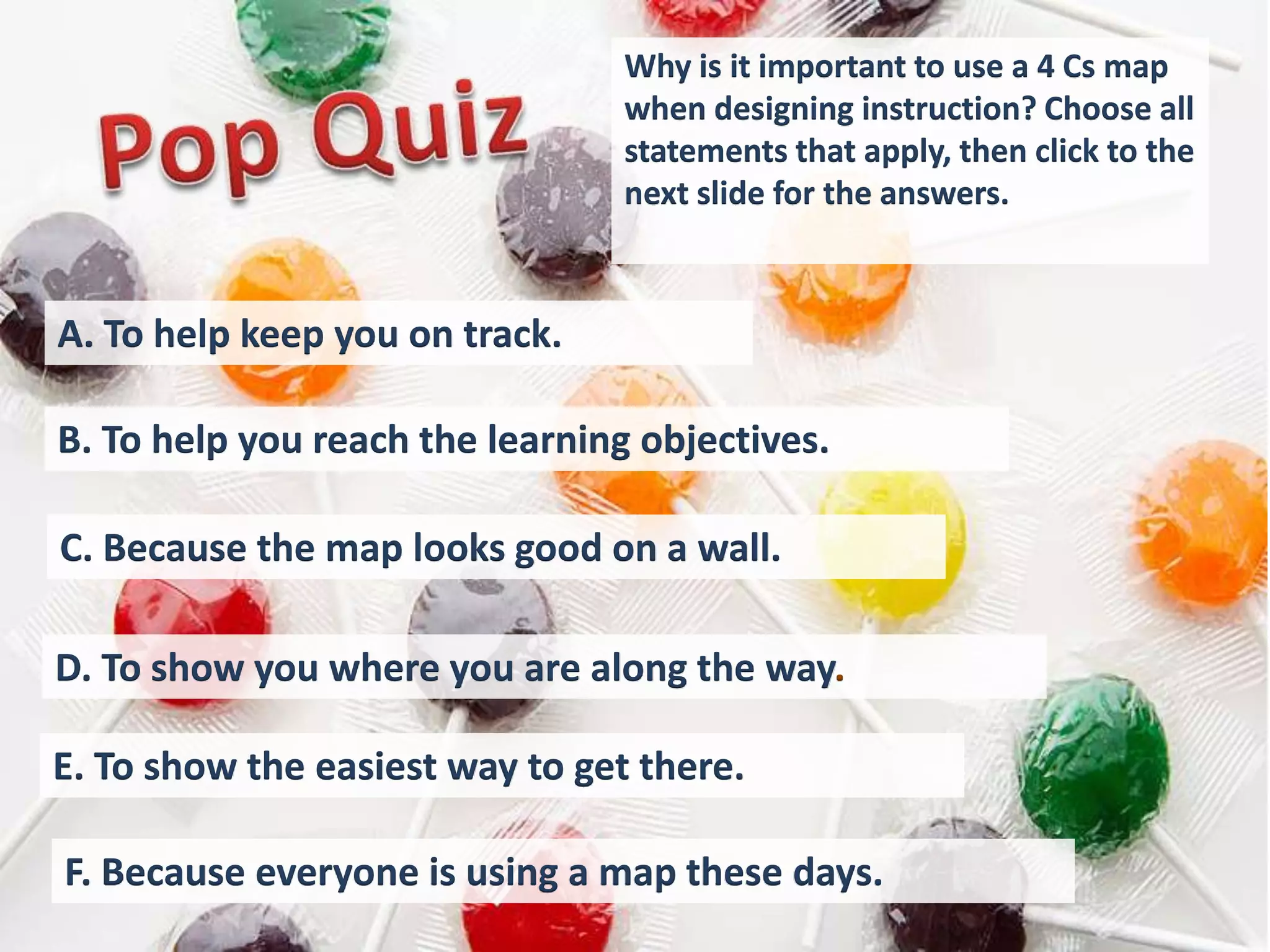
Why is it important to use a 4 Cs map
                                 when designing instruction? Choose all
                                 statements that apply, then click to the
                                 next slide for the answers.


A. To help keep you on track.

B. To help you reach the learning objectives.

C. Because the map looks good on a wall.

D. To show you where you are along the way.

E. To show the easiest way to get there.

F. Because everyone is using a map these days.
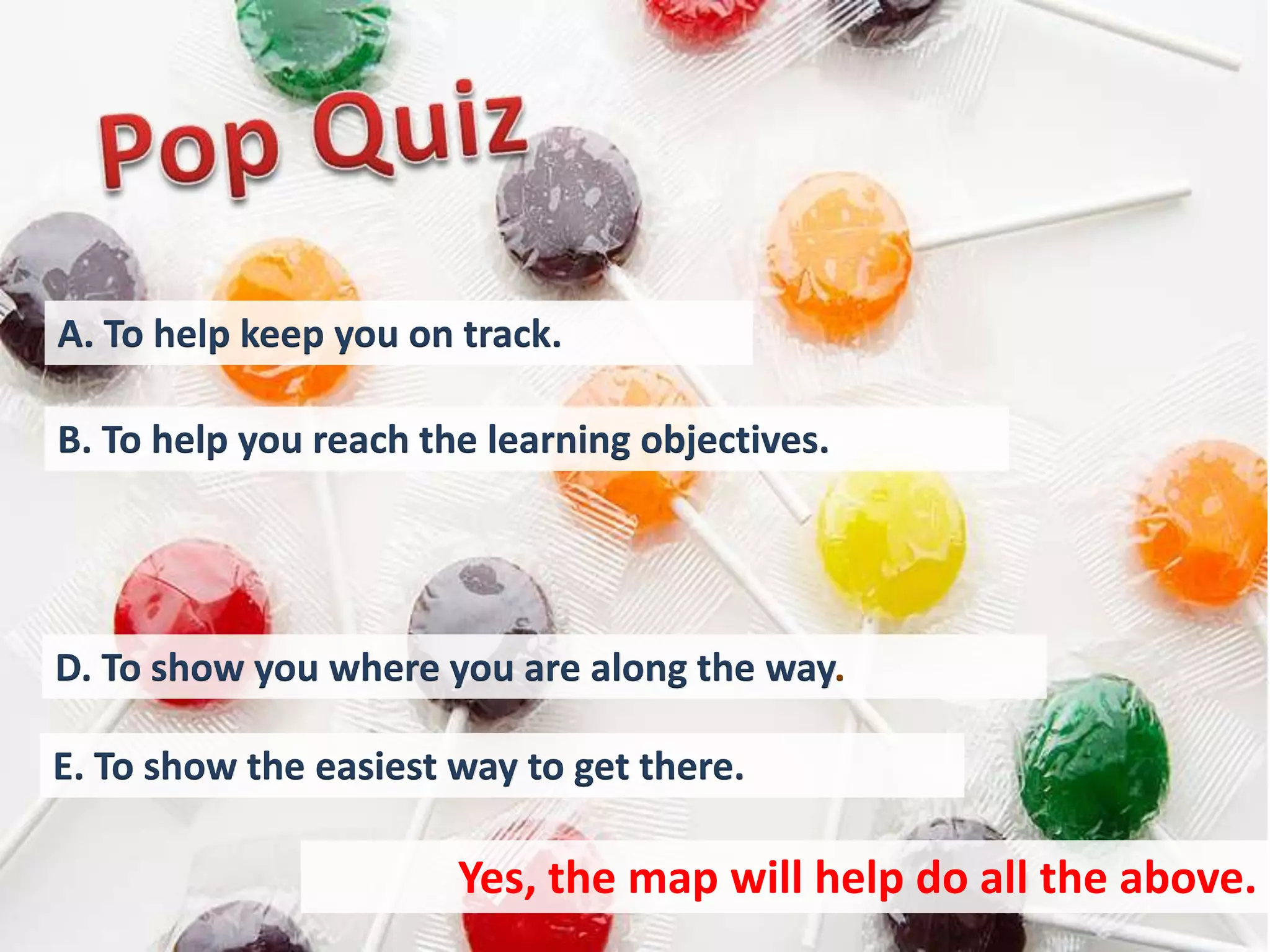
A. To help keep you on track.

B. To help you reach the learning objectives.


D. To show you where you are along the way.

E. To show the easiest way to get there.

                       Yes, the map will help do all the above.
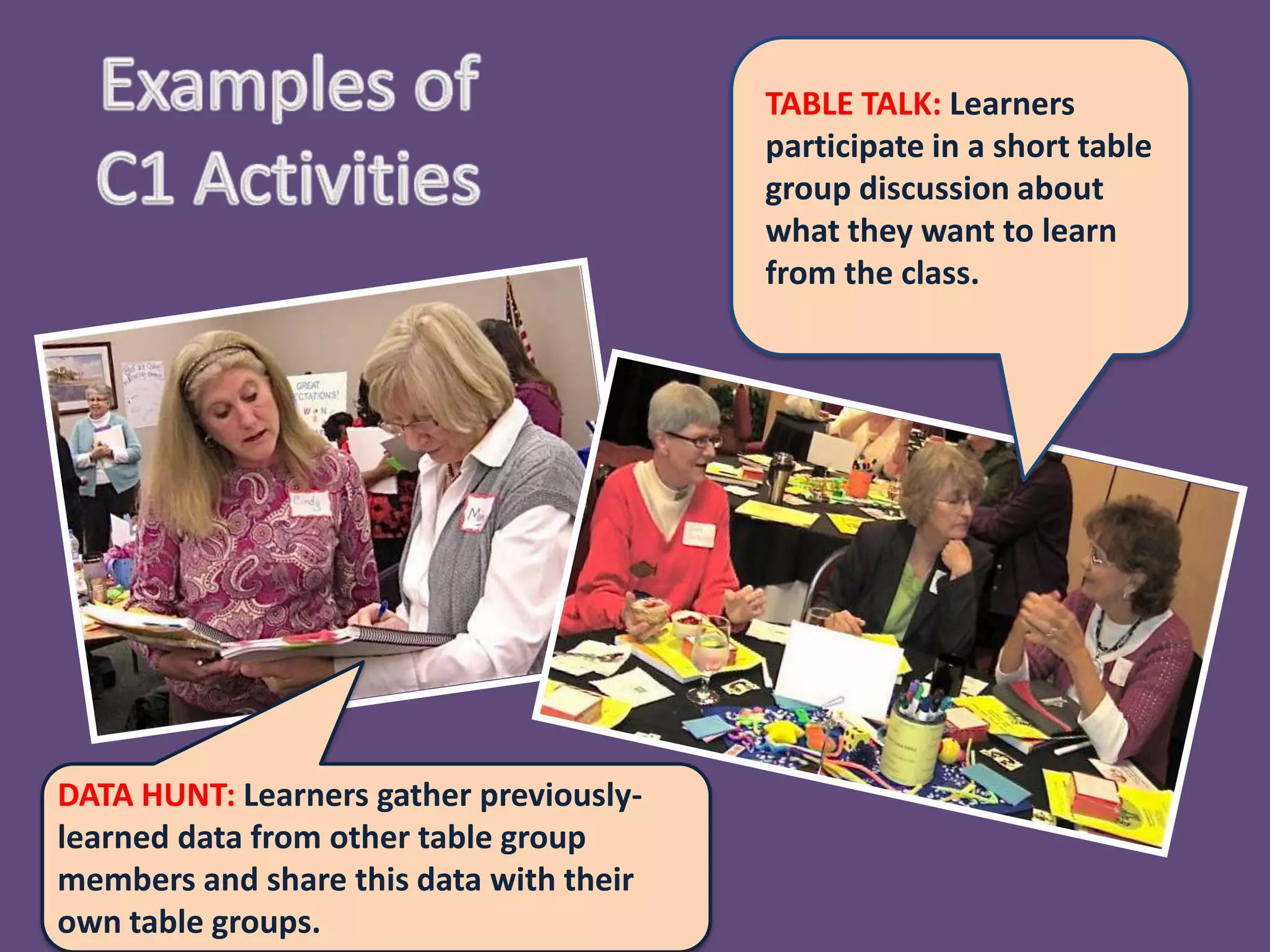
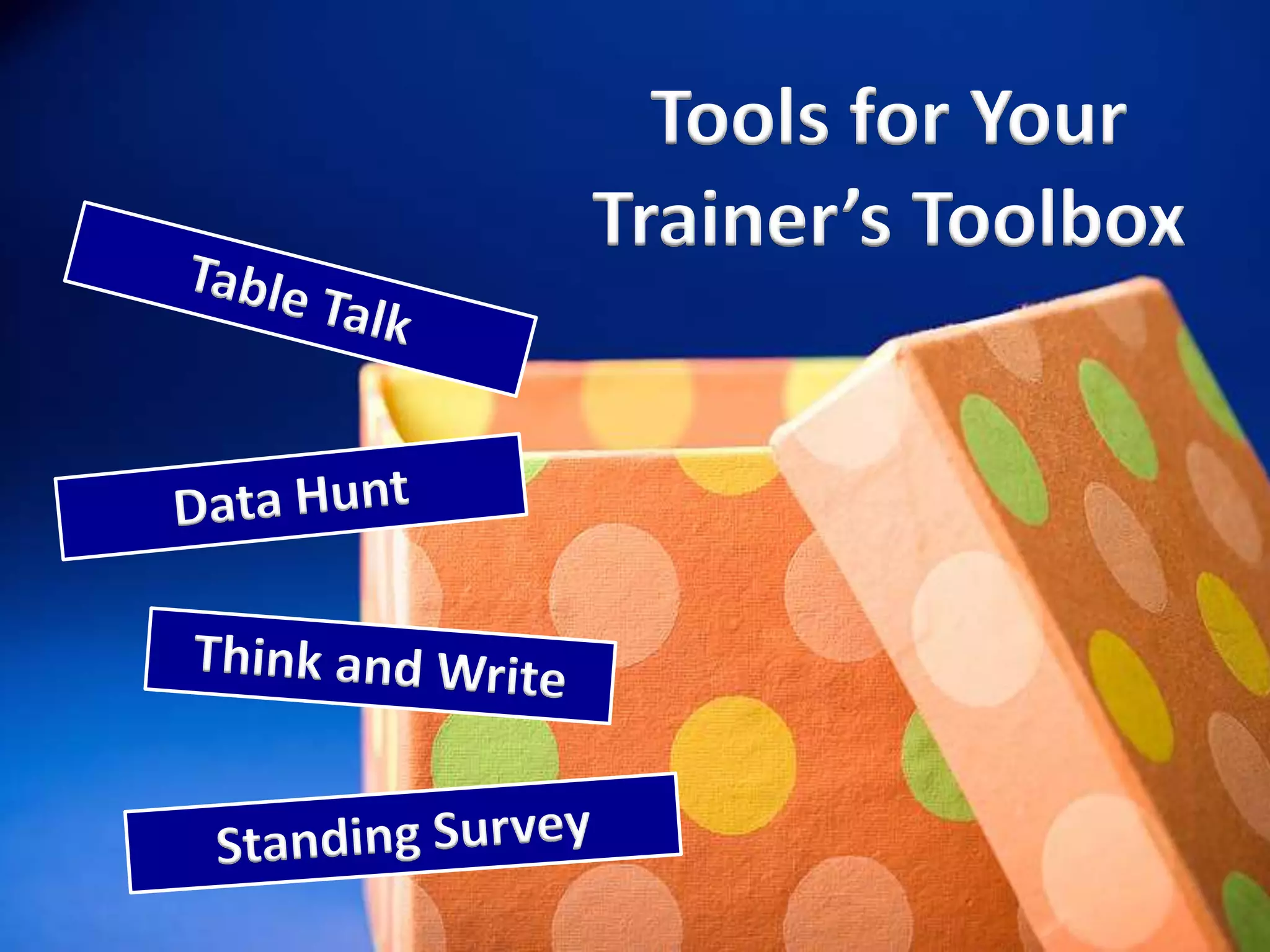
TABLE TALK: Learners
                                         participate in a short table
                                         group discussion about
                                         what they want to learn
                                         from the class.


DATA HUNT: Learners gather previously-
learned data from other table group
members and share this data with their
own table groups.
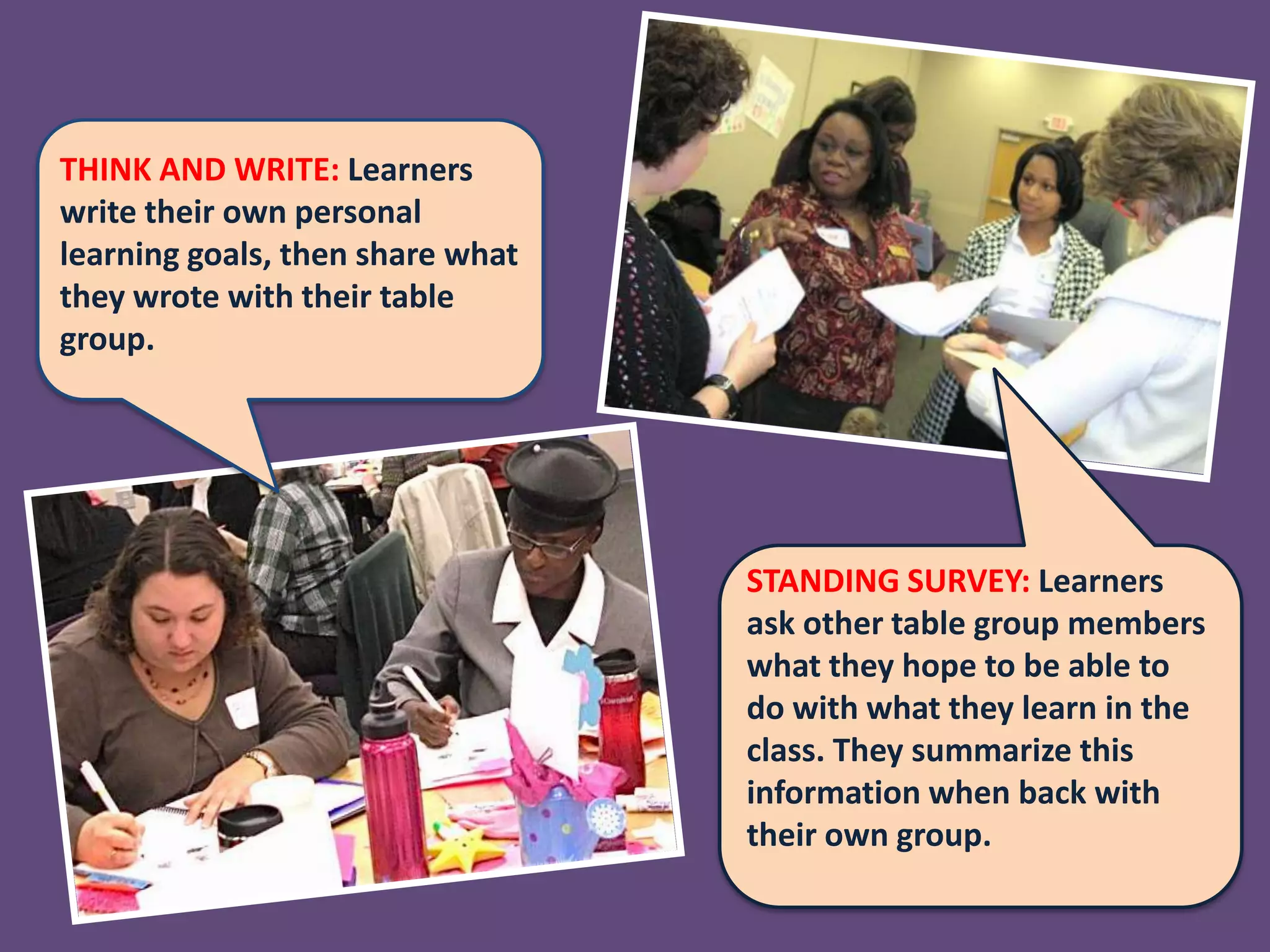
THINK AND WRITE: Learners
write their own personal
learning goals, then share what
they wrote with their table
group.


                                  STANDING SURVEY: Learners
                                  ask other table group members
                                  what they hope to be able to
                                  do with what they learn in the
                                  class. They summarize this
                                  information when back with
                                  their own group.
Tools for Your
Trainer’s Toolbox
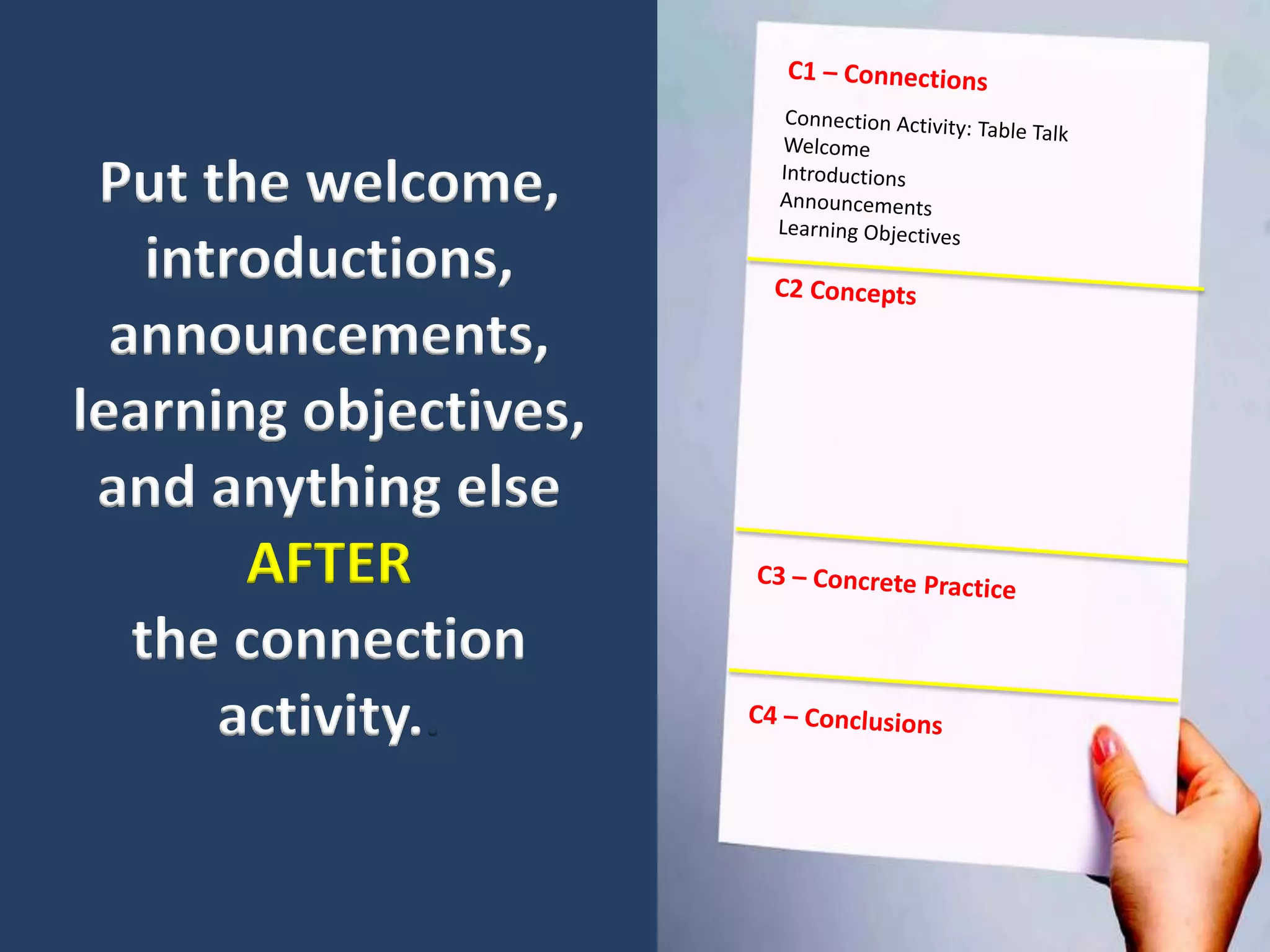
Put the welcome,
    introductions,
  announcements,
learning objectives,
 and anything else
        AFTER
   the connection
       activity..
Which statements ARE examples of effective
                                 C1 activities (tools) that connect learners to
                                 the topic and to each other? Choose your
                                 responses, then click to the next slide for the
                                 answers.


1. In pairs or triads, learners do a one-minute discussion about
what they already know about the topic.

2. Each learner stands and introduces himself or herself
to the class.

3. In table groups, learners discuss which of the course learning
objectives are most important to them and why.

4. The instructor introduces herself to the group
with a personal story.
1. In pairs or triads, learners do a one-minute discussion about
what they already know about the topic.


3. In table groups, learners discuss which of the course learning
objectives are most important to them and why.


                        Yes, #1 and #3 are effective C1 tools..
Post your 2 sticky notes on C1 of your map.
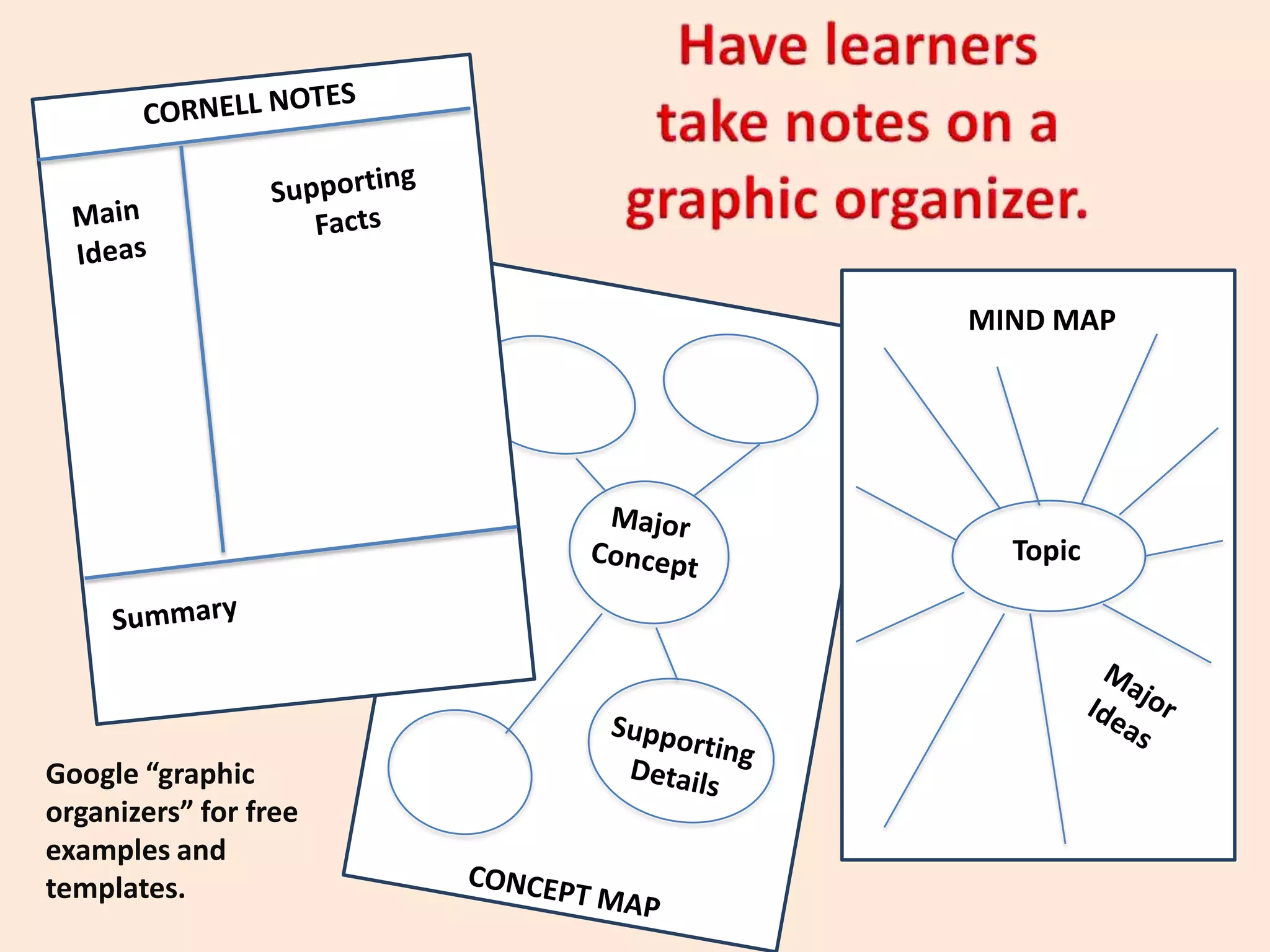
MIND MAP


                         Topic


Google “graphic
organizers” for free
examples and
templates.
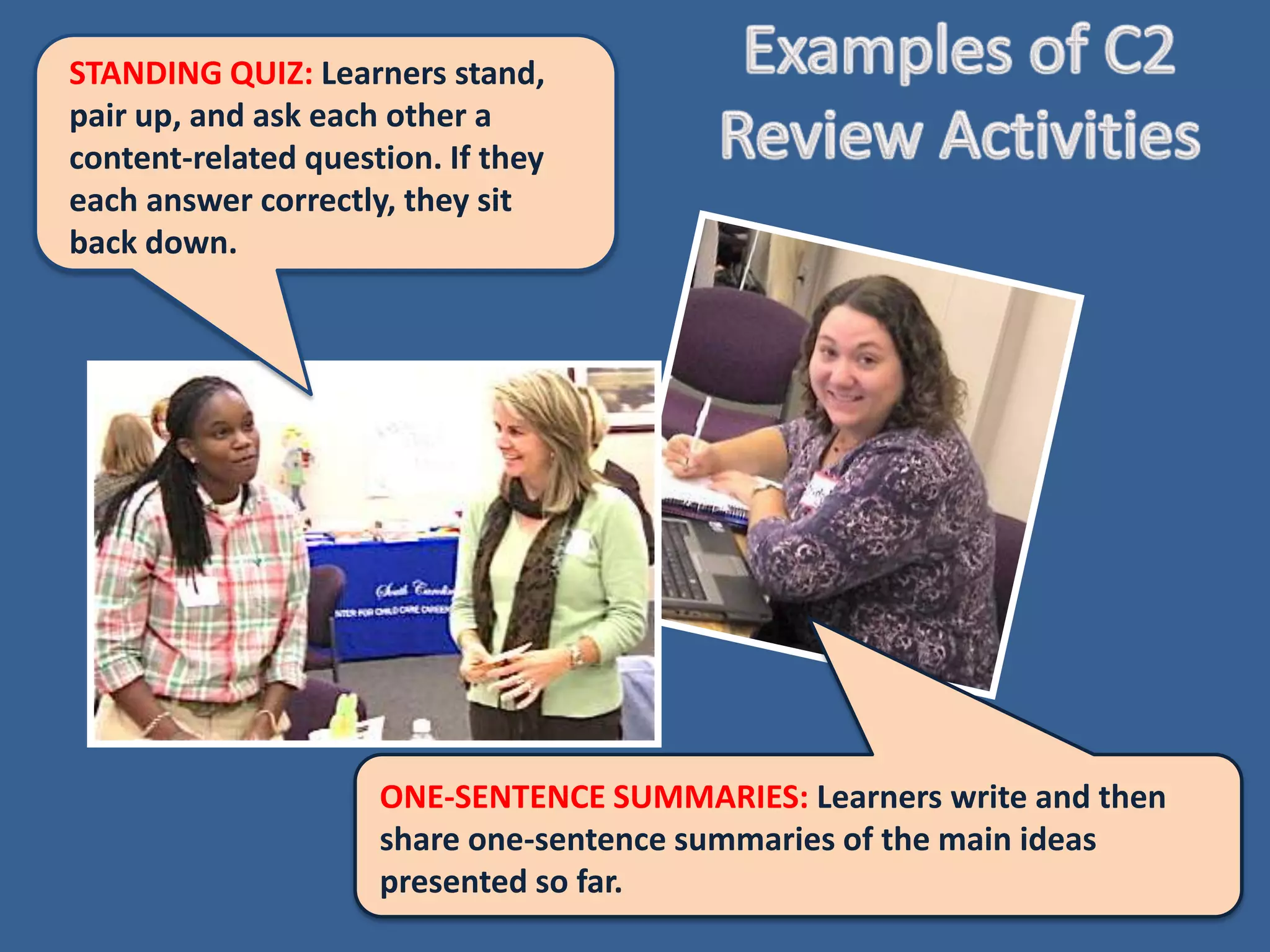
STANDING QUIZ: Learners
stand, pair up, and ask each other
a content-related question. If
they each answer correctly, they
sit back down.


                     ONE-SENTENCE SUMMARIES: Learners write and then
                     share one-sentence summaries of the main ideas
                     presented so far.
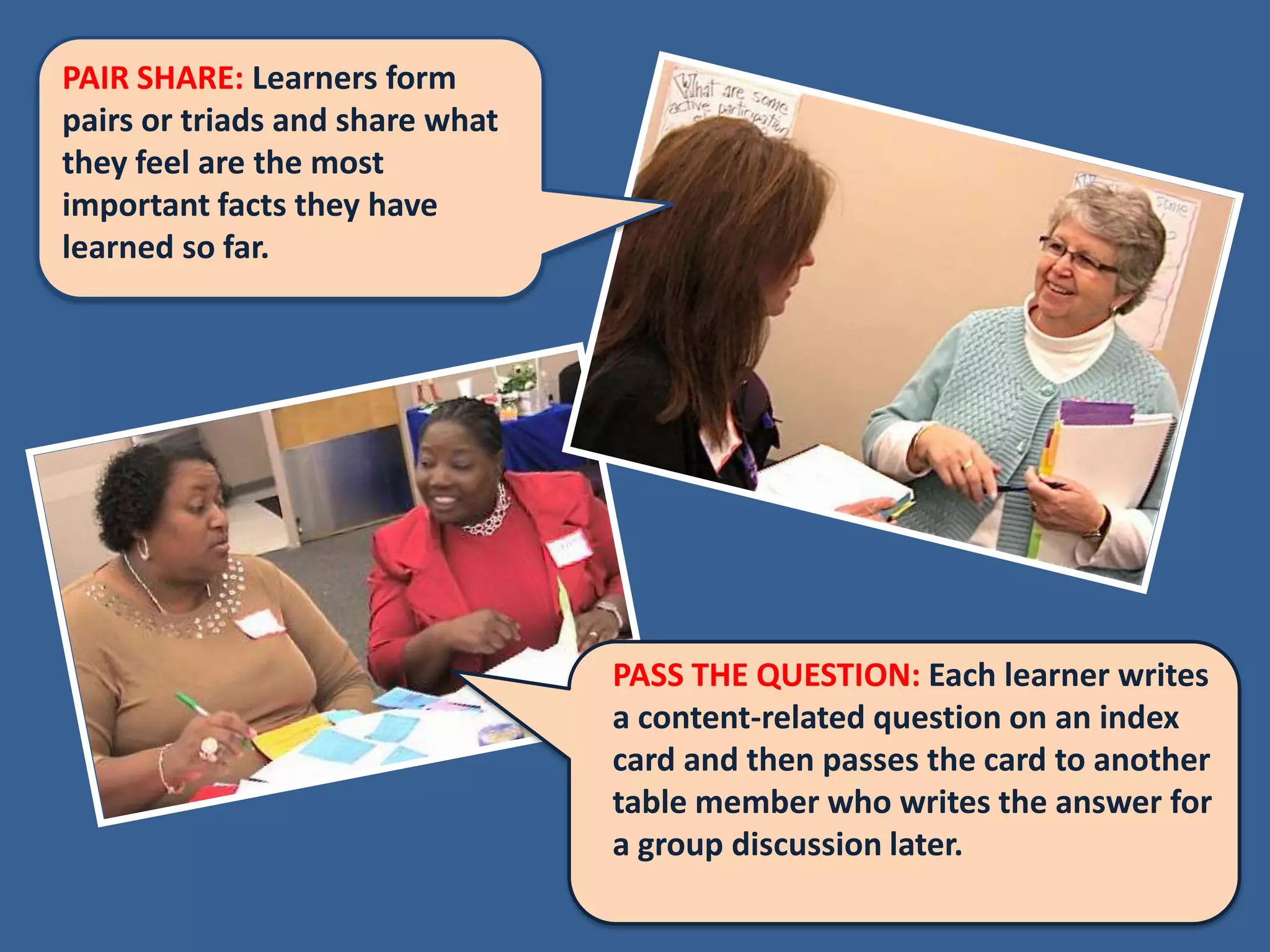
PAIR SHARE: Learners form
pairs or triads and share what
they feel are the most
important facts they have
learned so far.


                                 PASS THE QUESTION: Each learner writes
                                 a content-related question on an index
                                 card and then passes the card to another
                                 table member who writes the answer for
                                 a group discussion later.
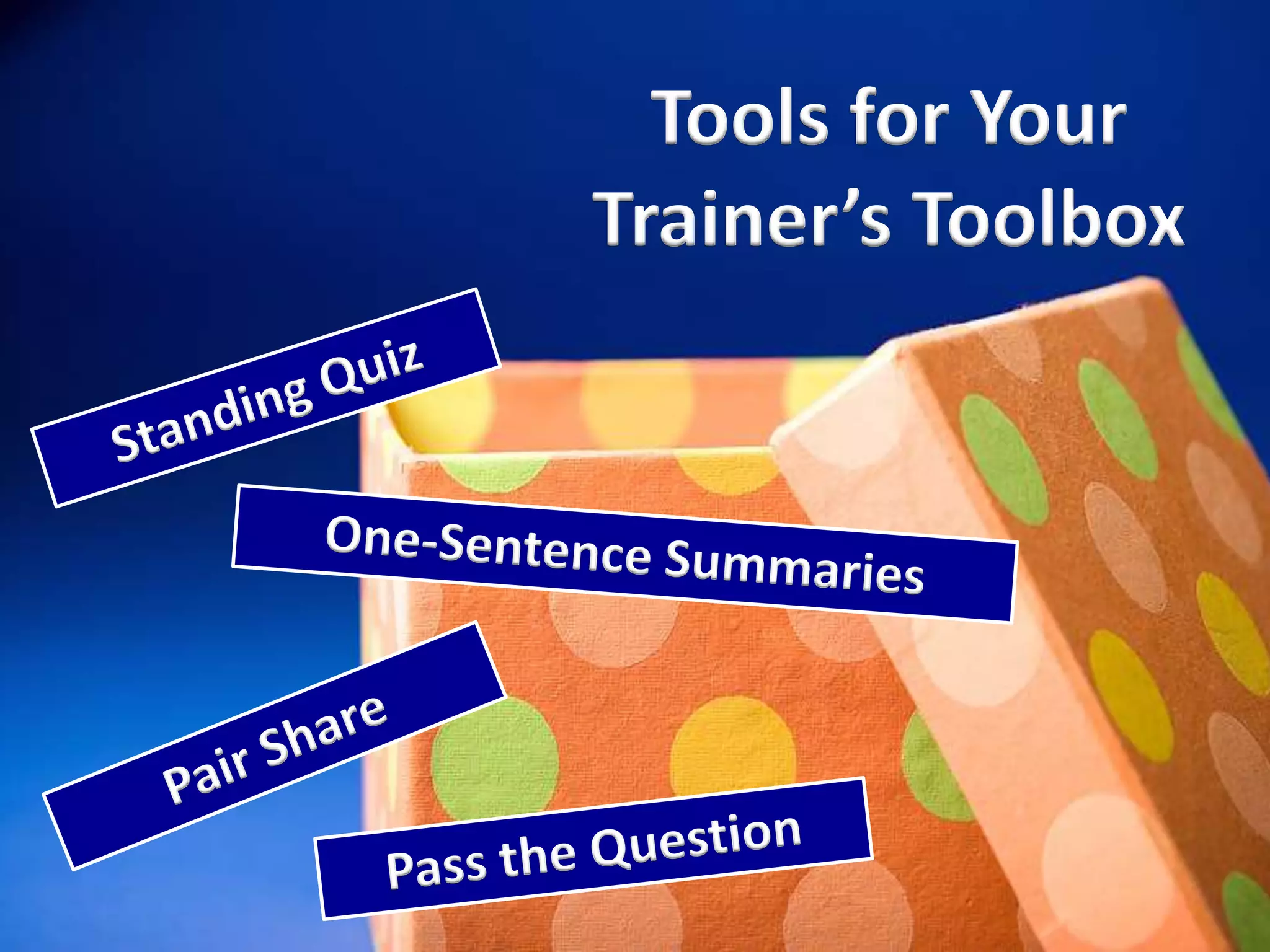
Tools for Your
Trainer’s Toolbox
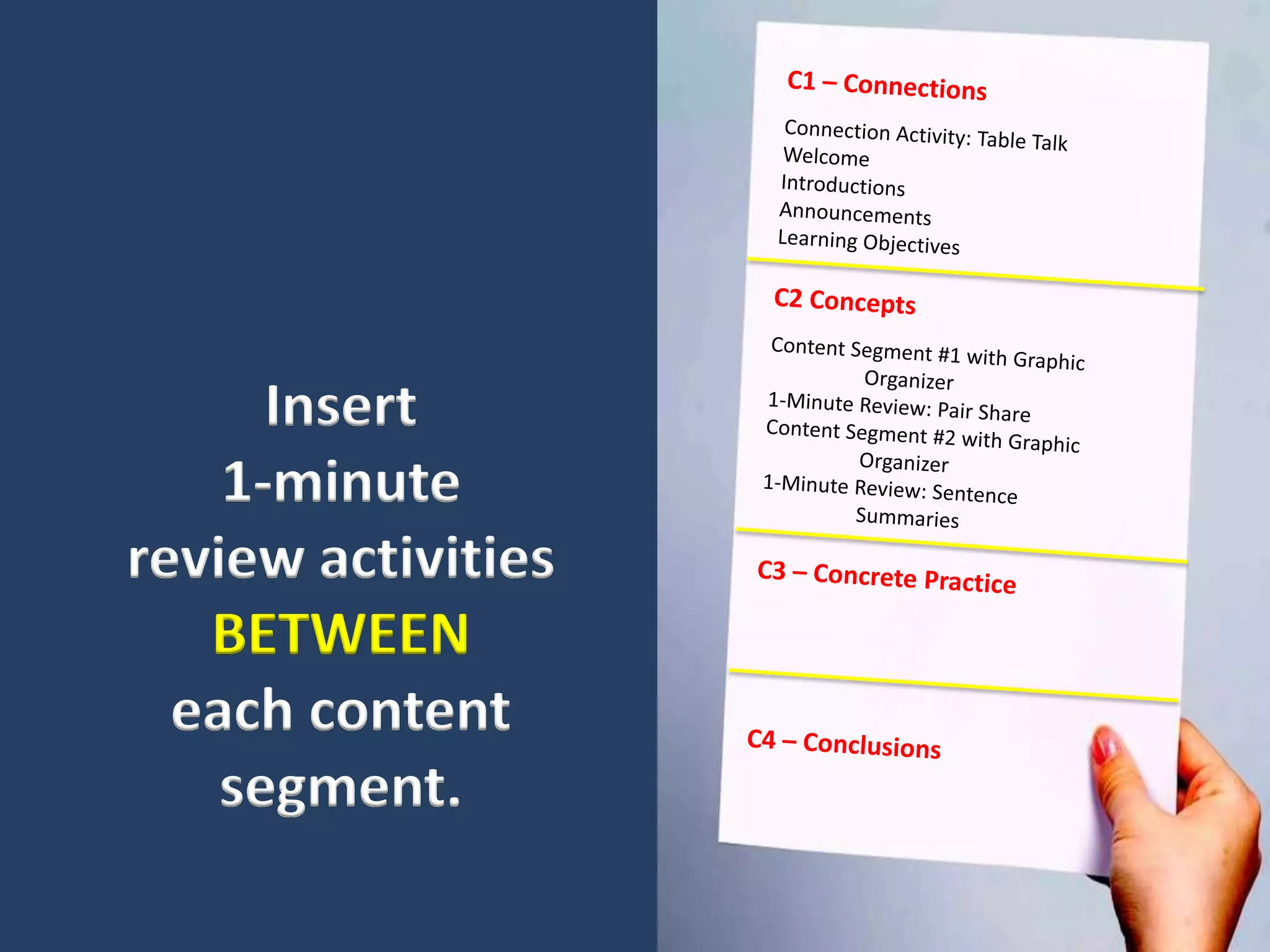
Insert
    1-minute
review activities
   BETWEEN
  each content
    segment.
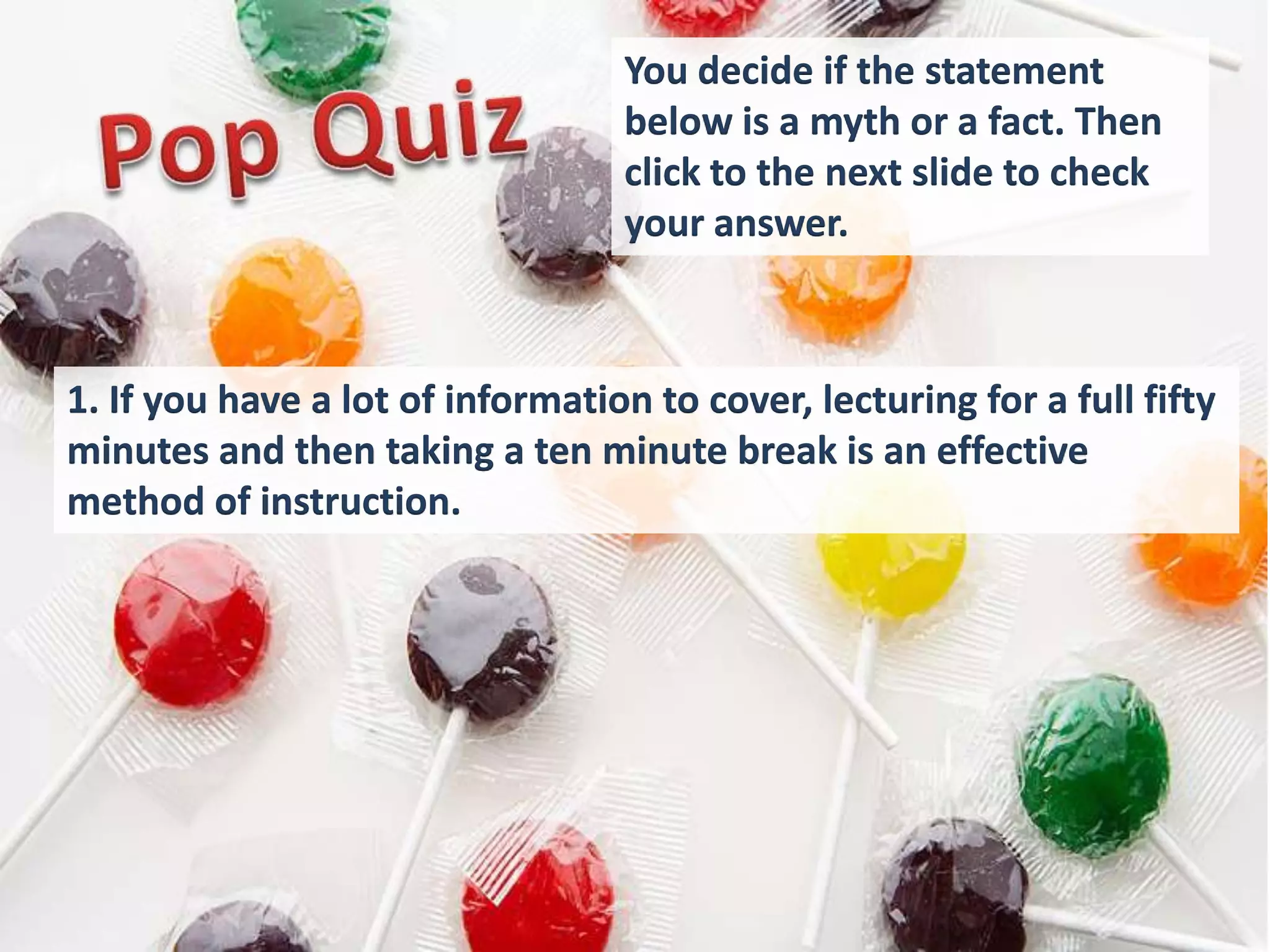
You decide if the statement
                                  below is a myth or a fact. Then
                                  click to the next slide to check
                                  your answer.


1. If you have a lot of information to cover, lecturing for a full fifty
minutes and then taking a ten minute break is an effective
method of instruction.
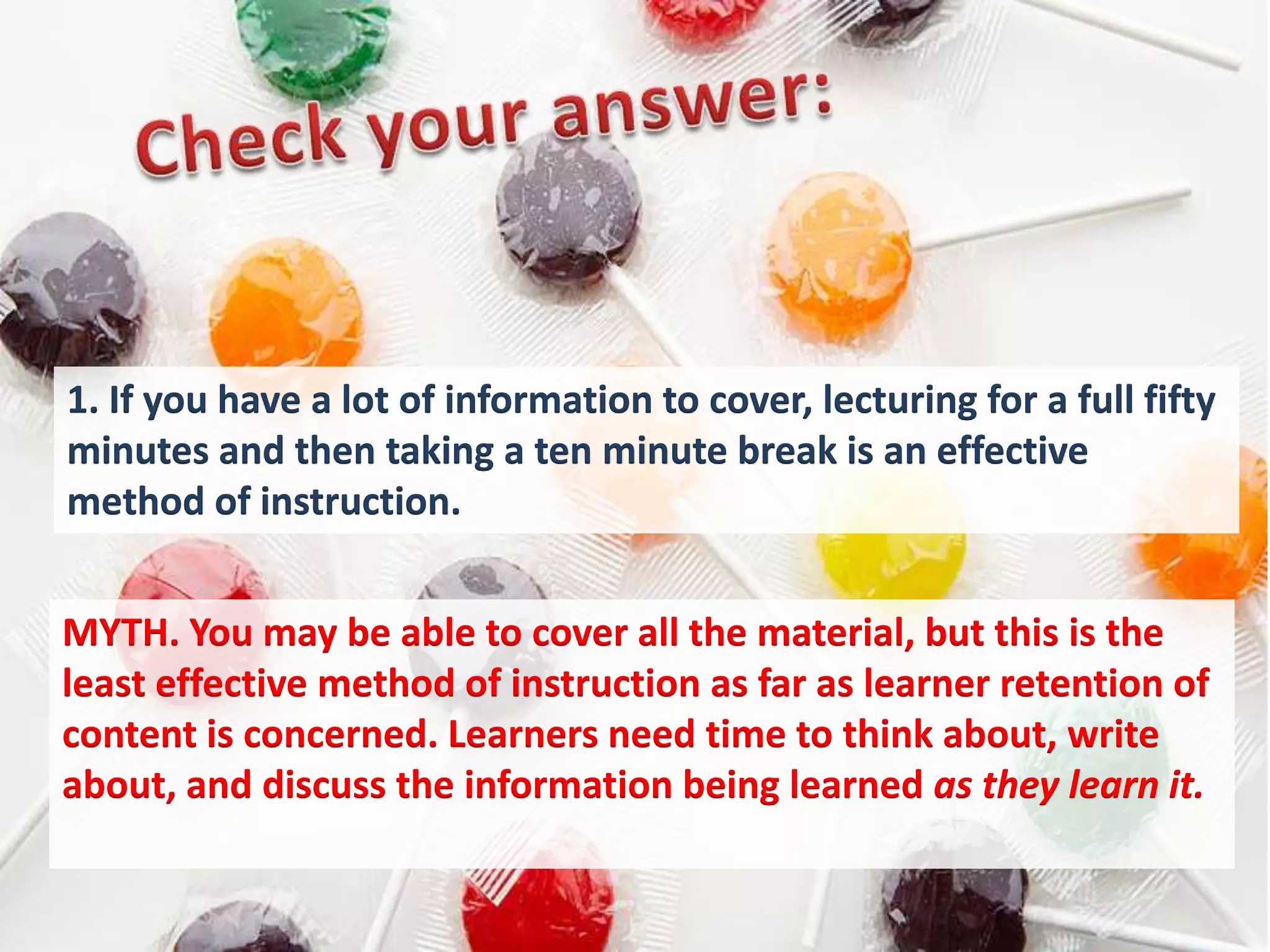
1. If you have a lot of information to cover, lecturing for a full fifty
minutes and then taking a ten minute break is an effective
method of instruction.


MYTH. You may be able to cover all the material, but this is the
least effective method of instruction as far as learner retention of
content is concerned. Learners need time to think about, write
about, and discuss the information being learned as they learn it.
You decide if the statement
                              below is a myth or a fact. Then
                              click to the next slide to check
                              your answer.


2. It’s wise to divide your content into smaller segments and
engage learners in short, quick review activities between
segments because they will remember more of the content this
way.
2. It’s wise to divide your content into smaller segments and
engage learners in short, quick review activities between
segments because they will remember more of the content this
way.

FACT. Research from cognitive neuroscience proves that the
human brain learns better and can retain information longer
when learning is interspersed with short periods of active review.
You decide if the statement
                                below is a myth or a fact. Then
                                click to the next slide to check
                                your answer.


3. When learners take notes while listening to a lecture, they will
remember more of the material, especially if the instructor
pauses to allow time for learner reflection and writing.
3. When learners take notes while listening to a lecture, they will
remember more of the material, especially if the instructor
pauses to allow time for learner reflection and writing.


FACT. More of the brain is engaged when learners have time to
think about and write about what they have heard.
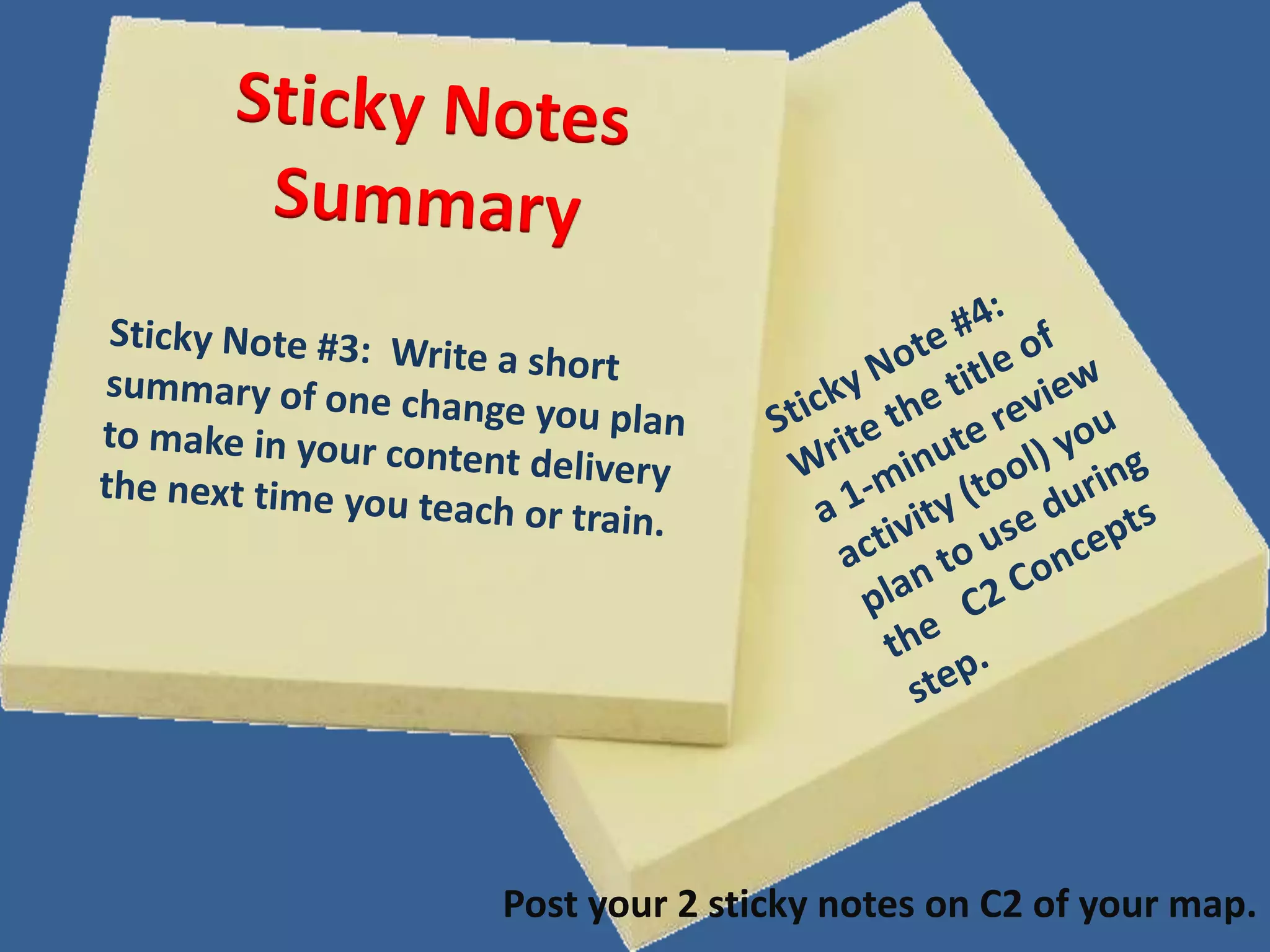
Post your 2 sticky notes on C2 of your map.
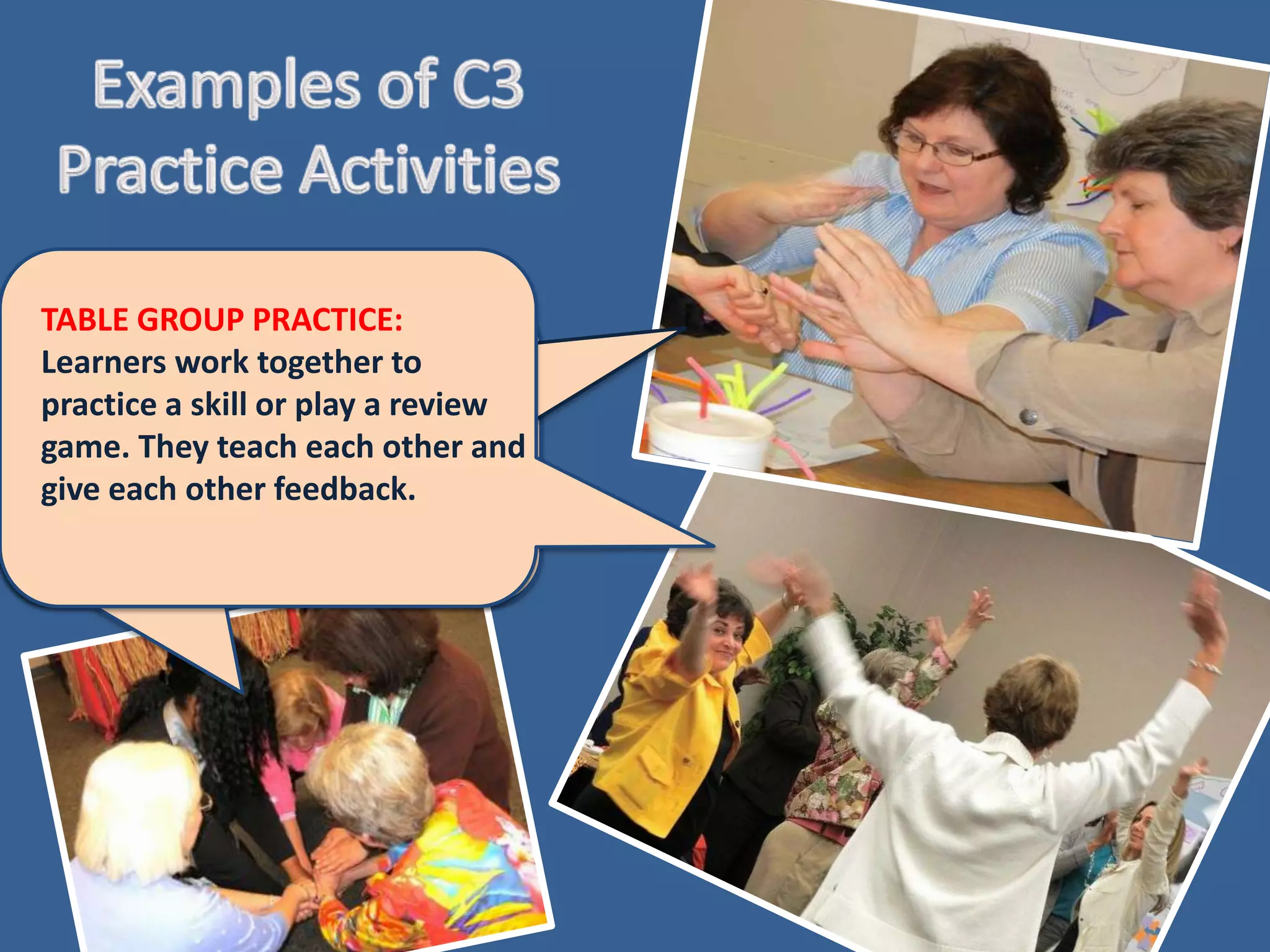
TABLE GROUP PRACTICE:
Learners work together to
practice a skill or play a review
game. They teach each other and
give each other feedback.
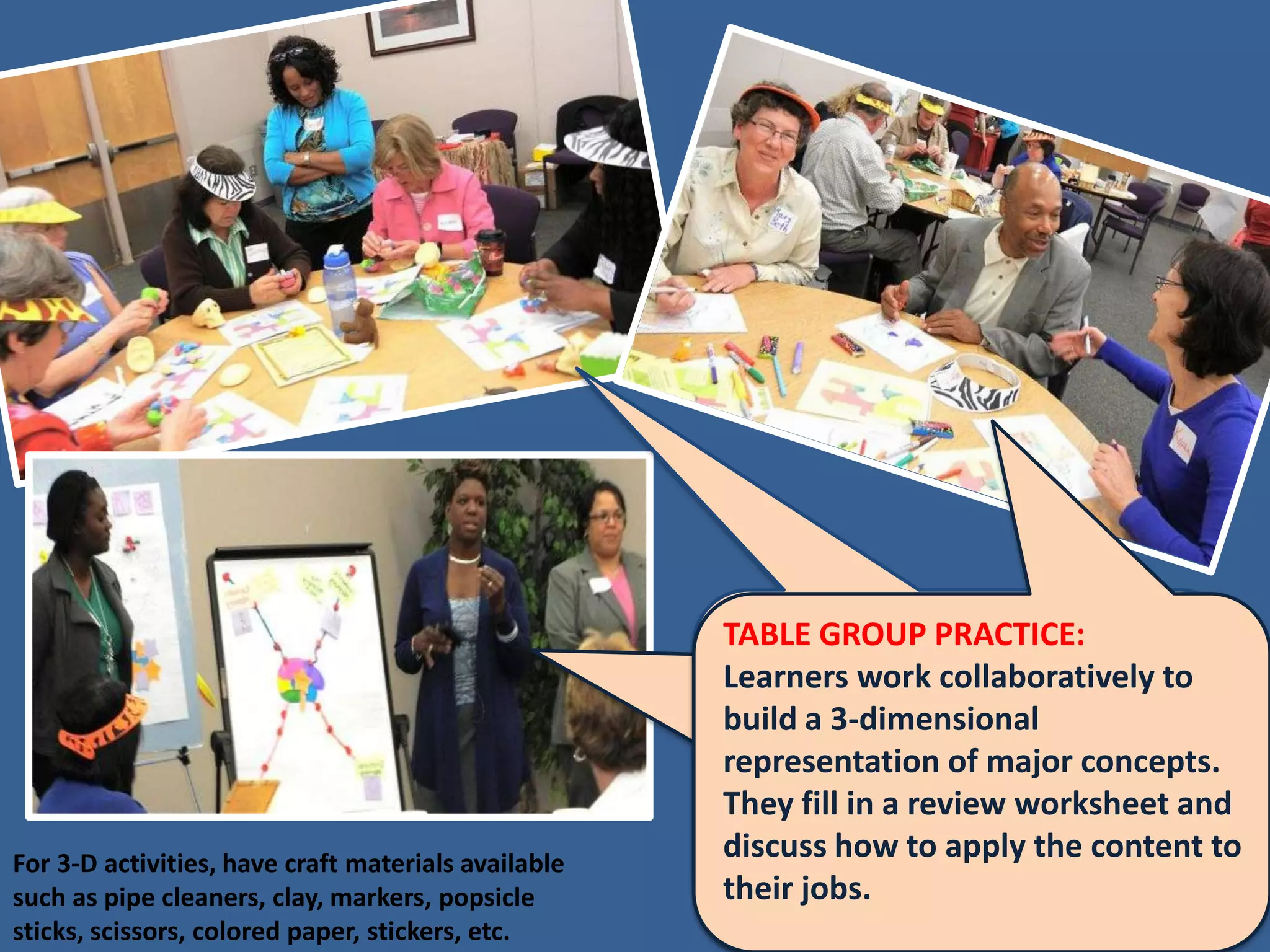
TABLE GROUP PRACTICE:
                                                     Learners work collaboratively to
                                                     build a 3-dimensional
                                                     representation of major concepts.
                                                     They fill in a review worksheet and
For 3-D activities, have craft materials available
                                                     discuss how to apply the content to
such as pipe cleaners, clay, markers, popsicle       their jobs.
sticks, scissors, colored paper, stickers, etc.
Tools for Your
Trainer’s Toolbox
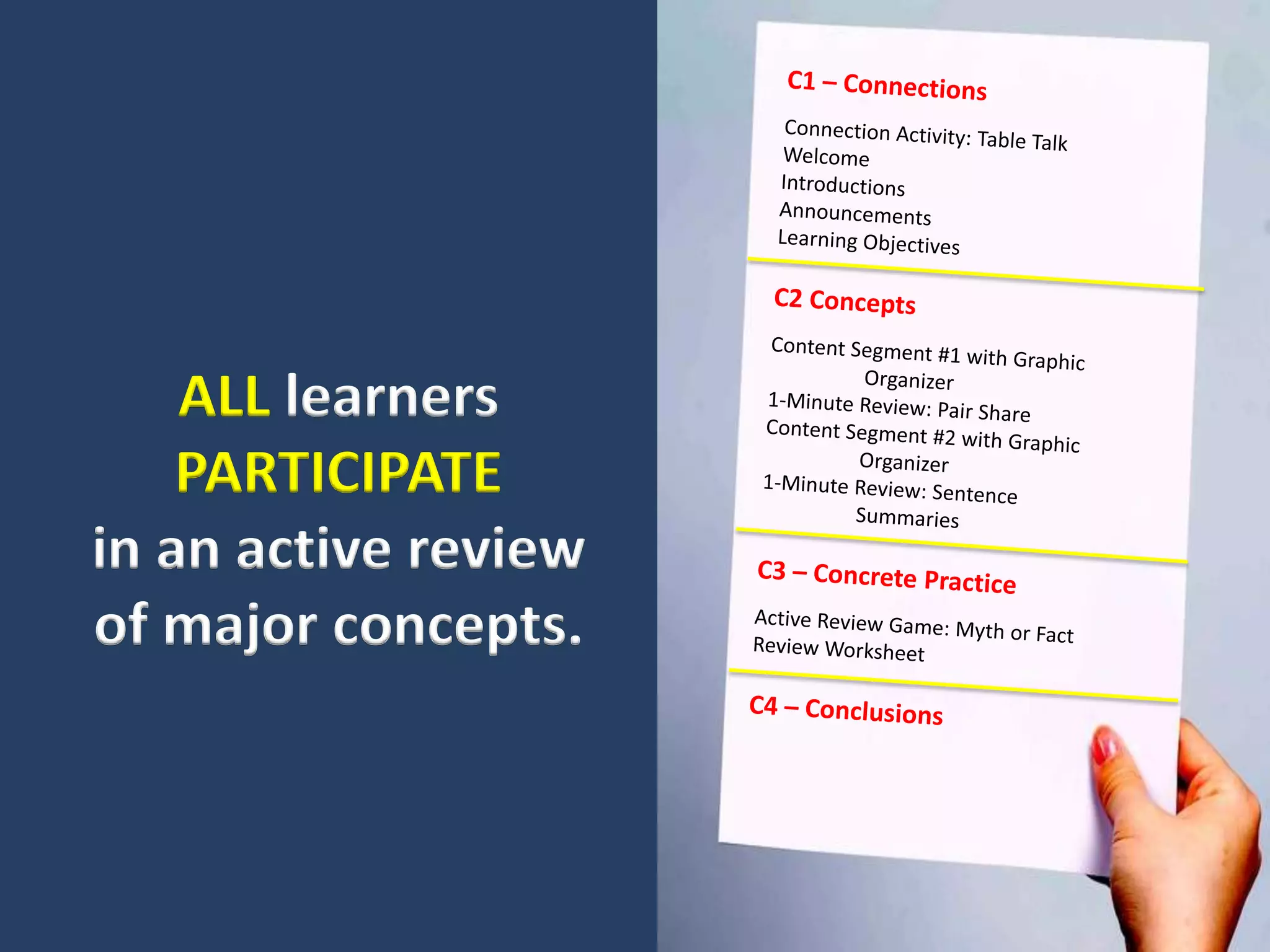
ALL learners
    PARTICIPATE
in an active review
of major concepts.
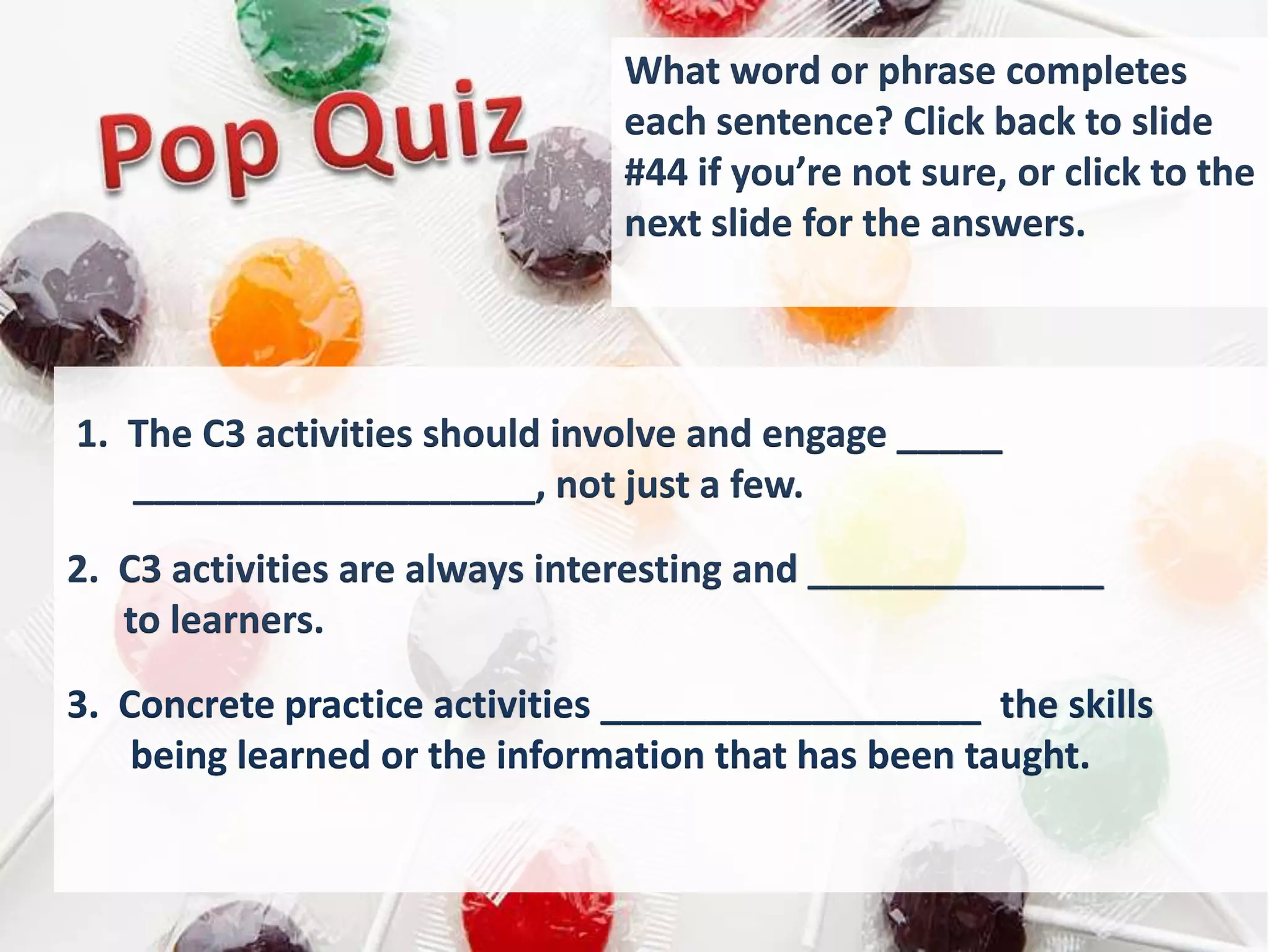
What word or phrase completes
                               each sentence? Click back to slide
                               #44 if you’re not sure, or click to the
                               next slide for the answers.


1. The C3 activities should involve and engage _____
   ___________________, not just a few.

2. C3 activities are always interesting and ______________
   to learners.
3. Concrete practice activities __________________ the skills
    being learned or the information that has been taught.
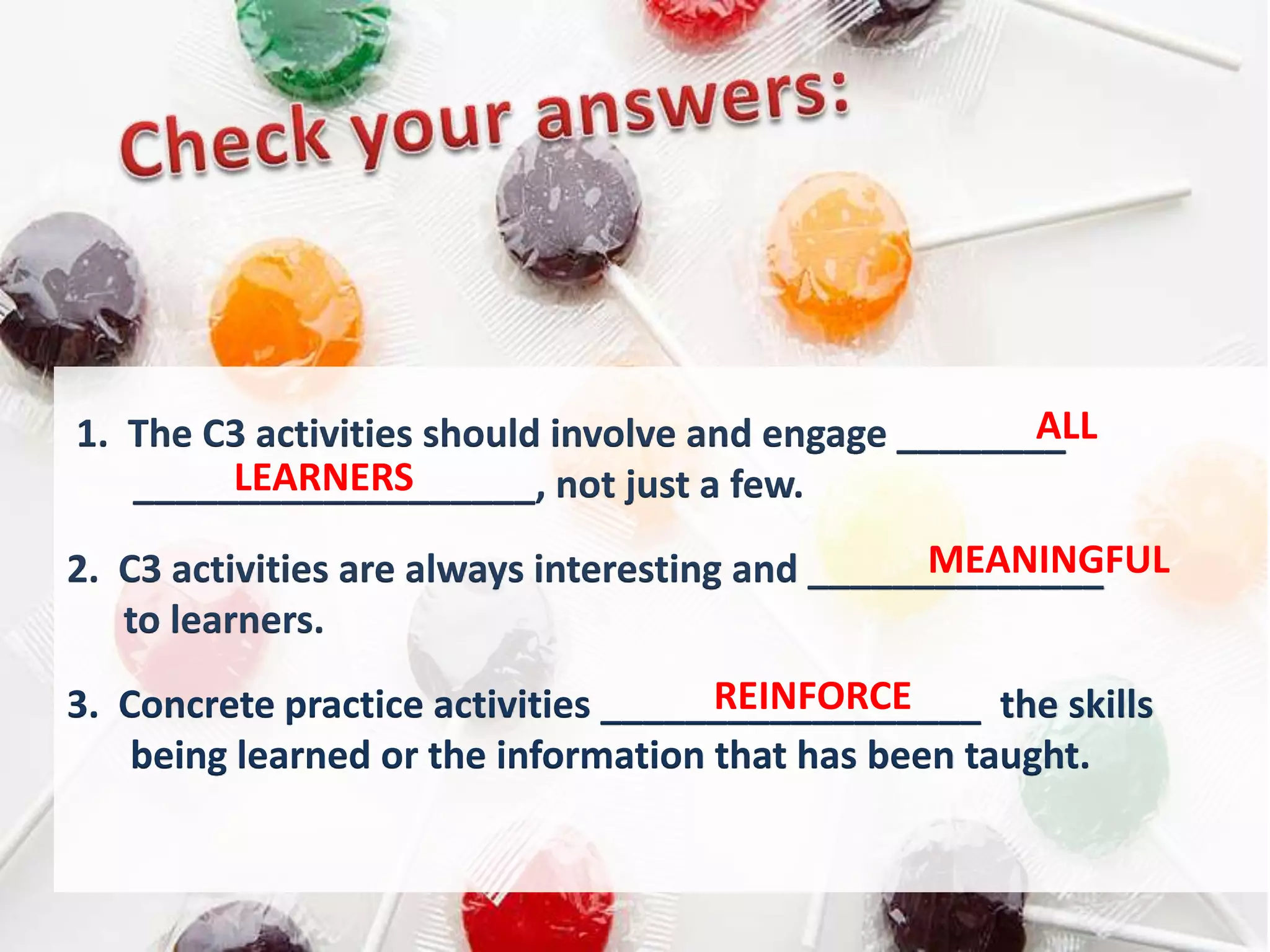
ALL
1. The C3 activities should involve and engage ________
        LEARNERS
   ___________________, not just a few.
                                                  MEANINGFUL
2. C3 activities are always interesting and ______________
   to learners.
                                     REINFORCE
3. Concrete practice activities __________________ the skills
    being learned or the information that has been taught.
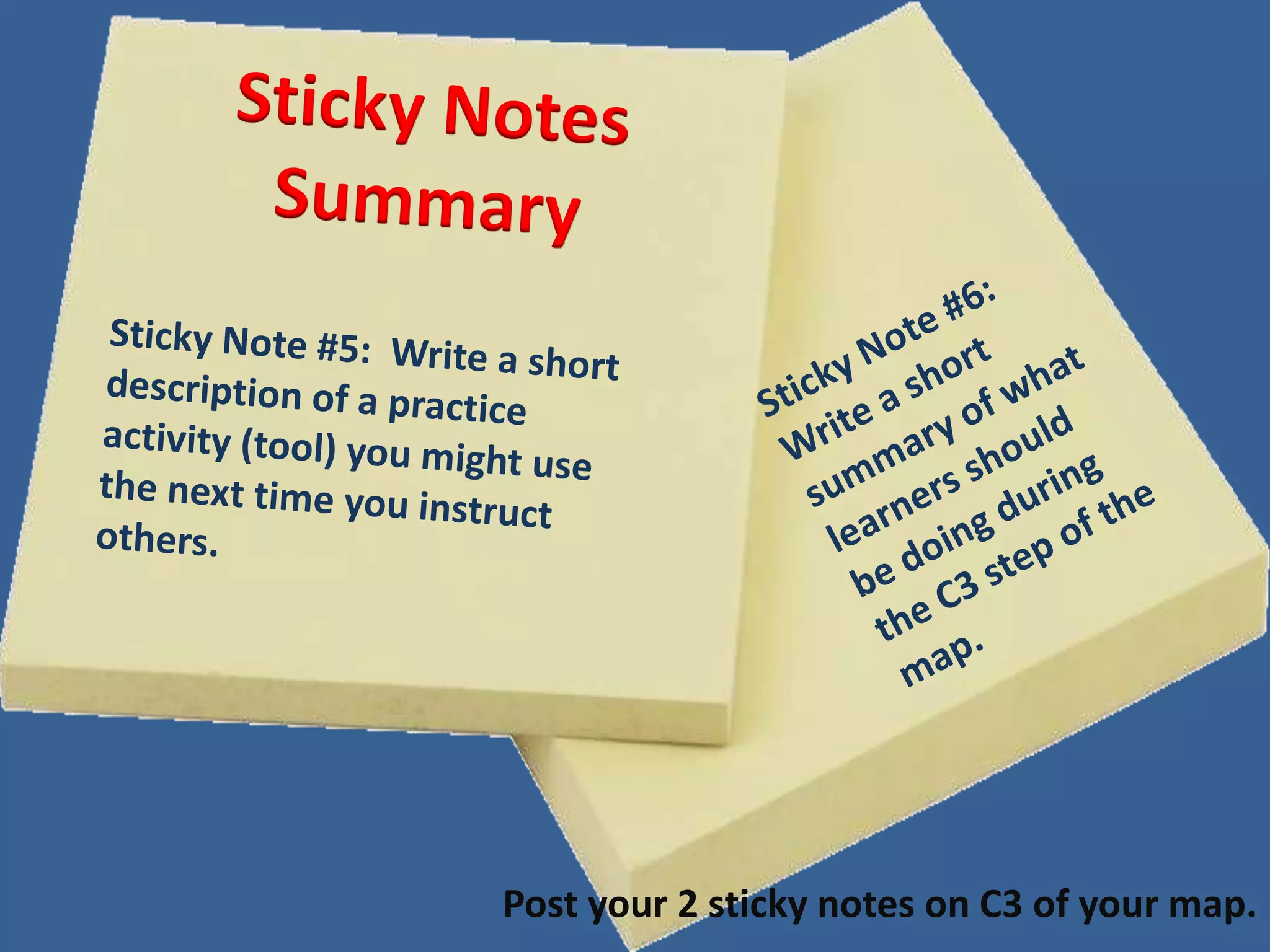
Post your 2 sticky notes on C3 of your map.
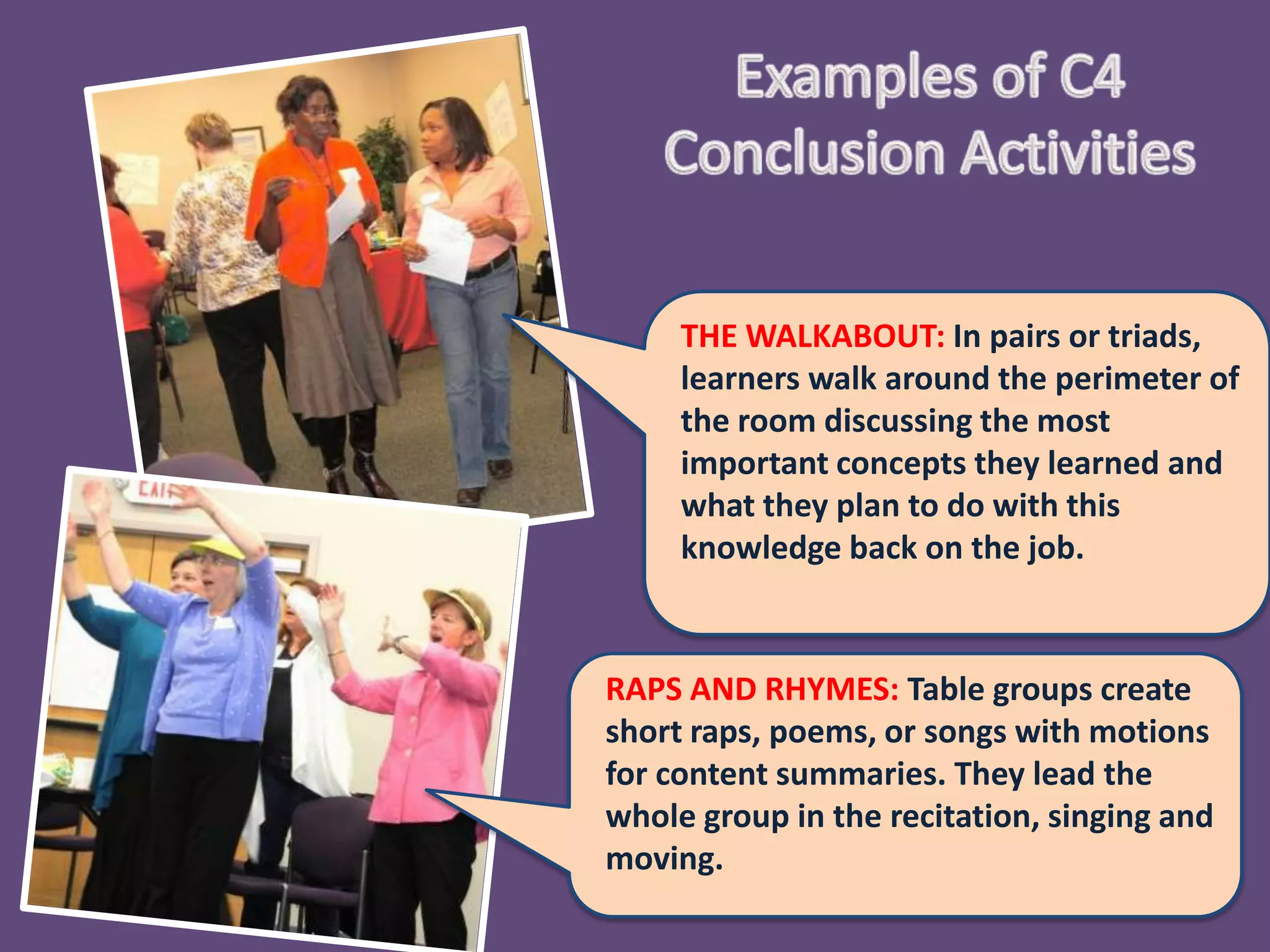
THE WALKABOUT: In pairs or
     triads, learners walk around the
     perimeter of the room discussing the
     most important concepts they learned
     and what they plan to do with this
     knowledge back on the job.


RAPS AND RHYMES: Table groups create
short raps, poems, or songs with motions
for content summaries. They lead the
whole group in the recitation, singing and
moving.
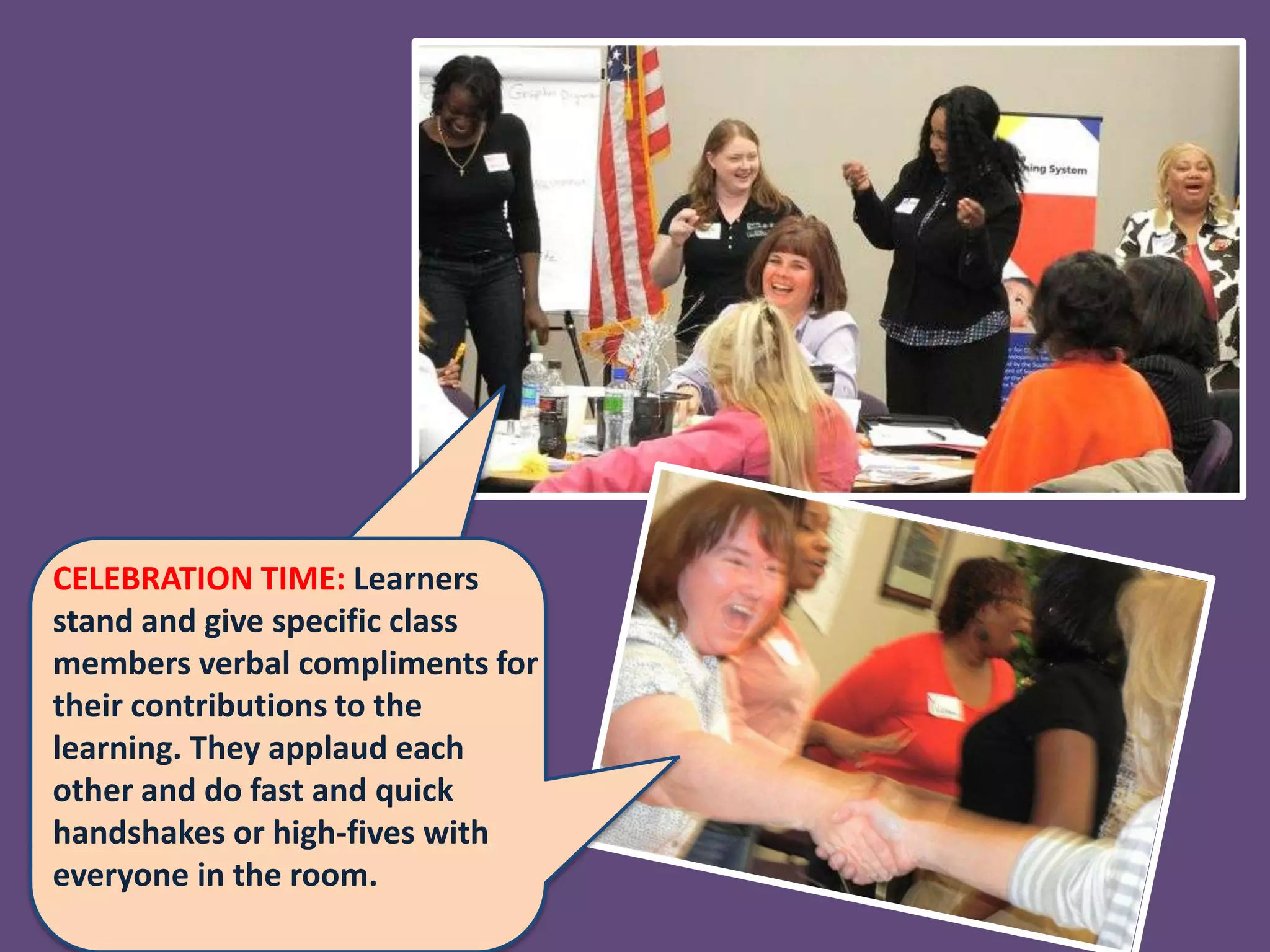
CELEBRATION TIME: Learners
stand and give specific class
members verbal compliments for
their contributions to the
learning. They applaud each
other and do fast and quick
handshakes or high-fives with
everyone in the room.
Tools for Your
Trainer’s Toolbox
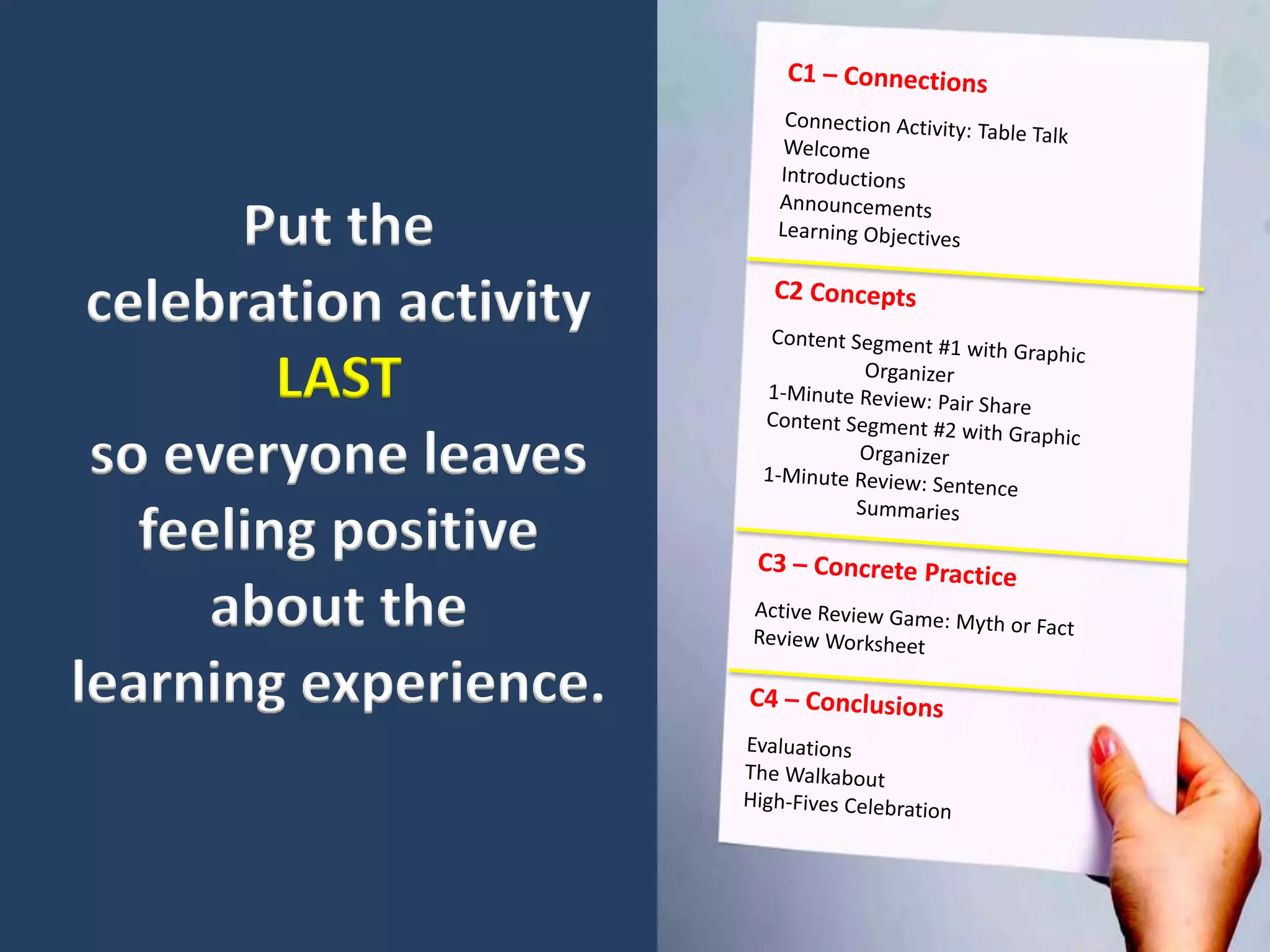
Put the
 celebration activity
         LAST
 so everyone leaves
   feeling positive
      about the
learning experience.
C4 Conclusions should include
                               which four pieces? Choose one of
                               the three lists, then click to the
                               next slide.


1. Introductions, learning goals, agenda, housekeeping

2. Summaries, evaluations, action plans, celebration

3. One-minute reviews, graphic organizers,
    skills practice, review games
2. Summaries, evaluations, action plans, celebration

                                            Yes, #2 is the
                                            correct list for
                                            C4 Conclusions.
Post your 2 sticky notes on C4 of your map.
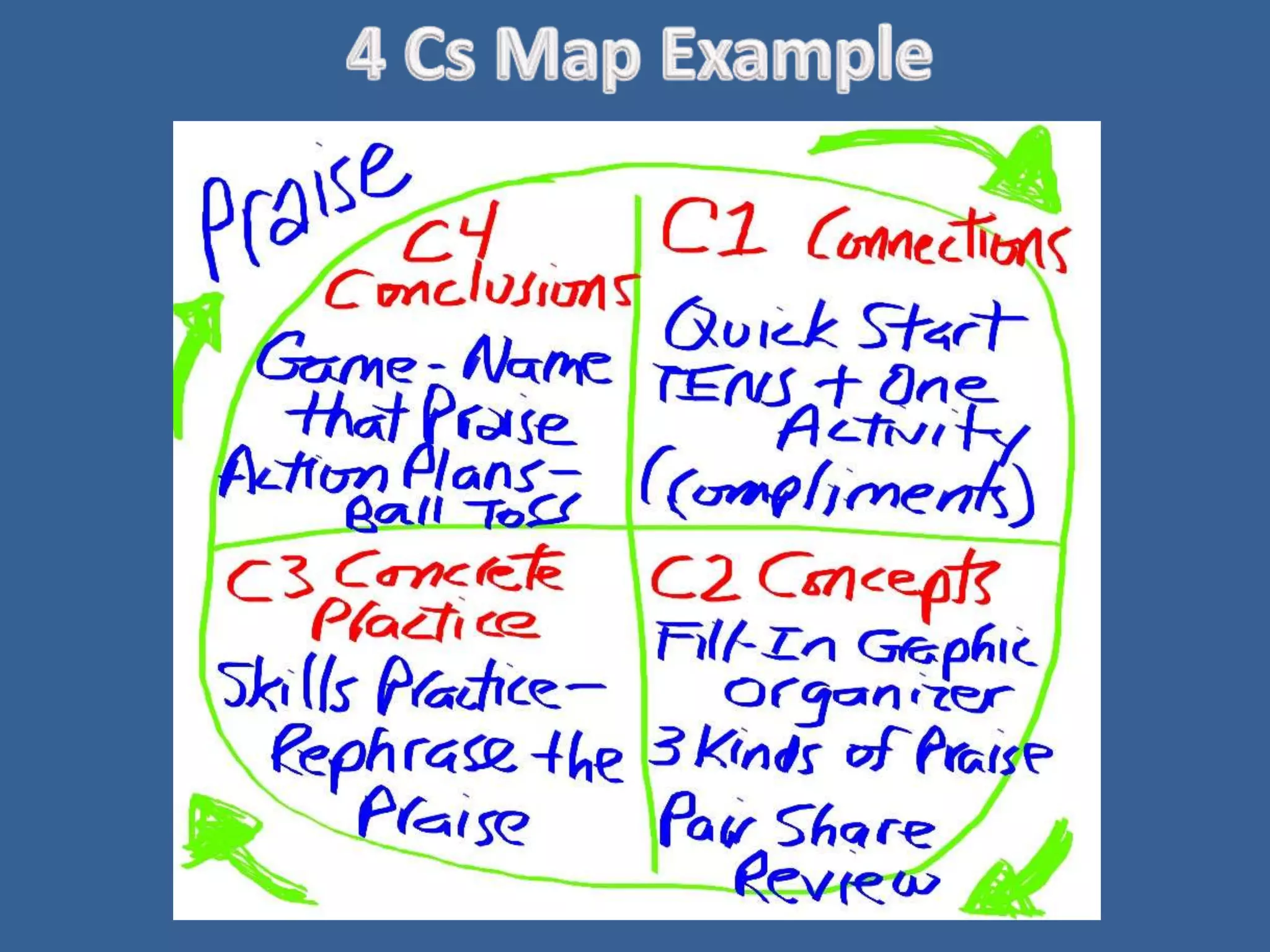
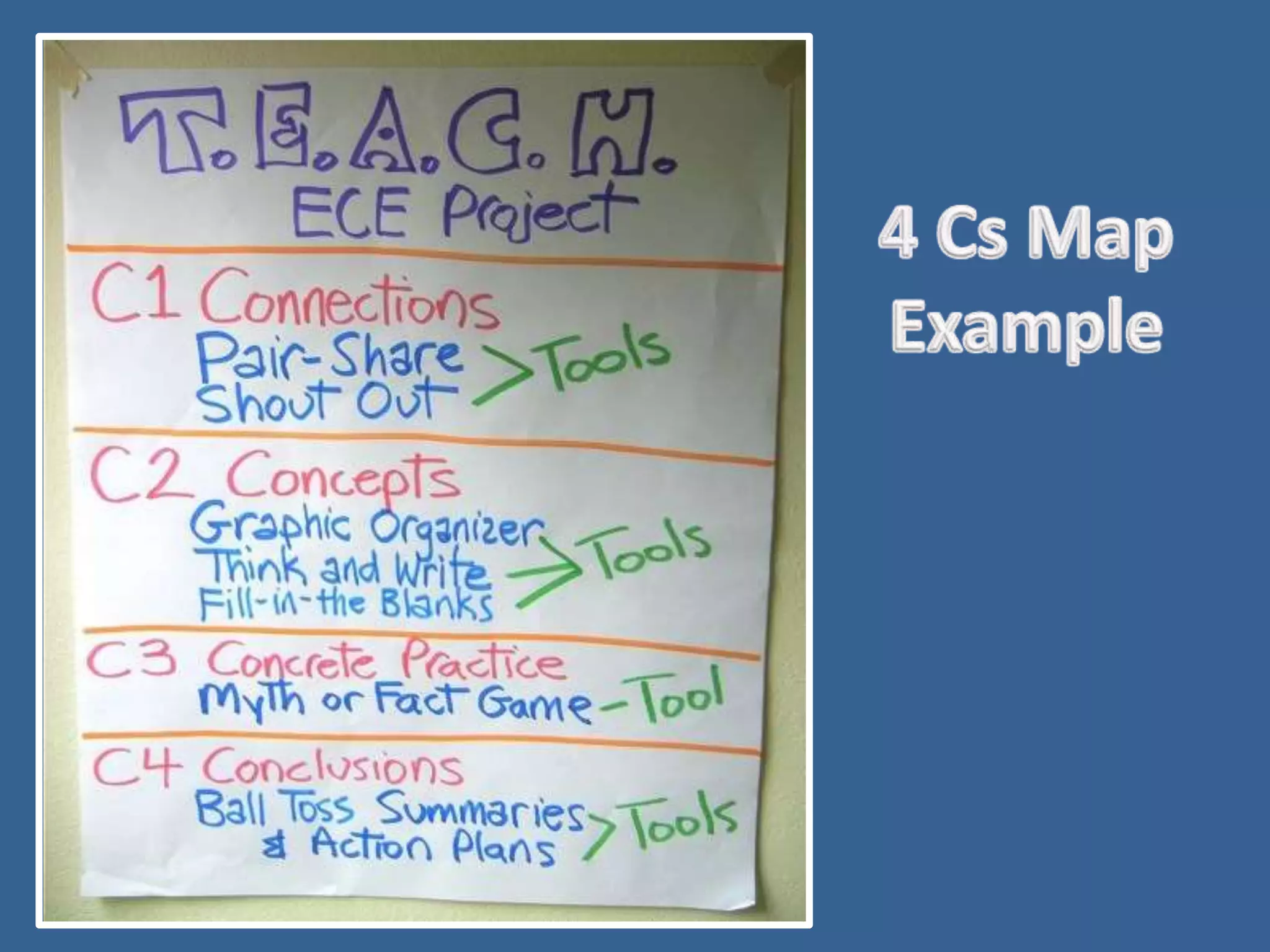
The 4 Cs map is a basic outline of your lesson, class, or training.
You have to fill in the content and details.
The 4 Cs map is a basic outline of your lesson, class, or training.
  You have to fill in the content and details.

You will need to figure out how much time to allow for each step
of the map. This will depend on the total training time and the
amount of content. The steps can be as long or as short as
necessary.
The 4 Cs map is a basic outline of your lesson, class, or training.
     You have to fill in the content and details.

   You will need to figure out how much time to allow for each step
   of the map. This will depend on the total training time and the
   amount of content. The steps can be as long or as short as
   necessary.

Post your map where you can see it as you teach.
You may still decide to write out a detailed script,
but the map will be your quick, visual guide.
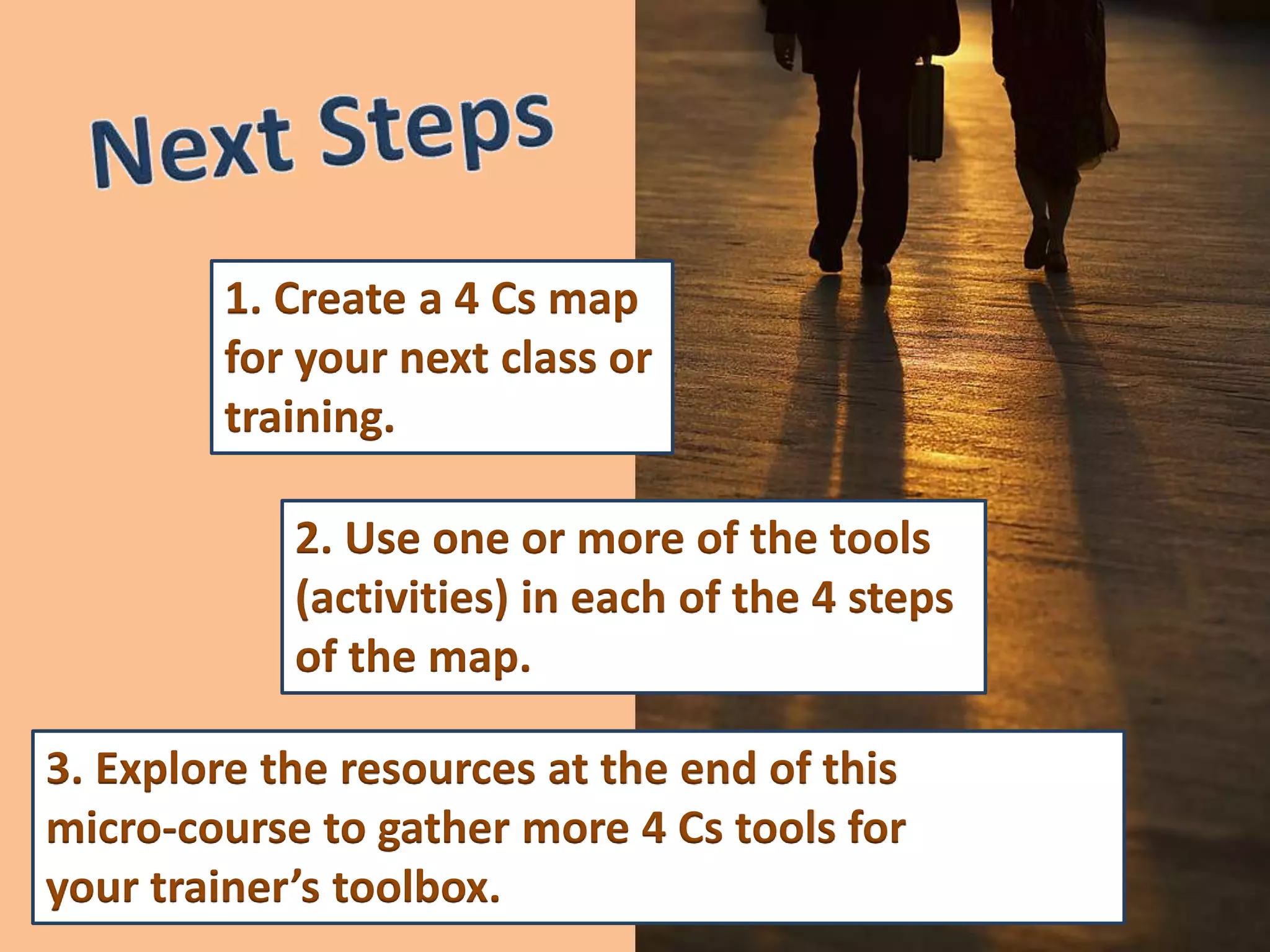
1. Create a 4 Cs map
        for your next class or
        training.

            2. Use one or more of the tools
            (activities) in each of the 4 steps
            of the map.

3. Explore the resources at the end of this
micro-course to gather more 4 Cs tools for
your trainer’s toolbox.
A note to all trainers for the South Carolina
         Center for Child Care Career Development:

If you have completed this micro-course as part of your
course requirements for Principles of Adult Learning,
please photocopy your 4 Cs training map and e-mail it to:
donna.davies@dss.sc.gov.
Or you can fax it to: 864-250-8690.
Please be sure to include your name and contact information.
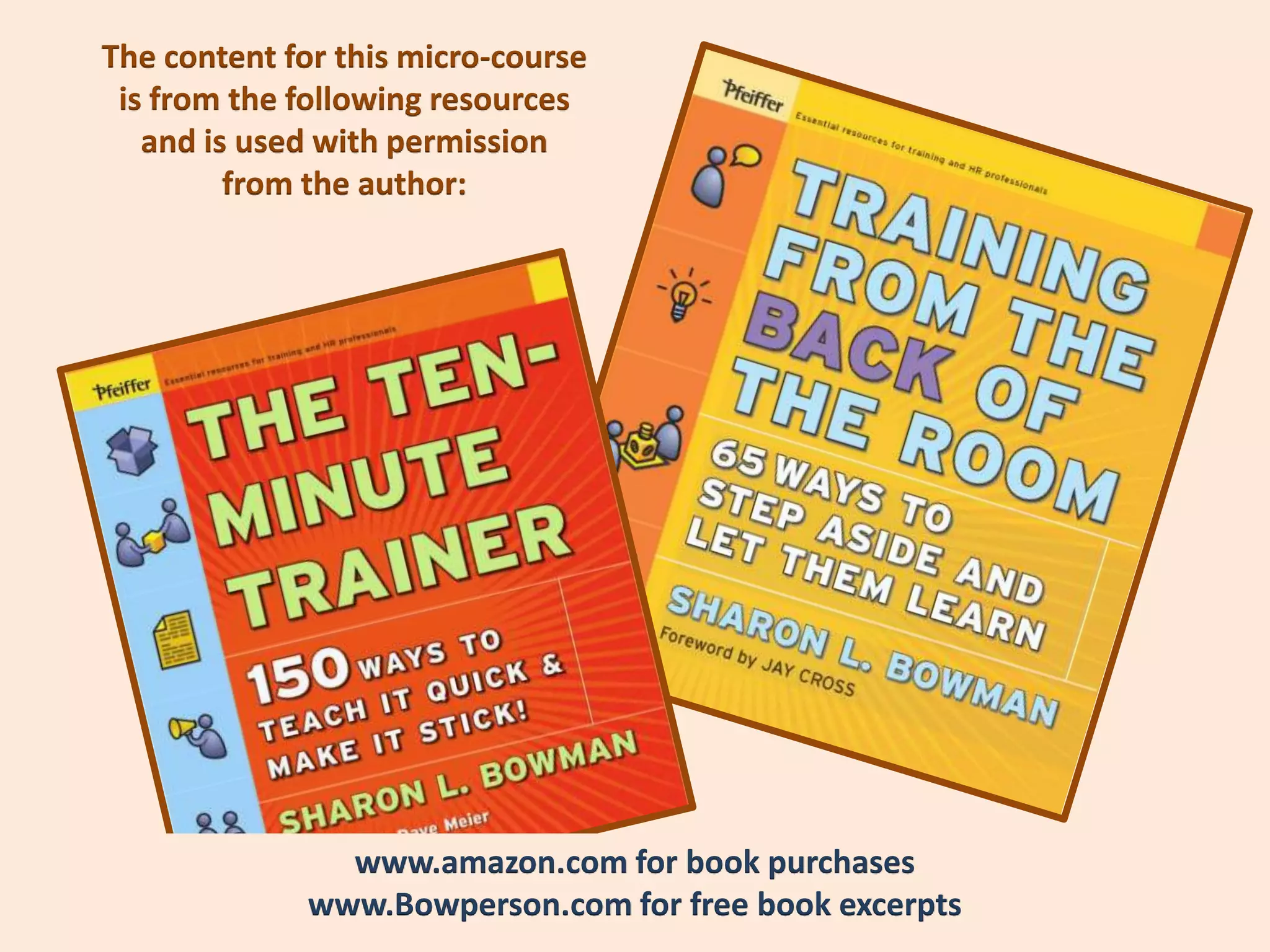
The content for this micro-course
is taken from the following resources
     and is used with permission
           from the author:


                  www.amazon.com for book purchases
                www.Bowperson.com for free book excerpts
Go to the following on www.slideshare.net:
       “Teaching Adults ANYTHING in 4 Easy Steps”
“How to Design Great Training: Begin with the End in Mind”
Slide set created for the South Carolina
Center for Child Care Career Development

    Slide set created by Sharon L. Bowman,
President, Bowperson Publishing & Training, Inc
www.Bowperson.com; SBowperson@gmail.com
Map It: Using the 4 Cs to Design and Deliver Great Training.

Map It: Using the 4 Cs to Design and Deliver Great Training.

  • 2.
    This micro-course wascreated for the South Carolina Center for Child Care Career Development.
  • 4.
    help you reachyour destination.
  • 5.
    help you reachyour destination. show you the easiest way to get there.
  • 6.
    help you reachyour destination. show you the easiest way to get there. keep you on track so you don’t get lost.
  • 7.
    help you reachyour destination. show you the easiest way to get there. keep you on track so you don’t get lost. show you where you are along the way.
  • 8.
    There is a MAP that will do the same for any training you design and deliver.
  • 9.
    It’s called the andit’s quick and easy to learn and to use.
  • 10.
    The 4 Cswill: help you reach your learning objectives. show you the easiest way to get there. keep you on track. show you where you are along the way.
  • 12.
  • 13.
    Use lines todivide your paper into 4 sections. These are examples of some of the ways you can do it.
  • 14.
    Label each section witha “sign.” C1 C2 Connections Concepts C3 Concrete C4 Practice Conclusions Now you’re ready to use your map.
  • 15.
    Why is itimportant to use a 4 Cs map when designing instruction? Choose all statements that apply, then click to the next slide for the answers. A. To help keep you on track. B. To help you reach the learning objectives. C. Because the map looks good on a wall. D. To show you where you are along the way. E. To show the easiest way to get there. F. Because everyone is using a map these days.
  • 16.
    A. To helpkeep you on track. B. To help you reach the learning objectives. D. To show you where you are along the way. E. To show the easiest way to get there. Yes, the map will help do all the above.
  • 20.
    TABLE TALK: Learners participate in a short table group discussion about what they want to learn from the class. DATA HUNT: Learners gather previously- learned data from other table group members and share this data with their own table groups.
  • 21.
    THINK AND WRITE:Learners write their own personal learning goals, then share what they wrote with their table group. STANDING SURVEY: Learners ask other table group members what they hope to be able to do with what they learn in the class. They summarize this information when back with their own group.
  • 22.
  • 23.
    Put the welcome, introductions, announcements, learning objectives, and anything else AFTER the connection activity..
  • 24.
    Which statements AREexamples of effective C1 activities (tools) that connect learners to the topic and to each other? Choose your responses, then click to the next slide for the answers. 1. In pairs or triads, learners do a one-minute discussion about what they already know about the topic. 2. Each learner stands and introduces himself or herself to the class. 3. In table groups, learners discuss which of the course learning objectives are most important to them and why. 4. The instructor introduces herself to the group with a personal story.
  • 25.
    1. In pairsor triads, learners do a one-minute discussion about what they already know about the topic. 3. In table groups, learners discuss which of the course learning objectives are most important to them and why. Yes, #1 and #3 are effective C1 tools..
  • 26.
    Post your 2sticky notes on C1 of your map.
  • 29.
    MIND MAP Topic Google “graphic organizers” for free examples and templates.
  • 31.
    STANDING QUIZ: Learners stand,pair up, and ask each other a content-related question. If they each answer correctly, they sit back down. ONE-SENTENCE SUMMARIES: Learners write and then share one-sentence summaries of the main ideas presented so far.
  • 32.
    PAIR SHARE: Learnersform pairs or triads and share what they feel are the most important facts they have learned so far. PASS THE QUESTION: Each learner writes a content-related question on an index card and then passes the card to another table member who writes the answer for a group discussion later.
  • 33.
  • 34.
    Insert 1-minute review activities BETWEEN each content segment.
  • 35.
    You decide ifthe statement below is a myth or a fact. Then click to the next slide to check your answer. 1. If you have a lot of information to cover, lecturing for a full fifty minutes and then taking a ten minute break is an effective method of instruction.
  • 36.
    1. If youhave a lot of information to cover, lecturing for a full fifty minutes and then taking a ten minute break is an effective method of instruction. MYTH. You may be able to cover all the material, but this is the least effective method of instruction as far as learner retention of content is concerned. Learners need time to think about, write about, and discuss the information being learned as they learn it.
  • 37.
    You decide ifthe statement below is a myth or a fact. Then click to the next slide to check your answer. 2. It’s wise to divide your content into smaller segments and engage learners in short, quick review activities between segments because they will remember more of the content this way.
  • 38.
    2. It’s wiseto divide your content into smaller segments and engage learners in short, quick review activities between segments because they will remember more of the content this way. FACT. Research from cognitive neuroscience proves that the human brain learns better and can retain information longer when learning is interspersed with short periods of active review.
  • 39.
    You decide ifthe statement below is a myth or a fact. Then click to the next slide to check your answer. 3. When learners take notes while listening to a lecture, they will remember more of the material, especially if the instructor pauses to allow time for learner reflection and writing.
  • 40.
    3. When learnerstake notes while listening to a lecture, they will remember more of the material, especially if the instructor pauses to allow time for learner reflection and writing. FACT. More of the brain is engaged when learners have time to think about and write about what they have heard.
  • 41.
    Post your 2sticky notes on C2 of your map.
  • 45.
    TABLE GROUP PRACTICE: Learnerswork together to practice a skill or play a review game. They teach each other and give each other feedback.
  • 46.
    TABLE GROUP PRACTICE: Learners work collaboratively to build a 3-dimensional representation of major concepts. They fill in a review worksheet and For 3-D activities, have craft materials available discuss how to apply the content to such as pipe cleaners, clay, markers, popsicle their jobs. sticks, scissors, colored paper, stickers, etc.
  • 47.
  • 48.
    ALL learners PARTICIPATE in an active review of major concepts.
  • 49.
    What word orphrase completes each sentence? Click back to slide #44 if you’re not sure, or click to the next slide for the answers. 1. The C3 activities should involve and engage _____ ___________________, not just a few. 2. C3 activities are always interesting and ______________ to learners. 3. Concrete practice activities __________________ the skills being learned or the information that has been taught.
  • 50.
    ALL 1. The C3activities should involve and engage ________ LEARNERS ___________________, not just a few. MEANINGFUL 2. C3 activities are always interesting and ______________ to learners. REINFORCE 3. Concrete practice activities __________________ the skills being learned or the information that has been taught.
  • 51.
    Post your 2sticky notes on C3 of your map.
  • 56.
    THE WALKABOUT: Inpairs or triads, learners walk around the perimeter of the room discussing the most important concepts they learned and what they plan to do with this knowledge back on the job. RAPS AND RHYMES: Table groups create short raps, poems, or songs with motions for content summaries. They lead the whole group in the recitation, singing and moving.
  • 57.
    CELEBRATION TIME: Learners standand give specific class members verbal compliments for their contributions to the learning. They applaud each other and do fast and quick handshakes or high-fives with everyone in the room.
  • 58.
  • 59.
    Put the celebrationactivity LAST so everyone leaves feeling positive about the learning experience.
  • 60.
    C4 Conclusions shouldinclude which four pieces? Choose one of the three lists, then click to the next slide. 1. Introductions, learning goals, agenda, housekeeping 2. Summaries, evaluations, action plans, celebration 3. One-minute reviews, graphic organizers, skills practice, review games
  • 61.
    2. Summaries, evaluations,action plans, celebration Yes, #2 is the correct list for C4 Conclusions.
  • 62.
    Post your 2sticky notes on C4 of your map.
  • 64.
    The 4 Csmap is a basic outline of your lesson, class, or training. You have to fill in the content and details.
  • 65.
    The 4 Csmap is a basic outline of your lesson, class, or training. You have to fill in the content and details. You will need to figure out how much time to allow for each step of the map. This will depend on the total training time and the amount of content. The steps can be as long or as short as necessary.
  • 66.
    The 4 Csmap is a basic outline of your lesson, class, or training. You have to fill in the content and details. You will need to figure out how much time to allow for each step of the map. This will depend on the total training time and the amount of content. The steps can be as long or as short as necessary. Post your map where you can see it as you teach. You may still decide to write out a detailed script, but the map will be your quick, visual guide.
  • 70.
    1. Create a4 Cs map for your next class or training. 2. Use one or more of the tools (activities) in each of the 4 steps of the map. 3. Explore the resources at the end of this micro-course to gather more 4 Cs tools for your trainer’s toolbox.
  • 71.
    A note toall trainers for the South Carolina Center for Child Care Career Development: If you have completed this micro-course as part of your course requirements for Principles of Adult Learning, please photocopy your 4 Cs training map and e-mail it to: donna.davies@dss.sc.gov. Or you can fax it to: 864-250-8690. Please be sure to include your name and contact information.
  • 72.
    The content forthis micro-course is taken from the following resources and is used with permission from the author: www.amazon.com for book purchases www.Bowperson.com for free book excerpts
  • 73.
    Go to thefollowing on www.slideshare.net: “Teaching Adults ANYTHING in 4 Easy Steps” “How to Design Great Training: Begin with the End in Mind”
  • 74.
    Slide set createdfor the South Carolina Center for Child Care Career Development Slide set created by Sharon L. Bowman, President, Bowperson Publishing & Training, Inc www.Bowperson.com; SBowperson@gmail.com