MAP BASED CLONING
SUBMITTEDTO: SUBMITTED BY:
DEPARTMENT OF ZOOLOGY SAKSHI
KURUKSHETRA UNIVERSITY, CLASS :- M.Sc. ZOOLOGY (3 rd
SEM)
KURUKSHETRA ROLL NO. :- 60
2.
CONTENTS:
INTRODUCTION
HISTORY
PRINCIPLE OF MAP BASED CLONING
STEPS OF MAP BASED CLONING
i. GENETIC MAPPING
ii. LIBRARY CONSTRUCTION
iii. SCREENING OR ISOLATION
iv. SUBCLONING OR SEQUENCING
APPLICATIONS OF MAP BASED CLONING
LIMITATIONS OF MAP BASED CLONING
CONCLUSION
REFRENCES
3.
INTRODUCTION
Map basedcloning is the process to recognize the genetic basis of mutant phenotype
with the help of linkage to markers whose physical location of the genome is known.
Map based cloning is also known as positional cloning. Positional cloning is used to
locate the position of a disease associated gene along the chromosomes.
It involves the isolation of partially overlapping DNA segments that progress along
the chromosome toward a gene.
4.
HISTORY
The firstsuccessful application of map based cloning in humans was developed with
the identification of gene for X –linked chronic granulomatous disease by Royer –
Pokora and Colleagues in 1985, it was the identification of the gene underlying
Duchenne Muscular Dystrophy .
In the mid 1980 , several groups are competed to clone the DMD gene using
different approaches.
By 1995, only about 50 inherited disease genes had been identified by this approach.
5.
PRINCIPLE OF MAPBASED CLONING
The first step of map based cloning or positional cloning is to identify a molecular marker that
lies close to gene of interest. The next step is to saturate this region around that the original
molecular marker with others markers. It shows recombination with gene.
The next step is to screen a large insert genomic library (BAC or YAC ) with marker to isolate
clones and hybridize to molecular marker.
To identify the initial markers that map are near flank the gene and found a clone to which the
marker hybridize, this is called as chromosomal walking.
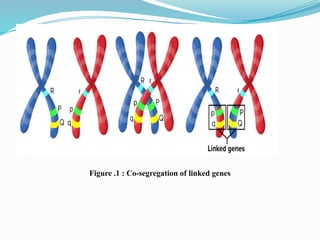
This involves creating a new markers and screening the segregating population with this new
markers. This population is large (1000-3000 individuals ) the markers that co segregate ( no
recombination ) with gene of interest.
STEPS OF MAPBASED CLONING
1. GENETIC MAPPING :
It is the foundational step in map based cloning , laying the groundwork for the
subsequent isolation of a specific gene. It involves two primary techniques : Linkage
Analysis and Physical mapping.
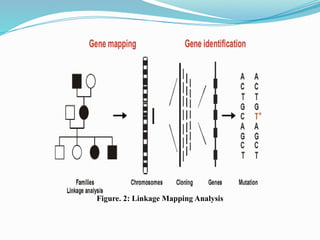
Linkage Analysis : Linkage Analysis is used to identify a genetic marker. These
markers are present in close vicinity of the gene of interest.
Genetic markers are short DNA sequences that very between individuals. They can
be Simple Sequence Repeats (SSRs) , Restriction Fragment Length Polymorphisms
(RFLPs ) , Single Nucleotide Polymorphisms (SNPs) are developed and used to
analyze the progeny.
Physical mapping: The physical location of the gene on a chromosome is
determined. This involves the chromosomal walking and chromosomal jumping
techniques :-
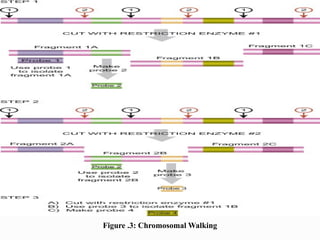
Chromosomal Walking :
It is a technique used to isolate a specific gene based on its location on a
chromosome.
It involves a series of overlapping DNA fragments that are cloned and
sequenced .These overlapping fragments are called contig clones that are assembled
in a continuous sequence form a contiguous region of the genome.
These are essential for creating a physical map of the region of interest.
2. LIBRARY CONSTRUCTION
It is a crucial step in map based cloning involving the creation of a collection of
DNA fragments representing the entire genome of an organism.
These fragments are inserted into cloning vectors and introduced into host cells
forming a library of DNA clones that are screened for gene of interest.
There are two types of libraries : Genomic Library (containing fragments
representing the entire genome of an organism) and cDNA library ( contains
fragments representing the mRNA transcripts present in a particular cell or tissue.
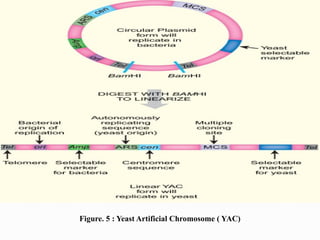
The most preferred vector used in Yeast Artificial Chromosomes (YACs).
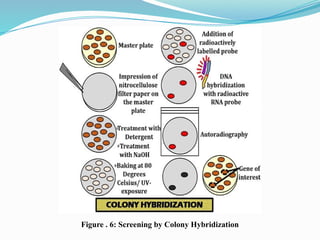
3. SCREENING ORISOLATION
The library is screened using probes that flank the gene of interest. It includes the
following steps:
1.Probe preparation: It is a crucial step in map based cloning involving the creation
of a labeled DNA or RNA sequence .This probe is used to screen a genomic library
and identify clones containing the gene. This probe is labeled either radioactively or
non radioactively.
2.Hybridization: The Probes are labeled with a detectable signal. The labeled probes
are hybridized to the DNA fragments in the genomic library.
3.Isolation : Positive clone containing the gene are isolated and purified.
4. SUBCLONING ANDSEQUENCING
The isolated DNA fragments are subcloned into smaller vectors for further analysis.
The DNA sequence is determined to identified the gene of interest.
Subcloning: Its purpose is to isolate a specific DNA fragment containing the gene of
interest from large genomic clone.
Sequencing : Its purpose is to determine the nucleotide sequence of the isolated
DNA fragments.
It is used in identification of the gene of interest and to determine the gene coding
sequencing and regulatory elements.
16.
APPLICATION OF MAPBASED CLONING
Gene identification :It identifies genes associated with genetic disorders. Some
genes responsible for desirable traits in plants and animals , such as disease
resistance , quality characteristics can be isolated.
Human genetics : Map based cloning has been used to identify genes involved in a
variety of human diseases including cystic fibrosis, Huntington diseases etc.
Forensic science : By comparing the specific DNA regions in the child’s DNA to
DNA of parents, paternity can be determined.
17.
LIMITATION OF MAPBASED CLONING
Time consuming and labor intensive : Requires the development of large
population of individuals with the mutant phenotype and their corresponding wild
type counterparts. The creation and screening of numerous molecular markers to
map the gene of interest can be time consuming.
Requires a genetic map : A high quality genetic map for the organism of interest
must be available, which not be the case for less well studied species.
Difficulty with complex traits : Many traits are controlled by multiple genes
(polygenic traits ) , making it difficult to identify the specific gene responsible for a
particular phenotype using map based cloning.
18.
CONCLUSION
Map basedcloning is a powerful technique used to isolate a specific gene based on
its chromosomal location.
Map based cloning remains a valuable tool for genetic research and made a
significant contributions for understanding of gene function and its application in
various field.
It is a significant tool for gene discovery especially in combination with other
approaches such as positional cloning and whole genome sequencing.
19.
REFERENCES
Allison , L.A.(2012).Fundamental Molecular Biology.2nd
Edition. John Wiley &
Sons , Inc.185-187.
Dubey , R.C.( 2014). A Textbook of Biotechnology. 5th
Edition. S. Chand & Company
Pvt. Ltd. 320-322.
Roy , D. (2010) . Biotechnology. 2nd
Edition. Narosa Publishing House Pvt. Ltd. 235-
237.
Strachan, T. and Read , A.( 2011). Human Molecular Genetics. 4th
Edition. Garland
Science, Taylor & Francis Group, LLC. 498-505.