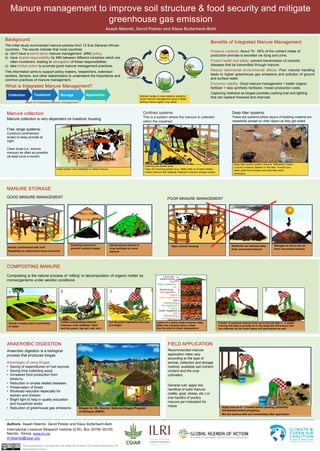
MANURE STORAGE
Animal confinement with roof
Possibility to collect both feces and urine
Covering manure to
prevent nutrient losses
Using banana leaves or
crop residues to cover
manure
Open animal housing Nutrients are washed away
from uncovered manure
Nitrogen is lost to the air
from uncovered manure
GOOD MANURE MANAGEMENT POOR MANURE MANAGEMENT
COMPOSTING MANURE
Composting is the natural process of ‘rotting’ or decomposition of organic matter by
microorganisms under aerobic conditions.
Chose a shady place in proximity
of water
Collect composting material
(manure, crop residues, fresh
and dry grass, top soil, ash, etc.)
Cut the plant material to the size
of a finger
Layers of a newly made compost heap.
Water the compost twice a week
Use the stick to check temperature
Tranfer of compost manure from 1st to 2nd pit after 2 - 3 weeks
Turning will help to provide air to the heap and will ensure that
the materials on the outer layers will decompose as well.
1 2 3 1 2
Topsoil
Green vegetation
Ash
Animal dung
Dry vegetation
Topsoil
Green vegetation
Ash
Animal dung
Dry vegetation
Topsoil
Green vegetation
Ash
Animal dung
Dry vegetation
Cover with
banana leaves
Manure collection
Manure collection is very dependent on livestock housing.
Free range systems:
Construct confinement
(kraal) to keep animals at
night
Clean kraal (i.e. remove
manure) as often as possible
(at least once a month)
Confined systems:
This is a system where the manure is collected
within the cowshed
ANAEROBIC DIGESTION
Anaerobic digestion is a biological
process that produces biogas
Advantages of using Biogas:
• Saving of expenditures on fuel sources
• Saving time collecting wood
• Increased food production from
bioslurry
• Reduction in smoke related diseases
• Preservation of forest
• Workload reduction especially for
women and children
• Bright light to help in quality education
and household works
• Reduction of greenhouse gas emissions
FIELD APPLICATION
Recommended manure
application rates vary
according to the type of
animal, collection and storage
method, available soil nutrient
content and the crop
cultivated.
General rule: apply two
handfuls of solid manure
(cattle, goat, sheep, etc.) or
one handful of poultry
manure per hole/plant for
maize
What is Integrated Manure Management?
Preserve nutrients: About 70 - 95% of the nutrient intake of
production animals is excreted via dung and urine.
Protect health and safety: prevent transmission of zoonotic
diseases that be transmitted through manure.
Reduce detrimental environmental effects: Poor manure handling
leads to higher greenhouse gas emissions and pollution of ground
and surface water.
Economic viability: Good manure management > better organic
fertilizer > less synthetic fertilizers >lower production costs.
Capturing methane as biogas provides cooking fuel and lighting
that can replace firewood and charcoal.
Manure management to improve soil structure & food security and mitigate
greenhouse gas emission
Asaah Ndambi, David Pelster and Klaus Butterbach-Bahl
Collection Treatment Storage Application
CROPS
Nutrient cycles in crop-livestock systems
LIVESTOCK LAND
Steps of Integrated Manure management
Apply manure 8 – 2 weeks before planting, preferably
immediately before ploughing.
Mix the manure with soil immediately after application
Biogas for life. Source: National Biogas Program
of Ethiopia (NBPE)
Kraal system with possibility to collect manure
Cleaning the animal shed
Clean the housing system (e.g. stalls) daily or at least weekly.
Collect manure with bedding material to reduce nitrogen losses
Deep litter systems:
These are systems where layers of bedding material are
repeatedly spread on older layers as they get soiled.
Deep litter poultry system (Source: Milkwood) Ensure
a correct moisture balance in the litter. Prevent any
water spills from drinkers and add litter when
necessary
Benefits of Integrated Manure Management
Good manure management gives a better
fertilizer hence higher crop yields.
Background
The initial study summarized manure policies from 12 Sub-Saharan African
countries. The results indicate that most countries:
a) don’t have a stand-alone manure management (MM) policy,
b) have shared responsibility for MM between different ministries which are
often incoherent, leading to abnegation of these responsibilities
c) take limited action to promote good manure management practices.
This information aims to support policy makers, researchers, extension
workers, farmers, and other stakeholders to understand the importance and
common practices of manure management.
Authors: Asaah Ndambi, David Pelster and Klaus Butterbach-Bahl
International Livestock Research Institute (ILRI), Box 30709 -00100,
Nairobi, Kenya www.ilri.org
A.Ndambi@cgiar.org
This presentation is licensed for use under the Creative Commons Attribution 4.0
International Licence

Manure management to improve soil structure and food security and mitigate greenhouse gas emission

  • 1.
    MANURE STORAGE Animal confinementwith roof Possibility to collect both feces and urine Covering manure to prevent nutrient losses Using banana leaves or crop residues to cover manure Open animal housing Nutrients are washed away from uncovered manure Nitrogen is lost to the air from uncovered manure GOOD MANURE MANAGEMENT POOR MANURE MANAGEMENT COMPOSTING MANURE Composting is the natural process of ‘rotting’ or decomposition of organic matter by microorganisms under aerobic conditions. Chose a shady place in proximity of water Collect composting material (manure, crop residues, fresh and dry grass, top soil, ash, etc.) Cut the plant material to the size of a finger Layers of a newly made compost heap. Water the compost twice a week Use the stick to check temperature Tranfer of compost manure from 1st to 2nd pit after 2 - 3 weeks Turning will help to provide air to the heap and will ensure that the materials on the outer layers will decompose as well. 1 2 3 1 2 Topsoil Green vegetation Ash Animal dung Dry vegetation Topsoil Green vegetation Ash Animal dung Dry vegetation Topsoil Green vegetation Ash Animal dung Dry vegetation Cover with banana leaves Manure collection Manure collection is very dependent on livestock housing. Free range systems: Construct confinement (kraal) to keep animals at night Clean kraal (i.e. remove manure) as often as possible (at least once a month) Confined systems: This is a system where the manure is collected within the cowshed ANAEROBIC DIGESTION Anaerobic digestion is a biological process that produces biogas Advantages of using Biogas: • Saving of expenditures on fuel sources • Saving time collecting wood • Increased food production from bioslurry • Reduction in smoke related diseases • Preservation of forest • Workload reduction especially for women and children • Bright light to help in quality education and household works • Reduction of greenhouse gas emissions FIELD APPLICATION Recommended manure application rates vary according to the type of animal, collection and storage method, available soil nutrient content and the crop cultivated. General rule: apply two handfuls of solid manure (cattle, goat, sheep, etc.) or one handful of poultry manure per hole/plant for maize What is Integrated Manure Management? Preserve nutrients: About 70 - 95% of the nutrient intake of production animals is excreted via dung and urine. Protect health and safety: prevent transmission of zoonotic diseases that be transmitted through manure. Reduce detrimental environmental effects: Poor manure handling leads to higher greenhouse gas emissions and pollution of ground and surface water. Economic viability: Good manure management > better organic fertilizer > less synthetic fertilizers >lower production costs. Capturing methane as biogas provides cooking fuel and lighting that can replace firewood and charcoal. Manure management to improve soil structure & food security and mitigate greenhouse gas emission Asaah Ndambi, David Pelster and Klaus Butterbach-Bahl Collection Treatment Storage Application CROPS Nutrient cycles in crop-livestock systems LIVESTOCK LAND Steps of Integrated Manure management Apply manure 8 – 2 weeks before planting, preferably immediately before ploughing. Mix the manure with soil immediately after application Biogas for life. Source: National Biogas Program of Ethiopia (NBPE) Kraal system with possibility to collect manure Cleaning the animal shed Clean the housing system (e.g. stalls) daily or at least weekly. Collect manure with bedding material to reduce nitrogen losses Deep litter systems: These are systems where layers of bedding material are repeatedly spread on older layers as they get soiled. Deep litter poultry system (Source: Milkwood) Ensure a correct moisture balance in the litter. Prevent any water spills from drinkers and add litter when necessary Benefits of Integrated Manure Management Good manure management gives a better fertilizer hence higher crop yields. Background The initial study summarized manure policies from 12 Sub-Saharan African countries. The results indicate that most countries: a) don’t have a stand-alone manure management (MM) policy, b) have shared responsibility for MM between different ministries which are often incoherent, leading to abnegation of these responsibilities c) take limited action to promote good manure management practices. This information aims to support policy makers, researchers, extension workers, farmers, and other stakeholders to understand the importance and common practices of manure management. Authors: Asaah Ndambi, David Pelster and Klaus Butterbach-Bahl International Livestock Research Institute (ILRI), Box 30709 -00100, Nairobi, Kenya www.ilri.org A.Ndambi@cgiar.org This presentation is licensed for use under the Creative Commons Attribution 4.0 International Licence