Elbow Examination
RSM Musculoskeletal Examination Masterclass:
Abbas Rashid
Consultant Elbow & Shoulder Surgeon
Remit
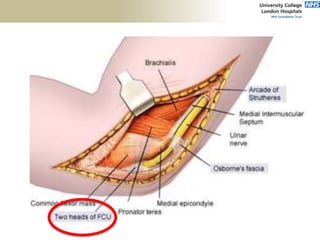
Surgical Anatomy
Osteoarticular
Capsuloligamentous
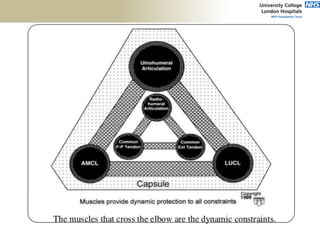
Muscles
Neurological
Remit
Surgical Anatomy
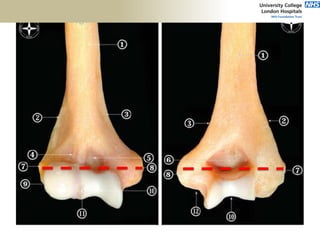
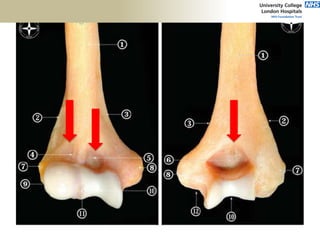
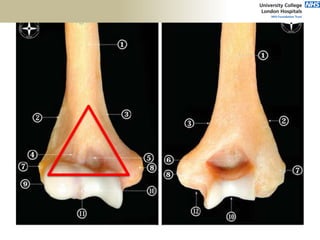
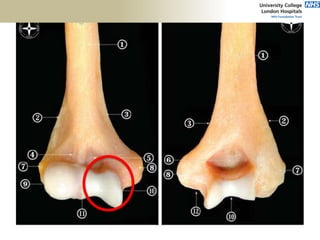
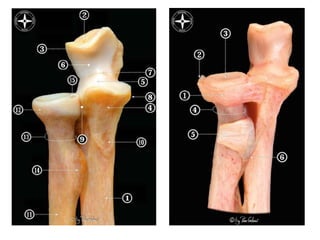
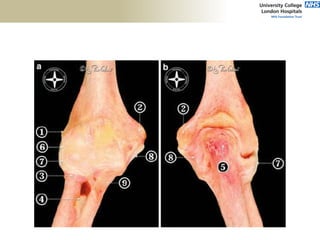
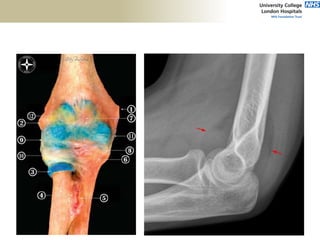
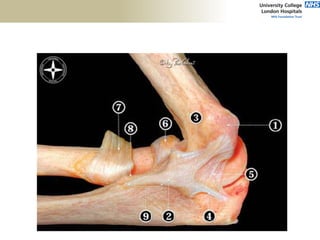
Osteoarticular
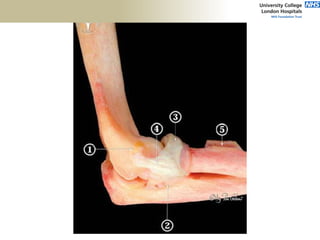
Capsuloligamentous
Muscles
Neurological
Idealised
clinical examination
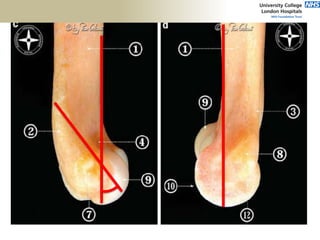
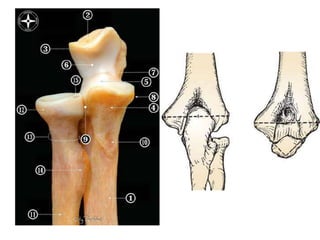
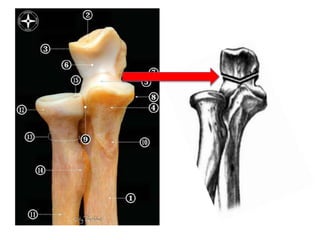
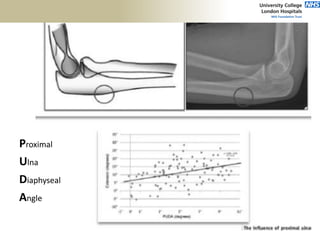
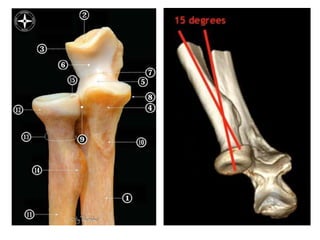
Proximal
Ulna
Diaphyseal
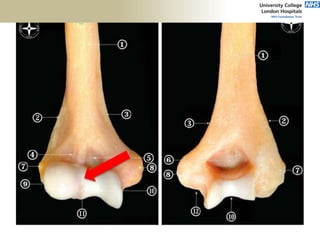
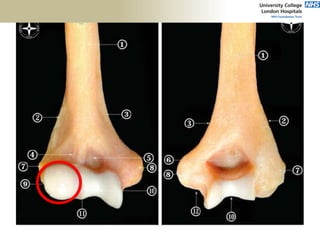
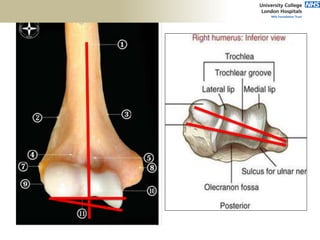
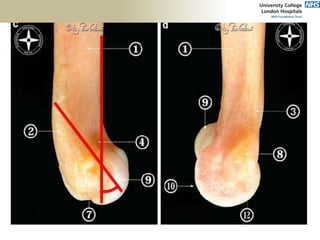
Angle
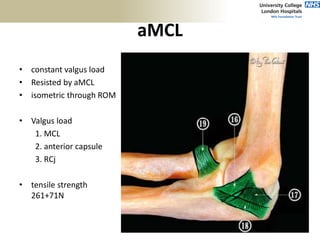
aMCL
• constant valgus load
• Resisted by aMCL
• isometric through ROM
• Valgus load
1. MCL
2. anterior capsule
3. RCj
• tensile strength
261+71N
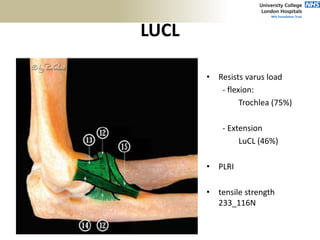
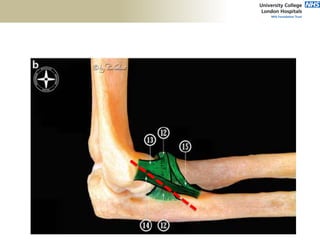
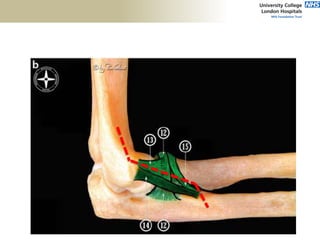
LUCL
• Resists varus load
- flexion:
Trochlea (75%)
- Extension
LuCL (46%)
• PLRI
• tensile strength
233_116N
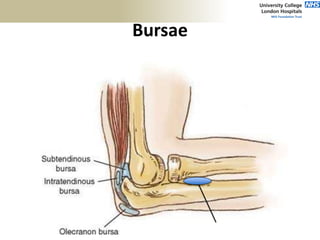
Bursae
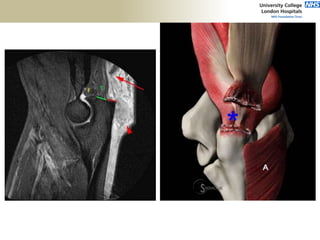
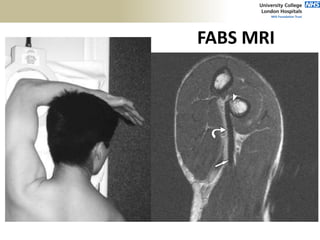
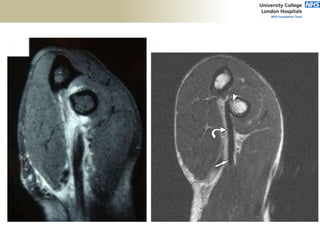
FABS MRI
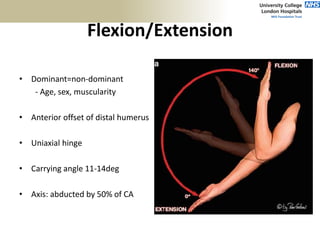
Flexion/Extension
• Dominant=non-dominant
- Age, sex, muscularity
• Anterior offset of distal humerus
• Uniaxial hinge
• Carrying angle 11-14deg
• Axis: abducted by 50% of CA
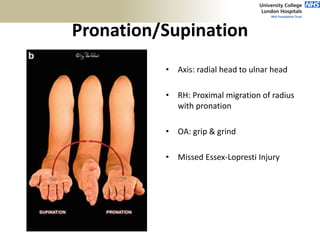
Pronation/Supination
• 80deg pronation
• 90degree supination
Pronation/Supination
• Axis: radial head to ulnar head
• RH: Proximal migration of radius
with pronation
• OA: grip & grind
• Missed Essex-Lopresti Injury
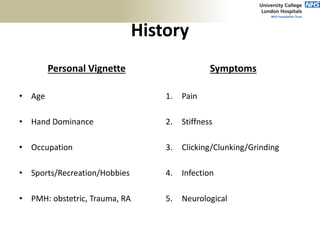
History
Personal Vignette
• Age
• Hand Dominance
• Occupation
• Sports/Recreation/Hobbies
• PMH: obstetric, Trauma, RA
Symptoms
1. Pain
2. Stiffness
3. Clicking/Clunking/Grinding
4. Infection
5. Neurological
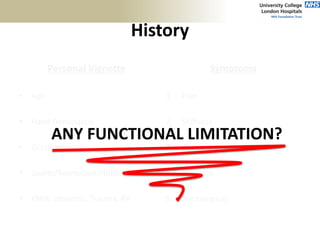
History
Personal Vignette
• Age
• Hand Dominance
• Occupation
• Sports/Recreation/Hobbies
• PMH: obstetric, Trauma, RA
Symptoms
1. Pain
2. Stiffness
3. Clicking/Clunking/Grinding
4. Infection
5. Neurological
ANY FUNCTIONAL LIMITATION?
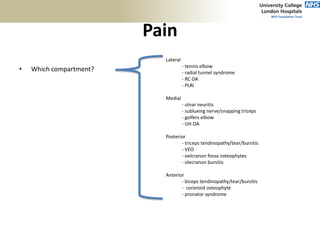
Pain
• Which compartment?
Lateral
- tennis elbow
- radial tunnel syndrome
- RC OA
- PLRI
Medial
- ulnar neuritis
- subluxing nerve/snapping triceps
- golfers elbow
- UH OA
Posterior
- triceps tendinopathy/tear/bursitis
- VEO
- oelcranon fossa osteophytes
- olecranon bursitis
Anterior
- biceps tendinopathy/tear/bursitis
- coronoid osteophyte
- pronator syndrome
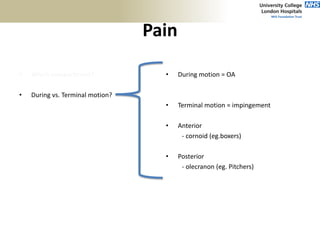
Pain
• Which compartment?
• During vs. Terminal motion?
• Worse in am or pm?
• Inciting activity?
• During motion = OA
• Terminal motion = impingement
• Anterior
- cornoid (eg.boxers)
• Posterior
- olecranon (eg. Pitchers)
Pain
• Which compartment?
• During vs. Terminal motion?
• Worse in am or pm?
• Inciting activity?
• AM
- gets better as day goes on
= inflammatory
• PM
- worse at end of day
= mechanical/OA
Instability
• Previous trauma?
• Macro vs. micro?
• Frequency?
- Pitchers/overhead athletes =
attenuation of aMCL
• Inciting injury?
Position of forearm at impact
• Sup, axial load, valgus stress
LUCL + RH +/- coronoid
= Terible Triad/PLRI
• Pro, axial load, varus stress
LUCL + AMF coronoid +/- pMCL
= Valgus PMRI
Instability
• Previous trauma?
• Macro vs. micro?
• Frequency?
- Pitchers/overhead athletes =
attenuation of aMCL
• Inciting injury?
• Previous dislocation
- CEO + LUCL + aMCL + CFPO
3/4 in-tact = conservative tx
• Repetitive
- attritional
- RA
- attrition aMCL + posterior impingement
= VEO (eg. Pitching athletes)
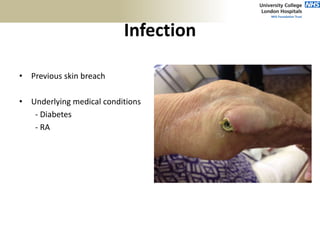
Infection
• Previous skin breach
• Underlying medical conditions
- Diabetes
- RA
Stiffness
• Previous injury or surgery
• Flex-Ext vs. Pro-Sup
• Impact
• +/- Secondary shoulder pain
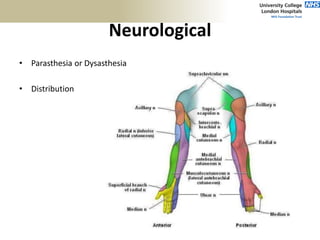
Neurological
• Parasthesia or Dysasthesia
• Distribution
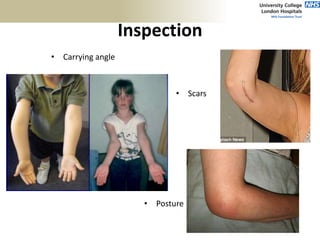
Inspection
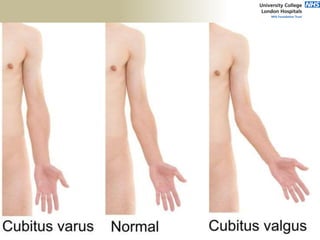
• Carrying angle
• Posture
• Scars
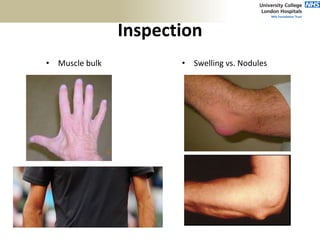
Inspection
• Muscle bulk • Swelling vs. Nodules
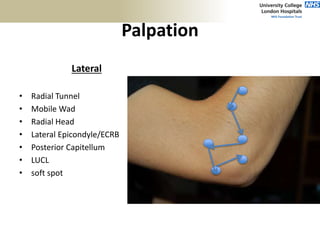
Palpation
Lateral
• Radial Tunnel
• Mobile Wad
• Radial Head
• Lateral Epicondyle/ECRB
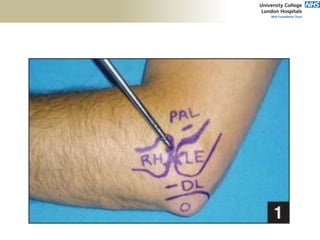
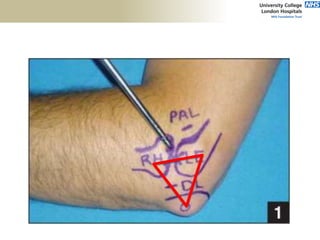
• Posterior Capitellum
• LUCL
• soft spot
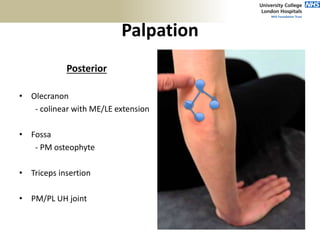
Palpation
Posterior
• Olecranon
- colinear with ME/LE extension
• Fossa
- PM osteophyte
• Triceps insertion
• PM/PL UH joint
Palpation
Medial
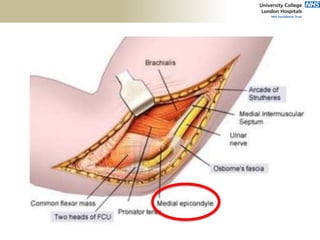
• ME
• CFO [under tension]
• MCL
• ulnar nerve
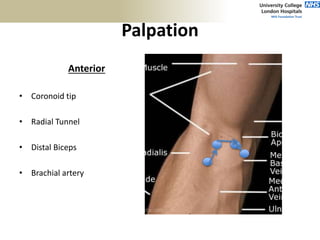
Palpation
Anterior
• Coronoid tip
• Radial Tunnel
• Distal Biceps
• Brachial artery
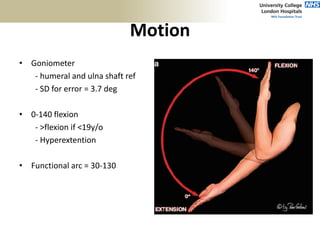
Motion
• Goniometer
- humeral and ulna shaft ref
- SD for error = 3.7 deg
• 0-140 flexion
- >flexion if <19y/o
- Hyperextention
• Functional arc = 30-130
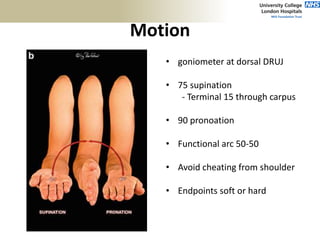
Motion
• goniometer at dorsal DRUJ
• 75 supination
- Terminal 15 through carpus
• 90 pronoation
• Functional arc 50-50
• Avoid cheating from shoulder
• Endpoints soft or hard
Neurological
• Cervical roots C5-T1
• Brachial plexus
• Peripheral nerves
• Extension=70% flexion
• Pronation=85% of supination
• Non-dominant =90%dominant
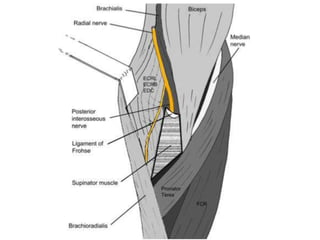
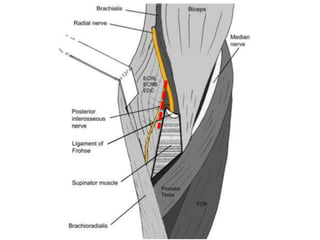
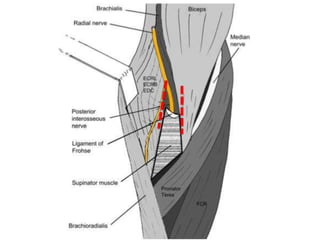
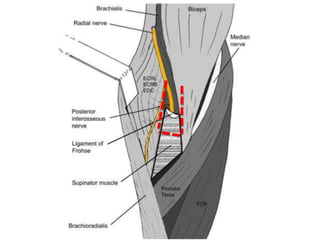
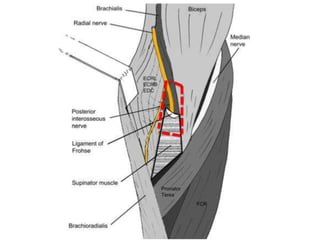
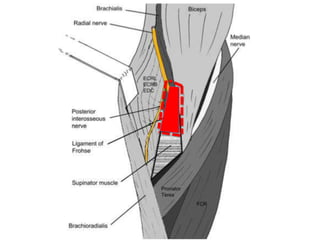
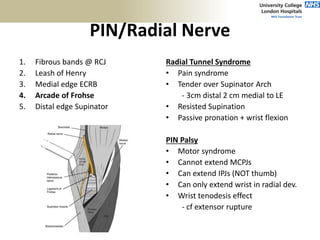
PIN/Radial Nerve
1. Fibrous bands @ RCJ
2. Leash of Henry
3. Medial edge ECRB
4. Arcade of Frohse
5. Distal edge Supinator
Radial Tunnel Syndrome
• Pain syndrome
• Tender over Supinator Arch
- 3cm distal 2 cm medial to LE
• Resisted Supination
• Passive pronation + wrist flexion
PIN Palsy
• Motor syndrome
• Cannot extend MCPJs
• Can extend IPJs (NOT thumb)
• Can only extend wrist in radial dev.
• Wrist tenodesis effect
- cf extensor rupture
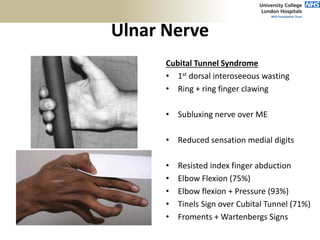
Ulnar Nerve
Cubital Tunnel Syndrome
• 1st dorsal interoseeous wasting
• Ring + ring finger clawing
• Subluxing nerve over ME
• Reduced sensation medial digits
• Resisted index finger abduction
• Elbow Flexion (75%)
• Elbow flexion + Pressure (93%)
• Tinels Sign over Cubital Tunnel (71%)
• Froments + Wartenbergs Signs
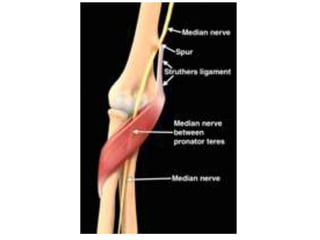
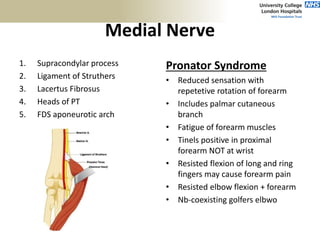
Medial Nerve
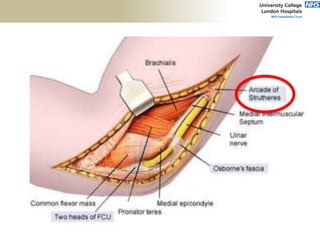
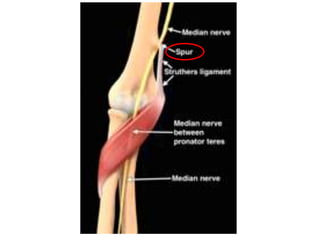
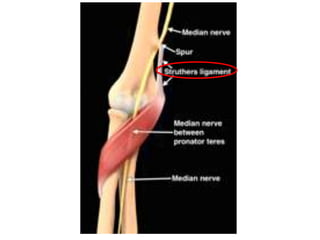
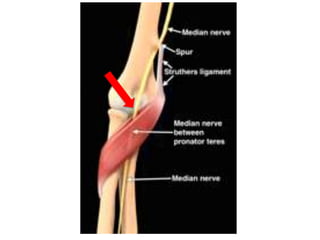
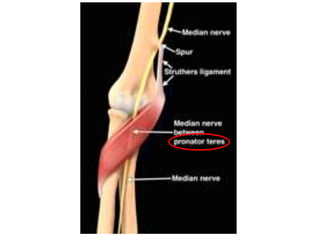
1. Supracondylar process
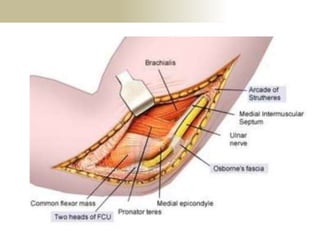
2. Ligament of Struthers
3. Lacertus Fibrosus
4. Heads of PT
5. FDS aponeurotic arch
Pronator Syndrome
• Reduced sensation with
repetetive rotation of forearm
• Includes palmar cutaneous
branch
• Fatigue of forearm muscles
• Tinels positive in proximal
forearm NOT at wrist
• Resisted flexion of long and ring
fingers may cause forearm pain
• Resisted elbow flexion + forearm
• Nb-coexisting golfers elbwo
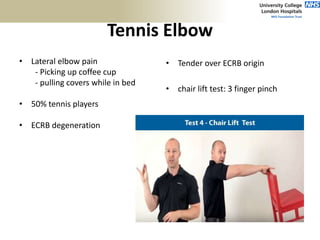
Tennis Elbow
• Lateral elbow pain
- Picking up coffee cup
- pulling covers while in bed
• 50% tennis players
• ECRB degeneration
• Tender over ECRB origin
• chair lift test: 3 finger pinch
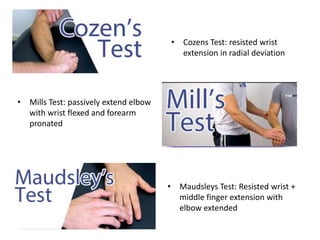
• Maudsleys Test: Resisted wrist +
middle finger extension with
elbow extended
• Cozens Test: resisted wrist
extension in radial deviation
• Mills Test: passively extend elbow
with wrist flexed and forearm
pronated
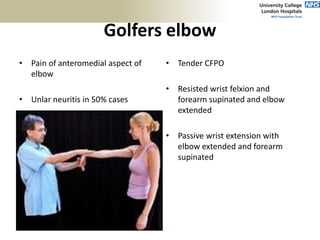
Golfers elbow
• Pain of anteromedial aspect of
elbow
• Unlar neuritis in 50% cases
• Tender CFPO
• Resisted wrist felxion and
forearm supinated and elbow
extended
• Passive wrist extension with
elbow extended and forearm
supinated
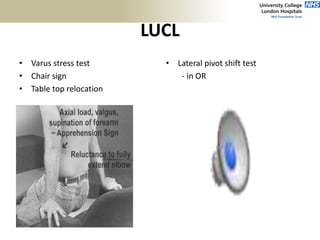
LUCL
• Varus stress test
• Chair sign
• Table top relocation
• Lateral pivot shift test
- in OR
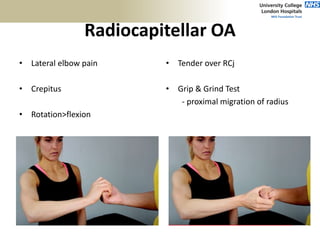
Radiocapitellar OA
• Lateral elbow pain
• Crepitus
• Rotation>flexion
• Tender over RCj
• Grip & Grind Test
- proximal migration of radius
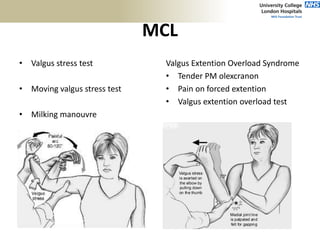
MCL
• Valgus stress test
• Moving valgus stress test
• Milking manouvre
Valgus Extention Overload Syndrome
• Tender PM olexcranon
• Pain on forced extention
• Valgus extention overload test
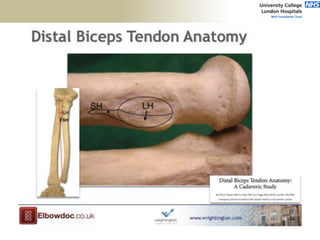
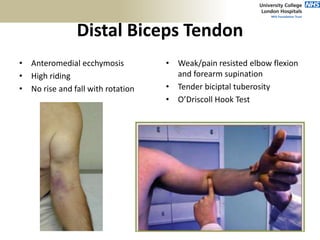
Distal Biceps Tendon
• Anteromedial ecchymosis
• High riding
• No rise and fall with rotation
• Weak/pain resisted elbow flexion
and forearm supination
• Tender biciptal tuberosity
• O’Driscoll Hook Test
Distal Triceps
• Pain on resisted elbow extension
• Posterior ecchymoses
• Defect proximal to olecranon tip
• No extension against gravity
• Viegas: Elbow extension when
triceps squeezed [modification of
Thompson Test].
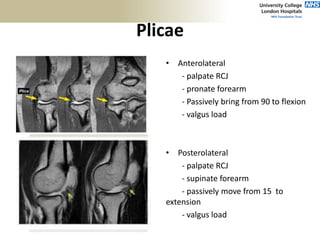
Plicae
• Anterolateral
- palpate RCJ
- pronate forearm
- Passively bring from 90 to flexion
- valgus load
• Posterolateral
- palpate RCJ
- supinate forearm
- passively move from 15 to
extension
- valgus load
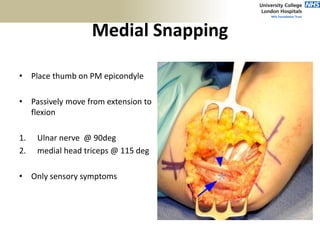
Medial Snapping
• Place thumb on PM epicondyle
• Passively move from extension to
flexion
1. Ulnar nerve @ 90deg
2. medial head triceps @ 115 deg
• Only sensory symptoms
Questions??
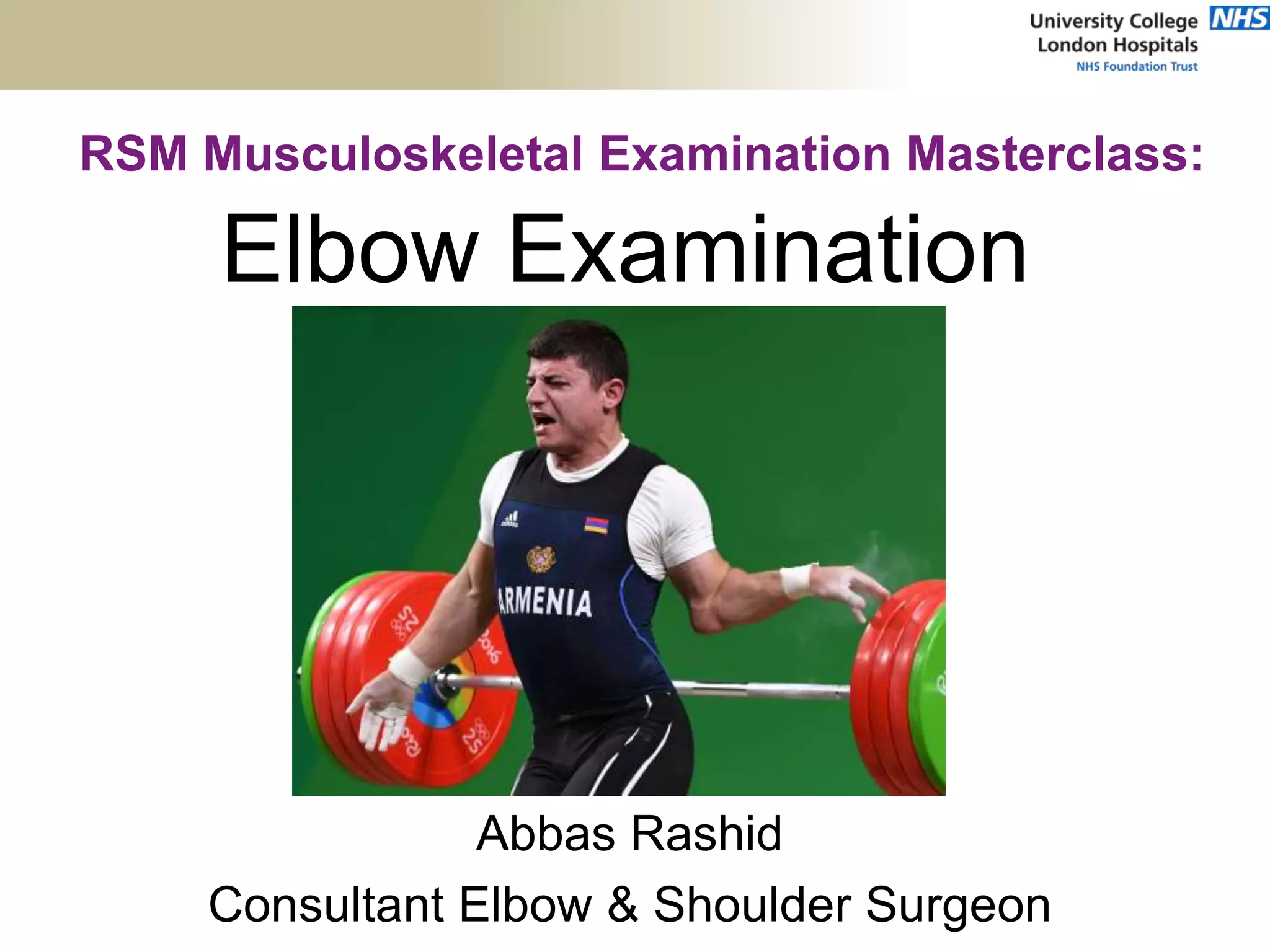
…not about this guy!
www.londonarmdoc.com
info@londonarmdoc.com

Elbow examination

  • 1.
    Elbow Examination RSM MusculoskeletalExamination Masterclass: Abbas Rashid Consultant Elbow & Shoulder Surgeon
  • 2.
  • 3.
  • 17.
  • 28.
    aMCL • constant valgusload • Resisted by aMCL • isometric through ROM • Valgus load 1. MCL 2. anterior capsule 3. RCj • tensile strength 261+71N
  • 30.
    LUCL • Resists varusload - flexion: Trochlea (75%) - Extension LuCL (46%) • PLRI • tensile strength 233_116N
  • 34.
  • 37.
  • 40.
    Flexion/Extension • Dominant=non-dominant - Age,sex, muscularity • Anterior offset of distal humerus • Uniaxial hinge • Carrying angle 11-14deg • Axis: abducted by 50% of CA Pronation/Supination • 80deg pronation • 90degree supination
  • 41.
    Pronation/Supination • Axis: radialhead to ulnar head • RH: Proximal migration of radius with pronation • OA: grip & grind • Missed Essex-Lopresti Injury
  • 59.
    History Personal Vignette • Age •Hand Dominance • Occupation • Sports/Recreation/Hobbies • PMH: obstetric, Trauma, RA Symptoms 1. Pain 2. Stiffness 3. Clicking/Clunking/Grinding 4. Infection 5. Neurological
  • 60.
    History Personal Vignette • Age •Hand Dominance • Occupation • Sports/Recreation/Hobbies • PMH: obstetric, Trauma, RA Symptoms 1. Pain 2. Stiffness 3. Clicking/Clunking/Grinding 4. Infection 5. Neurological ANY FUNCTIONAL LIMITATION?
  • 61.
    Pain • Which compartment? Lateral -tennis elbow - radial tunnel syndrome - RC OA - PLRI Medial - ulnar neuritis - subluxing nerve/snapping triceps - golfers elbow - UH OA Posterior - triceps tendinopathy/tear/bursitis - VEO - oelcranon fossa osteophytes - olecranon bursitis Anterior - biceps tendinopathy/tear/bursitis - coronoid osteophyte - pronator syndrome
  • 62.
    Pain • Which compartment? •During vs. Terminal motion? • Worse in am or pm? • Inciting activity? • During motion = OA • Terminal motion = impingement • Anterior - cornoid (eg.boxers) • Posterior - olecranon (eg. Pitchers)
  • 63.
    Pain • Which compartment? •During vs. Terminal motion? • Worse in am or pm? • Inciting activity? • AM - gets better as day goes on = inflammatory • PM - worse at end of day = mechanical/OA
  • 64.
    Instability • Previous trauma? •Macro vs. micro? • Frequency? - Pitchers/overhead athletes = attenuation of aMCL • Inciting injury? Position of forearm at impact • Sup, axial load, valgus stress LUCL + RH +/- coronoid = Terible Triad/PLRI • Pro, axial load, varus stress LUCL + AMF coronoid +/- pMCL = Valgus PMRI
  • 65.
    Instability • Previous trauma? •Macro vs. micro? • Frequency? - Pitchers/overhead athletes = attenuation of aMCL • Inciting injury? • Previous dislocation - CEO + LUCL + aMCL + CFPO 3/4 in-tact = conservative tx • Repetitive - attritional - RA - attrition aMCL + posterior impingement = VEO (eg. Pitching athletes)
  • 66.
    Infection • Previous skinbreach • Underlying medical conditions - Diabetes - RA
  • 67.
    Stiffness • Previous injuryor surgery • Flex-Ext vs. Pro-Sup • Impact • +/- Secondary shoulder pain
  • 68.
    Neurological • Parasthesia orDysasthesia • Distribution
  • 69.
  • 70.
    Inspection • Muscle bulk• Swelling vs. Nodules
  • 71.
    Palpation Lateral • Radial Tunnel •Mobile Wad • Radial Head • Lateral Epicondyle/ECRB • Posterior Capitellum • LUCL • soft spot
  • 72.
    Palpation Posterior • Olecranon - colinearwith ME/LE extension • Fossa - PM osteophyte • Triceps insertion • PM/PL UH joint
  • 73.
    Palpation Medial • ME • CFO[under tension] • MCL • ulnar nerve
  • 74.
    Palpation Anterior • Coronoid tip •Radial Tunnel • Distal Biceps • Brachial artery
  • 75.
    Motion • Goniometer - humeraland ulna shaft ref - SD for error = 3.7 deg • 0-140 flexion - >flexion if <19y/o - Hyperextention • Functional arc = 30-130
  • 76.
    Motion • goniometer atdorsal DRUJ • 75 supination - Terminal 15 through carpus • 90 pronoation • Functional arc 50-50 • Avoid cheating from shoulder • Endpoints soft or hard
  • 77.
    Neurological • Cervical rootsC5-T1 • Brachial plexus • Peripheral nerves • Extension=70% flexion • Pronation=85% of supination • Non-dominant =90%dominant
  • 78.
    PIN/Radial Nerve 1. Fibrousbands @ RCJ 2. Leash of Henry 3. Medial edge ECRB 4. Arcade of Frohse 5. Distal edge Supinator Radial Tunnel Syndrome • Pain syndrome • Tender over Supinator Arch - 3cm distal 2 cm medial to LE • Resisted Supination • Passive pronation + wrist flexion PIN Palsy • Motor syndrome • Cannot extend MCPJs • Can extend IPJs (NOT thumb) • Can only extend wrist in radial dev. • Wrist tenodesis effect - cf extensor rupture
  • 79.
    Ulnar Nerve Cubital TunnelSyndrome • 1st dorsal interoseeous wasting • Ring + ring finger clawing • Subluxing nerve over ME • Reduced sensation medial digits • Resisted index finger abduction • Elbow Flexion (75%) • Elbow flexion + Pressure (93%) • Tinels Sign over Cubital Tunnel (71%) • Froments + Wartenbergs Signs
  • 80.
    Medial Nerve 1. Supracondylarprocess 2. Ligament of Struthers 3. Lacertus Fibrosus 4. Heads of PT 5. FDS aponeurotic arch Pronator Syndrome • Reduced sensation with repetetive rotation of forearm • Includes palmar cutaneous branch • Fatigue of forearm muscles • Tinels positive in proximal forearm NOT at wrist • Resisted flexion of long and ring fingers may cause forearm pain • Resisted elbow flexion + forearm • Nb-coexisting golfers elbwo
  • 81.
    Tennis Elbow • Lateralelbow pain - Picking up coffee cup - pulling covers while in bed • 50% tennis players • ECRB degeneration • Tender over ECRB origin • chair lift test: 3 finger pinch
  • 82.
    • Maudsleys Test:Resisted wrist + middle finger extension with elbow extended • Cozens Test: resisted wrist extension in radial deviation • Mills Test: passively extend elbow with wrist flexed and forearm pronated
  • 83.
    Golfers elbow • Painof anteromedial aspect of elbow • Unlar neuritis in 50% cases • Tender CFPO • Resisted wrist felxion and forearm supinated and elbow extended • Passive wrist extension with elbow extended and forearm supinated
  • 84.
    LUCL • Varus stresstest • Chair sign • Table top relocation • Lateral pivot shift test - in OR
  • 85.
    Radiocapitellar OA • Lateralelbow pain • Crepitus • Rotation>flexion • Tender over RCj • Grip & Grind Test - proximal migration of radius
  • 86.
    MCL • Valgus stresstest • Moving valgus stress test • Milking manouvre Valgus Extention Overload Syndrome • Tender PM olexcranon • Pain on forced extention • Valgus extention overload test
  • 87.
    Distal Biceps Tendon •Anteromedial ecchymosis • High riding • No rise and fall with rotation • Weak/pain resisted elbow flexion and forearm supination • Tender biciptal tuberosity • O’Driscoll Hook Test
  • 88.
    Distal Triceps • Painon resisted elbow extension • Posterior ecchymoses • Defect proximal to olecranon tip • No extension against gravity • Viegas: Elbow extension when triceps squeezed [modification of Thompson Test].
  • 89.
    Plicae • Anterolateral - palpateRCJ - pronate forearm - Passively bring from 90 to flexion - valgus load • Posterolateral - palpate RCJ - supinate forearm - passively move from 15 to extension - valgus load
  • 90.
    Medial Snapping • Placethumb on PM epicondyle • Passively move from extension to flexion 1. Ulnar nerve @ 90deg 2. medial head triceps @ 115 deg • Only sensory symptoms
  • 91.
  • 92.
  • 93.