TECO Policies and Procedures
• 400-07 – Confined Space Policy
• 400-07P – Confined Space Procedure
• 400-07P1 – Permit-Required Confined Space
Listing
• 400-07P2 – Confined Space Entry Permit
• 400-07P3 – Confined Space Entry Checklist
Confined Space
Attendant and Authorized Entrant
Learning Objectives
 Define a confined space.
 State the 2 classifications of confined spaces.
 Identify the conditions required for a space to be
considered a permit-required confined space.
 Discuss the roles and responsibilities of a
confined space attendant.
 Discuss the roles and responsibilities for a
confined space authorized entrant.
Learning Objectives
 Describe the process to enter a permit-required
confined space.
 Identify the conditions required for a space to be
considered a non-permit confined space.
 Understand the requirements to reclassify a
permit-required confined space.
Working in a confined space is dangerous!
There are several hazards associated with
confined spaces, some that we take for granted
when working in a more typical environment. In
addition to usual workplace hazards we
encounter daily; confined spaces create
additional hazards unique to their environment.
These must be addressed and eliminated or
mitigated prior to starting any work inside a
confined space.
Confined Spaces
Confined Spaces are enclosed spaces that meet
the following conditions:
 Not designed for normal human occupancy
 Limited entry / exit locations (vessels, tanks, vaults,
cooling towers, etc.)
 Large enough to allow bodily entry to perform
assigned work
Confined Spaces
Confined Spaces are classified into two categories:
 Permit-required confined space
 Non-permit confined space
Permit-Required Confined
Spaces
Permit-Required
Confined Spaces
A permit-required confined space contains one or
more of the following characteristics:
 Contains or has the potential to contain a hazardous
atmosphere
 Contains material that has the potential for engulfing
entrant(s)
 Has an internal configuration where the entrant(s)
may become trapped or asphyxiated
 Contains any recognized serious safety or health
hazard.
Permit-Required
Confined Spaces
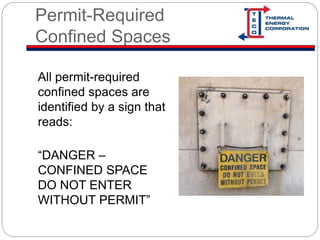
All permit-required
confined spaces are
identified by a sign that
reads:
“DANGER –
CONFINED SPACE
DO NOT ENTER
WITHOUT PERMIT”
Permit-Required
Confined Spaces
A list of Permit-Required Confined Spaces for
TECO both on and off site can be found at TECO
400-07P1.
NOTE: This is NOT an all-inclusive list.
 The list does not include temporary ditches,
trenches, or other potential spaces that can be
encountered.
 Conditions can change and some spaces that are
not on this list may become Permit-Required
Confined Spaces.
Permit-Required
Confined Spaces
 Some examples of Permit-Required Confined
Spaces on the list are boilers, water tanks, chemical
tanks, valve pits, weir pits, cooling towers, chiller
condensers and evaporators, lift stations, etc.
 All employees are required to notify their supervisor
immediately if they encounter a confined space
which is not included on the list in TECO 400-07P1.
Confined Space Attendant
 Attendant – An individual stationed OUTSIDE
one or more permit-required confined space
who monitors entrant(s) within those spaces.
 An attendant shall perform all the duties as
assigned in TECO Procedure 400-07P.
 The attendant shall not perform any other
duties that might interfere with the primary
duty of protecting the authorized entrants.
Attendant Duties
 Fully understands known hazards that may be
faced during entry.
 Maintains positive control over the confined
space(s) under his cognizance.
• Barricades the worksite and allows authorized
personnel ONLY to enter the work area.
• Maintains a log of all personnel entering and
exiting the confined space.
• Remains at designated workplace during entry
operations until relieved by another attendant.
Attendant Duties
 Responsible for ensuring the area inside and
outside the space is always safe. If unauthorized
personnel approach the area:
• Warn all unauthorized persons to remain outside
the area.
• Advise unauthorized persons they must exit
immediately.
• Inform all entrants and entry supervisor if an
authorized person entered the permitted space.
Attendant Duties
 Communicates with entrant(s) as necessary to
monitor entrant(s) status.
 Continuously monitors activities inside and
outside the space and sound an evacuation if:
• A prohibited condition is identified.
• A situation that could endanger the entrant(s) exists.
• Behavioral effects of hazard exposure to any entrant
are noticed.
• All required duties cannot be safely and effectively be
performed.
• Directed by the entry supervisor.
Attendant Duties
 Maintain appropriate communication device(s)
on hand in the event emergency and rescue
personnel are needed.
• In case of an emergency call the Operations
Control Room at 713-791-6740 or via radio.
• Operations will dispatch required personnel.
Attendant Duties
 The attendant may perform NON-ENTRY rescue
actions, as necessary.
 Under no circumstances should the attendant
enter the permitted space to provide rescue
actions, even if the attendant is also the entry
supervisor and/or trained to do so.
 Immediately call for assistance and remain on
station until another qualified attendant arrives or
the space no longer meets permitting
requirements.
Confined Space Entrant
 Entrant - An employee who is authorized by the
entry supervisor and is qualified to perform an
entry into a confined space.
 Entry - Occurs when ANY part of a person’s
body breaks the plane of a confined space
opening.
Confined Space Entrant
The entrant is expected to be knowledgeable of the
work to be done, the hazards associated with the
work and the confined space, required protective
gear to wear, any evacuation alarms, and normal
and emergency egress routes.
An authorized confined space entrant shall perform
all the duties as assigned in TECO Procedure 400-
07P.
Entrant Duties
 Fully understand known hazards that may be
faced during entry.
 Properly utilizes all required protective gear
 Recognizes unsafe conditions which warrant
space evacuation
 Communicate with the confined space attendant
as necessary to maintain the space as safe as
possible.
 Exit the space when required.
Entrant Duties
A confined space is required to be exited when:
 An evacuation order is given by an attendant or
entry supervisor
 An entrant recognizes any warning signs of
exposure to a dangerous situation
 An entrant detects a prohibited condition
 An evacuation alarm is activated
Exit the space safely and as quickly as possible.
Permit-Required
Confined Spaces
The process to establish and enter a permit
required space is outlined in TECO 400-07P. This
procedure should be referenced for all work within
a permit-required confine space.
 Obtain a confined space entry permit.
 The permit is to be filled out and signed by the
confined space entry supervisor. It is not necessary
that this person is a supervisor by title but must be
qualified as an entry supervisor.
 A second signature is required for a valid permit.
Permit-Required
Confined Spaces
 Once a valid entry permit is obtained and any
associated hazards are addressed, the entrance
cover may be removed.
 The entrance must be immediately barricaded to
prevent access.
 The supervisor shall determine what type of barrier
is used to limit unauthorized entry into the confined
space.
Permit-Required
Confined Spaces
 Appropriate atmospheric testing shall be conducted
at each entry point. Prior to entry, the following
testing must be conducted in this order:
• Oxygen content,
• Flammable gases and vapors, and
• Potential toxic air contaminants
 All meter readings shall be recorded on the permit
with the date and time they were taken.
Permit-Required
Confined Spaces
 If forced air ventilation is necessary to maintain
air quality:
• No one shall enter until the hazardous
atmosphere is eliminated.
• A fresh air supply fan must be used. Air supply
shall be from a clean source and installed at the
lowest manway possible.
• Any exceptions for forced air ventilation shall be
approved by the Vice President.
Permit-Required
Confined Spaces
 Atmospheric testing must be conducted and
recorded upon initial entry and at least every 4
hours.
 If the confined space is absent of entrants for 20
minutes or longer, a new test shall be performed
prior to reentry.
 If a hazardous atmospheric condition is detected,
• Evacuate all entrants immediately
• Determine the cause of the atmospheric hazard
• Address the hazard prior to reentry.
Permit-Required
Confined Spaces
 If the entry supervisor deems a retrieval system
is necessary, all entrants shall be properly fitted
prior to being able to enter.
 Appropriate rescue equipment shall be stored
within a reasonable distance (no greater than
100 feet) with minimal obstacles in the area.
Permit-Required
Confined Spaces
 A permit-required confined space may be
reclassified as a non-permit required space if actual
or potential atmospheric hazards no longer exist.
 Elimination of atmospheric hazards require multiple
layers of protection.
 Any entry made to eliminate a hazard must be done
under the permit-required process.
 The entry supervisor shall document the basis for
reclassification on the original permit.
 A confined space attendant is still required for
any reclassified space that has an entrant.
Non-Permit Confined Spaces
Non-Permit
Confined Spaces
A non-permit confined space is defined as a
confined space that does not contain – nor have
the potential to contain – any hazard capable of
causing death or serious physical injury.
 Does not require a permit
 Does not require additional steps in the confined
space procedure to be followed
 May be reclassified as permit-required if conditions
change to warrant a reclassification.
Non-Permit
Confined Spaces
If hazards arise within a non-permit confined
space, then:
 Everyone must exit the confined space immediately
 The Supervisor shall re-evaluate the classification of
the confined space
 If it is reclassified to a permit-required confined
space, then a permit must be issued, and all
additional permit-required confined space conditions
must be met prior to continuing any work
Review
 Define a confined space.
 State the 2 classifications of confined spaces.
 Identify the conditions required for a space to be
considered a permit-required confined space.
 Discuss the roles and responsibilities of a
confined space attendant.
 Discuss the roles and responsibilities for a
confined space authorized entrant.
Review
 Describe the process to enter a permit-required
confined space.
 Identify the conditions required for a space to be
considered a non-permit confined space.
 Understand the requirements to reclassify a
permit-required confined space.
References
TECO Policies and Procedures
• 400-07 – Confined Space Policy
• 400-07P – Confined Space Procedure
• 400-07P1 – Permit-Required Confined Space Listing
• 400-07P2 – Confined Space Entry Permit
• 400-07P3 – Confined Space Entry Checklist
All references can be found on SharePoint on the
TECO Home Page under “Policies & Procedures”

Confined Space Attendant and Entrant

  • 1.
    TECO Policies andProcedures • 400-07 – Confined Space Policy • 400-07P – Confined Space Procedure • 400-07P1 – Permit-Required Confined Space Listing • 400-07P2 – Confined Space Entry Permit • 400-07P3 – Confined Space Entry Checklist Confined Space Attendant and Authorized Entrant
  • 2.
    Learning Objectives  Definea confined space.  State the 2 classifications of confined spaces.  Identify the conditions required for a space to be considered a permit-required confined space.  Discuss the roles and responsibilities of a confined space attendant.  Discuss the roles and responsibilities for a confined space authorized entrant.
  • 3.
    Learning Objectives  Describethe process to enter a permit-required confined space.  Identify the conditions required for a space to be considered a non-permit confined space.  Understand the requirements to reclassify a permit-required confined space.
  • 4.
    Working in aconfined space is dangerous! There are several hazards associated with confined spaces, some that we take for granted when working in a more typical environment. In addition to usual workplace hazards we encounter daily; confined spaces create additional hazards unique to their environment. These must be addressed and eliminated or mitigated prior to starting any work inside a confined space.
  • 5.
    Confined Spaces Confined Spacesare enclosed spaces that meet the following conditions:  Not designed for normal human occupancy  Limited entry / exit locations (vessels, tanks, vaults, cooling towers, etc.)  Large enough to allow bodily entry to perform assigned work
  • 6.
    Confined Spaces Confined Spacesare classified into two categories:  Permit-required confined space  Non-permit confined space
  • 7.
  • 8.
    Permit-Required Confined Spaces A permit-requiredconfined space contains one or more of the following characteristics:  Contains or has the potential to contain a hazardous atmosphere  Contains material that has the potential for engulfing entrant(s)  Has an internal configuration where the entrant(s) may become trapped or asphyxiated  Contains any recognized serious safety or health hazard.
  • 9.
    Permit-Required Confined Spaces All permit-required confinedspaces are identified by a sign that reads: “DANGER – CONFINED SPACE DO NOT ENTER WITHOUT PERMIT”
  • 10.
    Permit-Required Confined Spaces A listof Permit-Required Confined Spaces for TECO both on and off site can be found at TECO 400-07P1. NOTE: This is NOT an all-inclusive list.  The list does not include temporary ditches, trenches, or other potential spaces that can be encountered.  Conditions can change and some spaces that are not on this list may become Permit-Required Confined Spaces.
  • 11.
    Permit-Required Confined Spaces  Someexamples of Permit-Required Confined Spaces on the list are boilers, water tanks, chemical tanks, valve pits, weir pits, cooling towers, chiller condensers and evaporators, lift stations, etc.  All employees are required to notify their supervisor immediately if they encounter a confined space which is not included on the list in TECO 400-07P1.
  • 12.
    Confined Space Attendant Attendant – An individual stationed OUTSIDE one or more permit-required confined space who monitors entrant(s) within those spaces.  An attendant shall perform all the duties as assigned in TECO Procedure 400-07P.  The attendant shall not perform any other duties that might interfere with the primary duty of protecting the authorized entrants.
  • 13.
    Attendant Duties  Fullyunderstands known hazards that may be faced during entry.  Maintains positive control over the confined space(s) under his cognizance. • Barricades the worksite and allows authorized personnel ONLY to enter the work area. • Maintains a log of all personnel entering and exiting the confined space. • Remains at designated workplace during entry operations until relieved by another attendant.
  • 14.
    Attendant Duties  Responsiblefor ensuring the area inside and outside the space is always safe. If unauthorized personnel approach the area: • Warn all unauthorized persons to remain outside the area. • Advise unauthorized persons they must exit immediately. • Inform all entrants and entry supervisor if an authorized person entered the permitted space.
  • 15.
    Attendant Duties  Communicateswith entrant(s) as necessary to monitor entrant(s) status.  Continuously monitors activities inside and outside the space and sound an evacuation if: • A prohibited condition is identified. • A situation that could endanger the entrant(s) exists. • Behavioral effects of hazard exposure to any entrant are noticed. • All required duties cannot be safely and effectively be performed. • Directed by the entry supervisor.
  • 16.
    Attendant Duties  Maintainappropriate communication device(s) on hand in the event emergency and rescue personnel are needed. • In case of an emergency call the Operations Control Room at 713-791-6740 or via radio. • Operations will dispatch required personnel.
  • 17.
    Attendant Duties  Theattendant may perform NON-ENTRY rescue actions, as necessary.  Under no circumstances should the attendant enter the permitted space to provide rescue actions, even if the attendant is also the entry supervisor and/or trained to do so.  Immediately call for assistance and remain on station until another qualified attendant arrives or the space no longer meets permitting requirements.
  • 18.
    Confined Space Entrant Entrant - An employee who is authorized by the entry supervisor and is qualified to perform an entry into a confined space.  Entry - Occurs when ANY part of a person’s body breaks the plane of a confined space opening.
  • 19.
    Confined Space Entrant Theentrant is expected to be knowledgeable of the work to be done, the hazards associated with the work and the confined space, required protective gear to wear, any evacuation alarms, and normal and emergency egress routes. An authorized confined space entrant shall perform all the duties as assigned in TECO Procedure 400- 07P.
  • 20.
    Entrant Duties  Fullyunderstand known hazards that may be faced during entry.  Properly utilizes all required protective gear  Recognizes unsafe conditions which warrant space evacuation  Communicate with the confined space attendant as necessary to maintain the space as safe as possible.  Exit the space when required.
  • 21.
    Entrant Duties A confinedspace is required to be exited when:  An evacuation order is given by an attendant or entry supervisor  An entrant recognizes any warning signs of exposure to a dangerous situation  An entrant detects a prohibited condition  An evacuation alarm is activated Exit the space safely and as quickly as possible.
  • 22.
    Permit-Required Confined Spaces The processto establish and enter a permit required space is outlined in TECO 400-07P. This procedure should be referenced for all work within a permit-required confine space.  Obtain a confined space entry permit.  The permit is to be filled out and signed by the confined space entry supervisor. It is not necessary that this person is a supervisor by title but must be qualified as an entry supervisor.  A second signature is required for a valid permit.
  • 23.
    Permit-Required Confined Spaces  Oncea valid entry permit is obtained and any associated hazards are addressed, the entrance cover may be removed.  The entrance must be immediately barricaded to prevent access.  The supervisor shall determine what type of barrier is used to limit unauthorized entry into the confined space.
  • 24.
    Permit-Required Confined Spaces  Appropriateatmospheric testing shall be conducted at each entry point. Prior to entry, the following testing must be conducted in this order: • Oxygen content, • Flammable gases and vapors, and • Potential toxic air contaminants  All meter readings shall be recorded on the permit with the date and time they were taken.
  • 25.
    Permit-Required Confined Spaces  Ifforced air ventilation is necessary to maintain air quality: • No one shall enter until the hazardous atmosphere is eliminated. • A fresh air supply fan must be used. Air supply shall be from a clean source and installed at the lowest manway possible. • Any exceptions for forced air ventilation shall be approved by the Vice President.
  • 26.
    Permit-Required Confined Spaces  Atmospherictesting must be conducted and recorded upon initial entry and at least every 4 hours.  If the confined space is absent of entrants for 20 minutes or longer, a new test shall be performed prior to reentry.  If a hazardous atmospheric condition is detected, • Evacuate all entrants immediately • Determine the cause of the atmospheric hazard • Address the hazard prior to reentry.
  • 27.
    Permit-Required Confined Spaces  Ifthe entry supervisor deems a retrieval system is necessary, all entrants shall be properly fitted prior to being able to enter.  Appropriate rescue equipment shall be stored within a reasonable distance (no greater than 100 feet) with minimal obstacles in the area.
  • 28.
    Permit-Required Confined Spaces  Apermit-required confined space may be reclassified as a non-permit required space if actual or potential atmospheric hazards no longer exist.  Elimination of atmospheric hazards require multiple layers of protection.  Any entry made to eliminate a hazard must be done under the permit-required process.  The entry supervisor shall document the basis for reclassification on the original permit.  A confined space attendant is still required for any reclassified space that has an entrant.
  • 29.
  • 30.
    Non-Permit Confined Spaces A non-permitconfined space is defined as a confined space that does not contain – nor have the potential to contain – any hazard capable of causing death or serious physical injury.  Does not require a permit  Does not require additional steps in the confined space procedure to be followed  May be reclassified as permit-required if conditions change to warrant a reclassification.
  • 31.
    Non-Permit Confined Spaces If hazardsarise within a non-permit confined space, then:  Everyone must exit the confined space immediately  The Supervisor shall re-evaluate the classification of the confined space  If it is reclassified to a permit-required confined space, then a permit must be issued, and all additional permit-required confined space conditions must be met prior to continuing any work
  • 32.
    Review  Define aconfined space.  State the 2 classifications of confined spaces.  Identify the conditions required for a space to be considered a permit-required confined space.  Discuss the roles and responsibilities of a confined space attendant.  Discuss the roles and responsibilities for a confined space authorized entrant.
  • 33.
    Review  Describe theprocess to enter a permit-required confined space.  Identify the conditions required for a space to be considered a non-permit confined space.  Understand the requirements to reclassify a permit-required confined space.
  • 34.
    References TECO Policies andProcedures • 400-07 – Confined Space Policy • 400-07P – Confined Space Procedure • 400-07P1 – Permit-Required Confined Space Listing • 400-07P2 – Confined Space Entry Permit • 400-07P3 – Confined Space Entry Checklist All references can be found on SharePoint on the TECO Home Page under “Policies & Procedures”

Editor's Notes

  • #2 This course will review the TECO policy, procedures and associated documentation. This policy underwent a major revision last year; three attachments have been added and roles and responsibilities are better defined. This training is to help your awareness to these changes, and it is expected that you are familiar with this information – especially if you going to be involved in any confined space work. These procedures are intended to comply with 29 CFR 1910.146, Confined Space Entry Regulations.
  • #3 Completing this training will allow you to perform duties associated with being a confined space attendant and/or authorized entrant. Those who will be filling out and approving permits will need additional training for confined space entry supervisors.
  • #4 Completing this training will allow you to perform duties associated with being a confined space attendant and/or authorized entrant. Those who will be filling out and approving permits will need additional training for confined space entry supervisors.
  • #5 The additional hazards that need to be discussed are numerous and each job will have its own risks. Some common hazards associated with confined spaces: Air quality Toxic vapors Sufficient lighting Limited egress Constricted working conditions Work taking place that may change environmental conditions (such as hot work)
  • #11 Please note that this list is NOT all-inclusive.
  • #12 Please note that this list is NOT all-inclusive.
  • #16 TECO Procedure 400-07P3 includes a list of personnel required to contact in an emergency.
  • #17 TECO Procedure 400-07P3 includes a list of personnel required to contact in an emergency.
  • #18 Attendant casualties remain amongst the top of all casualties for confined spaces. It’s human nature to save your co-workers, especially if they are family or friends. Most often, the attendant becomes a second casualty for the same reason as the first. Additionally, if help was not called, there may not be anyone else to ensure emergency notifications are made.
  • #23 Entry supervisor training is held in addition to this training. They must have a thorough understanding of all aspects of the job and working in a confined space. This includes, but is not limited to, the lockout/tagout process, atmospheric testing, hot work requirements, specialized PPE needed, and hazard recognition.
  • #24 All meter readings with date and time must be recorded on the permit.
  • #25 All meter readings with date and time must be recorded on the permit.
  • #31 The confined space entry supervisor will evaluate the current conditions surrounding the confined space and reclassify if necessary. If this occurs, ALL PERSONNEL INSIDE THE SPACE MUST IMMEDIATELY EXIT. Work may continue after a permit is written and any additional permit-required confined space conditions are met.
  • #33 Completing this training will allow you to perform duties associated with being a confined space attendant and/or authorized entrant. Those who will be filling out and approving permits will need additional training for confined space entry supervisors.
  • #34 Completing this training will allow you to perform duties associated with being a confined space attendant and/or authorized entrant. Those who will be filling out and approving permits will need additional training for confined space entry supervisors.