1
How does the biomechanical exposure of the upper body in manual
box handling differ from exposure in other tasks in the real
industrial context?
2
Abstract
333
44
Twelve workers had biomechanical
exposure assessed through trapezius
muscle activity and posture recordings
(upper back and upper arms) during 4 h
of a regular working day. Handling
tasks demonstrated the highest
biomechanical demand to the upper
body, particularly for peak loads of the
upper trapezius activation and upper
back forward flexion postures.
However, handling tasks were also
associated with a high exposure
variation. Interventions aiming to
decrease loads in handling tasks can be
relevant to decreasing peak loads and
avoiding musculoskeletal disorders on
the upper limbs.
555
6
Relevance to industry
Manual box handling is an occupational task commonly
associated with musculoskeletal injury risk. Knowing the
representativeness of manual box handling tasks in real
work contexts can help practitioners to better understand
the actual need for task-centered interventions.
77
Introduction
Some researchers have focused on the investigation of the effect of box weight or
handling height in biomechanical exposure of workers (Habes et al., 1985; Vrije et al.,
2016; Oliveira et al., 2011). Others have investigated preventive strategies, such as the use
of handles on boxes to decrease musculoskeletal load (Drury, 1980; Garg and Saxena,
1980; Jung and Jung, 2010; Silva et al., 2013). In any approach, experience seems to play
an important role (Plamondon et al., 2013; Gagnon, 2005). A previous study of our
group identified that experienced workers did not have the same biomechanical
advantages as inexperienced subjects when handling boxes designed to decrease
biomechanical demand (Nogueira et al., 2016). Both experienced and inexperienced
subjects had a lower biomechanical load when handling the non-commercial boxes
compared to the commercial ones. However, experienced workers did not have the same
advantage as inexperienced subjects when handling those new boxes. This shows the
complexity of controlling the musculoskeletal workload of handlers. On the other hand,
studies addressing biomechanical loads during manual box handling have been developed
using laboratory setups (Gagnon et al., 2016; Plamondon et al., 2010, 2013).
88
Methods
Subjects
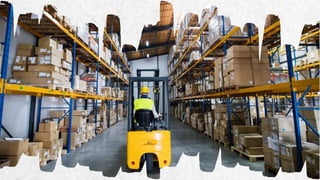
All the subjects were working in a supply and
assembly company, and agreed to participate.
They had no history of musculoskeletal
disorders in the past six months and were all
right-handed. The sample was composed by
thirteen male workers (28.14 ± 6.73 years,
81.26 ± 13.92 kg, 1.64 ± 0.49 m), who signed
the informed consent form. Only one
volunteer was excluded due to failure to
capture biomechanical exposure recordings.
The study was approved by the Ethics
Committee of the Federal University of São
Carlos (Process #28891014.2.0000.5504).
8
99
Protocol
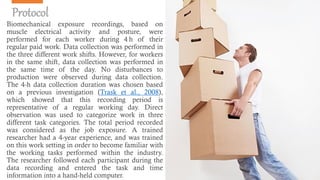
Biomechanical exposure recordings, based on
muscle electrical activity and posture, were
performed for each worker during 4 h of their
regular paid work. Data collection was performed in
the three different work shifts. However, for workers
in the same shift, data collection was performed in
the same time of the day. No disturbances to
production were observed during data collection.
The 4-h data collection duration was chosen based
on a previous investigation (Trask et al., 2008),
which showed that this recording period is
representative of a regular working day. Direct
observation was used to categorize work in three
different task categories. The total period recorded
was considered as the job exposure. A trained
researcher had a 4-year experience, and was trained
on this work setting in order to become familiar with
the working tasks performed within the industry.
The researcher followed each participant during the
data recording and entered the task and time
information into a hand-held computer.
10
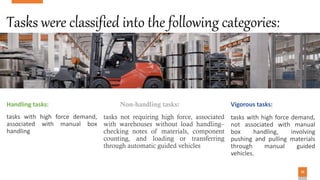
Handling tasks: Non-handling tasks: Vigorous tasks:
tasks with high force demand,
associated with manual box
handling
tasks not requiring high force, associated
with warehouses without load handling–
checking notes of materials, component
counting, and loading or transferring
through automatic guided vehicles
tasks with high force demand,
not associated with manual
box handling, involving
pushing and pulling materials
through manual guided
vehicles.
Tasks were classified into the following categories:
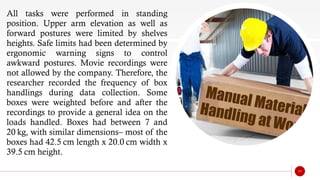
All tasks were performed in standing
position. Upper arm elevation as well as
forward postures were limited by shelves
heights. Safe limits had been determined by
ergonomic warning signs to control
awkward postures. Movie recordings were
not allowed by the company. Therefore, the
researcher recorded the frequency of box
handlings during data collection. Some
boxes were weighted before and after the
recordings to provide a general idea on the
loads handled. Boxes had between 7 and
20 kg, with similar dimensions– most of the
boxes had 42.5 cm length x 20.0 cm width x
39.5 cm height.
11
1212
“
12
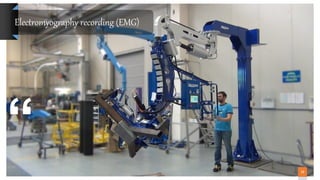
Electromyography recording (EMG)
ALPINE SKI HOUSE
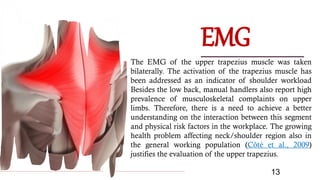
The EMG of the upper trapezius muscle was taken
bilaterally. The activation of the trapezius muscle has
been addressed as an indicator of shoulder workload
Besides the low back, manual handlers also report high
prevalence of musculoskeletal complaints on upper
limbs. Therefore, there is a need to achieve a better
understanding on the interaction between this segment
and physical risk factors in the workplace. The growing
health problem affecting neck/shoulder region also in
the general working population (Côté et al., 2009)
justifies the evaluation of the upper trapezius.
13
EMG
CMRR>92 dB; input impedance>1015Ω
in parallel, with 0.2 pF; a preamplifier
gain of 10 V/V; and noise at 1.2 μV
(RMS). The sensor was placed 2 cm
lateral from the middle point between
the seventh cervical vertebrae (C7) and
the acromion.
An adhesive reference electrode (5 × 5
cm) was placed on the manubrium
sternal. The signals were conditioned
by the main amplifier (Myomonitor IV,
Delsys, Boston, USA), with gain of
1000 V/V, a frequency band of 20–
450 Hz, 16 bits of resolution, and
1.2 μV (RMS) of noise.
14
The characteristics of
the electrodes
16
Posture recording-inclinometer (INC)
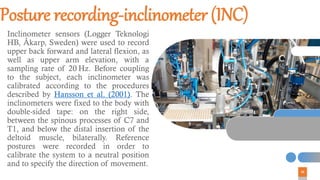
Inclinometer sensors (Logger Teknologi
HB, Åkarp, Sweden) were used to record
upper back forward and lateral flexion, as
well as upper arm elevation, with a
sampling rate of 20 Hz. Before coupling
to the subject, each inclinometer was
calibrated according to the procedures
described by Hansson et al. (2001). The
inclinometers were fixed to the body with
double-sided tape: on the right side,
between the spinous processes of C7 and
T1, and below the distal insertion of the
deltoid muscle, bilaterally. Reference
postures were recorded in order to
calibrate the system to a neutral position
and to specify the direction of movement.
17
THANKYOU
18
Customize this Template
Template Editing
Instructions and Feedback

Manual handling

  • 1.
    1 How does thebiomechanical exposure of the upper body in manual box handling differ from exposure in other tasks in the real industrial context?
  • 2.
  • 3.
  • 4.
    44 Twelve workers hadbiomechanical exposure assessed through trapezius muscle activity and posture recordings (upper back and upper arms) during 4 h of a regular working day. Handling tasks demonstrated the highest biomechanical demand to the upper body, particularly for peak loads of the upper trapezius activation and upper back forward flexion postures. However, handling tasks were also associated with a high exposure variation. Interventions aiming to decrease loads in handling tasks can be relevant to decreasing peak loads and avoiding musculoskeletal disorders on the upper limbs.
  • 5.
  • 6.
    6 Relevance to industry Manualbox handling is an occupational task commonly associated with musculoskeletal injury risk. Knowing the representativeness of manual box handling tasks in real work contexts can help practitioners to better understand the actual need for task-centered interventions.
  • 7.
    77 Introduction Some researchers havefocused on the investigation of the effect of box weight or handling height in biomechanical exposure of workers (Habes et al., 1985; Vrije et al., 2016; Oliveira et al., 2011). Others have investigated preventive strategies, such as the use of handles on boxes to decrease musculoskeletal load (Drury, 1980; Garg and Saxena, 1980; Jung and Jung, 2010; Silva et al., 2013). In any approach, experience seems to play an important role (Plamondon et al., 2013; Gagnon, 2005). A previous study of our group identified that experienced workers did not have the same biomechanical advantages as inexperienced subjects when handling boxes designed to decrease biomechanical demand (Nogueira et al., 2016). Both experienced and inexperienced subjects had a lower biomechanical load when handling the non-commercial boxes compared to the commercial ones. However, experienced workers did not have the same advantage as inexperienced subjects when handling those new boxes. This shows the complexity of controlling the musculoskeletal workload of handlers. On the other hand, studies addressing biomechanical loads during manual box handling have been developed using laboratory setups (Gagnon et al., 2016; Plamondon et al., 2010, 2013).
  • 8.
    88 Methods Subjects All the subjectswere working in a supply and assembly company, and agreed to participate. They had no history of musculoskeletal disorders in the past six months and were all right-handed. The sample was composed by thirteen male workers (28.14 ± 6.73 years, 81.26 ± 13.92 kg, 1.64 ± 0.49 m), who signed the informed consent form. Only one volunteer was excluded due to failure to capture biomechanical exposure recordings. The study was approved by the Ethics Committee of the Federal University of São Carlos (Process #28891014.2.0000.5504). 8
  • 9.
    99 Protocol Biomechanical exposure recordings,based on muscle electrical activity and posture, were performed for each worker during 4 h of their regular paid work. Data collection was performed in the three different work shifts. However, for workers in the same shift, data collection was performed in the same time of the day. No disturbances to production were observed during data collection. The 4-h data collection duration was chosen based on a previous investigation (Trask et al., 2008), which showed that this recording period is representative of a regular working day. Direct observation was used to categorize work in three different task categories. The total period recorded was considered as the job exposure. A trained researcher had a 4-year experience, and was trained on this work setting in order to become familiar with the working tasks performed within the industry. The researcher followed each participant during the data recording and entered the task and time information into a hand-held computer.
  • 10.
    10 Handling tasks: Non-handlingtasks: Vigorous tasks: tasks with high force demand, associated with manual box handling tasks not requiring high force, associated with warehouses without load handling– checking notes of materials, component counting, and loading or transferring through automatic guided vehicles tasks with high force demand, not associated with manual box handling, involving pushing and pulling materials through manual guided vehicles. Tasks were classified into the following categories:
  • 11.
    All tasks wereperformed in standing position. Upper arm elevation as well as forward postures were limited by shelves heights. Safe limits had been determined by ergonomic warning signs to control awkward postures. Movie recordings were not allowed by the company. Therefore, the researcher recorded the frequency of box handlings during data collection. Some boxes were weighted before and after the recordings to provide a general idea on the loads handled. Boxes had between 7 and 20 kg, with similar dimensions– most of the boxes had 42.5 cm length x 20.0 cm width x 39.5 cm height. 11
  • 12.
  • 13.
    ALPINE SKI HOUSE TheEMG of the upper trapezius muscle was taken bilaterally. The activation of the trapezius muscle has been addressed as an indicator of shoulder workload Besides the low back, manual handlers also report high prevalence of musculoskeletal complaints on upper limbs. Therefore, there is a need to achieve a better understanding on the interaction between this segment and physical risk factors in the workplace. The growing health problem affecting neck/shoulder region also in the general working population (Côté et al., 2009) justifies the evaluation of the upper trapezius. 13 EMG
  • 14.
    CMRR>92 dB; inputimpedance>1015Ω in parallel, with 0.2 pF; a preamplifier gain of 10 V/V; and noise at 1.2 μV (RMS). The sensor was placed 2 cm lateral from the middle point between the seventh cervical vertebrae (C7) and the acromion. An adhesive reference electrode (5 × 5 cm) was placed on the manubrium sternal. The signals were conditioned by the main amplifier (Myomonitor IV, Delsys, Boston, USA), with gain of 1000 V/V, a frequency band of 20– 450 Hz, 16 bits of resolution, and 1.2 μV (RMS) of noise. 14 The characteristics of the electrodes
  • 16.
    16 Posture recording-inclinometer (INC) Inclinometersensors (Logger Teknologi HB, Åkarp, Sweden) were used to record upper back forward and lateral flexion, as well as upper arm elevation, with a sampling rate of 20 Hz. Before coupling to the subject, each inclinometer was calibrated according to the procedures described by Hansson et al. (2001). The inclinometers were fixed to the body with double-sided tape: on the right side, between the spinous processes of C7 and T1, and below the distal insertion of the deltoid muscle, bilaterally. Reference postures were recorded in order to calibrate the system to a neutral position and to specify the direction of movement.
  • 17.
  • 18.
    18 Customize this Template TemplateEditing Instructions and Feedback