Welcome
Educational productivity:
Residual Factors &
Educational productivity,
Educational planning and
Manpower, Strategy for
Primary education Expansion
Introduction
To the economist, one of the most natural approaches is to
study the productivity of education, since prudent
investment is governed by the relative productivity of the
funds which is in turn determined by the marginal rate of
return compared with the best alternative use of the same
funds.
It is quite understandable that economists, who have always
followed the outlays of government with great interest,
recently have turned considerable attention to the study of
education’s productivity.
Productivity
defined as a ratio between “the output volume and the
volume of inputs”
According to “Peter Drucker”
Productivity means a balance between all factors of
production that will give the maximum output with the
smallest effort”.
Educational Productivity
Dictionary Meaning- ‘the ability of an entity
to produce abundantly or to yield favorable
or useful results’
The relationship between outputs and inputs
of firm or organization.
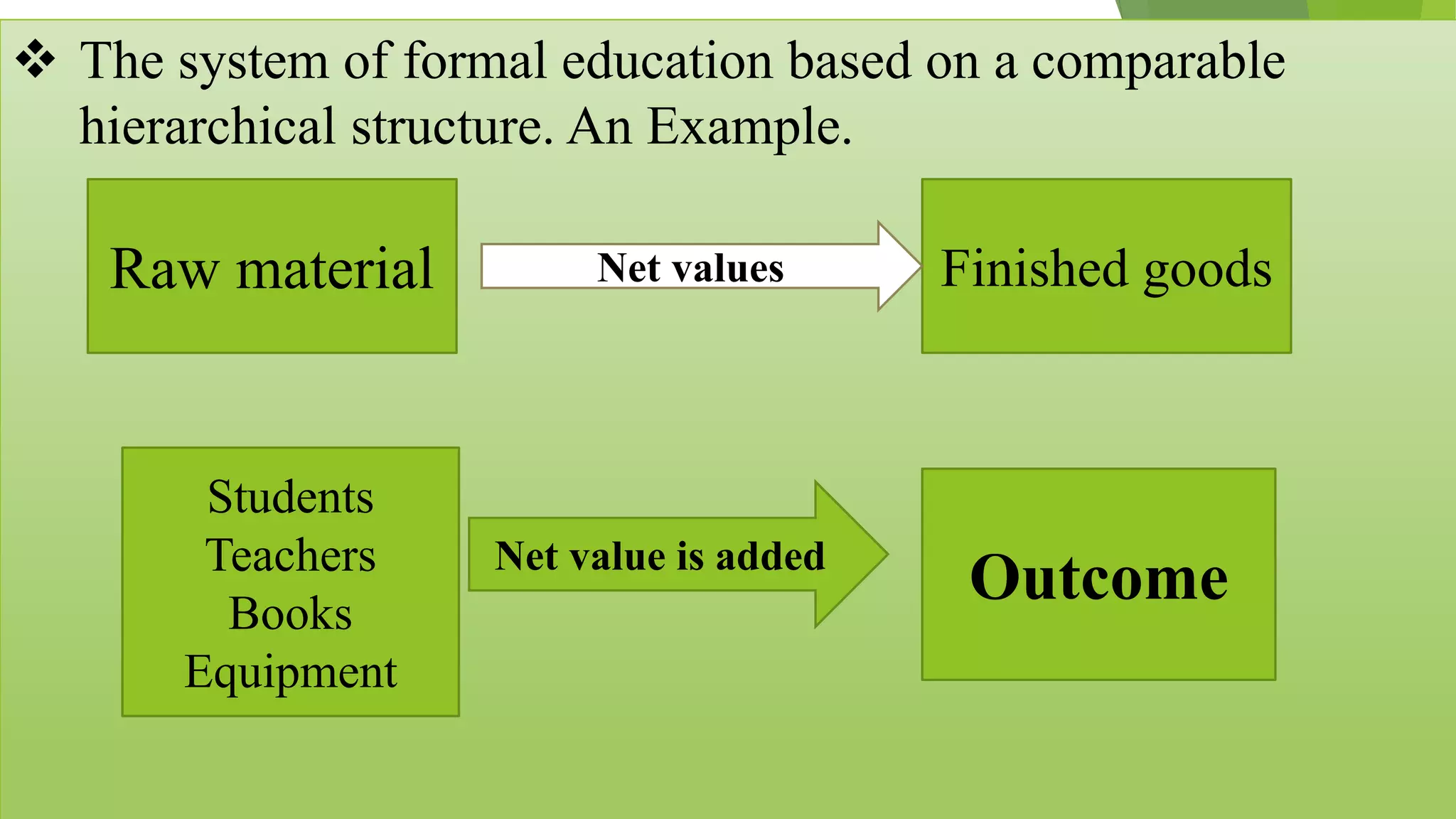
 The system of formal education based on a comparable
hierarchical structure. An Example.
Raw material Finished goods
Net values
Students
Teachers
Books
Equipment
Net value is added
Outcome
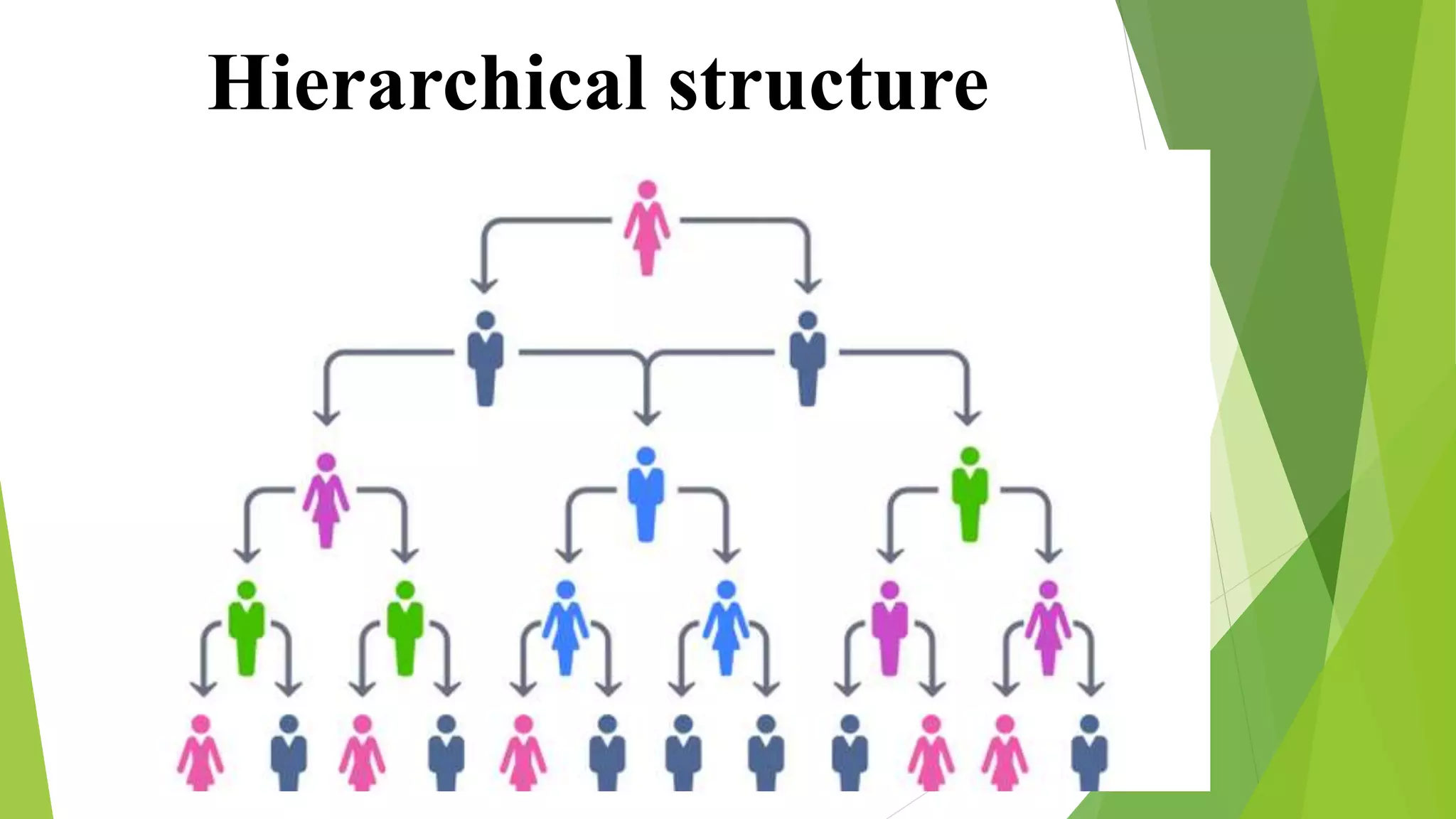
Hierarchical structure
In Education,
The most common measures of outcomes have
been :
1.Students' academic achievement while they
are in school (often measured by scores on
standardized tests)
2.Student performance upon entering the labor
market (generally measured by wages)
(Burtless, 1996:3).
Residual factors and educational
productivity
The residual approach is used to measure the extent to
which different factors are responsible for contributing
to economic growth.
The rate of increase in the aggregate output is
compared, under this approach, with the aggregate
input.
Residual factor – (Quality of labour) – educated,
skilled, technological knowledge.
Solow (1957), Svennilson (1964) and Denison (1962)
suggested that improvements in the quality of labour
force, including increased education, were important
together with other factors such as technological
progress and economies of scale and constitute an
important part of the residual.
Educational Planning and Manpower
“The process of determining the organizational
manpower requirements in the long run”.
1. Analyzing the current manpower inventory
2. Making future manpower forecasts
3. Developing employment programmers
4. Designtrainingprogrammes
Importance of manpower planning
(1) Key to managerial function
(2) Efficient utilization
(3) Motivation
(4) Better human relations
(5) Higher productivity
Need of manpower planning
1- Shortages and surplus
2- Recruitment and selection
3- Overstaffing can be avoided
4- Helps in identifying available talents
5- Growth and diversification of business
6- Realization of manpower management
Strategy for Primary Education
Expansion
Schemes that have motivated kids to go to School and Learn
to achieve the universalization of elementary education, the
government has started numerous projects and programs. In
keeping with the principles of the National Policy of
Education, the government has brought about various
schemes that ensure equitable education for all. The main
aim of these schemes is to improve access to good education
by expanding good schools, to promote equity and to improve
the basic quality of education.
Sarva Siksha Abhiyan
Introduced- 2001
Useful for children between the
age of 6 to 14
Aim- to universalize education and
improves its quality by time-bound
implementation strategy and
context specific planning.
Introduced 2013 July
objectives – Development of learning material that are gender-
sensitive, gender-sensitization of teachers, provisions like stationary,
uniforms, and workbooks.
Focus- to break stereotypes and make sure girls get good education
at the elementary education
 Plan was launched in 1995
known as the National Programmed
of Nutritional Support to
Primary Education
Objective- to eliminate classroom
hunger of children and to increase attendance and
enrolment of children at schools.
Women are also socially empowered since the scheme
creates employment opportunities.
5 important reasons that how the Mid Day meal
scheme is riddled with problems in India...
-- Focus is on reach not on quality or quantity
-- Serving death for lunch
-- Corruption
-- Lack of implementation
Enacted in 2009
This act made education for every child 6 to 14
years a fundamental right.
It also set the basic norms that must be followed by
every elementary school in the country.
Thus, children got the right to receive free
elementary education. This means that no child has
to pay any kind of charges or fee to complete
education up to elementary level.
The RTE act also aims at the development of
a curriculum that makes sure the child receives the
benefit of all-round development, building their
knowledge, talent, and potential.
The Right to Education Act has made it compulsory
to reserve 25 per cent in private schools for children
from economically weaker families
This scheme initiated in 2015 is one of the most
famous central government schemes for girl education.
The main aim of this government scheme was
initially to protect girl children from female feticide
and infanticide
Other objectives of the plan include stopping the
practice of gender-determination tests and
discrimination against girl children.
The Beti Bachao, Beti Padhao scheme ensures the
protection of girls and their survival and makes sure
that girls participate in educational activities
alongside boys.
Kasturba Gandhi Balika Vidyalaya
Launched in 2004, the KGBV scheme aims at setting up
residential schools for girls belonging to minority
communities at the upper primary level.
This scheme is mainly implemented in the parts of the
country where girls aren’t enrolled in school.
This scheme provides reservation of 25% to girls from
families below the poverty line and the rest 75% to the
girls belonging to ST, SC, OBC, and other minority
communities.
The main idea behind this scheme is that by setting up
residential schools, girls from disadvantaged groups of
the society can access quality education.
Scheme for Infrastructure
Development in Minority Institutes
(IDMI)- To improve the quality of education,
the scheme has been started to improve
infrastructure in unaided/aided minority
schools.
The salient features of this scheme include
expanding facilities that will help the education
of children from minority communities.
The entire country comes under this scheme,
but preference is given to places that have a
minority population above 20 per cent.
The scheme also encourages educational
facilities for children with special needs, girls,
and others who are mostly held back in society.
The Government has launched Rashtriya Aavishkar
Abhiyan (RAA) programme on 09.07.2015, to
motivate and engage children of the age group of 6-
18 years in science, mathematics and technology
through observation, experimentation, inference
drawing, model building, etc. both through inside
and outside classroom activities.
The Central Government also supports states and
UTs on early grade reading, writing and
comprehension, and early mathematics programmes
through a sub-programme namely 'Padhe Bharat
Badhe Bharat' (PBBB) in foundational years of
schooling.
14 initiatives taken by central government to improve teaching
standards in India
1. Subject wise learning
2. National achievement surveys
3. Minimum qualification of teachers
4. B.Ed. degree structure
5. Quality education
6. Equality in education
7. International exposure
8. Cultural festival
9. grading system
10. integrated data
11. E- Learning material for teachers and students
12. Interactive content for students
13. Massive open online courses (MOOCs)
14. Education Channels
Conclusion
Meeting the learning needs of all students is a complex and
demanding task for schools. How well students achieve at a
school depends on factors such as how well teachers engage
with their students, and the relationships schools have with
their students and parents. The assessment of student
achievement, or understanding what students know and can
do, is fundamental to effective teaching and to students’
learning. Unless teachers know students well and are
knowledgeable about their achievements, they cannot be
confident that they are meeting the learning needs of their
students.

Educational productivity:Residual Factors & Educational productivity, Educational planning and Manpower, Strategy for Primary education Expansion

  • 1.
  • 2.
    Educational productivity: Residual Factors& Educational productivity, Educational planning and Manpower, Strategy for Primary education Expansion
  • 3.
    Introduction To the economist,one of the most natural approaches is to study the productivity of education, since prudent investment is governed by the relative productivity of the funds which is in turn determined by the marginal rate of return compared with the best alternative use of the same funds. It is quite understandable that economists, who have always followed the outlays of government with great interest, recently have turned considerable attention to the study of education’s productivity.
  • 4.
    Productivity defined as aratio between “the output volume and the volume of inputs” According to “Peter Drucker” Productivity means a balance between all factors of production that will give the maximum output with the smallest effort”.
  • 5.
    Educational Productivity Dictionary Meaning-‘the ability of an entity to produce abundantly or to yield favorable or useful results’ The relationship between outputs and inputs of firm or organization.
  • 6.
     The systemof formal education based on a comparable hierarchical structure. An Example. Raw material Finished goods Net values Students Teachers Books Equipment Net value is added Outcome
  • 7.
  • 9.
    In Education, The mostcommon measures of outcomes have been : 1.Students' academic achievement while they are in school (often measured by scores on standardized tests) 2.Student performance upon entering the labor market (generally measured by wages) (Burtless, 1996:3).
  • 11.
    Residual factors andeducational productivity The residual approach is used to measure the extent to which different factors are responsible for contributing to economic growth. The rate of increase in the aggregate output is compared, under this approach, with the aggregate input.
  • 12.
    Residual factor –(Quality of labour) – educated, skilled, technological knowledge. Solow (1957), Svennilson (1964) and Denison (1962) suggested that improvements in the quality of labour force, including increased education, were important together with other factors such as technological progress and economies of scale and constitute an important part of the residual.
  • 13.
    Educational Planning andManpower “The process of determining the organizational manpower requirements in the long run”. 1. Analyzing the current manpower inventory 2. Making future manpower forecasts 3. Developing employment programmers 4. Designtrainingprogrammes
  • 14.
    Importance of manpowerplanning (1) Key to managerial function (2) Efficient utilization (3) Motivation (4) Better human relations (5) Higher productivity
  • 15.
    Need of manpowerplanning 1- Shortages and surplus 2- Recruitment and selection 3- Overstaffing can be avoided 4- Helps in identifying available talents 5- Growth and diversification of business 6- Realization of manpower management
  • 16.
    Strategy for PrimaryEducation Expansion Schemes that have motivated kids to go to School and Learn to achieve the universalization of elementary education, the government has started numerous projects and programs. In keeping with the principles of the National Policy of Education, the government has brought about various schemes that ensure equitable education for all. The main aim of these schemes is to improve access to good education by expanding good schools, to promote equity and to improve the basic quality of education.
  • 17.
    Sarva Siksha Abhiyan Introduced-2001 Useful for children between the age of 6 to 14 Aim- to universalize education and improves its quality by time-bound implementation strategy and context specific planning.
  • 18.
    Introduced 2013 July objectives– Development of learning material that are gender- sensitive, gender-sensitization of teachers, provisions like stationary, uniforms, and workbooks. Focus- to break stereotypes and make sure girls get good education at the elementary education
  • 19.
     Plan waslaunched in 1995 known as the National Programmed of Nutritional Support to Primary Education Objective- to eliminate classroom hunger of children and to increase attendance and enrolment of children at schools. Women are also socially empowered since the scheme creates employment opportunities.
  • 20.
    5 important reasonsthat how the Mid Day meal scheme is riddled with problems in India... -- Focus is on reach not on quality or quantity -- Serving death for lunch -- Corruption -- Lack of implementation
  • 21.
    Enacted in 2009 Thisact made education for every child 6 to 14 years a fundamental right. It also set the basic norms that must be followed by every elementary school in the country. Thus, children got the right to receive free elementary education. This means that no child has to pay any kind of charges or fee to complete education up to elementary level. The RTE act also aims at the development of a curriculum that makes sure the child receives the benefit of all-round development, building their knowledge, talent, and potential. The Right to Education Act has made it compulsory to reserve 25 per cent in private schools for children from economically weaker families
  • 22.
    This scheme initiatedin 2015 is one of the most famous central government schemes for girl education. The main aim of this government scheme was initially to protect girl children from female feticide and infanticide Other objectives of the plan include stopping the practice of gender-determination tests and discrimination against girl children. The Beti Bachao, Beti Padhao scheme ensures the protection of girls and their survival and makes sure that girls participate in educational activities alongside boys.
  • 23.
    Kasturba Gandhi BalikaVidyalaya Launched in 2004, the KGBV scheme aims at setting up residential schools for girls belonging to minority communities at the upper primary level. This scheme is mainly implemented in the parts of the country where girls aren’t enrolled in school. This scheme provides reservation of 25% to girls from families below the poverty line and the rest 75% to the girls belonging to ST, SC, OBC, and other minority communities. The main idea behind this scheme is that by setting up residential schools, girls from disadvantaged groups of the society can access quality education.
  • 24.
    Scheme for Infrastructure Developmentin Minority Institutes (IDMI)- To improve the quality of education, the scheme has been started to improve infrastructure in unaided/aided minority schools. The salient features of this scheme include expanding facilities that will help the education of children from minority communities. The entire country comes under this scheme, but preference is given to places that have a minority population above 20 per cent. The scheme also encourages educational facilities for children with special needs, girls, and others who are mostly held back in society.
  • 25.
    The Government haslaunched Rashtriya Aavishkar Abhiyan (RAA) programme on 09.07.2015, to motivate and engage children of the age group of 6- 18 years in science, mathematics and technology through observation, experimentation, inference drawing, model building, etc. both through inside and outside classroom activities. The Central Government also supports states and UTs on early grade reading, writing and comprehension, and early mathematics programmes through a sub-programme namely 'Padhe Bharat Badhe Bharat' (PBBB) in foundational years of schooling.
  • 26.
    14 initiatives takenby central government to improve teaching standards in India 1. Subject wise learning 2. National achievement surveys 3. Minimum qualification of teachers 4. B.Ed. degree structure 5. Quality education
  • 27.
    6. Equality ineducation 7. International exposure 8. Cultural festival 9. grading system 10. integrated data 11. E- Learning material for teachers and students
  • 28.
    12. Interactive contentfor students 13. Massive open online courses (MOOCs) 14. Education Channels
  • 29.
    Conclusion Meeting the learningneeds of all students is a complex and demanding task for schools. How well students achieve at a school depends on factors such as how well teachers engage with their students, and the relationships schools have with their students and parents. The assessment of student achievement, or understanding what students know and can do, is fundamental to effective teaching and to students’ learning. Unless teachers know students well and are knowledgeable about their achievements, they cannot be confident that they are meeting the learning needs of their students.