Manners Matter
Learning Professional Etiquettes
Sharafat Ibn Mollah Mosharraf
Software Development Consultant
Bangladesh Computer Council
27 August 2020
Green University of Bangladesh
About Me
Sharafat Ibn Mollah Mosharraf
BS CSE (DU), MS CSE (BUET)
Software Development Consultant
Bangladesh e-Government ERP Project,
Bangladesh Computer Council
Founder & Chief Technology Officer,
Eximus Technologies
Ex-Senior Software Engineer,
Therap Services & Backpack Technologies
2
sharafat@eximustech.com
www.sharafat.co.uk
Overview
● Introduction to Professional Etiquettes and Manners
● Workplace Etiquettes and Manners
● Meeting Etiquettes and Manners
● Communication Etiquettes
● Office Bathroom Etiquettes
● Be a Leader, Not a Boss
● Conclusion
● QA Session
3
Introduction to
Professional Etiquettes and Manners
4
Etiquette
5
● IPA: /ˈɛtɪˌkɛt/, /ˈɛtɪkɪt/
● িশষ্টাচার, আদব
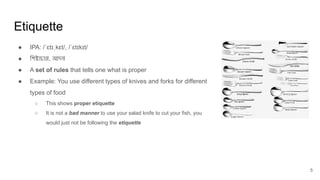
● A set of rules that tells one what is proper
● Example: You use different types of knives and forks for different
types of food
○ This shows proper etiquette
○ It is not a bad manner to use your salad knife to cut your fish, you
would just not be following the etiquette
Manner
6
● IPA: /ˈmænə/
● আচার-ব্যবহার, রীিতনীিত
● A way of doing something to be polite, courteous, etc.
● Showing proper manners means making the person
around you not to feel bad
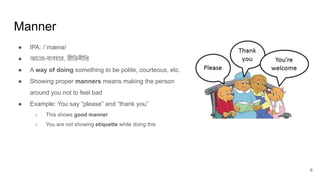
● Example: You say “please” and “thank you”
○ This shows good manner
○ You are not showing etiquette while doing this
Professional Etiquettes and Manners
7
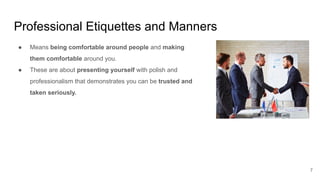
● Means being comfortable around people and making
them comfortable around you.
● These are about presenting yourself with polish and
professionalism that demonstrates you can be trusted and
taken seriously.
Why Professional Etiquettes and Manners Matter?
8
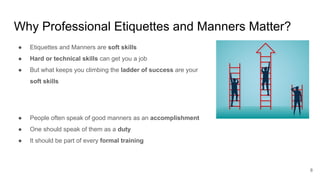
● Etiquettes and Manners are soft skills
● Hard or technical skills can get you a job
● But what keeps you climbing the ladder of success are your
soft skills
● People often speak of good manners as an accomplishment
● One should speak of them as a duty
● It should be part of every formal training
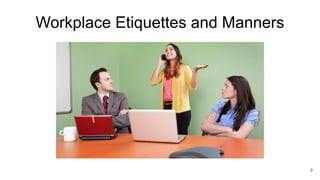
Workplace Etiquettes and Manners
9
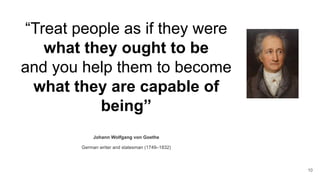
“Treat people as if they were
what they ought to be
and you help them to become
what they are capable of
being”
Johann Wolfgang von Goethe
German writer and statesman (1749–1832)
10
Show Respect
11
● Everyone deserves respect
● Address everyone formally until they ask you to use their first
name
● Make people feel valued
● Be the first to extend your hand for a handshake, and look the
person in the eye
● No matter whom you come in contact with, that person
deserves being treated with respect and dignity
● Even if you dislike someone for his or her behavior, you’ll
come out on top if you maintain a respectful manner
Show Courtesy
12
● Say “please”, “thank you”, “sorry”, “excuse me”
● This makes people understand you appreciate what they can do
or have done for you
● Forgetting to say these shows lack of appreciation and concern
for others, which is disrespectful and degrading
● Showing respect and courtesy doesn’t mean you have to let
people step on you, but it does mean showing concern for their
feelings, respecting their opinions, and being honest with them
○ If you think someone is mistreating you, deal with it and tell them
(with courtesy) you won’t tolerate disrespect
Be Kind
13
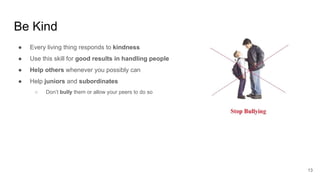
● Every living thing responds to kindness
● Use this skill for good results in handling people
● Help others whenever you possibly can
● Help juniors and subordinates
○ Don’t bully them or allow your peers to do so
Never Interrupt Someone
14
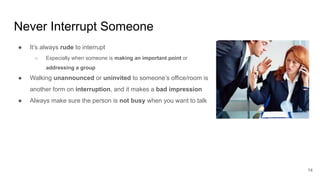
● It’s always rude to interrupt
○ Especially when someone is making an important point or
addressing a group
● Walking unannounced or uninvited to someone’s office/room is
another form on interruption, and it makes a bad impression
● Always make sure the person is not busy when you want to talk
Refrain from Gossip
15
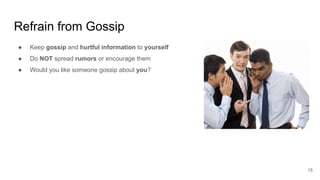
● Keep gossip and hurtful information to yourself
● Do NOT spread rumors or encourage them
● Would you like someone gossip about you?
Respect Everyone’s Privacy
16
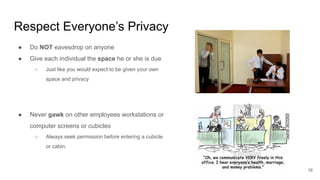
● Do NOT eavesdrop on anyone
● Give each individual the space he or she is due
○ Just like you would expect to be given your own
space and privacy
● Never gawk on other employees workstations or
computer screens or cubicles
○ Always seek permission before entering a cubicle
or cabin.
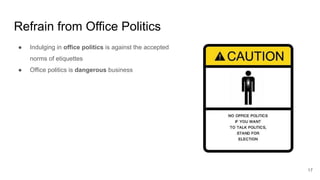
Refrain from Office Politics
17
● Indulging in office politics is against the accepted
norms of etiquettes
● Office politics is dangerous business
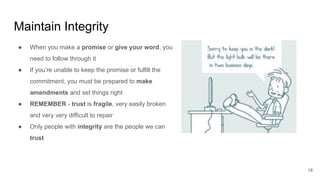
Maintain Integrity
18
● When you make a promise or give your word, you
need to follow through it
● If you’re unable to keep the promise or fulfill the
commitment, you must be prepared to make
amendments and set things right
● REMEMBER - trust is fragile, very easily broken
and very very difficult to repair
● Only people with integrity are the people we can
trust
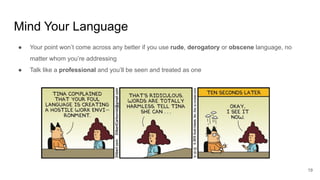
Mind Your Language
19
● Your point won’t come across any better if you use rude, derogatory or obscene language, no
matter whom you’re addressing
● Talk like a professional and you’ll be seen and treated as one
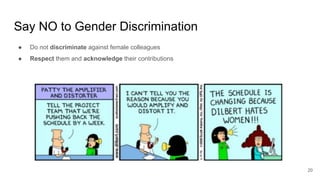
Say NO to Gender Discrimination
20
● Do not discriminate against female colleagues
● Respect them and acknowledge their contributions
Be Punctual
21
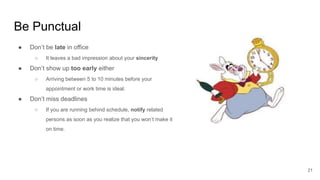
● Don’t be late in office
○ It leaves a bad impression about your sincerity
● Don’t show up too early either
○ Arriving between 5 to 10 minutes before your
appointment or work time is ideal.
● Don’t miss deadlines
○ If you are running behind schedule, notify related
persons as soon as you realize that you won’t make it
on time.
Keep Your Productivity High
22
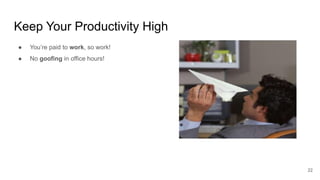
● You’re paid to work, so work!
● No goofing in office hours!
Dress Appropriately
23
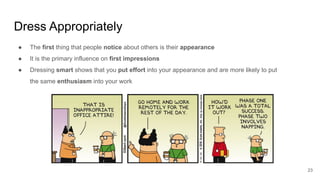
● The first thing that people notice about others is their appearance
● It is the primary influence on first impressions
● Dressing smart shows that you put effort into your appearance and are more likely to put
the same enthusiasm into your work
Always Practice Good Hygiene
24
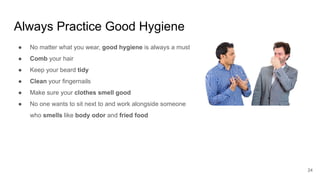
● No matter what you wear, good hygiene is always a must
● Comb your hair
● Keep your beard tidy
● Clean your fingernails
● Make sure your clothes smell good
● No one wants to sit next to and work alongside someone
who smells like body odor and fried food
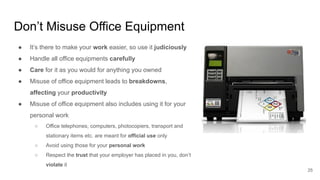
Don’t Misuse Office Equipment
25
● It’s there to make your work easier, so use it judiciously
● Handle all office equipments carefully
● Care for it as you would for anything you owned
● Misuse of office equipment leads to breakdowns,
affecting your productivity
● Misuse of office equipment also includes using it for your
personal work
○ Office telephones, computers, photocopiers, transport and
stationary items etc. are meant for official use only
○ Avoid using those for your personal work
○ Respect the trust that your employer has placed in you, don’t
violate it
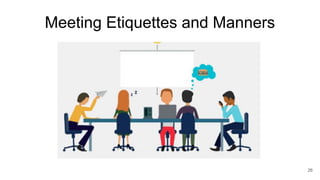
Meeting Etiquettes and Manners
26
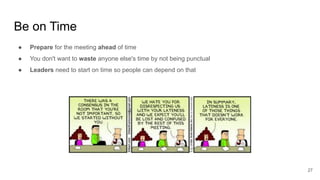
Be on Time
27
● Prepare for the meeting ahead of time
● You don't want to waste anyone else's time by not being punctual
● Leaders need to start on time so people can depend on that
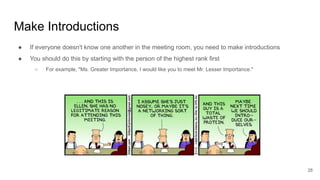
Make Introductions
28
● If everyone doesn't know one another in the meeting room, you need to make introductions
● You should do this by starting with the person of the highest rank first
○ For example, "Ms. Greater Importance, I would like you to meet Mr. Lesser Importance."
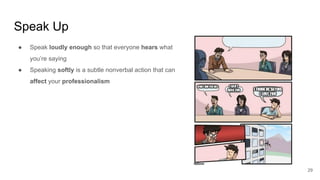
Speak Up
29
● Speak loudly enough so that everyone hears what
you’re saying
● Speaking softly is a subtle nonverbal action that can
affect your professionalism
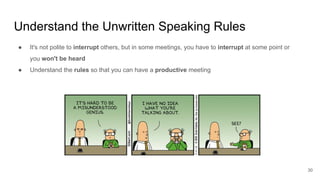
Understand the Unwritten Speaking Rules
30
● It's not polite to interrupt others, but in some meetings, you have to interrupt at some point or
you won't be heard
● Understand the rules so that you can have a productive meeting
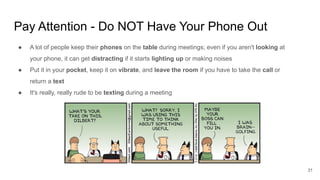
Pay Attention - Do NOT Have Your Phone Out
31
● A lot of people keep their phones on the table during meetings; even if you aren't looking at
your phone, it can get distracting if it starts lighting up or making noises
● Put it in your pocket, keep it on vibrate, and leave the room if you have to take the call or
return a text
● It's really, really rude to be texting during a meeting
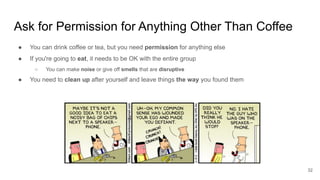
Ask for Permission for Anything Other Than Coffee
32
● You can drink coffee or tea, but you need permission for anything else
● If you're going to eat, it needs to be OK with the entire group
○ You can make noise or give off smells that are disruptive
● You need to clean up after yourself and leave things the way you found them
Don't Save All Your Questions for the End
33
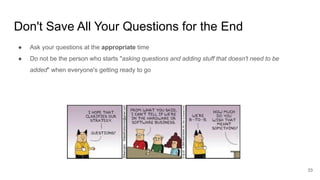
● Ask your questions at the appropriate time
● Do not be the person who starts "asking questions and adding stuff that doesn't need to be
added" when everyone's getting ready to go
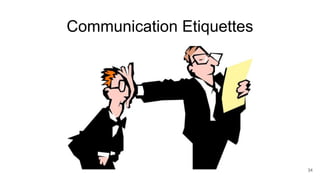
Communication Etiquettes
34
Communication Etiquettes
35
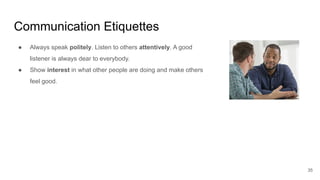
● Always speak politely. Listen to others attentively. A good
listener is always dear to everybody.
● Show interest in what other people are doing and make others
feel good.
Communication Etiquettes...
36
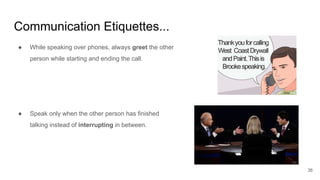
● While speaking over phones, always greet the other
person while starting and ending the call.
● Speak only when the other person has finished
talking instead of interrupting in between.
Communication Etiquettes...
37
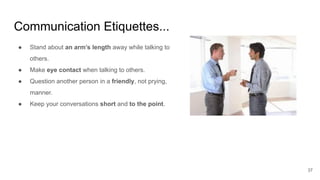
● Stand about an arm’s length away while talking to
others.
● Make eye contact when talking to others.
● Question another person in a friendly, not prying,
manner.
● Keep your conversations short and to the point.
Communication Etiquettes...
38
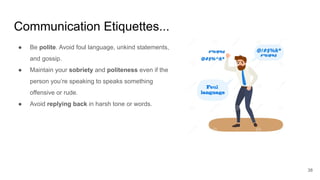
● Be polite. Avoid foul language, unkind statements,
and gossip.
● Maintain your sobriety and politeness even if the
person you’re speaking to speaks something
offensive or rude.
● Avoid replying back in harsh tone or words.
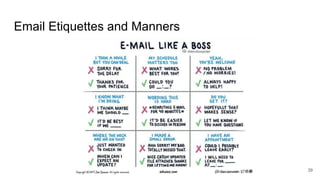
Email Etiquettes and Manners
39
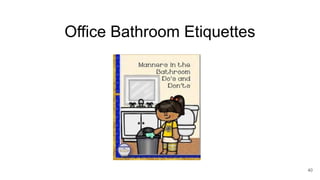
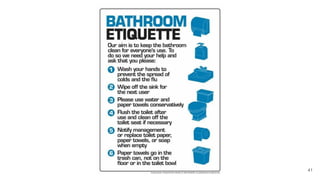
Office Bathroom Etiquettes
40
41
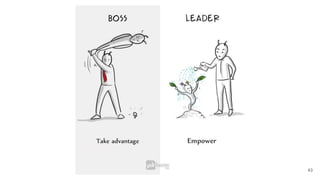
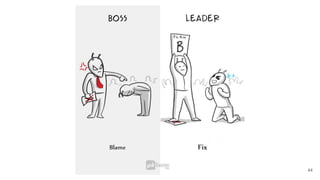
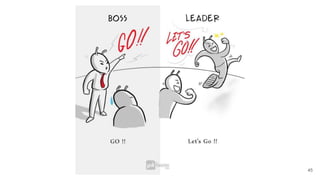
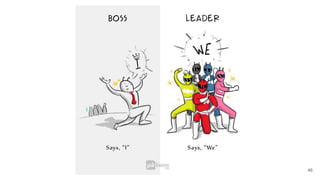
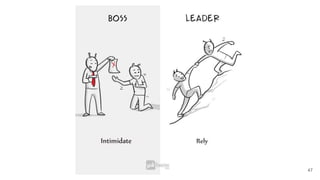
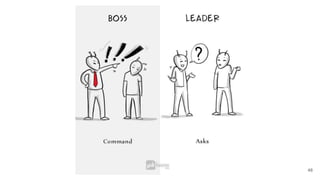
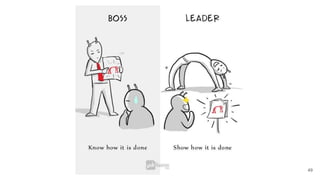
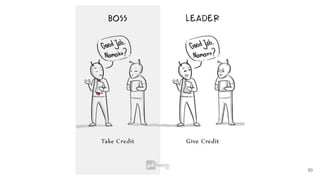
Be a Leader, Not a Boss
42
“People don’t leave their jobs, they leave their bosses.”
43
44
45
46
47
48
49
50
Conclusion
51
Key Take-Aways
52
● Use common sense
● Before doing something, think whether you’d like it if someone else did it
53
54

Manners Matter: Learning Professional Etiquettes

  • 1.
    Manners Matter Learning ProfessionalEtiquettes Sharafat Ibn Mollah Mosharraf Software Development Consultant Bangladesh Computer Council 27 August 2020 Green University of Bangladesh
  • 2.
    About Me Sharafat IbnMollah Mosharraf BS CSE (DU), MS CSE (BUET) Software Development Consultant Bangladesh e-Government ERP Project, Bangladesh Computer Council Founder & Chief Technology Officer, Eximus Technologies Ex-Senior Software Engineer, Therap Services & Backpack Technologies 2 sharafat@eximustech.com www.sharafat.co.uk
  • 3.
    Overview ● Introduction toProfessional Etiquettes and Manners ● Workplace Etiquettes and Manners ● Meeting Etiquettes and Manners ● Communication Etiquettes ● Office Bathroom Etiquettes ● Be a Leader, Not a Boss ● Conclusion ● QA Session 3
  • 4.
  • 5.
    Etiquette 5 ● IPA: /ˈɛtɪˌkɛt/,/ˈɛtɪkɪt/ ● িশষ্টাচার, আদব ● A set of rules that tells one what is proper ● Example: You use different types of knives and forks for different types of food ○ This shows proper etiquette ○ It is not a bad manner to use your salad knife to cut your fish, you would just not be following the etiquette
  • 6.
    Manner 6 ● IPA: /ˈmænə/ ●আচার-ব্যবহার, রীিতনীিত ● A way of doing something to be polite, courteous, etc. ● Showing proper manners means making the person around you not to feel bad ● Example: You say “please” and “thank you” ○ This shows good manner ○ You are not showing etiquette while doing this
  • 7.
    Professional Etiquettes andManners 7 ● Means being comfortable around people and making them comfortable around you. ● These are about presenting yourself with polish and professionalism that demonstrates you can be trusted and taken seriously.
  • 8.
    Why Professional Etiquettesand Manners Matter? 8 ● Etiquettes and Manners are soft skills ● Hard or technical skills can get you a job ● But what keeps you climbing the ladder of success are your soft skills ● People often speak of good manners as an accomplishment ● One should speak of them as a duty ● It should be part of every formal training
  • 9.
  • 10.
    “Treat people asif they were what they ought to be and you help them to become what they are capable of being” Johann Wolfgang von Goethe German writer and statesman (1749–1832) 10
  • 11.
    Show Respect 11 ● Everyonedeserves respect ● Address everyone formally until they ask you to use their first name ● Make people feel valued ● Be the first to extend your hand for a handshake, and look the person in the eye ● No matter whom you come in contact with, that person deserves being treated with respect and dignity ● Even if you dislike someone for his or her behavior, you’ll come out on top if you maintain a respectful manner
  • 12.
    Show Courtesy 12 ● Say“please”, “thank you”, “sorry”, “excuse me” ● This makes people understand you appreciate what they can do or have done for you ● Forgetting to say these shows lack of appreciation and concern for others, which is disrespectful and degrading ● Showing respect and courtesy doesn’t mean you have to let people step on you, but it does mean showing concern for their feelings, respecting their opinions, and being honest with them ○ If you think someone is mistreating you, deal with it and tell them (with courtesy) you won’t tolerate disrespect
  • 13.
    Be Kind 13 ● Everyliving thing responds to kindness ● Use this skill for good results in handling people ● Help others whenever you possibly can ● Help juniors and subordinates ○ Don’t bully them or allow your peers to do so
  • 14.
    Never Interrupt Someone 14 ●It’s always rude to interrupt ○ Especially when someone is making an important point or addressing a group ● Walking unannounced or uninvited to someone’s office/room is another form on interruption, and it makes a bad impression ● Always make sure the person is not busy when you want to talk
  • 15.
    Refrain from Gossip 15 ●Keep gossip and hurtful information to yourself ● Do NOT spread rumors or encourage them ● Would you like someone gossip about you?
  • 16.
    Respect Everyone’s Privacy 16 ●Do NOT eavesdrop on anyone ● Give each individual the space he or she is due ○ Just like you would expect to be given your own space and privacy ● Never gawk on other employees workstations or computer screens or cubicles ○ Always seek permission before entering a cubicle or cabin.
  • 17.
    Refrain from OfficePolitics 17 ● Indulging in office politics is against the accepted norms of etiquettes ● Office politics is dangerous business
  • 18.
    Maintain Integrity 18 ● Whenyou make a promise or give your word, you need to follow through it ● If you’re unable to keep the promise or fulfill the commitment, you must be prepared to make amendments and set things right ● REMEMBER - trust is fragile, very easily broken and very very difficult to repair ● Only people with integrity are the people we can trust
  • 19.
    Mind Your Language 19 ●Your point won’t come across any better if you use rude, derogatory or obscene language, no matter whom you’re addressing ● Talk like a professional and you’ll be seen and treated as one
  • 20.
    Say NO toGender Discrimination 20 ● Do not discriminate against female colleagues ● Respect them and acknowledge their contributions
  • 21.
    Be Punctual 21 ● Don’tbe late in office ○ It leaves a bad impression about your sincerity ● Don’t show up too early either ○ Arriving between 5 to 10 minutes before your appointment or work time is ideal. ● Don’t miss deadlines ○ If you are running behind schedule, notify related persons as soon as you realize that you won’t make it on time.
  • 22.
    Keep Your ProductivityHigh 22 ● You’re paid to work, so work! ● No goofing in office hours!
  • 23.
    Dress Appropriately 23 ● Thefirst thing that people notice about others is their appearance ● It is the primary influence on first impressions ● Dressing smart shows that you put effort into your appearance and are more likely to put the same enthusiasm into your work
  • 24.
    Always Practice GoodHygiene 24 ● No matter what you wear, good hygiene is always a must ● Comb your hair ● Keep your beard tidy ● Clean your fingernails ● Make sure your clothes smell good ● No one wants to sit next to and work alongside someone who smells like body odor and fried food
  • 25.
    Don’t Misuse OfficeEquipment 25 ● It’s there to make your work easier, so use it judiciously ● Handle all office equipments carefully ● Care for it as you would for anything you owned ● Misuse of office equipment leads to breakdowns, affecting your productivity ● Misuse of office equipment also includes using it for your personal work ○ Office telephones, computers, photocopiers, transport and stationary items etc. are meant for official use only ○ Avoid using those for your personal work ○ Respect the trust that your employer has placed in you, don’t violate it
  • 26.
  • 27.
    Be on Time 27 ●Prepare for the meeting ahead of time ● You don't want to waste anyone else's time by not being punctual ● Leaders need to start on time so people can depend on that
  • 28.
    Make Introductions 28 ● Ifeveryone doesn't know one another in the meeting room, you need to make introductions ● You should do this by starting with the person of the highest rank first ○ For example, "Ms. Greater Importance, I would like you to meet Mr. Lesser Importance."
  • 29.
    Speak Up 29 ● Speakloudly enough so that everyone hears what you’re saying ● Speaking softly is a subtle nonverbal action that can affect your professionalism
  • 30.
    Understand the UnwrittenSpeaking Rules 30 ● It's not polite to interrupt others, but in some meetings, you have to interrupt at some point or you won't be heard ● Understand the rules so that you can have a productive meeting
  • 31.
    Pay Attention -Do NOT Have Your Phone Out 31 ● A lot of people keep their phones on the table during meetings; even if you aren't looking at your phone, it can get distracting if it starts lighting up or making noises ● Put it in your pocket, keep it on vibrate, and leave the room if you have to take the call or return a text ● It's really, really rude to be texting during a meeting
  • 32.
    Ask for Permissionfor Anything Other Than Coffee 32 ● You can drink coffee or tea, but you need permission for anything else ● If you're going to eat, it needs to be OK with the entire group ○ You can make noise or give off smells that are disruptive ● You need to clean up after yourself and leave things the way you found them
  • 33.
    Don't Save AllYour Questions for the End 33 ● Ask your questions at the appropriate time ● Do not be the person who starts "asking questions and adding stuff that doesn't need to be added" when everyone's getting ready to go
  • 34.
  • 35.
    Communication Etiquettes 35 ● Alwaysspeak politely. Listen to others attentively. A good listener is always dear to everybody. ● Show interest in what other people are doing and make others feel good.
  • 36.
    Communication Etiquettes... 36 ● Whilespeaking over phones, always greet the other person while starting and ending the call. ● Speak only when the other person has finished talking instead of interrupting in between.
  • 37.
    Communication Etiquettes... 37 ● Standabout an arm’s length away while talking to others. ● Make eye contact when talking to others. ● Question another person in a friendly, not prying, manner. ● Keep your conversations short and to the point.
  • 38.
    Communication Etiquettes... 38 ● Bepolite. Avoid foul language, unkind statements, and gossip. ● Maintain your sobriety and politeness even if the person you’re speaking to speaks something offensive or rude. ● Avoid replying back in harsh tone or words.
  • 39.
  • 40.
  • 41.
  • 42.
    Be a Leader,Not a Boss 42 “People don’t leave their jobs, they leave their bosses.”
  • 43.
  • 44.
  • 45.
  • 46.
  • 47.
  • 48.
  • 49.
  • 50.
  • 51.
  • 52.
    Key Take-Aways 52 ● Usecommon sense ● Before doing something, think whether you’d like it if someone else did it
  • 53.
  • 54.