Essential Elements of Risk Assessment
David Mangold and Kent Muhlbauer
David.Mangold@DNV.com Kent.Muhlbauer@DNV.com
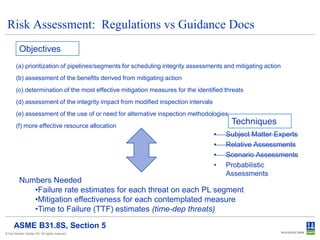
Risk Assessment: Regulations vs Guidance Docs
Objectives
(a) prioritization of pipelines/segments for scheduling integrity assessments and mitigating action
(b) assessment of the benefits derived from mitigating action
(c) determination of the most effective mitigation measures for the identified threats
(d) assessment of the integrity impact from modified inspection intervals
(e) assessment of the use of or need for alternative inspection methodologies

Techniques

(f) more effective resource allocation

•
•
•
•

Subject Matter Experts
Relative Assessments
Scenario Assessments
Probabilistic
Assessments

Numbers Needed
•Failure rate estimates for each threat on each PL segment
•Mitigation effectiveness for each contemplated measure
•Time to Failure (TTF) estimates (time-dep threats)
ASME B31.8S, Section 5
© Det Norske Veritas AS. All rights reserved.
Risk Assessment Essential Elements
 The Essential Elements are meant to
- Be common sense ingredients that make risk assessment meaningful, objective, and
acceptable to all stakeholders
- Be concise yet flexible, allowing tailored solutions (not a recipe) to situation-specific concerns
- Lead to smarter risk assessment

 The elements are meant to supplement, not replace, guidance, recommended
practice, and regulations already in place

© Det Norske Veritas AS. All rights reserved.

3
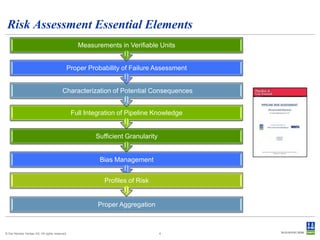
Risk Assessment Essential Elements
Measurements in Verifiable Units
Proper Probability of Failure Assessment
Characterization of Potential Consequences
Full Integration of Pipeline Knowledge

Sufficient Granularity

Bias Management
Profiles of Risk

Proper Aggregation

© Det Norske Veritas AS. All rights reserved.

4
Risk Assessment Essential Elements
Measurements in Verifiable Units
Measure in
Verifiable
Units

Probability of
Failure
Grounded in
Engineering
Principles

Fully
Characterize
Consequence of
Failure

Integrate
Pipeline
Knowledge

Incorporate
Sufficient
Granularity

Control the Bias

Profile the Risk
Reality

Unmask
Aggregation

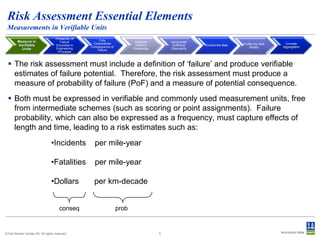
 The risk assessment must include a definition of ‘failure’ and produce verifiable
estimates of failure potential. Therefore, the risk assessment must produce a
measure of probability of failure (PoF) and a measure of potential consequence.
 Both must be expressed in verifiable and commonly used measurement units, free
from intermediate schemes (such as scoring or point assignments). Failure
probability, which can also be expressed as a frequency, must capture effects of
length and time, leading to a risk estimates such as:
•Incidents

per mile-year

•Fatalities

per mile-year

•Dollars

per km-decade

conseq

© Det Norske Veritas AS. All rights reserved.

prob

5
Risk Assessment Essential Elements
Proper Probability of Failure Assessment
Measure in
Verifiable
Units

Probability of
Failure
Grounded in
Engineering
Principles

Fully
Characterize
Consequence of
Failure

Integrate
Pipeline
Knowledge

Incorporate
Sufficient
Granularity

Control the Bias

Profile the Risk
Reality

Unmask
Aggregation

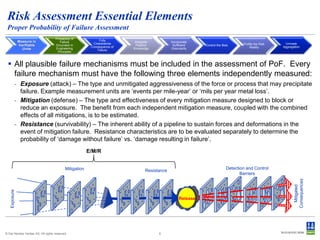
 All plausible failure mechanisms must be included in the assessment of PoF. Every
failure mechanism must have the following three elements independently measured:
- Exposure (attack) – The type and unmitigated aggressiveness of the force or process that may precipitate
failure. Example measurement units are ‘events per mile-year’ or ‘mils per year metal loss’.
- Mitigation (defense) – The type and effectiveness of every mitigation measure designed to block or
reduce an exposure. The benefit from each independent mitigation measure, coupled with the combined
effects of all mitigations, is to be estimated.
- Resistance (survivability) – The inherent ability of a pipeline to sustain forces and deformations in the
event of mitigation failure. Resistance characteristics are to be evaluated separately to determine the
probability of ‘damage without failure’ vs. ‘damage resulting in failure’.
E/M/R

© Det Norske Veritas AS. All rights reserved.

Release

6

Mitigated
Consequences

Detection and Control
Barriers

Resistance

Exposure

Mitigation
Risk Assessment Essential Elements
Proper Probability of Failure Assessment (continued)
Measure in
Verifiable
Units

Probability of
Failure
Grounded in
Engineering
Principles

Fully
Characterize
Consequence of
Failure

Integrate
Pipeline
Knowledge

Incorporate
Sufficient
Granularity

Control the Bias

Profile the Risk
Reality

Unmask
Aggregation

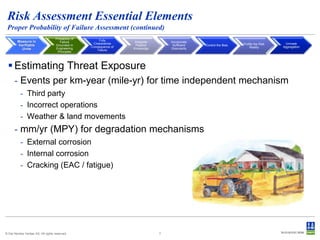
 Estimating Threat Exposure
- Events per km-year (mile-yr) for time independent mechanism
- Third party
- Incorrect operations
- Weather & land movements

- mm/yr (MPY) for degradation mechanisms
- External corrosion
- Internal corrosion
- Cracking (EAC / fatigue)

© Det Norske Veritas AS. All rights reserved.

7
Risk Assessment Essential Elements
Proper Probability of Failure Assessment (continued)
Measure in
Verifiable
Units

Probability of
Failure
Grounded in
Engineering
Principles

Fully
Characterize
Consequence of
Failure

Integrate
Pipeline
Knowledge

Incorporate
Sufficient
Granularity

Unmask
Aggregation

Profile the Risk
Reality

Control the Bias

 Measuring Mitigation
Strong, single measure
Or
Accumulation of lesser measures
1 - (remaining threat)

Remaining threat = (remnant from mit1) AND (remnant from mit2)
(remnant from mit3) …

AND

Mitigation

Mitigation % = 1-[(1-mit1) x (1-mit2) x (1-mit3)…]
Exposure

Coating

© Det Norske Veritas AS. All rights reserved.

8

CP

Mitigated
Exposure

Mitigation % =
Risk Assessment Essential Elements
Proper Probability of Failure Assessment (continued)
Measure in
Verifiable
Units

Probability of
Failure
Grounded in
Engineering
Principles

Fully
Characterize
Consequence of
Failure

Integrate
Pipeline
Knowledge

Incorporate
Sufficient
Granularity

Control the Bias

Profile the Risk
Reality

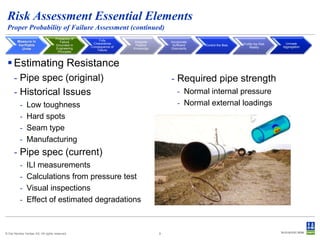
 Estimating Resistance
- Pipe spec (original)
- Historical Issues
-

- Required pipe strength
- Normal internal pressure
- Normal external loadings

Low toughness
Hard spots
Seam type
Manufacturing

- Pipe spec (current)
-

ILI measurements
Calculations from pressure test
Visual inspections
Effect of estimated degradations

© Det Norske Veritas AS. All rights reserved.

9

Unmask
Aggregation
Risk Assessment Essential Elements
Proper Probability of Failure Assessment (continued)
Measure in
Verifiable
Units

Probability of
Failure
Grounded in
Engineering
Principles

Fully
Characterize
Consequence of
Failure

Integrate
Pipeline
Knowledge

Incorporate
Sufficient
Granularity

Control the Bias

Profile the Risk
Reality

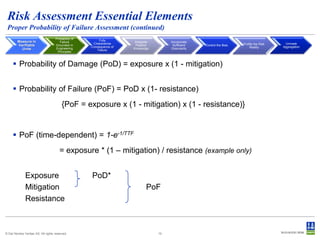
 Probability of Damage (PoD) = exposure x (1 - mitigation)

 Probability of Failure (PoF) = PoD x (1- resistance)
{PoF = exposure x (1 - mitigation) x (1 - resistance)}

 PoF (time-dependent) = 1-e-1/TTF
= exposure * (1 – mitigation) / resistance (example only)
Exposure
Mitigation
Resistance

© Det Norske Veritas AS. All rights reserved.

PoD*
PoF

10

Unmask
Aggregation
Risk Assessment Essential Elements
Proper Probability of Failure Assessment (continued)
Measure in
Verifiable
Units

Probability of
Failure
Grounded in
Engineering
Principles

Fully
Characterize
Consequence of
Failure

Integrate
Pipeline
Knowledge

Incorporate
Sufficient
Granularity

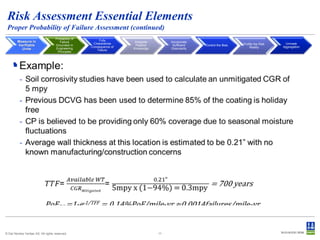


© Det Norske Veritas AS. All rights reserved.

11

Control the Bias

Profile the Risk
Reality

Unmask
Aggregation
Risk Assessment Essential Elements
Characterization of Potential Consequences
Measure in
Verifiable
Units

Probability of
Failure
Grounded in
Engineering
Principles

Fully
Characterize
Consequence of
Failure

Integrate
Pipeline
Knowledge

Incorporate
Sufficient
Granularity

Control the Bias

Profile the Risk
Reality

Unmask
Aggregation

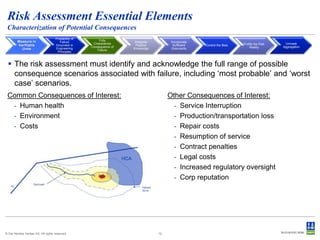
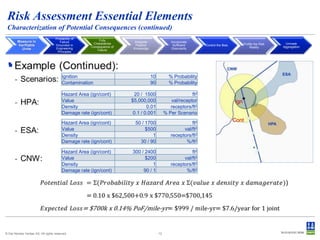
 The risk assessment must identify and acknowledge the full range of possible
consequence scenarios associated with failure, including ‘most probable’ and ‘worst
case’ scenarios.
Common Consequences of Interest:
- Human health
- Environment
- Costs

© Det Norske Veritas AS. All rights reserved.

Other Consequences of Interest:
- Service Interruption
- Production/transportation loss
- Repair costs
- Resumption of service
- Contract penalties
- Legal costs
- Increased regulatory oversight
- Corp reputation

12
Risk Assessment Essential Elements
Characterization of Potential Consequences (continued)
Measure in
Verifiable
Units

Probability of
Failure
Grounded in
Engineering
Principles

Fully
Characterize
Consequence of
Failure

Integrate
Pipeline
Knowledge

Incorporate
Sufficient
Granularity

Profile the Risk
Reality

Control the Bias


Ignition
Contamination

10
90

% Probability
% Probability

Hazard Area (ign/cont)
Value
Density
Damage rate (ign/cont)

20 / 1500
$5,000,000
0.01
0.1 / 0.001

ft2
val/receptor
receptors/ft2
% Per Scenario

Hazard Area (ign/cont)
Value
Density
Damage rate (ign/cont)

50 / 1700
$500
1
30 / 90

ft2
val/ft2
receptors/ft2
%/ft2

Hazard Area (ign/cont)
Value
Density
Damage rate (ign/cont)

300 / 2400
$200
1
90 / 1

ft2
val/ft2
receptors/ft2
%/ft2

© Det Norske Veritas AS. All rights reserved.

13

Ign

Cont

Unmask
Aggregation
Risk Assessment Essential Elements
Full Integration of Pipeline / Facility Knowledge
Measure in
Verifiable
Units

Probability of
Failure
Grounded in
Engineering
Principles

Fully
Characterize
Consequence of
Failure

Integrate
Pipeline
Knowledge

Incorporate
Sufficient
Granularity

Control the Bias

Profile the Risk
Reality

Unmask
Aggregation

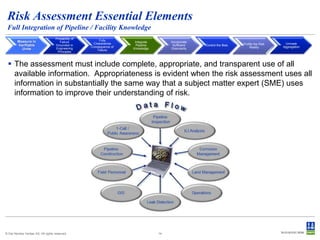
 The assessment must include complete, appropriate, and transparent use of all
available information. Appropriateness is evident when the risk assessment uses all
information in substantially the same way that a subject matter expert (SME) uses
information to improve their understanding of risk.

© Det Norske Veritas AS. All rights reserved.

14
Risk Assessment Essential Elements
Sufficient Granularity
Measure in
Verifiable
Units

Probability of
Failure
Grounded in
Engineering
Principles

Fully
Characterize
Consequence of
Failure

Integrate
Pipeline
Knowledge

Incorporate
Sufficient
Granularity

Control the Bias

Profile the Risk
Reality

Unmask
Aggregation

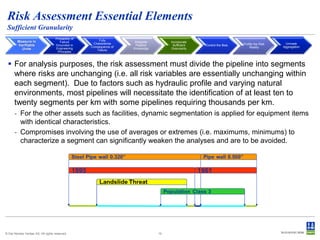
 For analysis purposes, the risk assessment must divide the pipeline into segments
where risks are unchanging (i.e. all risk variables are essentially unchanging within
each segment). Due to factors such as hydraulic profile and varying natural
environments, most pipelines will necessitate the identification of at least ten to
twenty segments per km with some pipelines requiring thousands per km.
- For the other assets such as facilities, dynamic segmentation is applied for equipment items
with identical characteristics.
- Compromises involving the use of averages or extremes (i.e. maximums, minimums) to
characterize a segment can significantly weaken the analyses and are to be avoided.

© Det Norske Veritas AS. All rights reserved.

15
Risk Assessment Essential Elements
Bias Management
Measure in
Verifiable
Units

Probability of
Failure
Grounded in
Engineering
Principles

Fully
Characterize
Consequence of
Failure

Integrate
Pipeline
Knowledge

Incorporate
Sufficient
Granularity

Control the Bias

Profile the Risk
Reality

Unmask
Aggregation

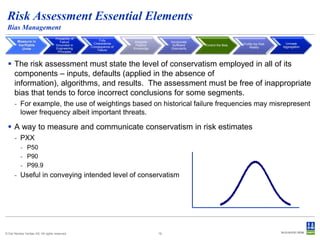
 The risk assessment must state the level of conservatism employed in all of its
components – inputs, defaults (applied in the absence of
information), algorithms, and results. The assessment must be free of inappropriate
bias that tends to force incorrect conclusions for some segments.
- For example, the use of weightings based on historical failure frequencies may misrepresent
lower frequency albeit important threats.

 A way to measure and communicate conservatism in risk estimates
- PXX
- P50
- P90
- P99.9

- Useful in conveying intended level of conservatism

© Det Norske Veritas AS. All rights reserved.

16
Risk Assessment Essential Elements
Profiles of Risk
Measure in
Verifiable
Units

Probability of
Failure
Grounded in
Engineering
Principles

Fully
Characterize
Consequence of
Failure

Integrate
Pipeline
Knowledge

Incorporate
Sufficient
Granularity

Control the Bias

Profile the Risk
Reality

Unmask
Aggregation

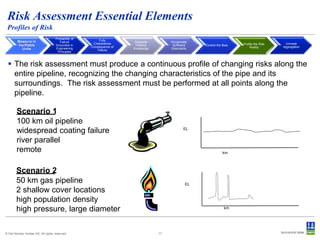
 The risk assessment must produce a continuous profile of changing risks along the
entire pipeline, recognizing the changing characteristics of the pipe and its
surroundings. The risk assessment must be performed at all points along the
pipeline.
Scenario 1
100 km oil pipeline
widespread coating failure
river parallel
remote

EL

km

Scenario 2
50 km gas pipeline
2 shallow cover locations
high population density
high pressure, large diameter
© Det Norske Veritas AS. All rights reserved.

EL

km

17
Risk Assessment Essential Elements
Profiles of Risk (continued)
Measure in
Verifiable
Units

Probability of
Failure
Grounded in
Engineering
Principles

Fully
Characterize
Consequence of
Failure

Integrate
Pipeline
Knowledge

Incorporate
Sufficient
Granularity

 Passing the ‘Map Point’ Test

© Det Norske Veritas AS. All rights reserved.

18

Control the Bias

Profile the Risk
Reality

Unmask
Aggregation
Risk Assessment Essential Elements
Proper Aggregation
Measure in
Verifiable
Units

Probability of
Failure
Grounded in
Engineering
Principles

Fully
Characterize
Consequence of
Failure

Integrate
Pipeline
Knowledge

Incorporate
Sufficient
Granularity

Control the Bias

Profile the Risk
Reality

Unmask
Aggregation

 A proper process for aggregation of the risks from multiple pipeline segments must
be included.

 Summarization of the risks from multiple segments must avoid simple statistics or
weighted statistics that mask the actual risks
PoF total = PoF1 + PoF2 + PoF3 + PoF4 + … PoFn
PoF total = Avg(PoF1, PoF2, … PoFn)
Overall PoF is probability of failure by [(thd pty) OR (corr) OR (geohaz)…]
Ps = 1 - PoF

Overall Ps is probability of surviving [(thd pty) AND (corr) AND (geohaz)….]
So…
PoFoverall = 1-[(1-PoFthdpty) x (1-PoFcorr) x (1-PoFgeohaz) x (1-PoFincops)]

© Det Norske Veritas AS. All rights reserved.

19
Intended Outcomes of Application of EE’s
 Efficient and transparent risk modeling
 Accurate, verifiable, and complete results
 Improved understanding of actual risk
 Risk-based input to guide integrity decision-making: true risk management

 Optimized resource allocation leading to higher levels of public
safety
 Appropriate level of standardization facilitating smoother regulatory audits
- Does not stifle creativity
- Does not dictate all aspects of the process
- Avoids need for (high-overhead) prescriptive documentation

 Expectations of regulators, the public, and operators fulfilled

© Det Norske Veritas AS. All rights reserved.

20
Safeguarding life, property
and the environment
www.dnv.com

© Det Norske Veritas AS. All rights reserved.

21

Mangold essential elements of risk assessment

  • 1.
    Essential Elements ofRisk Assessment David Mangold and Kent Muhlbauer David.Mangold@DNV.com Kent.Muhlbauer@DNV.com
  • 2.
    Risk Assessment: Regulationsvs Guidance Docs Objectives (a) prioritization of pipelines/segments for scheduling integrity assessments and mitigating action (b) assessment of the benefits derived from mitigating action (c) determination of the most effective mitigation measures for the identified threats (d) assessment of the integrity impact from modified inspection intervals (e) assessment of the use of or need for alternative inspection methodologies Techniques (f) more effective resource allocation • • • • Subject Matter Experts Relative Assessments Scenario Assessments Probabilistic Assessments Numbers Needed •Failure rate estimates for each threat on each PL segment •Mitigation effectiveness for each contemplated measure •Time to Failure (TTF) estimates (time-dep threats) ASME B31.8S, Section 5 © Det Norske Veritas AS. All rights reserved.
  • 3.
    Risk Assessment EssentialElements  The Essential Elements are meant to - Be common sense ingredients that make risk assessment meaningful, objective, and acceptable to all stakeholders - Be concise yet flexible, allowing tailored solutions (not a recipe) to situation-specific concerns - Lead to smarter risk assessment  The elements are meant to supplement, not replace, guidance, recommended practice, and regulations already in place © Det Norske Veritas AS. All rights reserved. 3
  • 4.
    Risk Assessment EssentialElements Measurements in Verifiable Units Proper Probability of Failure Assessment Characterization of Potential Consequences Full Integration of Pipeline Knowledge Sufficient Granularity Bias Management Profiles of Risk Proper Aggregation © Det Norske Veritas AS. All rights reserved. 4
  • 5.
    Risk Assessment EssentialElements Measurements in Verifiable Units Measure in Verifiable Units Probability of Failure Grounded in Engineering Principles Fully Characterize Consequence of Failure Integrate Pipeline Knowledge Incorporate Sufficient Granularity Control the Bias Profile the Risk Reality Unmask Aggregation  The risk assessment must include a definition of ‘failure’ and produce verifiable estimates of failure potential. Therefore, the risk assessment must produce a measure of probability of failure (PoF) and a measure of potential consequence.  Both must be expressed in verifiable and commonly used measurement units, free from intermediate schemes (such as scoring or point assignments). Failure probability, which can also be expressed as a frequency, must capture effects of length and time, leading to a risk estimates such as: •Incidents per mile-year •Fatalities per mile-year •Dollars per km-decade conseq © Det Norske Veritas AS. All rights reserved. prob 5
  • 6.
    Risk Assessment EssentialElements Proper Probability of Failure Assessment Measure in Verifiable Units Probability of Failure Grounded in Engineering Principles Fully Characterize Consequence of Failure Integrate Pipeline Knowledge Incorporate Sufficient Granularity Control the Bias Profile the Risk Reality Unmask Aggregation  All plausible failure mechanisms must be included in the assessment of PoF. Every failure mechanism must have the following three elements independently measured: - Exposure (attack) – The type and unmitigated aggressiveness of the force or process that may precipitate failure. Example measurement units are ‘events per mile-year’ or ‘mils per year metal loss’. - Mitigation (defense) – The type and effectiveness of every mitigation measure designed to block or reduce an exposure. The benefit from each independent mitigation measure, coupled with the combined effects of all mitigations, is to be estimated. - Resistance (survivability) – The inherent ability of a pipeline to sustain forces and deformations in the event of mitigation failure. Resistance characteristics are to be evaluated separately to determine the probability of ‘damage without failure’ vs. ‘damage resulting in failure’. E/M/R © Det Norske Veritas AS. All rights reserved. Release 6 Mitigated Consequences Detection and Control Barriers Resistance Exposure Mitigation
  • 7.
    Risk Assessment EssentialElements Proper Probability of Failure Assessment (continued) Measure in Verifiable Units Probability of Failure Grounded in Engineering Principles Fully Characterize Consequence of Failure Integrate Pipeline Knowledge Incorporate Sufficient Granularity Control the Bias Profile the Risk Reality Unmask Aggregation  Estimating Threat Exposure - Events per km-year (mile-yr) for time independent mechanism - Third party - Incorrect operations - Weather & land movements - mm/yr (MPY) for degradation mechanisms - External corrosion - Internal corrosion - Cracking (EAC / fatigue) © Det Norske Veritas AS. All rights reserved. 7
  • 8.
    Risk Assessment EssentialElements Proper Probability of Failure Assessment (continued) Measure in Verifiable Units Probability of Failure Grounded in Engineering Principles Fully Characterize Consequence of Failure Integrate Pipeline Knowledge Incorporate Sufficient Granularity Unmask Aggregation Profile the Risk Reality Control the Bias  Measuring Mitigation Strong, single measure Or Accumulation of lesser measures 1 - (remaining threat) Remaining threat = (remnant from mit1) AND (remnant from mit2) (remnant from mit3) … AND Mitigation Mitigation % = 1-[(1-mit1) x (1-mit2) x (1-mit3)…] Exposure Coating © Det Norske Veritas AS. All rights reserved. 8 CP Mitigated Exposure Mitigation % =
  • 9.
    Risk Assessment EssentialElements Proper Probability of Failure Assessment (continued) Measure in Verifiable Units Probability of Failure Grounded in Engineering Principles Fully Characterize Consequence of Failure Integrate Pipeline Knowledge Incorporate Sufficient Granularity Control the Bias Profile the Risk Reality  Estimating Resistance - Pipe spec (original) - Historical Issues - - Required pipe strength - Normal internal pressure - Normal external loadings Low toughness Hard spots Seam type Manufacturing - Pipe spec (current) - ILI measurements Calculations from pressure test Visual inspections Effect of estimated degradations © Det Norske Veritas AS. All rights reserved. 9 Unmask Aggregation
  • 10.
    Risk Assessment EssentialElements Proper Probability of Failure Assessment (continued) Measure in Verifiable Units Probability of Failure Grounded in Engineering Principles Fully Characterize Consequence of Failure Integrate Pipeline Knowledge Incorporate Sufficient Granularity Control the Bias Profile the Risk Reality  Probability of Damage (PoD) = exposure x (1 - mitigation)  Probability of Failure (PoF) = PoD x (1- resistance) {PoF = exposure x (1 - mitigation) x (1 - resistance)}  PoF (time-dependent) = 1-e-1/TTF = exposure * (1 – mitigation) / resistance (example only) Exposure Mitigation Resistance © Det Norske Veritas AS. All rights reserved. PoD* PoF 10 Unmask Aggregation
  • 11.
    Risk Assessment EssentialElements Proper Probability of Failure Assessment (continued) Measure in Verifiable Units Probability of Failure Grounded in Engineering Principles Fully Characterize Consequence of Failure Integrate Pipeline Knowledge Incorporate Sufficient Granularity  © Det Norske Veritas AS. All rights reserved. 11 Control the Bias Profile the Risk Reality Unmask Aggregation
  • 12.
    Risk Assessment EssentialElements Characterization of Potential Consequences Measure in Verifiable Units Probability of Failure Grounded in Engineering Principles Fully Characterize Consequence of Failure Integrate Pipeline Knowledge Incorporate Sufficient Granularity Control the Bias Profile the Risk Reality Unmask Aggregation  The risk assessment must identify and acknowledge the full range of possible consequence scenarios associated with failure, including ‘most probable’ and ‘worst case’ scenarios. Common Consequences of Interest: - Human health - Environment - Costs © Det Norske Veritas AS. All rights reserved. Other Consequences of Interest: - Service Interruption - Production/transportation loss - Repair costs - Resumption of service - Contract penalties - Legal costs - Increased regulatory oversight - Corp reputation 12
  • 13.
    Risk Assessment EssentialElements Characterization of Potential Consequences (continued) Measure in Verifiable Units Probability of Failure Grounded in Engineering Principles Fully Characterize Consequence of Failure Integrate Pipeline Knowledge Incorporate Sufficient Granularity Profile the Risk Reality Control the Bias  Ignition Contamination 10 90 % Probability % Probability Hazard Area (ign/cont) Value Density Damage rate (ign/cont) 20 / 1500 $5,000,000 0.01 0.1 / 0.001 ft2 val/receptor receptors/ft2 % Per Scenario Hazard Area (ign/cont) Value Density Damage rate (ign/cont) 50 / 1700 $500 1 30 / 90 ft2 val/ft2 receptors/ft2 %/ft2 Hazard Area (ign/cont) Value Density Damage rate (ign/cont) 300 / 2400 $200 1 90 / 1 ft2 val/ft2 receptors/ft2 %/ft2 © Det Norske Veritas AS. All rights reserved. 13 Ign Cont Unmask Aggregation
  • 14.
    Risk Assessment EssentialElements Full Integration of Pipeline / Facility Knowledge Measure in Verifiable Units Probability of Failure Grounded in Engineering Principles Fully Characterize Consequence of Failure Integrate Pipeline Knowledge Incorporate Sufficient Granularity Control the Bias Profile the Risk Reality Unmask Aggregation  The assessment must include complete, appropriate, and transparent use of all available information. Appropriateness is evident when the risk assessment uses all information in substantially the same way that a subject matter expert (SME) uses information to improve their understanding of risk. © Det Norske Veritas AS. All rights reserved. 14
  • 15.
    Risk Assessment EssentialElements Sufficient Granularity Measure in Verifiable Units Probability of Failure Grounded in Engineering Principles Fully Characterize Consequence of Failure Integrate Pipeline Knowledge Incorporate Sufficient Granularity Control the Bias Profile the Risk Reality Unmask Aggregation  For analysis purposes, the risk assessment must divide the pipeline into segments where risks are unchanging (i.e. all risk variables are essentially unchanging within each segment). Due to factors such as hydraulic profile and varying natural environments, most pipelines will necessitate the identification of at least ten to twenty segments per km with some pipelines requiring thousands per km. - For the other assets such as facilities, dynamic segmentation is applied for equipment items with identical characteristics. - Compromises involving the use of averages or extremes (i.e. maximums, minimums) to characterize a segment can significantly weaken the analyses and are to be avoided. © Det Norske Veritas AS. All rights reserved. 15
  • 16.
    Risk Assessment EssentialElements Bias Management Measure in Verifiable Units Probability of Failure Grounded in Engineering Principles Fully Characterize Consequence of Failure Integrate Pipeline Knowledge Incorporate Sufficient Granularity Control the Bias Profile the Risk Reality Unmask Aggregation  The risk assessment must state the level of conservatism employed in all of its components – inputs, defaults (applied in the absence of information), algorithms, and results. The assessment must be free of inappropriate bias that tends to force incorrect conclusions for some segments. - For example, the use of weightings based on historical failure frequencies may misrepresent lower frequency albeit important threats.  A way to measure and communicate conservatism in risk estimates - PXX - P50 - P90 - P99.9 - Useful in conveying intended level of conservatism © Det Norske Veritas AS. All rights reserved. 16
  • 17.
    Risk Assessment EssentialElements Profiles of Risk Measure in Verifiable Units Probability of Failure Grounded in Engineering Principles Fully Characterize Consequence of Failure Integrate Pipeline Knowledge Incorporate Sufficient Granularity Control the Bias Profile the Risk Reality Unmask Aggregation  The risk assessment must produce a continuous profile of changing risks along the entire pipeline, recognizing the changing characteristics of the pipe and its surroundings. The risk assessment must be performed at all points along the pipeline. Scenario 1 100 km oil pipeline widespread coating failure river parallel remote EL km Scenario 2 50 km gas pipeline 2 shallow cover locations high population density high pressure, large diameter © Det Norske Veritas AS. All rights reserved. EL km 17
  • 18.
    Risk Assessment EssentialElements Profiles of Risk (continued) Measure in Verifiable Units Probability of Failure Grounded in Engineering Principles Fully Characterize Consequence of Failure Integrate Pipeline Knowledge Incorporate Sufficient Granularity  Passing the ‘Map Point’ Test © Det Norske Veritas AS. All rights reserved. 18 Control the Bias Profile the Risk Reality Unmask Aggregation
  • 19.
    Risk Assessment EssentialElements Proper Aggregation Measure in Verifiable Units Probability of Failure Grounded in Engineering Principles Fully Characterize Consequence of Failure Integrate Pipeline Knowledge Incorporate Sufficient Granularity Control the Bias Profile the Risk Reality Unmask Aggregation  A proper process for aggregation of the risks from multiple pipeline segments must be included.  Summarization of the risks from multiple segments must avoid simple statistics or weighted statistics that mask the actual risks PoF total = PoF1 + PoF2 + PoF3 + PoF4 + … PoFn PoF total = Avg(PoF1, PoF2, … PoFn) Overall PoF is probability of failure by [(thd pty) OR (corr) OR (geohaz)…] Ps = 1 - PoF Overall Ps is probability of surviving [(thd pty) AND (corr) AND (geohaz)….] So… PoFoverall = 1-[(1-PoFthdpty) x (1-PoFcorr) x (1-PoFgeohaz) x (1-PoFincops)] © Det Norske Veritas AS. All rights reserved. 19
  • 20.
    Intended Outcomes ofApplication of EE’s  Efficient and transparent risk modeling  Accurate, verifiable, and complete results  Improved understanding of actual risk  Risk-based input to guide integrity decision-making: true risk management  Optimized resource allocation leading to higher levels of public safety  Appropriate level of standardization facilitating smoother regulatory audits - Does not stifle creativity - Does not dictate all aspects of the process - Avoids need for (high-overhead) prescriptive documentation  Expectations of regulators, the public, and operators fulfilled © Det Norske Veritas AS. All rights reserved. 20
  • 21.
    Safeguarding life, property andthe environment www.dnv.com © Det Norske Veritas AS. All rights reserved. 21

Editor's Notes

  • #2 Thank you for having me hear to speakMy nameI’m here on behalf of Kent Muhlbauer, world renowned leader on pipeline risk management. Mr Muhlbauer regrets that he cannot attend this important meeting and offers his email information here for any attendee to contact him.The work that we’re about to present is a collaboration between DNV and Kent MuhlbauerBefore EE slide, discuss why I’m hereWe’eve tried to ull strengths of all thee different risk assessments together and that’s what we call the essential elementsI’ve got a lot of material here that I’m going to throw at you quicklyMy objective is to throw a lot of stuff to you, so I’d like to march quickly through this material and hit you with a lot at once
  • #3 In the US, we are currently at a cross roads of sorts. We have many older RA methodologies, not designed for IMP; we have industry standards like ASME B31.8S that have missed the mark a bit, regarding RA; we have a disconnect between what the objectives of the newer pipeline regulations and the currently available guidance documents.Our regulator, PHMSA, is concerned and has issued a warning to the industry that RA must be improved. In response to that and these other concerns, we have developed the EE’s.
  • #4 Discuss PHMSA viewpoint?Not sure what to say hereFocus on ingredients, not recipesIn addition to local regs
  • #5 Here we have an overview of the essential elementsThese essential elements are a foundation to build onFirst, Measurements in Verifiable Units - We want absolute values in real world units which can hold weight with regulatorsProper PoF Assessment – We want a probability of failure calculation which is grounded in engineering principles and takes into account exposure, mitigation, and resistanceCharacterization of Potential Consequences- Want to capture full range of consequence scenariosFull Integration of Pipeline Knowledge – We want to bring in every piece of information you haveSufficient Granularity – Want to capture any time the risk of your pipeline changes, this could be due to a single valve or a populated areaBias management – Want conservatism of the assessment to be fully transparentProfiles of Risk – We want a continuous profile of risk along the entire pipelineProper Aggregation – I will go over the equations we have at our disposal to properly aggregate risk and account for all threats impacting a pipelineNow I will dive a little deeper into each of these elements
  • #6 We start with the first element - Measurements in Verifiable UnitsNeed to clearly define failure and consequenceThen measure or estimate its occurrence over time and spaceThis allows us to produce verifiable risk estimates, free of intermediate schemes such as scoring or point assignmentsI’ve listed some example units (read slide)We are still using probability times consequence, but we have real, tangible unitsUnits embody the definition of risk (WKM)
  • #7 Our next element; Proper PoF Assessment-All plausible failure mechanisms, E-M-R-As shown on the graphic below, barrier analysis-Exposure, anything that is attacking the pipeline -Example units events/mi-yr or mils per year metal loss-Mitigation, anything you have in place to stop the exposure from ever reaching the pipe, can be multiple mitigations-Resistance, at this point the exposure has gotten past any mitigation, leaving just the pipe’s inherent ability to resist failure-The three things need to be measured independently (WKM)
  • #8 Two main approaches to exposure estimationactual incident counts for first (Events per mile-year (mile-yr) for time independent mechanism)Third Party DamageIncorrect operationsWeather and land movementspotential damage rate for second (MPY for degradation mechanisms)CorrosionCrackingFatigue
  • #9 Measuring mitigationWe want to give credit for any and all mitigations in place….. such asCPCoatingThis could be a single strong measure or several lesser measuresThere are simple equations to aggregate these mitigations and get a overall mitigation %Specify that this reduces the exposure by a certain %, the original unit remains (mpy/ events/mi-year)Limitation of previous methodologies had no or gate option (WKM)
  • #10 Estimating ResistancePipe strength is at the heart of resistance measurementsWe can use original pipe specifications, WT, gradeAlso look at historical issues such low toughness or seam typesWe also want to look at current pipe specifications gathered from inspections / FEAAlso the pipe strength for internal and external loadings
  • #11 Now that we’ve established exposure, mitigation, and resistance…. We can calculate probability of failure.We first use exposure and mitigation to calculate a probability of damageWe then use the probability of damage value and resistance to calculate probability of failure* Thankfully we don’t have a lot of failures to calibrate against. Calibration based on ILI can only be done if PoD is calculated separate.Need to say something about TTF, at core of model trying to calculate TTF for every type of threatWith that TTF we can then calculate a PoFMany different types of distributions available to do this, the Poisson distribution is shownCould call TTF remaining life instead
  • #12 Here we have an example (read slide example)The point of the slide is that the math is very simple and intuitive
  • #13 Now let’s move on to consequenceThe risk assessment must account all possible consequence scenariosThese must include most probable and worst case scenarios and account for both ignition and contaminationI’ve listed some consequences of interest which I’m sure you’re all familiar withWe want to account for all of these in the risk assessmentThe older models always focus on the worst case consequence which isn’t the full story (WKM) start with this
  • #14 Let’s continue our pervious example where we calculated a 0.14% PoF/mi-yrNow this section of the pipeline is near a highly populated area, an environmentally sensitive area, and a commercially navigable waterwayEach of these receptors will have a unit value or $/unit as well as a density or number of units/ft^2We need to calculate a hazard area for both ignition and contamination, with corresponding damage rates for eachIf you look at the image to the right of the slide you can see the hazard areas and how they intersect the pipelineWe can then use the probabilities of ignition and contamination along with the corresponding hazard areas and damage rates to get a potential lossFinally we can use our original probability value of 0.14% with our newly calculated potential loss of roughly $700,000 to get an expected loss of $7.6/year for 1 joint of pipeConsequence assessment has a lot of moving parts but it isn’t very complicatedBusy slide but the point I want to make is we have GIS tools so we can intersect square footage of all receptors, and we can tabulate all that so it comes out to simple math
  • #15 The next element is the integration of pipeline knowledgeThe RA is the engine by with you can make IM decisions, however if you’re not including the right info you’re setting it up for failureWe need to bring all available information into the risk assessmentInspectionGISSMEsWe want the assessment to use all the information in that same way an SME uses the informationLots of lists in existing standards about what info to included, collective intel of organization is to be captured
  • #16 We also need to ensure sufficient granularity in the risk assessmentWe do this with dynamic segmentationAny time the risk of a pipeline changes..This could be a WT change, a location class change, an environmental change..For any of these or other changes we need to capture it using a new segmentMost pipelines need at least 10 to 20 segments per km with some requiring thousands per kmYou could have 200 layers of information that are all producing their own segmentation which is why we want to use the computer to do this
  • #17 Another essential element of risk assessment is Bias ManagementThe risk assessment must state the level of conservatism present in all componentsWe know that there is uncertainty surrounding every measurementWe should choose to adopt a methodology of:increased uncertainty means increased riskInappropriate bias must not be present in the assessmentFor example, historical failure frequencies may misrepresent important threats for your pipelineWe can communicate conservatism using P50, P90, or P99.9This tells us where we are on the curveModel has to state what level of conservatism it’s usingManagement or public p50Doing risk management p90 or p99.9
  • #18 Now we move onto Profiles of RiskLet’s first consider the example shownWe have two very different pipelines listed hereFor scenario 1 we have an oil pipeline in a remote location with coating failure and a river running parallelFor scenario 2 we have a high pressure, large diameter gas pipeline in a high population area with 2 shallow cover locationsEven from these brief descriptions, you can easily recognize different threats, different consequence potential between the twoWe must recognize all of these changes in characteristics of the pipe and its surroundingsIn order to do this the risk assessment must produce a continuous profile of changing risks at all points along the pipelineThese 2 pipelines might have exactly the same expected loss, but the picture shows you that the risk is widely different and the risk management strategy needs to be widely differentLooking at these profiles, some risk management is obvious, but not all is obvious, you can’t begin to do risk management until you understand the profiles
  • #19 This test is often overlooked. Basically, it means that you should be able to pull out a map of your system, put your finger on any point along the pipeline and determine the risk at that point—either relative or absolute. Furthermore, you should be able to find out specifically the corrosion risk, the third party risk, the types of receptors, the spill volume, etc. This may seem an obvious thing for a risk assessment to do, but you’d be surprised how many cannot do this. Some have pre-determined their risk areas so they know little about other areas (and one must wonder about this pre-determination). Others do not retain information specific to a given location. Others don’t role up risks into summary judgments. The risk information should be a characteristic of the pipeline at all points.Alert them that this is what we're teaching our auditors to do
  • #20 Finally we must properly aggregate risksWe must avoid simple statistics that may mask the actual risks presentWe cannot add the probabilities; this only works for very small probabilities and will go over 100% if any threats have high probabilitiesWe also don’t want to take an average of probabilities; this will mask any outliers and hide the true risksWe must aggregate the risks using AND gates and OR gatesThe overall probability of failure is the probability of failure of one threat OR the nextThe overall probability of surviving us the probability of surviving one that AND the nextThis gives us an equation shown at the bottom of the slide to properly aggregate risks
  • #21 - Incidentsper mile-year,Fatalitiesper km-year,Costs per mile-decadeOur objective is the highlighted one, it’s what everybody wantsAlong the way we’ve got these other benefits while not forcing a cookbook approach