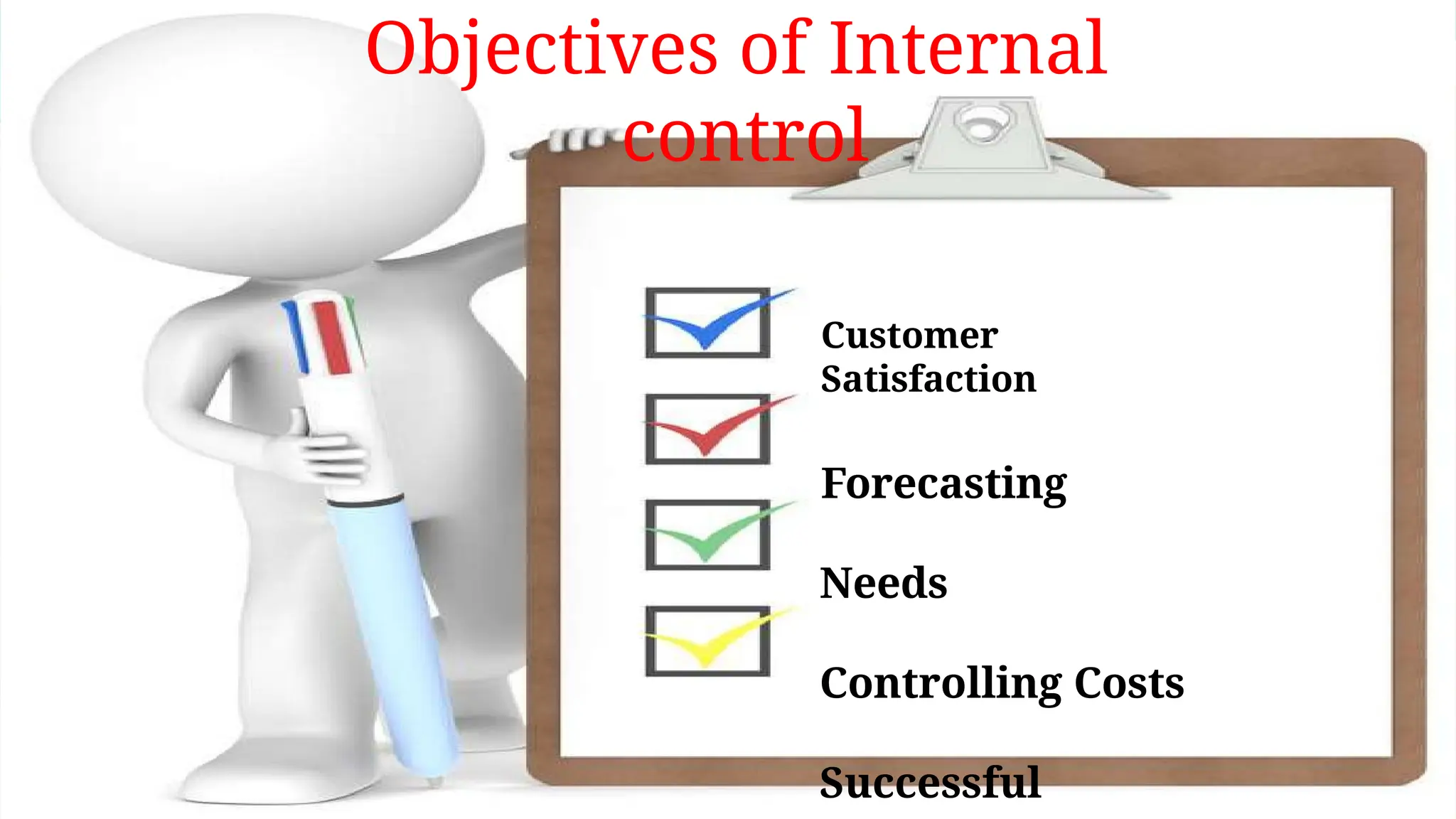
Objectives of Inventory Planning
⚫ Customer Satisfaction
⚫ Forecasting Needs
⚫ Controlling Costs
⚫ Successful Storage
Objectives of Internal
control
Customer
Satisfaction
Forecasting
Needs
Controlling Costs
Successful
Outline
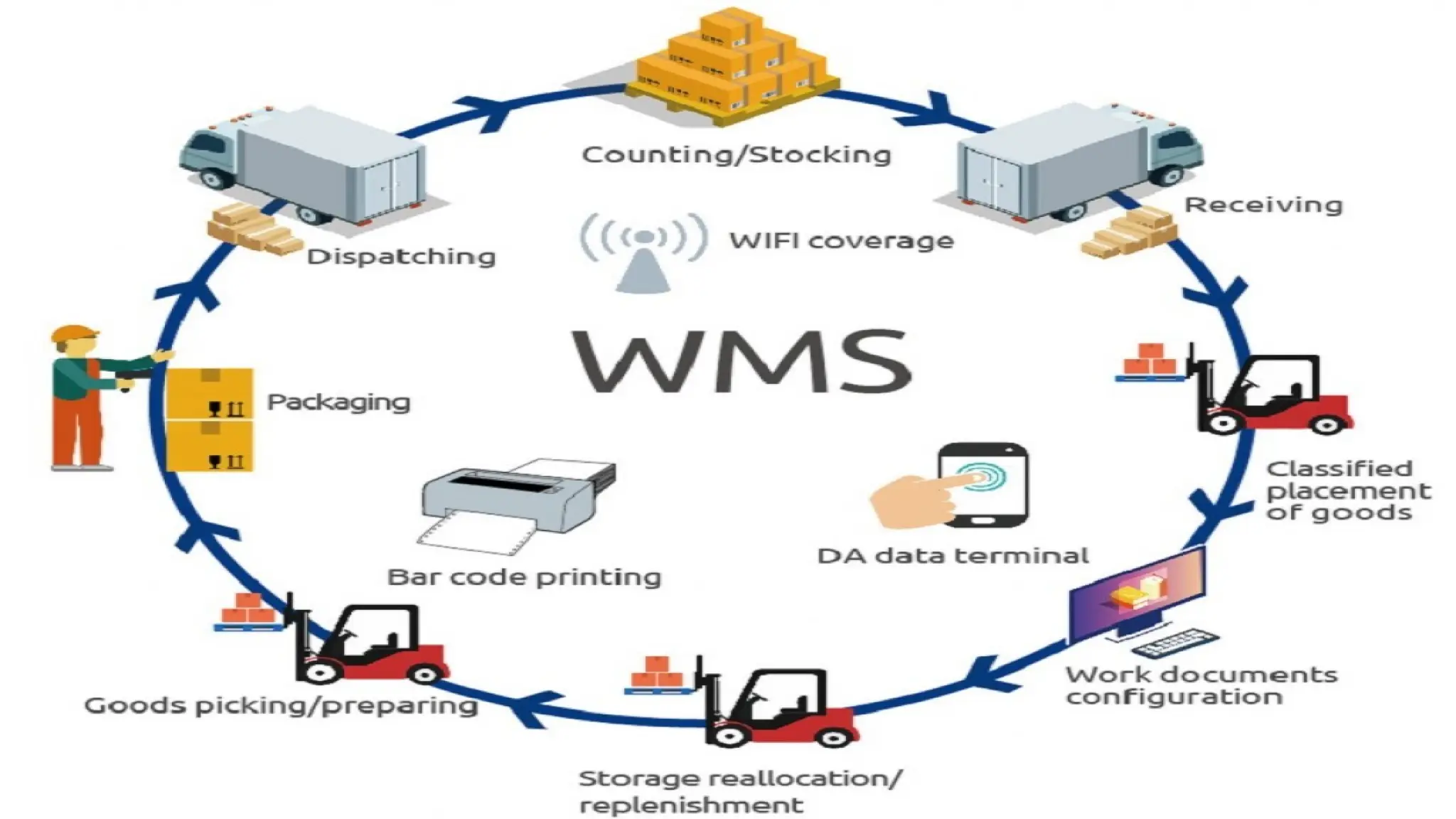
 WMS
 Picking /palletizing/offloading
 Safety
 Action plan
 WM
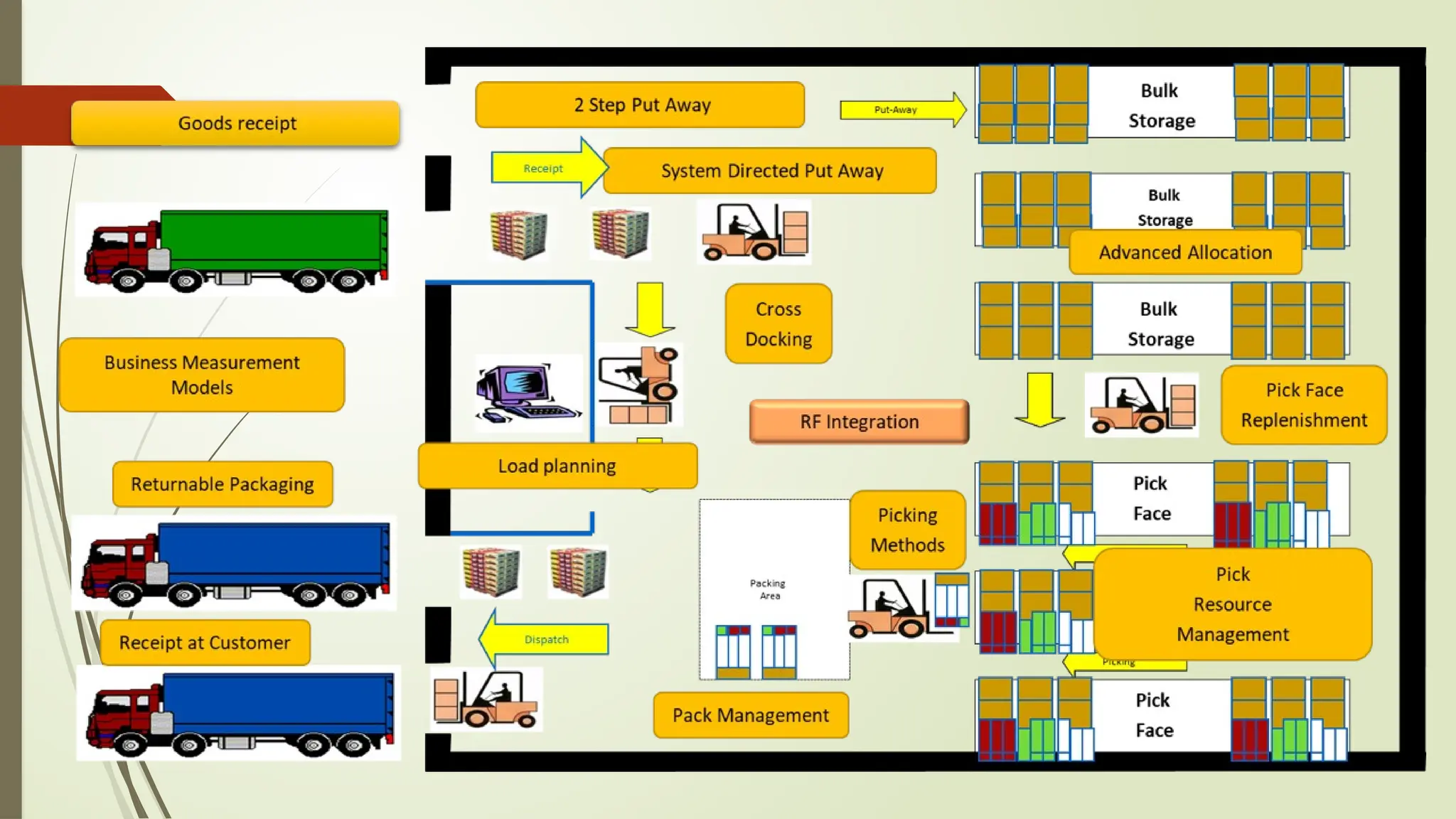
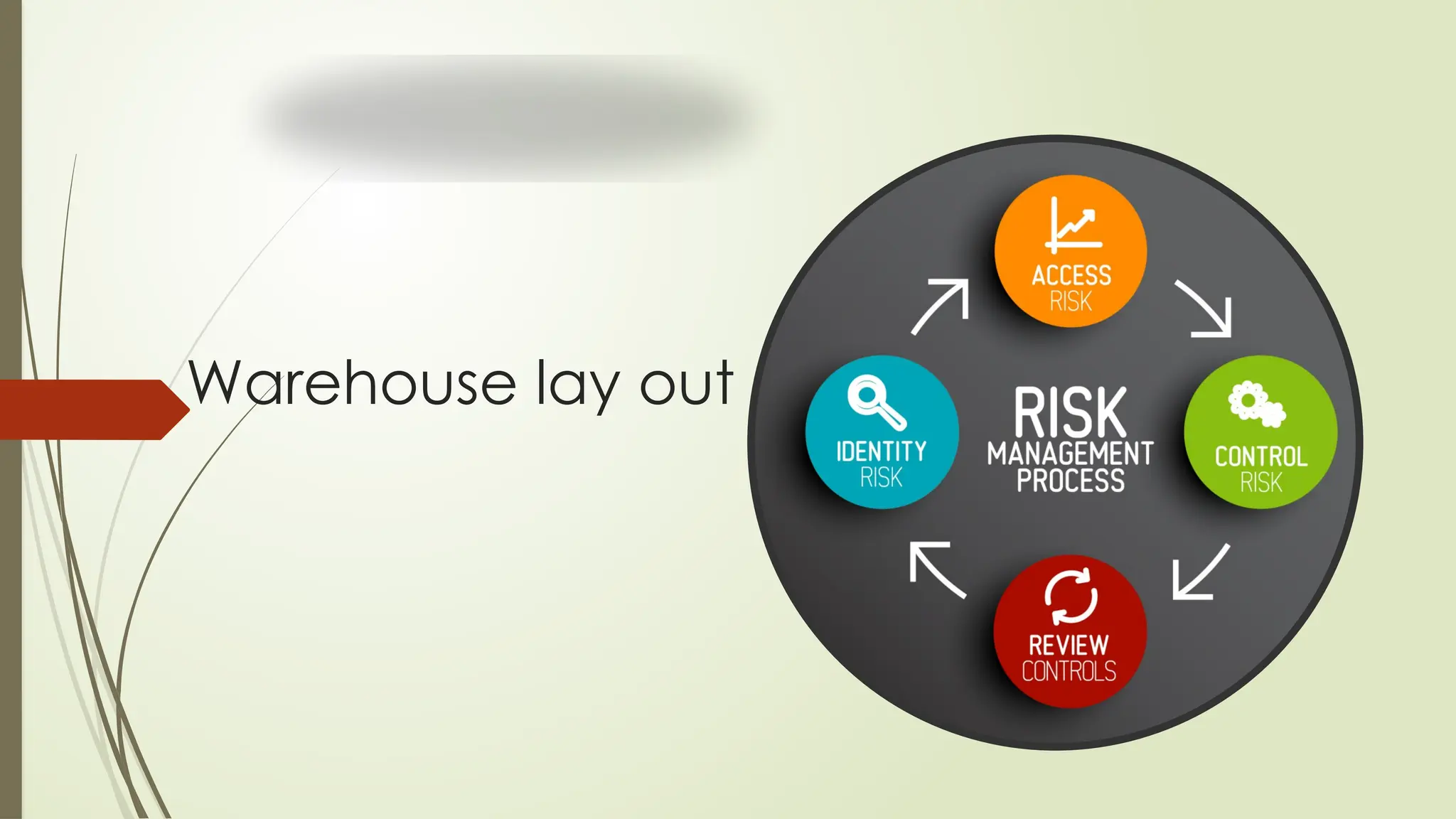
 Warehouse layout
 Zone labelling/ division numbering
 Shelf labelling
 Product layout
 Product organisation
 Personnel sub assignation
 moping
THE ROLE OF THE WAREHOUSE IN THE LOGISTICS SYSTEM
 The warehouse is where the supply chain holds or stores goods.
 Functions of warehousing include
 Transportation consolidation
 Product mixing
 Docking
 Service
 Protection against contingencies
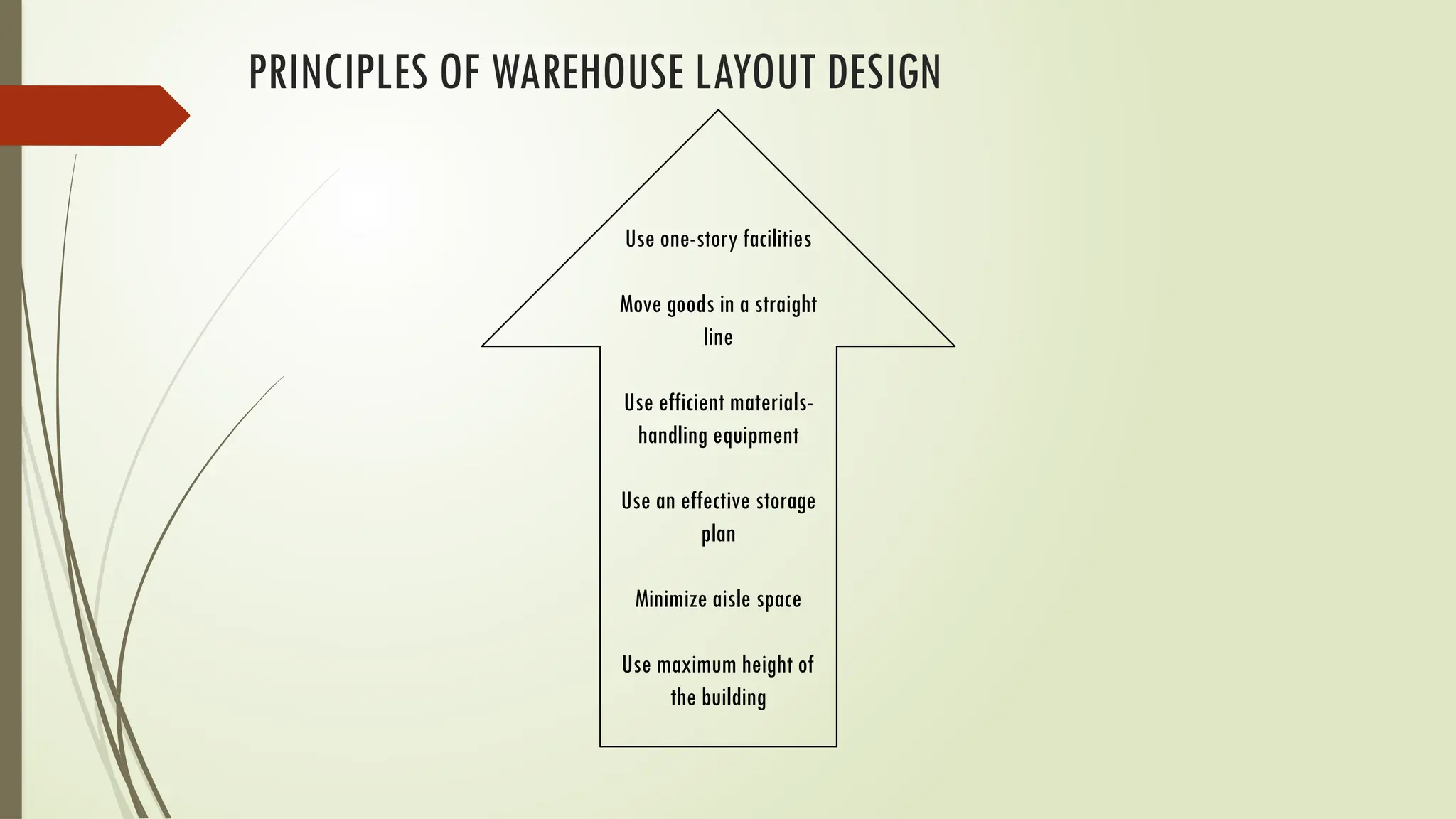
PRINCIPLES OF WAREHOUSE LAYOUT DESIGN
Use one-story facilities
Move goods in a straight
line
Use efficient materials-
handling equipment
Use an effective storage
plan
Minimize aisle space
Use maximum height of
the building
WAREHOUSE PROCESS
Put-away
•Identify Product
•Identify Product Location
•Move Products
•Update Records
Storage
•Equipment
•Stock Location
– Popularity
– Unit Size
– Cube
Shipping Preparation
•Packing
•Labeling
•Stacking
Order Picking
•Information
•Walk & Pick
•Batch Picking
Shipping
•Schedule Carrier
•Load Vehicle
•Bill of Loading
•Record Update
RECEIVING
•Schedule Carrier
•Unload Vehicle
•Inspect for damage
INPUT
OUTPUT
Service benefits of warehousing
Full Line Stocking at
United Electric’s
Distribution Center
 Spot-stocking is the positioning
of inventory for seasonal or
promotional demand
 Full line stocking provides one-
stop shopping capability for
goods from multiple suppliers
 Value-added services include
any work that creates a greater
value for customers
 See Table 10.1 for examples
OBJECTIVES OF EFFICIENT WAREHOUSE OPERATIONS
• Provide timely customer service.
• Keep track of items so they can be found readily & correctly.
• Minimize the total physical effort & thus the cost of moving goods into &
out of storage.
• Provide communication links with customers
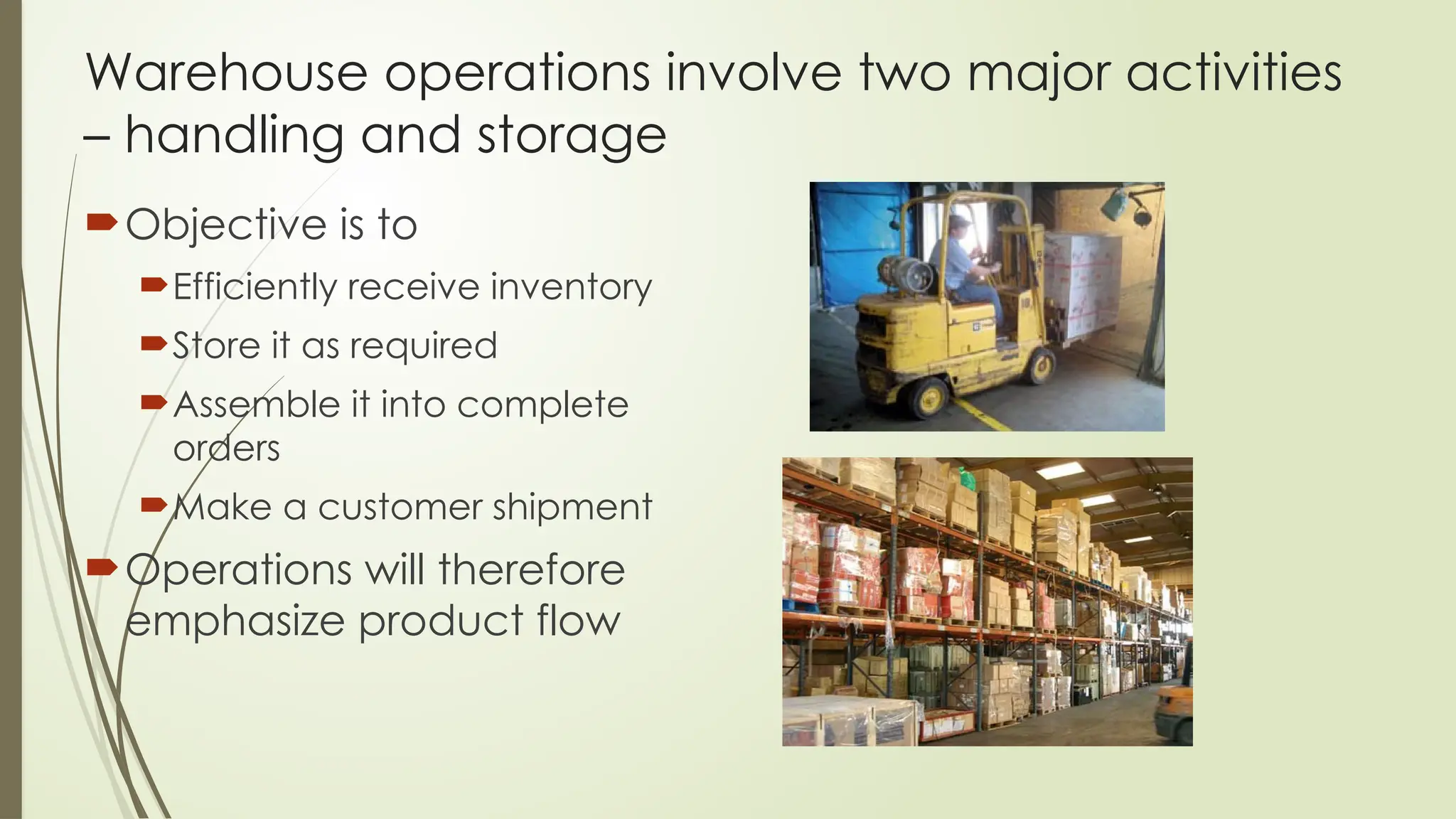
Warehouse operations involve two major activities
– handling and storage
Objective is to
Efficiently receive inventory
Store it as required
Assemble it into complete
orders
Make a customer shipment
Operations will therefore
emphasize product flow
Handling
Handling must optimize
movement continuity and
efficiency
Receiving—Unloading the
arriving vehicles
In-Storage—moving goods for
storage (transfer) or order
selection (picking)
Shipping—verifying the order
and loading the departing
vehicles
Storage plans should make product
velocity a major factor
 Slotting determines
specific locations for
the product based on
 Velocity—how fast the
goods move
 Weight—how heavy is
the product
 Special Characteristics
—how large or small,
does it require rack or
bin storage
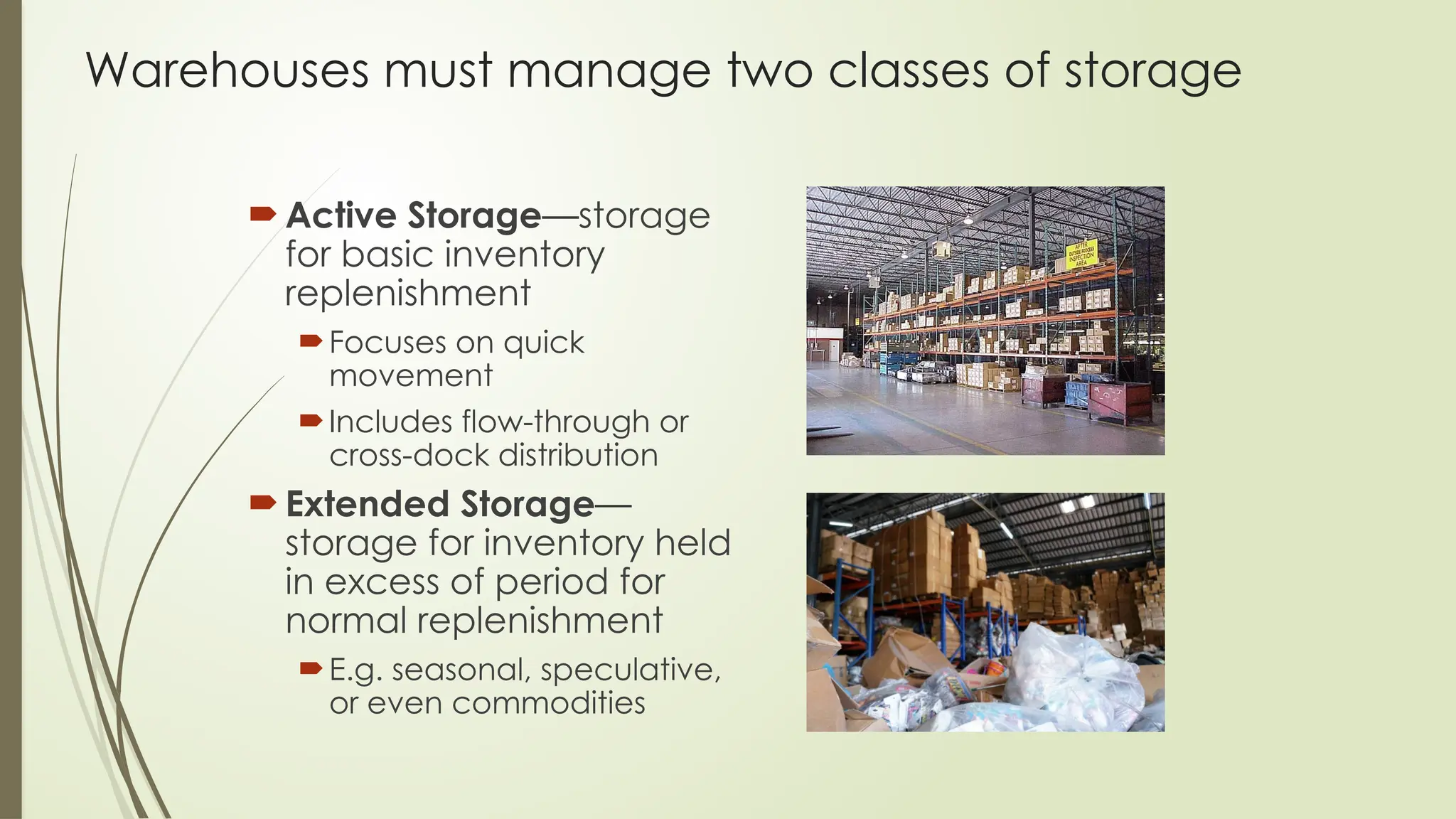
Warehouses must manage two classes of storage
 Active Storage—storage
for basic inventory
replenishment
Focuses on quick
movement
Includes flow-through or
cross-dock distribution
 Extended Storage—
storage for inventory held
in excess of period for
normal replenishment
E.g. seasonal, speculative,
or even commodities
• Warehouses processes and the associated material flow
Receiving Shipping
Reserve Storage
and
Pallet Picking
Case
Picking
Broken
Case
Picking
Accumulation, Sortation & Packing
Cross-docking
Direct
putaway
to reserve
Direct
putaway
to primary
Replenishment Replenishment
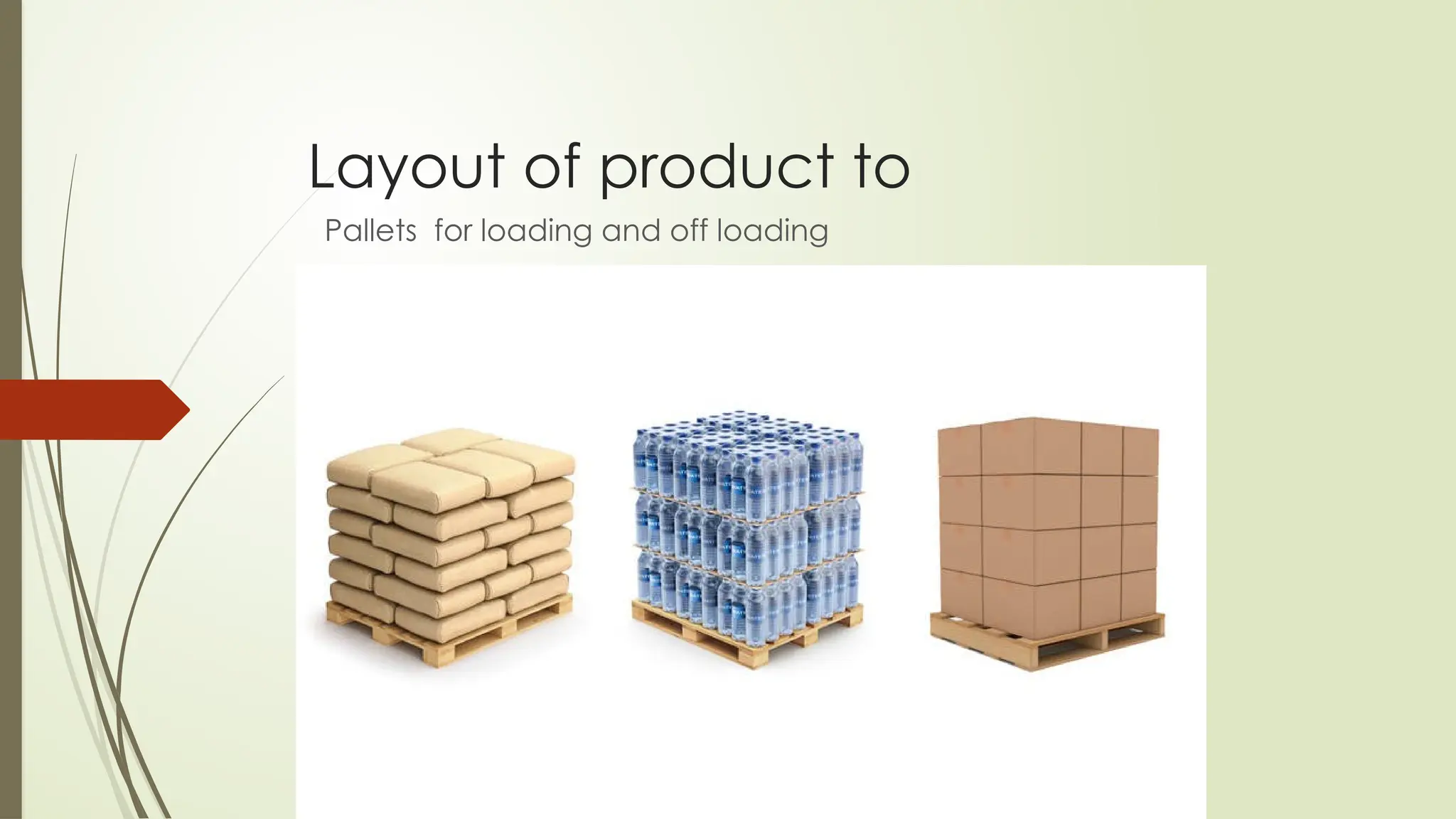
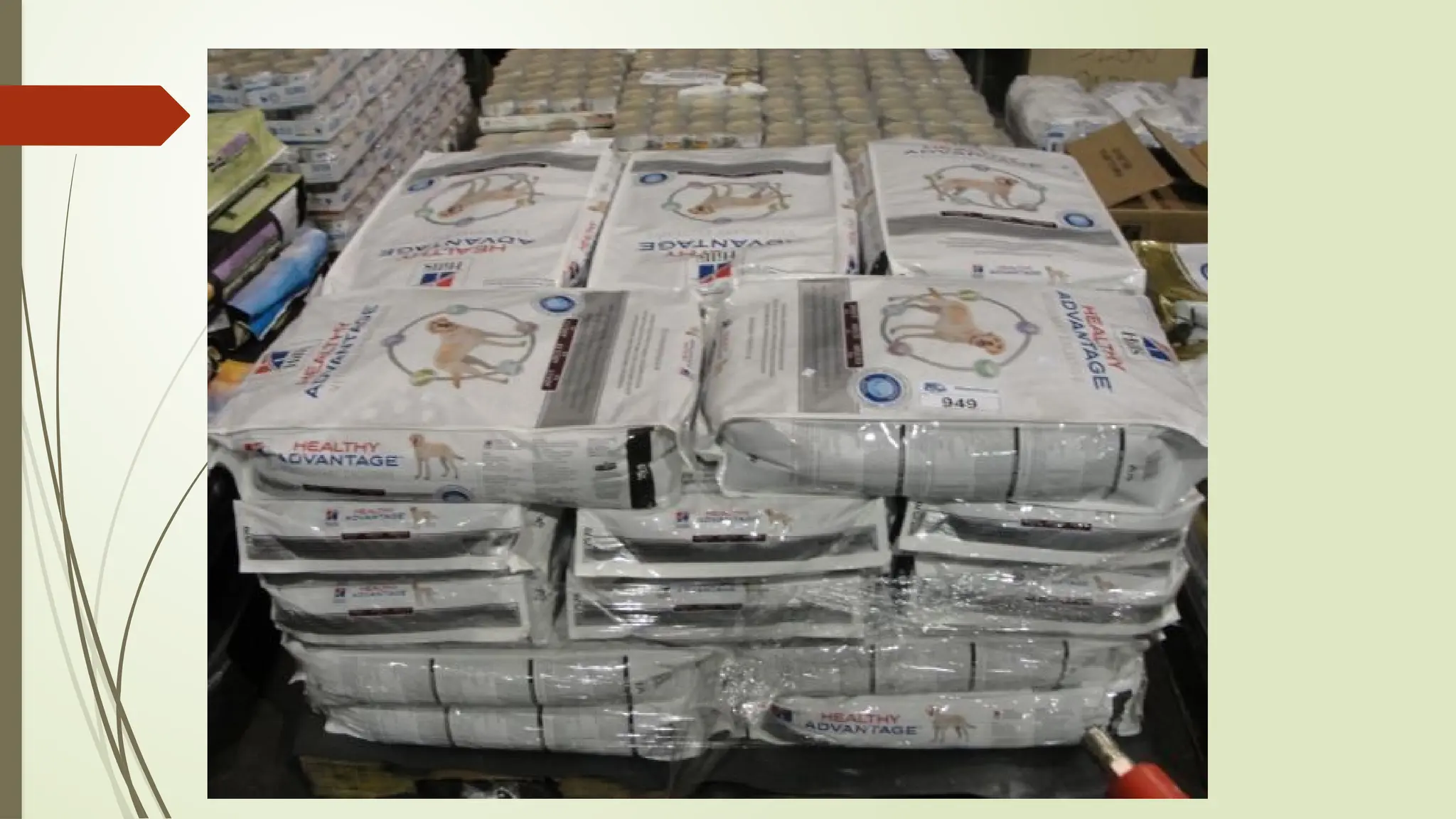
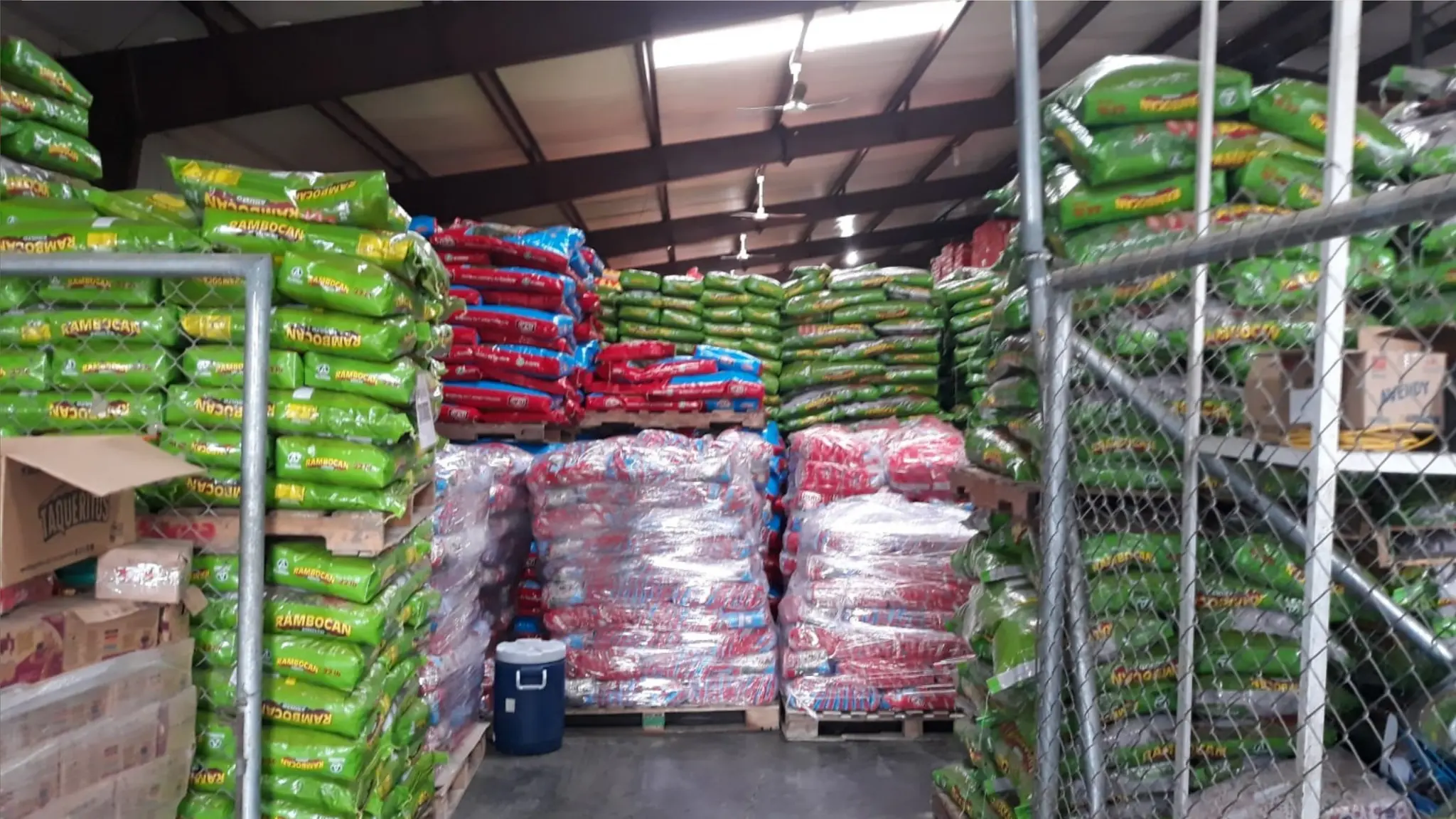
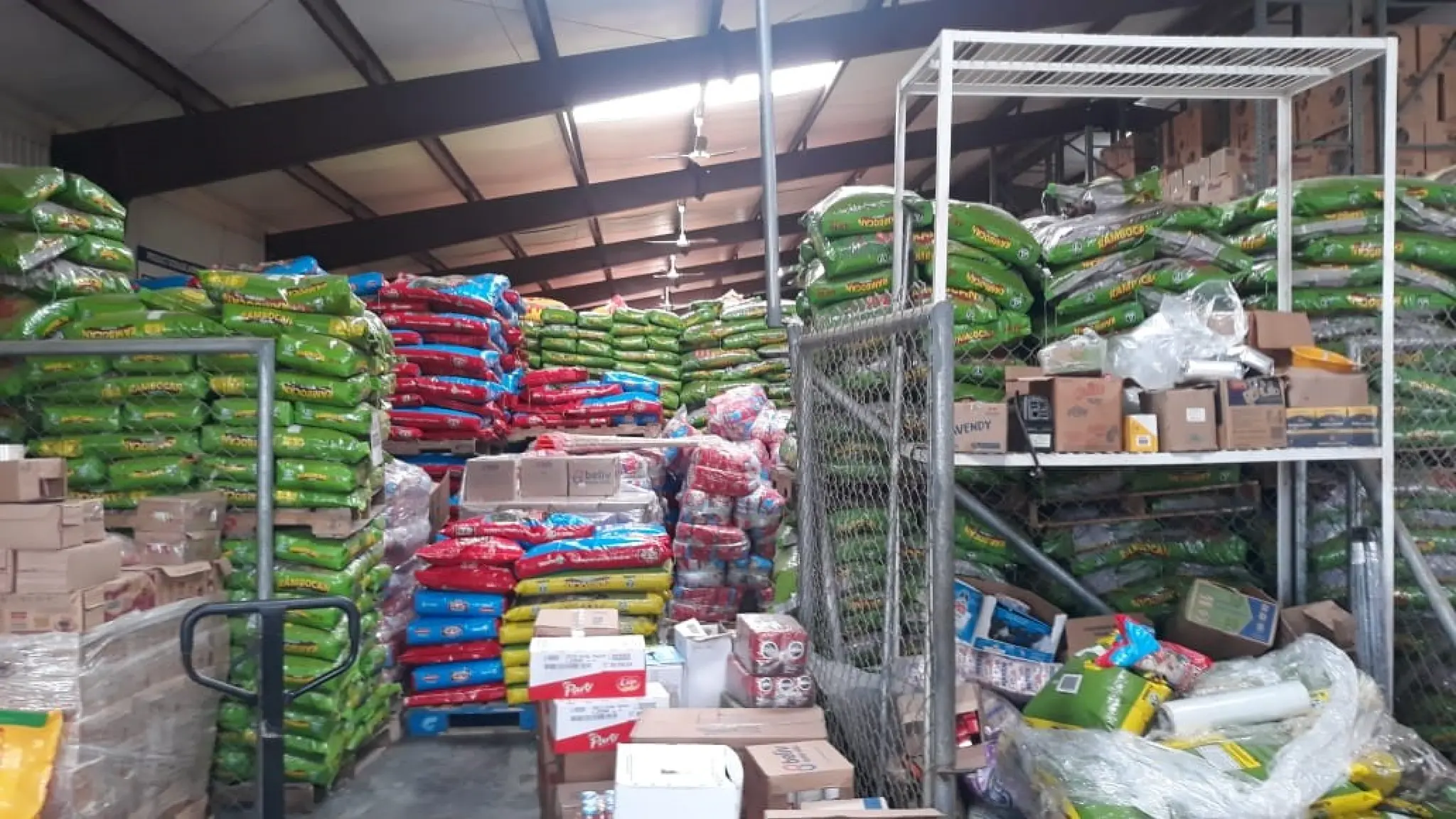
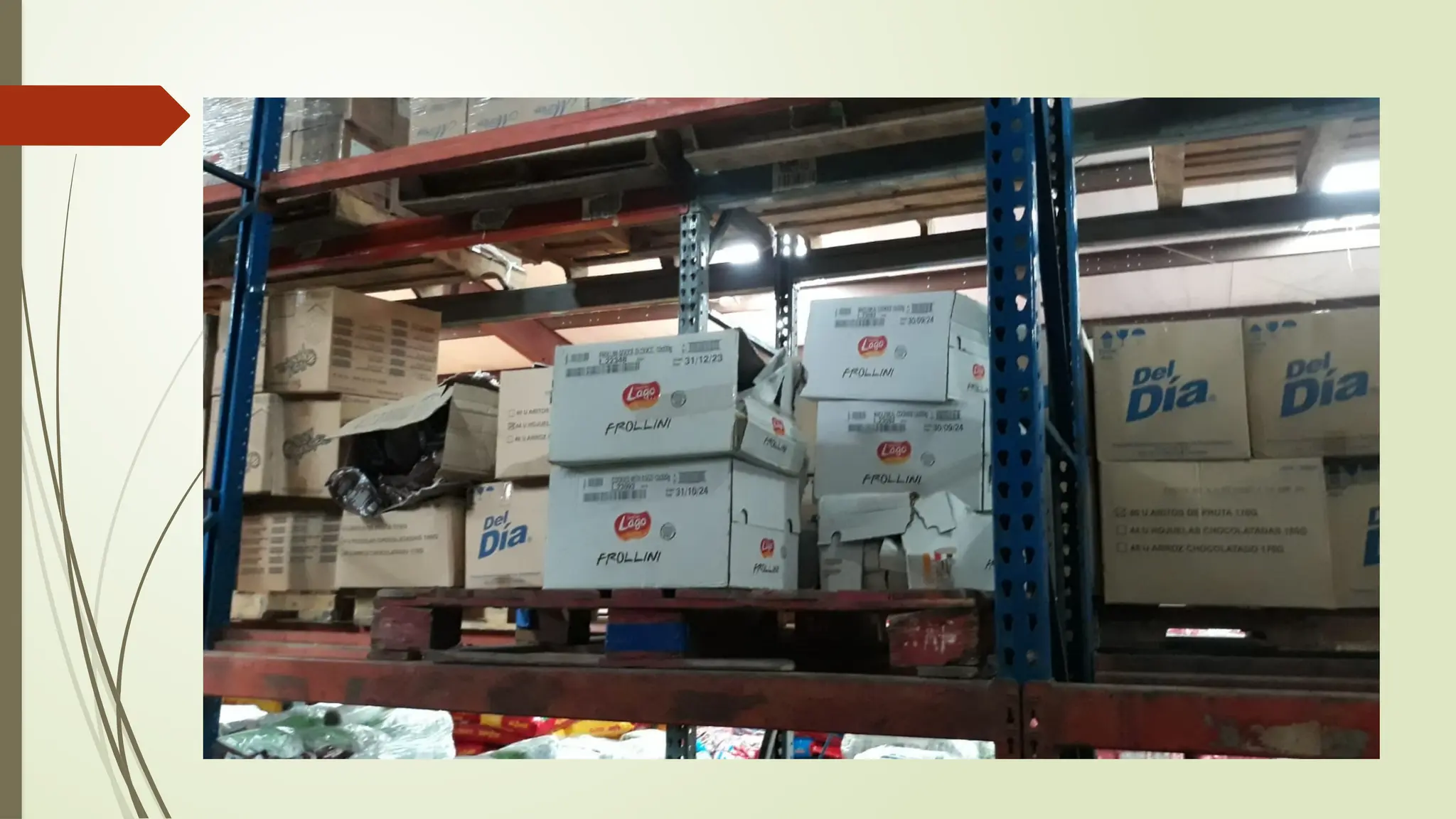
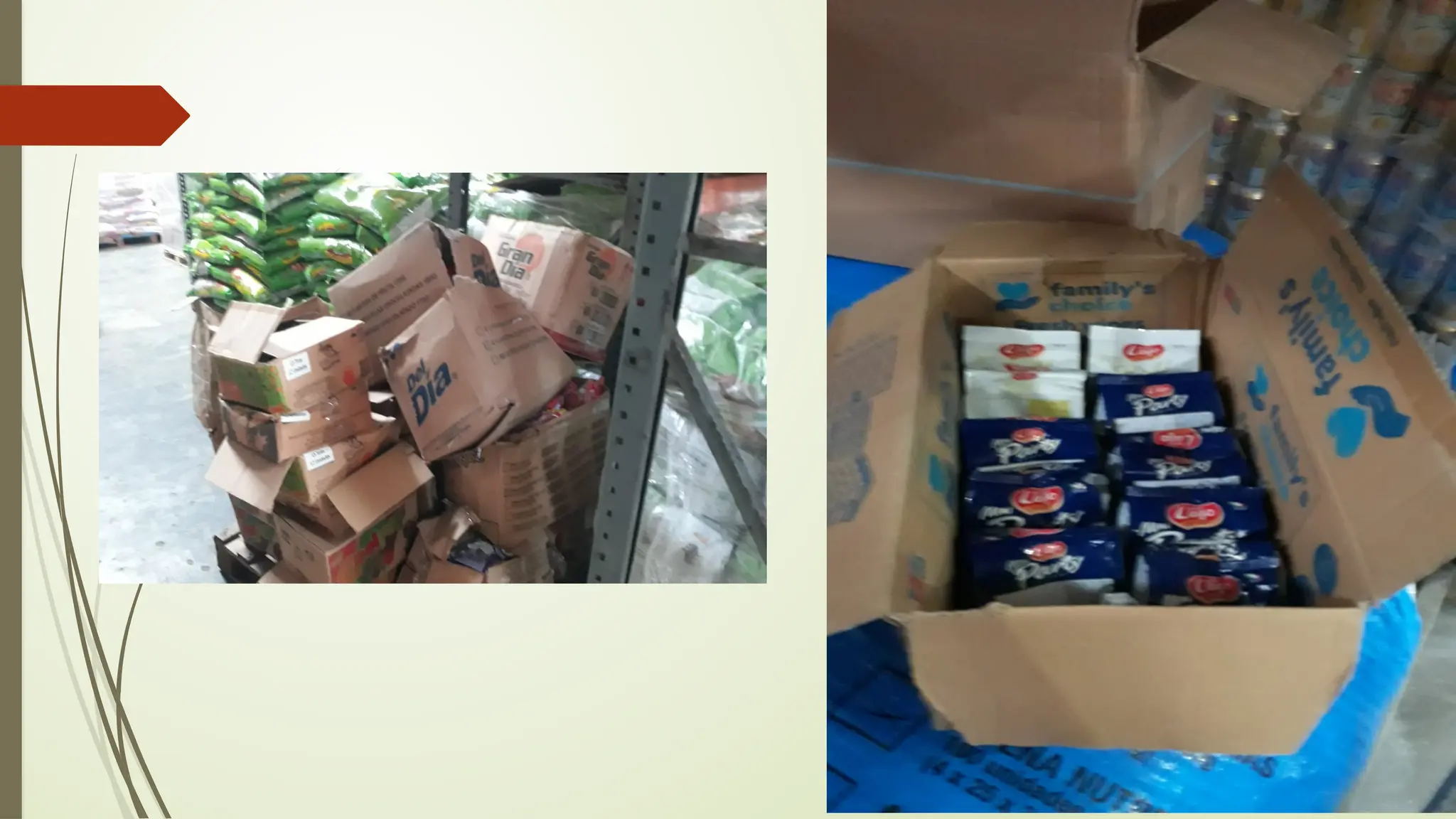
Layout of product to
Pallets for loading and off loading
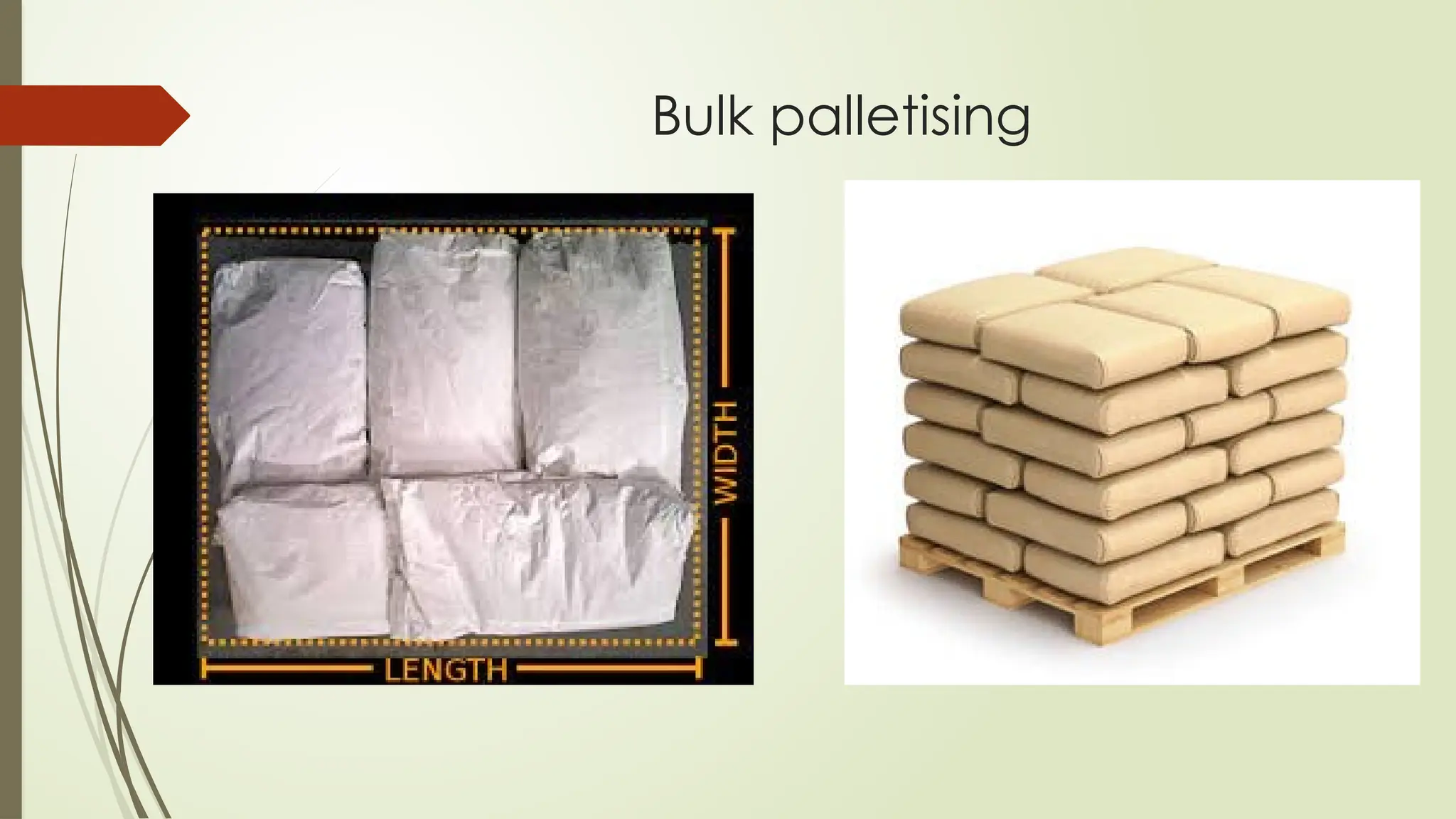
Bulk palletising
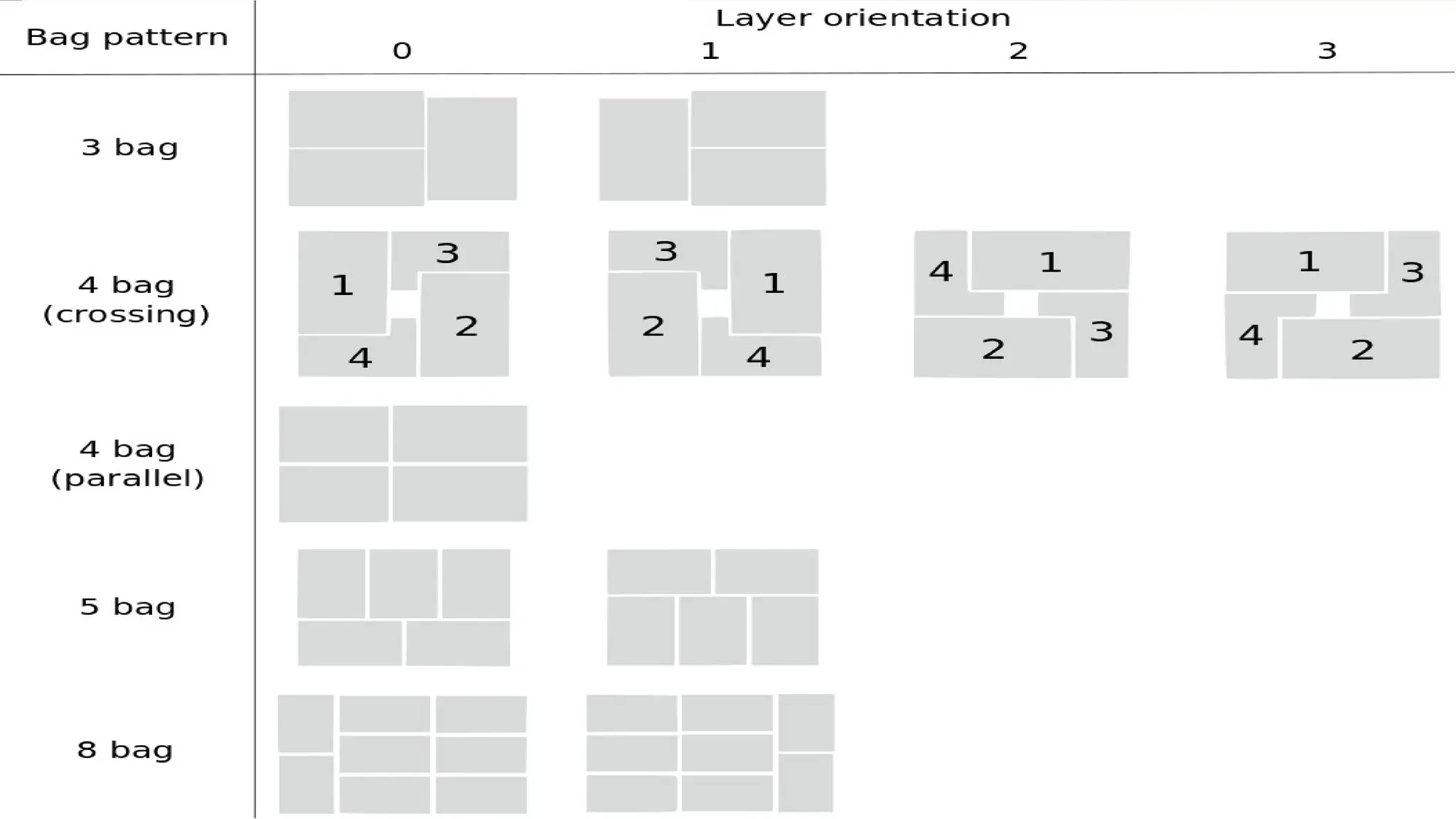
Unit Layer ( standard pallet weight
1500 lbs / pallet weight 50 lbs)
Pallet lay out of 4 for 44 lbs sack
48*40 Pallet can hold- 8900lbs ( floor pallet)
7 row by 4 layout = 28 sacks (1232 lbs + 50)
3 pallets = 84 sacks (3696 lbs + 150)
Pallet lay out of 5 for 44 lbs sack
48*40 Pallet can hold- 8900lbs ( floor pallet)
6 row by 5 layout = 30 sacks (1320lbs + 50)
3 pallets = 90 sacks (3960 lbs + 150)
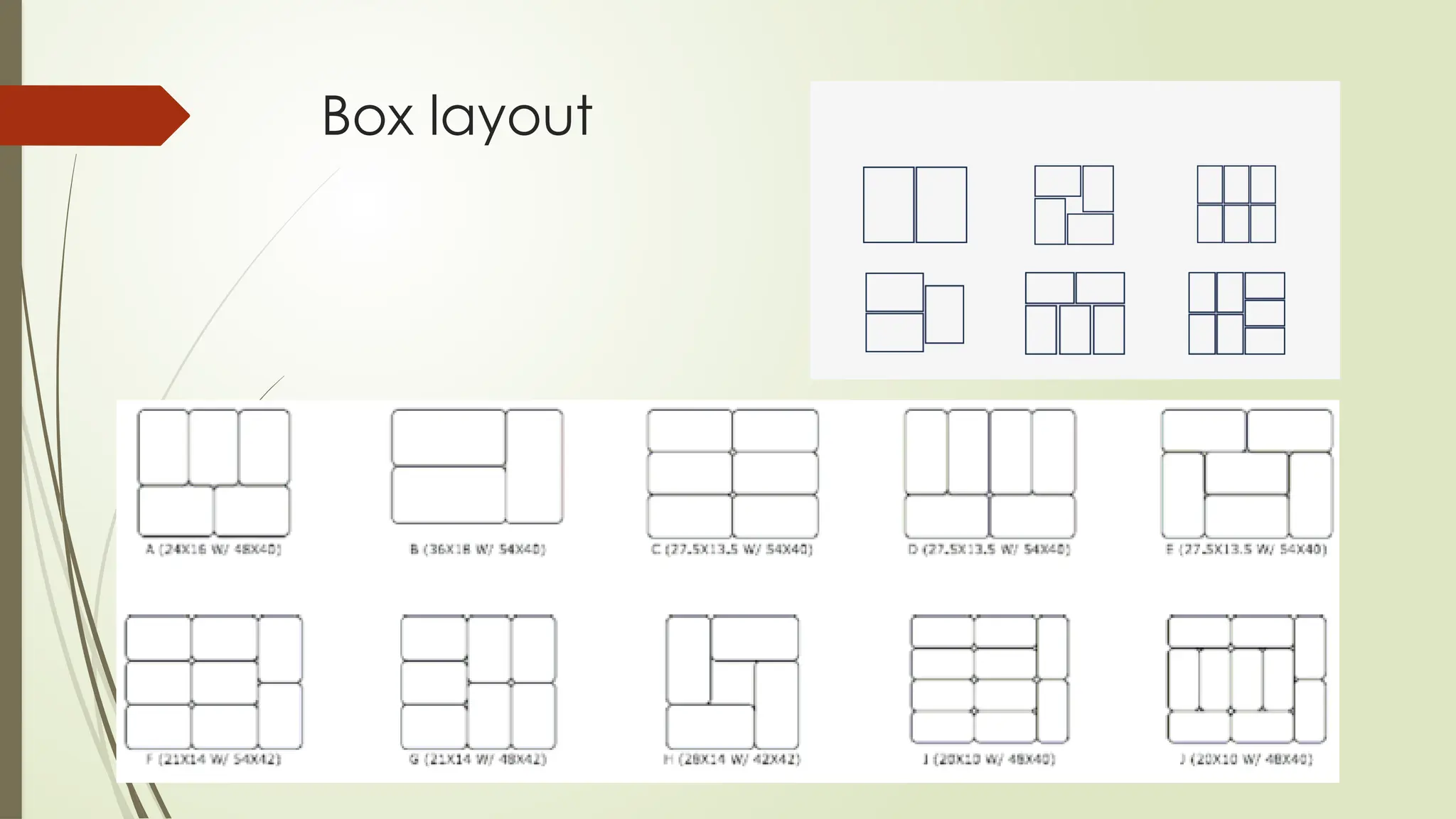
Box Palleting
Box layout
Internal control Safety Awareness
Logistics Safety Awareness
 The fatal injury rate for the logistics industry is
higher than the national average for all industries
 Several potential hazards for workers in the
logistics field:
 Slips, Trips and Falls
 Materials Handling
 Back Injury
 PPE
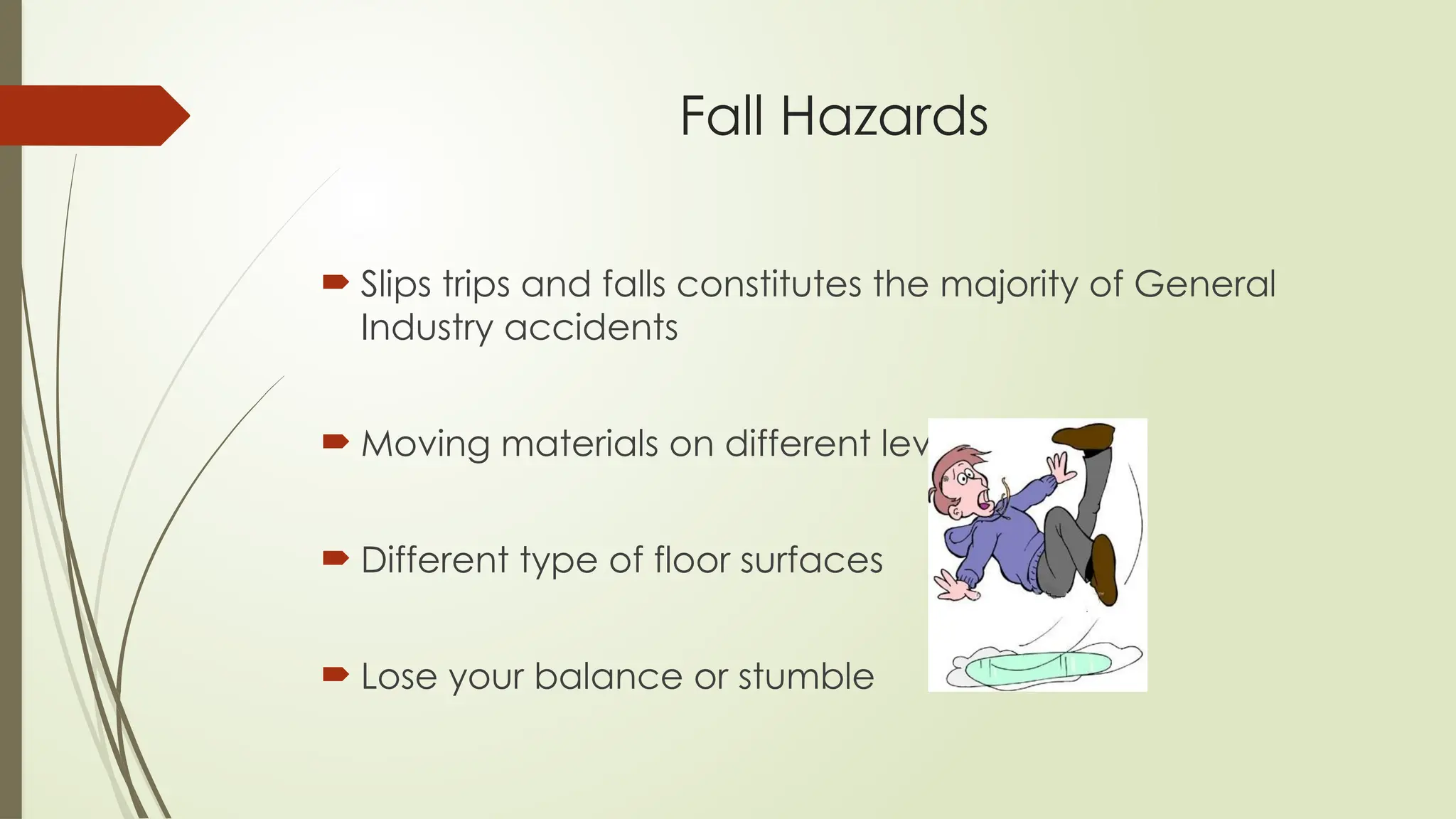
Fall Hazards
 Slips trips and falls constitutes the majority of General
Industry accidents
 Moving materials on different levels
 Different type of floor surfaces
 Lose your balance or stumble
Fall Hazards
 Slip
 Trip
 Fall
 occurs when persons foot contacts an
object or lower level unexpectedly
causing them to be thrown off
balance
 occurs when you are too far off
balance
 occurs when too little friction/traction
between the shoe and walking surface
Fall Hazards
Materials Handling
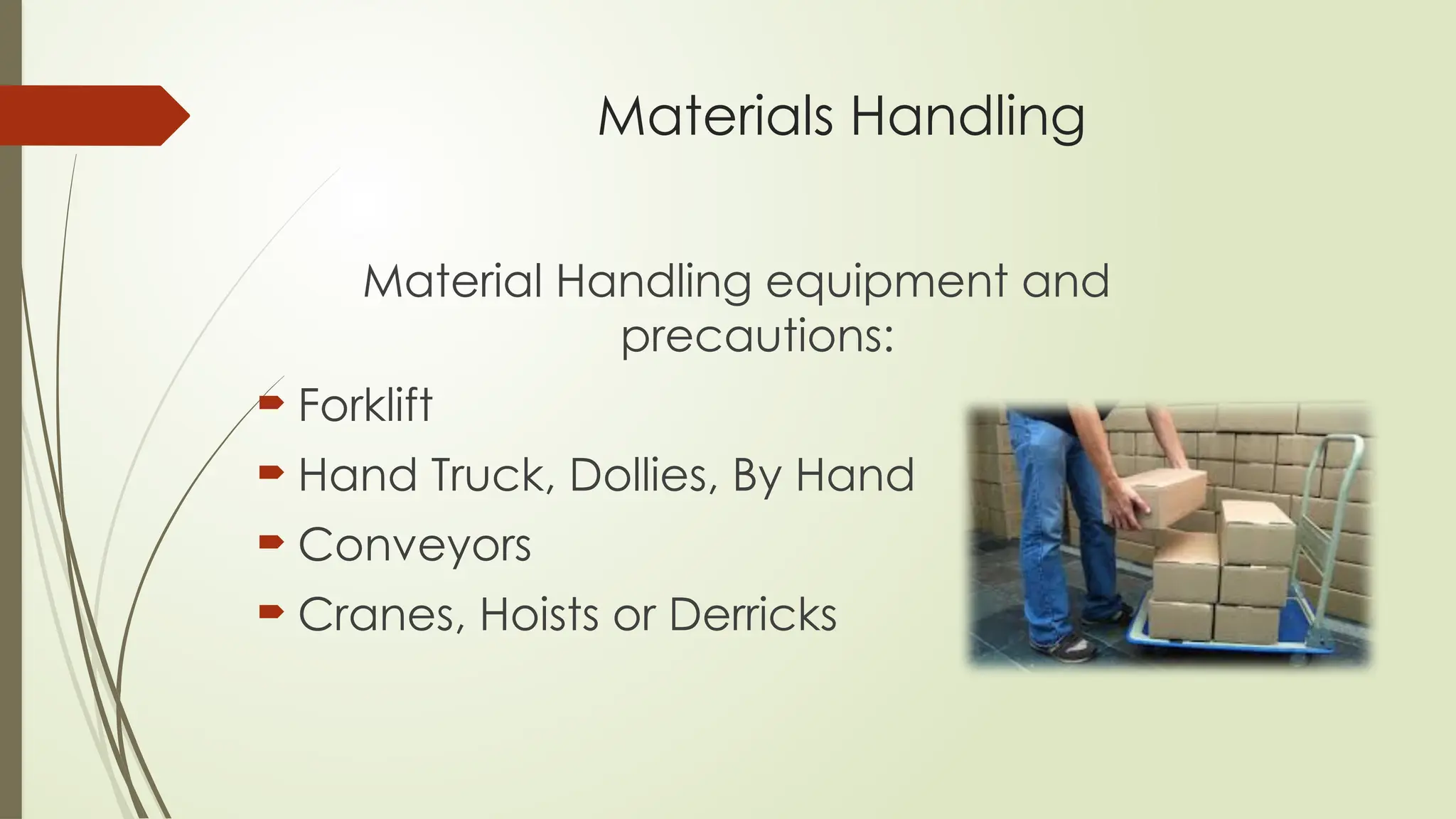
Material Handling equipment and
precautions:
 Forklift
 Hand Truck, Dollies, By Hand
 Conveyors
 Cranes, Hoists or Derricks
Materials Handling/Back Safety
• Material handling is the lifting, lowering,
moving, pushing pulling carrying equipment,
supplies tools etc. from one place to
another.
• Control stressors by:
• Minimizing the amount of weight handled
• Use material handling devices
• Break material into smaller packages
• Plan ahead
Back Safety
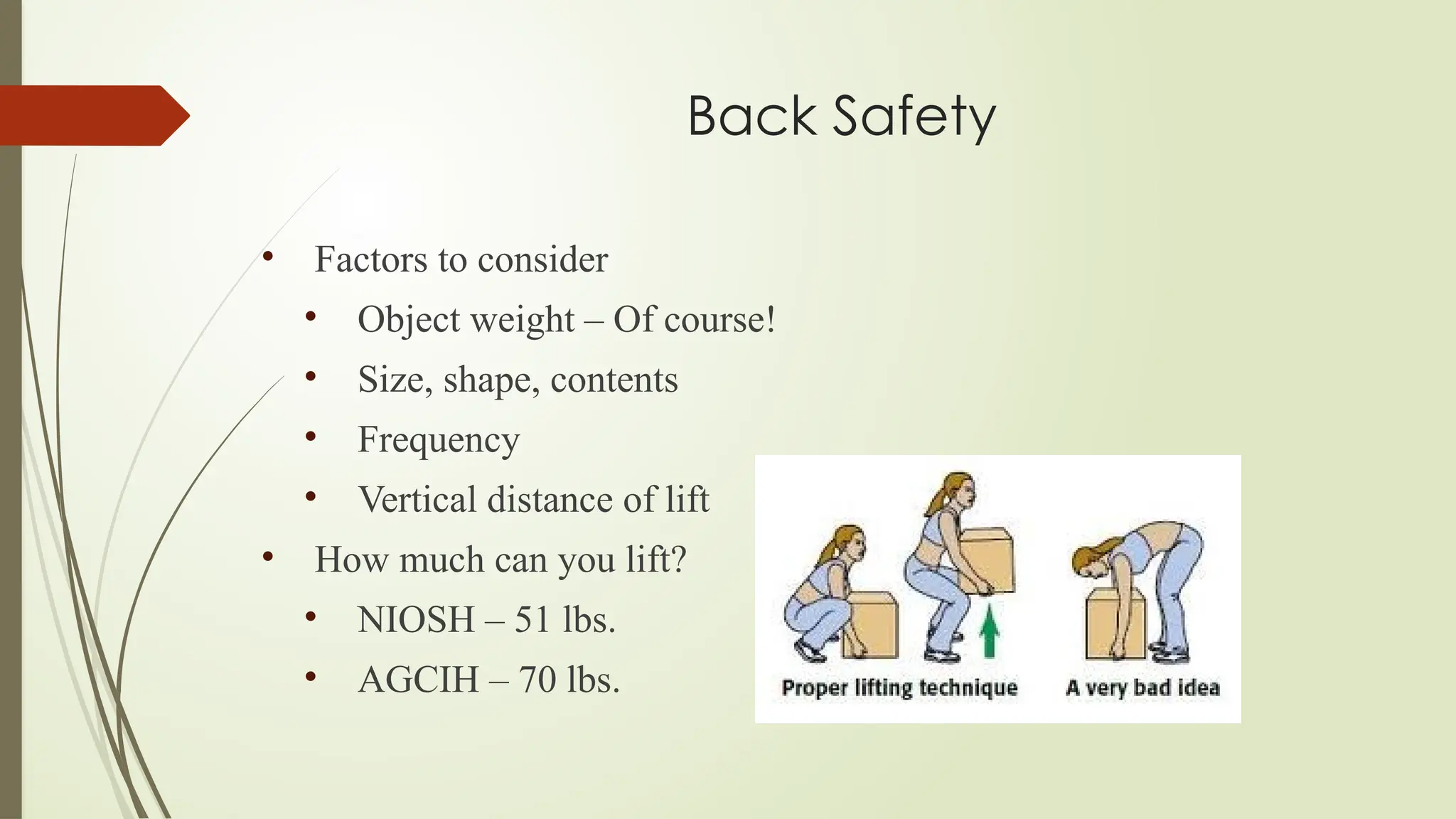
• Factors to consider
• Object weight – Of course!
• Size, shape, contents
• Frequency
• Vertical distance of lift
• How much can you lift?
• NIOSH – 51 lbs.
• AGCIH – 70 lbs.
Personal Protective Equipment
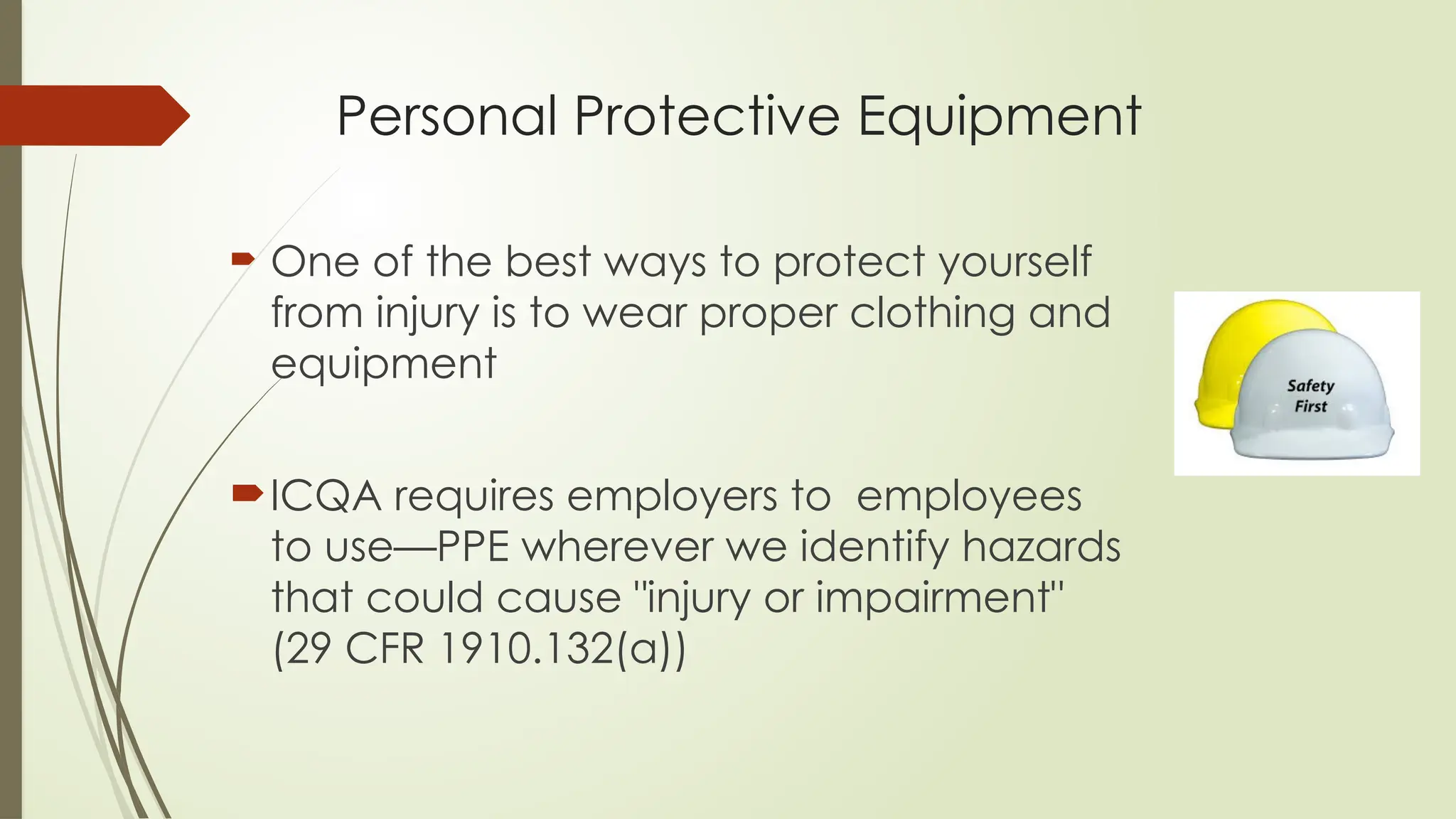
 One of the best ways to protect yourself
from injury is to wear proper clothing and
equipment
ICQA requires employers to employees
to use—PPE wherever we identify hazards
that could cause "injury or impairment"
(29 CFR 1910.132(a))
Personal Protective Equipment
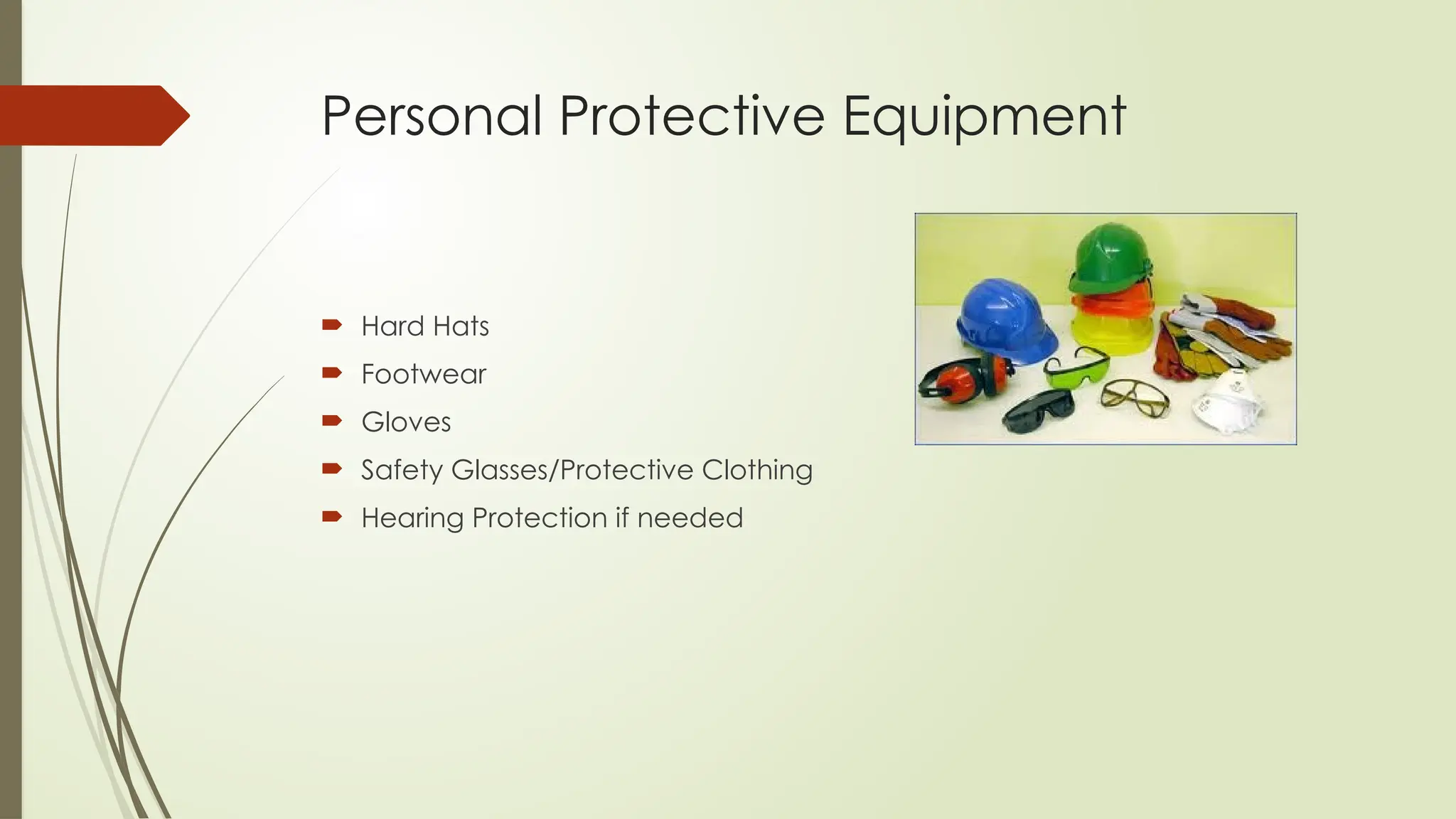
 Hard Hats
 Footwear
 Gloves
 Safety Glasses/Protective Clothing
 Hearing Protection if needed
PPT-098-01 1
Behavior Based Safety
PPT-098-01 6
BETARI BOX MODEL
MY ATTITUDE
AFFECTS
MY BEHAVIOR
AFFECTS
YOUR ATTITUDE
AFFECTS
YOUR BEHAVIOR
AFFECTS
PPT-098-01 7
What’s Your Excuse?
Address Unsafe Work Practices
1. Get it done.
2. Undiscussed incompetence - unsafe practices that
stem from skill deficits that can’t be discussed.
3. Just this once - unsafe practices that are justified
because they are exceptions to the rule.
4. This is overboard - unsafe practices that bypass
precautions management or workers consider
excessive
5. Are you a team player - unsafe practices that are
justified for the good of the team, company or
customer.
Time Management
PPT-098-01 9
PPT-098-01 51
Reactive vs. Proactive
The difference between
being
Reactive vs. Proactive
PPT-098-01 53
• Accidents are believed
to be caused by
careless employees &
are unavoidable
• Focus on ICQA
compliance
• Safety is dictated
down to employees
• Accidents are seen as
defects in the system
& can be prevented by
fixing the system
• Focus on continuous
improvement
• Employees are
empowered & involved
in the process
Reactive vs. Proactive
PPT-098-01 61
Housekeeping
• Workplaces must be kept
clean, orderly and
sanitary.
• Workroom floors must be
maintained as clean and
dry as possible.
PPT-098-01 62
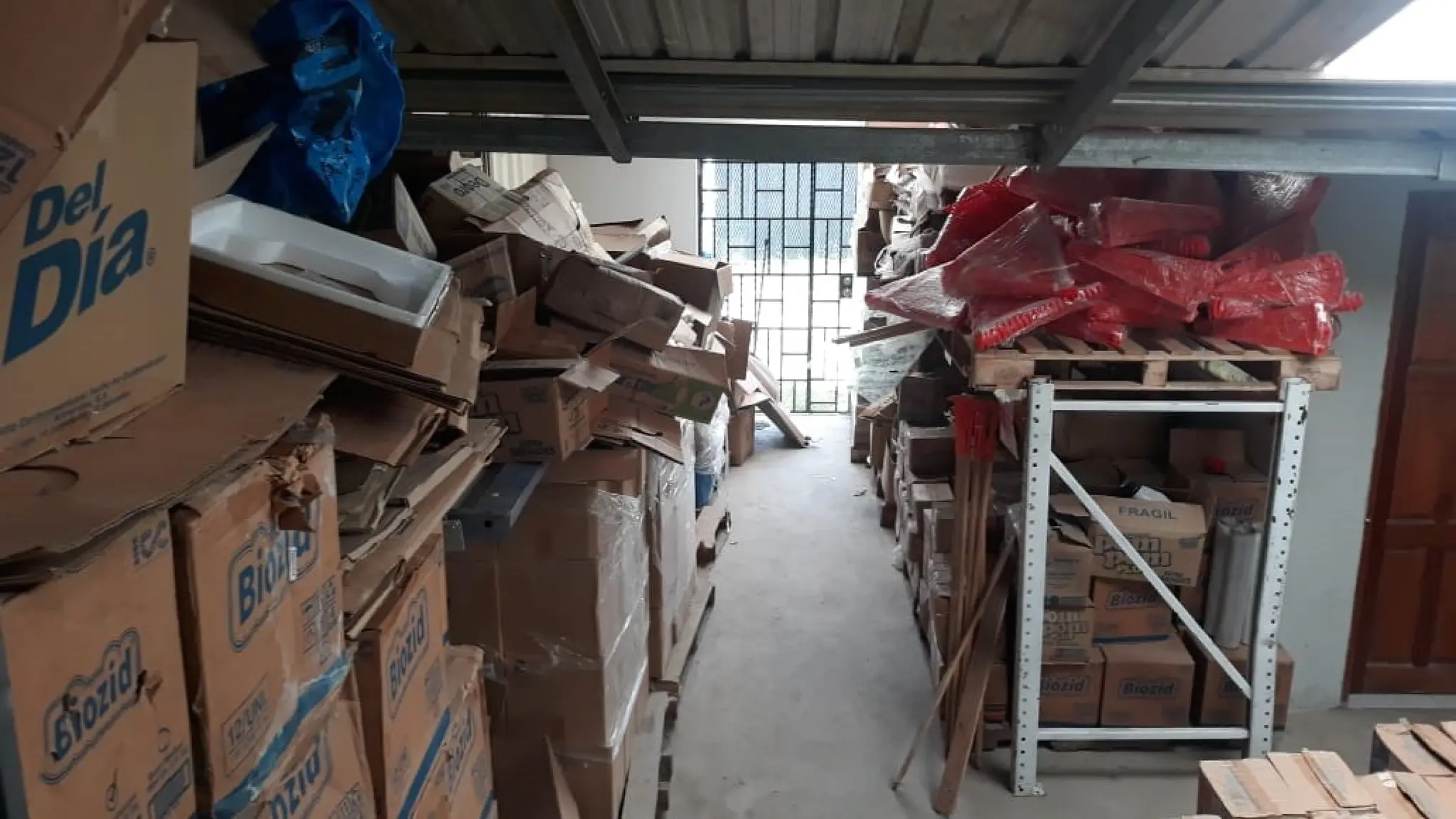
Housekeeping Tips
 Immediately clean up anything
on the floor that creates a slip
hazard: water, grease, paper,
dust or other debris.
 Keep walkways clear of boxes
and other obstructions.
 Close cabinets used for storage
when not in use.
 Never block fire exits or fire
equipment.
PPT-098-01 63
Housekeeping Tips
 Make sure stacked materials do
not impede vision.
 Don’t store items in or on
electrical panels or control
boxes.
 Pick up and store tools in their
proper location immediately
after use.
 Keep ventilation systems clear
of dust and debris and stored
materials.
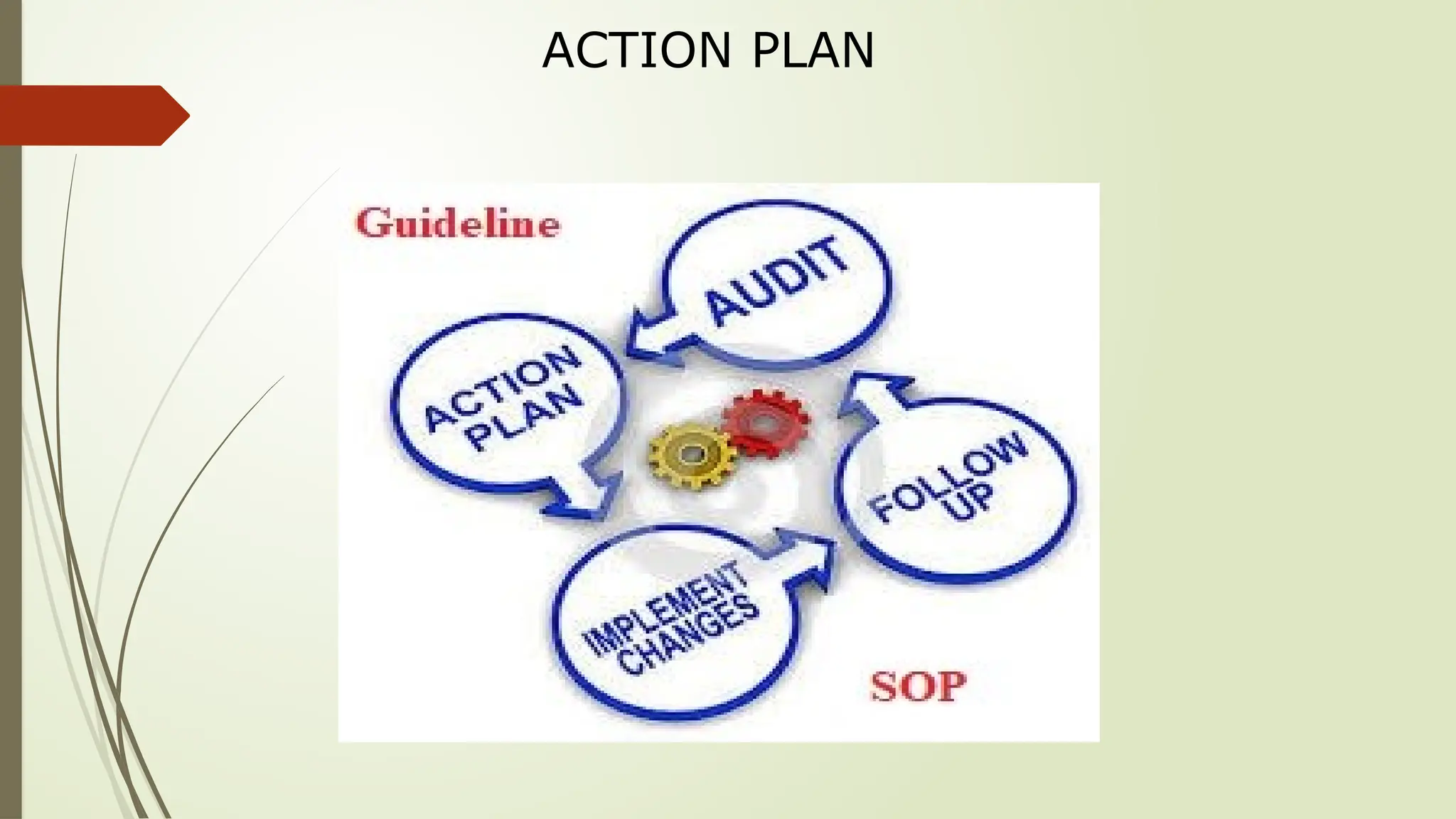
ACTION PLAN
MR. RICARDO
Logistic, Warehouse
Management
MR. JOSUE
Internal control Management, Audit
Supervisor
Mr. Mendez
WM Supervisor
Dispatch
Invoicing
/ order
Delivery
Receiving
Returns
QA
organization
Product protection
Site safety
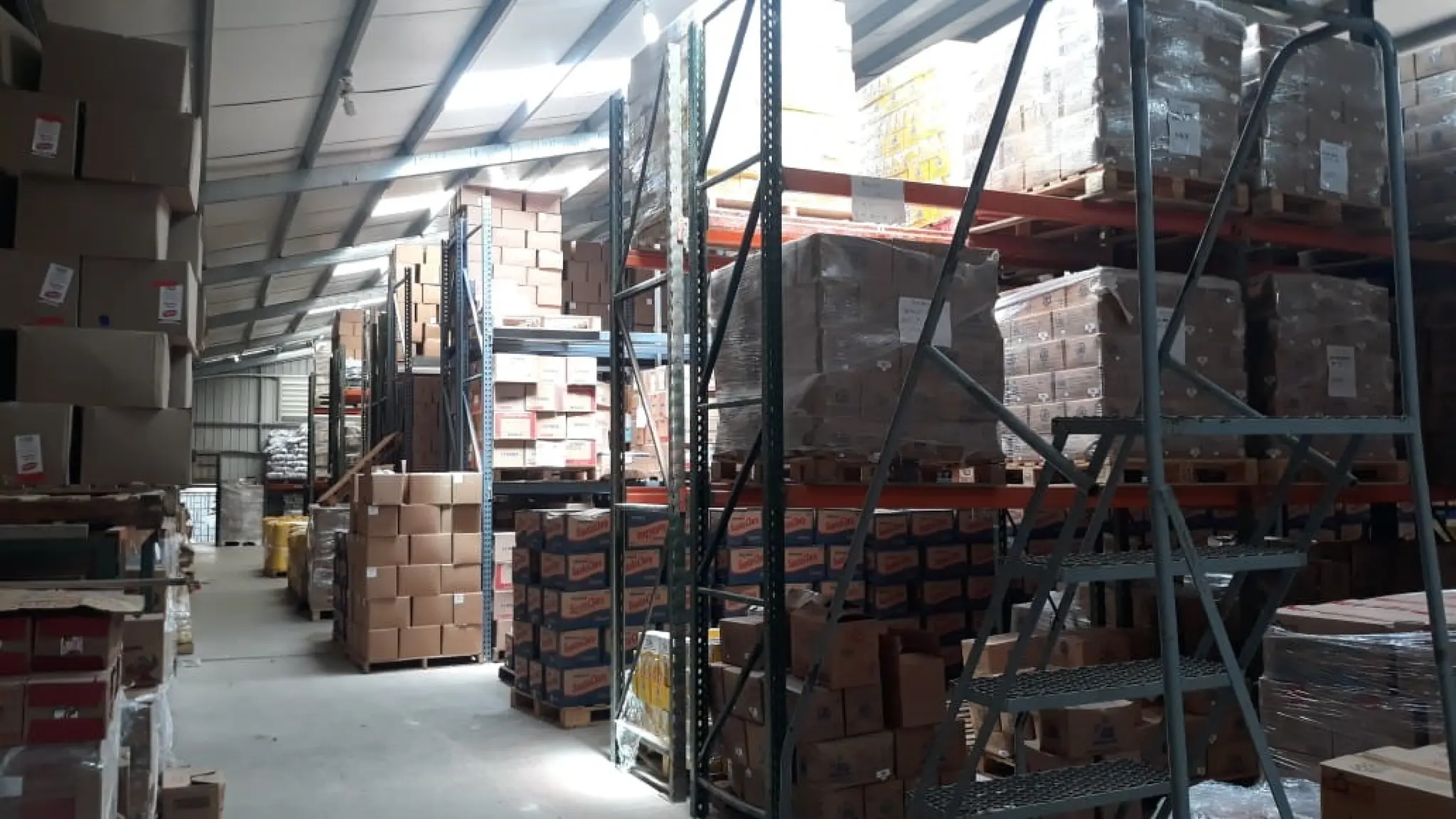
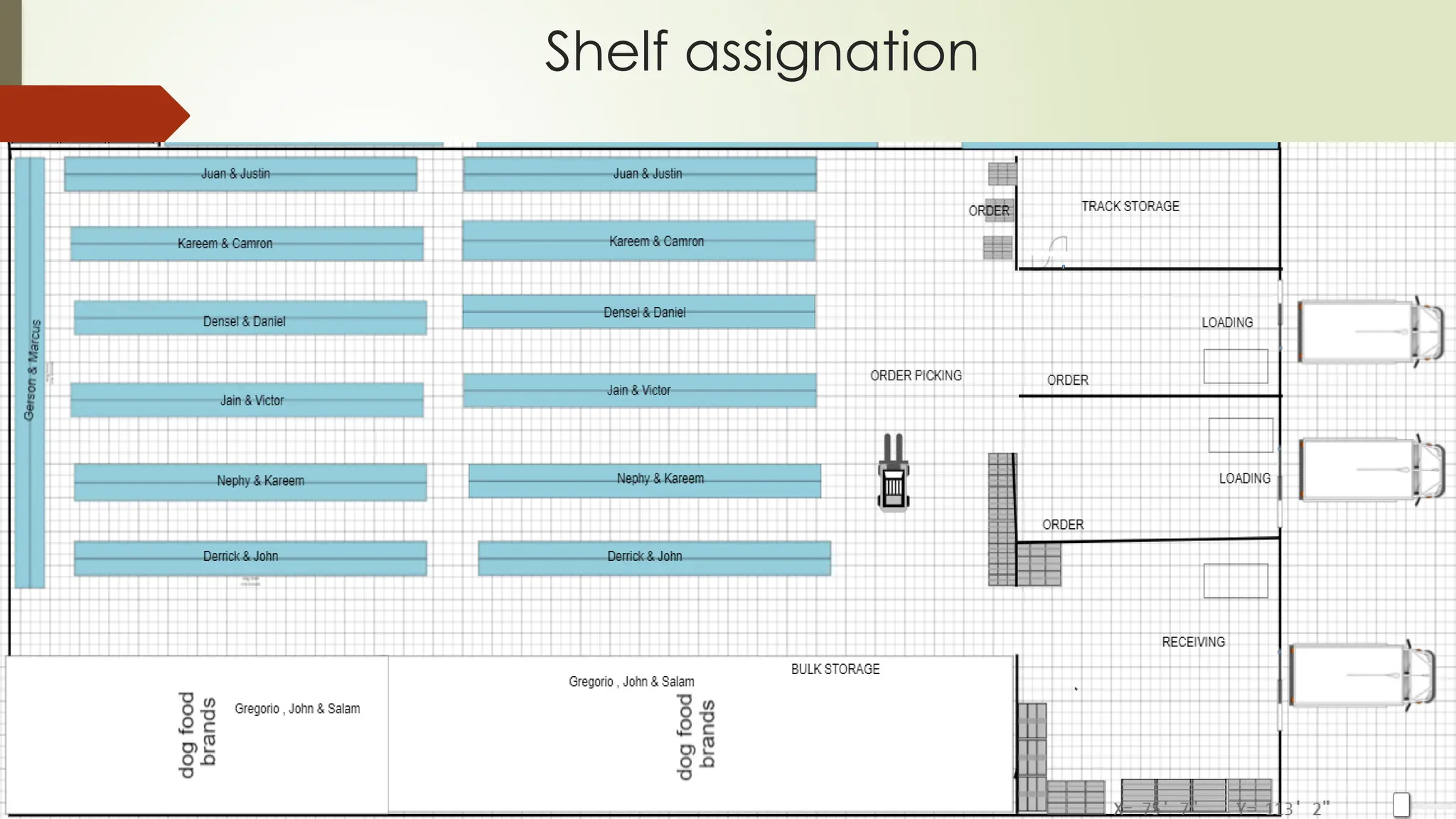
Warehouse lay out
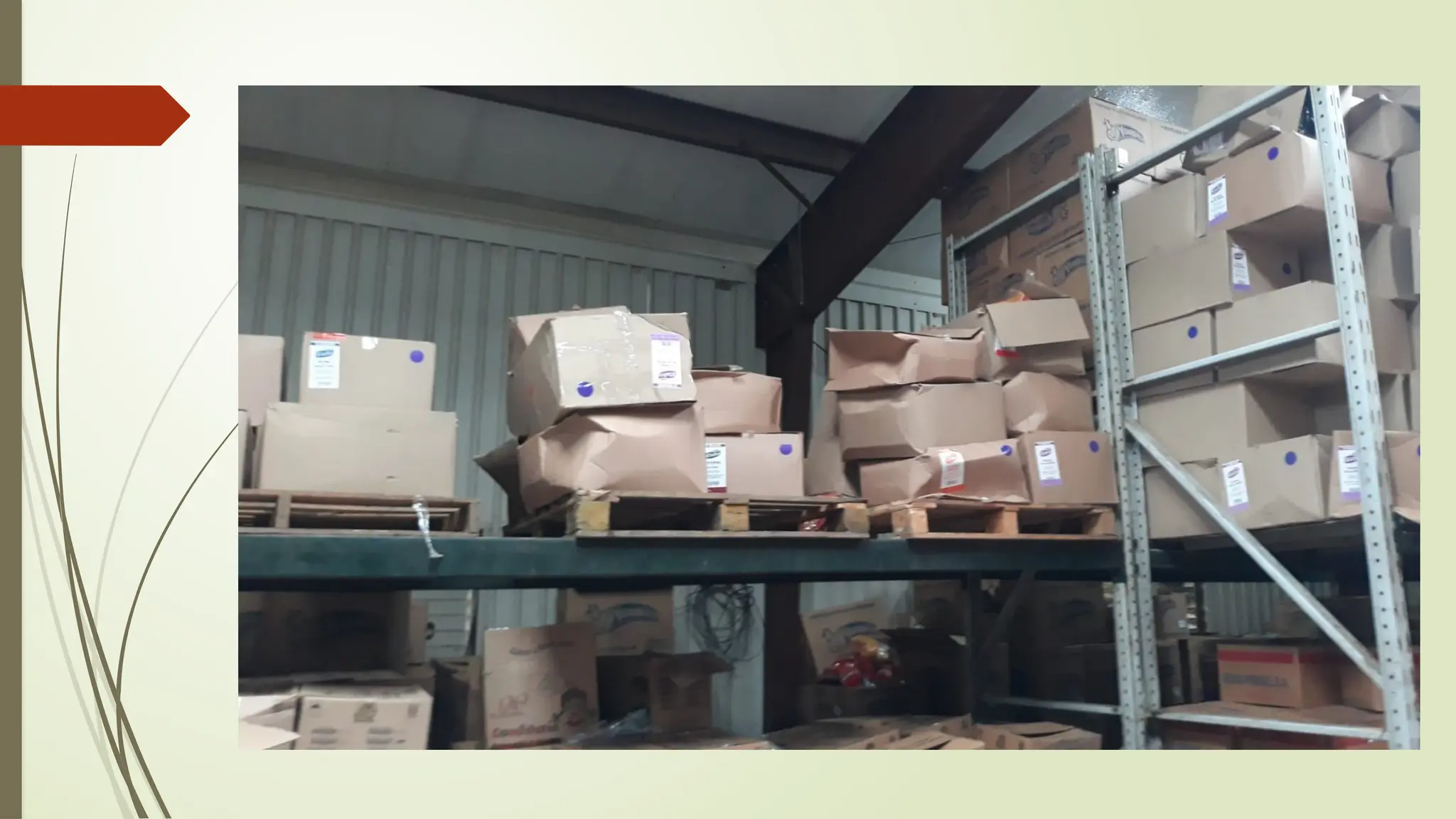
Old layout
New Layout
Shelf assignation
Responsibility
 Ensure area is clean
 Ensure picking process is done well ( no multiple open Boxes)
 Ensure Boxes/ bulk contain correct amount of product stated
 Ensure proper labelling of product
 Ensure all boxes and items are properly organised
 this are daily routines and MUST be completed before leaving Or early
morning before starting regular hours.
SHELF LABELING
PRODUCT LAYOUT ON SHELF
 EACH ZONE HAS A LETTER AND A SUB DIVISION NUMBERS
 EXAMPLE- LAYOUT (SHELF) A1
 THE SUB DEVISION IS THE SHELF DIVISIONS
 EXAMPLE A1(1) , A1(2) OR A1 (3)
 PLEASE REMEMBER THAT ALL PRODUCT ON SHELF DIVISION 3 IS ALWAYS THE
LIGHT PRODUCT
 EXAMPLE CHIPS
 THE SHELF DIVISION PRODUCT 2 IS FOR MID LOAD ITEMS
 THE SHELF DIVISION 1 IS FOR HEALVY LOAD OR PICKING ITEMS
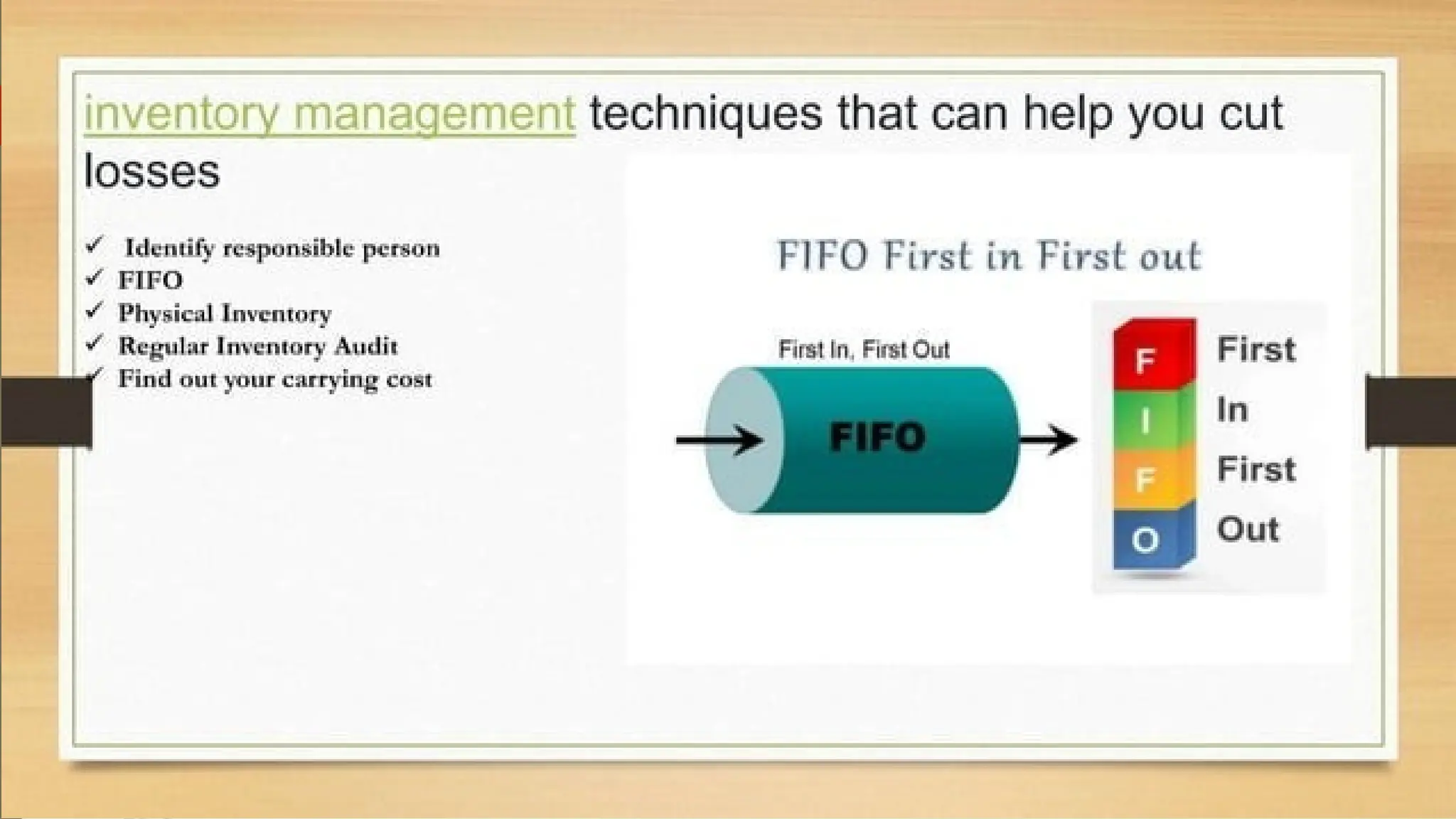
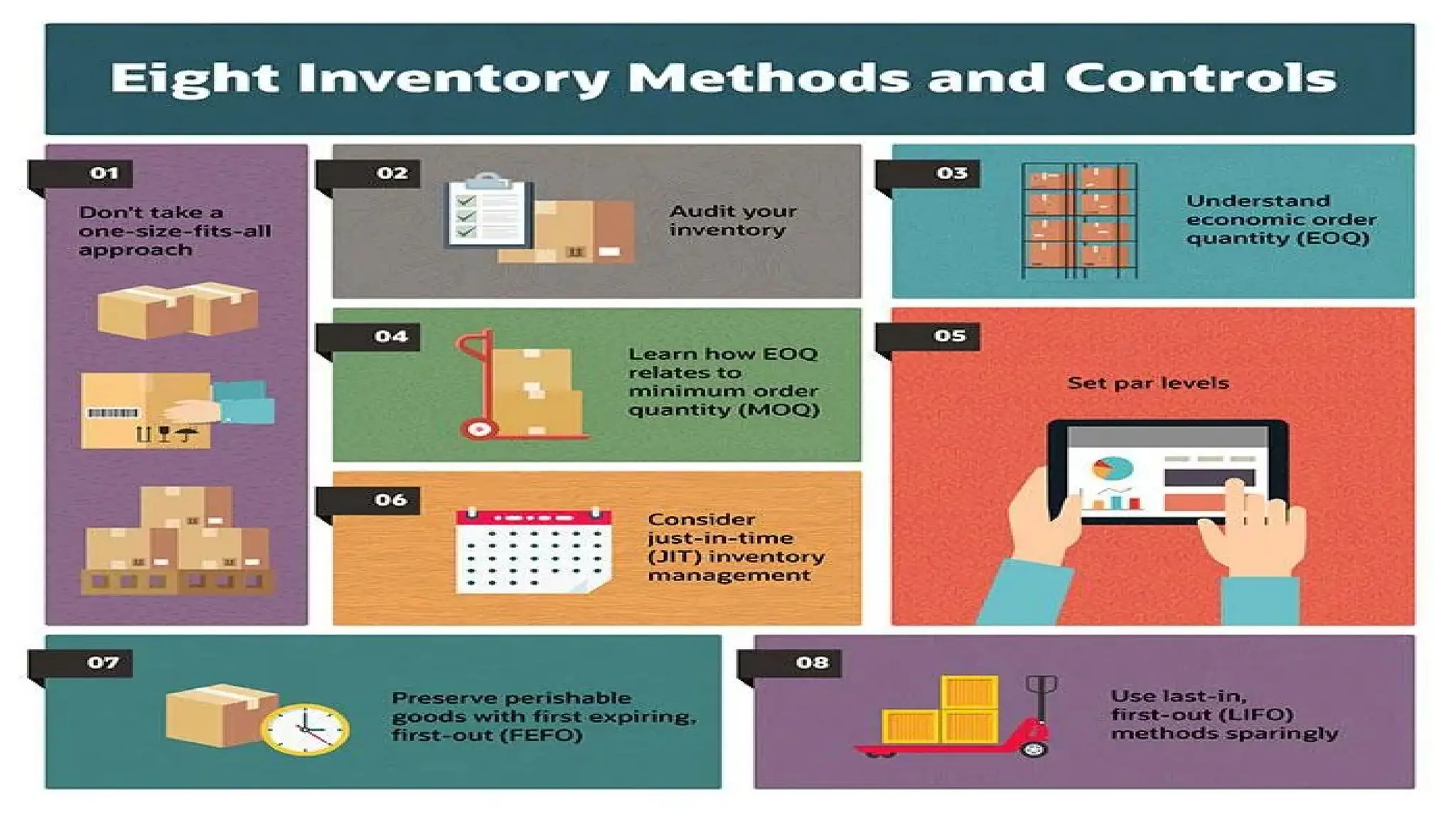
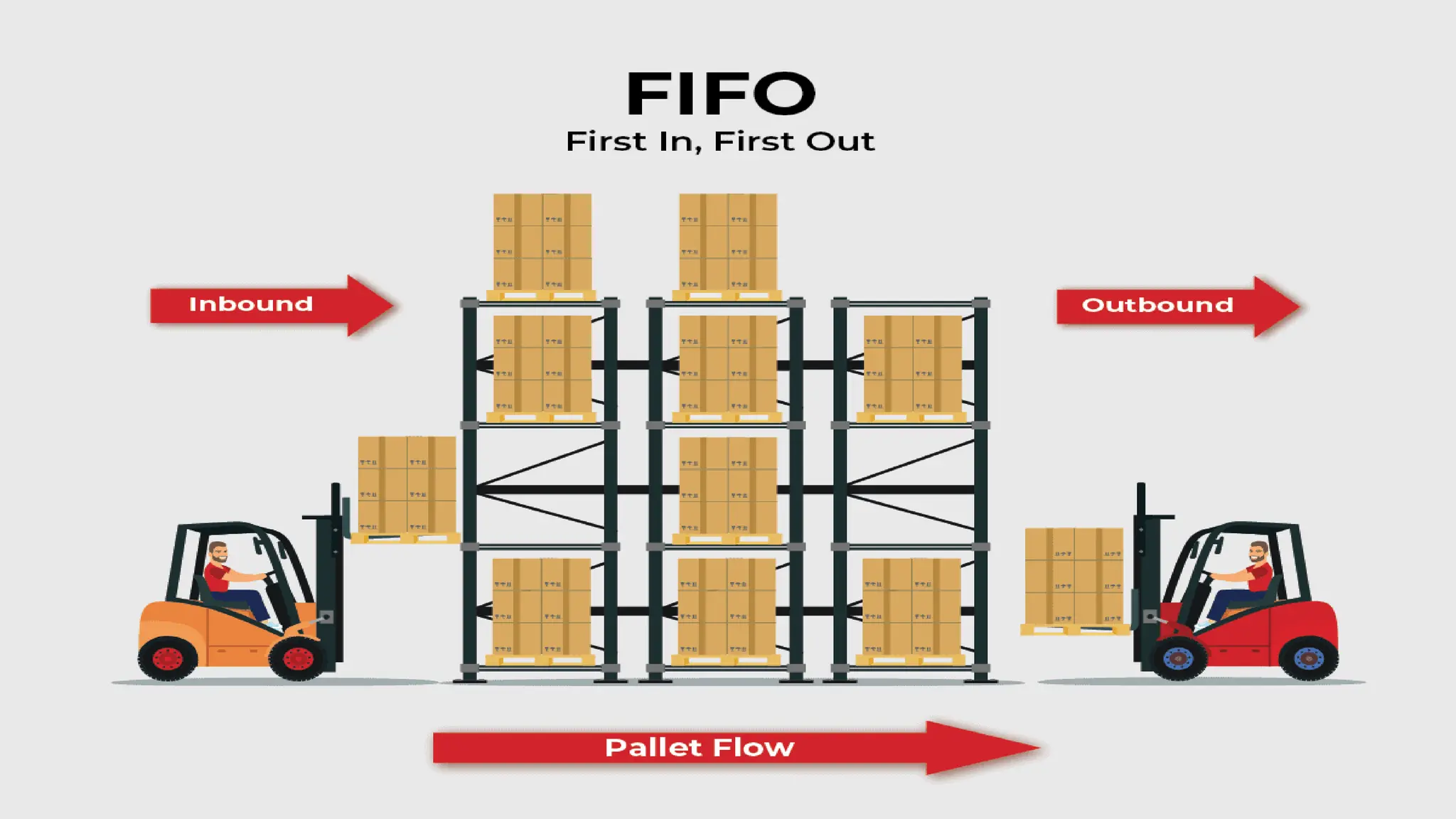
 PLEASE NOTE ALL ITEMS MUST BE ARAGE USING THE ABC METHOD AND THE
FIFO OR THE LIFO METHOD
ABC analysis (Inventory)
IN THIS WAY WE CAN AVOID THE
FOLLOWING
To achieve we must
1. Apply the PDCA CYCLE
2. APPLY the 8 Methods of Inventory in a Warehouse
3. Use a Audit plan checklist
4. Perpetual Implementation
5. Inventory control reports
MOPING
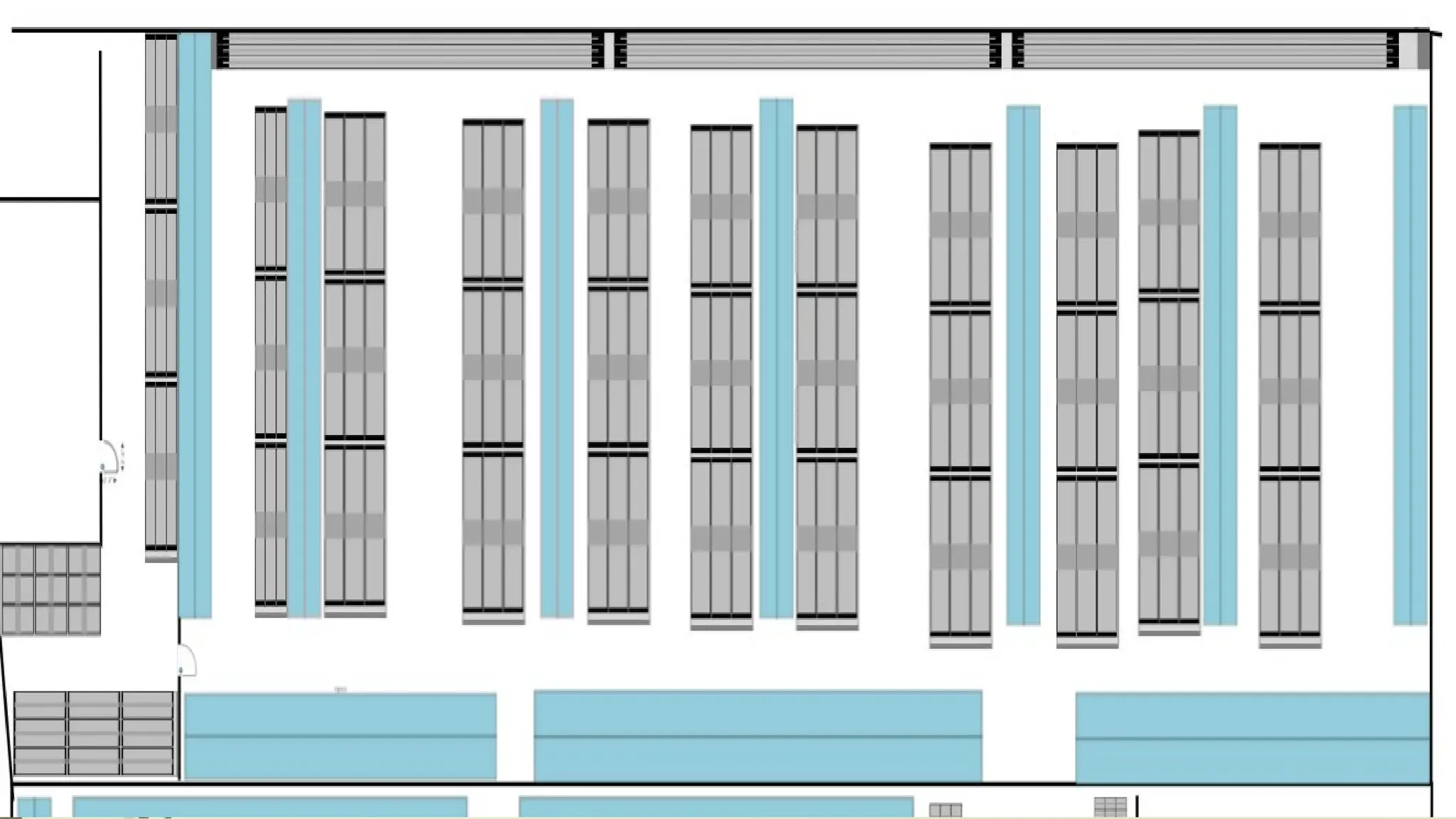
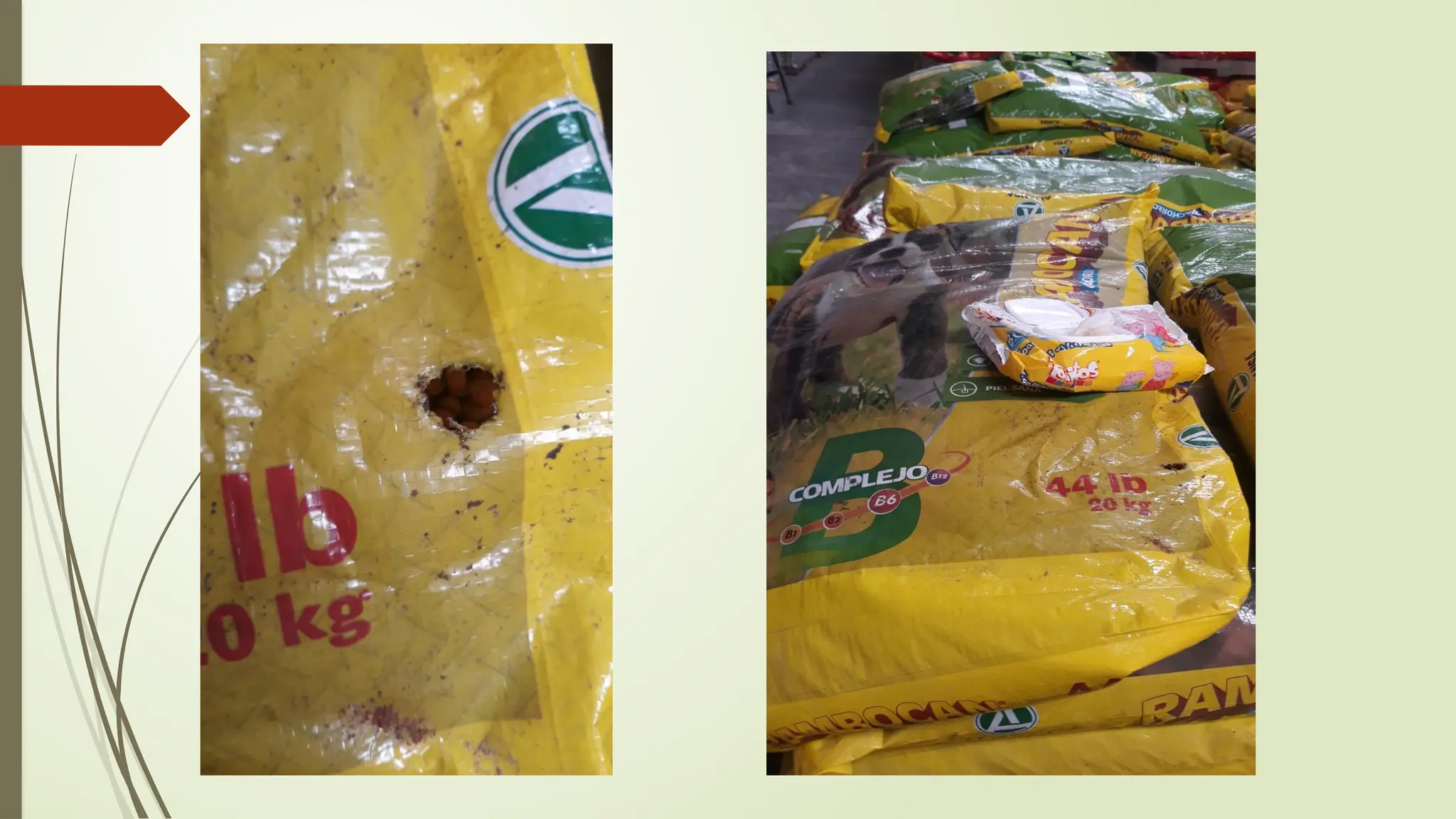
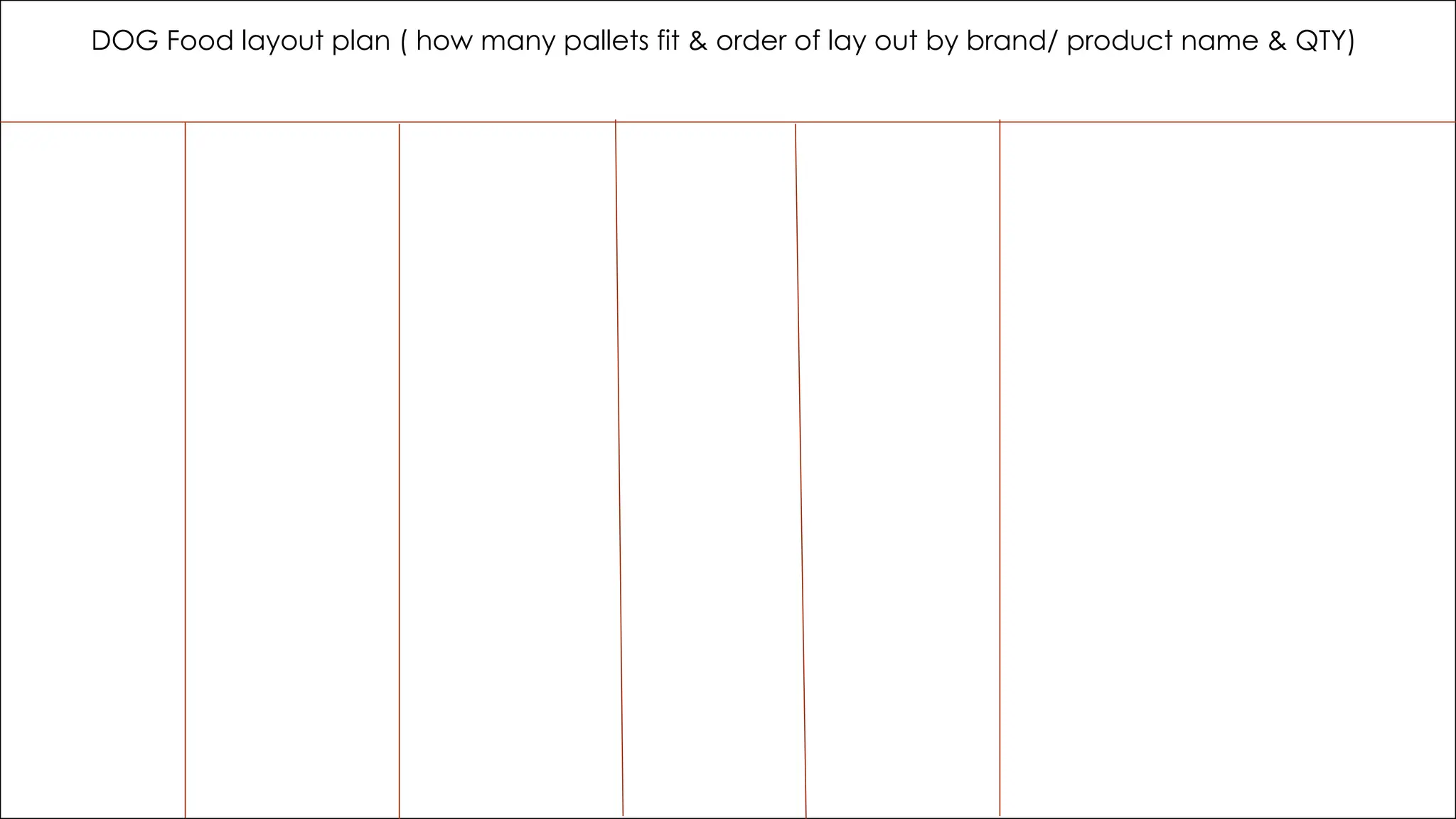
DOG Food layout plan ( how many pallets fit & order of lay out by brand/ product name & QTY)
Shelf layout ( how many pallets fit & order of lay out by brand / product name & QTY)
Broken line represents the self division from 3,2,1 order
___1
___2
3
2
1
3
2
1
wms ppt.pptxcsfcsdsdssdsjnkjnjknjnjnjnjj

wms ppt.pptxcsfcsdsdssdsjnkjnjknjnjnjnjj

  • 2.
    Objectives of InventoryPlanning ⚫ Customer Satisfaction ⚫ Forecasting Needs ⚫ Controlling Costs ⚫ Successful Storage Objectives of Internal control Customer Satisfaction Forecasting Needs Controlling Costs Successful
  • 3.
    Outline  WMS  Picking/palletizing/offloading  Safety  Action plan  WM  Warehouse layout  Zone labelling/ division numbering  Shelf labelling  Product layout  Product organisation  Personnel sub assignation  moping
  • 5.
    THE ROLE OFTHE WAREHOUSE IN THE LOGISTICS SYSTEM  The warehouse is where the supply chain holds or stores goods.  Functions of warehousing include  Transportation consolidation  Product mixing  Docking  Service  Protection against contingencies
  • 6.
    PRINCIPLES OF WAREHOUSELAYOUT DESIGN Use one-story facilities Move goods in a straight line Use efficient materials- handling equipment Use an effective storage plan Minimize aisle space Use maximum height of the building
  • 7.
    WAREHOUSE PROCESS Put-away •Identify Product •IdentifyProduct Location •Move Products •Update Records Storage •Equipment •Stock Location – Popularity – Unit Size – Cube Shipping Preparation •Packing •Labeling •Stacking Order Picking •Information •Walk & Pick •Batch Picking Shipping •Schedule Carrier •Load Vehicle •Bill of Loading •Record Update RECEIVING •Schedule Carrier •Unload Vehicle •Inspect for damage INPUT OUTPUT
  • 8.
    Service benefits ofwarehousing Full Line Stocking at United Electric’s Distribution Center  Spot-stocking is the positioning of inventory for seasonal or promotional demand  Full line stocking provides one- stop shopping capability for goods from multiple suppliers  Value-added services include any work that creates a greater value for customers  See Table 10.1 for examples
  • 9.
    OBJECTIVES OF EFFICIENTWAREHOUSE OPERATIONS • Provide timely customer service. • Keep track of items so they can be found readily & correctly. • Minimize the total physical effort & thus the cost of moving goods into & out of storage. • Provide communication links with customers
  • 10.
    Warehouse operations involvetwo major activities – handling and storage Objective is to Efficiently receive inventory Store it as required Assemble it into complete orders Make a customer shipment Operations will therefore emphasize product flow
  • 11.
    Handling Handling must optimize movementcontinuity and efficiency Receiving—Unloading the arriving vehicles In-Storage—moving goods for storage (transfer) or order selection (picking) Shipping—verifying the order and loading the departing vehicles
  • 12.
    Storage plans shouldmake product velocity a major factor  Slotting determines specific locations for the product based on  Velocity—how fast the goods move  Weight—how heavy is the product  Special Characteristics —how large or small, does it require rack or bin storage
  • 13.
    Warehouses must managetwo classes of storage  Active Storage—storage for basic inventory replenishment Focuses on quick movement Includes flow-through or cross-dock distribution  Extended Storage— storage for inventory held in excess of period for normal replenishment E.g. seasonal, speculative, or even commodities
  • 16.
    • Warehouses processesand the associated material flow Receiving Shipping Reserve Storage and Pallet Picking Case Picking Broken Case Picking Accumulation, Sortation & Packing Cross-docking Direct putaway to reserve Direct putaway to primary Replenishment Replenishment
  • 30.
    Layout of productto Pallets for loading and off loading
  • 32.
  • 33.
    Unit Layer (standard pallet weight 1500 lbs / pallet weight 50 lbs) Pallet lay out of 4 for 44 lbs sack 48*40 Pallet can hold- 8900lbs ( floor pallet) 7 row by 4 layout = 28 sacks (1232 lbs + 50) 3 pallets = 84 sacks (3696 lbs + 150) Pallet lay out of 5 for 44 lbs sack 48*40 Pallet can hold- 8900lbs ( floor pallet) 6 row by 5 layout = 30 sacks (1320lbs + 50) 3 pallets = 90 sacks (3960 lbs + 150)
  • 35.
  • 36.
  • 37.
  • 38.
    Logistics Safety Awareness The fatal injury rate for the logistics industry is higher than the national average for all industries  Several potential hazards for workers in the logistics field:  Slips, Trips and Falls  Materials Handling  Back Injury  PPE
  • 39.
    Fall Hazards  Slipstrips and falls constitutes the majority of General Industry accidents  Moving materials on different levels  Different type of floor surfaces  Lose your balance or stumble
  • 40.
    Fall Hazards  Slip Trip  Fall  occurs when persons foot contacts an object or lower level unexpectedly causing them to be thrown off balance  occurs when you are too far off balance  occurs when too little friction/traction between the shoe and walking surface
  • 41.
  • 42.
    Materials Handling Material Handlingequipment and precautions:  Forklift  Hand Truck, Dollies, By Hand  Conveyors  Cranes, Hoists or Derricks
  • 43.
    Materials Handling/Back Safety •Material handling is the lifting, lowering, moving, pushing pulling carrying equipment, supplies tools etc. from one place to another. • Control stressors by: • Minimizing the amount of weight handled • Use material handling devices • Break material into smaller packages • Plan ahead
  • 44.
    Back Safety • Factorsto consider • Object weight – Of course! • Size, shape, contents • Frequency • Vertical distance of lift • How much can you lift? • NIOSH – 51 lbs. • AGCIH – 70 lbs.
  • 45.
    Personal Protective Equipment One of the best ways to protect yourself from injury is to wear proper clothing and equipment ICQA requires employers to employees to use—PPE wherever we identify hazards that could cause "injury or impairment" (29 CFR 1910.132(a))
  • 46.
    Personal Protective Equipment Hard Hats  Footwear  Gloves  Safety Glasses/Protective Clothing  Hearing Protection if needed
  • 47.
  • 48.
    PPT-098-01 6 BETARI BOXMODEL MY ATTITUDE AFFECTS MY BEHAVIOR AFFECTS YOUR ATTITUDE AFFECTS YOUR BEHAVIOR AFFECTS
  • 49.
    PPT-098-01 7 What’s YourExcuse? Address Unsafe Work Practices 1. Get it done. 2. Undiscussed incompetence - unsafe practices that stem from skill deficits that can’t be discussed. 3. Just this once - unsafe practices that are justified because they are exceptions to the rule. 4. This is overboard - unsafe practices that bypass precautions management or workers consider excessive 5. Are you a team player - unsafe practices that are justified for the good of the team, company or customer.
  • 50.
  • 51.
    PPT-098-01 51 Reactive vs.Proactive The difference between being Reactive vs. Proactive
  • 52.
    PPT-098-01 53 • Accidentsare believed to be caused by careless employees & are unavoidable • Focus on ICQA compliance • Safety is dictated down to employees • Accidents are seen as defects in the system & can be prevented by fixing the system • Focus on continuous improvement • Employees are empowered & involved in the process Reactive vs. Proactive
  • 53.
    PPT-098-01 61 Housekeeping • Workplacesmust be kept clean, orderly and sanitary. • Workroom floors must be maintained as clean and dry as possible.
  • 54.
    PPT-098-01 62 Housekeeping Tips Immediately clean up anything on the floor that creates a slip hazard: water, grease, paper, dust or other debris.  Keep walkways clear of boxes and other obstructions.  Close cabinets used for storage when not in use.  Never block fire exits or fire equipment.
  • 55.
    PPT-098-01 63 Housekeeping Tips Make sure stacked materials do not impede vision.  Don’t store items in or on electrical panels or control boxes.  Pick up and store tools in their proper location immediately after use.  Keep ventilation systems clear of dust and debris and stored materials.
  • 56.
  • 61.
    MR. RICARDO Logistic, Warehouse Management MR.JOSUE Internal control Management, Audit Supervisor Mr. Mendez WM Supervisor Dispatch Invoicing / order Delivery Receiving Returns QA organization Product protection Site safety
  • 62.
  • 63.
  • 75.
  • 77.
  • 78.
    Responsibility  Ensure areais clean  Ensure picking process is done well ( no multiple open Boxes)  Ensure Boxes/ bulk contain correct amount of product stated  Ensure proper labelling of product  Ensure all boxes and items are properly organised  this are daily routines and MUST be completed before leaving Or early morning before starting regular hours.
  • 79.
  • 81.
    PRODUCT LAYOUT ONSHELF  EACH ZONE HAS A LETTER AND A SUB DIVISION NUMBERS  EXAMPLE- LAYOUT (SHELF) A1  THE SUB DEVISION IS THE SHELF DIVISIONS  EXAMPLE A1(1) , A1(2) OR A1 (3)  PLEASE REMEMBER THAT ALL PRODUCT ON SHELF DIVISION 3 IS ALWAYS THE LIGHT PRODUCT  EXAMPLE CHIPS  THE SHELF DIVISION PRODUCT 2 IS FOR MID LOAD ITEMS  THE SHELF DIVISION 1 IS FOR HEALVY LOAD OR PICKING ITEMS  PLEASE NOTE ALL ITEMS MUST BE ARAGE USING THE ABC METHOD AND THE FIFO OR THE LIFO METHOD
  • 82.
  • 84.
    IN THIS WAYWE CAN AVOID THE FOLLOWING
  • 95.
    To achieve wemust 1. Apply the PDCA CYCLE 2. APPLY the 8 Methods of Inventory in a Warehouse 3. Use a Audit plan checklist 4. Perpetual Implementation 5. Inventory control reports
  • 101.
  • 102.
    DOG Food layoutplan ( how many pallets fit & order of lay out by brand/ product name & QTY)
  • 103.
    Shelf layout (how many pallets fit & order of lay out by brand / product name & QTY) Broken line represents the self division from 3,2,1 order ___1 ___2 3 2 1 3 2 1

Editor's Notes

  • #38 Slips, Trips and Falls Materials Handling Back Injury PPE- (work boots, hard hats, eye protection, gloves) Most common is Slips, trips and falls. When you carry and move materials on different levels, and on different types of floor surface, its all too easy to lose your balance or stumble over an out of place item Questions on slide Material Handling- Materials stored in a warehouse can also pose dangers. As you know, we have to protect ourselves from both physical and health hazards when we work in a warehouse that contains (dollies, forklifts) Knowledge of proper identification of hazard labels. Hazardous substances or flammable or combustible materials. Back Injury- proper lifting of items
  • #39 They cause 15% of all accidental deaths, and are second only to motor vehicles as a cause of fatalities. The OSHA standards for walking/working surfaces apply to all permanent places of employment
  • #40 Match word to definition
  • #41 2nd picture- Classroom Activity- Discuss- Identify fall hazards and what can be done to fix it? Break classroom into teams- Have each student write down each hazard noted in the picture above. With each hazard have the team write down the correct way to limit the hazard
  • #42 Discuss the following with each category Forklift OSHA only permits trained, authorized operators to use them. Key points that both operators and people in the area should remember: • No one but the operator should ever ride on a forklift. • Never stand or walk under the raised part of a forklift, even if it's empty. • Place forklift loads carefully so they're stable and won't fall off or tip the truck over. • Drive a forklift slowly, obeying traffic rules. • Keep forks—and loads—low and tilted back while moving. • Park a forklift with forks lowered and tilted flat, brake set, and key removed. 2. HandTruck/Dollies/By Hand Dollies and hand trucks are much simpler. But they, too, can be hazardous if they're not loaded and used properly. Here are some reminders: Load heavy objects on the bottom and secure any bulky or awkward items. Don't pile items so high that you can't see over them. Push, rather than pull, when possible. Lean in the direction you're going and keep the load ahead of you when walking downhill. Conveyors be careful to avoid injury from contact with a conveyor belt's gears, shafts and other moving parts. Conveyors have guards to protect you from their moving parts and pinch points. Be sure to leave those guards in place. It's also wise not to wear loose clothes or jewelry when you work around a conveyor. If you're working under or next to a moving conveyor, stay alert. There's always a chance of materials coming off the belt, and you don't want them to hit you. 4. Cranes, Hoists, or Derricks OSHA requires operators to be trained and authorized. Like forklifts, these machines are subject to a great many OSHA rules, including careful inspection and maintenance to assure that the equipment is in top—and safe—condition. Precautions for cranes, hoists, and derricks: Use the equipment only for its intended purpose. Check the maximum load capacity and stay within it. • Clear the work area of items that could be hit or knocked over during operation. • Stay out of the way of a functioning crane, hoist, or derrick unless you're directly involved with the job at hand.
  • #43 Your own body can be a hazard if you lift and carry materials improperly, risking back injuries. Material handling and lifting injuries are becoming exceedingly painful, are very difficult to heal. Once a relatively minor injury occurs, there is a high possibility that will happen again. Constant motion, recurring lifting eventually will re-injure the area and cause back pain. Some methods of controlling back stressors include but are not limited to: Minimize weight of object being carried Ask for help Plan ahead the move
  • #44 Instructor notes: In 1991 NIOSH revised the lifting manual limits from 90 lbs to 51 lbs Most of you have probably heard that in order to lift safely, you must lift properly. You're told to "bend your knees not your back," and "don't twist as you lift." This is good advice but sometimes seems to go against human nature. Yet, there are actions you can take to help you lift properly. 1- The further the load is from the center line of your body, the greater the strain imposed on your back. If need be, squat down to lift the load and pull it between your legs. This gets it closer to the center of your body and helps prevent the need to bend at the waist. 2- The most common cause of back injury is overloading. Try to see that heavy objects are placed and stored above knee level and below shoulder level. If you suspect the load is too heavy to be lifted comfortably, do not chance it. Use a mechanical aid, break the load down into its component parts, or get help. 3- This means don't bend at the waist when reaching to lift an object. Keep the natural arch in your lower back, which distributes the load evenly over the surface of spinal disks, and is less stressful than if the disk is pinched between vertebras. Bending principally from the hips is acceptable if you maintain the arch in your back, rather than bending at the waist. 4- A protruding stomach is an extra load carried away from the center line of the body, and prevents you from keeping a lifted object close-the number one rule for back care. When you bend at the waist to lift, due to the leverage principal, the load is up to 10 times heavier than its actual weight. A "pot belly" puts extra, stressful weight on the spine.
  • #45 Instructor notes: Discuss slide and personal experience with PPE and any hazards PPE has prevented
  • #46 Hard Hats- hats are an important form of protection, which OSHA requires "where there is a potential for injury to the head from falling objects" (29 CFR 1910.135(a)). Foot Wear - Protecting your feet is important, too. OSHA requires protective footwear "where there is a danger of foot injuries due to falling or rolling objects, or objects piercing the sole....“ Your shoes should also have nonskid soles to prevent slips when you work on loading docks, ladders, etc. Gloves - gloves to protect your hands when you're handling materials that are rough or sharp or have splinters Safety Glasses- Some such tasks may also require safety glasses. You'll also need gloves and safety glasses—and perhaps protective clothing—if you handle chemicals. Hearing Protection- In high-noise areas, you also may need hearing protection.
  • #47 Supervisors, tasked with the in-house Safety Mission, should have a firm understanding of safety needs. This is accomplished through a Job Safety Analysis, Inspections and use of other methods to create a workable safety program.
  • #48 The Betari Box Model is a cyclic method showing how attitudes from management can foster negative or positive reinforcement in an agency.
  • #49 Your Excuse?? I just want to accomplish my job. I want to get it done! Unsafe practices which may stem from the literacy of group members and other skill deficits “I’m only working without gloves just this once to clear the line and get things moving again.” “We’ve never had an injury at this point in production, so the use of PPE and other safety guards is counterproductive.” “Just help me get this loaded on the truck so we can meet the deadline. This is for our premier client.”
  • #50 Often a supervisor tasked with the Safety Program has other issues with which to contend. As you’ll note, they run the gambit as those shown; time management, decentralization of the program; supervision required, as well as establishing SMART objectives: Specific, Measurable, Attainable, Relevant, and Time-Bound.
  • #51 Now we’ll look at the difference between being Reactive or Proactive.
  • #52 The left views accidents as something which can not be planned against. It seeks to minimize the effort which ends up being a minimized result.
  • #53 There are differences between comfortable and cluttered as well as between tolerable and deadly. Poor Housekeeping can cover a multitude of potential problems. Therefore, Workplaces must be kept clean, orderly and sanitary. Workroom floors must be maintained as clean and dry as possible.
  • #54 All slipping hazards must be removed as soon as found. Walkways should be kept clear of obstructions. Keep cabinet doors closed and never block fire exists or equipment.
  • #55 Don’t allow materials to impede vision when carrying them. Keep electrical panels or control boxes clear. Store tools properly immediately after use. Keep ventilation systems clear of dust, debris, and vapors of stored materials.