LESSONS FROM THE FI ELDAGILE
ManagingTimeInAgile
PierreE.Neis|pierre@wecompany.me
The Scrum example
+ Time management in Scrum
+ Total time in meetings
+ The Scrum Flow
+ How to manage your time
TimeManagementInScrum1/2
3
SprintPlanning1SprintPlanning2
Sprint
Rétrospecti
Sprint
Review
DAI LY SCRUM EVERYDAY
Sprint
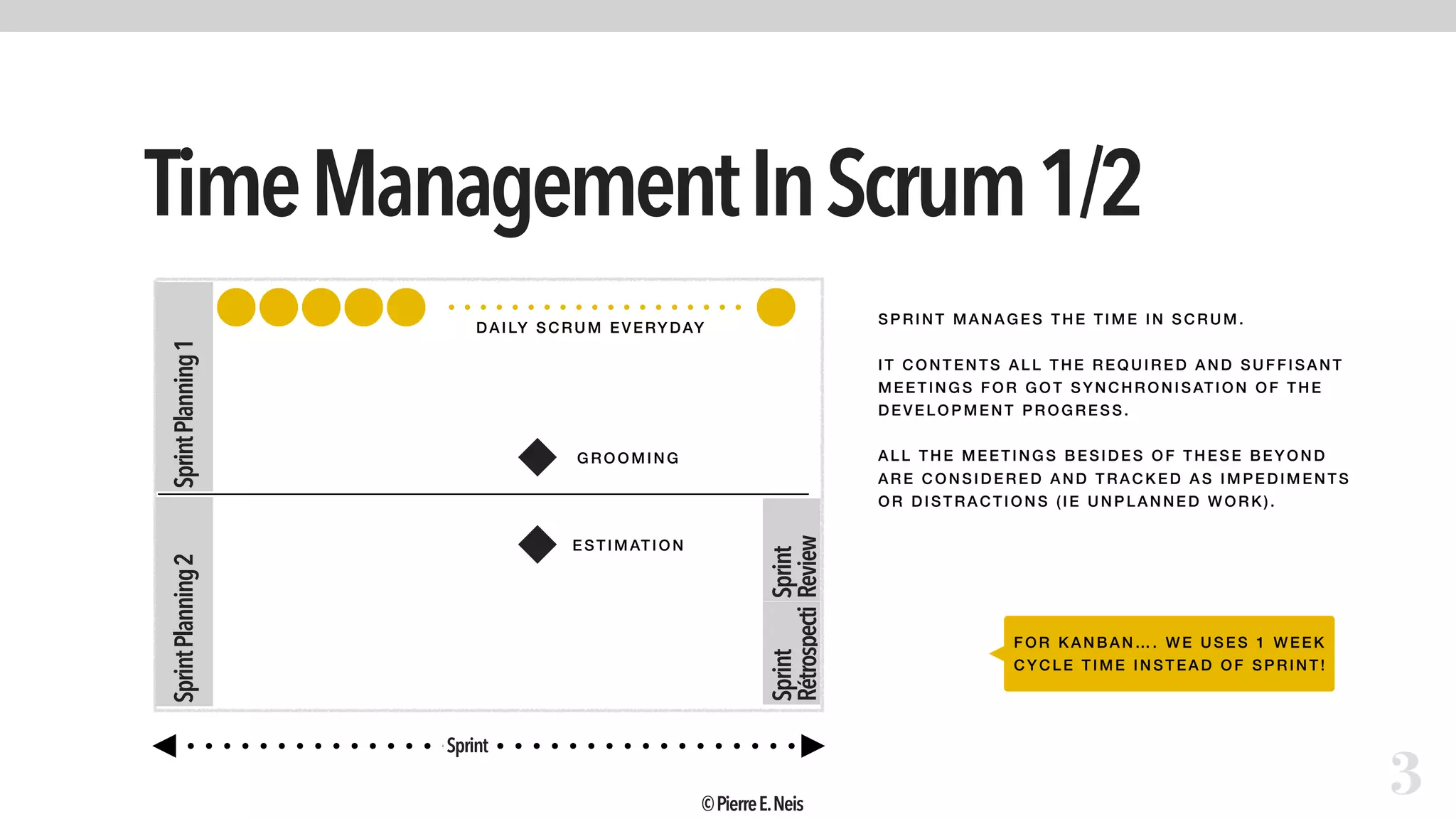
SPR INT MA NA GES T HE T IME IN SCRUM.
IT CONT ENTS A LL THE RE QUIRE D AND SUFFISA NT
ME ETI NGS F OR GOT SYNCHRONISATI ON OF T HE
DEVELOP MENT P ROGRESS.
ALL T HE ME ETI NGS B ESIDES OF THE SE B EYOND
AR E CONSI DE RE D AND TRA CKE D AS IM PEDIMENT S
OR DIST RACT IONS ( IE UNPLA NNE D WORK).
GROOM ING
ESTI MATI ON
FOR KANBAN…. WE USE S 1 WE EK
CYCLE TI ME I NST EAD OF SPRINT !
©PierreE.Neis
TimeManagementInScrum2/2
4
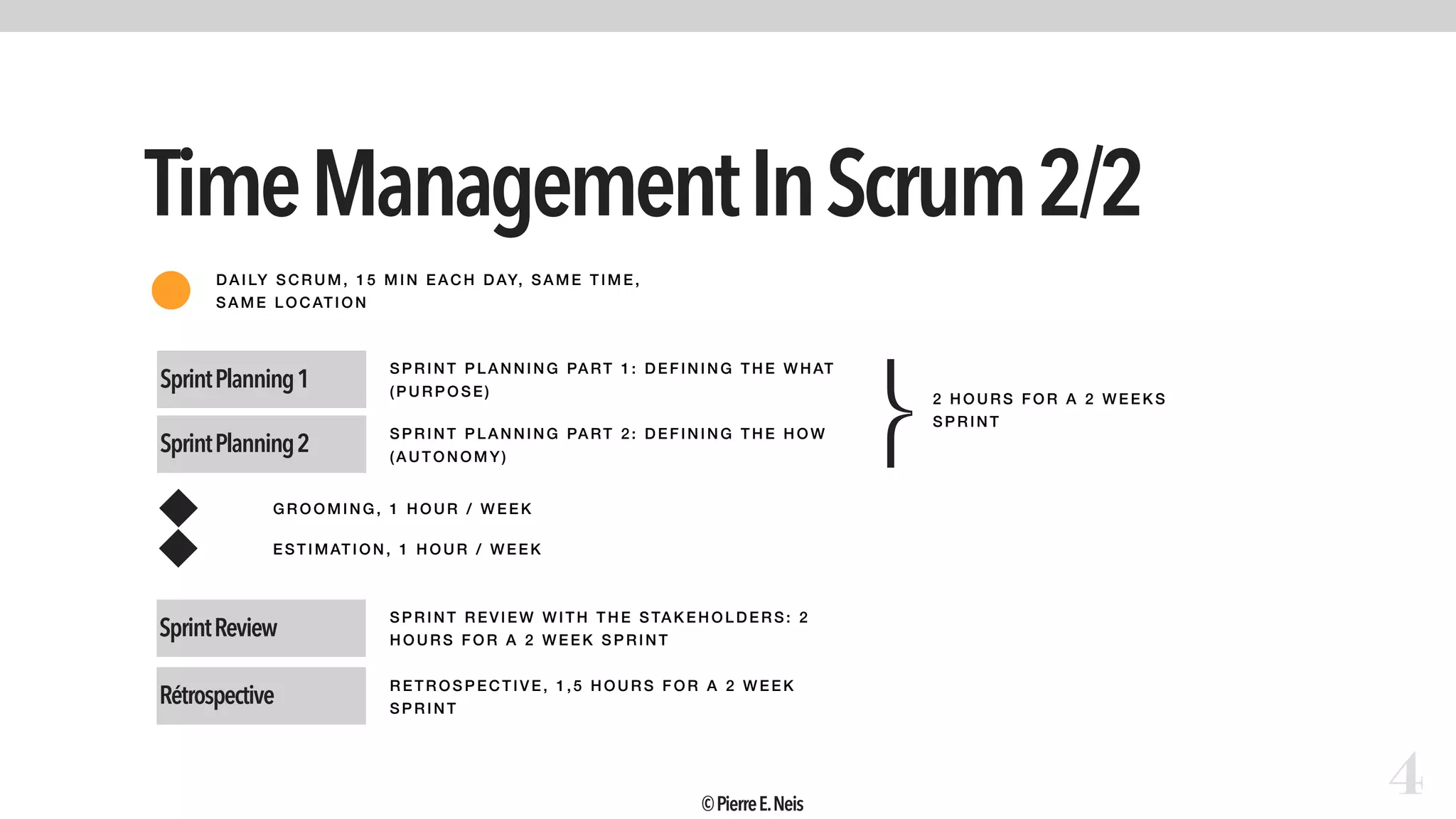
DAI LY S CR UM, 15 MI N EACH DAY, SAM E T IME,
SA ME LOCATION
SprintPlanning1
SPRI NT PLANNING PART 1: DEFI NI NG THE WHAT
(PURPOSE)
SprintPlanning2
SPRI NT PLANNING PART 2: DEFI NI NG THE HOW
(AUTONOMY)
⎬2 HOURS FOR A 2 WEE KS
SPR INT
GROOM ING, 1 HOUR / WEEK
ESTIMATION, 1 HOUR / WE EK
SprintReview
SPRI NT REVIEW WI TH T HE STAKE HOLDERS: 2
HOURS FOR A 2 WEEK SPRI NT
Rétrospective
RETROSPECTIVE, 1, 5 HOURS FOR A 2 WEE K
SPRI NT
©PierreE.Neis
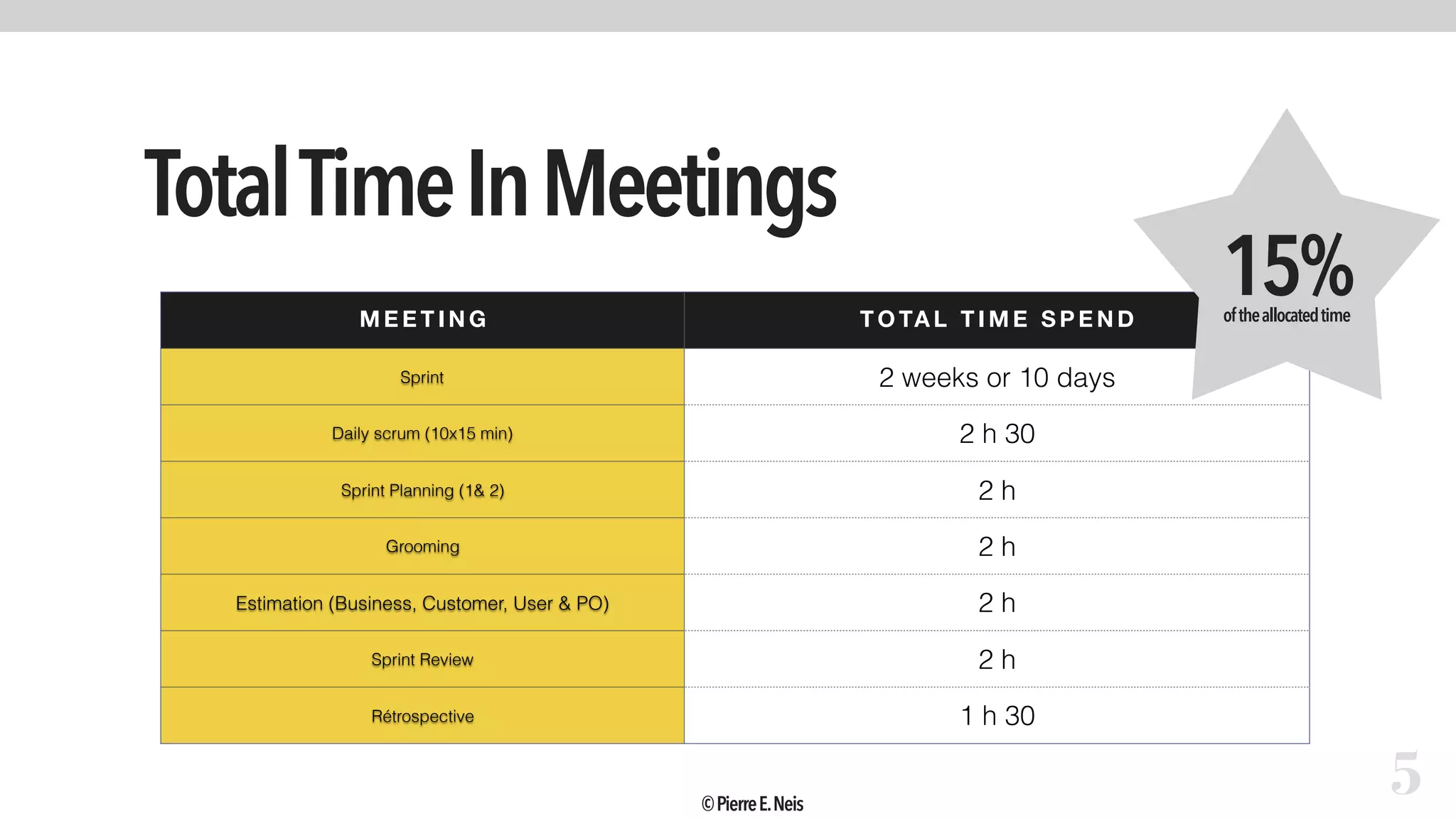
TotalTimeInMeetings
5
M E E T I N G T O TA L T I M E S P E N D
Sprint 2 weeks or 10 days
Daily scrum (10x15 min) 2 h 30
Sprint Planning (1& 2) 2 h
Grooming 2 h
Estimation (Business, Customer, User & PO) 2 h
Sprint Review 2 h
Rétrospective 1 h 30
15%oftheallocatedtime
©PierreE.Neis
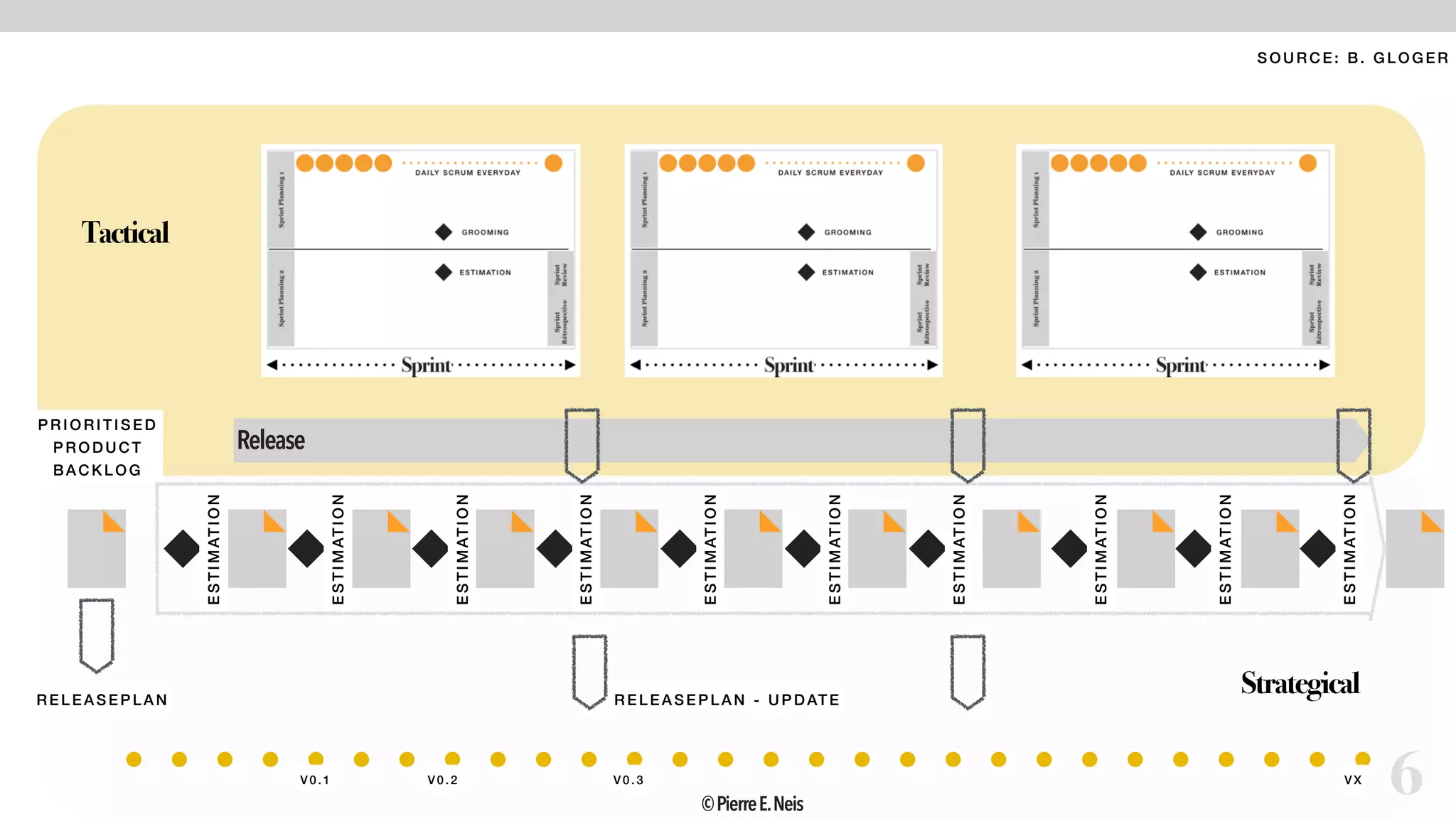
6
Release
PRIORITISED
PRODUCT
BACKL OG
ESTIMATION
ESTIMATION
ESTIMATION
ESTIMATION
ESTIMATION
ESTIMATION
ESTIMATION
ESTIMATION
ESTIMATION
ESTIMATION
RELE ASEPLAN RELEASEPLAN - UP DATE
V0. 1 V 0. 2 V 0. 3 VX
Tactical
Strategical
SOUR CE : B . GLOGE R
©PierreE.Neis
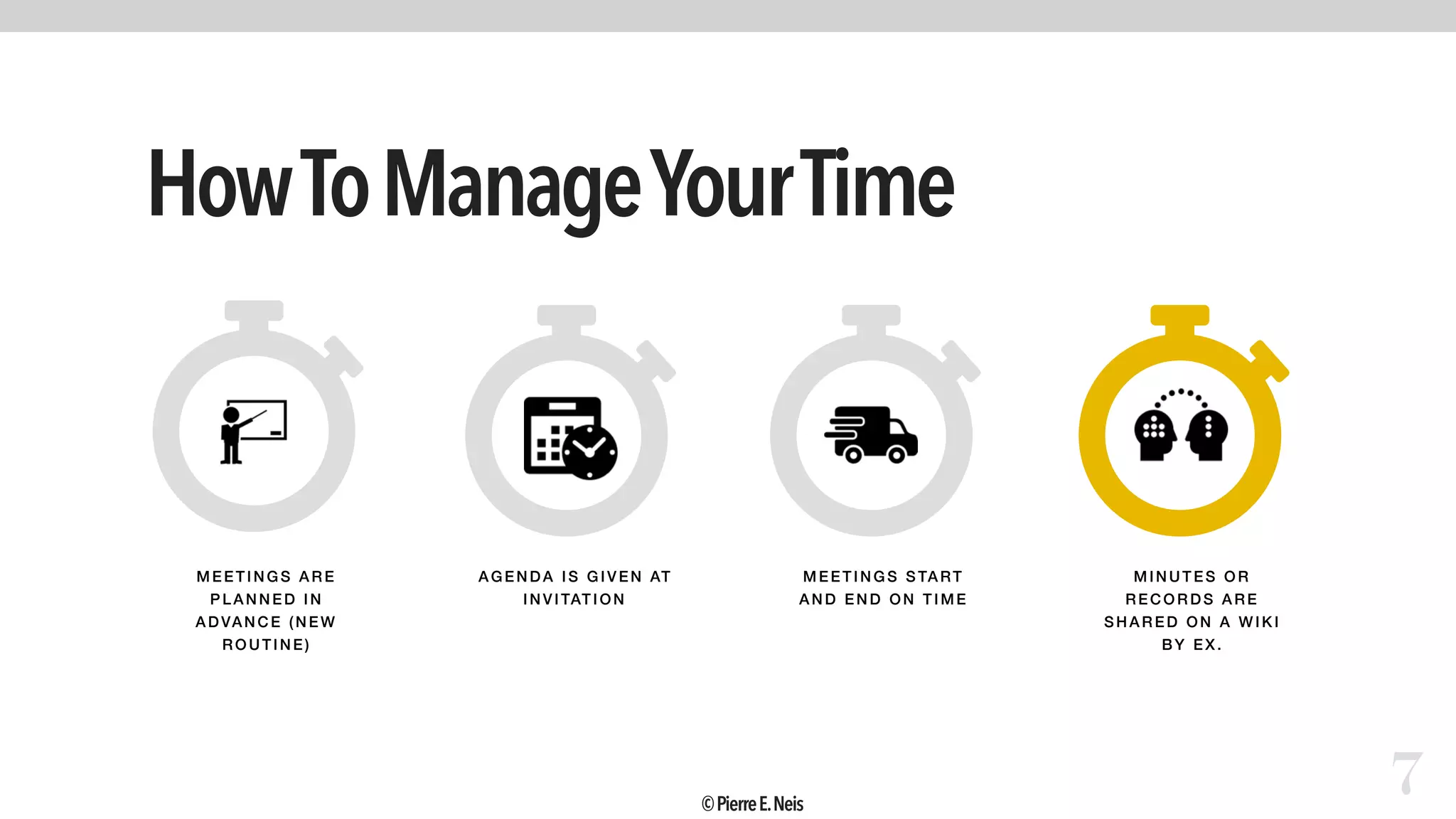
HowToManageYourTime
7
MEETIN GS AR E
PLAN NED IN
ADVA NCE ( NEW
ROU TINE)
AGENDA I S G IVEN AT
INVITATI ON
ME ETI NGS STA RT
AND E ND ON T IME
MINUTE S OR
RE COR DS ARE
SHARE D ON A WIKI
BY E X.
©PierreE.Neis
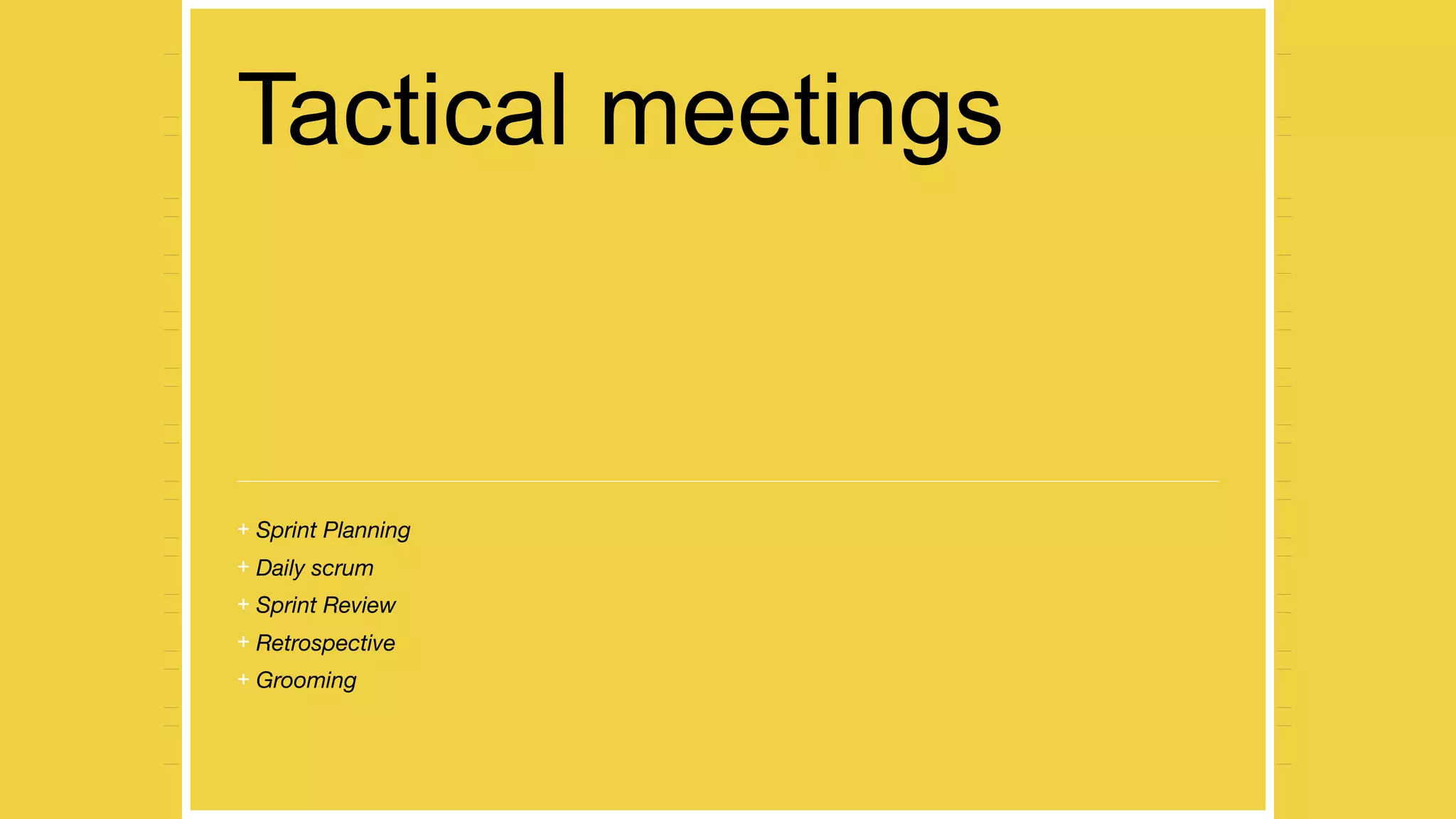
Tactical meetings
+ Sprint Planning
+ Daily scrum
+ Sprint Review
+ Retrospective
+ Grooming
SprintPlanning
9
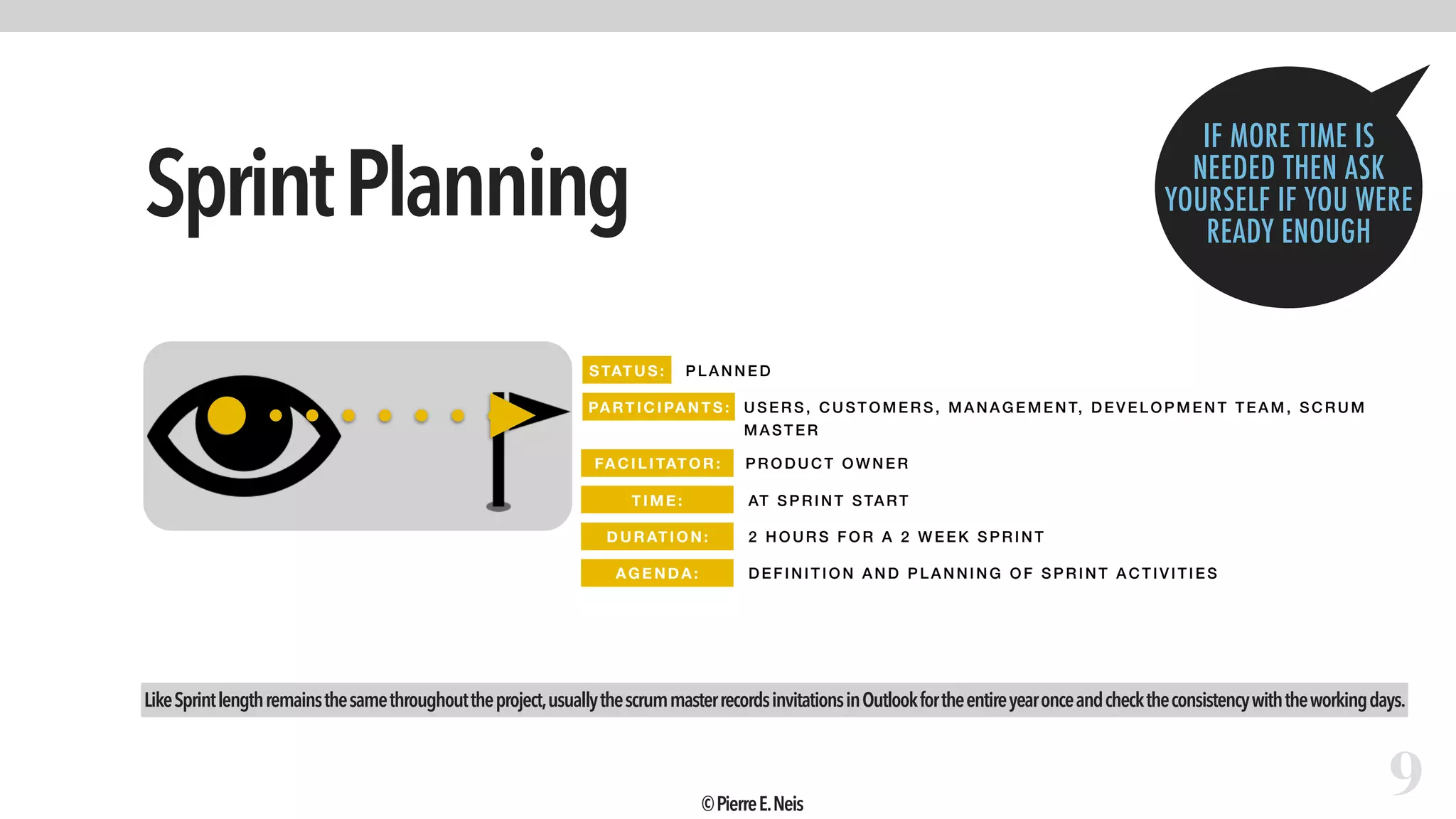
STATUS: PLANNED
PARTICIPANTS: USERS, CUST OME RS, M ANA GE MENT, DE VE LOP ME NT T EA M, SCR UM
MAST ER
FACI LI TATO R: PRODUCT OWNER
TIME: AT SPRI NT START
DURATIO N: 2 HOURS FOR A 2 WEE K SPRI NT
AGENDA: DEF INITI ON A ND PLANNING OF SPRINT ACTIV ITIE S
LikeSprintlengthremainsthesamethroughouttheproject,usuallythescrummasterrecordsinvitationsinOutlookfortheentireyearonceandchecktheconsistencywiththeworkingdays.
IF MORE TIME IS
NEEDED THEN ASK
YOURSELF IF YOU WERE
READY ENOUGH
©PierreE.Neis
DailyScrum
10
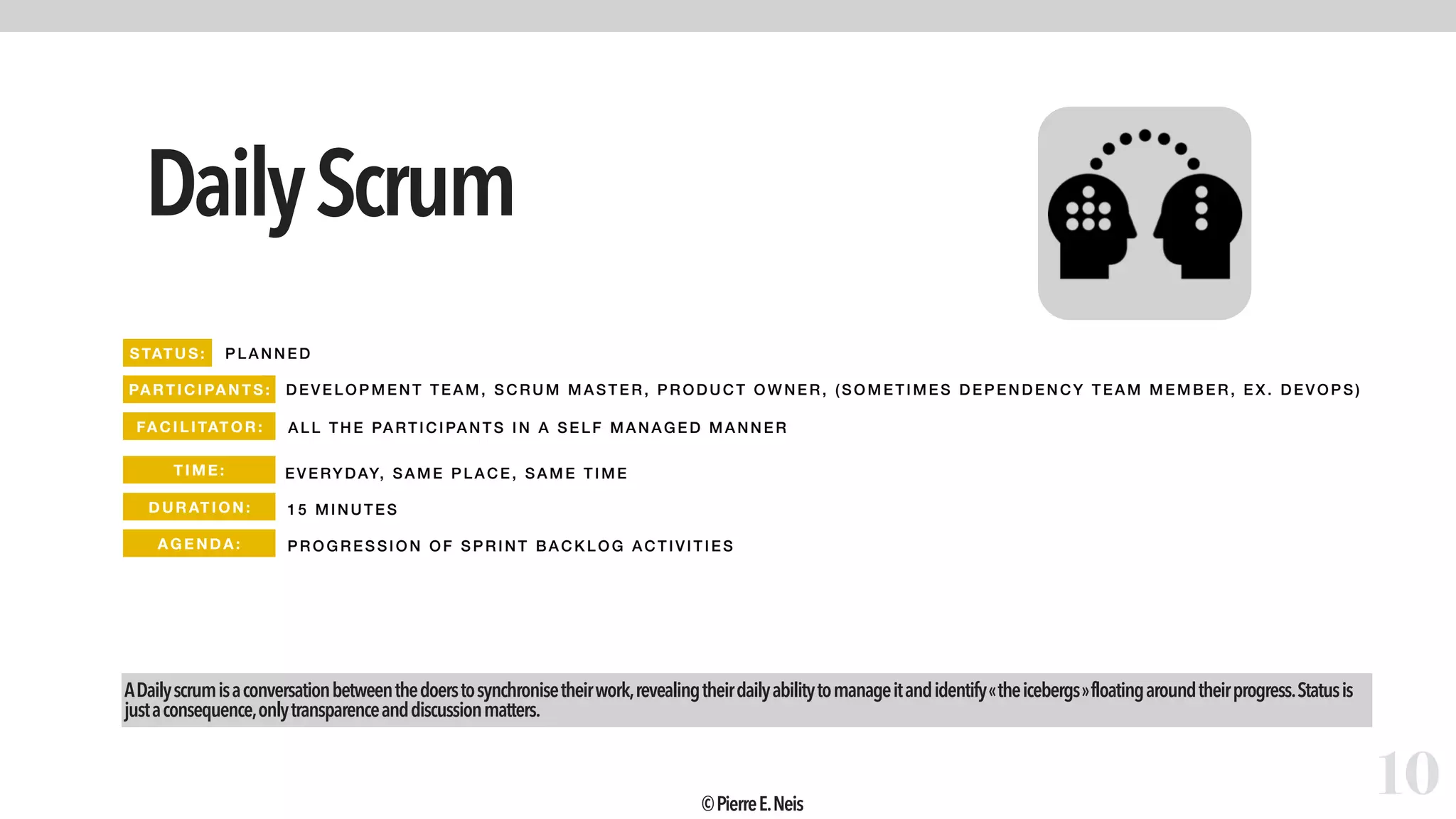
PLAN NED
DEVELOPM ENT TEAM, SCRUM M ASTER, PRODUCT OWNER , (SOME TIMES DE PE NDE NCY TEAM MEMBER, EX. DEVOPS)
EVERY DAY, SAME PLACE, SAME TI ME
15 MINUTES
PR OGRES SION OF SPRINT BACKLOG ACT IVITIES
ADailyscrumisaconversationbetweenthedoerstosynchronisetheirwork,revealingtheirdailyabilitytomanageitandidentify« theicebergs »floatingaroundtheirprogress.Statusis
justaconsequence,onlytransparenceanddiscussionmatters.
ALL THE PARTI CI PANT S IN A SE LF MANAGED MANNER
STATUS:
PARTIC IPANTS:
FA CIL ITAT OR:
TIME :
DURATI ON:
AGEND A:
©PierreE.Neis
SprintReview
11
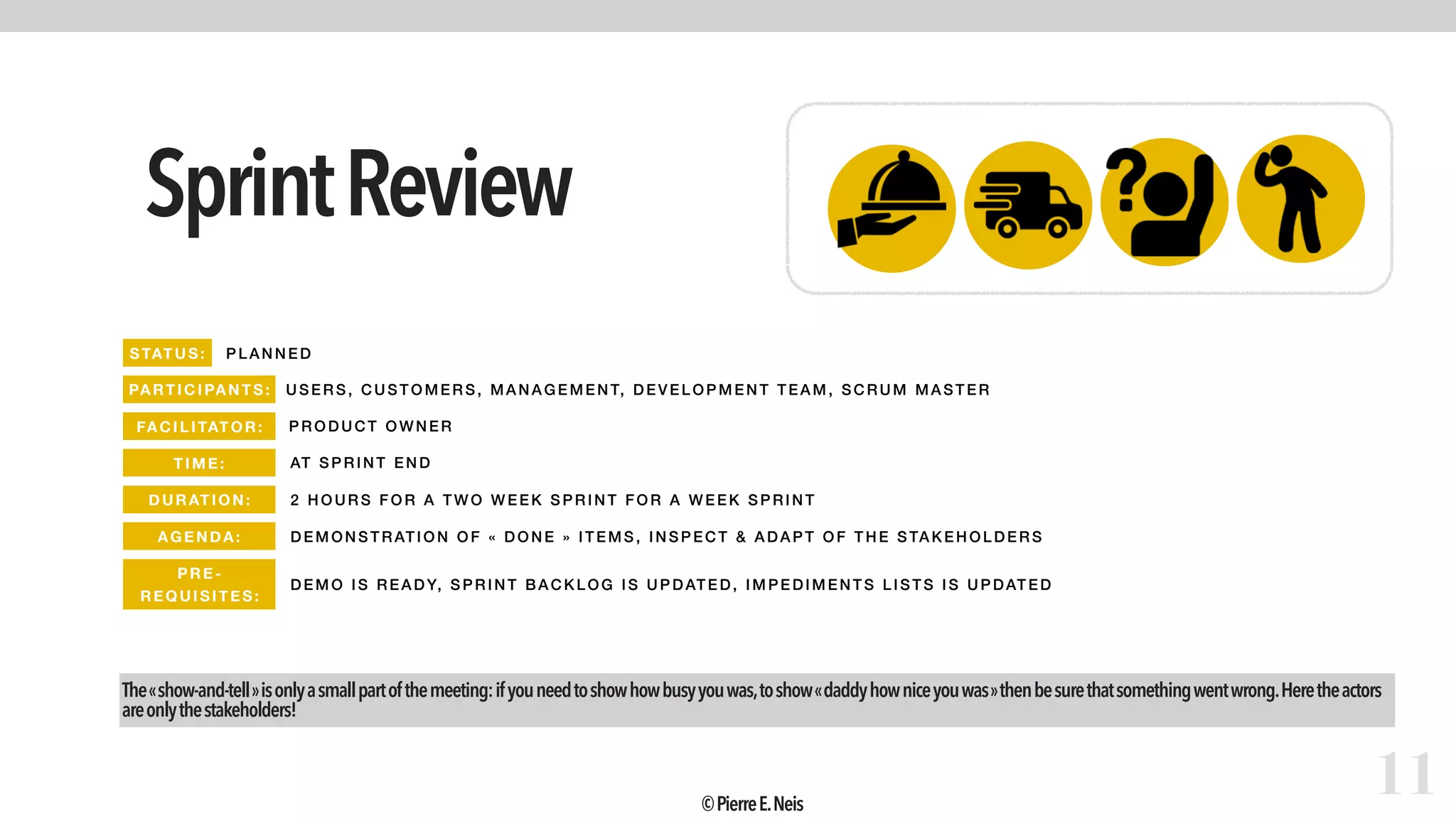
STATUS: PLAN NED
PARTIC IPANTS: USER S, CUSTOM ERS, M ANAGEMENT, DEVELOPMENT T EA M, SCR UM M ASTE R
FA CIL ITAT OR: PR ODUCT OW NER
TIME : AT SP RINT END
DURATI ON: 2 HOUR S FOR A TW O WE EK SPRI NT F OR A WEEK SPRINT
AGEND A: DEMON STRATION OF «  DONE  » IT EM S, INSPECT & ADA P T OF THE STAKEHO LDERS
The« show-and-tell »isonlyasmallpartofthemeeting:ifyouneedtoshowhowbusyyouwas,toshow« daddyhowniceyouwas »thenbesurethatsomethingwentwrong.Heretheactors
areonlythestakeholders!
PRE -
REQUISITES:
DEMO IS READY, SPRI NT BACKLOG IS UPDATED, IMPE DIMENT S LIST S IS UPDATE D
©PierreE.Neis
Retrospective
12
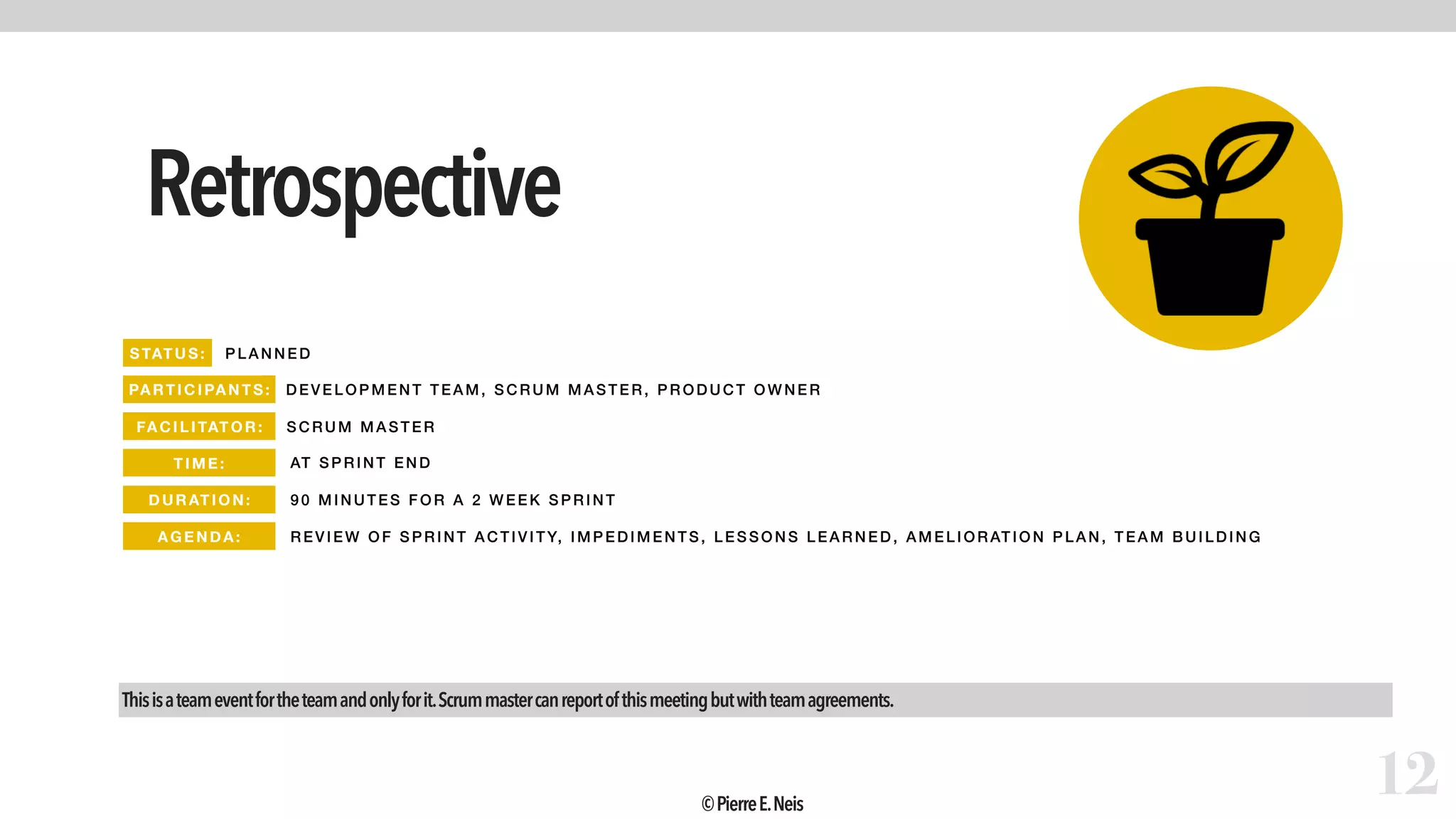
PLAN NED
DEVELOPM ENT TEAM, SCRUM M ASTER, PRODUCT OWNER
SCR UM M ASTER
AT SP RINT END
90 MINUTES FOR A 2 WEEK SPRINT
REVIEW OF SPRINT ACTI VI TY, I MPE DI MENTS, LESSONS LEA RNE D, AM ELIOR ATION P LAN, TEAM BUILDING
Thisisateameventfortheteamandonlyforit.Scrummastercanreportofthismeetingbutwithteamagreements.
STATUS:
PARTIC IPANTS:
FA CIL ITAT OR:
TIME :
DURATI ON:
AGEND A:
©PierreE.Neis
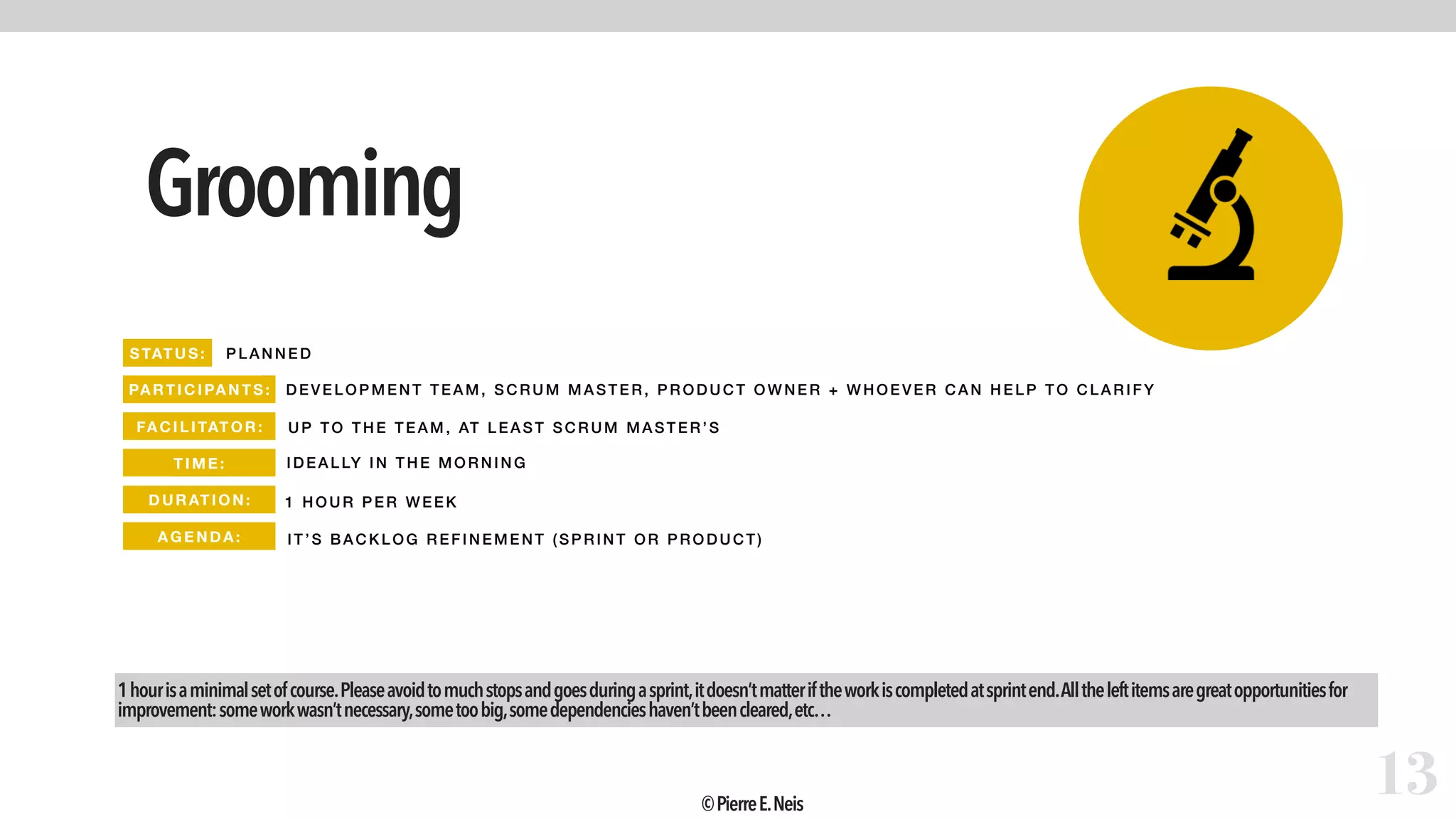
Grooming
13
PLAN NED
DEVELOPM ENT TEAM, SCRUM M ASTER, PRODUCT OWNER + WHO EVE R CA N HELP TO CLARIFY
1 HOUR P ER WEEK
IT’S B ACKLOG REFINEMENT ( SPRINT OR PRODUCT)
1hourisaminimalsetofcourse.Pleaseavoidtomuchstopsandgoesduringasprint,itdoesn’tmatteriftheworkiscompletedatsprintend.Alltheleftitemsaregreatopportunitiesfor
improvement:someworkwasn’tnecessary,sometoobig,somedependencieshaven’tbeencleared,etc…
UP TO THE TEAM, AT LE AST SCRUM M ASTER’S
STATUS:
PARTIC IPANTS:
FA CIL ITAT OR:
TIME :
DURATI ON:
AGEND A:
IDEALLY IN THE MORNING
©PierreE.Neis
Strategical meetings
+ business value estimation
+ scrum-of-scrums
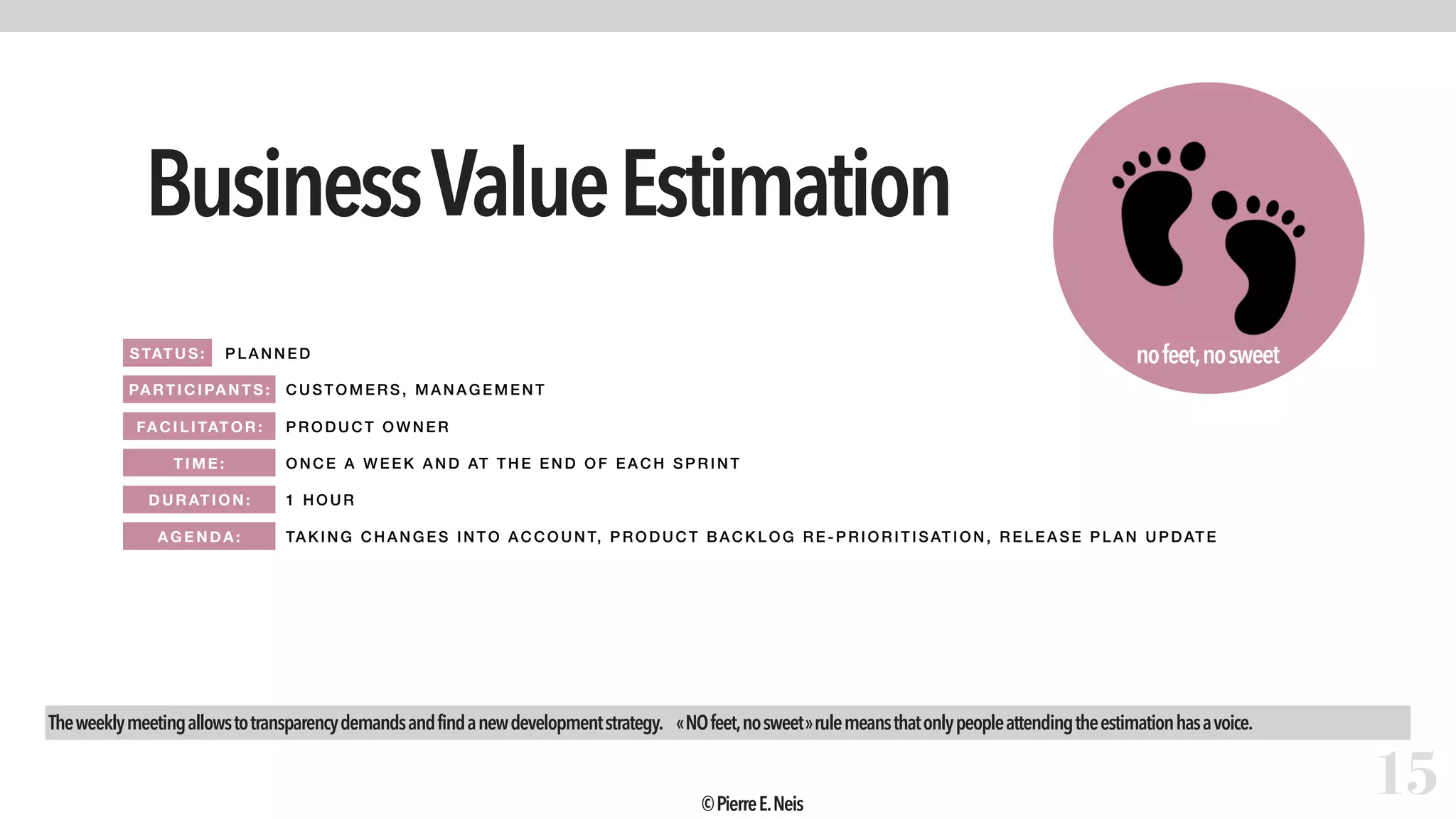
nofeet,nosweet
BusinessValueEstimation
15
PLAN NED
CUS TOM ER S, MANAGE MENT
PR ODUCT OW NER
ONCE A WEEK AND AT THE END OF EACH SPRINT
1 HOUR
TA KING CHANGES I NTO ACCOUNT, PRODUCT BACKLO G R E- PR IOR IT ISAT ION, RE LE ASE PLAN UPDATE
Theweeklymeetingallowstotransparencydemandsandfindanewdevelopmentstrategy. « NOfeet,nosweet »rulemeansthatonlypeopleattendingtheestimationhasavoice.
STATUS:
PARTIC IPANTS:
FA CIL ITAT OR:
TIME :
DURATI ON:
AGEND A:
©PierreE.Neis
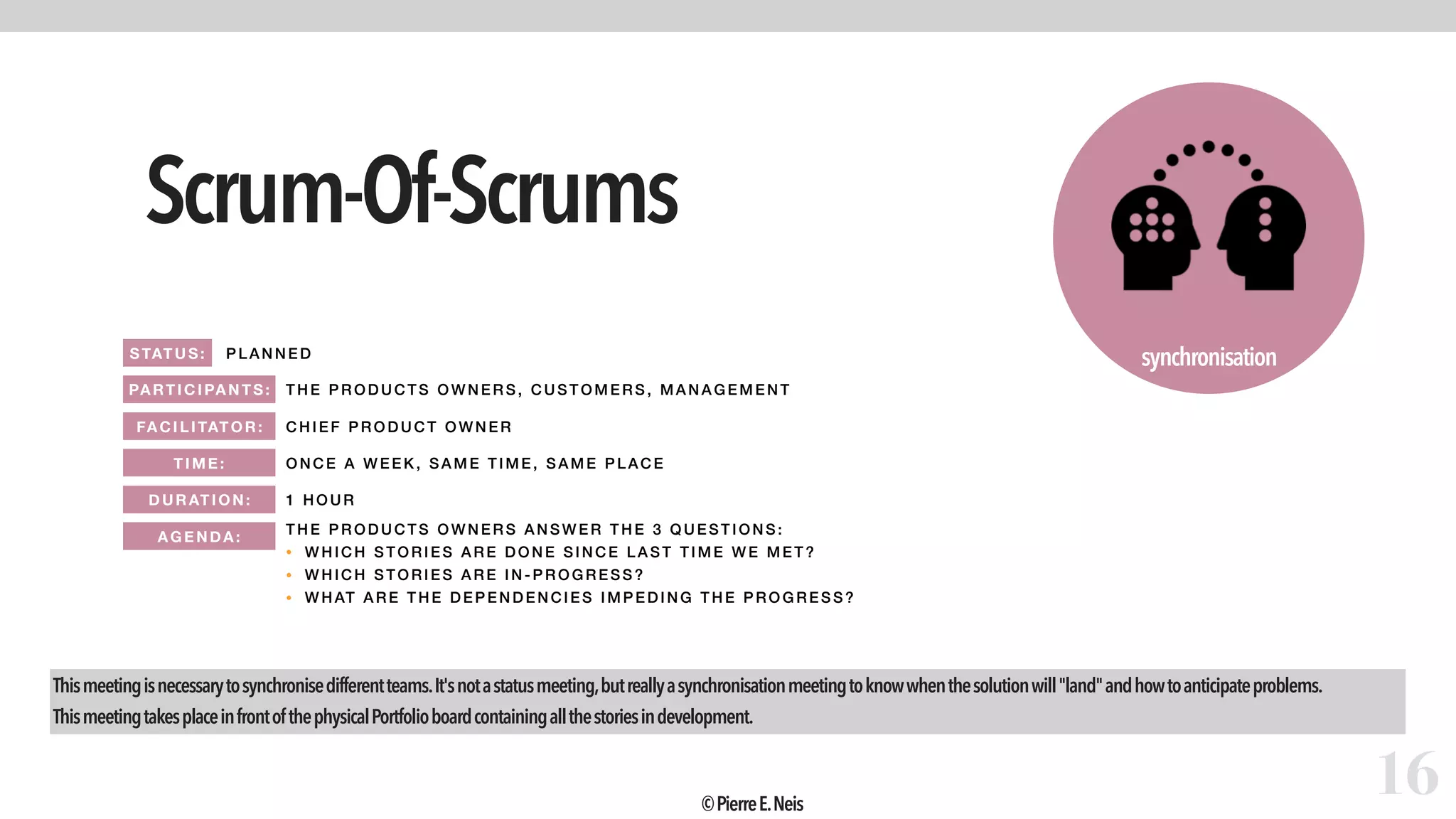
synchronisation
Scrum-Of-Scrums
16
PLAN NED
THE P RODUCTS OWNE RS, CUSTOMERS, MANAGEMENT
CHIEF PRO DUCT OWNE R
ONCE A WEEK, SAME T IME, SAME PLACE
1 HOUR
THE P RODUCTS OWNE RS ANSWE R T HE 3 QUESTIONS:
• WHICH STORIES ARE DONE SI NCE LAST TI ME WE ME T?
• WHICH STORIES ARE IN-PROG RE SS?
• WHAT A RE THE DEPENDENCI ES I MPEDING THE PRO GRE SS?
Thismeetingisnecessarytosynchronisedifferentteams.It'snotastatusmeeting,butreallyasynchronisationmeetingtoknowwhenthesolutionwill"land"andhowtoanticipateproblems.
ThismeetingtakesplaceinfrontofthephysicalPortfolioboardcontainingallthestoriesindevelopment.
STATUS:
PARTIC IPANTS:
FA CIL ITAT OR:
TIME :
DURATI ON:
AGEND A:
©PierreE.Neis
Stephen Covey’s time
management Grid
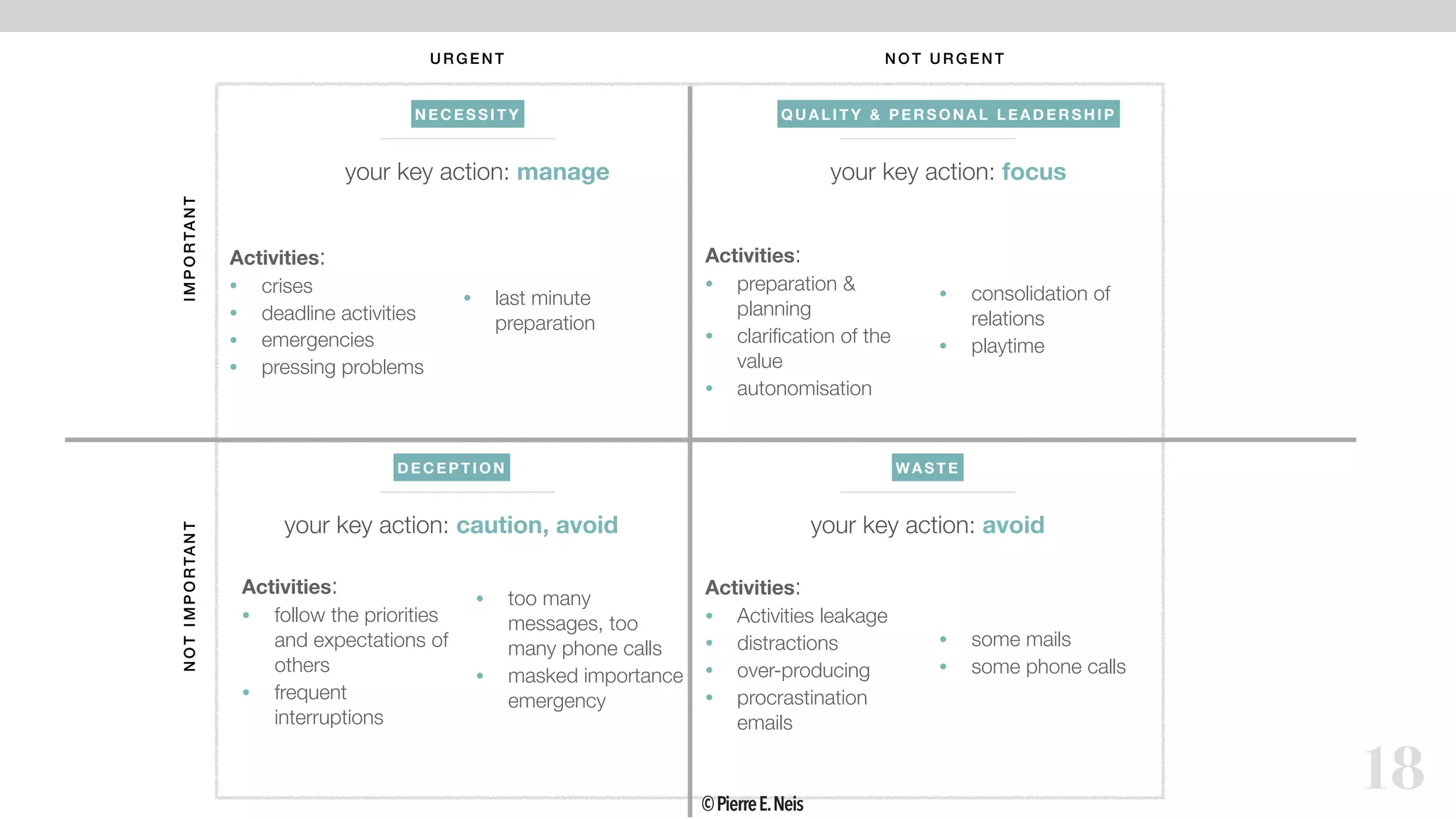
18
URG ENT NOT URGENT
IMPORTANTNOTIMPORTANT
NECESSI TY QU AL ITY & PERSONAL L EADERSHIP
DECEPTIO N WASTE
your key action: manage your key action: focus
your key action: caution, avoid your key action: avoid
Activities:
• crises
• deadline activities
• emergencies
• pressing problems
• last minute
preparation
Activities:
• preparation &
planning
• clarification of the
value
• autonomisation
• consolidation of
relations
• playtime
Activities:
• follow the priorities
and expectations of
others
• frequent
interruptions
• too many
messages, too
many phone calls
• masked importance
emergency
Activities:
• Activities leakage
• distractions
• over-producing
• procrastination
emails
• some mails
• some phone calls
©PierreE.Neis
Softskills applied to
non-violent
communication
20
Hand Head Heart
HAVE RULES AN D
PR OCED UR ES
KNOWING RULES AND
PROCEDURES
ADHER E T O
RULES A ND PROCEDURES
©PierreE.Neis
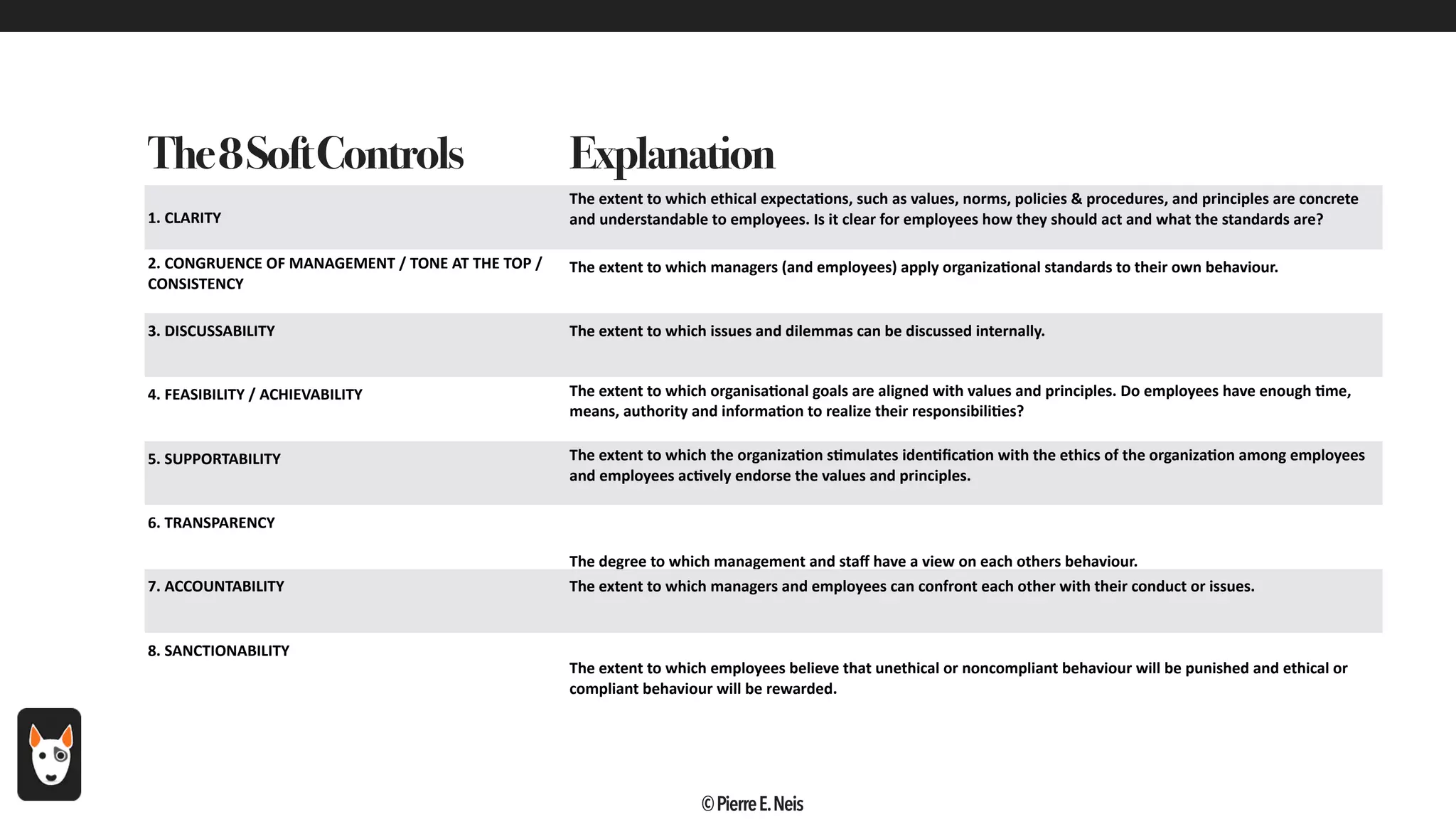
TheBasicQuestionsForSoftControls:
21
The8SoftControls Explanation
1.	CLARITY	
The	extent	to	which	ethical	expecta7ons,	such	as	values,	norms,	policies	&	procedures,	and	principles	are	concrete	
and	understandable	to	employees.	Is	it	clear	for	employees	how	they	should	act	and	what	the	standards	are?	
2.	CONGRUENCE	OF	MANAGEMENT	/	TONE	AT	THE	TOP	/	
CONSISTENCY	
The	extent	to	which	managers	(and	employees)	apply	organiza7onal	standards	to	their	own	behaviour.	
3.	DISCUSSABILITY	 The	extent	to	which	issues	and	dilemmas	can	be	discussed	internally.	
4.	FEASIBILITY	/	ACHIEVABILITY	 The	extent	to	which	organisa7onal	goals	are	aligned	with	values	and	principles.	Do	employees	have	enough	7me,	
means,	authority	and	informa7on	to	realize	their	responsibili7es?	
5.	SUPPORTABILITY	 The	extent	to	which	the	organiza7on	s7mulates	iden7fica7on	with	the	ethics	of	the	organiza7on	among	employees	
and	employees	ac7vely	endorse	the	values	and	principles.		
6.	TRANSPARENCY	
The	degree	to	which	management	and	staff	have	a	view	on	each	others	behaviour.		
7.	ACCOUNTABILITY	 The	extent	to	which	managers	and	employees	can	confront	each	other	with	their	conduct	or	issues.	
8.	SANCTIONABILITY	
The	extent	to	which	employees	believe	that	unethical	or	noncompliant	behaviour	will	be	punished	and	ethical	or	
compliant	behaviour	will	be	rewarded.
©PierreE.Neis
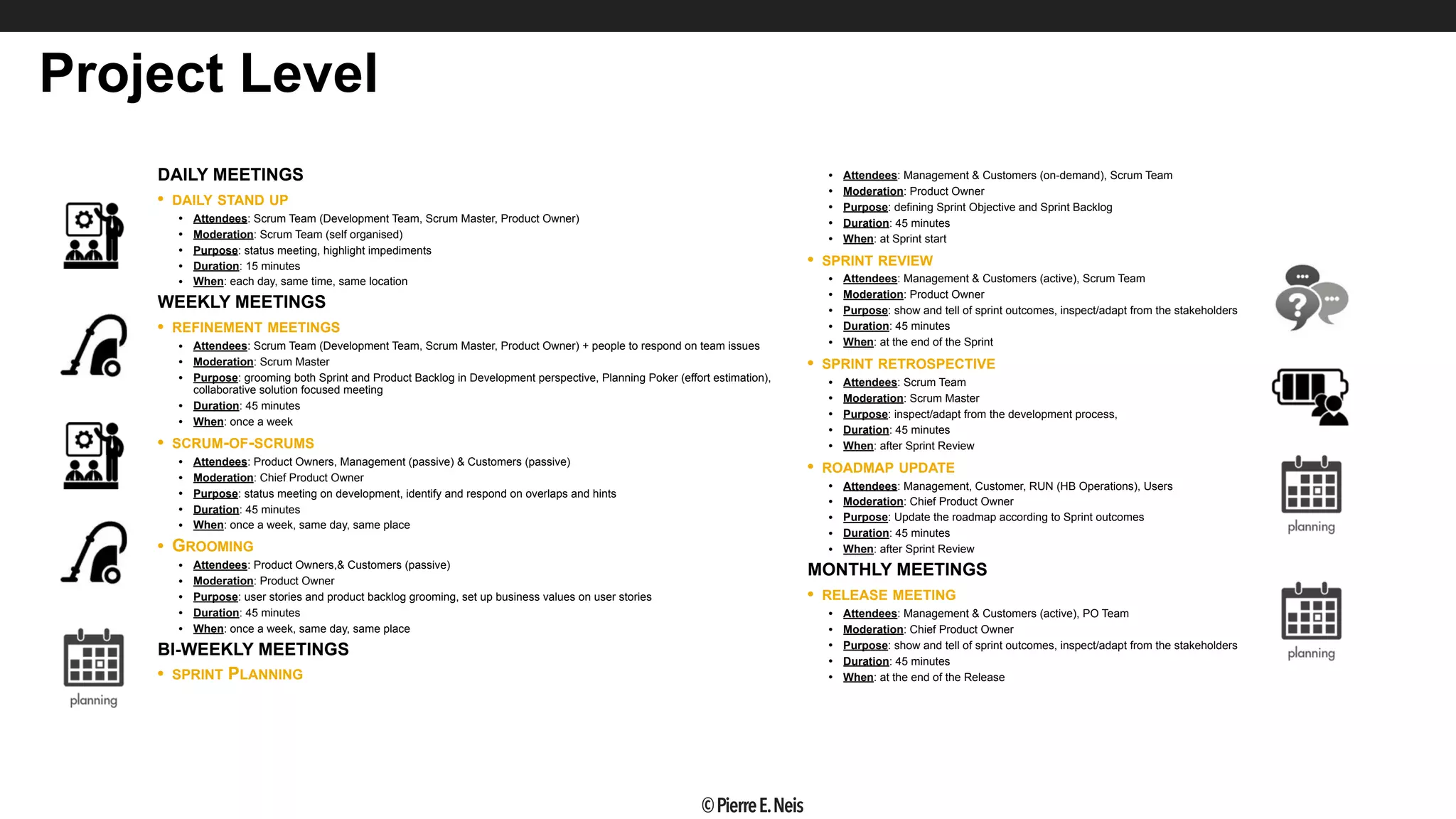
Example of large
organisation
DAILY MEETINGS
• DAILY STAND UP
• Attendees: Scrum Team (Development Team, Scrum Master, Product Owner)
• Moderation: Scrum Team (self organised)
• Purpose: status meeting, highlight impediments
• Duration: 15 minutes
• When: each day, same time, same location
WEEKLY MEETINGS
• REFINEMENT MEETINGS
• Attendees: Scrum Team (Development Team, Scrum Master, Product Owner) + people to respond on team issues
• Moderation: Scrum Master
• Purpose: grooming both Sprint and Product Backlog in Development perspective, Planning Poker (effort estimation),
collaborative solution focused meeting
• Duration: 45 minutes
• When: once a week
• SCRUM-OF-SCRUMS
• Attendees: Product Owners, Management (passive) & Customers (passive)
• Moderation: Chief Product Owner
• Purpose: status meeting on development, identify and respond on overlaps and hints
• Duration: 45 minutes
• When: once a week, same day, same place
• GROOMING
• Attendees: Product Owners,& Customers (passive)
• Moderation: Product Owner
• Purpose: user stories and product backlog grooming, set up business values on user stories
• Duration: 45 minutes
• When: once a week, same day, same place
BI-WEEKLY MEETINGS
• SPRINT PLANNING
• Attendees: Management & Customers (on-demand), Scrum Team
• Moderation: Product Owner
• Purpose: defining Sprint Objective and Sprint Backlog
• Duration: 45 minutes
• When: at Sprint start
• SPRINT REVIEW
• Attendees: Management & Customers (active), Scrum Team
• Moderation: Product Owner
• Purpose: show and tell of sprint outcomes, inspect/adapt from the stakeholders
• Duration: 45 minutes
• When: at the end of the Sprint
• SPRINT RETROSPECTIVE
• Attendees: Scrum Team
• Moderation: Scrum Master
• Purpose: inspect/adapt from the development process,
• Duration: 45 minutes
• When: after Sprint Review
• ROADMAP UPDATE
• Attendees: Management, Customer, RUN (HB Operations), Users
• Moderation: Chief Product Owner
• Purpose: Update the roadmap according to Sprint outcomes
• Duration: 45 minutes
• When: after Sprint Review
MONTHLY MEETINGS
• RELEASE MEETING
• Attendees: Management & Customers (active), PO Team
• Moderation: Chief Product Owner
• Purpose: show and tell of sprint outcomes, inspect/adapt from the stakeholders
• Duration: 45 minutes
• When: at the end of the Release
Project Level
©PierreE.Neis
Conclusion
• Referring to the scrum framework, all the
meetings outside the « ceremonies » are
considered as « impediments » or « distractions »
and fosters confusion.
• In large project or programs, a couple of new
meetings to synchronise the effort, like scrum-of-
scrums and delivery meetings, can be added in
the global time constraint of 15% of time.
• Product Owners and Scrum Masters do have
beside meetings and these should not impact the
self organised cycle of development teams. These
meetings should provide matter for the project/
program.
24
Pierre Neis
pierre@wecompany.me|@elpedromajor

Managing time in agile

  • 1.
    LESSONS FROM THEFI ELDAGILE ManagingTimeInAgile PierreE.Neis|pierre@wecompany.me
  • 2.
    The Scrum example +Time management in Scrum + Total time in meetings + The Scrum Flow + How to manage your time
  • 3.
    TimeManagementInScrum1/2 3 SprintPlanning1SprintPlanning2 Sprint Rétrospecti Sprint Review DAI LY SCRUMEVERYDAY Sprint SPR INT MA NA GES T HE T IME IN SCRUM. IT CONT ENTS A LL THE RE QUIRE D AND SUFFISA NT ME ETI NGS F OR GOT SYNCHRONISATI ON OF T HE DEVELOP MENT P ROGRESS. ALL T HE ME ETI NGS B ESIDES OF THE SE B EYOND AR E CONSI DE RE D AND TRA CKE D AS IM PEDIMENT S OR DIST RACT IONS ( IE UNPLA NNE D WORK). GROOM ING ESTI MATI ON FOR KANBAN…. WE USE S 1 WE EK CYCLE TI ME I NST EAD OF SPRINT ! ©PierreE.Neis
  • 4.
    TimeManagementInScrum2/2 4 DAI LY SCR UM, 15 MI N EACH DAY, SAM E T IME, SA ME LOCATION SprintPlanning1 SPRI NT PLANNING PART 1: DEFI NI NG THE WHAT (PURPOSE) SprintPlanning2 SPRI NT PLANNING PART 2: DEFI NI NG THE HOW (AUTONOMY) ⎬2 HOURS FOR A 2 WEE KS SPR INT GROOM ING, 1 HOUR / WEEK ESTIMATION, 1 HOUR / WE EK SprintReview SPRI NT REVIEW WI TH T HE STAKE HOLDERS: 2 HOURS FOR A 2 WEEK SPRI NT Rétrospective RETROSPECTIVE, 1, 5 HOURS FOR A 2 WEE K SPRI NT ©PierreE.Neis
  • 5.
    TotalTimeInMeetings 5 M E ET I N G T O TA L T I M E S P E N D Sprint 2 weeks or 10 days Daily scrum (10x15 min) 2 h 30 Sprint Planning (1& 2) 2 h Grooming 2 h Estimation (Business, Customer, User & PO) 2 h Sprint Review 2 h Rétrospective 1 h 30 15%oftheallocatedtime ©PierreE.Neis
  • 6.
  • 7.
    HowToManageYourTime 7 MEETIN GS ARE PLAN NED IN ADVA NCE ( NEW ROU TINE) AGENDA I S G IVEN AT INVITATI ON ME ETI NGS STA RT AND E ND ON T IME MINUTE S OR RE COR DS ARE SHARE D ON A WIKI BY E X. ©PierreE.Neis
  • 8.
    Tactical meetings + SprintPlanning + Daily scrum + Sprint Review + Retrospective + Grooming
  • 9.
    SprintPlanning 9 STATUS: PLANNED PARTICIPANTS: USERS,CUST OME RS, M ANA GE MENT, DE VE LOP ME NT T EA M, SCR UM MAST ER FACI LI TATO R: PRODUCT OWNER TIME: AT SPRI NT START DURATIO N: 2 HOURS FOR A 2 WEE K SPRI NT AGENDA: DEF INITI ON A ND PLANNING OF SPRINT ACTIV ITIE S LikeSprintlengthremainsthesamethroughouttheproject,usuallythescrummasterrecordsinvitationsinOutlookfortheentireyearonceandchecktheconsistencywiththeworkingdays. IF MORE TIME IS NEEDED THEN ASK YOURSELF IF YOU WERE READY ENOUGH ©PierreE.Neis
  • 10.
    DailyScrum 10 PLAN NED DEVELOPM ENTTEAM, SCRUM M ASTER, PRODUCT OWNER , (SOME TIMES DE PE NDE NCY TEAM MEMBER, EX. DEVOPS) EVERY DAY, SAME PLACE, SAME TI ME 15 MINUTES PR OGRES SION OF SPRINT BACKLOG ACT IVITIES ADailyscrumisaconversationbetweenthedoerstosynchronisetheirwork,revealingtheirdailyabilitytomanageitandidentify« theicebergs »floatingaroundtheirprogress.Statusis justaconsequence,onlytransparenceanddiscussionmatters. ALL THE PARTI CI PANT S IN A SE LF MANAGED MANNER STATUS: PARTIC IPANTS: FA CIL ITAT OR: TIME : DURATI ON: AGEND A: ©PierreE.Neis
  • 11.
    SprintReview 11 STATUS: PLAN NED PARTICIPANTS: USER S, CUSTOM ERS, M ANAGEMENT, DEVELOPMENT T EA M, SCR UM M ASTE R FA CIL ITAT OR: PR ODUCT OW NER TIME : AT SP RINT END DURATI ON: 2 HOUR S FOR A TW O WE EK SPRI NT F OR A WEEK SPRINT AGEND A: DEMON STRATION OF «  DONE  » IT EM S, INSPECT & ADA P T OF THE STAKEHO LDERS The« show-and-tell »isonlyasmallpartofthemeeting:ifyouneedtoshowhowbusyyouwas,toshow« daddyhowniceyouwas »thenbesurethatsomethingwentwrong.Heretheactors areonlythestakeholders! PRE - REQUISITES: DEMO IS READY, SPRI NT BACKLOG IS UPDATED, IMPE DIMENT S LIST S IS UPDATE D ©PierreE.Neis
  • 12.
    Retrospective 12 PLAN NED DEVELOPM ENTTEAM, SCRUM M ASTER, PRODUCT OWNER SCR UM M ASTER AT SP RINT END 90 MINUTES FOR A 2 WEEK SPRINT REVIEW OF SPRINT ACTI VI TY, I MPE DI MENTS, LESSONS LEA RNE D, AM ELIOR ATION P LAN, TEAM BUILDING Thisisateameventfortheteamandonlyforit.Scrummastercanreportofthismeetingbutwithteamagreements. STATUS: PARTIC IPANTS: FA CIL ITAT OR: TIME : DURATI ON: AGEND A: ©PierreE.Neis
  • 13.
    Grooming 13 PLAN NED DEVELOPM ENTTEAM, SCRUM M ASTER, PRODUCT OWNER + WHO EVE R CA N HELP TO CLARIFY 1 HOUR P ER WEEK IT’S B ACKLOG REFINEMENT ( SPRINT OR PRODUCT) 1hourisaminimalsetofcourse.Pleaseavoidtomuchstopsandgoesduringasprint,itdoesn’tmatteriftheworkiscompletedatsprintend.Alltheleftitemsaregreatopportunitiesfor improvement:someworkwasn’tnecessary,sometoobig,somedependencieshaven’tbeencleared,etc… UP TO THE TEAM, AT LE AST SCRUM M ASTER’S STATUS: PARTIC IPANTS: FA CIL ITAT OR: TIME : DURATI ON: AGEND A: IDEALLY IN THE MORNING ©PierreE.Neis
  • 14.
    Strategical meetings + businessvalue estimation + scrum-of-scrums
  • 15.
    nofeet,nosweet BusinessValueEstimation 15 PLAN NED CUS TOMER S, MANAGE MENT PR ODUCT OW NER ONCE A WEEK AND AT THE END OF EACH SPRINT 1 HOUR TA KING CHANGES I NTO ACCOUNT, PRODUCT BACKLO G R E- PR IOR IT ISAT ION, RE LE ASE PLAN UPDATE Theweeklymeetingallowstotransparencydemandsandfindanewdevelopmentstrategy. « NOfeet,nosweet »rulemeansthatonlypeopleattendingtheestimationhasavoice. STATUS: PARTIC IPANTS: FA CIL ITAT OR: TIME : DURATI ON: AGEND A: ©PierreE.Neis
  • 16.
    synchronisation Scrum-Of-Scrums 16 PLAN NED THE PRODUCTS OWNE RS, CUSTOMERS, MANAGEMENT CHIEF PRO DUCT OWNE R ONCE A WEEK, SAME T IME, SAME PLACE 1 HOUR THE P RODUCTS OWNE RS ANSWE R T HE 3 QUESTIONS: • WHICH STORIES ARE DONE SI NCE LAST TI ME WE ME T? • WHICH STORIES ARE IN-PROG RE SS? • WHAT A RE THE DEPENDENCI ES I MPEDING THE PRO GRE SS? Thismeetingisnecessarytosynchronisedifferentteams.It'snotastatusmeeting,butreallyasynchronisationmeetingtoknowwhenthesolutionwill"land"andhowtoanticipateproblems. ThismeetingtakesplaceinfrontofthephysicalPortfolioboardcontainingallthestoriesindevelopment. STATUS: PARTIC IPANTS: FA CIL ITAT OR: TIME : DURATI ON: AGEND A: ©PierreE.Neis
  • 17.
  • 18.
    18 URG ENT NOTURGENT IMPORTANTNOTIMPORTANT NECESSI TY QU AL ITY & PERSONAL L EADERSHIP DECEPTIO N WASTE your key action: manage your key action: focus your key action: caution, avoid your key action: avoid Activities: • crises • deadline activities • emergencies • pressing problems • last minute preparation Activities: • preparation & planning • clarification of the value • autonomisation • consolidation of relations • playtime Activities: • follow the priorities and expectations of others • frequent interruptions • too many messages, too many phone calls • masked importance emergency Activities: • Activities leakage • distractions • over-producing • procrastination emails • some mails • some phone calls ©PierreE.Neis
  • 19.
  • 20.
    20 Hand Head Heart HAVERULES AN D PR OCED UR ES KNOWING RULES AND PROCEDURES ADHER E T O RULES A ND PROCEDURES ©PierreE.Neis
  • 21.
    TheBasicQuestionsForSoftControls: 21 The8SoftControls Explanation 1. CLARITY The extent to which ethical expecta7ons, such as values, norms, policies & procedures, and principles are concrete and understandable to employees. Is it clear for employees how they should act and what the standards are? 2. CONGRUENCE OF MANAGEMENT / TONE AT THE TOP / CONSISTENCY The extent to which managers (and employees) apply organiza7onal standards to their own behaviour. 3. DISCUSSABILITY The extent to which issues and dilemmas can be discussed internally. 4. FEASIBILITY / ACHIEVABILITY The extent to which organisa7onal goals are aligned with values and principles. Do employees have enough 7me, means, authority and informa7on to realize their responsibili7es? 5. SUPPORTABILITY The extent to which the organiza7on s7mulates iden7fica7on with the ethics of the organiza7on among employees and employees ac7vely endorse the values and principles. 6. TRANSPARENCY The degree to which management and staff have a view on each others behaviour. 7. ACCOUNTABILITY The extent to which managers and employees can confront each other with their conduct or issues. 8. SANCTIONABILITY The extent to which employees believe that unethical or noncompliant behaviour will be punished and ethical or compliant behaviour will be rewarded. ©PierreE.Neis
  • 22.
  • 23.
    DAILY MEETINGS • DAILYSTAND UP • Attendees: Scrum Team (Development Team, Scrum Master, Product Owner) • Moderation: Scrum Team (self organised) • Purpose: status meeting, highlight impediments • Duration: 15 minutes • When: each day, same time, same location WEEKLY MEETINGS • REFINEMENT MEETINGS • Attendees: Scrum Team (Development Team, Scrum Master, Product Owner) + people to respond on team issues • Moderation: Scrum Master • Purpose: grooming both Sprint and Product Backlog in Development perspective, Planning Poker (effort estimation), collaborative solution focused meeting • Duration: 45 minutes • When: once a week • SCRUM-OF-SCRUMS • Attendees: Product Owners, Management (passive) & Customers (passive) • Moderation: Chief Product Owner • Purpose: status meeting on development, identify and respond on overlaps and hints • Duration: 45 minutes • When: once a week, same day, same place • GROOMING • Attendees: Product Owners,& Customers (passive) • Moderation: Product Owner • Purpose: user stories and product backlog grooming, set up business values on user stories • Duration: 45 minutes • When: once a week, same day, same place BI-WEEKLY MEETINGS • SPRINT PLANNING • Attendees: Management & Customers (on-demand), Scrum Team • Moderation: Product Owner • Purpose: defining Sprint Objective and Sprint Backlog • Duration: 45 minutes • When: at Sprint start • SPRINT REVIEW • Attendees: Management & Customers (active), Scrum Team • Moderation: Product Owner • Purpose: show and tell of sprint outcomes, inspect/adapt from the stakeholders • Duration: 45 minutes • When: at the end of the Sprint • SPRINT RETROSPECTIVE • Attendees: Scrum Team • Moderation: Scrum Master • Purpose: inspect/adapt from the development process, • Duration: 45 minutes • When: after Sprint Review • ROADMAP UPDATE • Attendees: Management, Customer, RUN (HB Operations), Users • Moderation: Chief Product Owner • Purpose: Update the roadmap according to Sprint outcomes • Duration: 45 minutes • When: after Sprint Review MONTHLY MEETINGS • RELEASE MEETING • Attendees: Management & Customers (active), PO Team • Moderation: Chief Product Owner • Purpose: show and tell of sprint outcomes, inspect/adapt from the stakeholders • Duration: 45 minutes • When: at the end of the Release Project Level ©PierreE.Neis
  • 24.
    Conclusion • Referring tothe scrum framework, all the meetings outside the « ceremonies » are considered as « impediments » or « distractions » and fosters confusion. • In large project or programs, a couple of new meetings to synchronise the effort, like scrum-of- scrums and delivery meetings, can be added in the global time constraint of 15% of time. • Product Owners and Scrum Masters do have beside meetings and these should not impact the self organised cycle of development teams. These meetings should provide matter for the project/ program. 24 Pierre Neis pierre@wecompany.me|@elpedromajor