#Only90sKidsWillGetThis
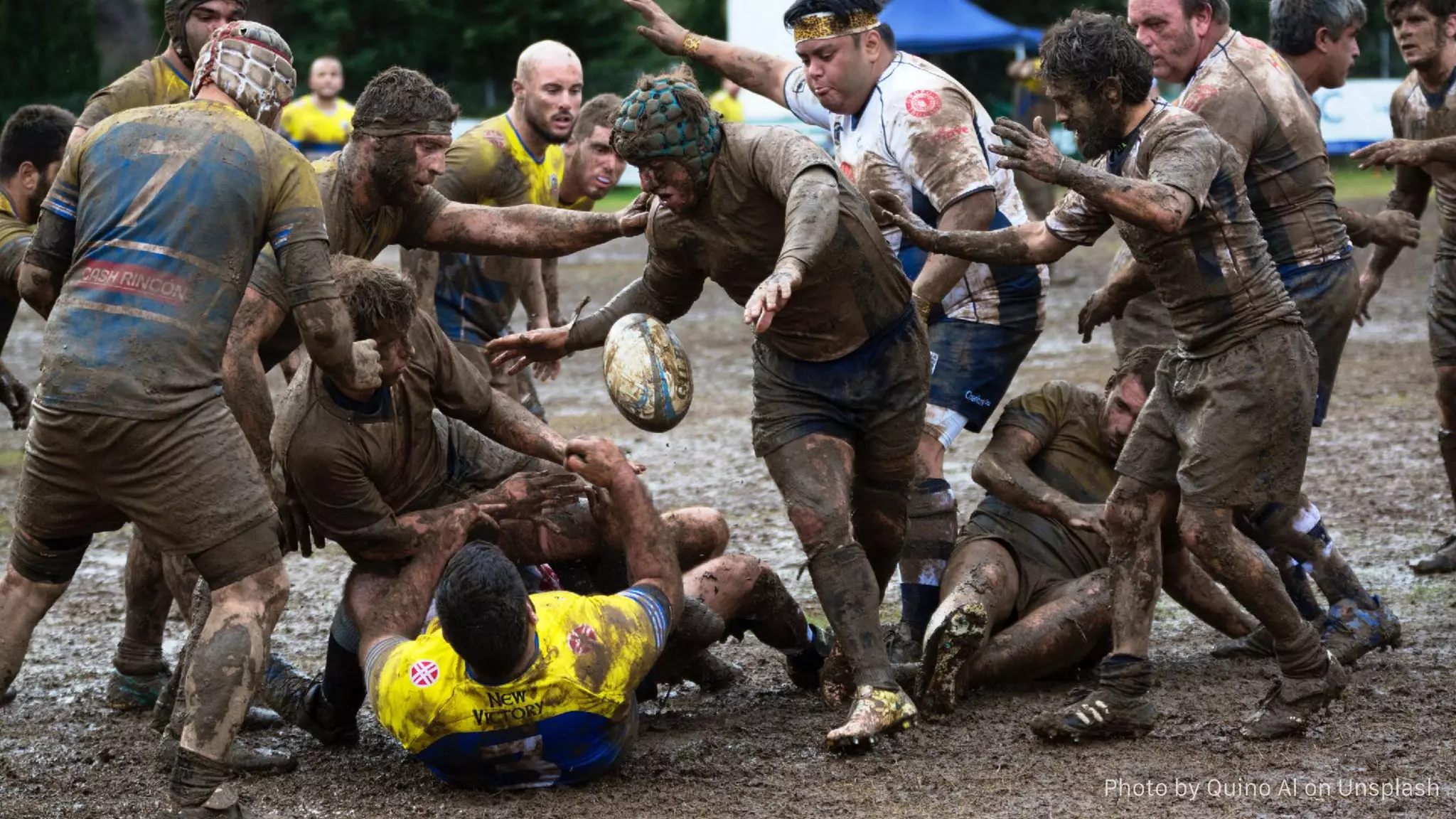
Photo by Quino Al on Unsplash
A scrum (short for scrummage) is a
method of restarting play in rugby that
involves players packing closely together
with their heads down and attempting to
gain possession of the ball.
For other uses, see Scrum (disambiguation).
Scrum may refer to:
•Scrum (rugby), a method of restarting play in rugby
•Scrum (media), an impromptu press conference, often
held immediately outside an event
•Autozam Scrum, a microvan and pickup truck sold in
Japan by Mazda
•“Scrum", a song on the album Diabolus in Musica by Slayer
•Scrum (software), a variant of the agile methodology used
for software development
Scrum (software)
•The product is built in a series of fixed-length
iterations called sprints that give teams a
framework for shipping on a regular cadence.
•Milestones–i.e., the end of a sprint–come
frequently, bringing with them a feeling of
tangible progress.
•Short iterations reinforce the importance of good
estimation and fast feedback from tests.
Justin Searls
@searls
To be clear, apathy isn't a moral failing—
it's actually a rational coping mechanism
in unhealthy environments.
Want an apathetic software team?
Pressure them to meet aggressive
arbitrary deadlines or exert undue
control over how they do their work
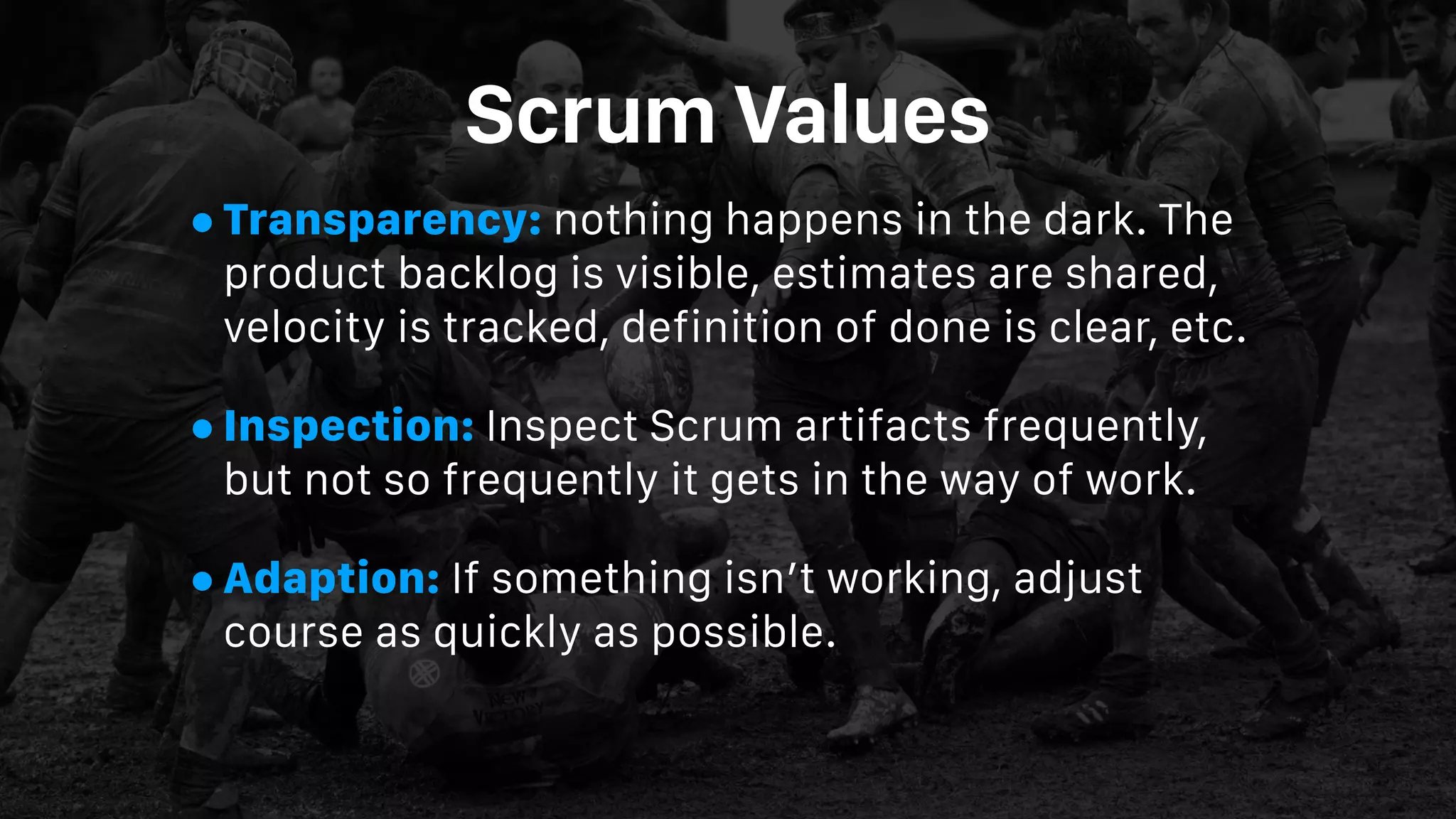
Scrum Values
•Transparency: nothing happens in the dark. The
product backlog is visible, estimates are shared,
velocity is tracked, definition of done is clear, etc.
•Inspection: Inspect Scrum artifacts frequently,
but not so frequently it gets in the way of work.
•Adaption: If something isn’t working, adjust
course as quickly as possible.
— meet the —
Scrum Team
— the —
Product
Owner
— the —
Scrum
Master
— the —
Dev
Team
photo by rawpixel on unsplash
Here's the catch: reaching
the “performing” stage is
impossible if a team's
make-up keeps changing!
image credit: Atlassian
photo by rawpixel on unsplash
— the —
Product
Owner
photo by rawpixel on unsplash
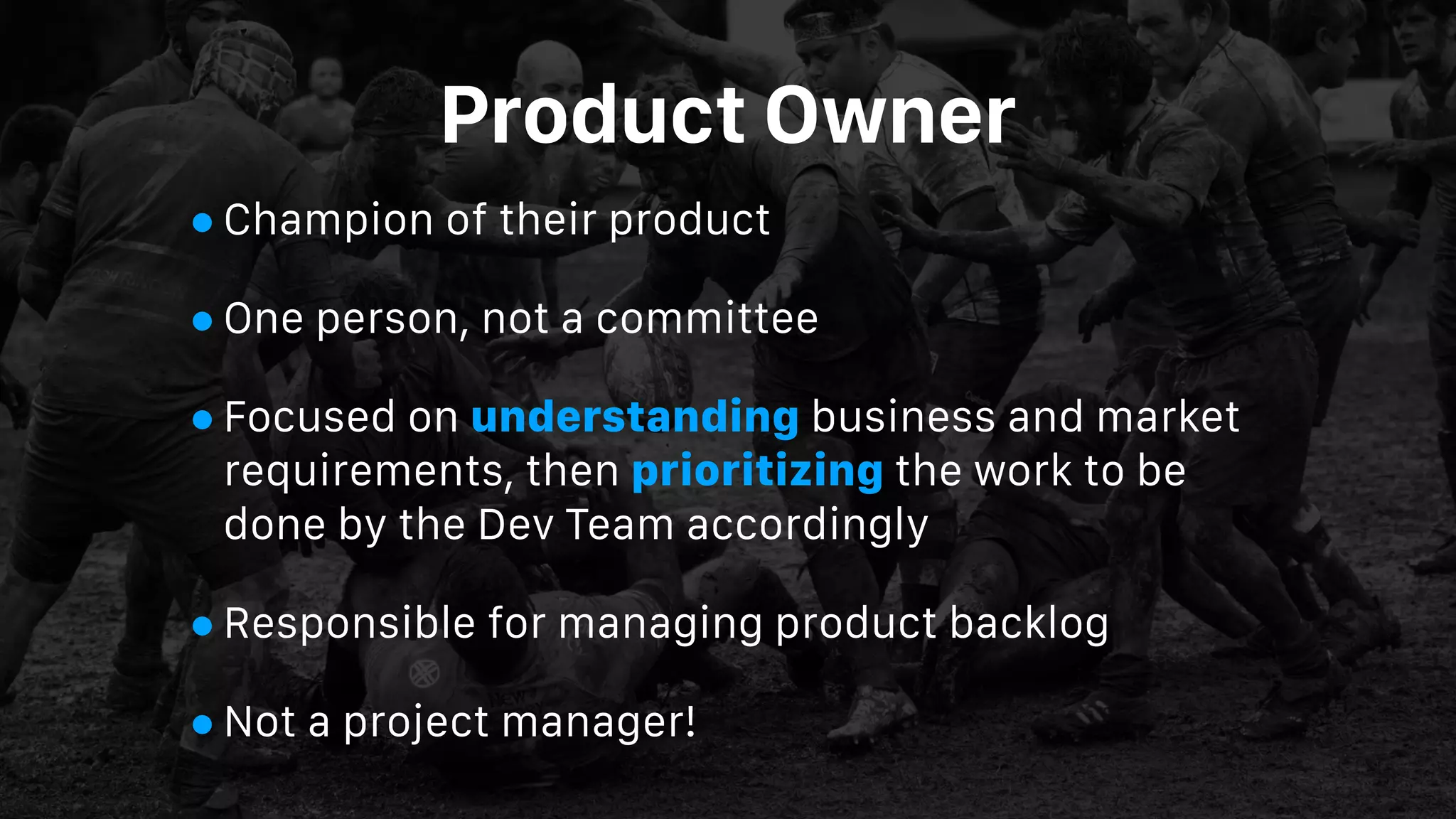
Product Owner
•Champion of their product
•One person, not a committee
•Focused on understanding business and market
requirements, then prioritizing the work to be
done by the Dev Team accordingly
•Responsible for managing product backlog
•Not a project manager!
photo by rawpixel on unsplash
— the —
Dev
Team
photo by rawpixel on unsplash
Development Team
•Champions of sustainable development practices
•Consists of 3-9 professionals
•Responsible for planning the sprint and delivering a
potentially releasable increment of “Done” work
•Self-organizing: No one (not even the Scrum Master)
tells the Dev Team how to work
•Cross-functional: Has all competencies needed to do
the work without depending on non-team members
photo by rawpixel on unsplash
— the —
Scrum
Master
photo by rawpixel on unsplash
Scrum Master
•Champion of process within their team
•Coach the team and the business on Scrum & look for
ways to fine-tune their process
•Resolve impediments for the Dev Team, insulating
them from external disruptions when possible
•Defend against a common Scrum anti-pattern:
changing a sprint's scope after it has begun
•Also not a project manager!
Scrum Master
•What happens when there’s no dedicated Scrum
Master?
•Avoid conflicts of interest — Product Owners should
not act as Scrum Masters
•Rotating the Scrum Master role through the Dev Team
can inject fresh ideas
•Best to worst: Dedicated Scrum Master, Shared Scrum
Masters, Engineer Scrum Master, No Scrum Master
— the —
Scrum Rituals
Scrum Rituals
•Prescribed events create regularity and minimize
the need for meetings not defined in Scrum
•All events are time-boxed
•Other than the sprint itself, each event is a formal
opportunity to inspect and adapt
The Sprint
A fixed length of work during which a
“Done,” useable, and potentially releasable
product increment is created.
The Sprint
•Once started, no changes that would endanger the
sprint goal
•That includes adding user stories or changing
sprint length
•Sprint cancellations are traumatic to the Scrum
team, and are very uncommon
How Long is a Sprint?
•Sprint length can range from 1–4 weeks
•2 weeks is pretty standard
•You can get more done in a longer sprint, 

but you’re less capable of reacting to changes
•Keeping sprint length consistent gives the Dev
Team critical feedback on estimation & delivery
process, makes forecasts increasingly accurate
over time.
Product Backlog
Grooming
The team reviews and estimates
user stories in the product backlog
Product Backlog Grooming
•Duration: 1 hour / week of sprint
•Happens: Could be anytime, but often first day of
sprint, or alternate Mondays
•Attendees: scrum team
•Purpose: The Product Owner gets help with the
product backlog.
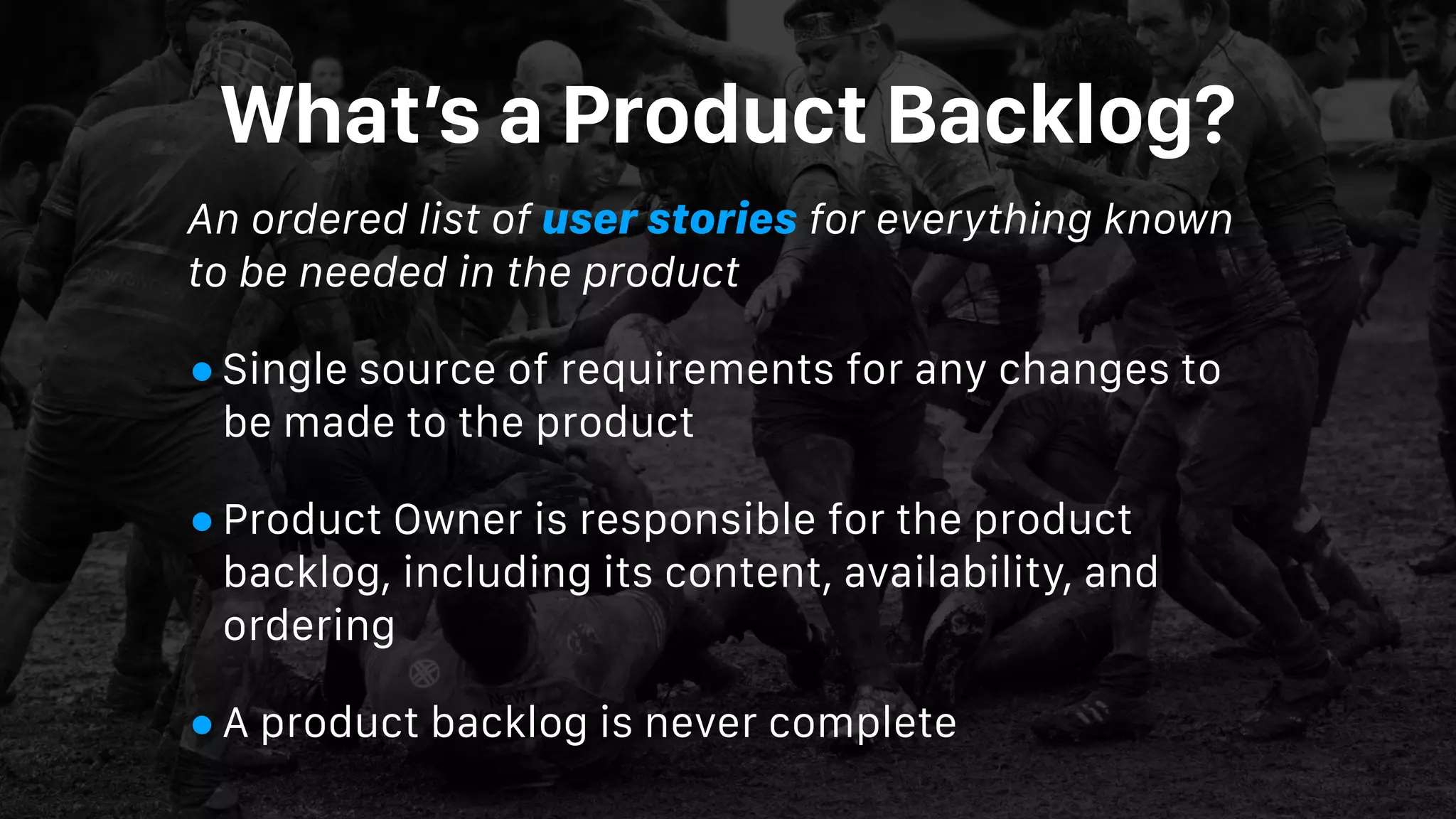
What’s a Product Backlog?
An ordered list of user stories for everything known
to be needed in the product
•Single source of requirements for any changes to
be made to the product
•Product Owner is responsible for the product
backlog, including its content, availability, and
ordering
•A product backlog is never complete
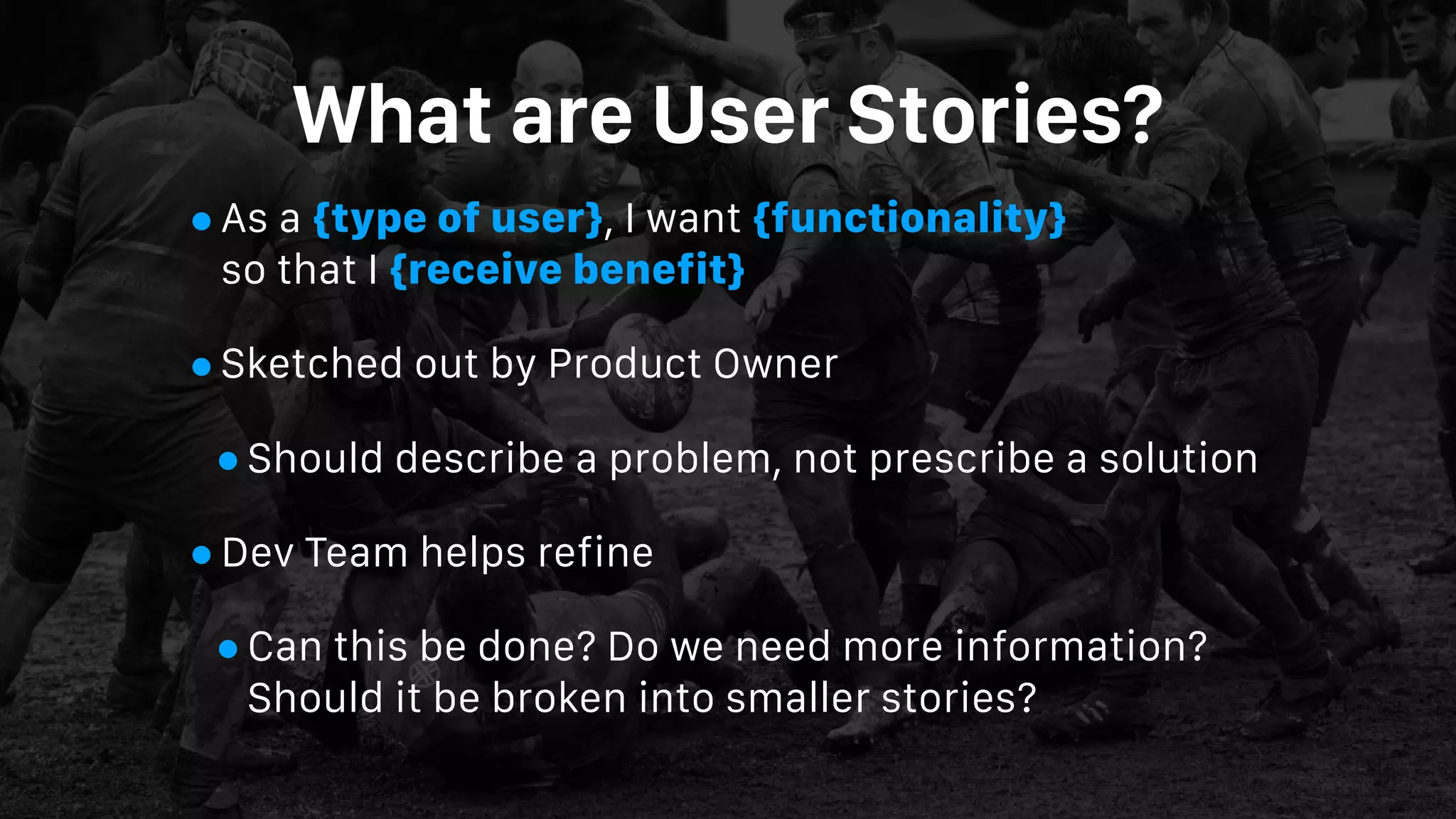
What are User Stories?
•As a {type of user}, I want {functionality} 

so that I {receive benefit}
•Sketched out by Product Owner
•Should describe a problem, not prescribe a solution
•Dev Team helps refine
•Can this be done? Do we need more information?
Should it be broken into smaller stories?
How Do We Estimate?
•Dev Team plays planning poker to assign story points
•Points rate the relative effort of work, not time to complete
•Estimated relative to other well-understood work.

“Is this more or less complicated than that story?”
•Abstraction avoids the “Architect can do it in 2 hours, but
the intern needs a full week” problem
•Estimates will be inaccurate until the team establishes a
common baseline after a few sprints
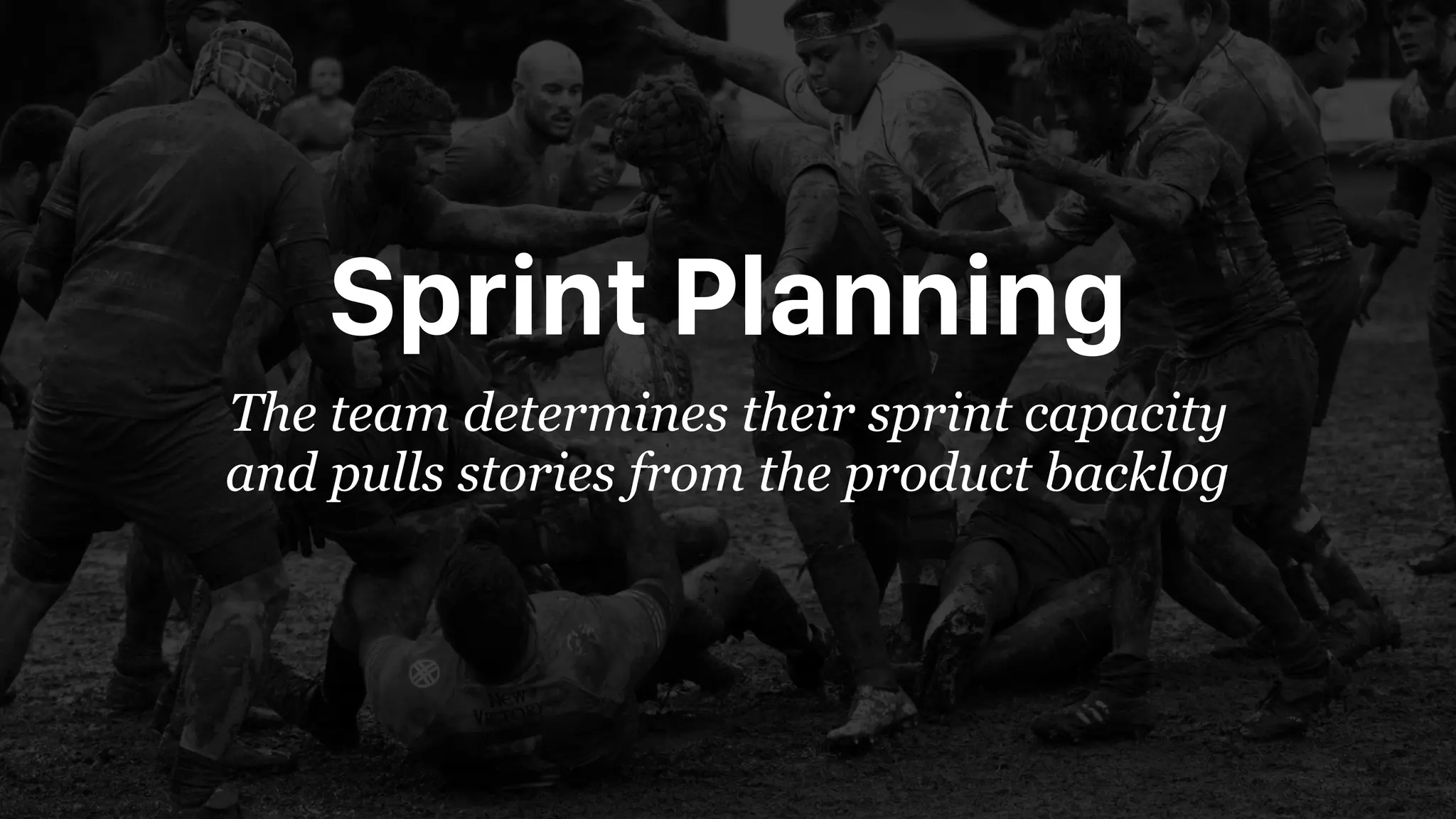
Sprint Planning
The team determines their sprint capacity
and pulls stories from the product backlog
Sprint Planning
•Duration: 2 hours / week of sprint

(new teams may need more time)
•Happens: first day of the sprint
•Attendees: scrum team
•Purpose: The Dev Team plans their work with
guidance from the Product Owner
Sprint Planning
•Capacity for the sprint is determined by
reviewing velocity
•User stories are pulled in order from the top of
the product backlog
•The team breaks user stories into tasks for the
sprint backlog
•Define a sprint goal to provide context and
guidance to the team
What’s a Sprint Backlog?
An ordered list of tasks created from user stories accepted
into the current sprint
•Stories must be estimated and contain clear

acceptance criteria
•Should not change once the sprint starts, because the
Dev Team is making a informed commitment to deliver
this body of work.
•What about bugs and P0 interruptions?

(they’re going to happen!)
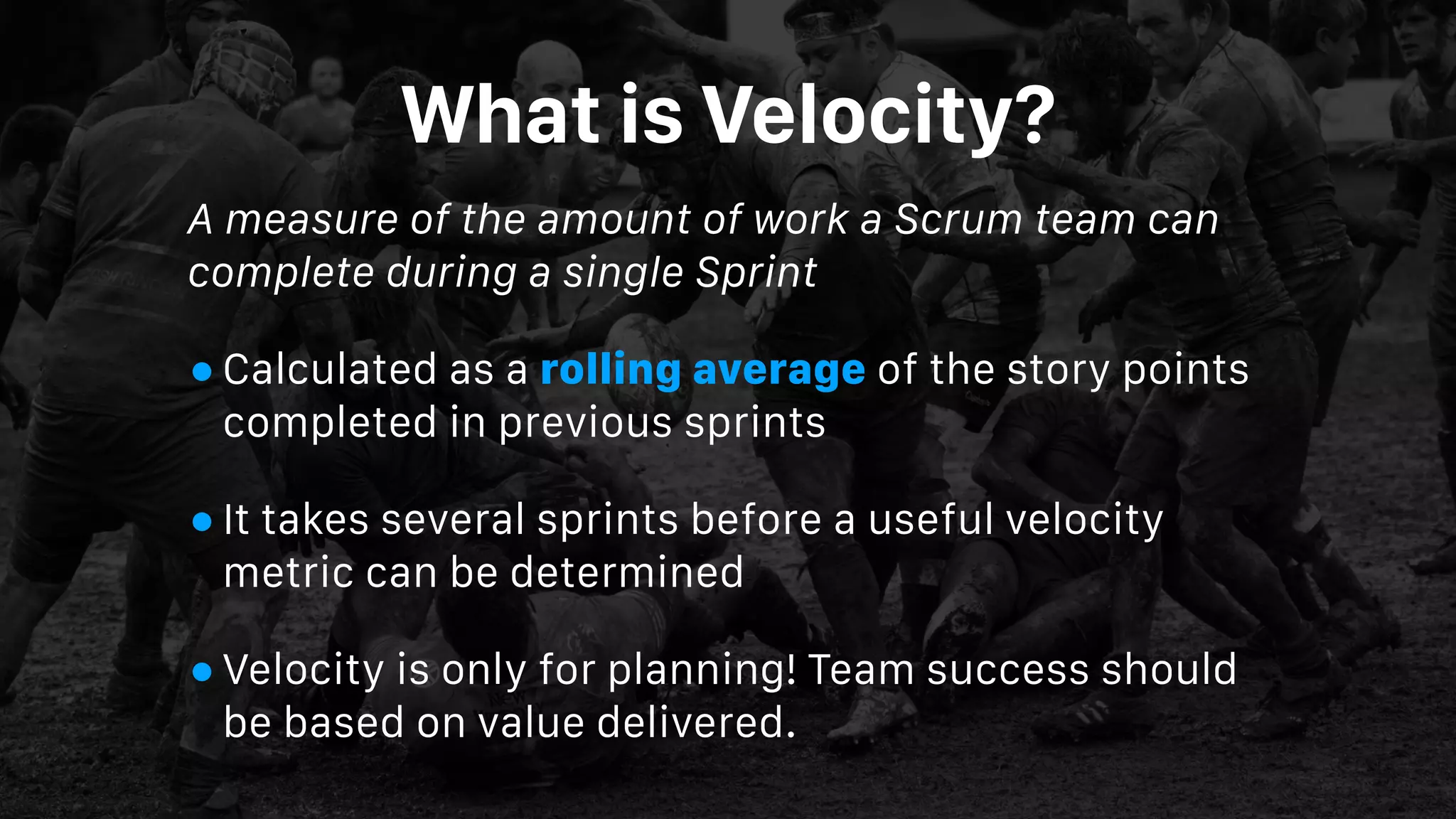
What is Velocity?
A measure of the amount of work a Scrum team can
complete during a single Sprint
•Calculated as a rolling average of the story points
completed in previous sprints
•It takes several sprints before a useful velocity
metric can be determined
•Velocity is only for planning! Team success should
be based on value delivered.
image credit: Atlassian
Daily Scrum
a.k.a. Standup
The Dev Team plans their work
for the next 24 hours and checks
progress towards sprint goal
Daily Scrum
•Duration: 15 min timeboxed
•Happens: every day
•Attendees: Dev Team, Scrum Master. Product
Owner optional.
• If others are present, the Scrum Master ensures that they do not disrupt the meeting.
•Purpose: The Dev Team checks their progress
toward the sprint goal
Daily Scrum
•Check progress by:
•Answer the three questions
•Review the burndown chart
•This is a meeting for the Dev Team,

not a detailed status report for management
•Blockers should be escalated to Scrum Master
What are the Three Questions?
•What did I do yesterday that helped the Dev Team
meet the sprint goal?
•What will I do today to help the Dev Team meet the
sprint goal?
•Do I see any impediment that prevents me or the
Dev Team from meeting the sprint goal?
•This is not “justify your salary” time.

Answers should be relevant to the sprint goal.
What’s a Burndown Chart?
Shows the work completed over time compared to an
ideal trend line
•Reviewing this chart can be a useful tool to see if
the Dev Team is on-track to complete their work
•If the burndown line extends beyond the trend line,
the team may be falling behind their goal
•If the burndown line makes steep drops, the team
should work on breaking stories into smaller tasks
image credit: Atlassian
Sprint Review
An informal demo of what was
achieved by the team to the Product
Owner and other stakeholders
Sprint Review
•Duration: 30 min / week of sprint
•Happens: last day of the sprint
•Attendees: scrum team, key stakeholders invited
by Product Owner
•Purpose: Demonstrate work and get feedback
Sprint Review
•Focus on the product, not the process
•Work should be fully demonstrable and meet the
team's definition of “Done” to be considered
complete and ready to showcase in the review
•Celebrate success
•Gather feedback, which should channel back into
the product backlog
Sprint Retrospective
A review of what did and didn't go well
with actions to make the next sprint better.
Sprint Retrospective
•Duration: 30 min / week of sprint
•Happens: last day of the sprint
•Attendees: scrum team (no management!)
•Purpose: Review and improve process
Sprint Retrospective
•Focus on improving process, not the product
•Not a time for complaints without action
•Reflect on what went well during the sprint so the
team can continue to focus on those areas
•Find out what's not working and use the time to
find creative solutions and develop an action plan
— let’s —
Recap
image credit: scrum.org
Scrum Values
•Transparency: nothing happens in the dark. The
product backlog is visible, estimates are shared,
velocity is tracked, definition of done is clear, etc.
•Inspection: Inspect Scrum artifacts frequently,
but not so frequently it gets in the way of work.
•Adaption: If something isn’t working, adjust
course as quickly as possible.
Learn More
•The Scrum Guide

https://www.scrumguides.org/
•Scrum Rituals, Summarized

https://wp.me/p27LsI-3G
•Atlassian Scrum Guide

https://www.atlassian.com/agile/scrum
Scott Vandehey — spaceninja.com — @spaceninja

Let's Talk About Scrum

  • 1.
  • 2.
    Photo by QuinoAl on Unsplash
  • 3.
    A scrum (short for scrummage) isa method of restarting play in rugby that involves players packing closely together with their heads down and attempting to gain possession of the ball. For other uses, see Scrum (disambiguation).
  • 4.
    Scrum may refer to: •Scrum(rugby), a method of restarting play in rugby •Scrum (media), an impromptu press conference, often held immediately outside an event •Autozam Scrum, a microvan and pickup truck sold in Japan by Mazda •“Scrum", a song on the album Diabolus in Musica by Slayer •Scrum (software), a variant of the agile methodology used for software development
  • 5.
    Scrum (software) •The product isbuilt in a series of fixed-length iterations called sprints that give teams a framework for shipping on a regular cadence. •Milestones–i.e., the end of a sprint–come frequently, bringing with them a feeling of tangible progress. •Short iterations reinforce the importance of good estimation and fast feedback from tests.
  • 6.
    Justin Searls @searls To beclear, apathy isn't a moral failing— it's actually a rational coping mechanism in unhealthy environments. Want an apathetic software team? Pressure them to meet aggressive arbitrary deadlines or exert undue control over how they do their work
  • 7.
    Scrum Values •Transparency: nothinghappens in the dark. The product backlog is visible, estimates are shared, velocity is tracked, definition of done is clear, etc. •Inspection: Inspect Scrum artifacts frequently, but not so frequently it gets in the way of work. •Adaption: If something isn’t working, adjust course as quickly as possible.
  • 8.
    — meet the— Scrum Team
  • 9.
    — the — Product Owner —the — Scrum Master — the — Dev Team photo by rawpixel on unsplash
  • 10.
    Here's the catch:reaching the “performing” stage is impossible if a team's make-up keeps changing! image credit: Atlassian
  • 11.
    photo by rawpixelon unsplash
  • 12.
    — the — Product Owner photoby rawpixel on unsplash
  • 13.
    Product Owner •Champion oftheir product •One person, not a committee •Focused on understanding business and market requirements, then prioritizing the work to be done by the Dev Team accordingly •Responsible for managing product backlog •Not a project manager!
  • 14.
    photo by rawpixelon unsplash
  • 15.
    — the — Dev Team photoby rawpixel on unsplash
  • 16.
    Development Team •Champions ofsustainable development practices •Consists of 3-9 professionals •Responsible for planning the sprint and delivering a potentially releasable increment of “Done” work •Self-organizing: No one (not even the Scrum Master) tells the Dev Team how to work •Cross-functional: Has all competencies needed to do the work without depending on non-team members
  • 17.
    photo by rawpixelon unsplash
  • 18.
    — the — Scrum Master photoby rawpixel on unsplash
  • 19.
    Scrum Master •Champion ofprocess within their team •Coach the team and the business on Scrum & look for ways to fine-tune their process •Resolve impediments for the Dev Team, insulating them from external disruptions when possible •Defend against a common Scrum anti-pattern: changing a sprint's scope after it has begun •Also not a project manager!
  • 20.
    Scrum Master •What happenswhen there’s no dedicated Scrum Master? •Avoid conflicts of interest — Product Owners should not act as Scrum Masters •Rotating the Scrum Master role through the Dev Team can inject fresh ideas •Best to worst: Dedicated Scrum Master, Shared Scrum Masters, Engineer Scrum Master, No Scrum Master
  • 21.
  • 22.
    Scrum Rituals •Prescribed eventscreate regularity and minimize the need for meetings not defined in Scrum •All events are time-boxed •Other than the sprint itself, each event is a formal opportunity to inspect and adapt
  • 23.
    The Sprint A fixedlength of work during which a “Done,” useable, and potentially releasable product increment is created.
  • 24.
    The Sprint •Once started,no changes that would endanger the sprint goal •That includes adding user stories or changing sprint length •Sprint cancellations are traumatic to the Scrum team, and are very uncommon
  • 25.
    How Long isa Sprint? •Sprint length can range from 1–4 weeks •2 weeks is pretty standard •You can get more done in a longer sprint, 
 but you’re less capable of reacting to changes •Keeping sprint length consistent gives the Dev Team critical feedback on estimation & delivery process, makes forecasts increasingly accurate over time.
  • 26.
    Product Backlog Grooming The teamreviews and estimates user stories in the product backlog
  • 27.
    Product Backlog Grooming •Duration:1 hour / week of sprint •Happens: Could be anytime, but often first day of sprint, or alternate Mondays •Attendees: scrum team •Purpose: The Product Owner gets help with the product backlog.
  • 28.
    What’s a ProductBacklog? An ordered list of user stories for everything known to be needed in the product •Single source of requirements for any changes to be made to the product •Product Owner is responsible for the product backlog, including its content, availability, and ordering •A product backlog is never complete
  • 29.
    What are UserStories? •As a {type of user}, I want {functionality} 
 so that I {receive benefit} •Sketched out by Product Owner •Should describe a problem, not prescribe a solution •Dev Team helps refine •Can this be done? Do we need more information? Should it be broken into smaller stories?
  • 30.
    How Do WeEstimate? •Dev Team plays planning poker to assign story points •Points rate the relative effort of work, not time to complete •Estimated relative to other well-understood work.
 “Is this more or less complicated than that story?” •Abstraction avoids the “Architect can do it in 2 hours, but the intern needs a full week” problem •Estimates will be inaccurate until the team establishes a common baseline after a few sprints
  • 31.
    Sprint Planning The teamdetermines their sprint capacity and pulls stories from the product backlog
  • 32.
    Sprint Planning •Duration: 2hours / week of sprint
 (new teams may need more time) •Happens: first day of the sprint •Attendees: scrum team •Purpose: The Dev Team plans their work with guidance from the Product Owner
  • 33.
    Sprint Planning •Capacity forthe sprint is determined by reviewing velocity •User stories are pulled in order from the top of the product backlog •The team breaks user stories into tasks for the sprint backlog •Define a sprint goal to provide context and guidance to the team
  • 34.
    What’s a SprintBacklog? An ordered list of tasks created from user stories accepted into the current sprint •Stories must be estimated and contain clear
 acceptance criteria •Should not change once the sprint starts, because the Dev Team is making a informed commitment to deliver this body of work. •What about bugs and P0 interruptions?
 (they’re going to happen!)
  • 35.
    What is Velocity? Ameasure of the amount of work a Scrum team can complete during a single Sprint •Calculated as a rolling average of the story points completed in previous sprints •It takes several sprints before a useful velocity metric can be determined •Velocity is only for planning! Team success should be based on value delivered.
  • 36.
  • 37.
    Daily Scrum a.k.a. Standup TheDev Team plans their work for the next 24 hours and checks progress towards sprint goal
  • 38.
    Daily Scrum •Duration: 15min timeboxed •Happens: every day •Attendees: Dev Team, Scrum Master. Product Owner optional. • If others are present, the Scrum Master ensures that they do not disrupt the meeting. •Purpose: The Dev Team checks their progress toward the sprint goal
  • 39.
    Daily Scrum •Check progressby: •Answer the three questions •Review the burndown chart •This is a meeting for the Dev Team,
 not a detailed status report for management •Blockers should be escalated to Scrum Master
  • 40.
    What are theThree Questions? •What did I do yesterday that helped the Dev Team meet the sprint goal? •What will I do today to help the Dev Team meet the sprint goal? •Do I see any impediment that prevents me or the Dev Team from meeting the sprint goal? •This is not “justify your salary” time.
 Answers should be relevant to the sprint goal.
  • 41.
    What’s a BurndownChart? Shows the work completed over time compared to an ideal trend line •Reviewing this chart can be a useful tool to see if the Dev Team is on-track to complete their work •If the burndown line extends beyond the trend line, the team may be falling behind their goal •If the burndown line makes steep drops, the team should work on breaking stories into smaller tasks
  • 42.
  • 43.
    Sprint Review An informaldemo of what was achieved by the team to the Product Owner and other stakeholders
  • 44.
    Sprint Review •Duration: 30min / week of sprint •Happens: last day of the sprint •Attendees: scrum team, key stakeholders invited by Product Owner •Purpose: Demonstrate work and get feedback
  • 45.
    Sprint Review •Focus onthe product, not the process •Work should be fully demonstrable and meet the team's definition of “Done” to be considered complete and ready to showcase in the review •Celebrate success •Gather feedback, which should channel back into the product backlog
  • 46.
    Sprint Retrospective A reviewof what did and didn't go well with actions to make the next sprint better.
  • 47.
    Sprint Retrospective •Duration: 30min / week of sprint •Happens: last day of the sprint •Attendees: scrum team (no management!) •Purpose: Review and improve process
  • 48.
    Sprint Retrospective •Focus onimproving process, not the product •Not a time for complaints without action •Reflect on what went well during the sprint so the team can continue to focus on those areas •Find out what's not working and use the time to find creative solutions and develop an action plan
  • 49.
  • 50.
  • 51.
    Scrum Values •Transparency: nothinghappens in the dark. The product backlog is visible, estimates are shared, velocity is tracked, definition of done is clear, etc. •Inspection: Inspect Scrum artifacts frequently, but not so frequently it gets in the way of work. •Adaption: If something isn’t working, adjust course as quickly as possible.
  • 52.
    Learn More •The ScrumGuide
 https://www.scrumguides.org/ •Scrum Rituals, Summarized
 https://wp.me/p27LsI-3G •Atlassian Scrum Guide
 https://www.atlassian.com/agile/scrum Scott Vandehey — spaceninja.com — @spaceninja