MANAGING RESOURCES FOR
BUSINESS ANALYTICS
MRS. S. RHEMA JOY, AP, MBA
MANAGING BA PERSONNEL
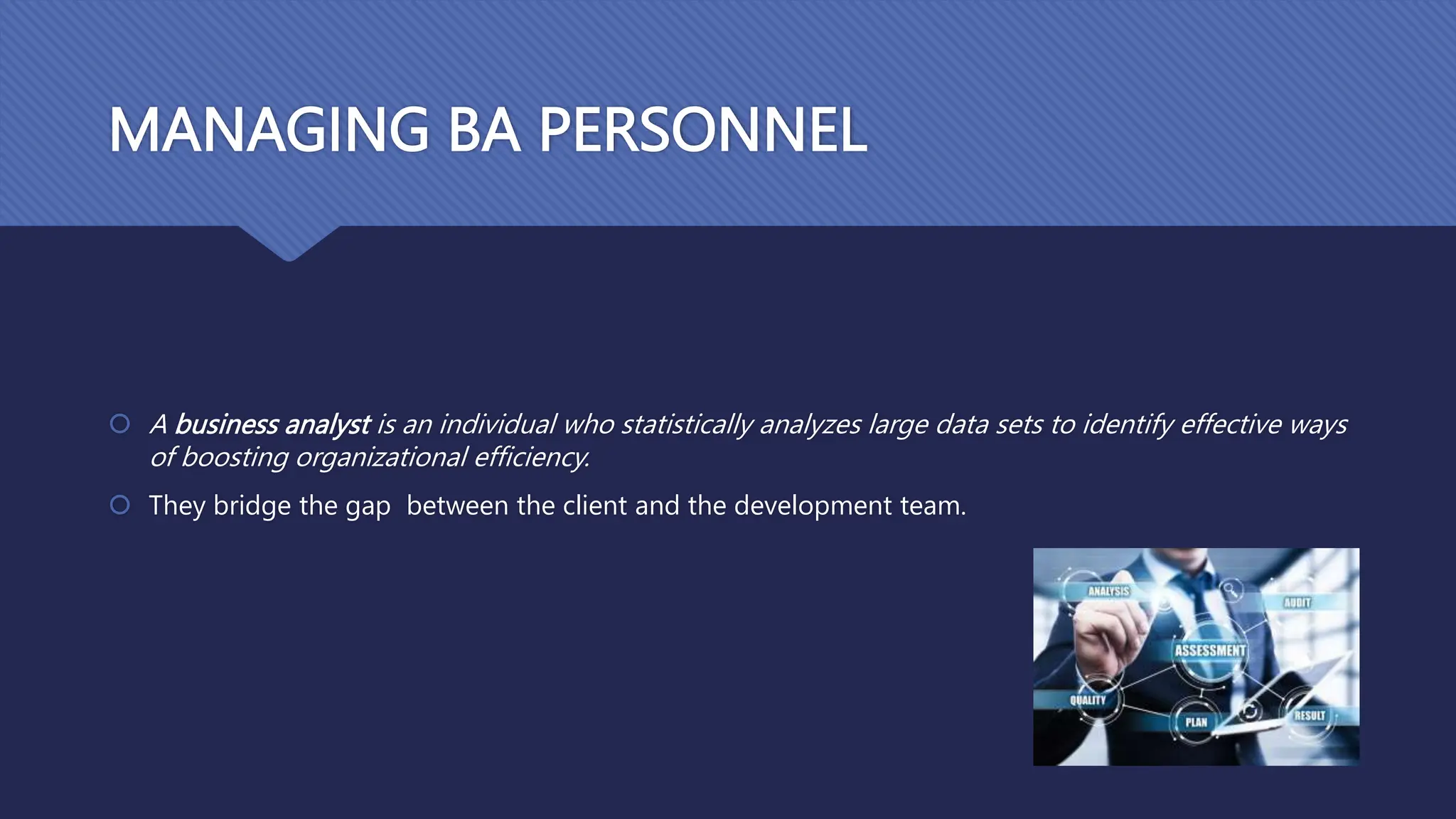
 A business analyst is an individual who statistically analyzes large data sets to identify effective ways
of boosting organizational efficiency.
 They bridge the gap between the client and the development team.
Skills required for BA Personnel
✓ Verbal and written communication
✓ Analytical and systems thinking
✓ Technology and business knowledge
✓ Modelling (process, data and system)
✓ Relationship management
✓ Negotiation
✓ Evaluation and business analysis
✓ Planning and management
✓ Elicitation and facilitation
Roles of BA Personnel
• As a contributor
• As a facilitator
• As an analyst
KEY RESPONSIBILITIES OF A BUSINESS
ANALYTICS PERSONNEL
a) Initiation phase
b) Planning phase
c) Executing phase
d) Monitoring and controlling phase
e) Closing phase
❖ Pure business analysts
❖ IT business analysts
❖ Data business analyst
❖ Functional business analyst
❖ Business system analyst
❖ Business requirements analyst
❖ Reporting business analyst
❖ Business intelligence analyst
TYPES OF BUSINESS ANALYTICS
PERSONNEL:
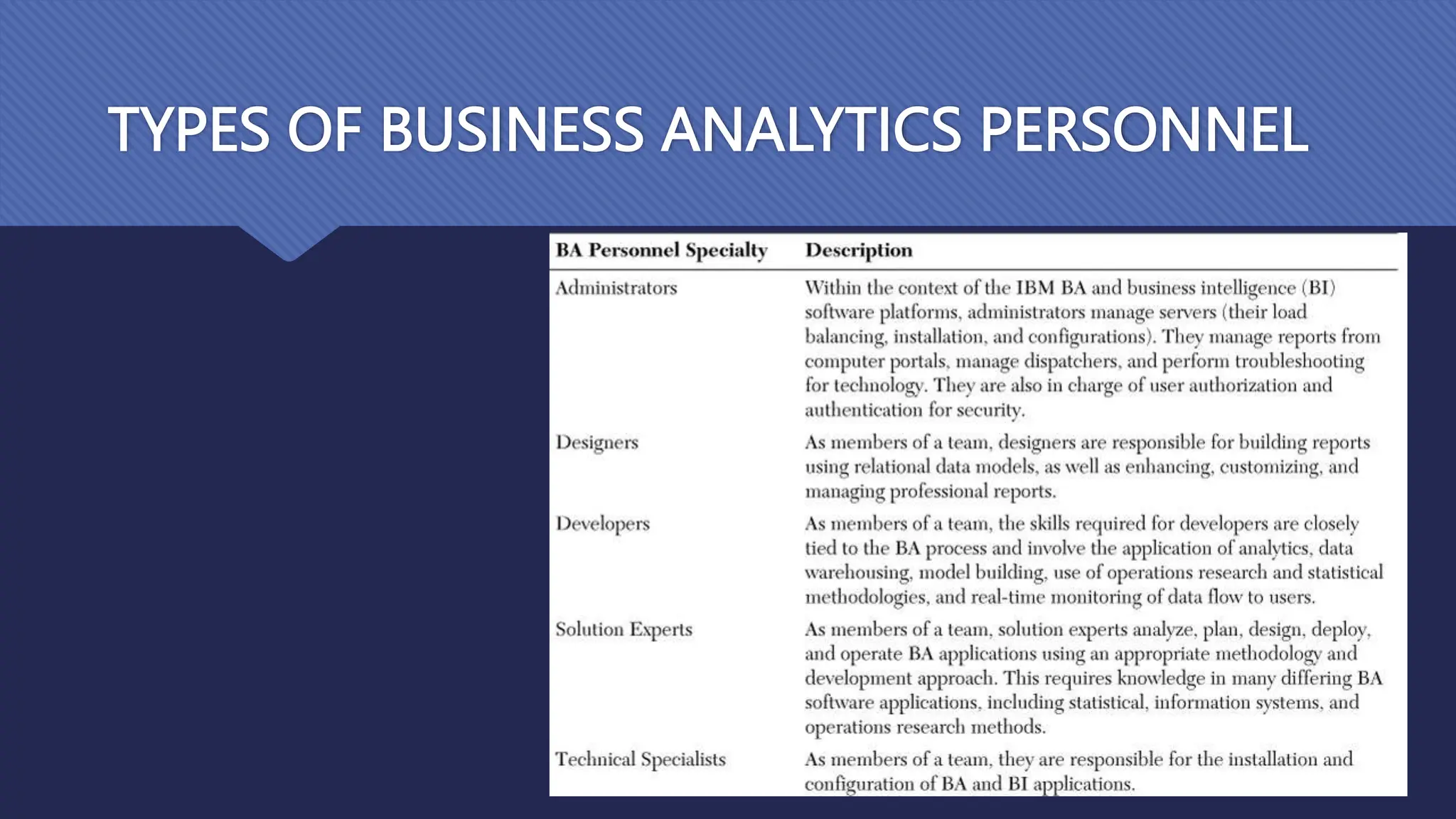
TYPES OF BUSINESS ANALYTICS PERSONNEL
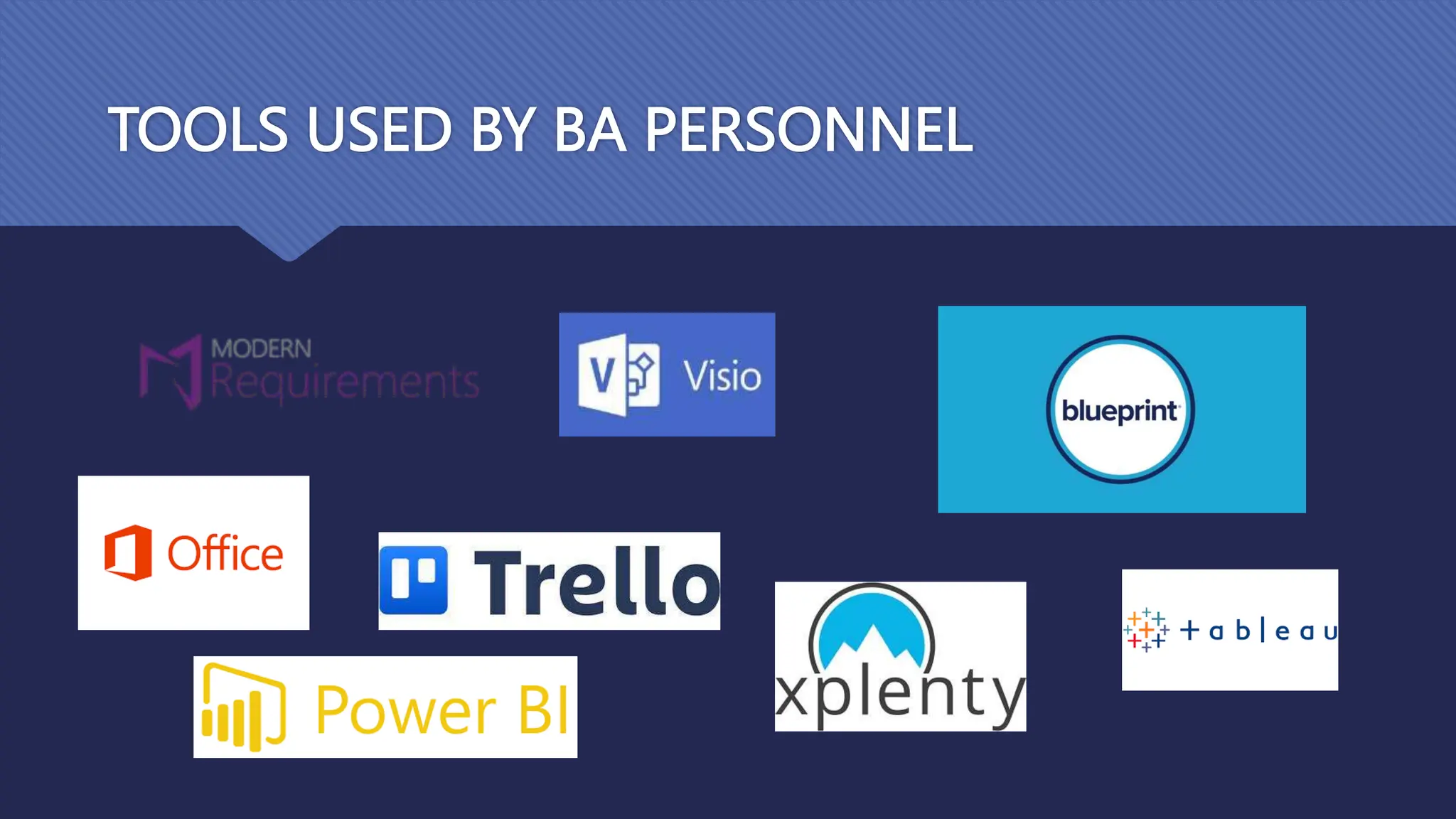
TOOLS USED BY BA PERSONNEL
MANAGING BA PERSONNEL
 Understand what a BA does and their value
 Give them tools
 Make sure they have time to “think”
 Keep BA to “over-analyse”
 Spending time with BA
 Get comfortable with the common & not so common BA methods
 Brush up your stakeholder management skills
 Go deep into the tech side of the job
DATA
a) Primary sources of data
b) Secondary sources of data
Primary Sources of Data
 Primary data is a type of data that is collected by researchers directly from main sources through
interviews, surveys, experiments, etc. Primary data are usually collected from the source—where the
data originally originates from and are regarded as the best kind of data in research.
 Key Elements:
✓ Primary data means first-hand information collected by an investigator.
✓ It is collected for the first time.
✓ It is original and more reliable.
✓ For example, the population census conducted by the government of India after every ten years is
primary data.
Primary Data Collection Methods
 Quantitative Data Collection Methods
 Qualitative Data Collection Methods
❖ Survey
❖ Interview method
Personal Interview
Telephonic Interview
❖ Questionnaire method
❖ Schedules
❖ Experimentation
Other methods for collection of data includes:
✓ Warranty cards
✓ Auditing
✓ Mechanical devices
✓ Simulation
✓ Observation
✓ Projective methods
Significance and Limitations
Significance of Primary data:
 ✓ Reliability
 ✓ Variety of techniques
 ✓ Wide coverage including special cases
 ✓ Complete control over process
 ✓ Cost effective collection
 ✓ Sole ownership of information
Limitations of Primary Data:
 ✓ Costly affair
 ✓ Time consuming
 ✓ Infeasible
 ✓ Huge quantity of data
 ✓ Unwillingness to answer
Secondary Sources of Data
 Secondary data is the data that has already been collected through primary sources and made readily
available for researchers to use for their own research. It is a type of data that has already been
collected in the past.
Secondary Data Collection Methods
 Books
 Published Sources
 Unpublished Personal Sources
 Journals
 Newspapers
 Websites
 Diaries
 Government Records
Other sources of secondary data collection include:
✓ Sales analysis
✓ Invoice analysis
✓ Financial data
✓ Transportation data
✓ Storage data
✓ Libraries
✓ Literature
✓ Periodicals
✓ References and bibliography
✓ Census and registration data
✓ Trade associations
✓ Commercial research institutions
✓ International organisation
Data Issues
 Data quality can be defined as data that
serves the purpose for which it is collected.
 Accurately representing reality, measuring
what it is supposed to measure, being
timeless, and having completeness.
 Data privacy refers to the protection of shared
data such that access is permitted only to
those users for whom it is intended.
 Data leaks on product quality failures can
damage brand image, and customers can
become distrustful of a firm that shares
information given in confidence.
BA TECHNOLOGY
a) Computer hardware
b) Computer software
c) Networking and telecommunications technology
Internet, Intranet, Extranet
d) Data management technology
• Database Management System (DBMS)
• Data warehouses
OLAP (OnLine Analytical Processing)
• Data mining
• Text mining
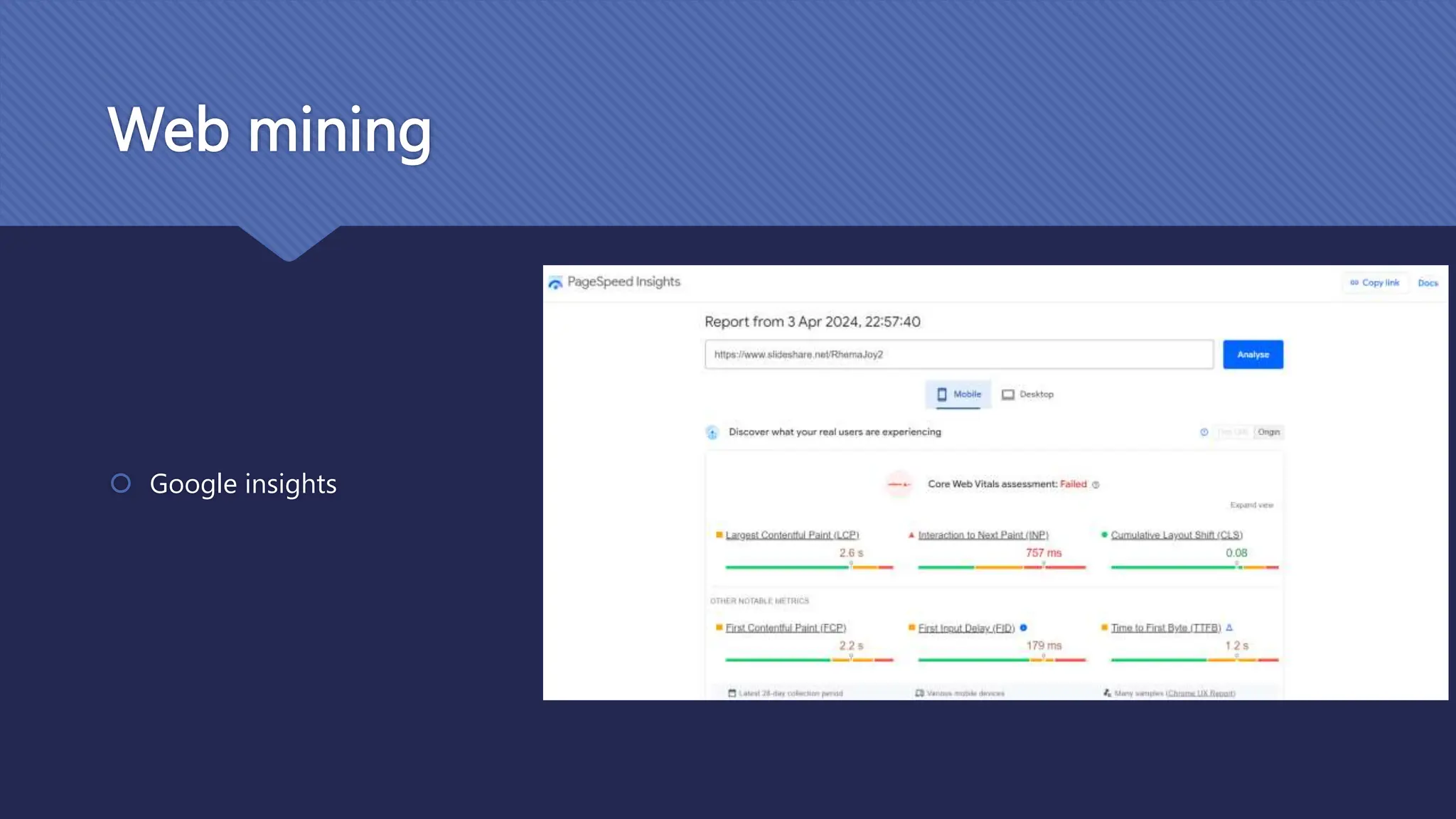
• Web mining
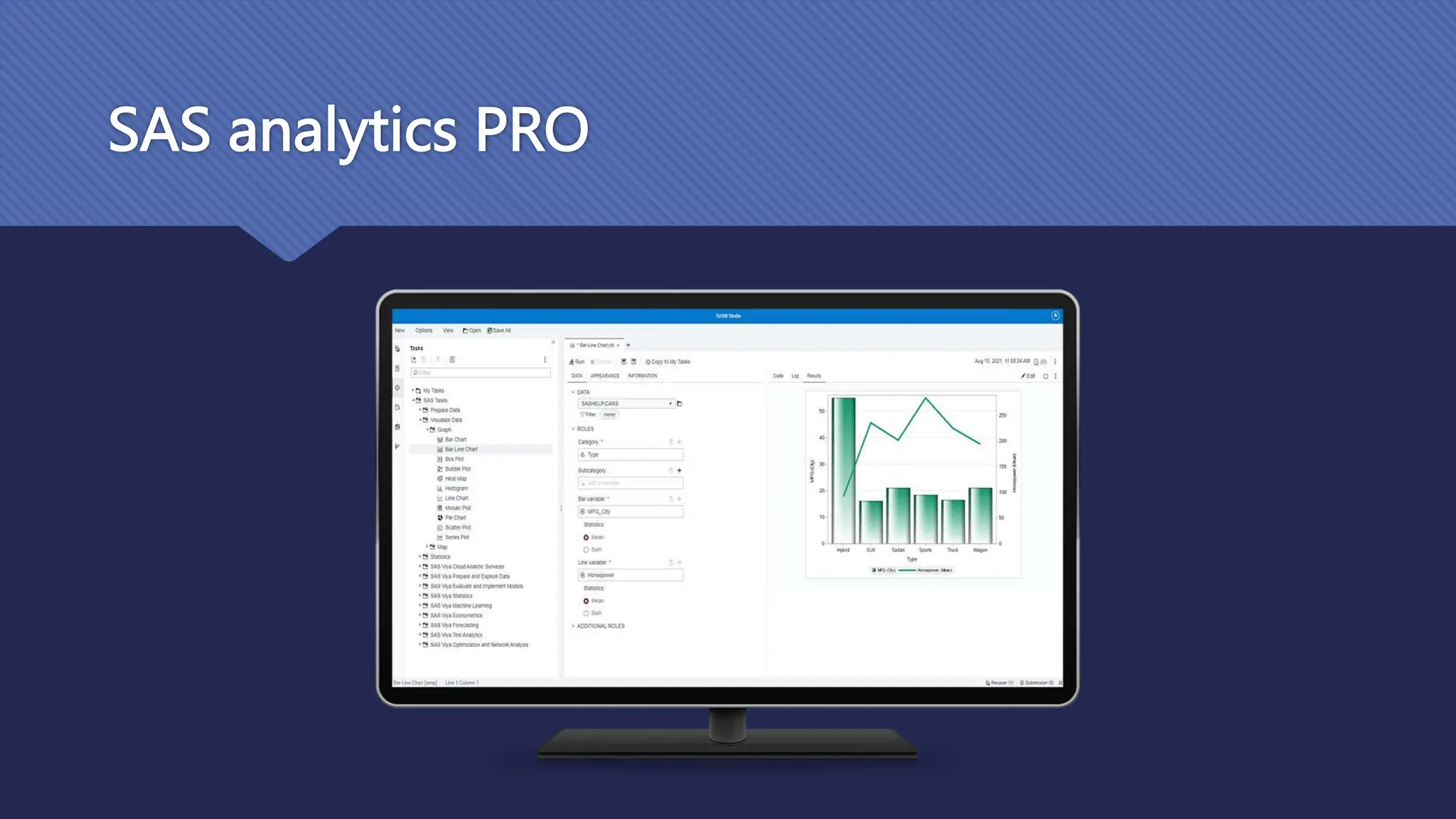
• SAS analytics
• Microsoft excel spreadsheet
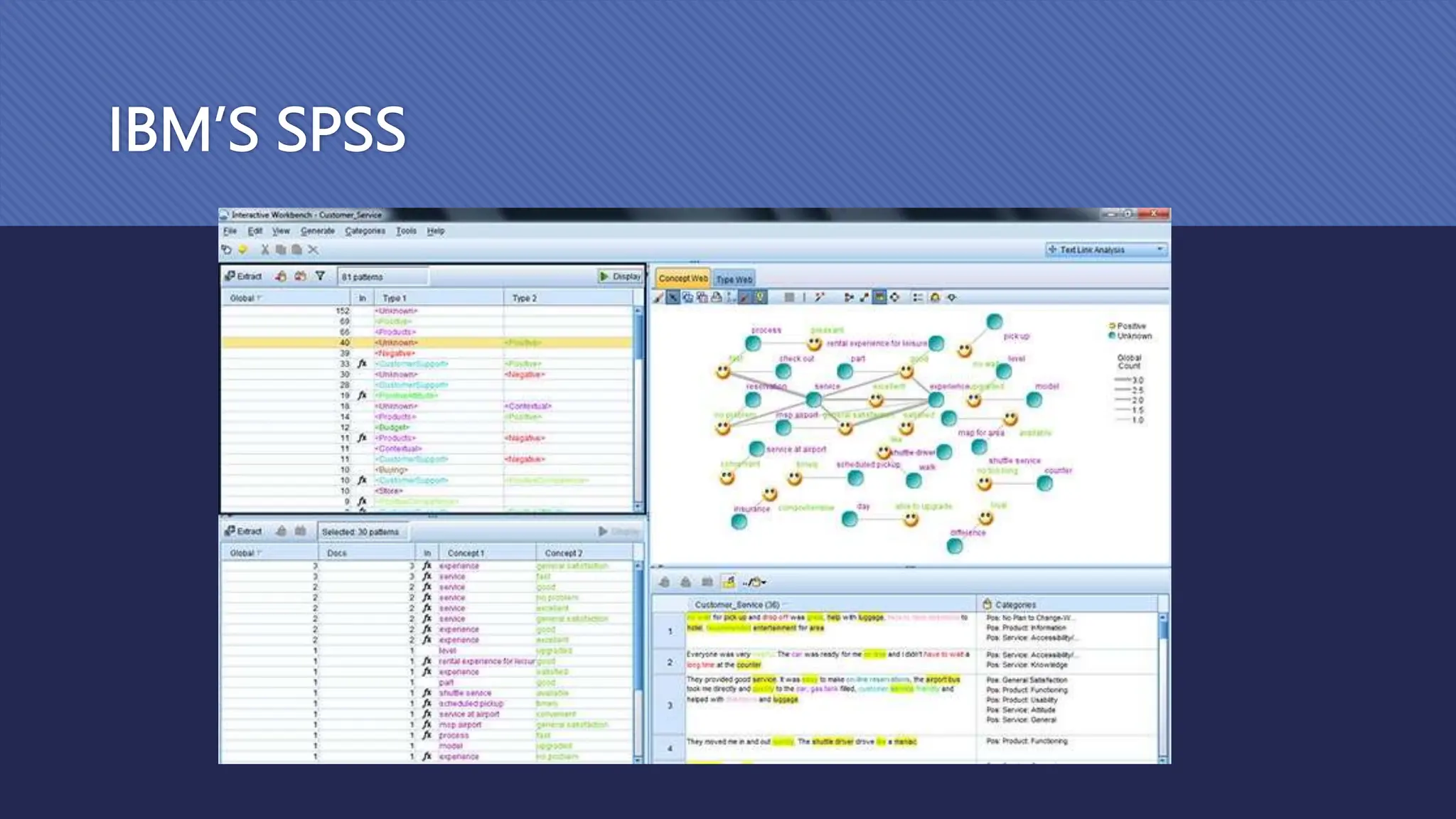
• IBM’s SPSS software
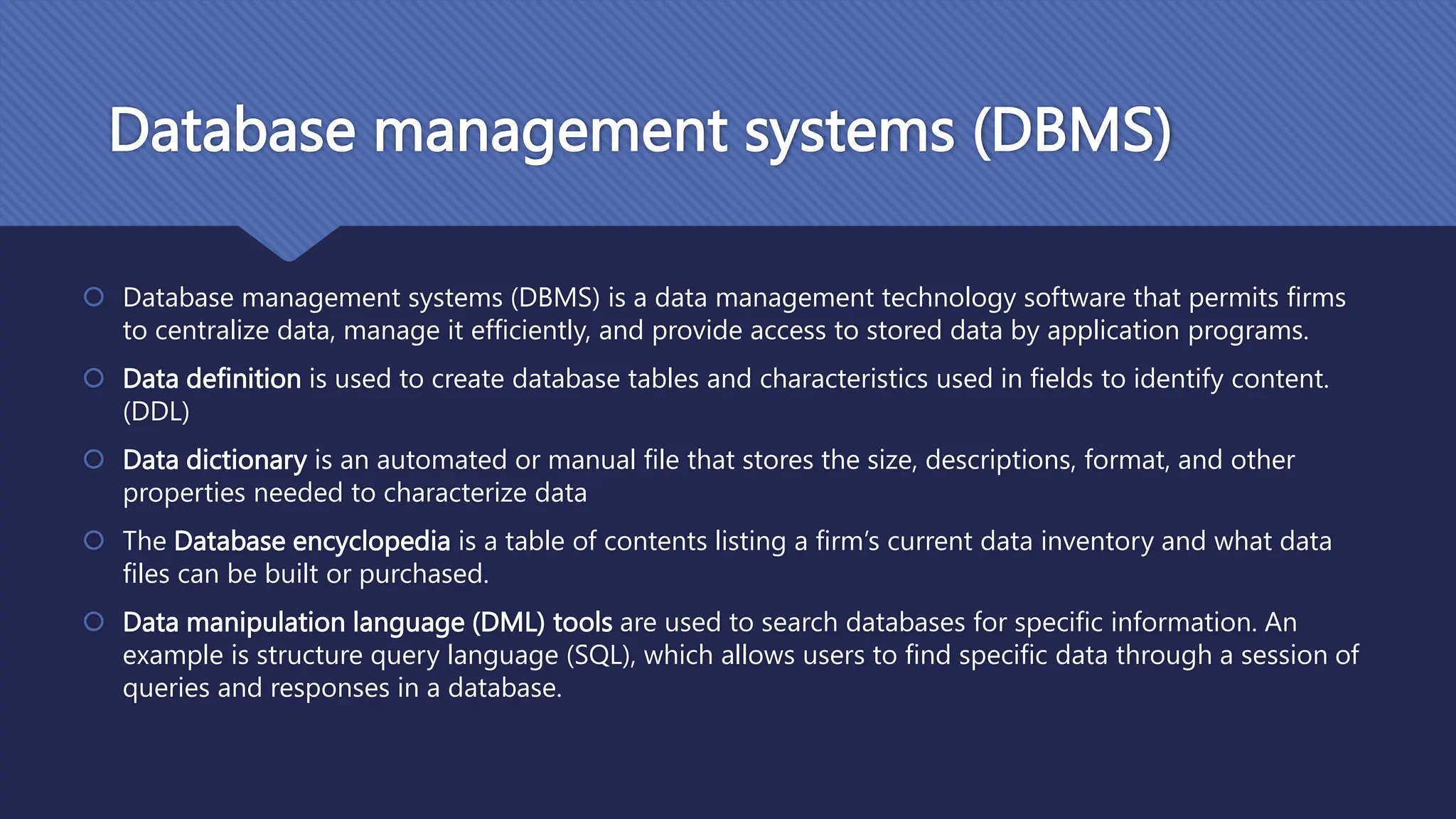
Database management systems (DBMS)
 Database management systems (DBMS) is a data management technology software that permits firms
to centralize data, manage it efficiently, and provide access to stored data by application programs.
 Data definition is used to create database tables and characteristics used in fields to identify content.
(DDL)
 Data dictionary is an automated or manual file that stores the size, descriptions, format, and other
properties needed to characterize data
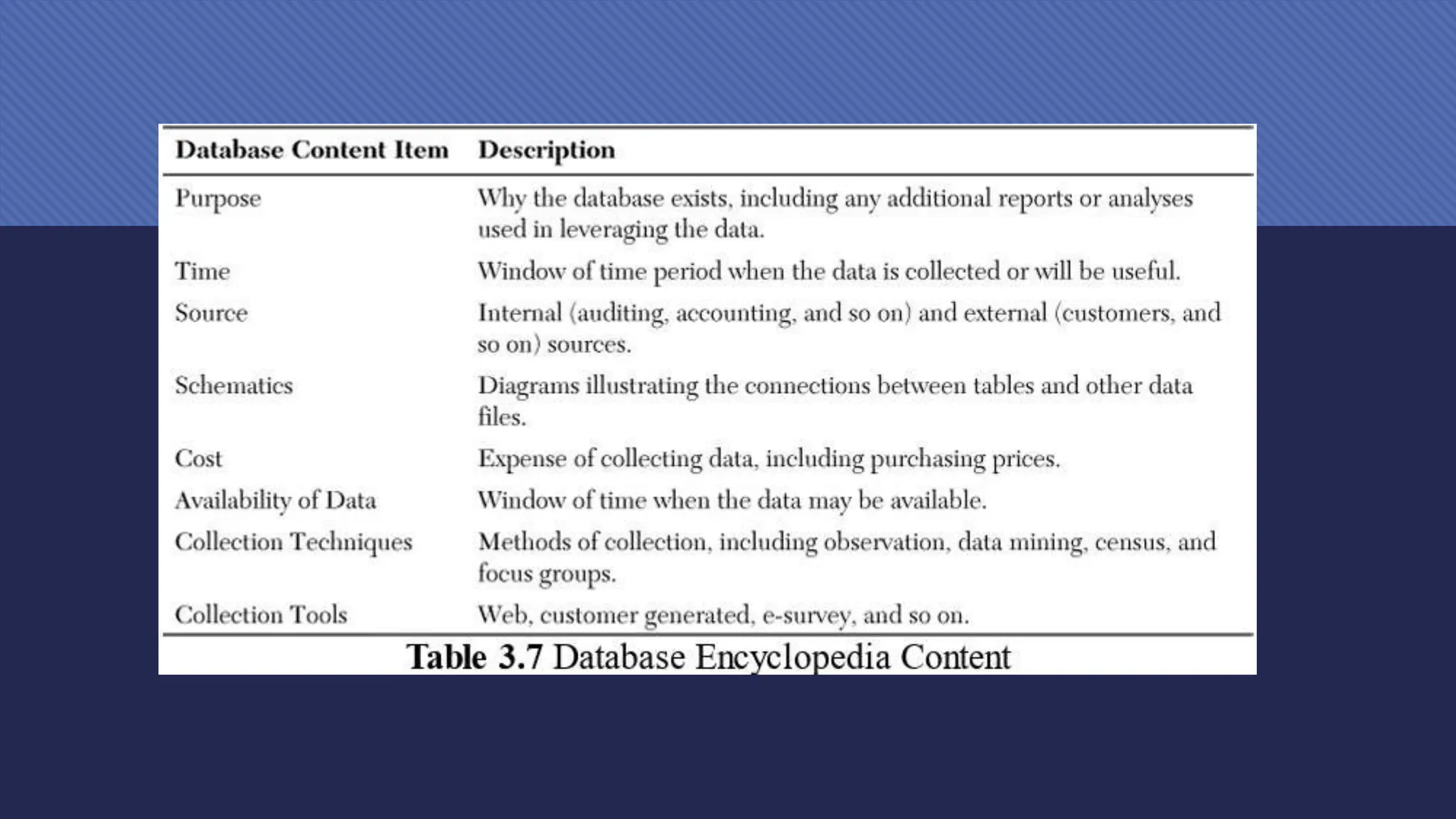
 The Database encyclopedia is a table of contents listing a firm’s current data inventory and what data
files can be built or purchased.
 Data manipulation language (DML) tools are used to search databases for specific information. An
example is structure query language (SQL), which allows users to find specific data through a session of
queries and responses in a database.
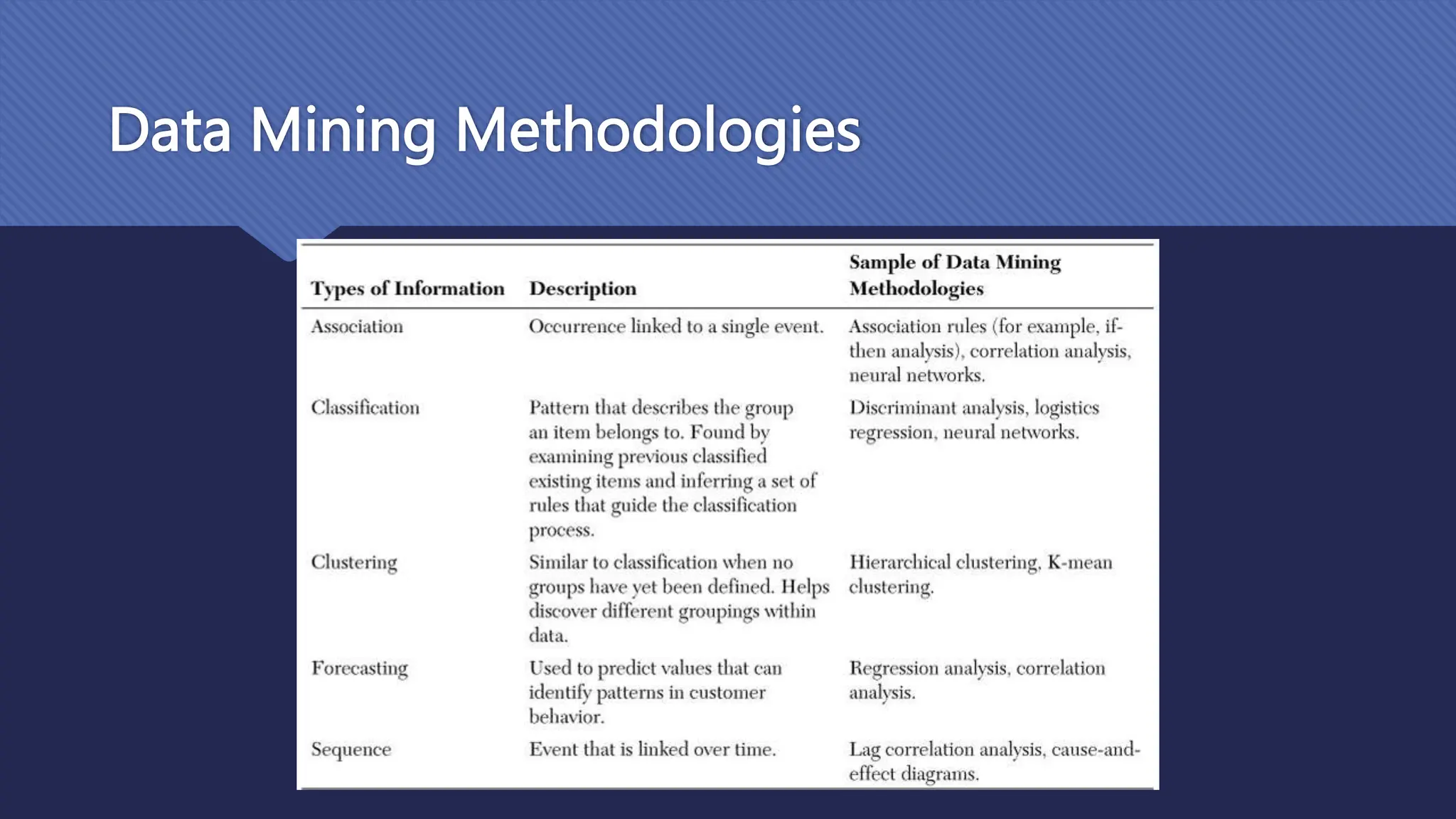
Data Mining Methodologies
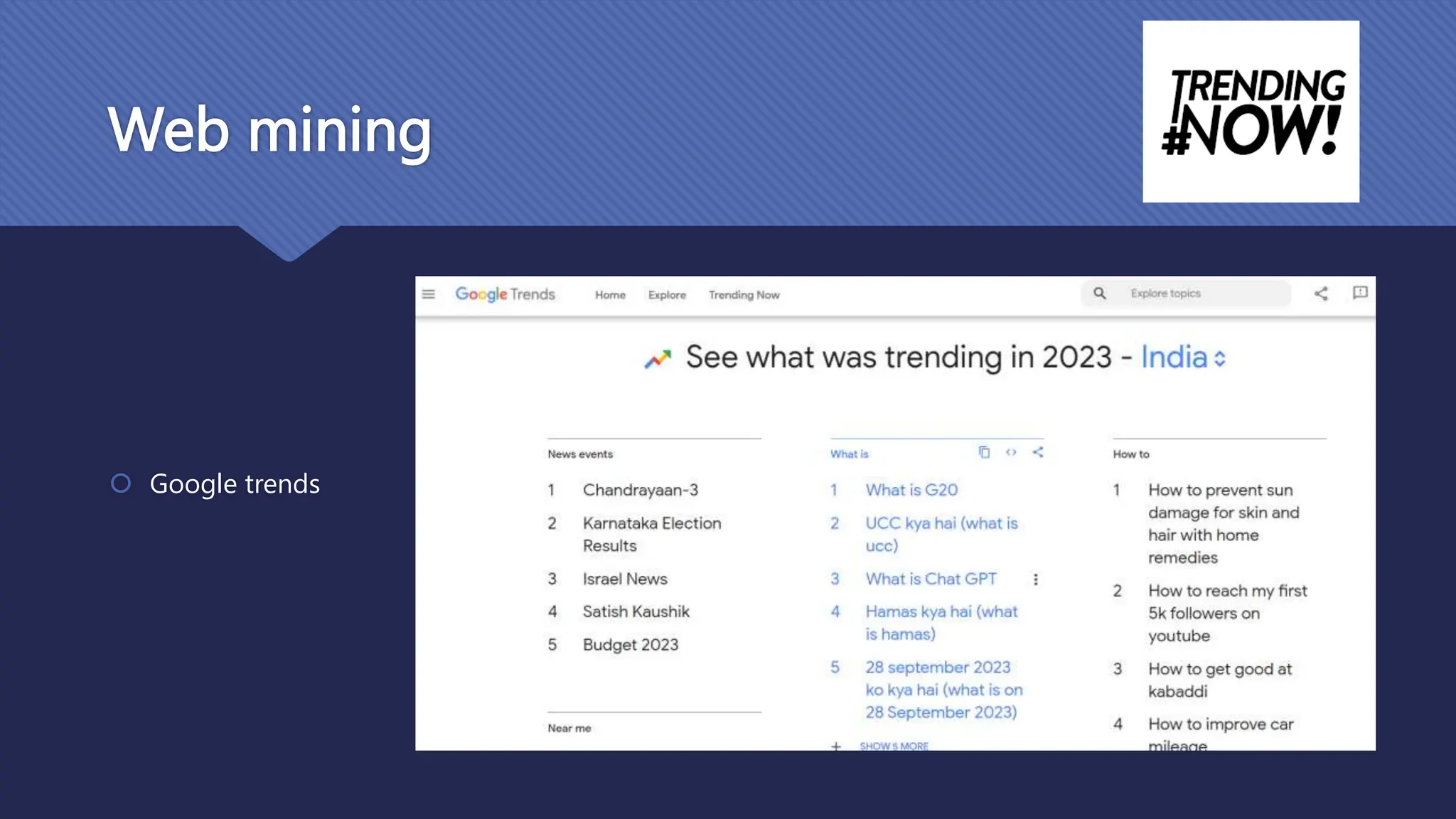
Web mining
 Google trends
Web mining
 Google insights
SAS analytics PRO
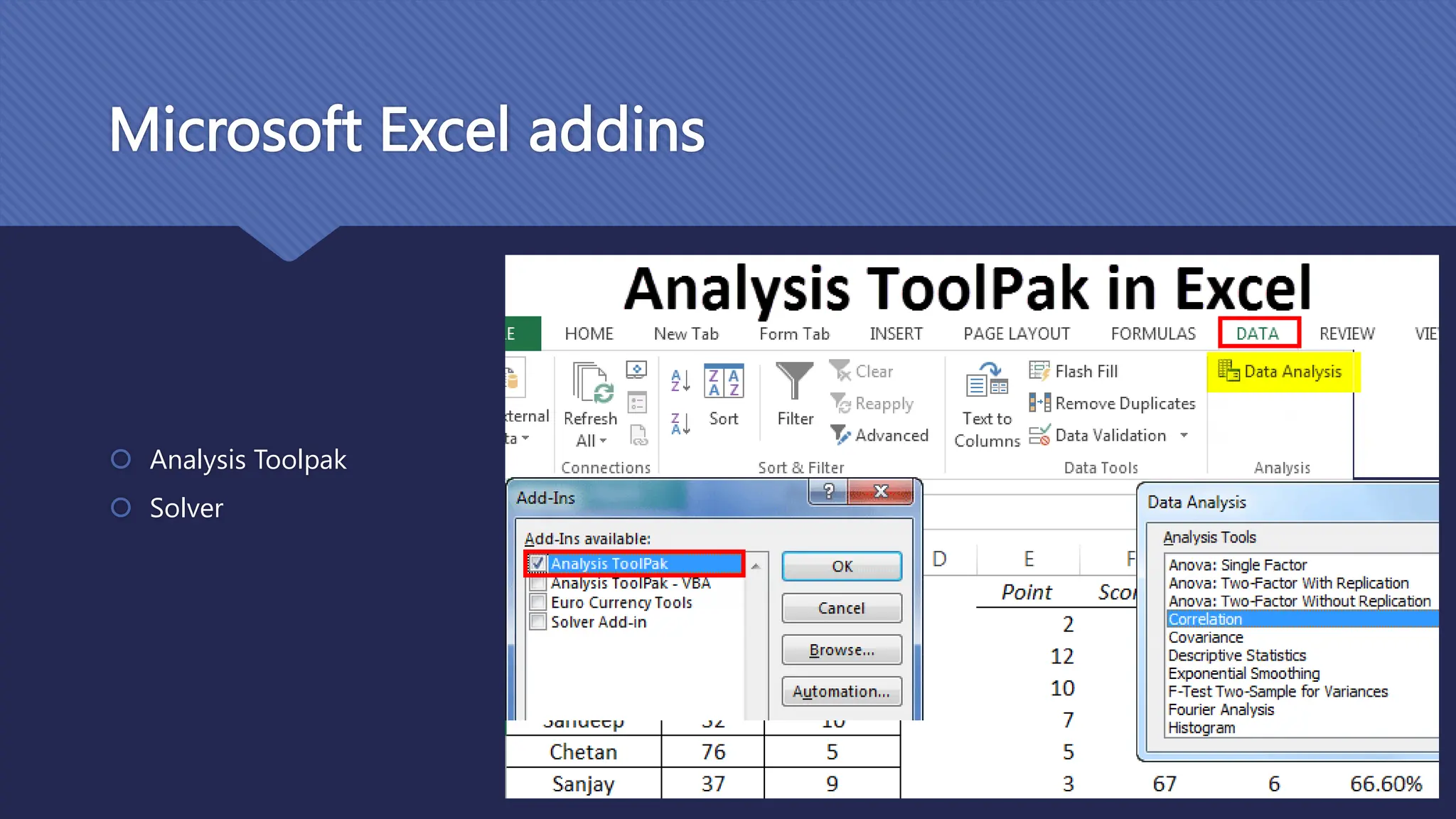
Microsoft Excel addins
 Analysis Toolpak
 Solver
IBM’S SPSS
ORGANISATIONAL STRUCTURES ALIGNING BA
 According to Isson and Harriot, to successfully implement Business Analytics (BA) within
organisations, the BA in whatever organization form it takes must be fully integrated throughout a
firm.
BA Programme, Project and teams
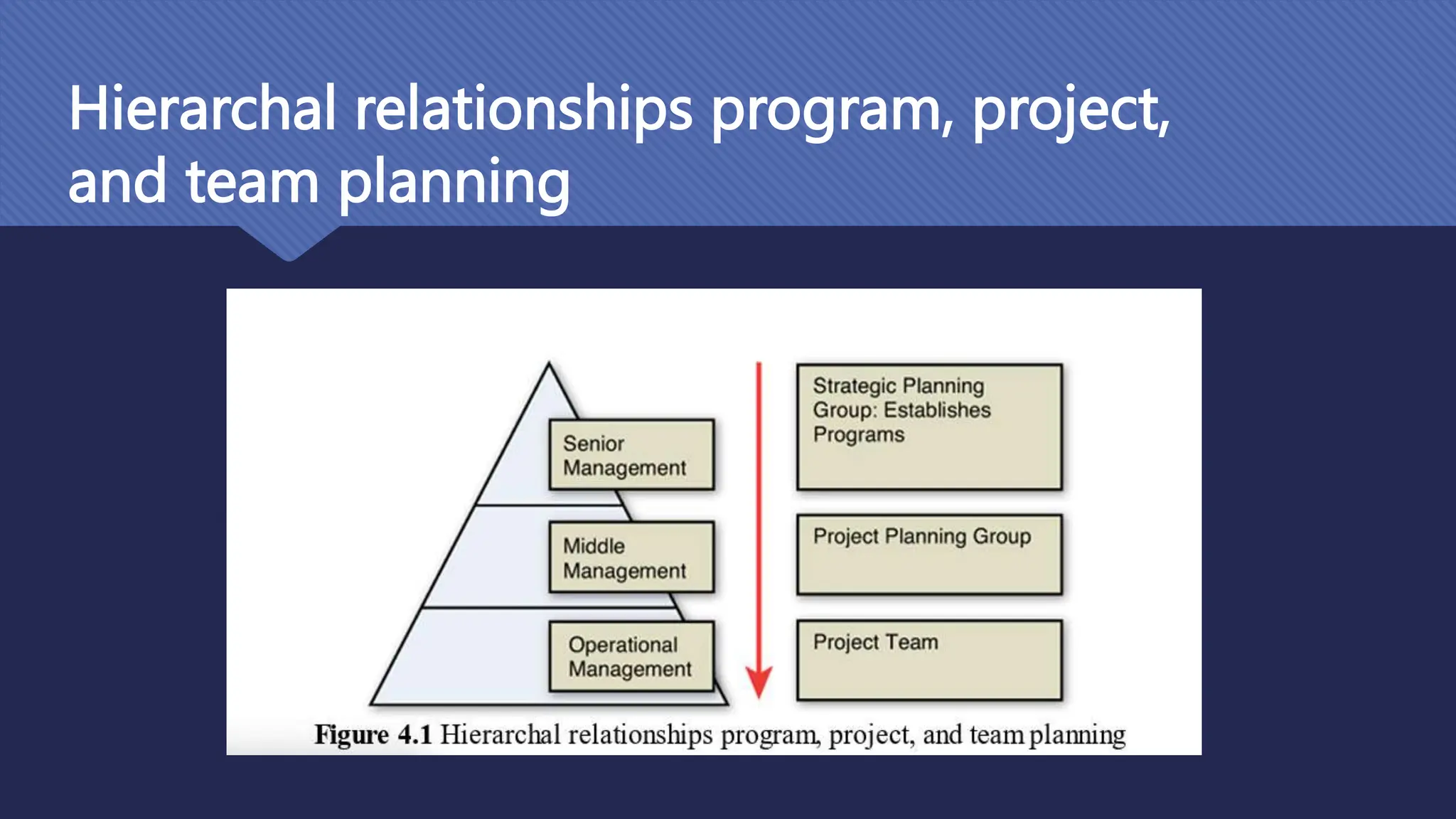
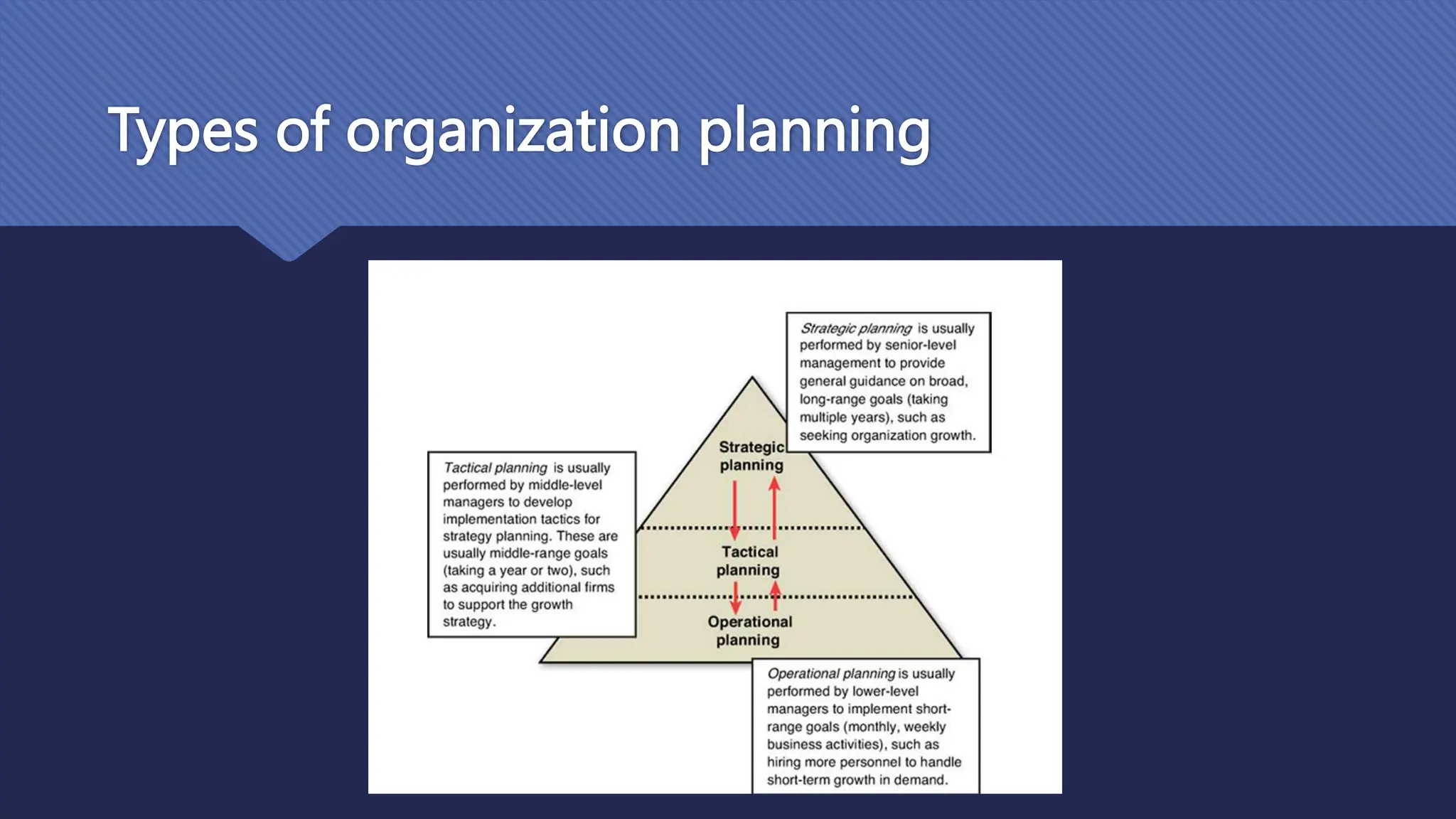
 Most organizations are hierarchical, with senior managers making the strategic planning decisions,
middle-level managers making tactical planning decisions, and lower-level managers making
operational planning decisions.
 A program is the process that seeks to create an outcome and usually involves managing several
related projects with the intention of improving organizational performance. A program can also be
a large project.
 A project tends to deliver outcomes and can be defined as having temporary rather than
permanent social systems within or across organizations to accomplish particular and clearly
defined tasks, usually under time constraints.
 Projects are often composed of teams. A team consists of a group of people with skills to achieve a
common purpose. Teams are especially appropriate for conducting complex tasks that have many
interdependent subtasks
Hierarchal relationships program, project,
and team planning
Types of organization planning
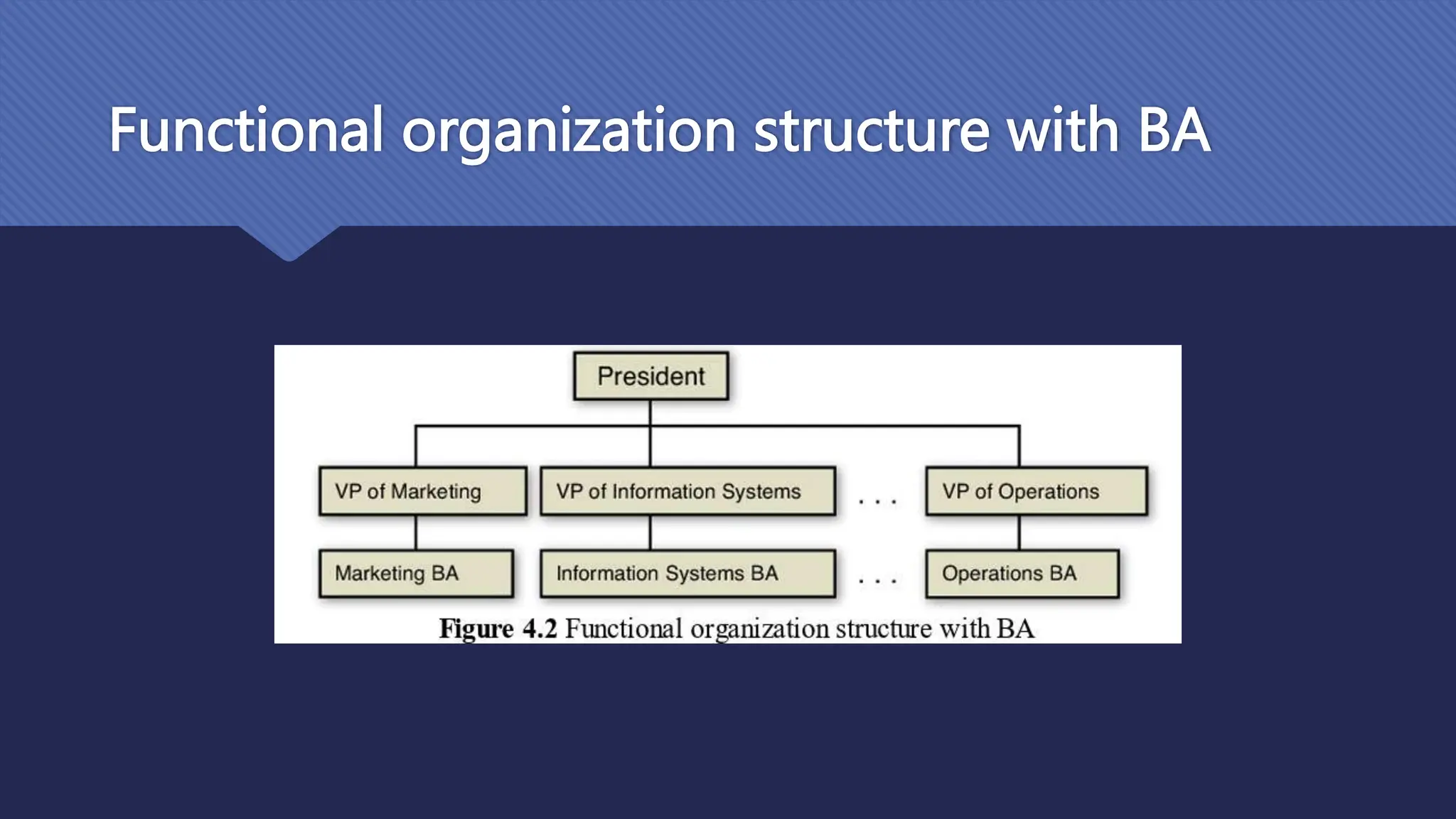
Functional organization structure with BA
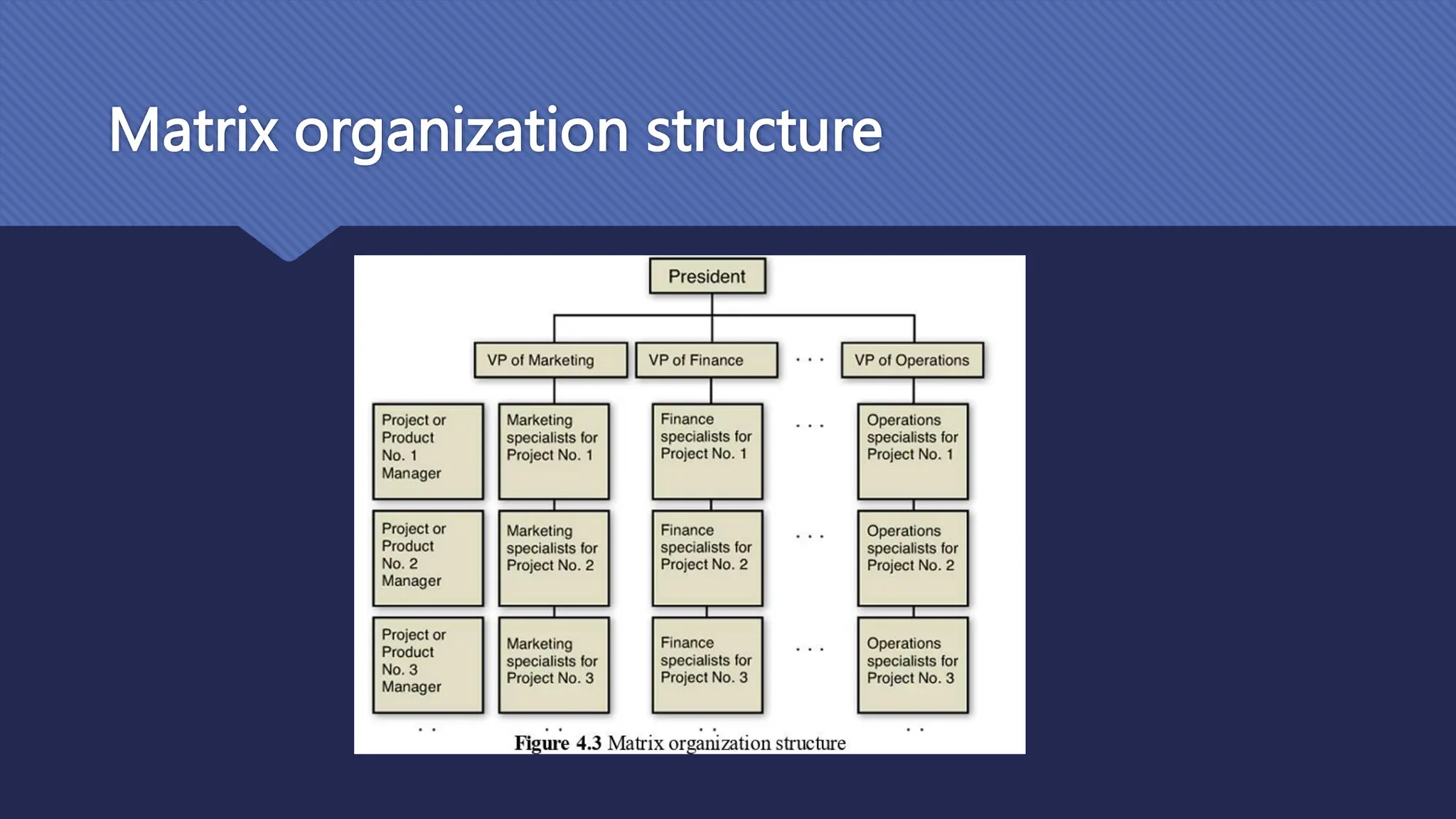
Matrix organization structure
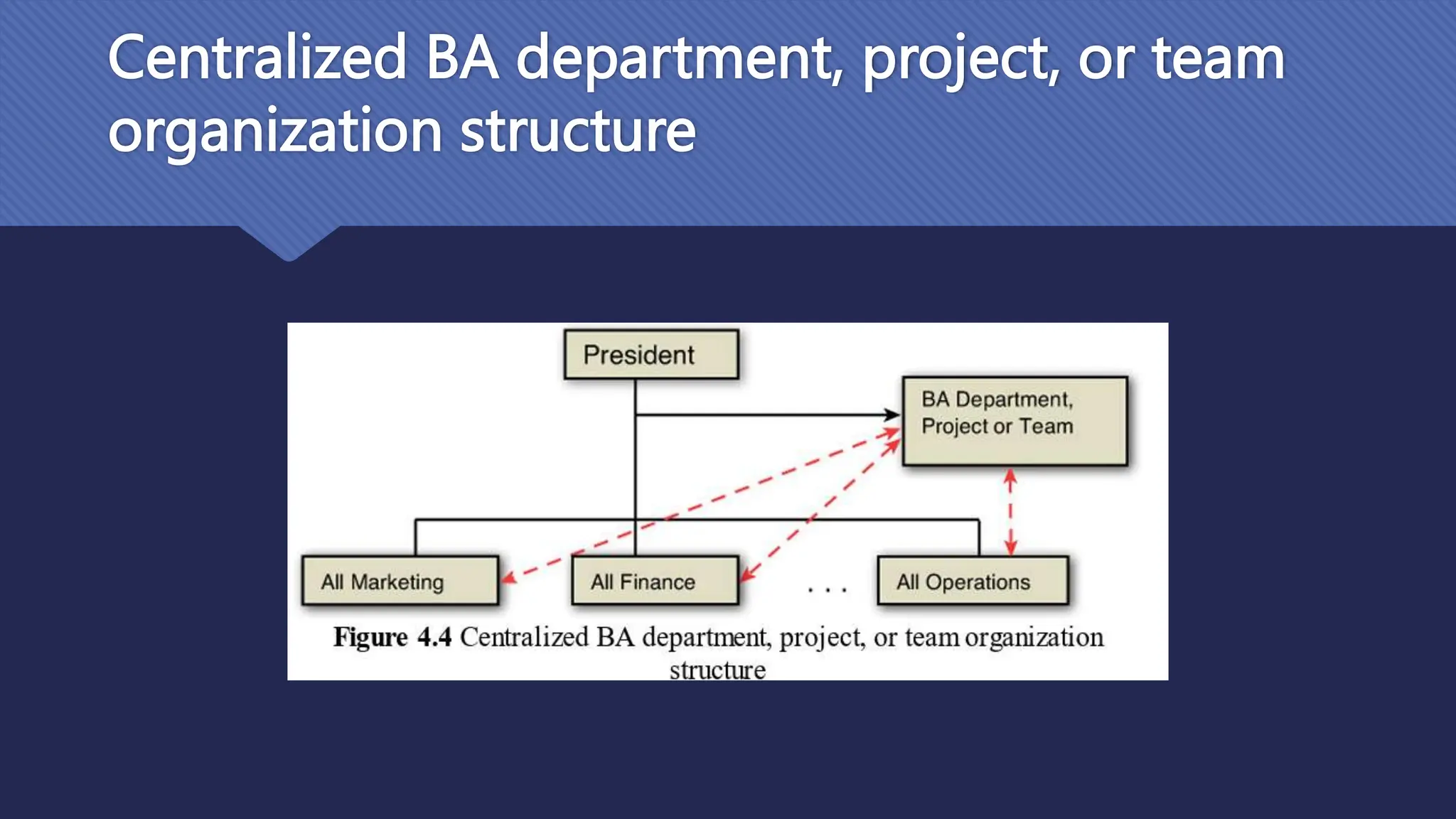
Centralized BA department, project, or team
organization structure
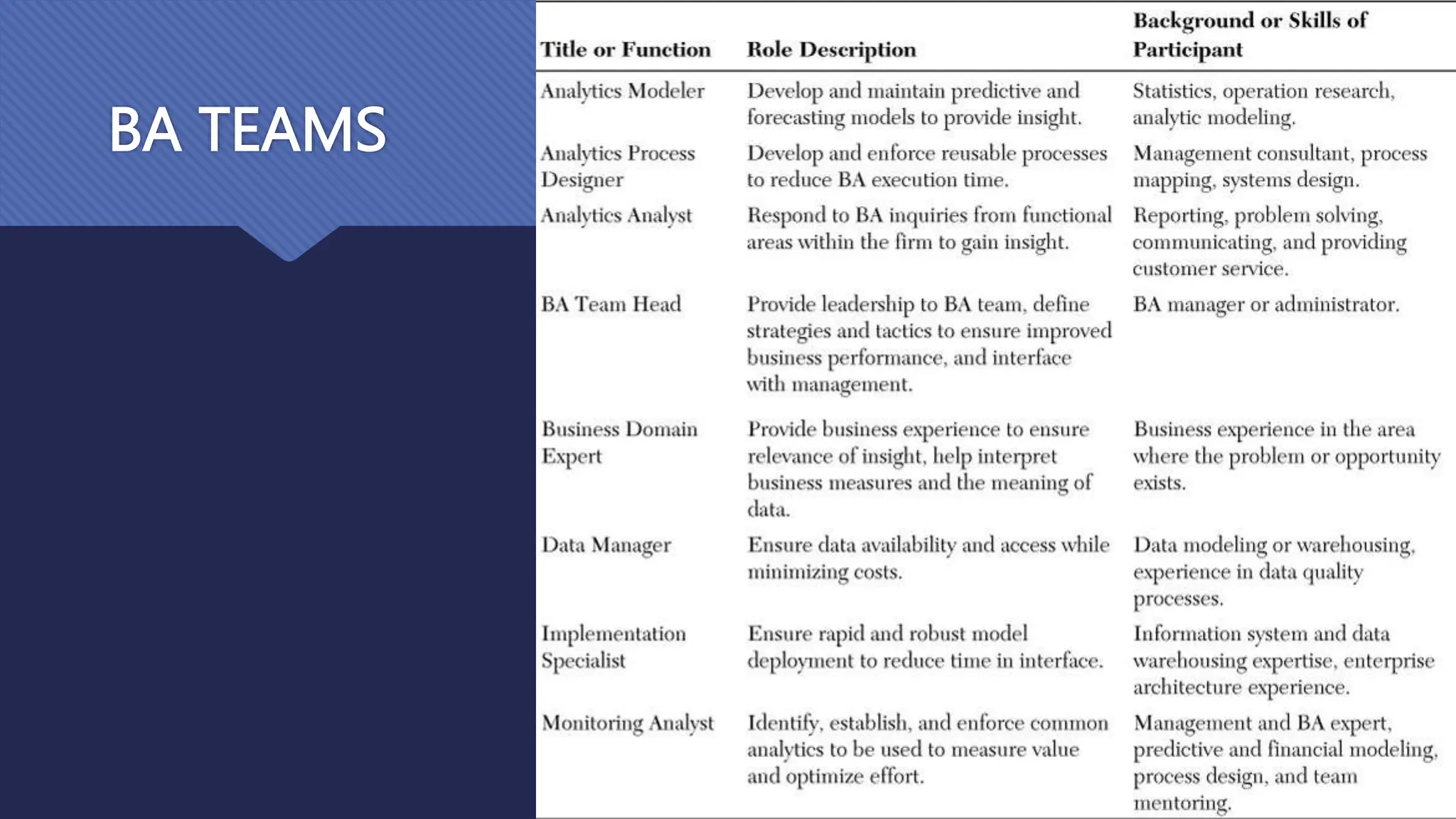
BA TEAMS
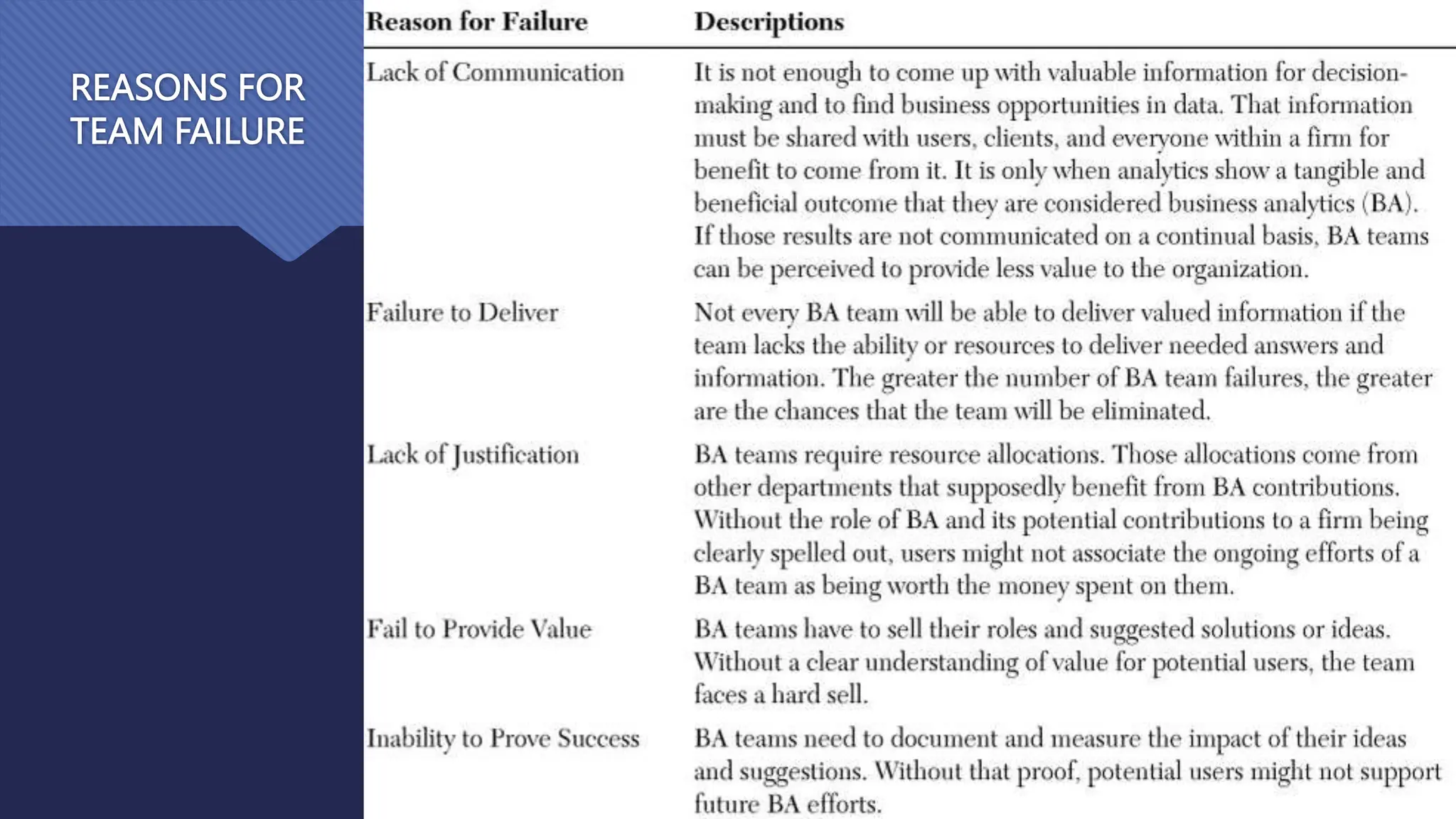
REASONS FOR
TEAM FAILURE
Management Issues
 Establishing an information policy,
 outsourcing business analytics,
 ensuring data quality,
 measuring business analytics contribution,
 and managing change
MANAGING INFORMATION POLICY
 There is a need to manage information. This is accomplished by establishing an information policy
to structure rules on how information and data are to be organized and maintained and who is
allowed to view the data or change it. The information policy specifies organizational rules for
sharing, disseminating, acquiring, standardizing, classifying, and inventorying all types of
information and data. It defines the specific procedures and accountabilities that identify which
users and organizational units can share information, where the information can be distributed, and
who is responsible for updating and maintaining the information.
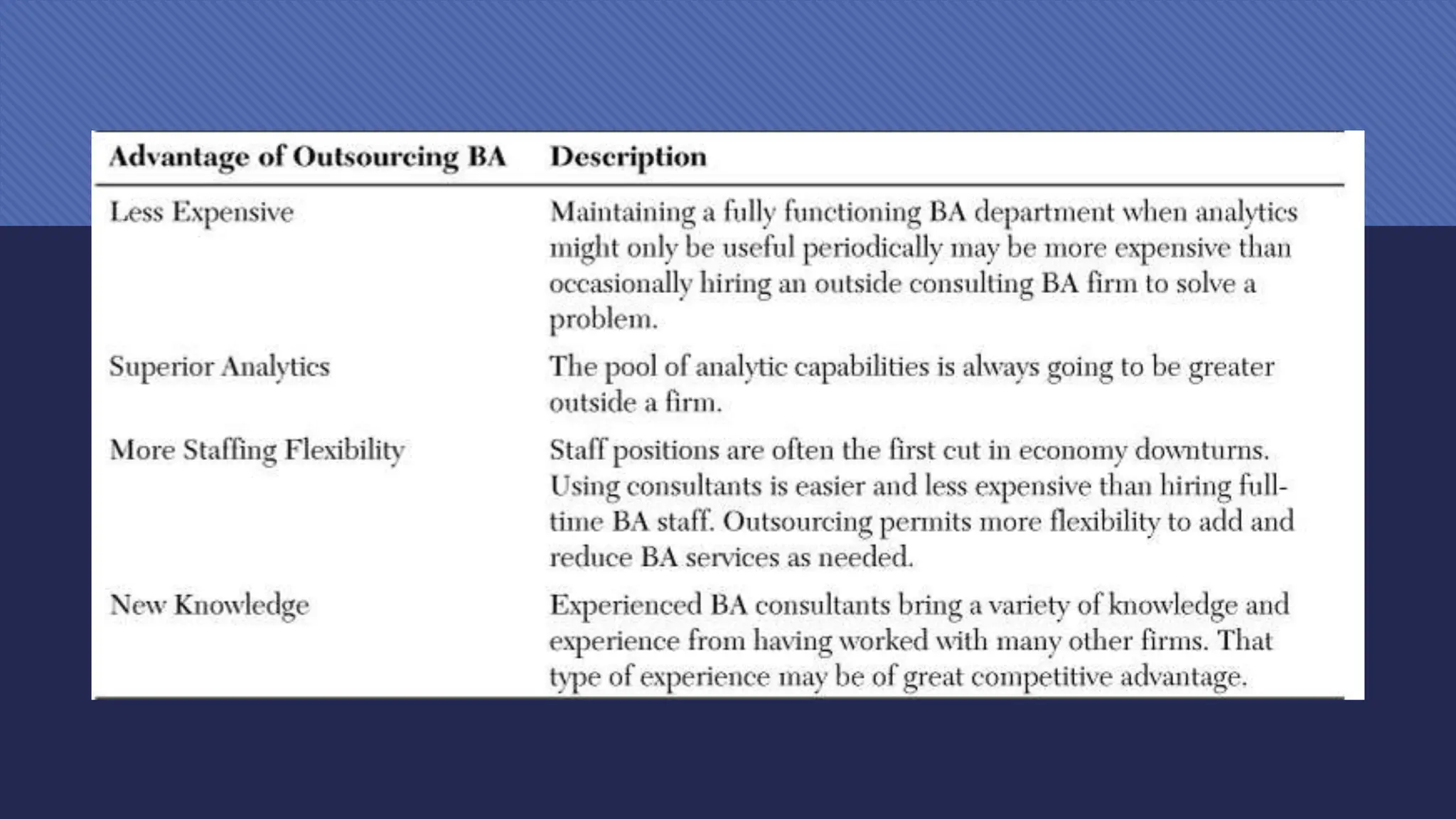
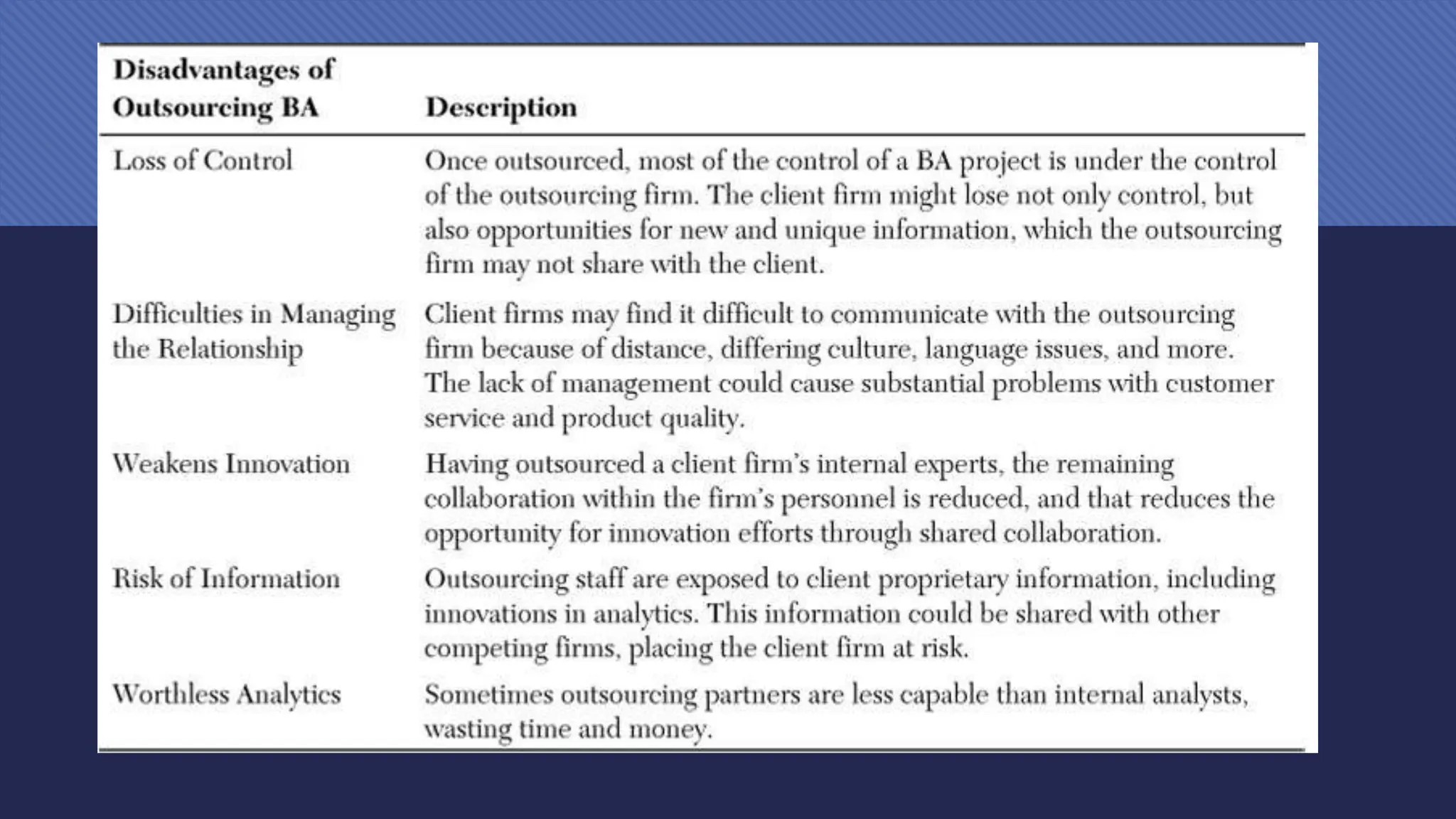
Outsourcing BA
 Outsourcing can be defined as a strategy by which an organization chooses to allocate some
business activities and responsibilities from an internal source to an external source. Any business
activity can be outsourced, including BA. BA is a staff function that is easier to outsource than other
line management tasks, such as running a warehouse.
ENSURING DATA QUALITY
 Data quality refers to accuracy, precision, and completeness of data. High-quality data is considered
to correctly reflect the real world in which it is extracted. Poor quality data caused by data entry
errors, poorly maintained databases, out-of-date data, and incomplete data usually leads to bad
decisions and undermines BA within a firm. Organizationally, the database management systems
personnel are managerially responsible for ensuring data quality.
 An organization needs to identify and correct faulty data and establish routines and procedures for
editing data in the database. The analysis of data quality can begin with a data quality audit, where
a structured survey or inspection of accuracy and level of completeness of data is undertaken.
 If during the data quality audit files are found that have errors, a process called data cleansing or
data scrubbing is undertaken to eliminate or repair data.
Measuring Business Analytics Contribution
 The investment in BA must continually be justified by communicating the BA contribution to the
organization for ongoing projects. This means that performance analytics should be computed for
every BA project and BA team initiative.
 Measuring the value and contributions that BA brings to an organization is essential to helping the
firm understand why the application of BA is worth the investment.
Managing Change
 Organizational culture is how an organization supports cooperation, coordination, and
empowerment of employees.
 Change management is defined as an approach for transitioning the organization (individuals,
teams, projects, departments) to a changed and desired future state. Changes in an organization
can be planned or unplanned.
 The application of BA invariably will result in both types of changes because of BA’s specific
problem-solving role and opportunity finding exploratory nature of BA.

MANAGING RESOURCES FOR BUSINESS ANALYTICS BA4206 ANNA UNIVERSITY

  • 1.
    MANAGING RESOURCES FOR BUSINESSANALYTICS MRS. S. RHEMA JOY, AP, MBA
  • 2.
    MANAGING BA PERSONNEL A business analyst is an individual who statistically analyzes large data sets to identify effective ways of boosting organizational efficiency.  They bridge the gap between the client and the development team.
  • 3.
    Skills required forBA Personnel ✓ Verbal and written communication ✓ Analytical and systems thinking ✓ Technology and business knowledge ✓ Modelling (process, data and system) ✓ Relationship management ✓ Negotiation ✓ Evaluation and business analysis ✓ Planning and management ✓ Elicitation and facilitation
  • 4.
    Roles of BAPersonnel • As a contributor • As a facilitator • As an analyst
  • 5.
    KEY RESPONSIBILITIES OFA BUSINESS ANALYTICS PERSONNEL a) Initiation phase b) Planning phase c) Executing phase d) Monitoring and controlling phase e) Closing phase
  • 6.
    ❖ Pure businessanalysts ❖ IT business analysts ❖ Data business analyst ❖ Functional business analyst ❖ Business system analyst ❖ Business requirements analyst ❖ Reporting business analyst ❖ Business intelligence analyst TYPES OF BUSINESS ANALYTICS PERSONNEL:
  • 7.
    TYPES OF BUSINESSANALYTICS PERSONNEL
  • 8.
    TOOLS USED BYBA PERSONNEL
  • 9.
    MANAGING BA PERSONNEL Understand what a BA does and their value  Give them tools  Make sure they have time to “think”  Keep BA to “over-analyse”  Spending time with BA  Get comfortable with the common & not so common BA methods  Brush up your stakeholder management skills  Go deep into the tech side of the job
  • 10.
    DATA a) Primary sourcesof data b) Secondary sources of data
  • 11.
    Primary Sources ofData  Primary data is a type of data that is collected by researchers directly from main sources through interviews, surveys, experiments, etc. Primary data are usually collected from the source—where the data originally originates from and are regarded as the best kind of data in research.  Key Elements: ✓ Primary data means first-hand information collected by an investigator. ✓ It is collected for the first time. ✓ It is original and more reliable. ✓ For example, the population census conducted by the government of India after every ten years is primary data.
  • 12.
    Primary Data CollectionMethods  Quantitative Data Collection Methods  Qualitative Data Collection Methods ❖ Survey ❖ Interview method Personal Interview Telephonic Interview ❖ Questionnaire method ❖ Schedules ❖ Experimentation Other methods for collection of data includes: ✓ Warranty cards ✓ Auditing ✓ Mechanical devices ✓ Simulation ✓ Observation ✓ Projective methods
  • 13.
    Significance and Limitations Significanceof Primary data:  ✓ Reliability  ✓ Variety of techniques  ✓ Wide coverage including special cases  ✓ Complete control over process  ✓ Cost effective collection  ✓ Sole ownership of information Limitations of Primary Data:  ✓ Costly affair  ✓ Time consuming  ✓ Infeasible  ✓ Huge quantity of data  ✓ Unwillingness to answer
  • 14.
    Secondary Sources ofData  Secondary data is the data that has already been collected through primary sources and made readily available for researchers to use for their own research. It is a type of data that has already been collected in the past.
  • 15.
    Secondary Data CollectionMethods  Books  Published Sources  Unpublished Personal Sources  Journals  Newspapers  Websites  Diaries  Government Records Other sources of secondary data collection include: ✓ Sales analysis ✓ Invoice analysis ✓ Financial data ✓ Transportation data ✓ Storage data ✓ Libraries ✓ Literature ✓ Periodicals ✓ References and bibliography ✓ Census and registration data ✓ Trade associations ✓ Commercial research institutions ✓ International organisation
  • 16.
    Data Issues  Dataquality can be defined as data that serves the purpose for which it is collected.  Accurately representing reality, measuring what it is supposed to measure, being timeless, and having completeness.  Data privacy refers to the protection of shared data such that access is permitted only to those users for whom it is intended.  Data leaks on product quality failures can damage brand image, and customers can become distrustful of a firm that shares information given in confidence.
  • 17.
    BA TECHNOLOGY a) Computerhardware b) Computer software c) Networking and telecommunications technology Internet, Intranet, Extranet d) Data management technology • Database Management System (DBMS) • Data warehouses OLAP (OnLine Analytical Processing) • Data mining • Text mining • Web mining • SAS analytics • Microsoft excel spreadsheet • IBM’s SPSS software
  • 18.
    Database management systems(DBMS)  Database management systems (DBMS) is a data management technology software that permits firms to centralize data, manage it efficiently, and provide access to stored data by application programs.  Data definition is used to create database tables and characteristics used in fields to identify content. (DDL)  Data dictionary is an automated or manual file that stores the size, descriptions, format, and other properties needed to characterize data  The Database encyclopedia is a table of contents listing a firm’s current data inventory and what data files can be built or purchased.  Data manipulation language (DML) tools are used to search databases for specific information. An example is structure query language (SQL), which allows users to find specific data through a session of queries and responses in a database.
  • 19.
  • 20.
  • 21.
  • 23.
  • 24.
    Microsoft Excel addins Analysis Toolpak  Solver
  • 25.
  • 26.
    ORGANISATIONAL STRUCTURES ALIGNINGBA  According to Isson and Harriot, to successfully implement Business Analytics (BA) within organisations, the BA in whatever organization form it takes must be fully integrated throughout a firm.
  • 27.
    BA Programme, Projectand teams  Most organizations are hierarchical, with senior managers making the strategic planning decisions, middle-level managers making tactical planning decisions, and lower-level managers making operational planning decisions.  A program is the process that seeks to create an outcome and usually involves managing several related projects with the intention of improving organizational performance. A program can also be a large project.  A project tends to deliver outcomes and can be defined as having temporary rather than permanent social systems within or across organizations to accomplish particular and clearly defined tasks, usually under time constraints.  Projects are often composed of teams. A team consists of a group of people with skills to achieve a common purpose. Teams are especially appropriate for conducting complex tasks that have many interdependent subtasks
  • 28.
    Hierarchal relationships program,project, and team planning
  • 29.
  • 30.
  • 31.
  • 32.
    Centralized BA department,project, or team organization structure
  • 33.
  • 34.
  • 35.
    Management Issues  Establishingan information policy,  outsourcing business analytics,  ensuring data quality,  measuring business analytics contribution,  and managing change
  • 36.
    MANAGING INFORMATION POLICY There is a need to manage information. This is accomplished by establishing an information policy to structure rules on how information and data are to be organized and maintained and who is allowed to view the data or change it. The information policy specifies organizational rules for sharing, disseminating, acquiring, standardizing, classifying, and inventorying all types of information and data. It defines the specific procedures and accountabilities that identify which users and organizational units can share information, where the information can be distributed, and who is responsible for updating and maintaining the information.
  • 37.
    Outsourcing BA  Outsourcingcan be defined as a strategy by which an organization chooses to allocate some business activities and responsibilities from an internal source to an external source. Any business activity can be outsourced, including BA. BA is a staff function that is easier to outsource than other line management tasks, such as running a warehouse.
  • 40.
    ENSURING DATA QUALITY Data quality refers to accuracy, precision, and completeness of data. High-quality data is considered to correctly reflect the real world in which it is extracted. Poor quality data caused by data entry errors, poorly maintained databases, out-of-date data, and incomplete data usually leads to bad decisions and undermines BA within a firm. Organizationally, the database management systems personnel are managerially responsible for ensuring data quality.  An organization needs to identify and correct faulty data and establish routines and procedures for editing data in the database. The analysis of data quality can begin with a data quality audit, where a structured survey or inspection of accuracy and level of completeness of data is undertaken.  If during the data quality audit files are found that have errors, a process called data cleansing or data scrubbing is undertaken to eliminate or repair data.
  • 41.
    Measuring Business AnalyticsContribution  The investment in BA must continually be justified by communicating the BA contribution to the organization for ongoing projects. This means that performance analytics should be computed for every BA project and BA team initiative.  Measuring the value and contributions that BA brings to an organization is essential to helping the firm understand why the application of BA is worth the investment.
  • 42.
    Managing Change  Organizationalculture is how an organization supports cooperation, coordination, and empowerment of employees.  Change management is defined as an approach for transitioning the organization (individuals, teams, projects, departments) to a changed and desired future state. Changes in an organization can be planned or unplanned.  The application of BA invariably will result in both types of changes because of BA’s specific problem-solving role and opportunity finding exploratory nature of BA.