















Welcome!


       Jason@WomackCompany.com
               US 805 640 6401
               UK 020 8144 7000
          www.WomackCompany.com
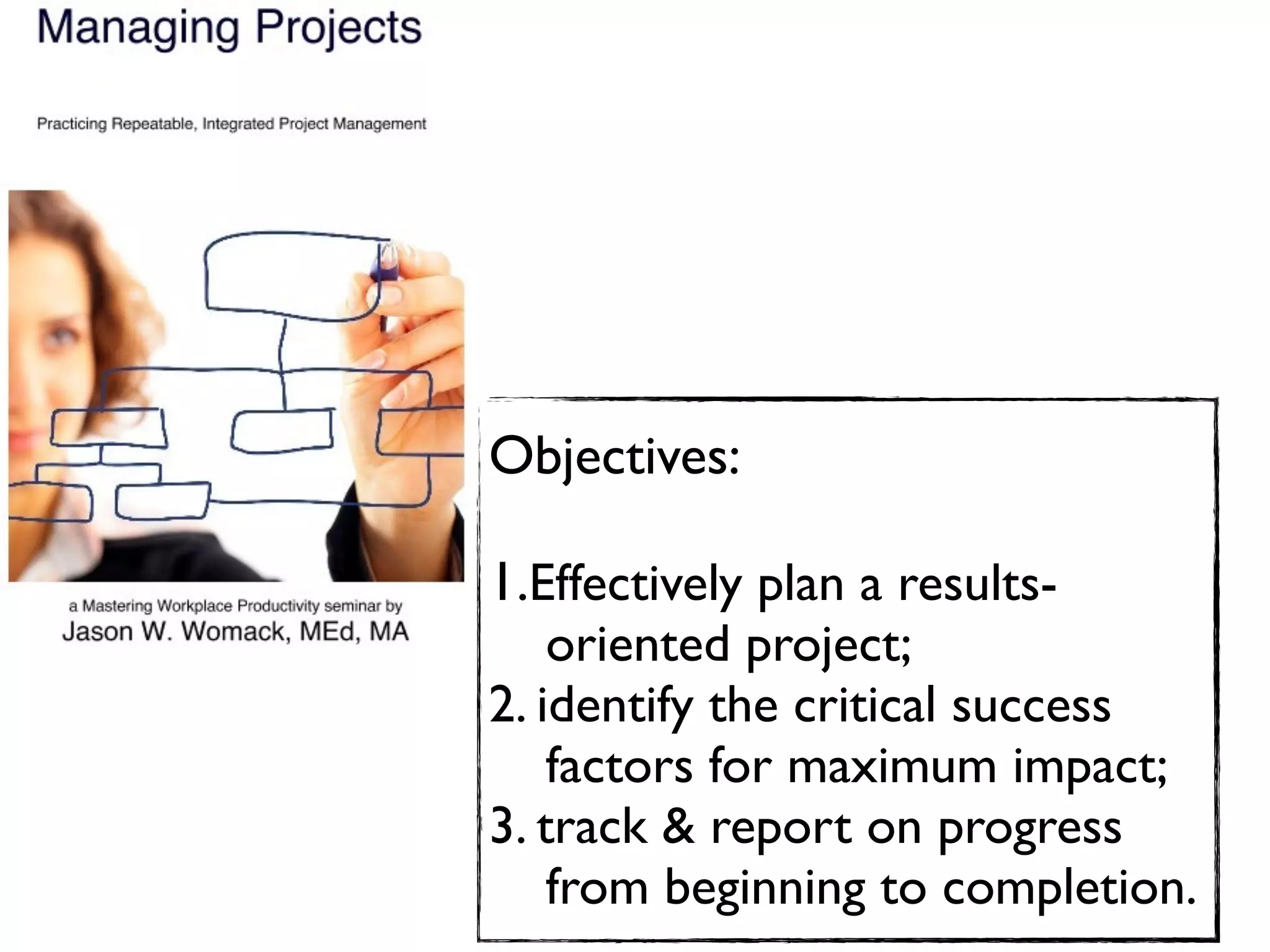
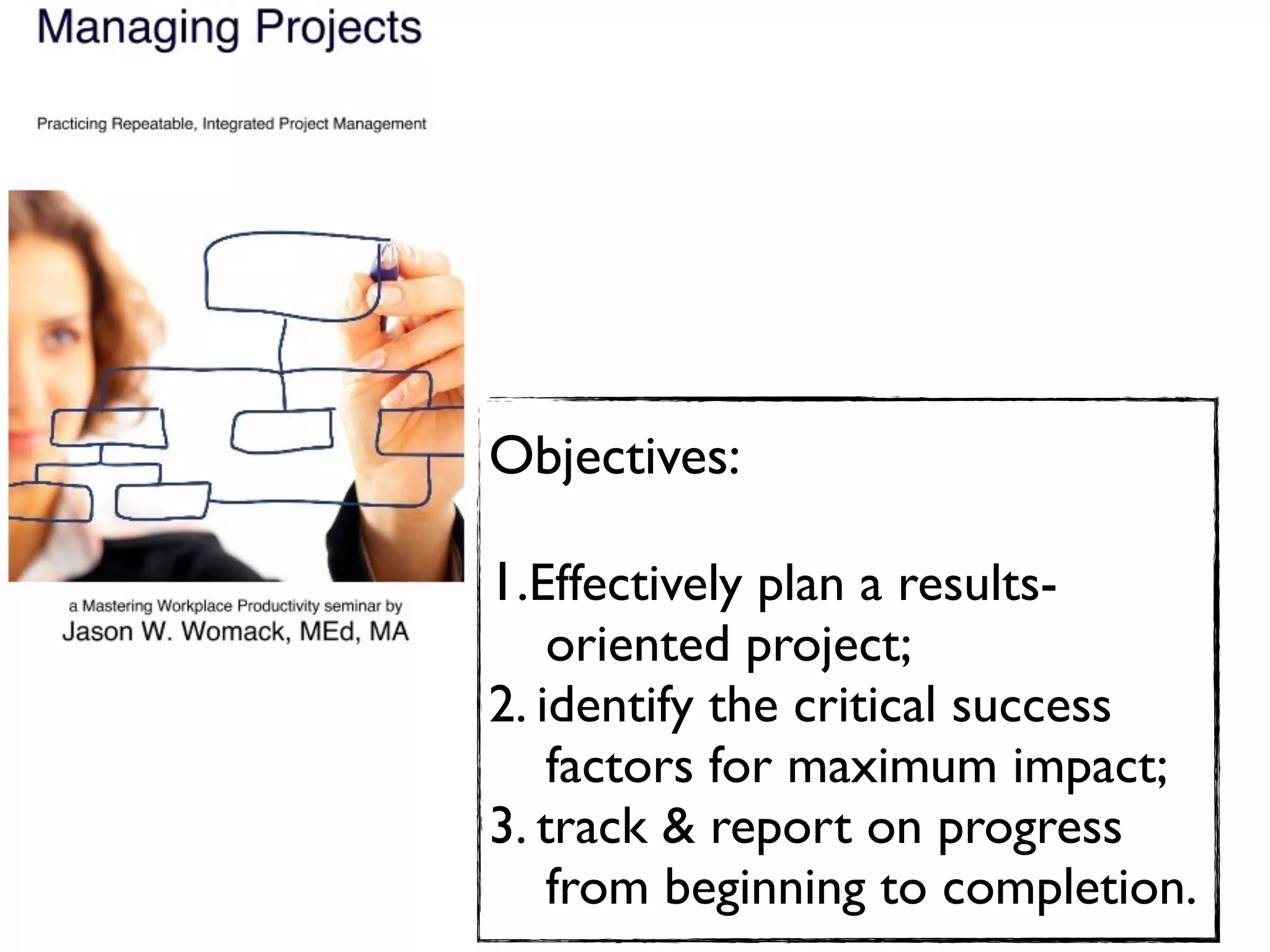
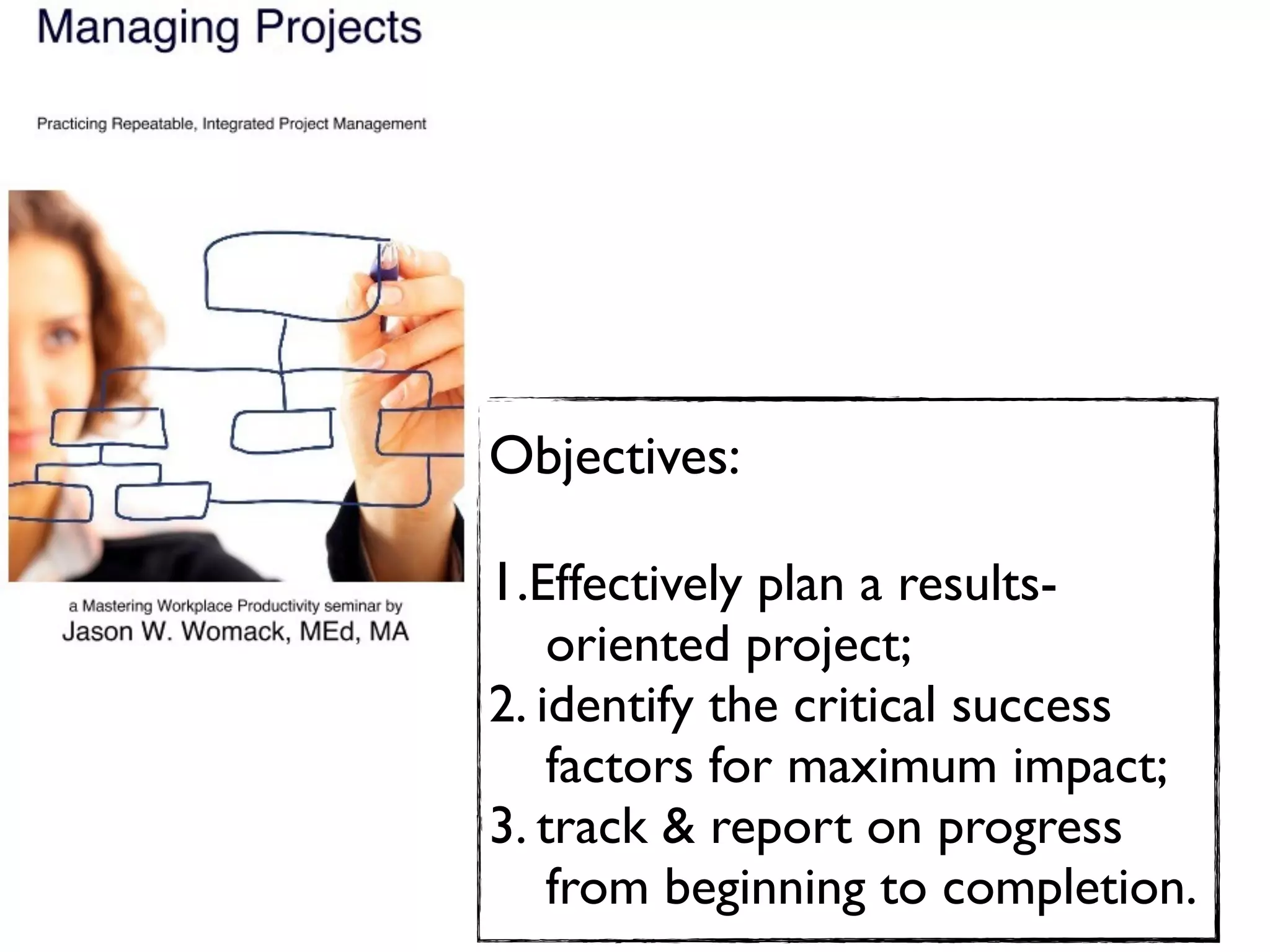
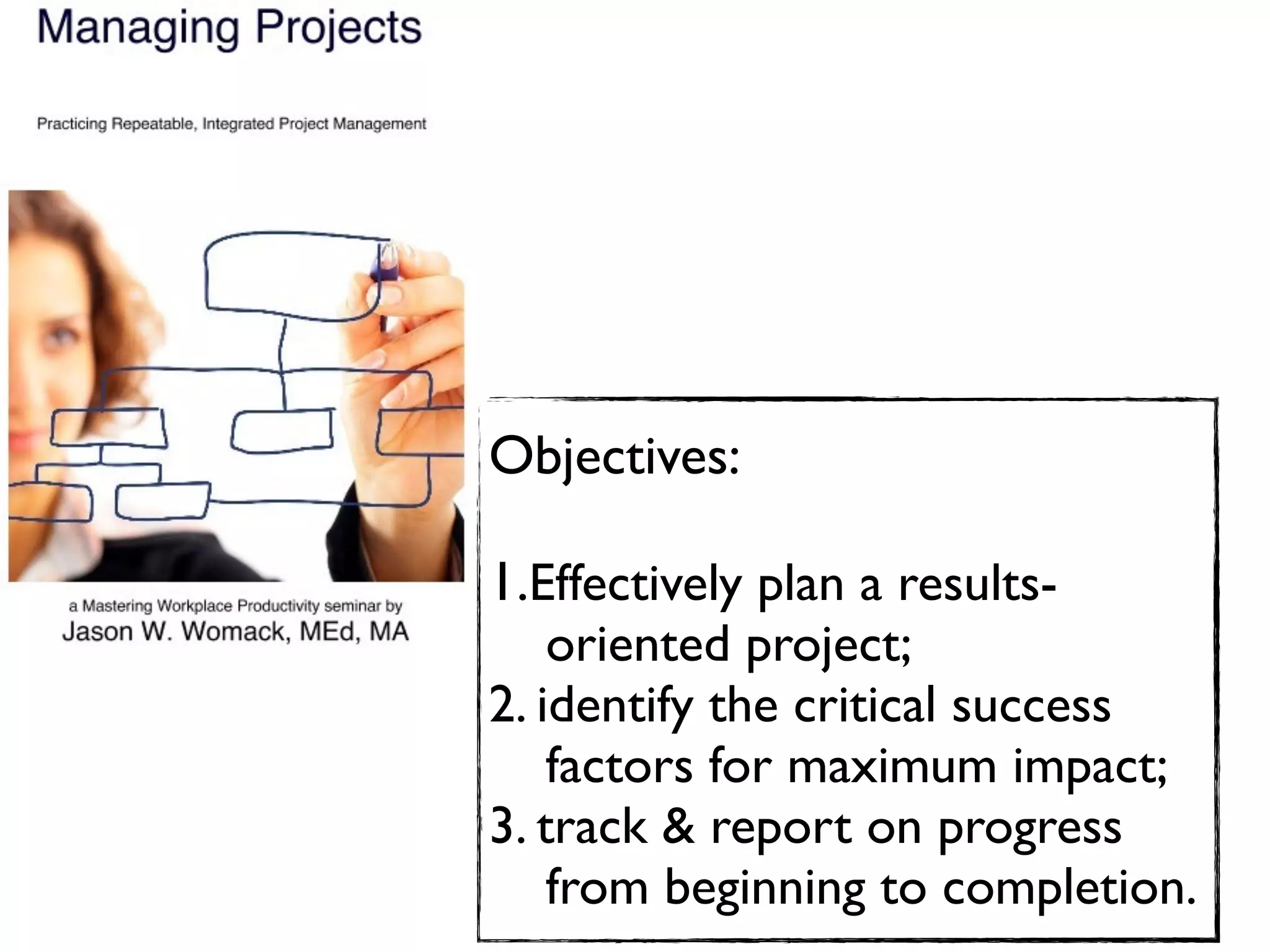
Objectives:

1.Effectively plan a results-

 oriented project;
2. identify the critical success

 factors for maximum impact;
3. track & report on progress

 from beginning to completion.
Fill out page 2 of your booklet.
THANK YOU
• In just a moment, please
 introduce yourself to the 2
 people next to you...
•   ... and share the name of the
    project you’re currently thinking
    about for the course today.


      •   “Hi my name is...
          And, the name of the project is...”
3
Page 3

Please review the three areas we
will explore during this workshop.
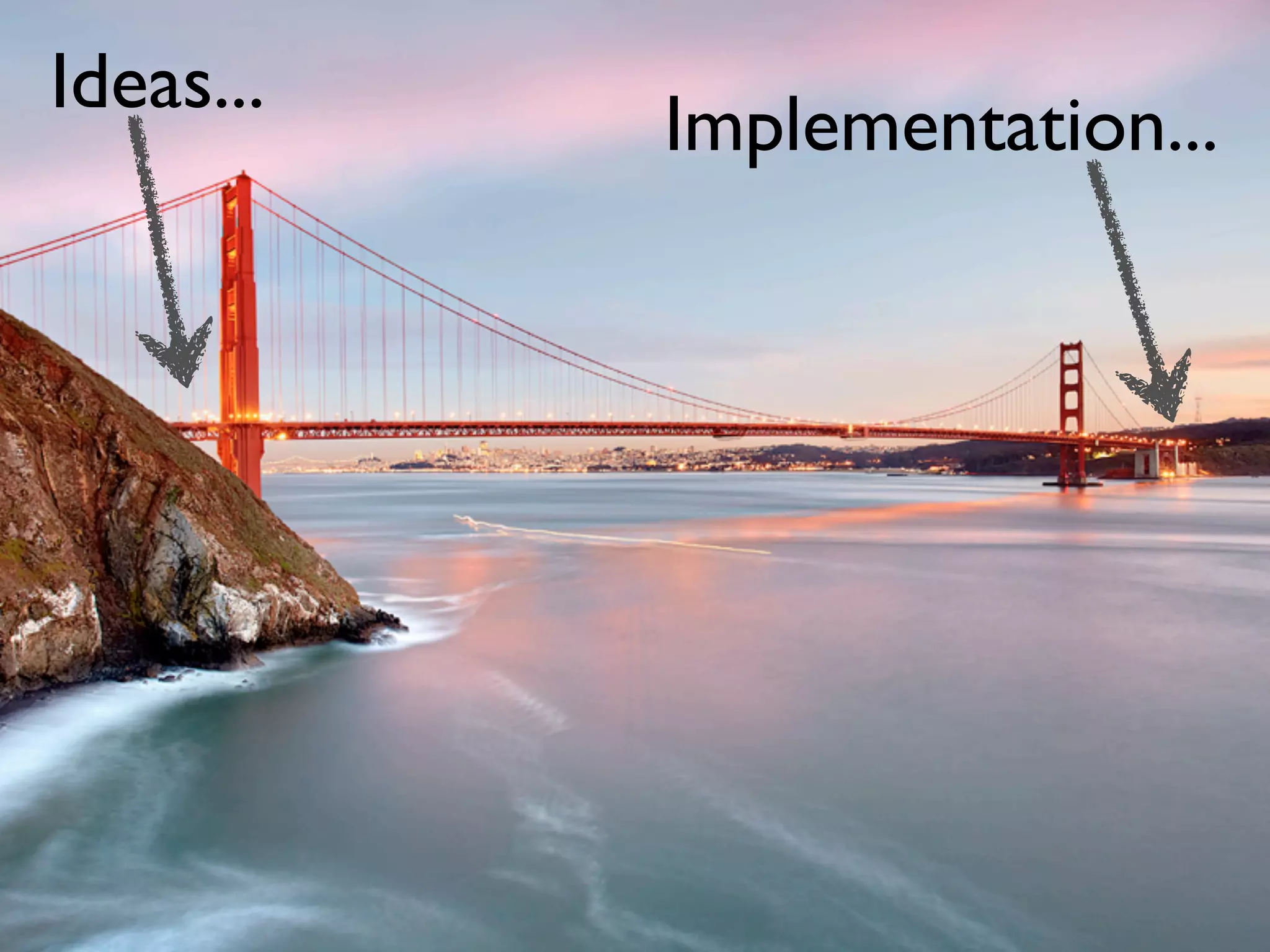
Ideas...
           Implementation...
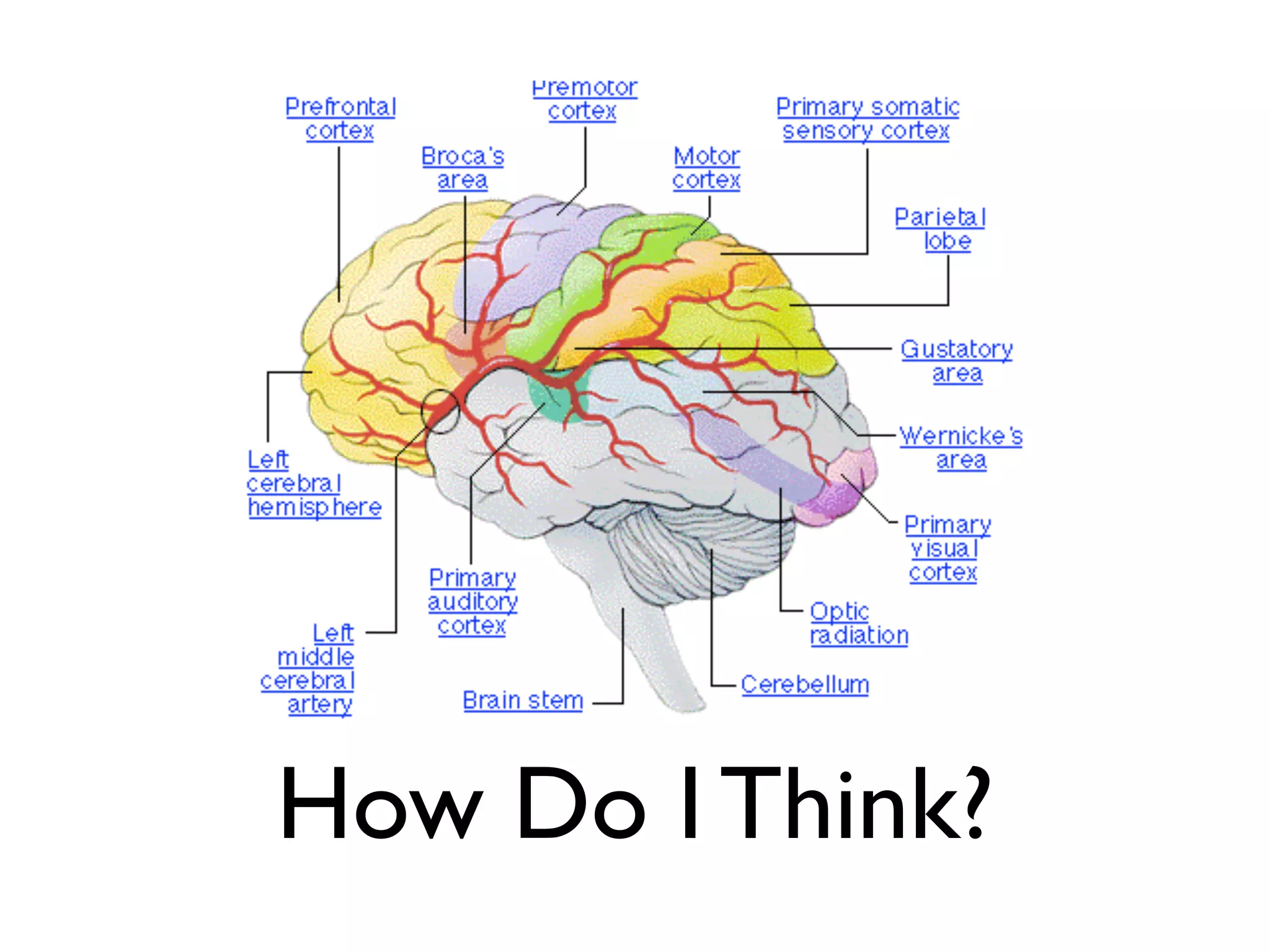
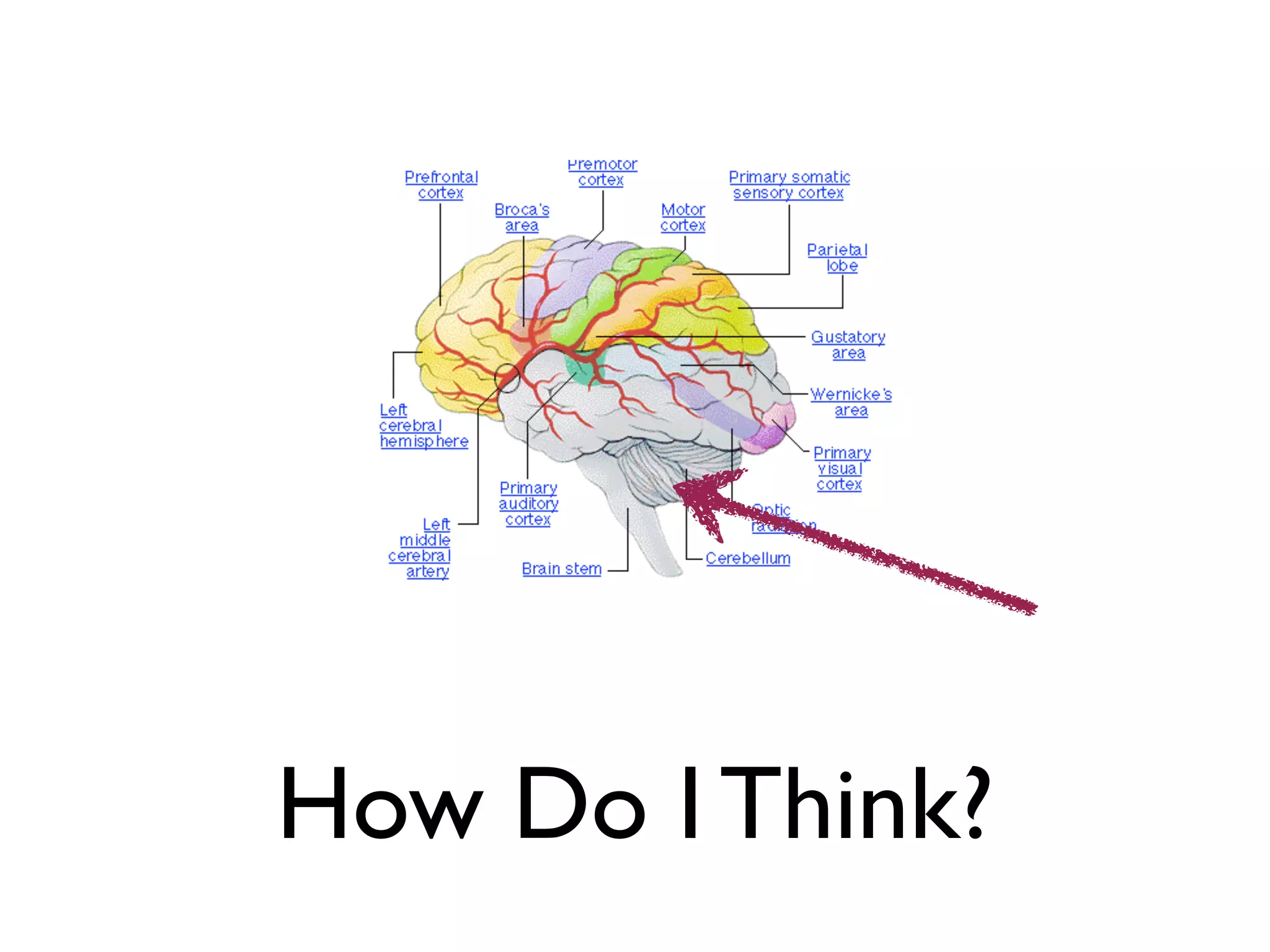
How Do I Think?
Page 32-33
           True...or False
(as in generally... or most of the time)
Page 34-35
     Rank in order of preference
        1 = MOST preferred
         3= LEAST preferred
(as in generally... or most of the time)
How Do I Think?
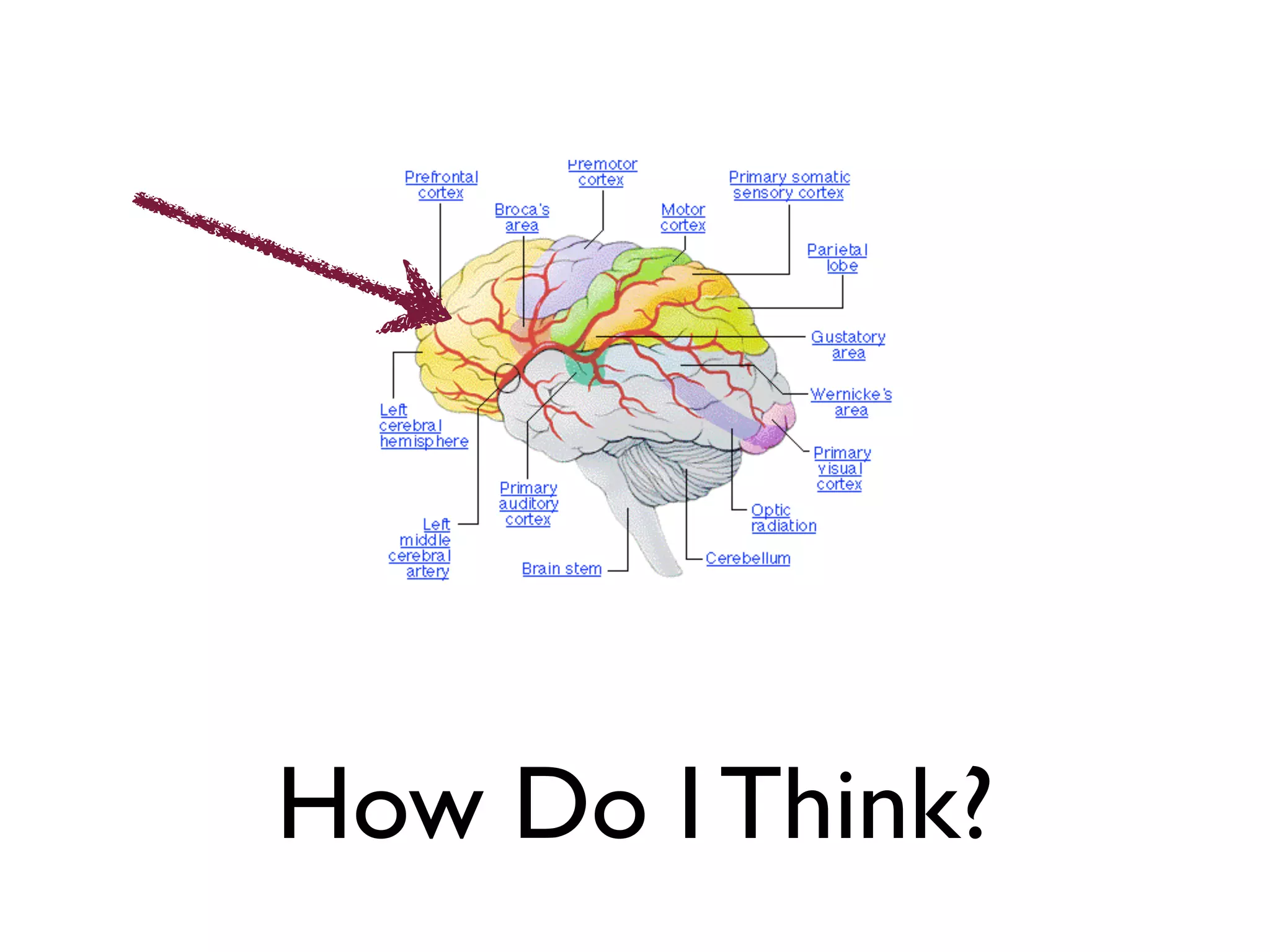
How Do I Think?
•   Please write your own
    response to the prompt on
    the top of page 4:
• “Managing Projects” means:
     _____________________________
     _____________________________
     _____________________________
Objectives:

1.Effectively plan a results-

 oriented project;
2. identify the critical success

 factors for maximum impact;
3. track & report on progress

 from beginning to completion.
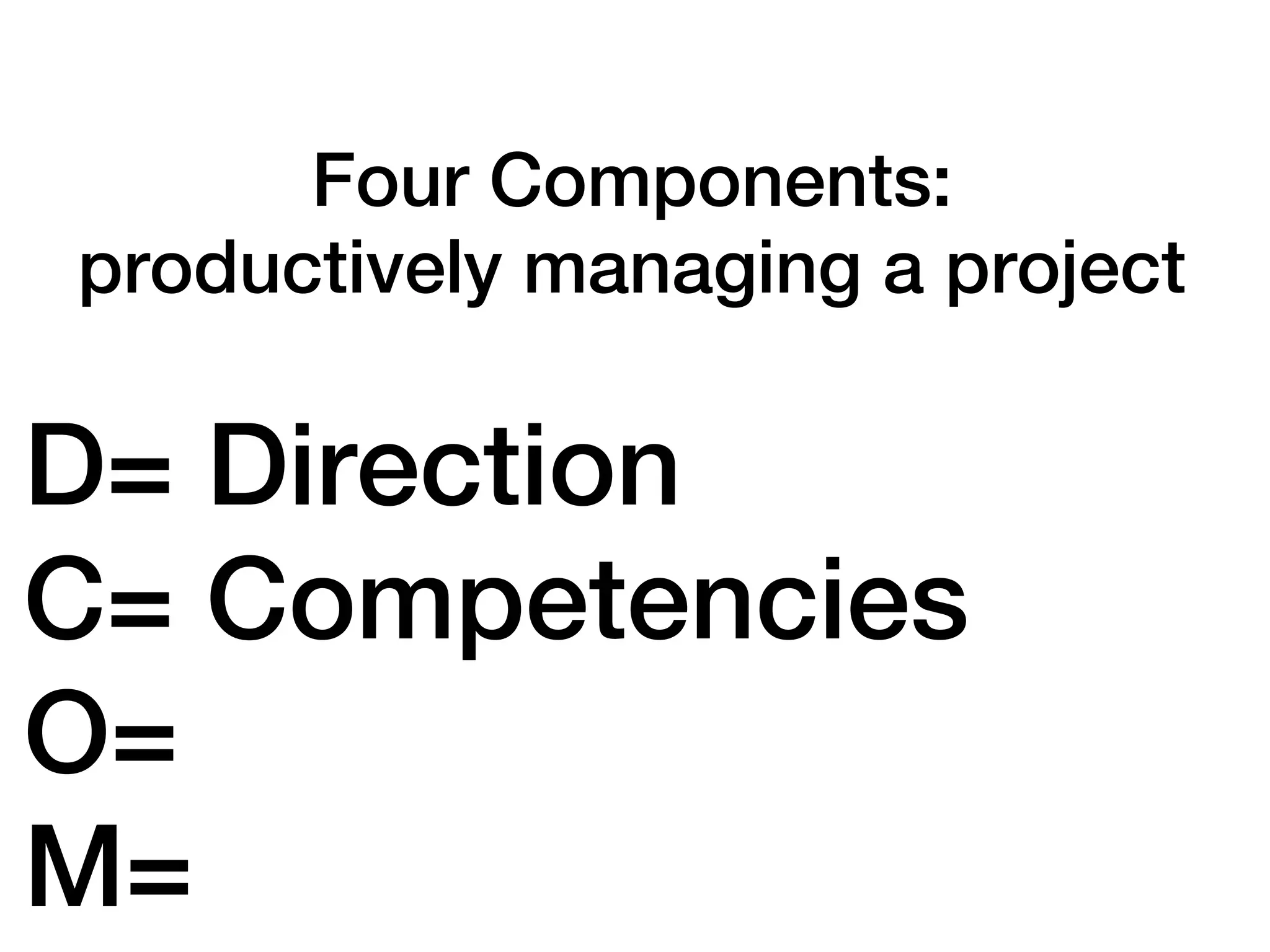
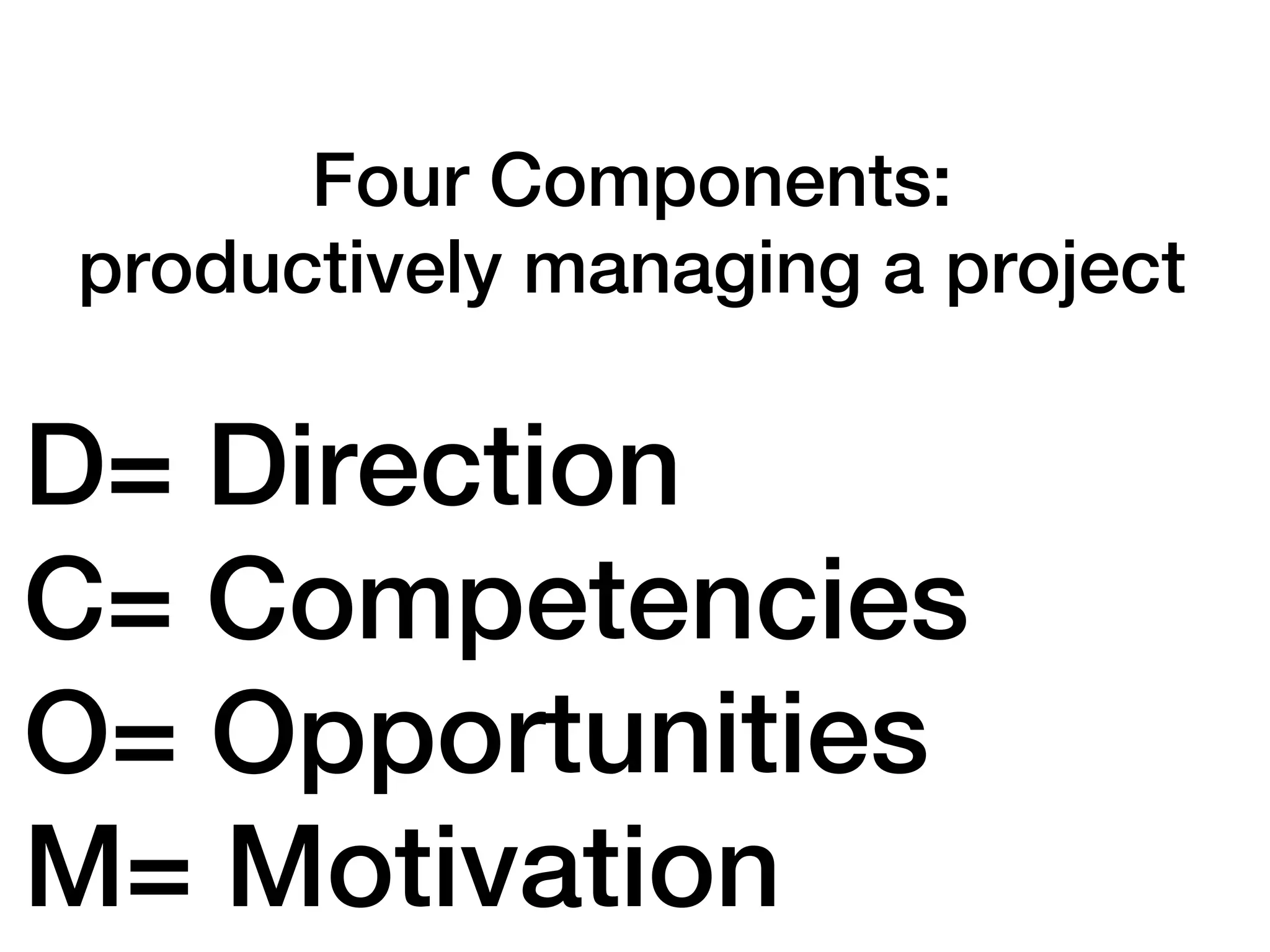
Four Components:
productively managing a project

D=
C=
O=
M=
Four Components:
productively managing a project

D= Direction
C=
O=
M=
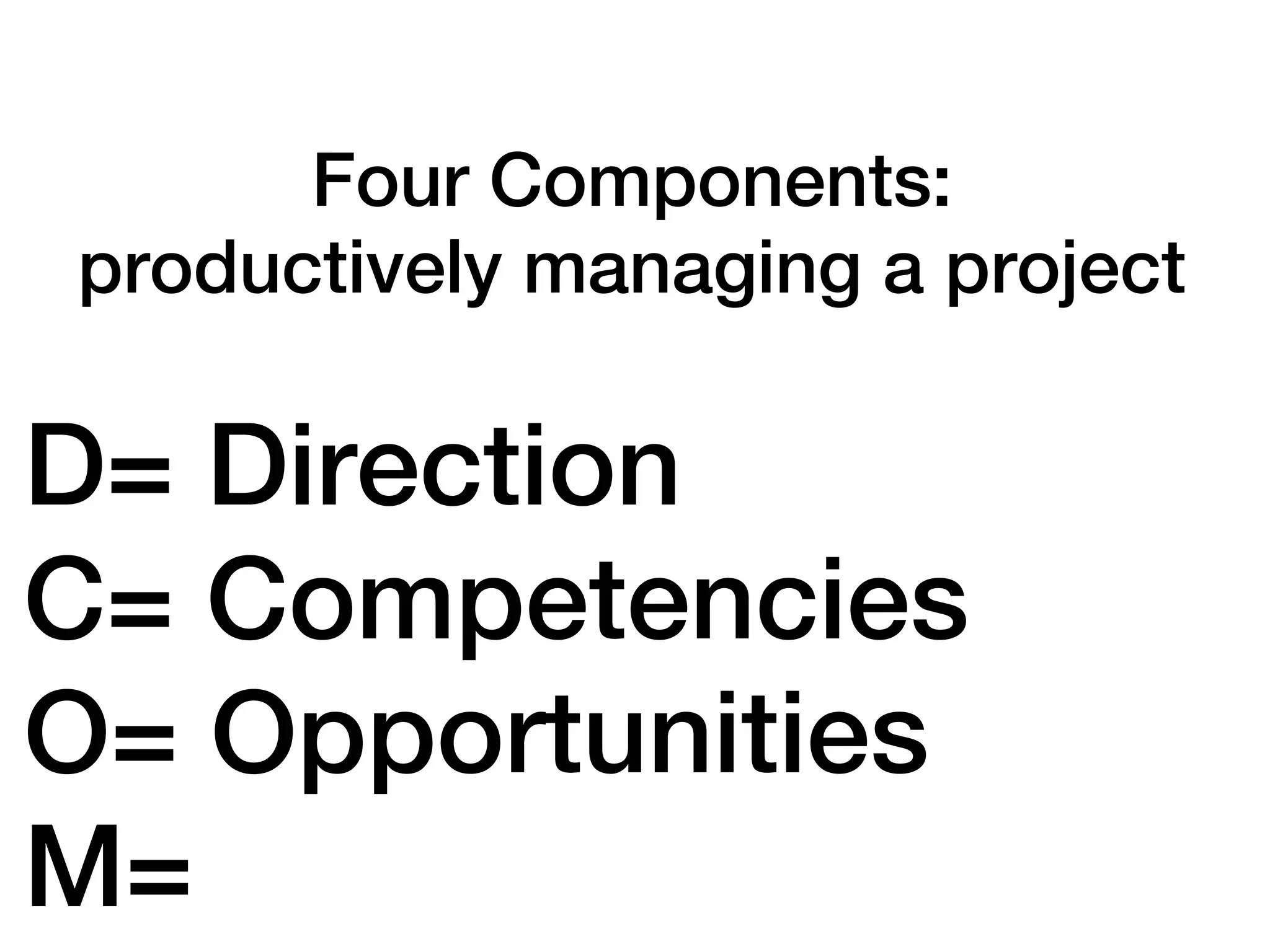
Four Components:
productively managing a project

D= Direction
C= Competencies
O=
M=
Four Components:
productively managing a project

D= Direction
C= Competencies
O= Opportunities
M=
Four Components:
productively managing a project

D= Direction
C= Competencies
O= Opportunities
M= Motivation
•   Page 5
Objectives:

1.Effectively plan a results-

 oriented project;
2. identify the critical success

 factors for maximum impact;
3. track & report on progress

 from beginning to completion.
•   Please write a brief (please
    keep it to 10-20 words)
    definition of the project you
    brought to think about and
    plan today.
• (This is a VERY rough draft
     description of the project.)
•   Now, in small groups, please
    share - one at a time - the
    project you’re thinking
    about/planning/managing.

      •   “Hi my name is...
          And, my project is...”
Critical
     Success
     Factors
*Critical Success Factor
(CSF) is the term for an
element that is necessary for
an organization
or project to achieve its
mission.
• Who are the significant stakeholders?
  ___________________ (
       )
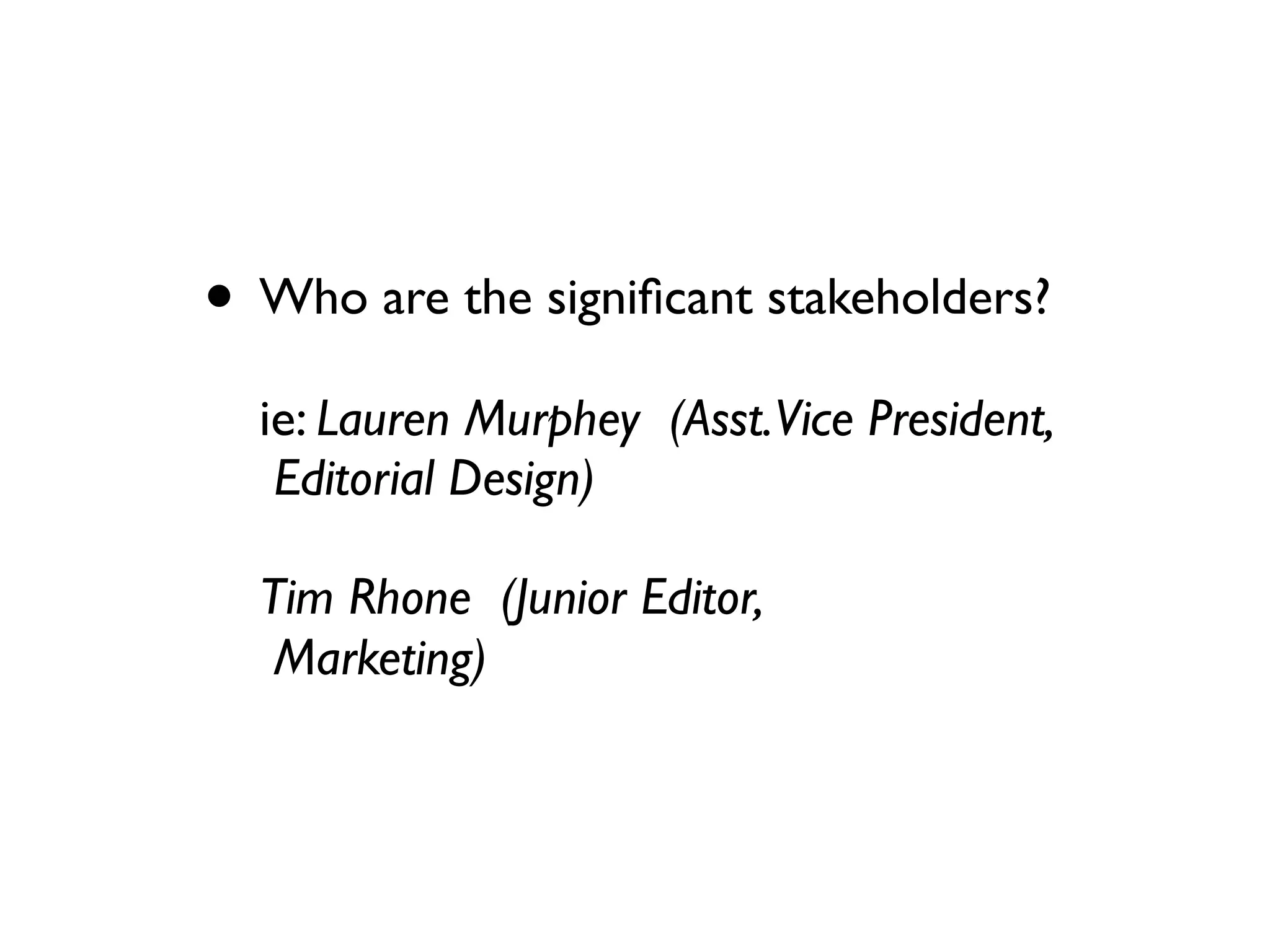
• Who are the significant stakeholders?
  ie: Lauren Murphey (Asst.Vice President,
   Editorial Design)

  Tim Rhone (Junior Editor,
   Marketing)
Name            Discussion Points

Name
....item A to discuss....
....item b to discuss....
....item c to discuss....

________ ____________________
____________________
____________________


________ ____________________
____________________
____________________


________ ____________________
____________________
____________________
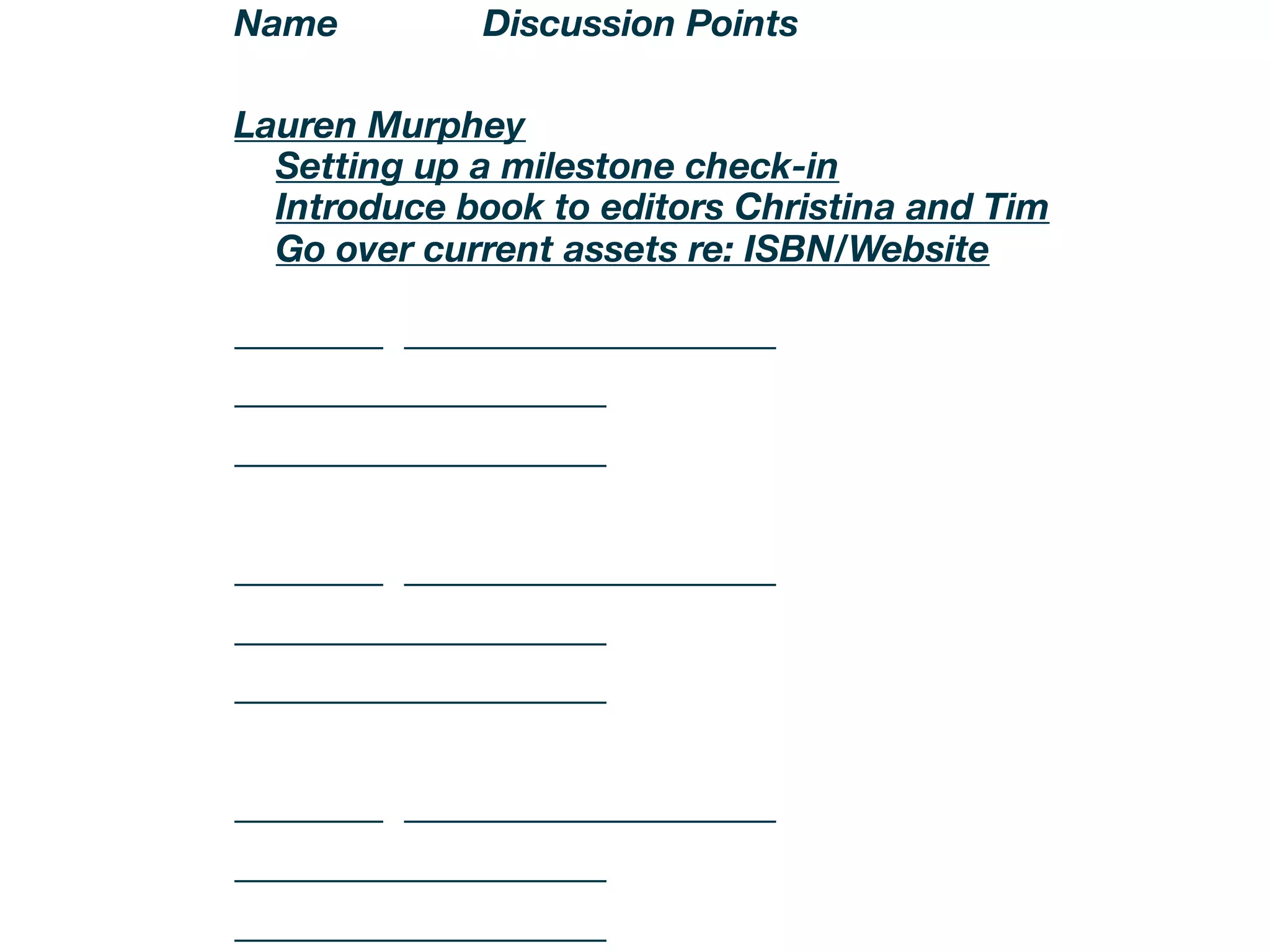
Name          Discussion Points

Lauren Murphey
....Setting up a milestone check-in....
....Introduce book to editors Christina and Tim....
....Go over current assets re: ISBN/Website....

________ ____________________
____________________
____________________


________ ____________________
____________________
____________________


________ ____________________
____________________
____________________
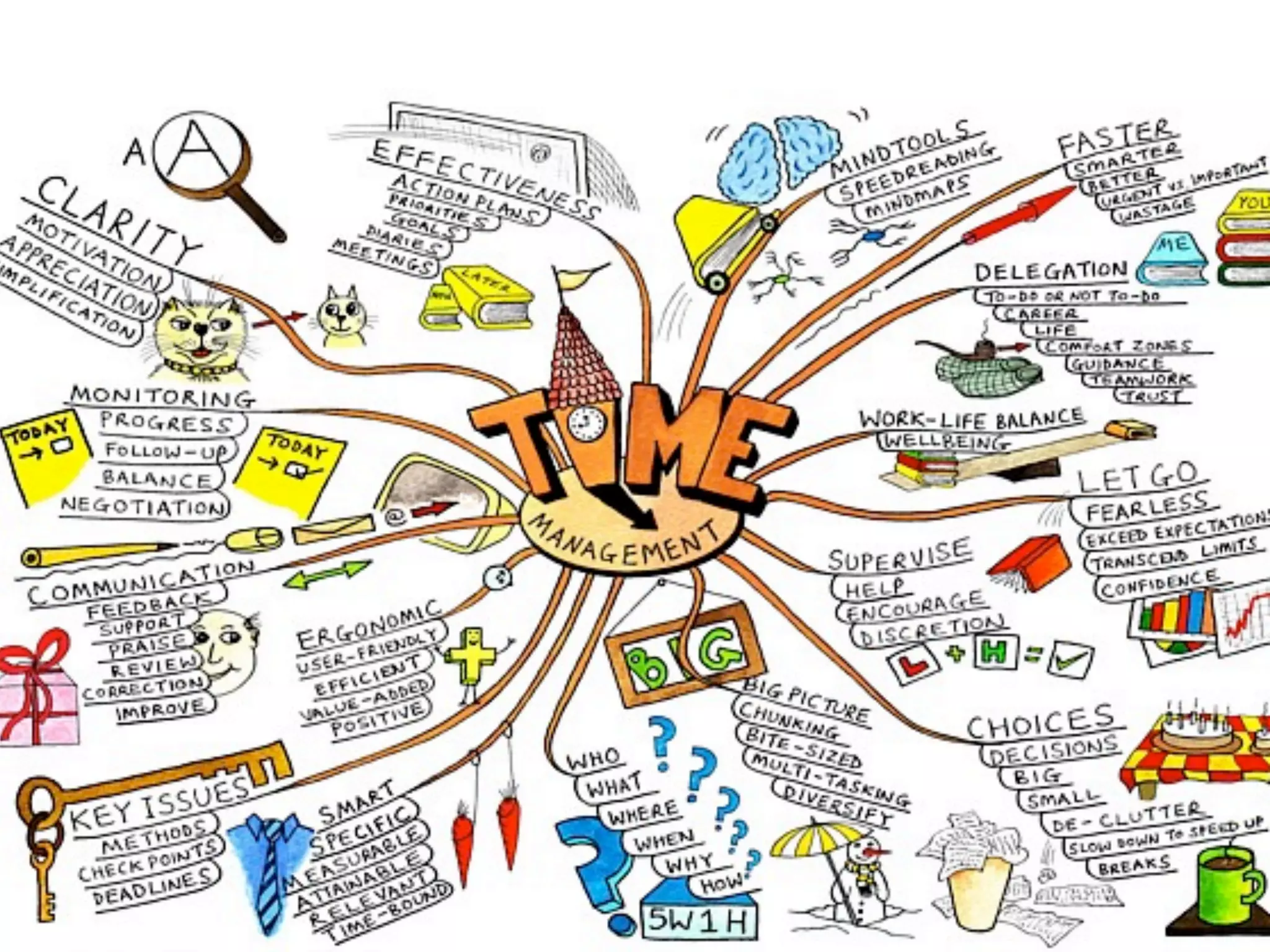
Brain
 Storm
What are you already thinking...?
____________________   ____________________
____________________   ____________________
____________________   ____________________
____________________   ____________________
____________________   ____________________
____________________   ____________________
____________________   ____________________
____________________   ____________________
____________________   ____________________
____________________   ____________________
____________________   ____________________
____________________   ____________________
____________________   ____________________
____________________   ____________________
____________________   ____________________
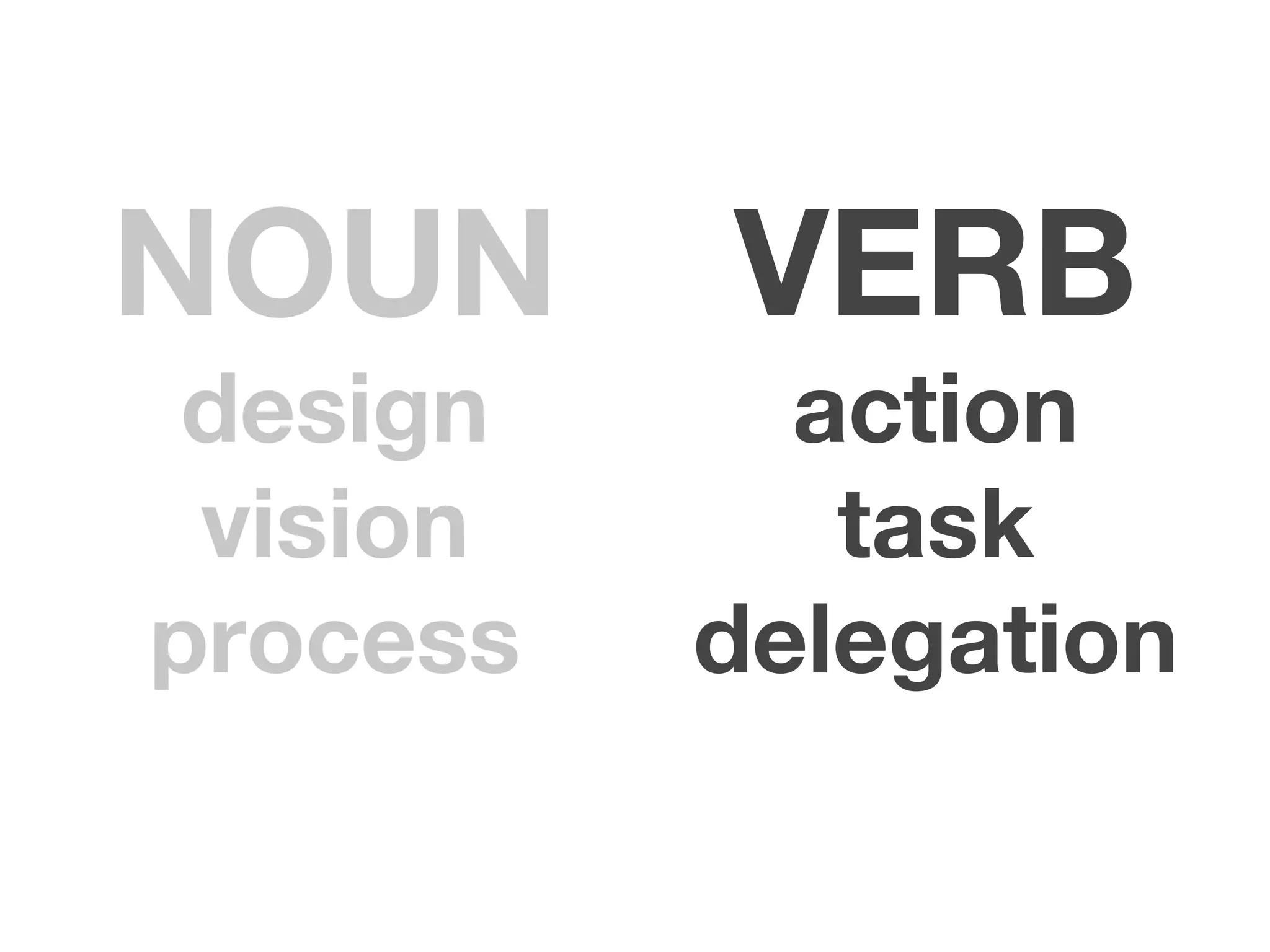
NOUN   VERB
NOUN      VERB
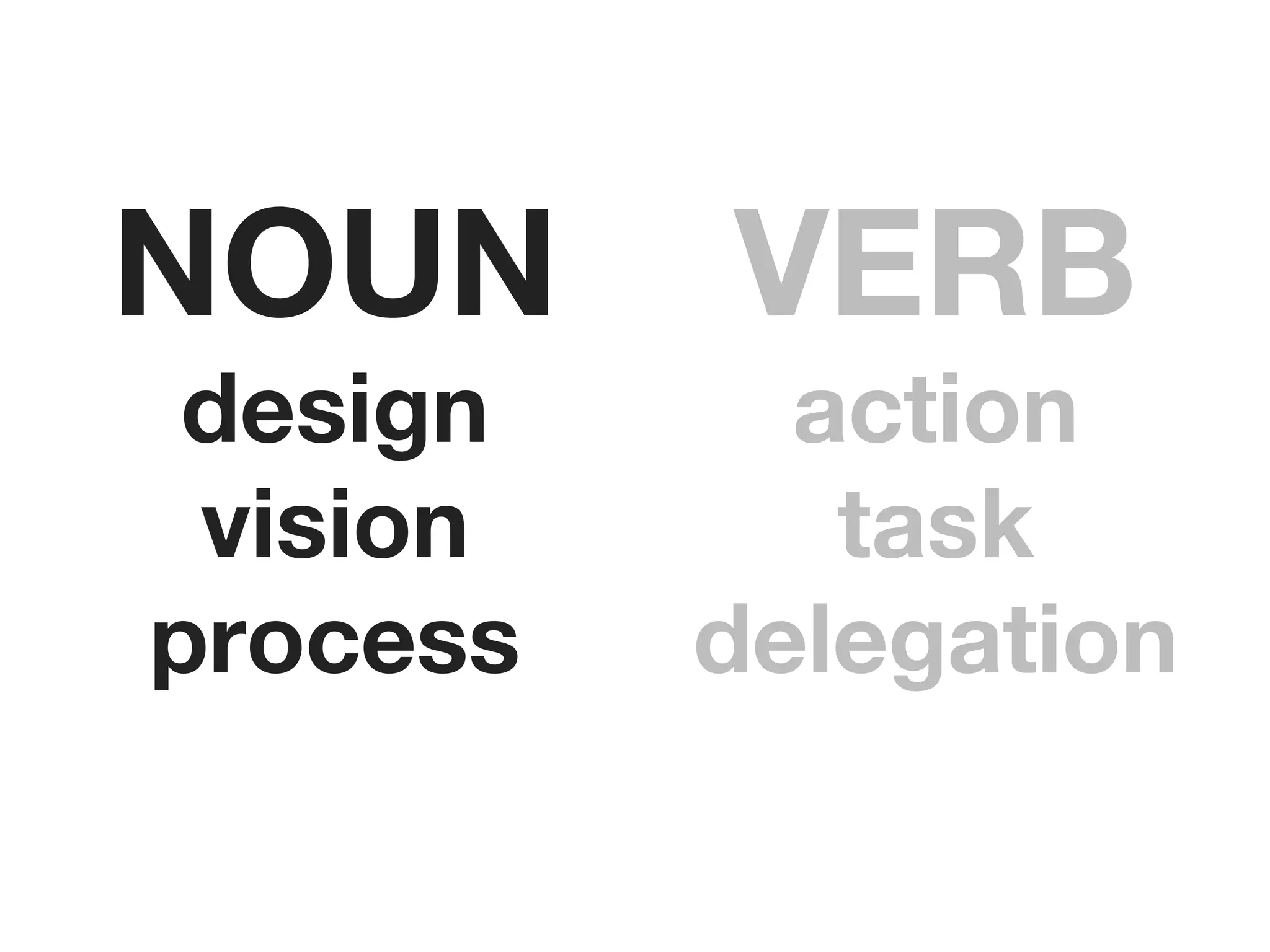
 design     action
 vision      task
process   delegation
NOUN      VERB
 design     action
 vision      task
process   delegation
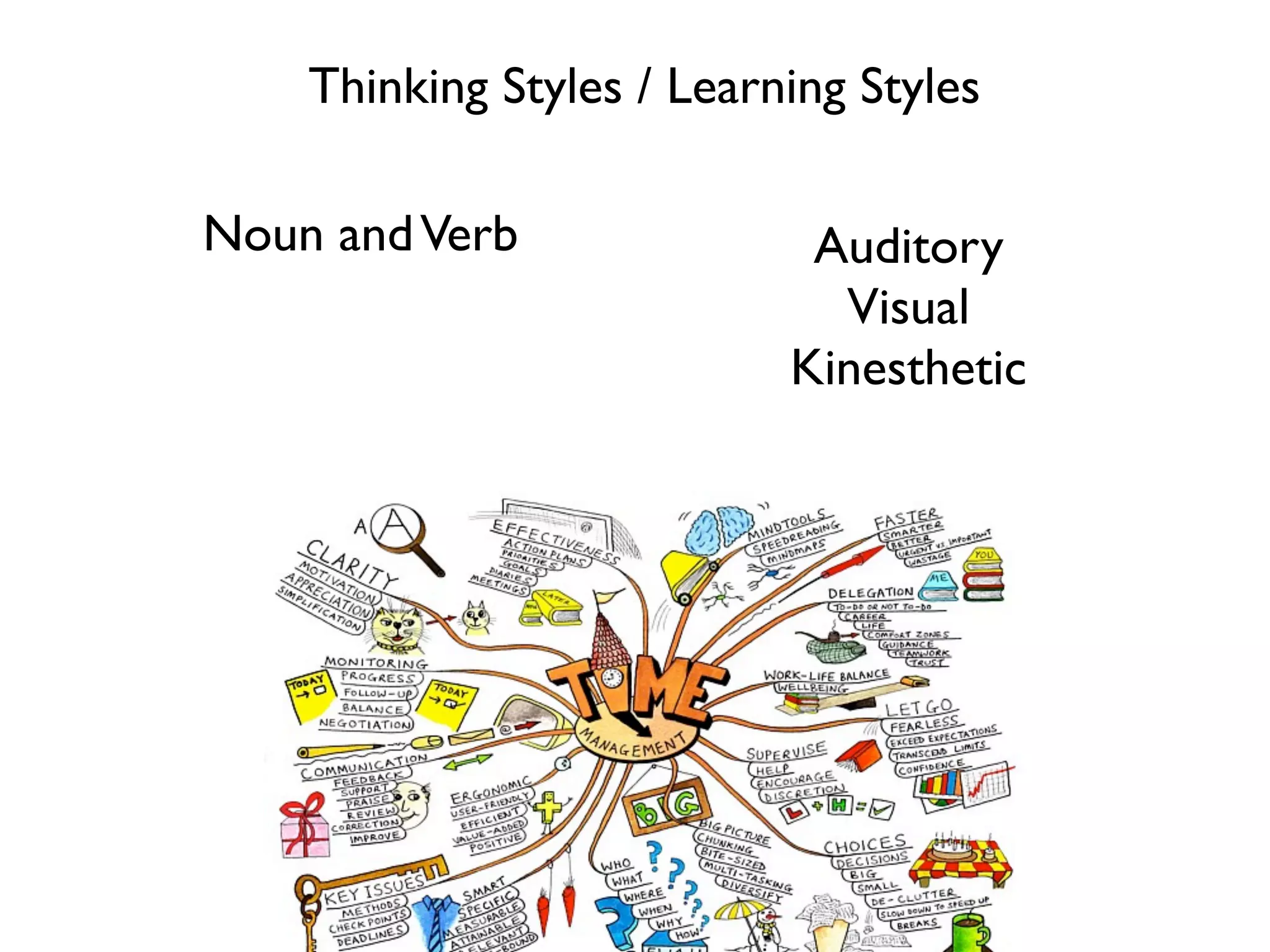
Thinking Styles / Learning Styles

Noun and Verb               Auditory
                             Visual
                           Kinesthetic
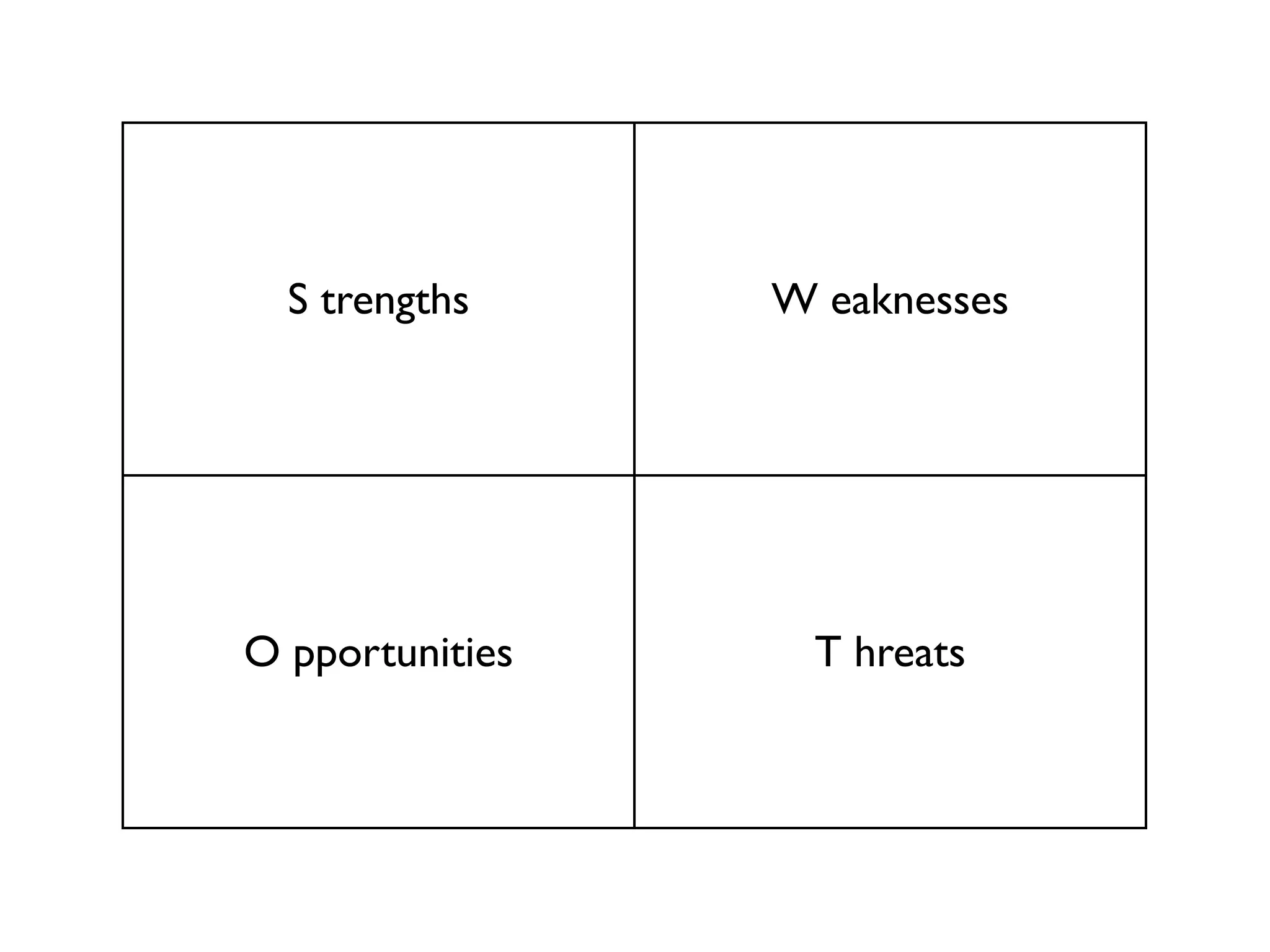
S trengths     W eaknesses


O pportunities     T hreats
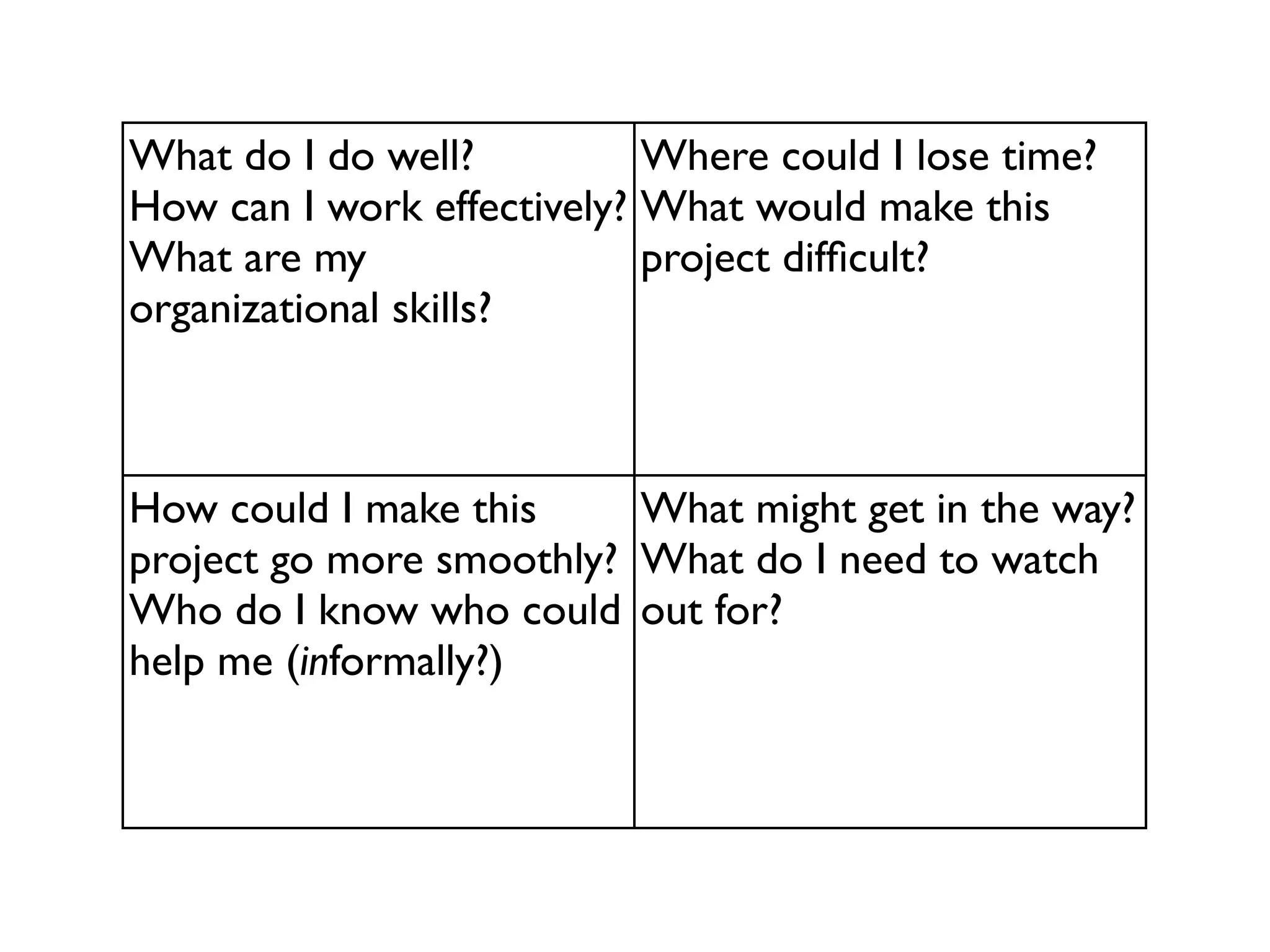
What do I do well?          Where could I lose time?
How can I work effectively? What would make this
What are my                 project difficult?
organizational skills?


How could I make this     What might get in the way?
project go more smoothly? What do I need to watch
Who do I know who could out for?
help me (informally?)
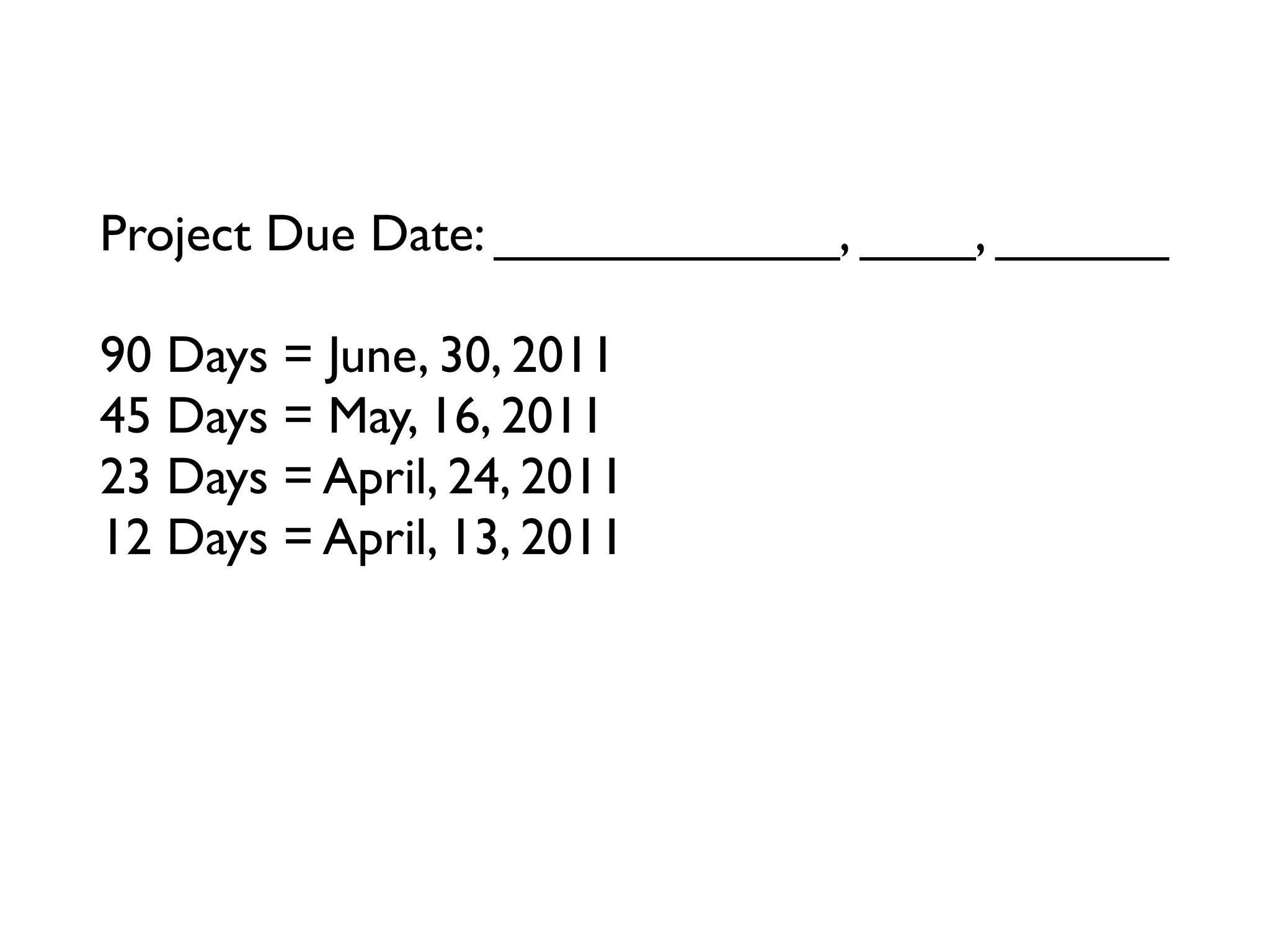
Project Due Date: ____________, ____, ______

90 Days = ____________, ____, ______
45 Days = ____________, ____, ______
23 Days = ____________, ____, ______
12 Days = ____________, ____, ______
6 Days = ____________, ____, ______
3 Days = ____________, ____, ______
Tomorrow = ____________, ____, ______
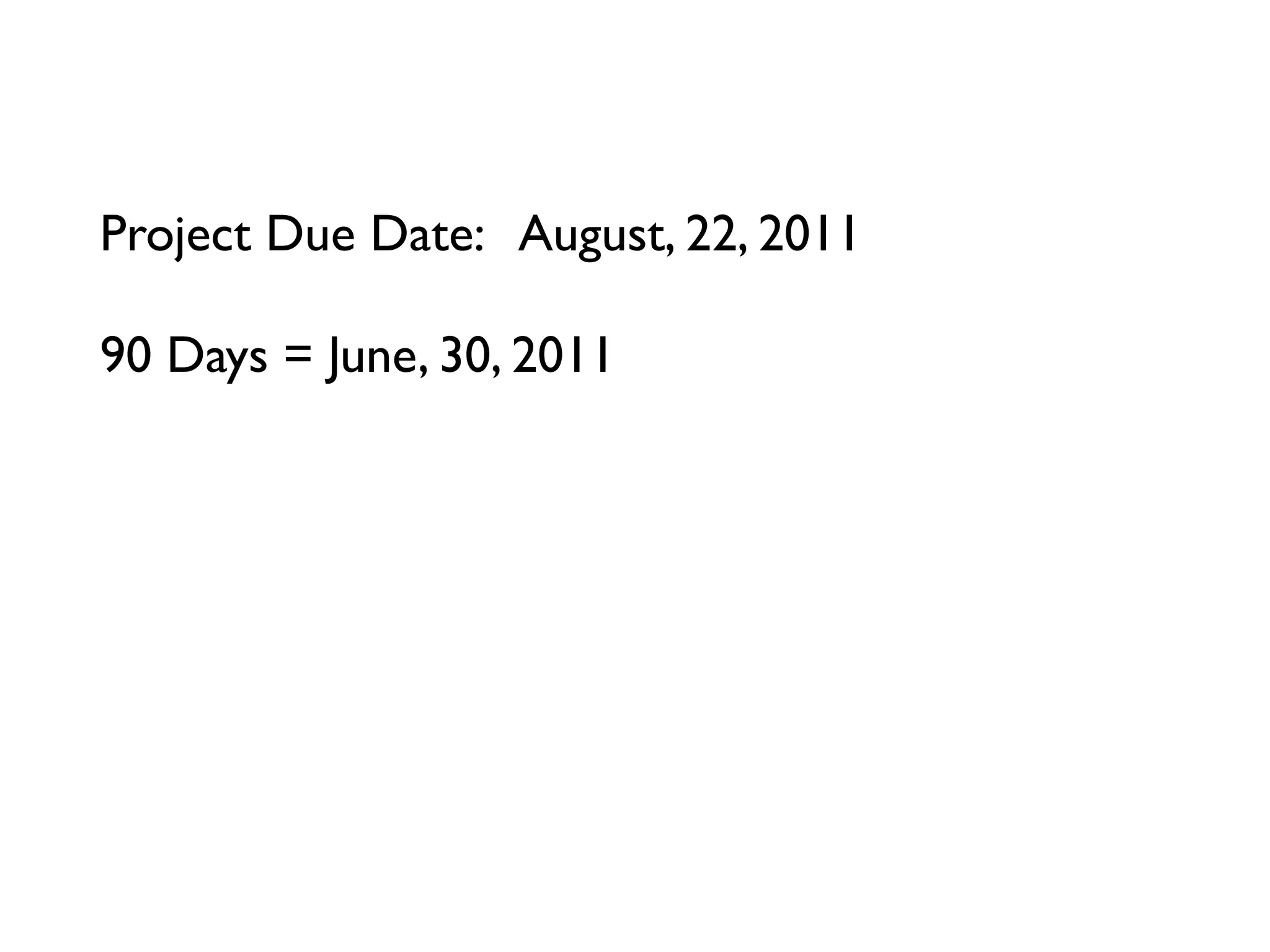
Project Due Date: August, 22, 2011

90 Days = June, 30, 2011
45 Days = ____________, ____, ______
23 Days = ____________, ____, ______
12 Days = ____________, ____, ______
6 Days = ____________, ____, ______
3 Days = ____________, ____, ______
Tomorrow = ____________, ____, ______
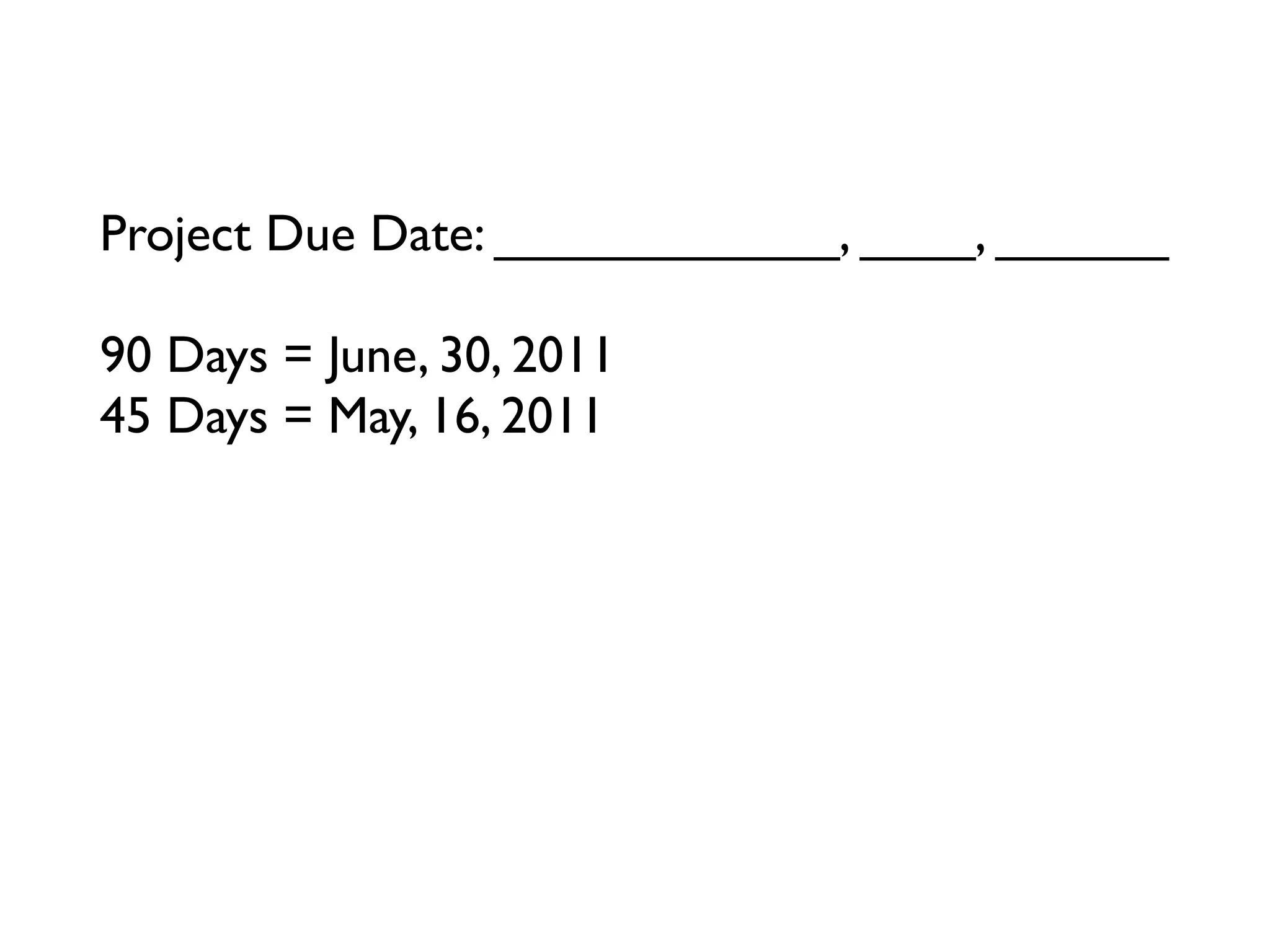
Project Due Date: ____________, ____, ______

90 Days = June, 30, 2011
45 Days = May, 16, 2011
23 Days = ____________, ____, ______
12 Days = ____________, ____, ______
6 Days = ____________, ____, ______
3 Days = ____________, ____, ______
Tomorrow = ____________, ____, ______
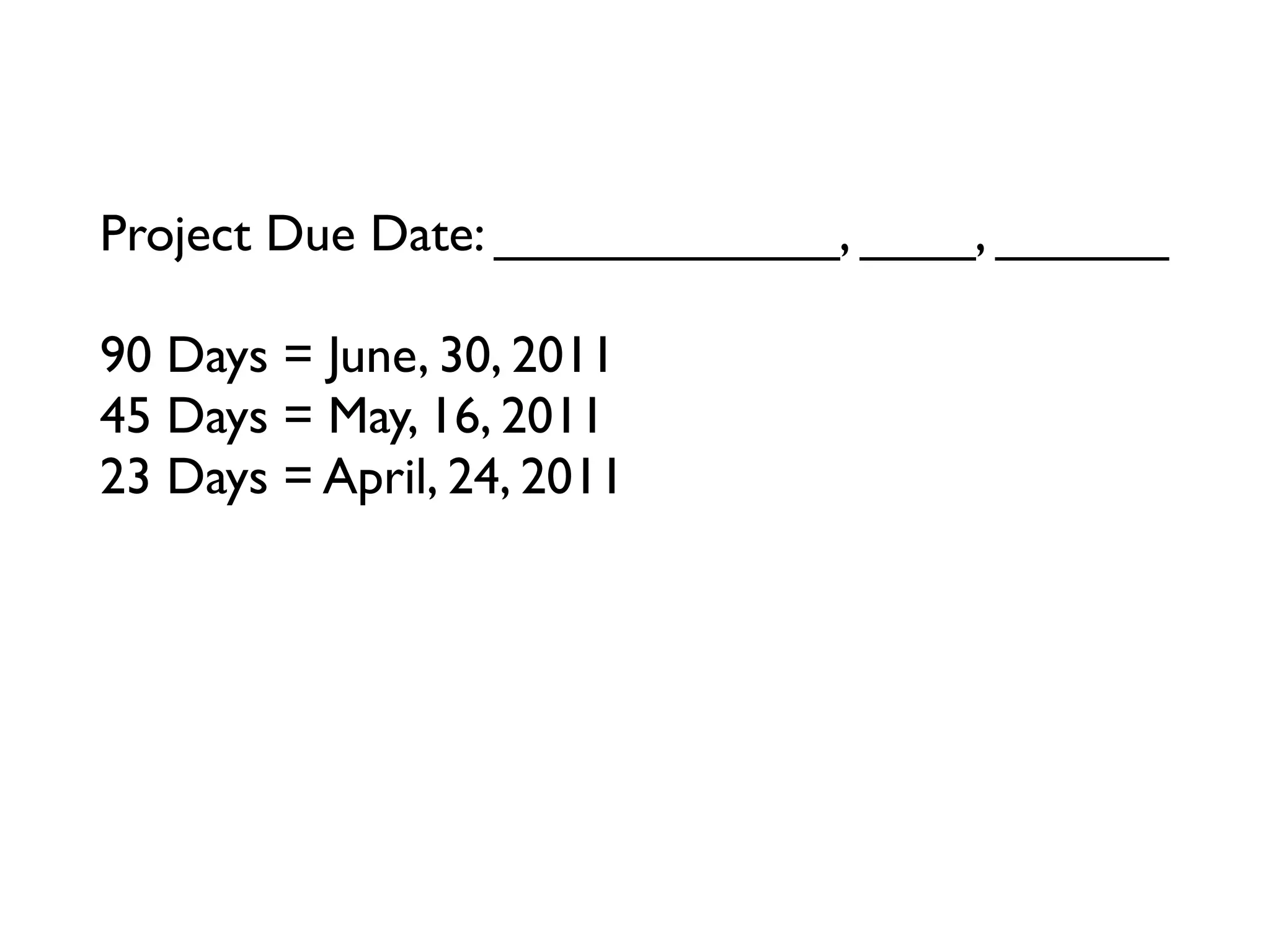
Project Due Date: ____________, ____, ______

90 Days = June, 30, 2011
45 Days = May, 16, 2011
23 Days = April, 24, 2011
12 Days = ____________, ____, ______
6 Days = ____________, ____, ______
3 Days = ____________, ____, ______
Tomorrow = ____________, ____, ______
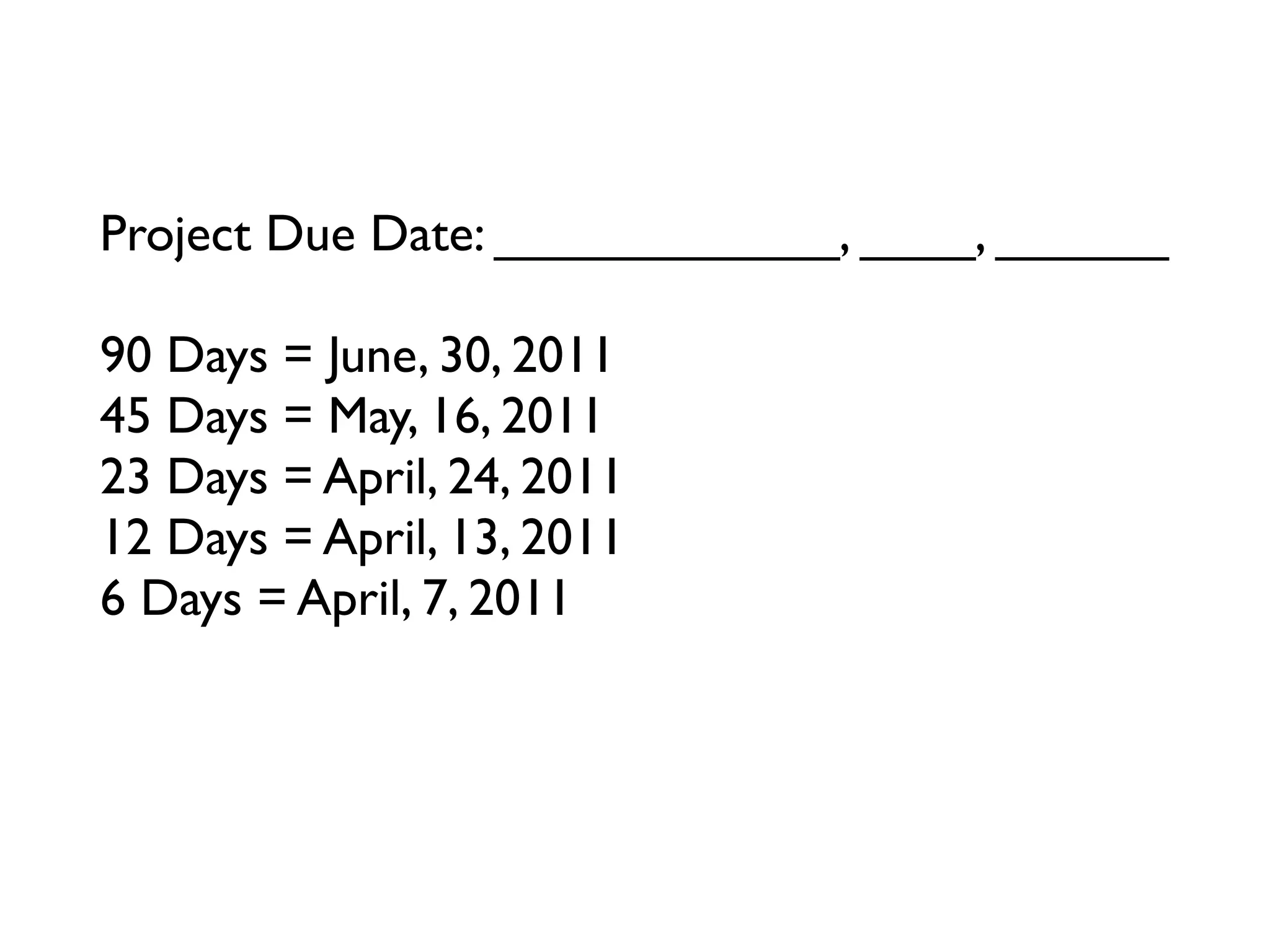
Project Due Date: ____________, ____, ______

90 Days = June, 30, 2011
45 Days = May, 16, 2011
23 Days = April, 24, 2011
12 Days = April, 13, 2011
6 Days = ____________, ____, ______
3 Days = ____________, ____, ______
Tomorrow = ____________, ____, ______
Project Due Date: ____________, ____, ______

90 Days = June, 30, 2011
45 Days = May, 16, 2011
23 Days = April, 24, 2011
12 Days = April, 13, 2011
6 Days = April, 7, 2011
3 Days = ____________, ____, ______
Tomorrow = ____________, ____, ______
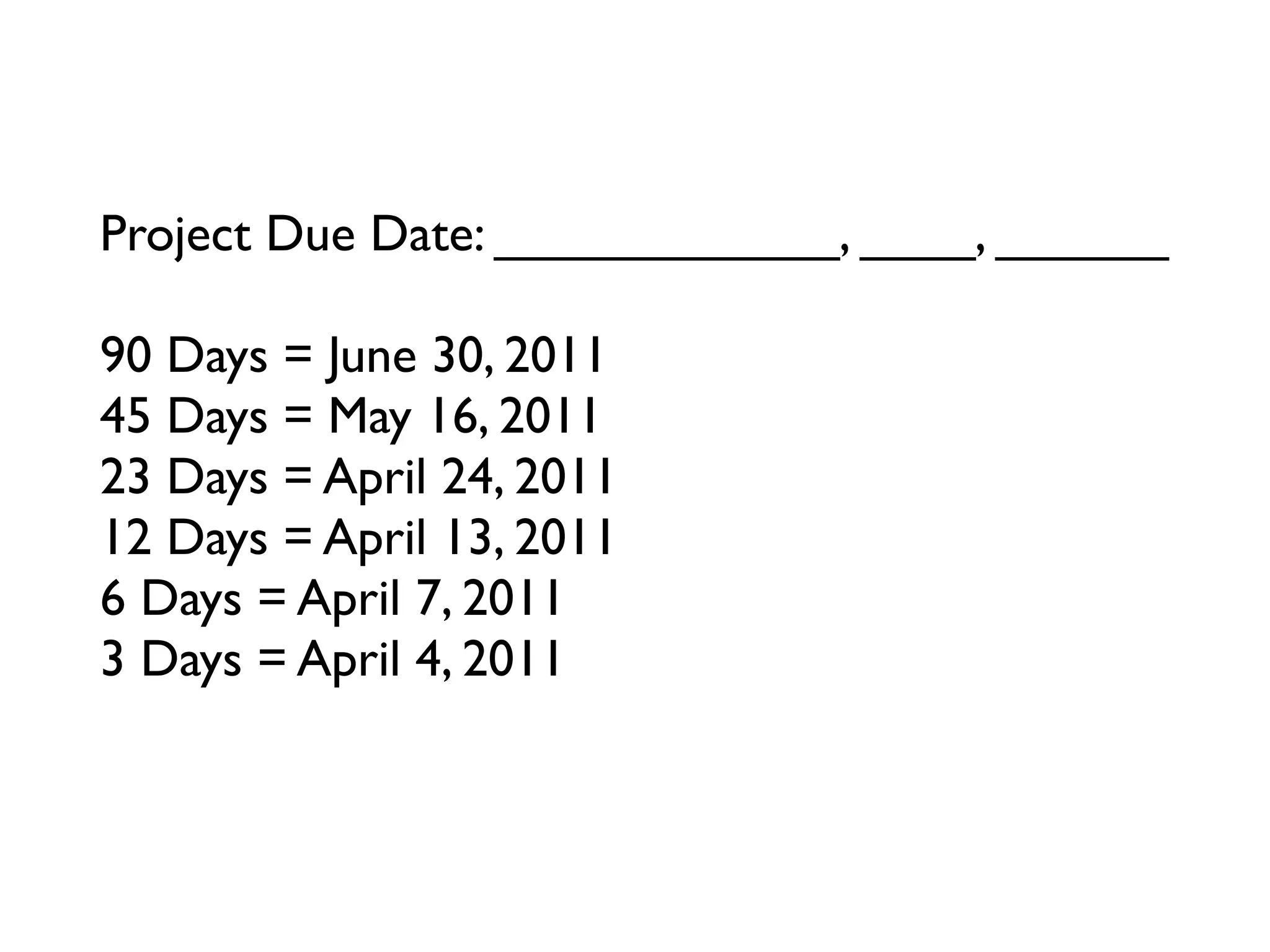
Project Due Date: ____________, ____, ______

90 Days = June 30, 2011
45 Days = May 16, 2011
23 Days = April 24, 2011
12 Days = April 13, 2011
6 Days = April 7, 2011
3 Days = April 4, 2011
Tomorrow = ____________, ____, ______
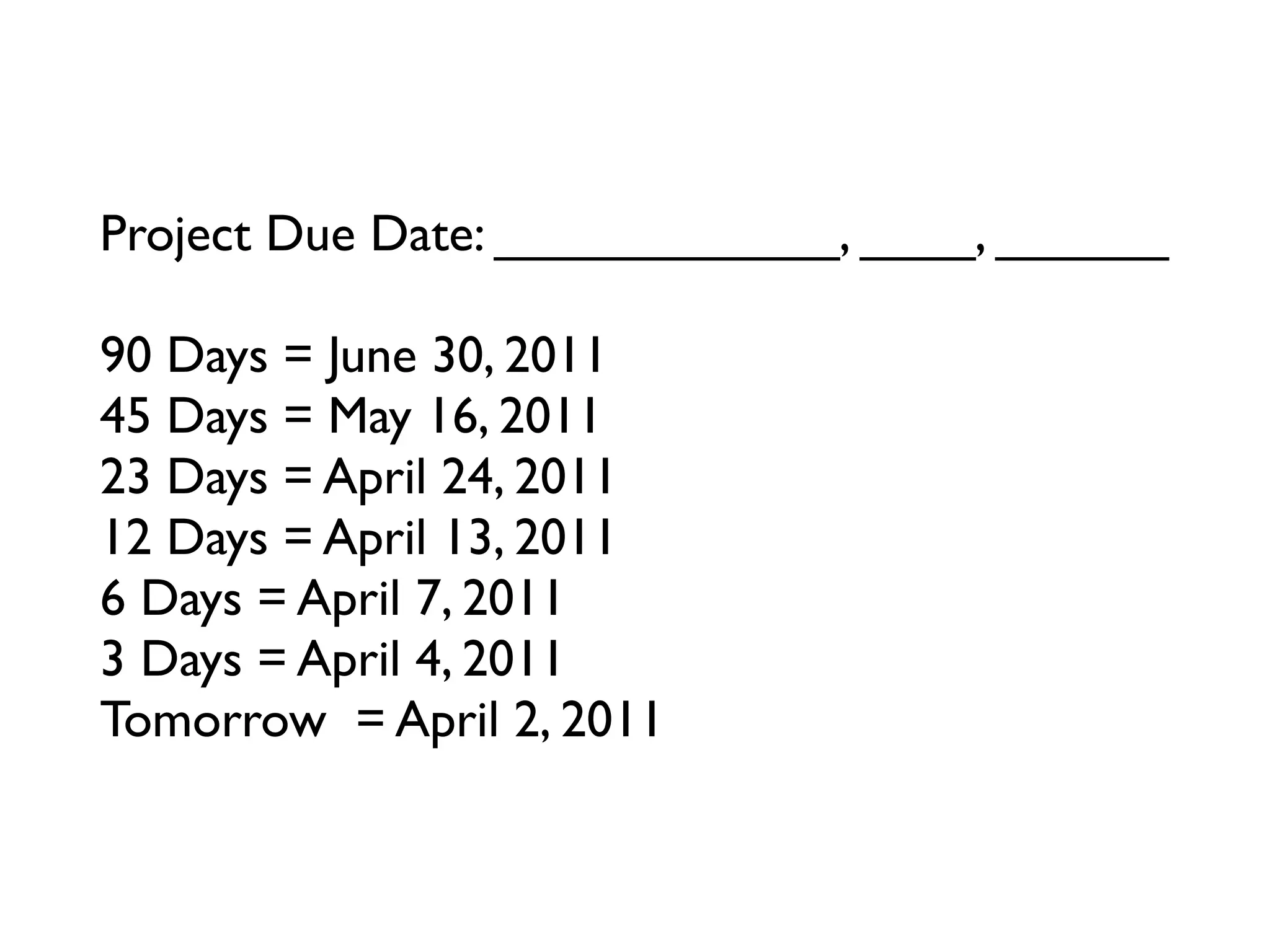
Project Due Date: ____________, ____, ______

90 Days = June 30, 2011
45 Days = May 16, 2011
23 Days = April 24, 2011
12 Days = April 13, 2011
6 Days = April 7, 2011
3 Days = April 4, 2011
Tomorrow = April 2, 2011
Objectives:

1.Effectively plan a results-

 oriented project;
2. identify the critical success

 factors for maximum impact;
3. track & report on progress

 from beginning to completion.
Page 12
    A One-Page Project Plan

Please fill in the blanks there...
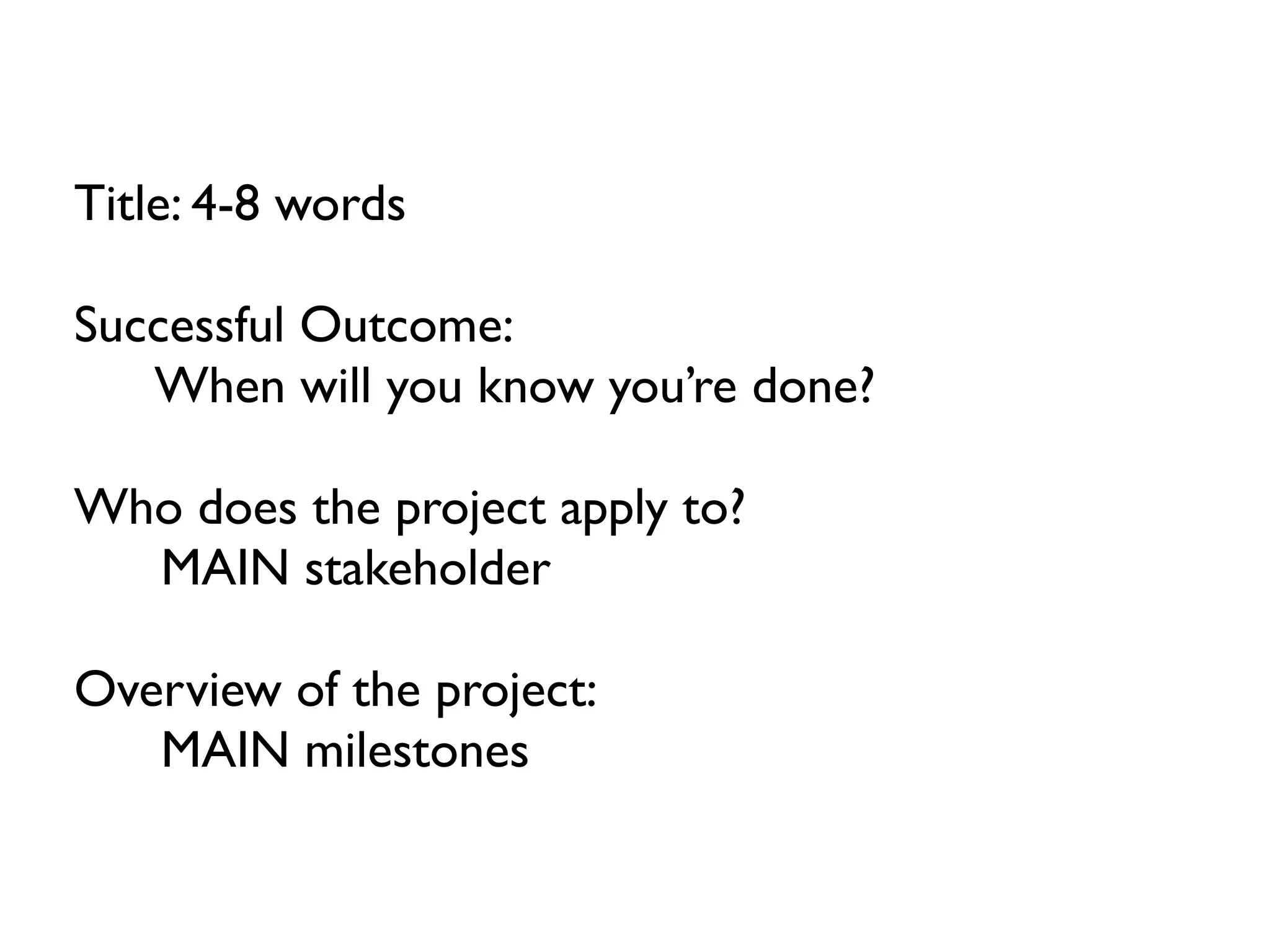
Title: 4-8 words

Successful Outcome:
   When will you know you’re done?

Who does the project apply to?
  MAIN stakeholder

Overview of the project:
   MAIN milestones
Page 13
     (on the blank page there...)

 Please draft your own version of a
 Project Plan - how you will address
planning, working on and completing
 the project you are thinking about.
Groups of 3.

Please take turns sharing your
current project, and your “overview”
of the project plan.
Groups of 3.

Please take turns sharing your
current project, and your “overview”
of the project plan.

Partners:
As you’re listening, think about learning
and communication styles.
Please use this feedback:
“Have you thought about...?”
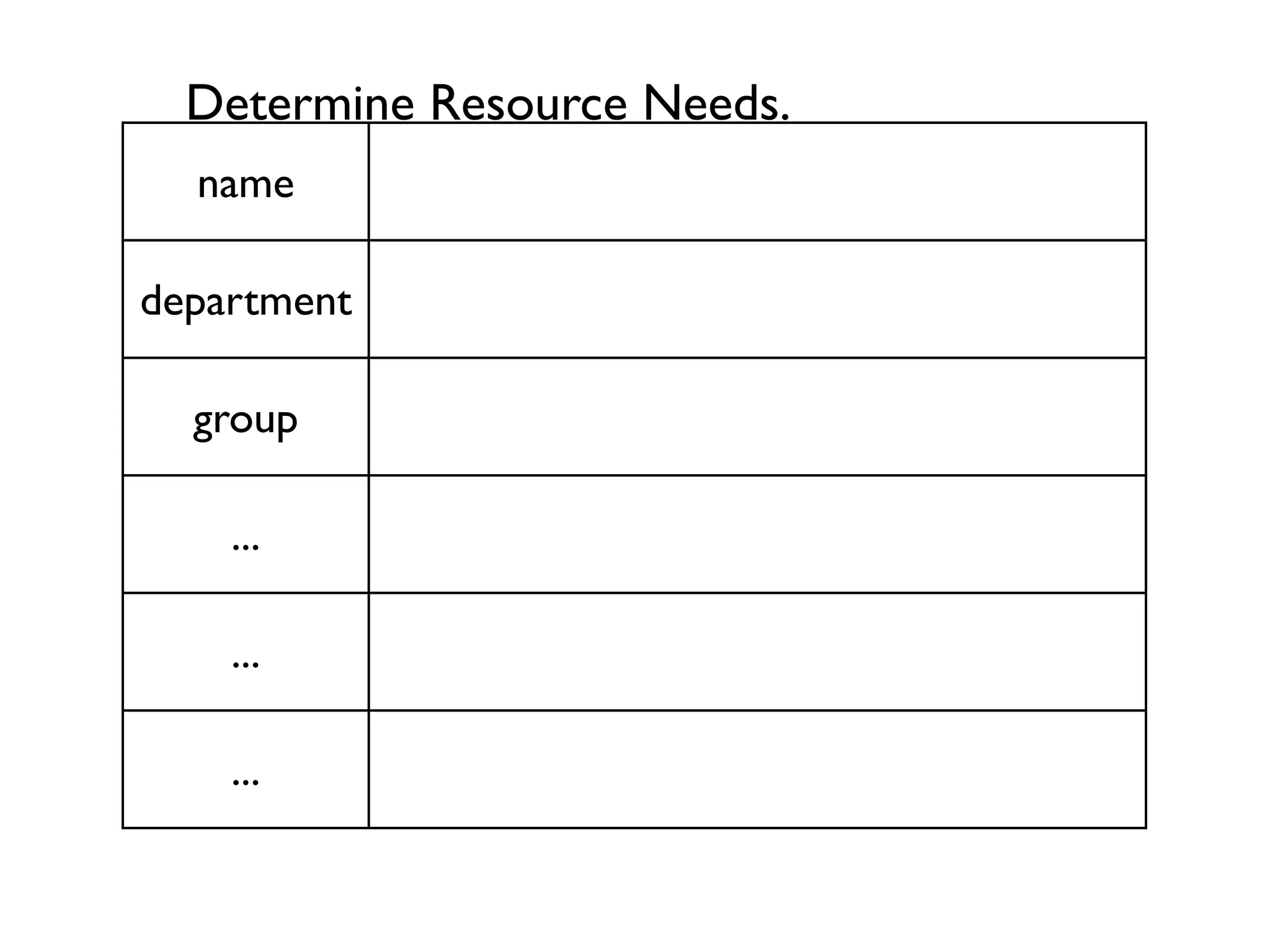
Determine Resource Needs.
  name

department

  group

    ...

    ...

    ...
Page 16
Objectives:

1.Effectively plan a results-

 oriented project;
2. identify the critical success

 factors for maximum impact;
3. track & report on progress

 from beginning to completion.
Page 16

2 keys to improving your daily productivity
Page 17

What is a “typical” day like for you?

Write/Draw/Outline your activities and
roles from the time you get in to the
office, until you leave for the day.
questions/
  comments
   considerations
90 Days = ____________, ____, ______
45 Days = ____________, ____, ______
23 Days = ____________, ____, ______
12 Days = ____________, ____, ______
6 Days = ____________, ____, ______
3 Days = ____________, ____, ______
Tomorrow = ____________, ____, ______
Please read over Pages 18-19

Then...

Fill in the prompts on page 20.
Determine Resource Needs (continued)

Page 21:

___________
  _______________________
  _______________________
  _______________________
Page 21:

larger part of the project
  subtask #1
  subtask #2
  subtask #3
Page 21:

Draft conclusion YBJGB (10-15 pages)
 Review the proposal chapter info
 Brainstorm the “concluding story” (So That...)
 Call for interview: Dave B., Josh M.
Ways that we communicate &
influence ourselves and others
1. Auditory
2.
3.
Review pages 32-35 to see
some of your own
preferences…
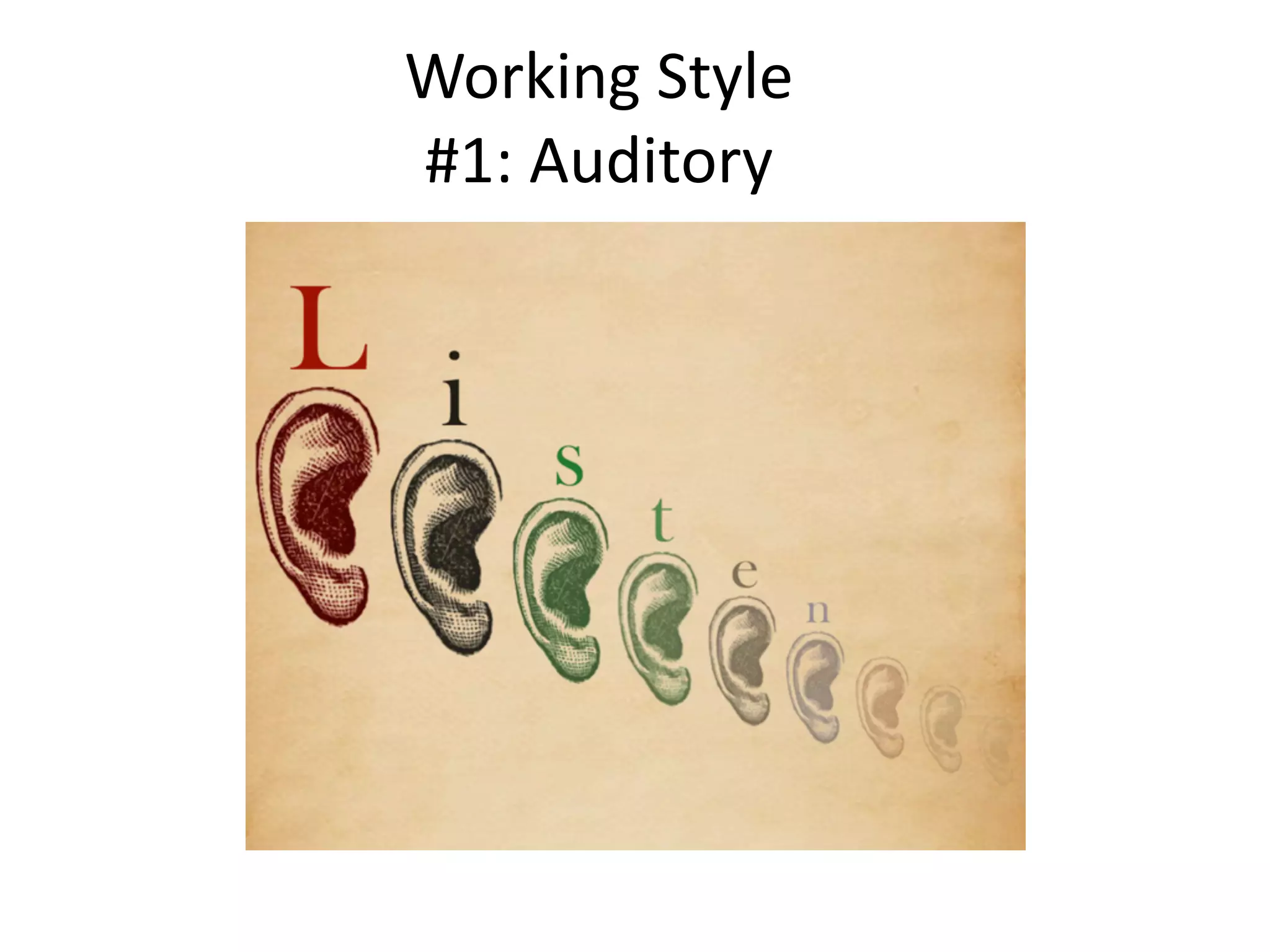
Working
Style
#1:
Auditory
Working
Style
#1:
Auditory
•Cues that one is auditory / things to say:
• “Do you hear what I'm saying? ”
• “Sounds good to me.”
• “That sounds right.”
• “That rings a bell.”
• “I hear ya.”
RECOMMENDED TECHNIQUES:

• Record notes and and listen to the recording.

• Engage in discussions.

• Read out loud.

• Consider a speech recognition tool such as:
  http://www.womackcompany.com/reqall
Ways that we communicate &
influence ourselves and others
1. Auditory
2. Visual
3.
Review pages 32-35 to see
some of your own
preferences…
Working
Style
 #2
Visual
Working Style #2: Visual
•Cues that one is visual / things to say:
• “That looks good.”
• “I see what you’re talking about”
• “I can picture it.”
• “Can you show me again?”
• “Ahhhh, that’s what it looks like.”
RECOMMENDED TECHNIQUES:

• Avoid visual distractions.

• Use highlighters/sticky notes to emphasize
  pieces of the material.

• Write things down, take notes and draw
  illustrations.

• Take pictures, look at them later.
Ways that we communicate &
influence ourselves and others
1. Auditory
2. Visual
3. Kinesthetic
Review pages 32-35 to see
some of your own
preferences…
Working
Style
#3
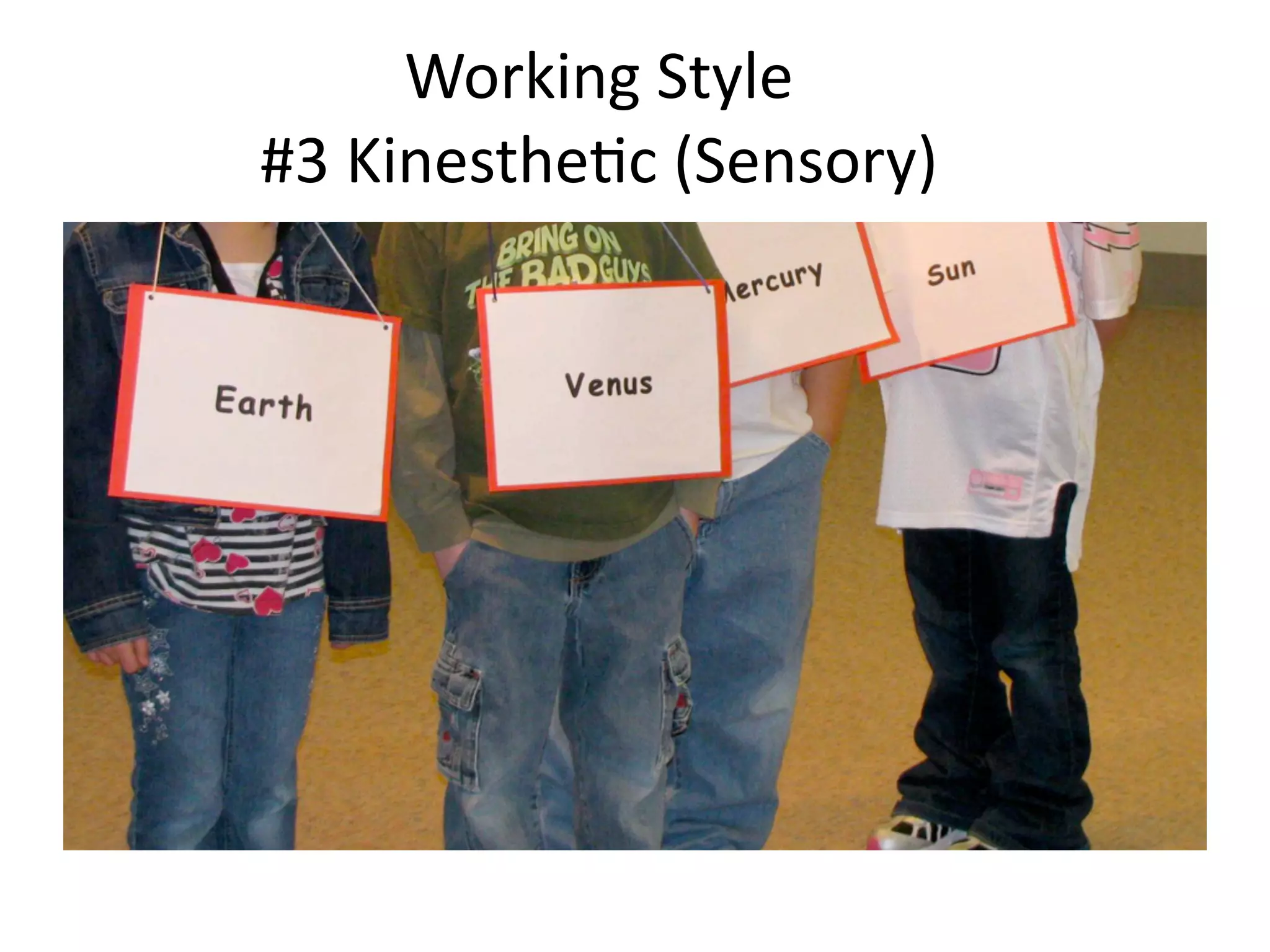
Kinesthe;c
(Sensory)
Working
Style
#3:
Kinesthe;c
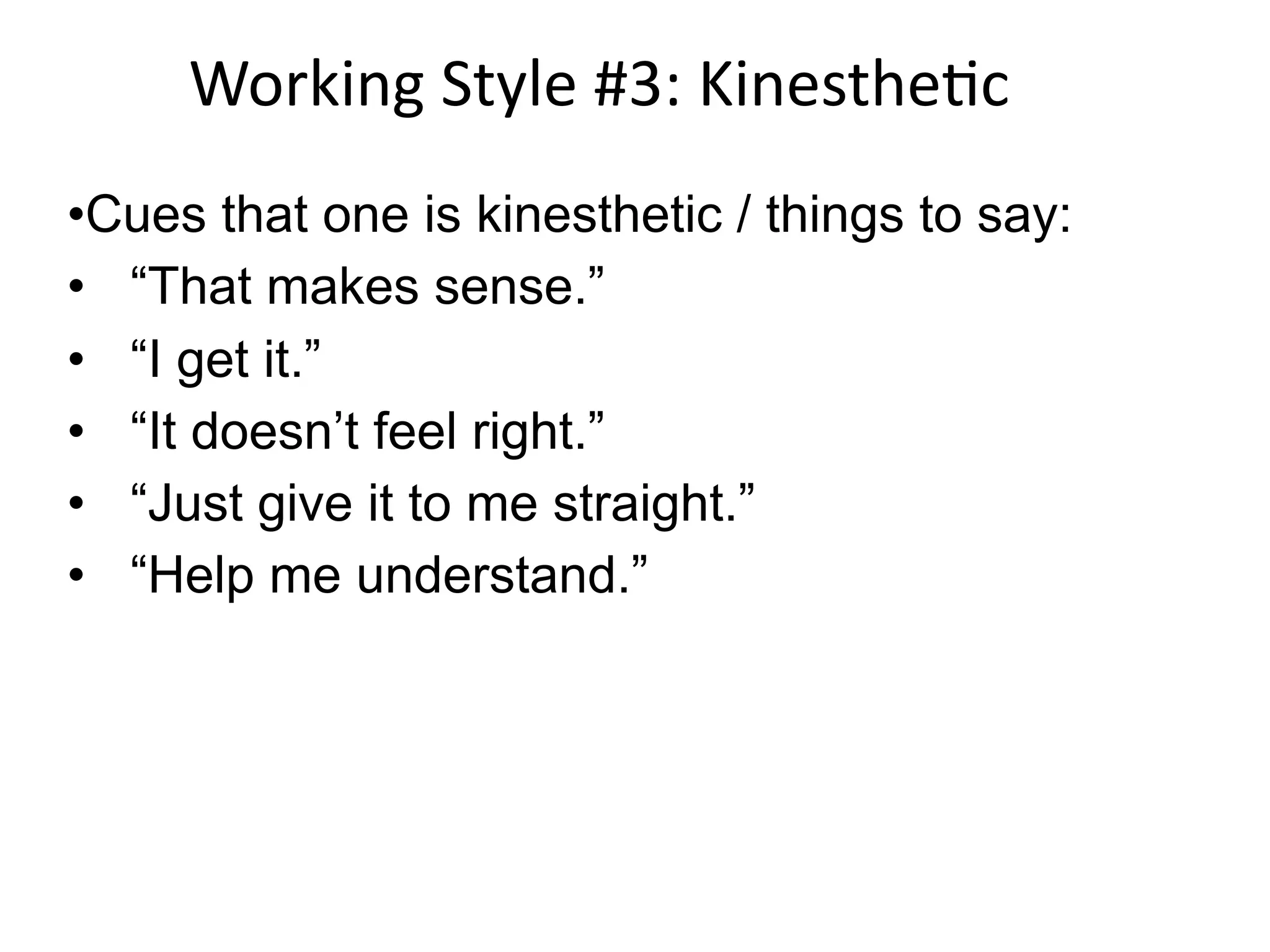
•Cues that one is kinesthetic / things to say:
• “That makes sense.”
• “I get it.”
• “It doesn’t feel right.”
• “Just give it to me straight.”
• “Help me understand.”
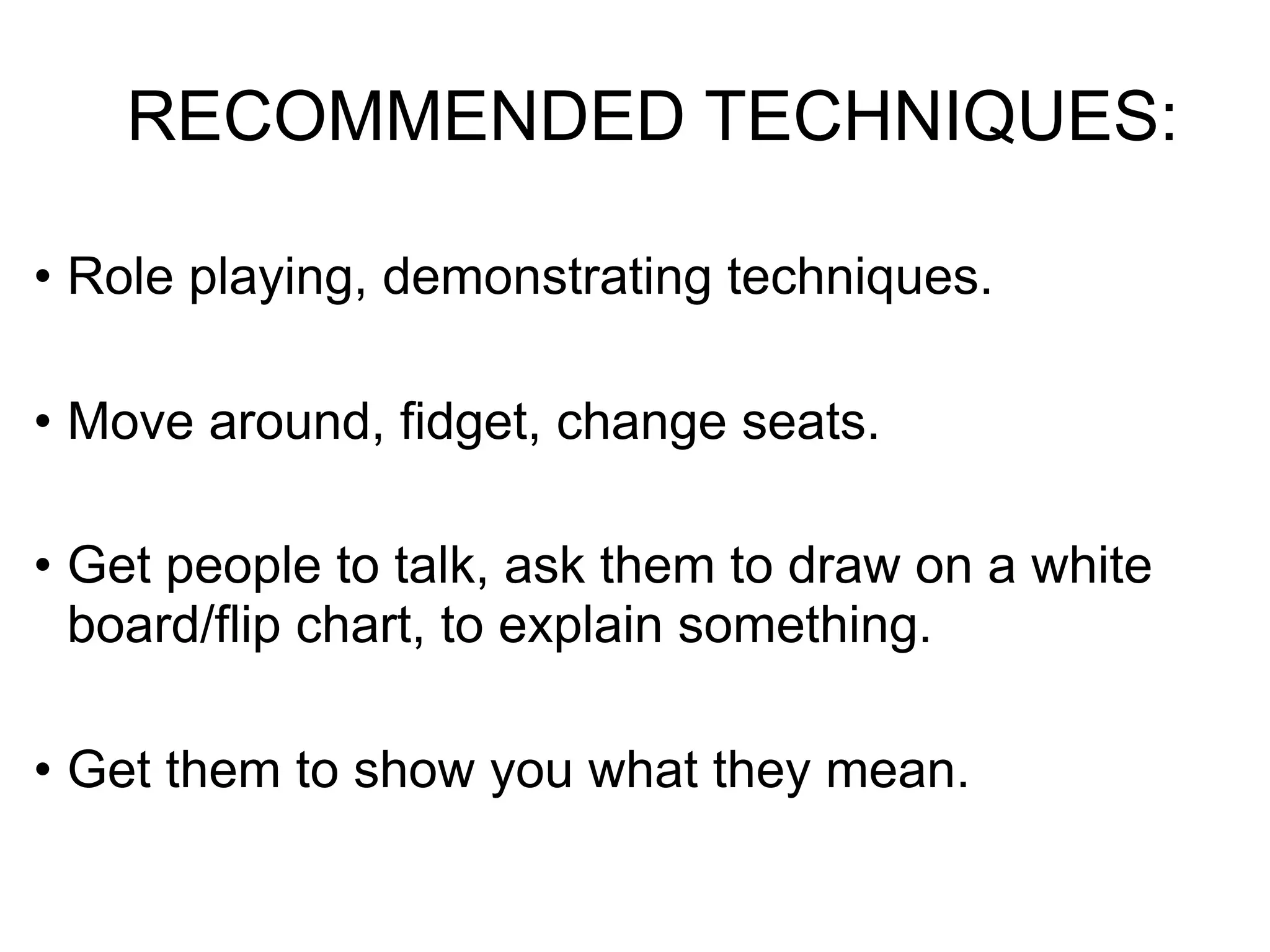
RECOMMENDED TECHNIQUES:

• Role playing, demonstrating techniques.

• Move around, fidget, change seats.

• Get people to talk, ask them to draw on a white
  board/flip chart, to explain something.

• Get them to show you what they mean.
Page 22-23
  Much of the time, a form of
“delegation” is asking for advice
   or assistance from others
  (coworkers, colleagues, etc)
Objectives:

1.Effectively plan a results-

 oriented project;
2. identify the critical success

 factors for maximum impact;
3. track & report on progress

 from beginning to completion.
Tracking your
own progress
   Pages 24-25
Page 26 (+ 7 things)
Page 29-31
Read and underline/highlight...
THANK
                                 YOU
                          Objectives:

                          1.Effectively plan a results-
                          
 oriented project;
jason@womackcompany.com   2. identify the critical success
      805-640-6401        
 factors for maximum impact;
                          3. track & report on progress
                          
 from beginning to completion.

Managing Projects overview

  • 1.
    Welcome! Jason@WomackCompany.com US 805 640 6401 UK 020 8144 7000 www.WomackCompany.com
  • 2.
    Objectives: 1.Effectively plan aresults- oriented project; 2. identify the critical success factors for maximum impact; 3. track & report on progress from beginning to completion.
  • 3.
    Fill out page2 of your booklet.
  • 4.
  • 5.
    • In justa moment, please introduce yourself to the 2 people next to you...
  • 6.
    ... and share the name of the project you’re currently thinking about for the course today. • “Hi my name is... And, the name of the project is...”
  • 7.
  • 8.
    Page 3 Please reviewthe three areas we will explore during this workshop.
  • 9.
    Ideas... Implementation...
  • 10.
    How Do IThink?
  • 11.
    Page 32-33 True...or False (as in generally... or most of the time)
  • 12.
    Page 34-35 Rank in order of preference 1 = MOST preferred 3= LEAST preferred (as in generally... or most of the time)
  • 13.
    How Do IThink?
  • 14.
    How Do IThink?
  • 15.
    Please write your own response to the prompt on the top of page 4: • “Managing Projects” means: _____________________________ _____________________________ _____________________________
  • 16.
    Objectives: 1.Effectively plan aresults- oriented project; 2. identify the critical success factors for maximum impact; 3. track & report on progress from beginning to completion.
  • 18.
  • 20.
    Four Components: productively managinga project D= Direction C= O= M=
  • 23.
    Four Components: productively managinga project D= Direction C= Competencies O= M=
  • 26.
    Four Components: productively managinga project D= Direction C= Competencies O= Opportunities M=
  • 29.
    Four Components: productively managinga project D= Direction C= Competencies O= Opportunities M= Motivation
  • 31.
    Page 5
  • 32.
    Objectives: 1.Effectively plan aresults- oriented project; 2. identify the critical success factors for maximum impact; 3. track & report on progress from beginning to completion.
  • 33.
    Please write a brief (please keep it to 10-20 words) definition of the project you brought to think about and plan today. • (This is a VERY rough draft description of the project.)
  • 34.
    Now, in small groups, please share - one at a time - the project you’re thinking about/planning/managing. • “Hi my name is... And, my project is...”
  • 35.
    Critical Success Factors *Critical Success Factor (CSF) is the term for an element that is necessary for an organization or project to achieve its mission.
  • 36.
    • Who arethe significant stakeholders? ___________________ ( )
  • 37.
    • Who arethe significant stakeholders? ie: Lauren Murphey (Asst.Vice President, Editorial Design) Tim Rhone (Junior Editor, Marketing)
  • 38.
    Name Discussion Points Name ....item A to discuss.... ....item b to discuss.... ....item c to discuss.... ________ ____________________ ____________________ ____________________ ________ ____________________ ____________________ ____________________ ________ ____________________ ____________________ ____________________
  • 39.
    Name Discussion Points Lauren Murphey ....Setting up a milestone check-in.... ....Introduce book to editors Christina and Tim.... ....Go over current assets re: ISBN/Website.... ________ ____________________ ____________________ ____________________ ________ ____________________ ____________________ ____________________ ________ ____________________ ____________________ ____________________
  • 41.
  • 42.
    What are youalready thinking...? ____________________ ____________________ ____________________ ____________________ ____________________ ____________________ ____________________ ____________________ ____________________ ____________________ ____________________ ____________________ ____________________ ____________________ ____________________ ____________________ ____________________ ____________________ ____________________ ____________________ ____________________ ____________________ ____________________ ____________________ ____________________ ____________________ ____________________ ____________________ ____________________ ____________________
  • 44.
    NOUN VERB
  • 45.
    NOUN VERB design action vision task process delegation
  • 46.
    NOUN VERB design action vision task process delegation
  • 47.
    Thinking Styles /Learning Styles Noun and Verb Auditory Visual Kinesthetic
  • 48.
    S trengths W eaknesses O pportunities T hreats
  • 49.
    What do Ido well? Where could I lose time? How can I work effectively? What would make this What are my project difficult? organizational skills? How could I make this What might get in the way? project go more smoothly? What do I need to watch Who do I know who could out for? help me (informally?)
  • 50.
    Project Due Date:____________, ____, ______ 90 Days = ____________, ____, ______ 45 Days = ____________, ____, ______ 23 Days = ____________, ____, ______ 12 Days = ____________, ____, ______ 6 Days = ____________, ____, ______ 3 Days = ____________, ____, ______ Tomorrow = ____________, ____, ______
  • 51.
    Project Due Date:August, 22, 2011 90 Days = June, 30, 2011 45 Days = ____________, ____, ______ 23 Days = ____________, ____, ______ 12 Days = ____________, ____, ______ 6 Days = ____________, ____, ______ 3 Days = ____________, ____, ______ Tomorrow = ____________, ____, ______
  • 52.
    Project Due Date:____________, ____, ______ 90 Days = June, 30, 2011 45 Days = May, 16, 2011 23 Days = ____________, ____, ______ 12 Days = ____________, ____, ______ 6 Days = ____________, ____, ______ 3 Days = ____________, ____, ______ Tomorrow = ____________, ____, ______
  • 53.
    Project Due Date:____________, ____, ______ 90 Days = June, 30, 2011 45 Days = May, 16, 2011 23 Days = April, 24, 2011 12 Days = ____________, ____, ______ 6 Days = ____________, ____, ______ 3 Days = ____________, ____, ______ Tomorrow = ____________, ____, ______
  • 54.
    Project Due Date:____________, ____, ______ 90 Days = June, 30, 2011 45 Days = May, 16, 2011 23 Days = April, 24, 2011 12 Days = April, 13, 2011 6 Days = ____________, ____, ______ 3 Days = ____________, ____, ______ Tomorrow = ____________, ____, ______
  • 55.
    Project Due Date:____________, ____, ______ 90 Days = June, 30, 2011 45 Days = May, 16, 2011 23 Days = April, 24, 2011 12 Days = April, 13, 2011 6 Days = April, 7, 2011 3 Days = ____________, ____, ______ Tomorrow = ____________, ____, ______
  • 56.
    Project Due Date:____________, ____, ______ 90 Days = June 30, 2011 45 Days = May 16, 2011 23 Days = April 24, 2011 12 Days = April 13, 2011 6 Days = April 7, 2011 3 Days = April 4, 2011 Tomorrow = ____________, ____, ______
  • 57.
    Project Due Date:____________, ____, ______ 90 Days = June 30, 2011 45 Days = May 16, 2011 23 Days = April 24, 2011 12 Days = April 13, 2011 6 Days = April 7, 2011 3 Days = April 4, 2011 Tomorrow = April 2, 2011
  • 59.
    Objectives: 1.Effectively plan aresults- oriented project; 2. identify the critical success factors for maximum impact; 3. track & report on progress from beginning to completion.
  • 60.
    Page 12 A One-Page Project Plan Please fill in the blanks there...
  • 61.
    Title: 4-8 words SuccessfulOutcome: When will you know you’re done? Who does the project apply to? MAIN stakeholder Overview of the project: MAIN milestones
  • 62.
    Page 13 (on the blank page there...) Please draft your own version of a Project Plan - how you will address planning, working on and completing the project you are thinking about.
  • 63.
    Groups of 3. Pleasetake turns sharing your current project, and your “overview” of the project plan.
  • 64.
    Groups of 3. Pleasetake turns sharing your current project, and your “overview” of the project plan. Partners: As you’re listening, think about learning and communication styles. Please use this feedback: “Have you thought about...?”
  • 65.
    “Have you thoughtabout...?”
  • 66.
    Determine Resource Needs. name department group ... ... ...
  • 67.
  • 68.
    Objectives: 1.Effectively plan aresults- oriented project; 2. identify the critical success factors for maximum impact; 3. track & report on progress from beginning to completion.
  • 69.
    Page 16 2 keysto improving your daily productivity
  • 71.
    Page 17 What isa “typical” day like for you? Write/Draw/Outline your activities and roles from the time you get in to the office, until you leave for the day.
  • 73.
    questions/ comments considerations 90 Days = ____________, ____, ______ 45 Days = ____________, ____, ______ 23 Days = ____________, ____, ______ 12 Days = ____________, ____, ______ 6 Days = ____________, ____, ______ 3 Days = ____________, ____, ______ Tomorrow = ____________, ____, ______
  • 74.
    Please read overPages 18-19 Then... Fill in the prompts on page 20.
  • 75.
    Determine Resource Needs(continued) Page 21: ___________ _______________________ _______________________ _______________________
  • 76.
    Page 21: larger partof the project subtask #1 subtask #2 subtask #3
  • 77.
    Page 21: Draft conclusionYBJGB (10-15 pages) Review the proposal chapter info Brainstorm the “concluding story” (So That...) Call for interview: Dave B., Josh M.
  • 79.
    Ways that wecommunicate & influence ourselves and others 1. Auditory 2. 3. Review pages 32-35 to see some of your own preferences…
  • 80.
  • 81.
    Working
Style
#1:
Auditory •Cues that oneis auditory / things to say: • “Do you hear what I'm saying? ” • “Sounds good to me.” • “That sounds right.” • “That rings a bell.” • “I hear ya.”
  • 82.
    RECOMMENDED TECHNIQUES: • Recordnotes and and listen to the recording. • Engage in discussions. • Read out loud. • Consider a speech recognition tool such as: http://www.womackcompany.com/reqall
  • 83.
    Ways that wecommunicate & influence ourselves and others 1. Auditory 2. Visual 3. Review pages 32-35 to see some of your own preferences…
  • 84.
  • 85.
    Working Style #2:Visual •Cues that one is visual / things to say: • “That looks good.” • “I see what you’re talking about” • “I can picture it.” • “Can you show me again?” • “Ahhhh, that’s what it looks like.”
  • 86.
    RECOMMENDED TECHNIQUES: • Avoidvisual distractions. • Use highlighters/sticky notes to emphasize pieces of the material. • Write things down, take notes and draw illustrations. • Take pictures, look at them later.
  • 87.
    Ways that wecommunicate & influence ourselves and others 1. Auditory 2. Visual 3. Kinesthetic Review pages 32-35 to see some of your own preferences…
  • 88.
  • 89.
    Working
Style
#3:
Kinesthe;c •Cues that oneis kinesthetic / things to say: • “That makes sense.” • “I get it.” • “It doesn’t feel right.” • “Just give it to me straight.” • “Help me understand.”
  • 90.
    RECOMMENDED TECHNIQUES: • Roleplaying, demonstrating techniques. • Move around, fidget, change seats. • Get people to talk, ask them to draw on a white board/flip chart, to explain something. • Get them to show you what they mean.
  • 91.
    Page 22-23 Much of the time, a form of “delegation” is asking for advice or assistance from others (coworkers, colleagues, etc)
  • 92.
    Objectives: 1.Effectively plan aresults- oriented project; 2. identify the critical success factors for maximum impact; 3. track & report on progress from beginning to completion.
  • 93.
  • 94.
    Page 26 (+7 things)
  • 95.
    Page 29-31 Read andunderline/highlight...
  • 97.
    THANK YOU Objectives: 1.Effectively plan a results- oriented project; jason@womackcompany.com 2. identify the critical success 805-640-6401 factors for maximum impact; 3. track & report on progress from beginning to completion.