Prepared By:
Roy B. Cabarles, LPT
Irrespective of the nature of the business or
the strength of the people within it, problems
will arise at some stage. It doesn’t matter how
well you may prepare for any eventuality,
problems will arise at unexpected times and
caused by a variety of reason and circumstances
regardless of the type of problem that arises, it
is the role of manager or supervisor to ensure
that they are sold where possible in a timely
manner, using minimal impact on staff and
customer or to ensure any negative effect are
minimize and contained. The management of
problems is one of the key and most important
requirements of manager.
Introduction
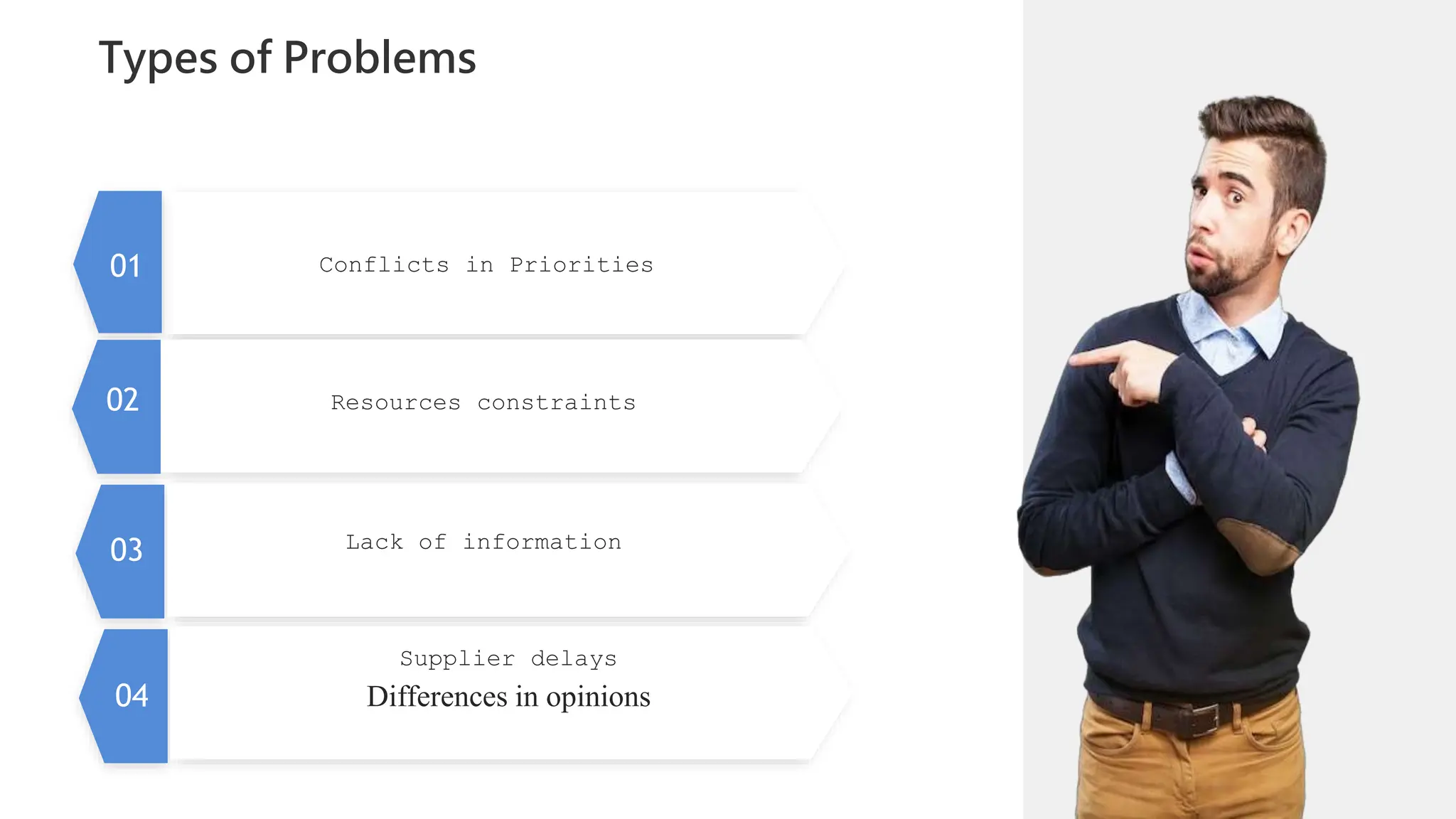
01
Conflicts in Priorities
Types of Problems
02
0
04
01
02
02 Resources constraints
03 Lack of information
Supplier delays
Differences in opinions
04
01
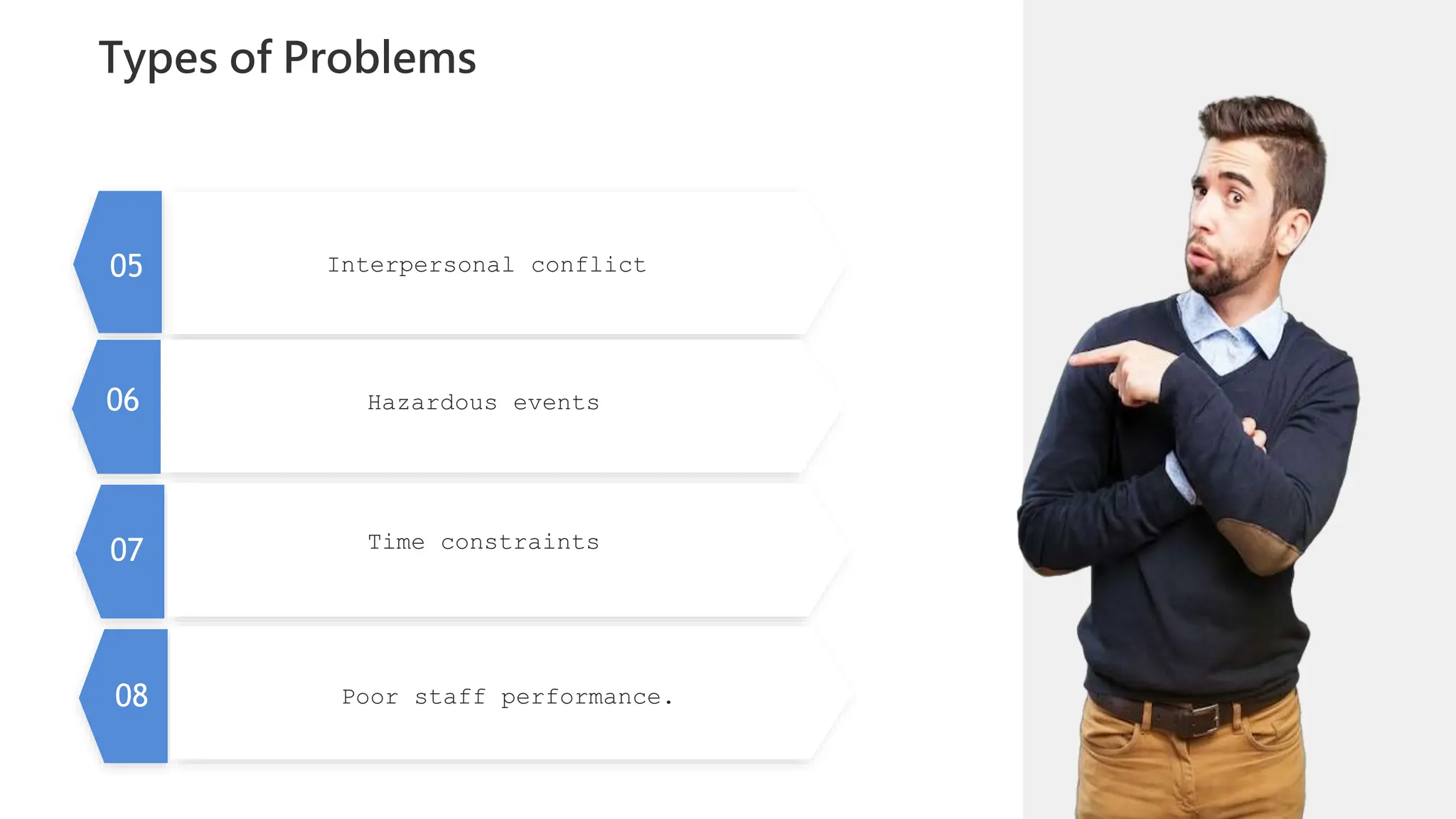
Interpersonal conflict
Types of Problems
02
0
04
05
02
06 Hazardous events
07 Time constraints
Poor staff performance.
08
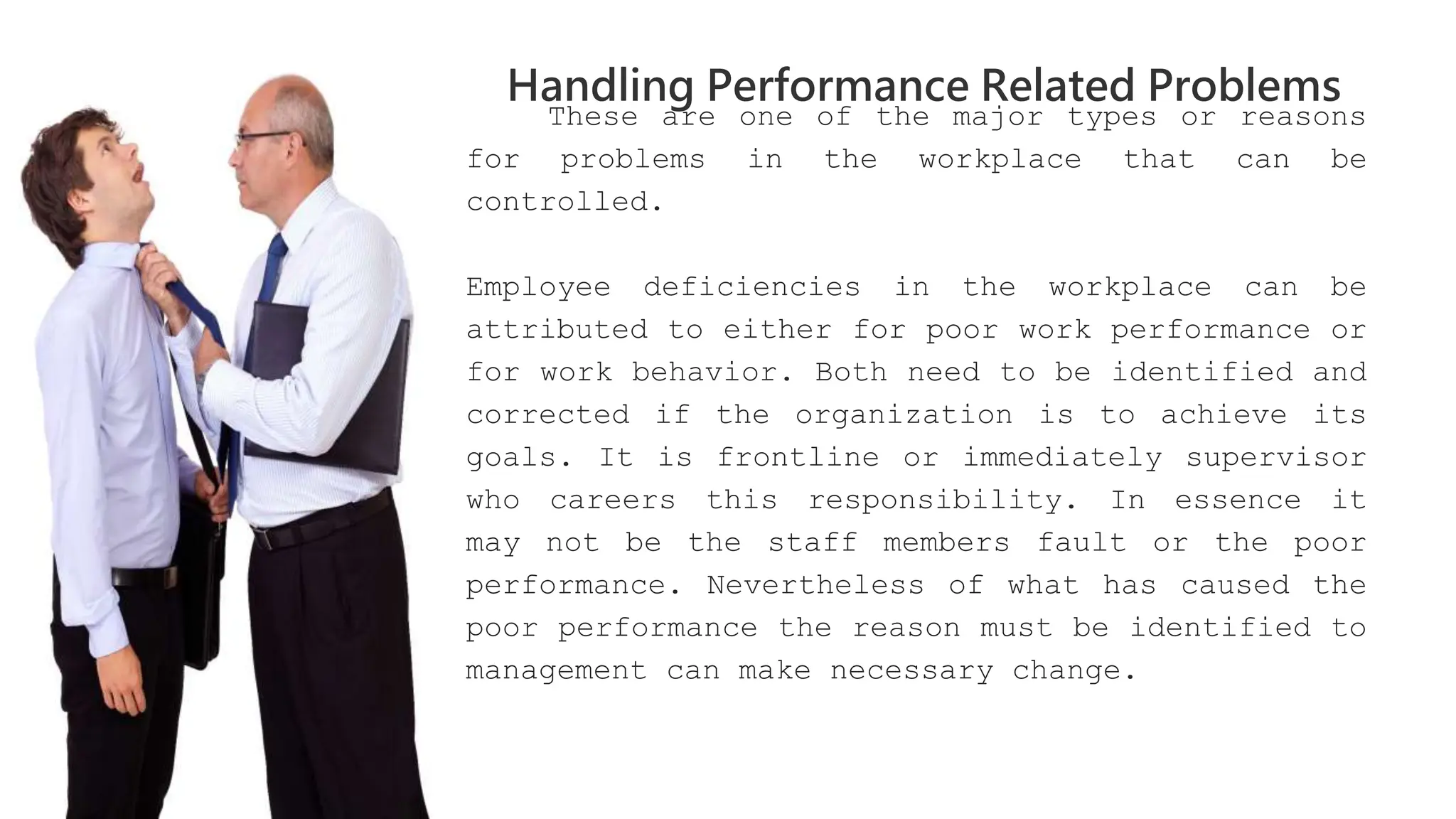
These are one of the major types or reasons
for problems in the workplace that can be
controlled.
Employee deficiencies in the workplace can be
attributed to either for poor work performance or
for work behavior. Both need to be identified and
corrected if the organization is to achieve its
goals. It is frontline or immediately supervisor
who careers this responsibility. In essence it
may not be the staff members fault or the poor
performance. Nevertheless of what has caused the
poor performance the reason must be identified to
management can make necessary change.
Handling Performance Related Problems
01
02
0
04
05
02
03
Sources of Ineffective Performance
06
06
07
• Before counseling an employee on poor performance or inappropriate
job behaviors it is worth considering the likely uses or worth problems.
In particular, reason tells us that an employee who has been performing
well for sometime does not simply ‘turn bad’. There must be reason for
the decline in performance.
• Definitely, we need to consider the source of ineffective work
performance because in some instances the reason might lie within our
organization such as harassment in which case, legally, it is the
organization responsibility to fix it. Similar, management cannot hope
to resolve the ineffective performance problems if they don’t
understand it’s mini source.
01
02
0
04
05
02
03
Sources of Ineffective Performance
06
06
07
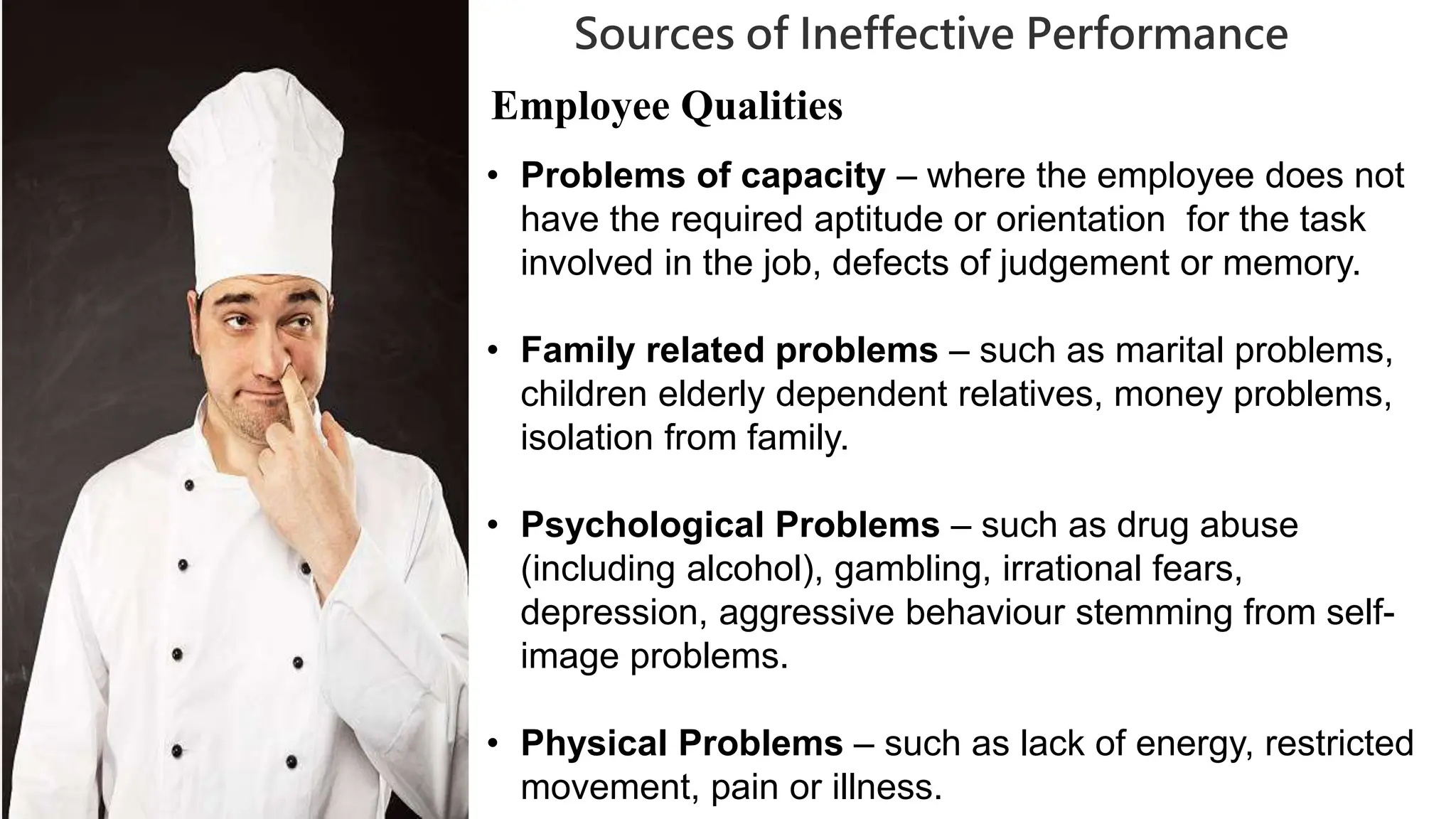
Employee Qualities
• Problems of capacity – where the employee does not
have the required aptitude or orientation for the task
involved in the job, defects of judgement or memory.
• Family related problems – such as marital problems,
children elderly dependent relatives, money problems,
isolation from family.
• Psychological Problems – such as drug abuse
(including alcohol), gambling, irrational fears,
depression, aggressive behaviour stemming from self-
image problems.
• Physical Problems – such as lack of energy, restricted
movement, pain or illness.
01
02
0
04
05
02
03
06
06
07
Organizational Source of Employee Performance
The origin of poor performance in the employee can
sometimes be attributed to the organization. This could
include the following factors:
• Problems with higher decision and policies such as a
person place in the wrong position
• Impact of supervisors such as leadership style, bad
communication or instruction, inappropriate managerial
standards or criteria, discrimination and a lack of
managing diversity
• Problems with peers such as harassment , bullying,
problems with team cohesion and acceptance,
discrimination and hazing.
• Problems from the work context such as geographic
location, bad physical worth environment, unsafe
condition in work process.
01
02
0
04
05
02
03
Sources of Ineffective Performance
06
06
07
External Source Problem
These are problems an employee can have the stem
from society and its value. These includes situation
where society values class with the job.
• Clashes with moral or religious issue- working on
certain days, assisting guest with certain unsavory
request.
• Changing economic condition- economic uncertain of
raising interest rates or impending legislation that
appears to create job insecurity.
Before counseling's an employee for poor performance or
conducting the performance appraisal, management needs
to consider:
• What are the symptoms and what are the likely causes
• If the causes are because of something that is
internal to the organization; the organization maybe
responsible for further problems.
• Identify whether you are dealing with a worth
performance problem, such as not achieving targets or
objectives, or a work behavior problem, such as their
work might be fine, but their behavior in the
workplace is inappropriate. This difference will be
covered in more details later.
• Interpret checklist and then put them into
Consideration and conducting performance
Appraisal
The manager shall review facts surrounding
performance concern before addressing staff
performance. The same way, all feedback must be based
on facts, so too must the practice of addressing staff
performance. Why do businesses monitor and address
staff performance? Many businesses have an active
program of monitoring staff performance in order to;
• Identify staff who need extra, or top-up, training
• Praise staff who are performing well
• Maintain service standards
• Demonstrate management concern and commitment to
deliver stated service levels
• Identify staff that may be able to be promoted or
given additional levels of responsibility
Reviewing Facts Surrounding Performance
Concerns
What might supervisors/managers have to do? Positively,
supervisors need to obtain original, first hand
evidence hence the need to gather factual evidence
about performance by exercising the following aspects.
• Observing staff while they are undertaking actual
workplace access to verify and assess practical
skills
• Listening to staff when they interact with customers/
guests to judge the level of interpersonal and
communication skills
• Examining finished products that staff have produced
• Talking to other staff, customers/guest.
• Reading the “complaints and compliments”.
What managers should do to settle the
Issue?
The immediate action must be taken sensitively to
avoid embarrassment to the staff member involved,
and will often require an apology to the customer
as you intervene. When you take this immediate
action, you may do the task yourself, demonstrate
the task to the worker involved and then
supervise their activities, or arrange for
another members.
The Need to Take Immediate Actions
• The manager shall arrange schedule to discuss
situation with employees in private manner.
• The discussion of individual staff performance is
very useful way to maintain and raise service
levels within a business.
• The management must lay out clear expectations to
the employee. This should include expectations
ass they relate to company policy and the
requirements of the position.
• The manager must documents all the meetings and
communications. Keep detailed notes of each
meeting, including the issues communicated and
any warnings which were issued.
Arrangement with Employers Discussion
01
Notification of employee about Performance
02
0
01
02
0
03
04
The management shall initiate the process of notifying employees about
performance discussion sessions. When staffs have been made aware of
the nature and frequency of staff performance assessments and the
relevant facts have been obtained, you will then notify the relevant staff
of time and place to conduct their performance assessment session.
• Advice staff in-person about the time and place for the session.
• Advise them of how long you expect the session to take.
• Give them a brief outline of the nature of the session.
• Let them know that their session will be conducted one-to-one.
01
Factors to consider when meeting staff to address
performance
02
0
01
02
0
03
04
when meeting with staff to discuss their performance then the positive
framework already established in relation to staff performance must be
continued. The following considerations help to achieve the process.
• Time the session so the staff member is fresh and more ready to listen, rather
than holding it at the end of the shift when the staff member may be tired
and wanting to go home as quickly as possible.
• hold private, one-to-one sessions that are free from interruption to protect
privacy and demonstrate you value the session.
• start the session by mentioning something positive about their performance.
This helps set the scene on a positive note.
01
actors to consider when meeting staff to address
performance
02
0
01
02
0
03
04
• Move on to identify the performance that is the subject of the
meeting, then explain what the requirements are this area.
• Ask the staff member how they believe they conform to those
requirements. This is a useful technique because most staff are smart
enough to know where their performance is sub-standard and they
are usually prepared to identify where they are performing below
expectations.
For the management, in order to maximize the possibility
of staff agreeing and committing to change then you may
need to highlight the following points to sell the need
for change in specific context relating to the change
required and the staff member concerned.
• How the change will better meet management, customer
and co-worker expectation.
• How the change will positively impact on the efforts of
colleagues.
• How the change will benefit the business-saving time,
saving cost, increasing revenue and productivity,
better safety, less waste, higher quality end products,
repeat business, etc.
• How the change will benefit them: by making their job
easier, increasing pride in their work, increasing
their level of safety, increasing the possibility of
POINTS TO ADDRESS AND CONSIDER IN CONFIRMING
AGREEMENT WITH STAFF
01
TAKING DISCIPLINARY ACTION IF REQUIRED
02
0
01
02
0
03
04
Your standard operating procedure should always be to use
disciplinary action against staff as the last option. Taking disciplinary
action as you first course of action will not encourage staff member’s
confidence in you, it might indicate to management.
• Plenty of one-to-one session, when requirements and consequences
have been outlined.
• Provision of appropriate support such as mentoring coaching, and
other forms of support at suitable times.
• Demonstrating your desire to work co-operatively to achieve the
required change.
• Provision of ongoing support and encouragement to comply.
• Explanation of the need for change and how such change can take
place.
01
Issuing a verbal warning
Possible disciplinary action
02
0
04
01
02
02 Giving a written warning
03
Suspending the staff member
from duty for a prescribed
time
Dismissing the staff member
04
When applying penalties for undesirable staff
behavior or performance it is vital that you are
consistent in the in the actions you take. Falling
to be consistent in the application of penalties
gives rise to the following factors.
• Feelings amongst the staff that you have
favorites who are treated differently/more
advantageously.
• Allegations of unfair treatment, which can have
industrial relations/legal consequences.
• Belief by management that you are incapable of
appropriate staff management in difficult times.
CONSISTENCY OF MANAGER’S ACTION
01
02
0
04
01
02
03
DOCUMENTING DISCUSSIONS AND
DISCIPLINARY ACTION TAKEN
02
03
it is advisable to document any communications
occurring between you and staff in relation to
performance or other workplace issues. You may be
tempted to believe you can accurately remember all
that was said, when it was said, etc. .
04
THE NEED FOR DOCUMENTS/RECORD
• They can provide evidence of what was said and when it
was said
• They can give you material to reflect on when you are
next faced with a similar situation.
• Learn from any mistakes or errors of judgement you
might have made in the past, and we all male them.
• Provide consistency in your actions by reflecting this
time, what you did last time.
01
02
0
04
01
02
03
SEEKING ASSISTANCE
OF TEAM MEMBER
02
01
ROLE OF SUPPORT
02
0
04
01
02
02
03
04
Support is two way street and who provides or receives
support will change depending on what is required to
effectively handle each situation. It is not uncommon for
one specific person to be both the provider and the recipient
of support, in different situation.
01
PROVIDING ASSISTANCE TO
EMPLOYEES
02
0
04
01
02
02
03
04
Assistance is often the by-product of support and these two
terms are often used in the same context. Assistance is a
form of support which a person can give to another and
include, but is certainly not limited to:
• Providing back-up support
• Explaining, clarifying
• Providing solving
• Providing encouragement
• Providing feedback to another team member
• Undertaking extra tasks, if necessary
TYPES OF SUPPORT
0
02
02
0
04
Physical support- skills set and actual physical help whether it be
lifting, carrying, pushing or pulling.
Intellectual support- frameworks, documents, knowledge and
advice
Financial support- money needed to be able to undertake an
activity
Infrastructural support- physical items including buildings,
equipment, fixtures
Resources support- food, beverages, uniforms, stationary and
other supply.
Mentoring – advice and guidance
The aim of any workplace is the achievement of tasks, to
a predetermined standard or expectation. Any failure to
do so may require some type of support to rectify any
shortfalls. as a manager, identify the need for support
is a complex matter which must be approached with
delicacy.
• The problem may be caused by manager themselves.
• They may be embarrassed they cannot do something .
• Cultural characteristics exist where people do not want
to lose face.
• They want to maintain personal pride and asking for
support may highlight a weakness or incompetency.
IDENTIFYING NEED FOR SUPPORT
• Observation – viewing an inability of a person to
undertake job tasks or constantly making mistakes
• Staff behavior – they may be reluctant, frustrated,
stressed or not motivated in starting or completing a
task
• Direct request form a person – whether a direct request
or repeating asking for help
• Customer complaints – customer may have complained
about a persons behavior or performance
• Productivity reports – reports may show that a person
is unable to perform tasks to a set quality standard
• New tasks or job role – new tasks and responsibilities
may require staff to receive additional resources or
training
SIGNS OF IDENTIFYING THE NEED FOR SUPPORT
There are a number of people who will provide support
to others. As mentioned, support is the provision of
some area of assistance or expertise one person may
have which can help others complete their tasks.
Following are people who provide support and examples
of support that may be provide:
Staffs/Individuals, Unit Managers Who
Can Provide Support
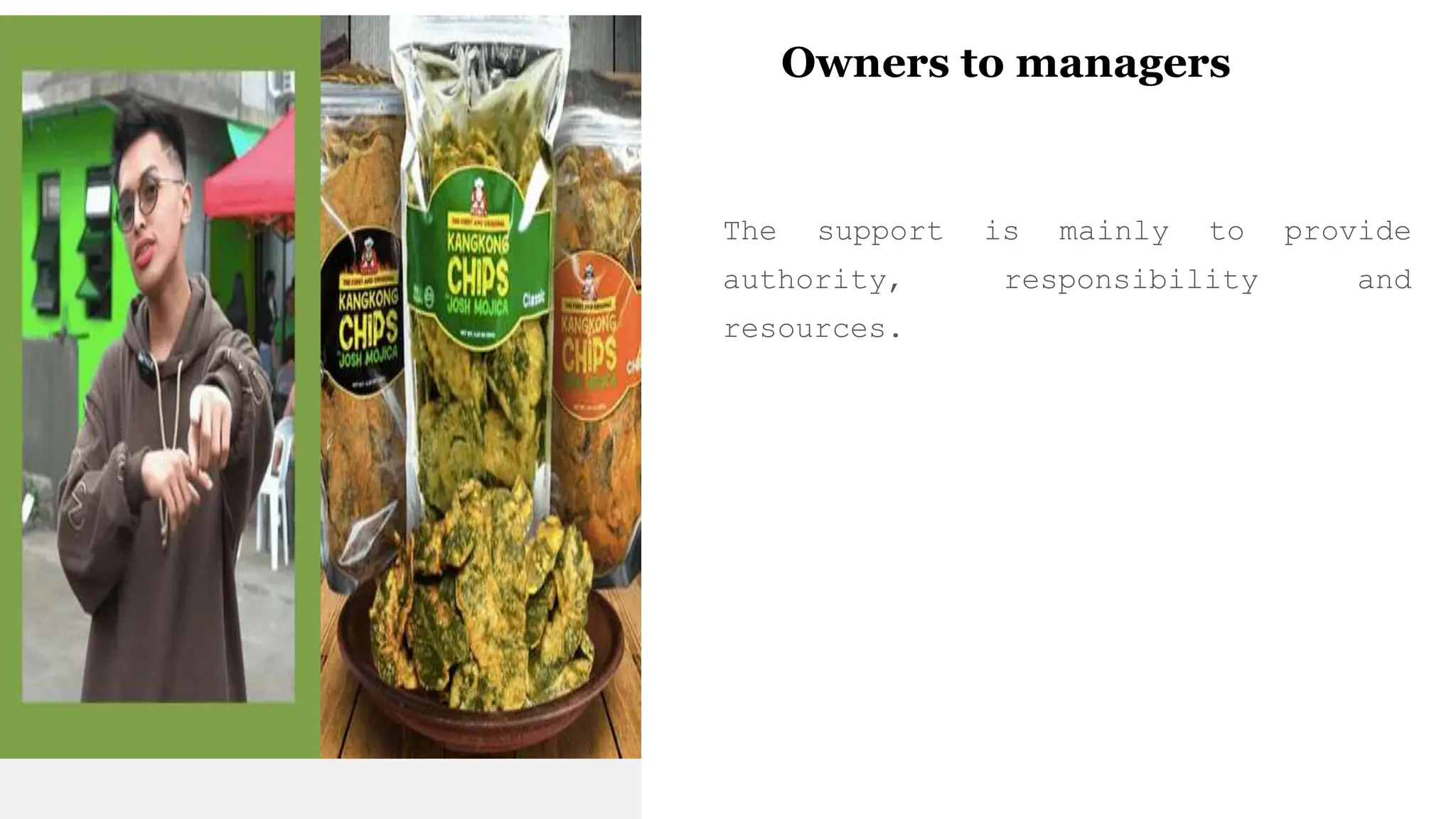
Owners to managers
The support is mainly to provide
authority, responsibility and
resources.
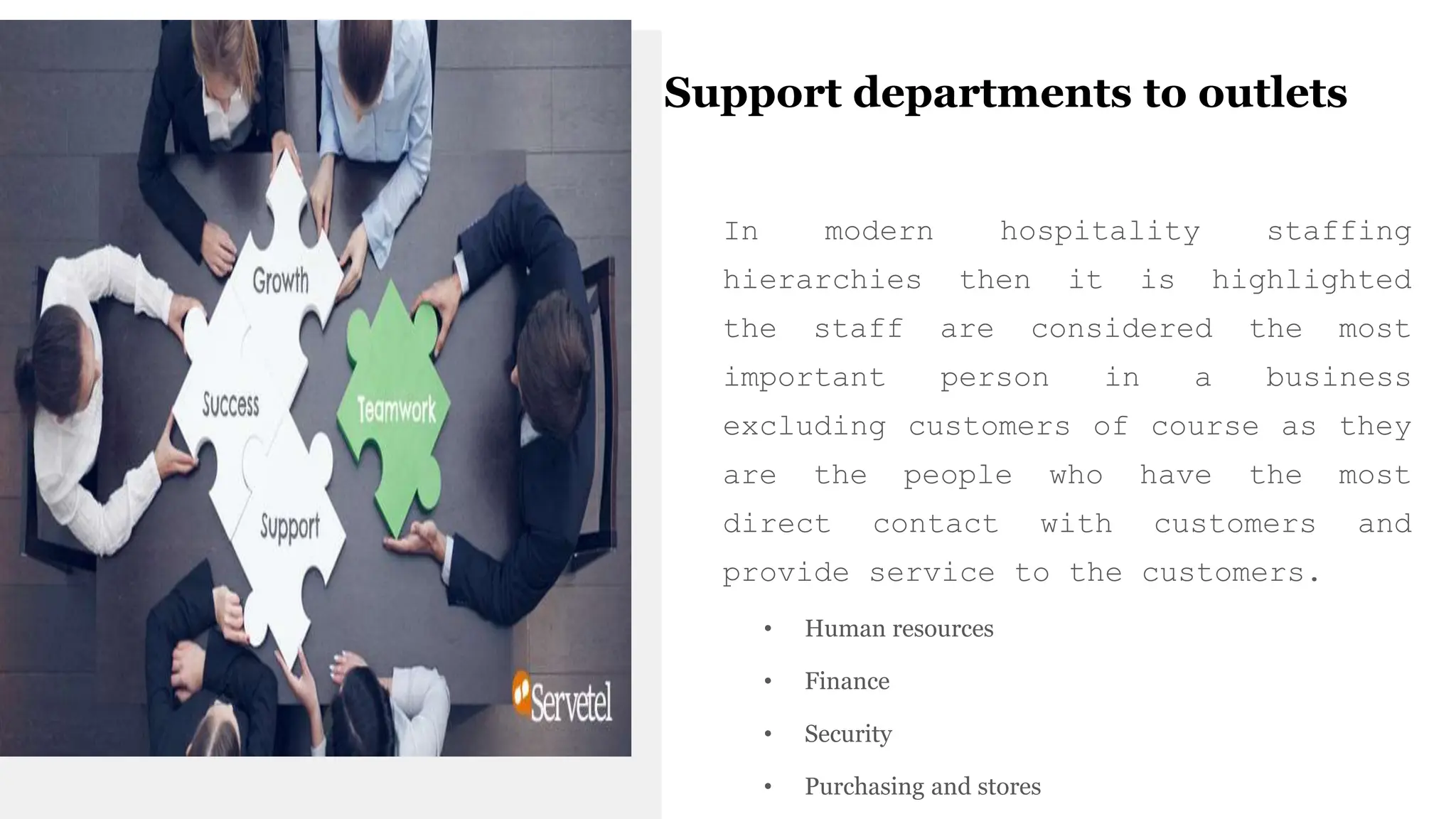
Support departments to outlets
In modern hospitality staffing
hierarchies then it is highlighted
the staff are considered the most
important person in a business
excluding customers of course as they
are the people who have the most
direct contact with customers and
provide service to the customers.
• Human resources
• Finance
• Security
• Purchasing and stores
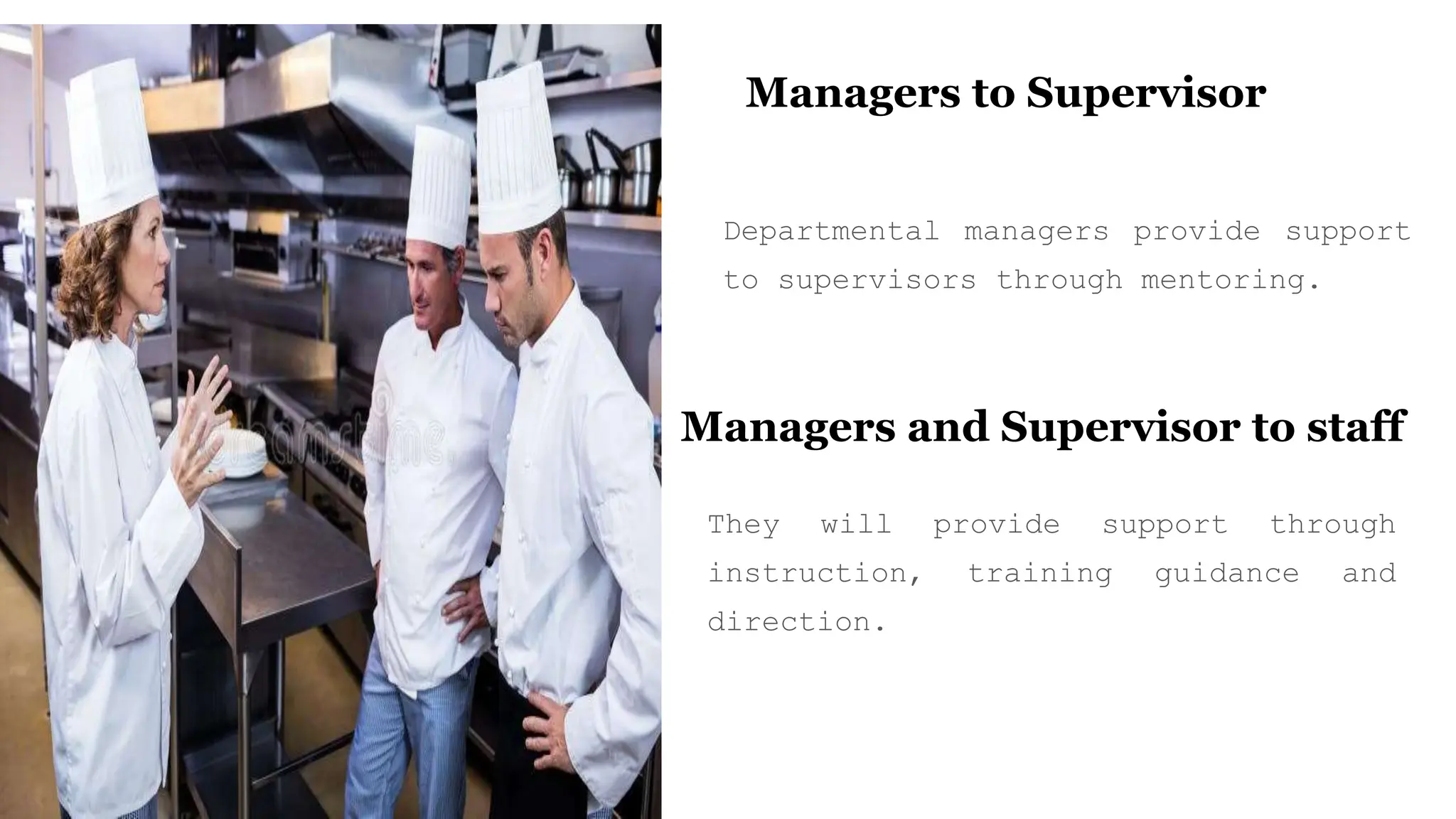
Managers to Supervisor
Departmental managers provide support
to supervisors through mentoring.
Managers and Supervisor to staff
They will provide support through
instruction, training guidance and
direction.
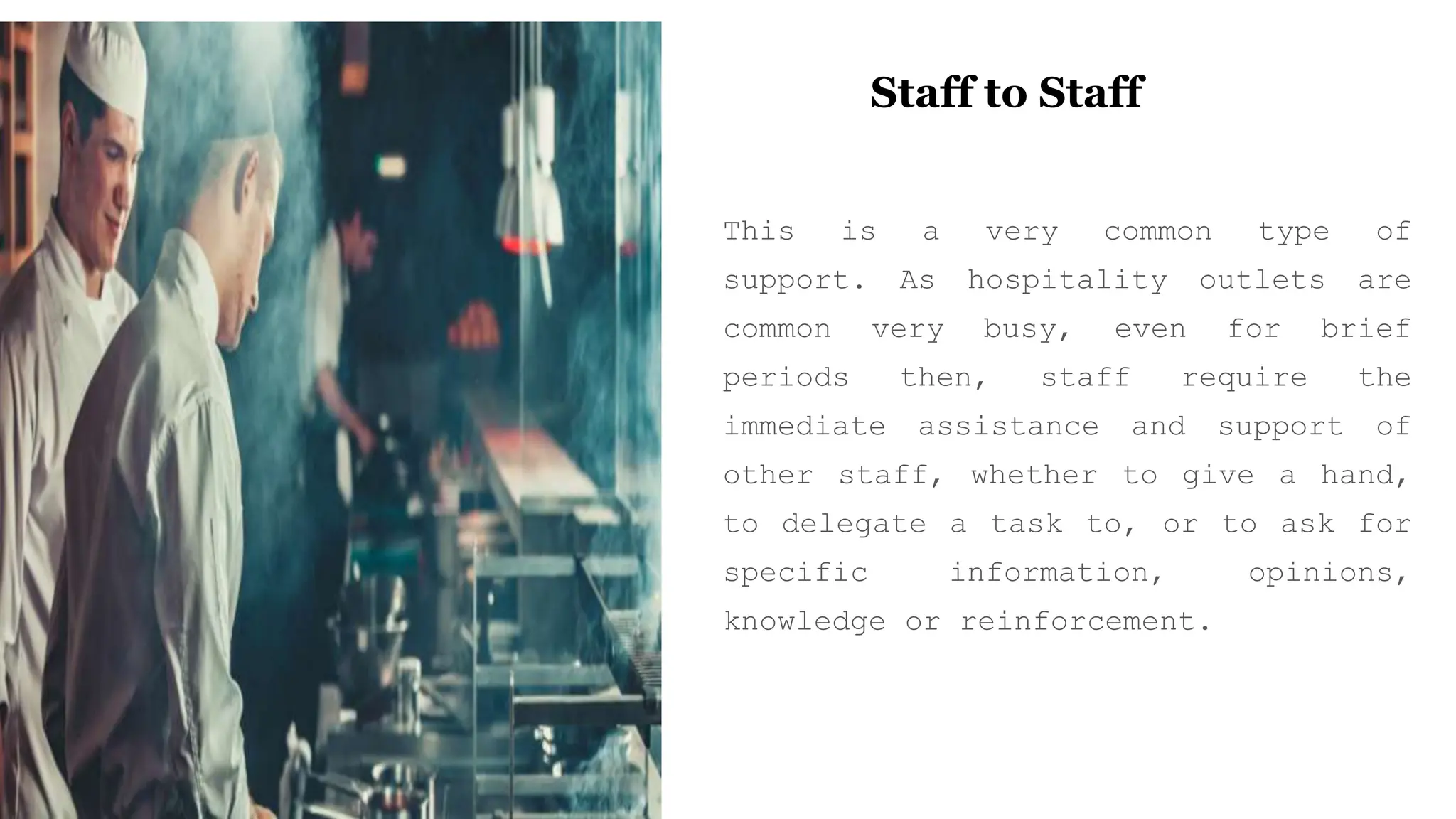
Staff to Staff
This is a very common type of
support. As hospitality outlets are
common very busy, even for brief
periods then, staff require the
immediate assistance and support of
other staff, whether to give a hand,
to delegate a task to, or to ask for
specific information, opinions,
knowledge or reinforcement.
Staff to Managers
They will provide support through the
completion of task and feedback in
relation to operations.
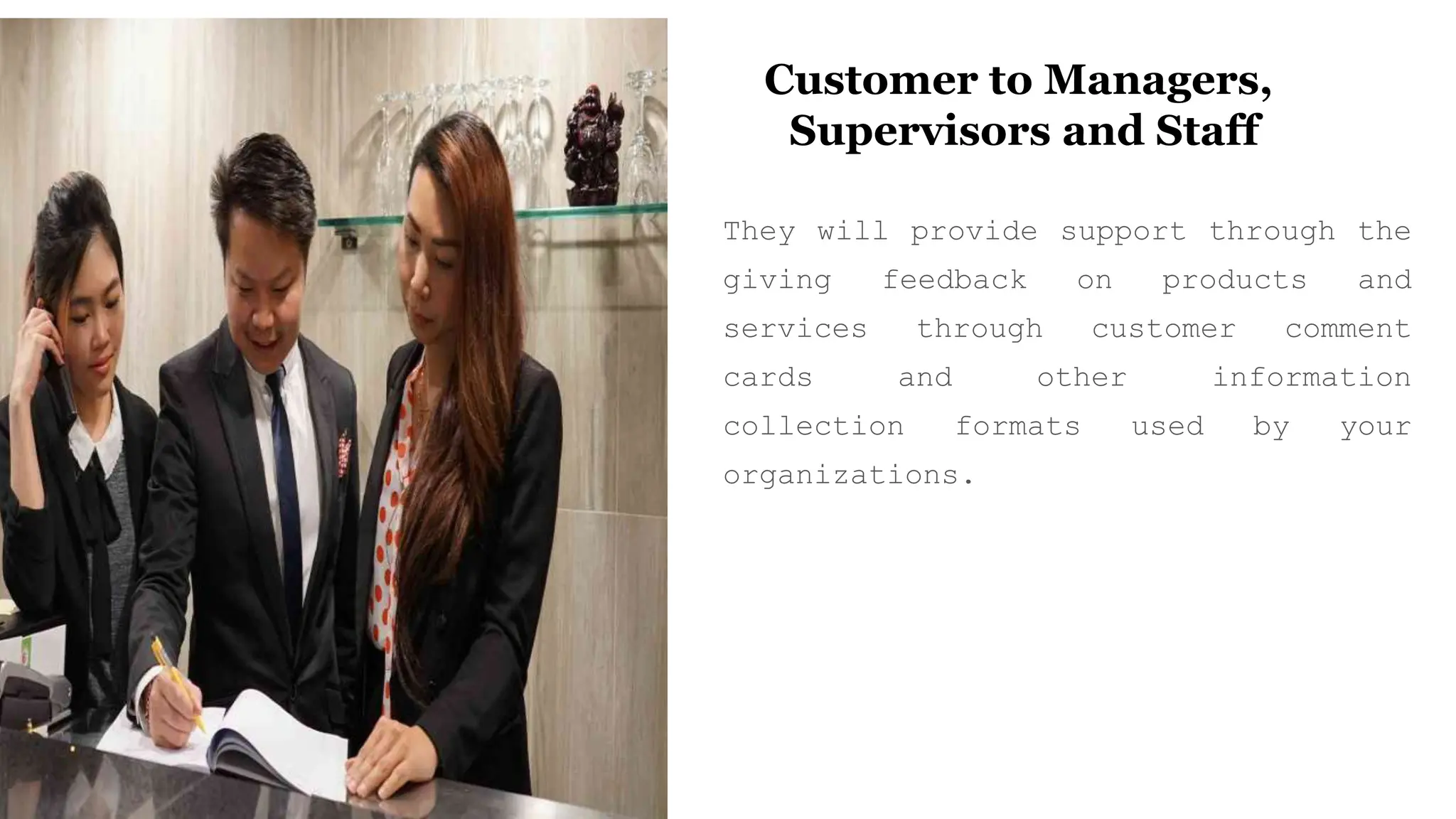
Customer to Managers,
Supervisors and Staff
They will provide support through the
giving feedback on products and
services through customer comment
cards and other information
collection formats used by your
organizations.
01
02
0
04
01
02
03
TIMING, SUPPORT
AND ORIENTATION
02
01
Timing, Support And Orientation
02
0
04
01
02
02
03
04
Our industry is one that is very much time oriented.
Customers and other staff will rely on individuals to get
nominated work finished by a set time. Customers expect
service, food, drinks or rooms cleaned by a set time and
when this doesn’t happen, their satisfaction levels drop.
Other staff may depend on others doing a certain task so
that they can then do their work. They may have factored
this into their planning and prioritizing of their workload.
01
Staffs who receive support
02
0
04
01
02
02
03
04
The people in an organization who need assistance
will commonly include the following:
• Colleagues
• People from other, but related, departments
• Managers and supervisors.
The management shall initiate the process of
communicating requirements of work activities using a
participative approach. When working in the hospitality
industry, there is a need for supervisors and managers to
communicate with both staff and fellow colleagues on a
constant basis. In essence colleagues are other staff in
your business; however it may also apply to people
working in external business that help provide products
or service provided to your customer. This can include
contractors or suppliers. It is importance that all these
communications are conducted in a polite, professional,
clear and concise manner.
Types of communication
• Verbal
• Written format
• Non-verbal
Communicating Requirements Of Work Activities
01
TYPES OF COMMUNICATION
02
0
04
01
02
02
03
04
• Verbal - including face-to-face communications and
talking on the phone. This is also embraces the use of
languages other than English and the use of indigenous
language.
• Written format - which includes electronic mail and
hard copy communications such as letters, sign as letter
signs, labels, posters, and advertising and warning
material.
• Non-verbal - facial expressions, gestures, sign language.
COMMUNICATING WITH COLLEAGUES AND STAFF
Communication with colleagues is aimed at ensuring staffs are aware of what is
expected and that each customer has an enjoyable experience at your
establishment. Communicating used between colleagues may come in different
formals, whether through meetings, emails, documentations or phone calls, but
the purpose normally is operationally focused relating to relaying information in
one of the following.
• Clarify of purpose, including vision, mission, goals
• Operational performance – financial summary, feedback of activities or
customer complaints.
• Upcoming events-times, dates, inclusion, staffing requirements and
requirements for ordering of stock.
• Products and services – new or amended offerings
• Promotional activities – schedule activities, merchandising, promotional codes,
inclusion in packages or promotions, prices and availability.
• Specific customer – VIP status, special request, bookings or complaints
01
TIPS FOR EFFECTIVE COMMUNICATION
02
0
04
01
02
02
03
04
• Follow all establishment policies regarding communication with costumers and
colleagues. These may exist for greeting customers, interacting with staff and
answering the phone.
• Use a persons name where it is known and if you don’t know a customers name
use sir/madam.
• Be honest but be sensitive, tactful, caring and respectful
• Use please and thank you a lot
• Don’t interrupt
• Speak at an appropriate pace and volume and don’t yell, don’t whisper
• Make sure your non-verbal language matches the verbal communication you
are sending. This commonly means smiling when it is appropriate to do so, and
displaying a serious demeanor when something serious is being discussed.
01
02
0
04
05
02
03
Building trust
06
06
07
Indeed, effective communication is not only important but is it
essential that trust is developed between a supervisor and staff? So what is
trust and how you should supposed to build it?
It is commonly believed and accepted that trust is perhaps the most critical
aspect in building of a harmonious, effective and efficient work
environment. This is true regardless of the industry or business. Business
that have trust among employees are usually successful and those that
don’t frequently are not.
01
Ways To Create And Build Trust
02
0
04
01
02
02
03
04
There are many great and effective ways for managers to build trust into their
teams.
1. Establish and maintain integrity – it is the foundation of trust in any hospitality
industry. Integrity must begin at the top and the move down. This means,
among other things, keeping promises and always telling the truth.
2. Communicate vision, values, mission and goals – Communication is important, since
it provides the path for information and truth. By communication the
organization’s key framework, management defines where it’s going. By
communicating its values, the methods for getting there are established.
3. Consider all employees as equal partners in the organization - Trust is established when
every staff member, regardless of positioning feels an important and active part of
the team. This begins with management not appearing to be superior or more
important than their staff.
01
Ways To Create And Build Trust
02
0
04
01
02
02
03
04
There are many great and effective ways for managers to build trust into their
teams.
4. Focus on team rather than individual and personal goals.
– When employees feel that everyone is pulling together in order to accomplish a
shared vision, rather than a series of personal agendas, trust results. This is the
essence of teamwork. When a team really works, the players trust one another.
5. Do what’s right regardless of personal risk.
– We all know intuitively what’s “right” in nearly every situation. Following this
instinctive sense and ignoring any personal consequences will nearly always
create respect from those around us. From this respect comes trust.
So far we have looked at ways to build trust. As can
be seen then it takes work and dedication. It is
important to note that trust can also be lost very
quickly. When lost, it is very hard to regain and can
have a major negative impact on the synergy of the team
and its effectiveness. Ways to lose trust include:
• Act and speak inconsistently - Nothing confuses people
faster than inconsistency. Staff must be able to feel
like there are consistent actions, decisions and
consequences in which to operate.
• Seek personal rather than shared gain - One who is out
only for themselves, especially in a team environment,
quickly loses the respect and trust of others.
• Withhold information - To date in this section, we have
seen the importance of effective communication. When
the communication channels shut down, rumors start
misinformation is believed to be real and then denials.
Ways to lose trust
• Lie or tell half-truths - Untruthfulness is a quick way
to break a bond of trust. People may accept it once,
even, twice, but normally it is not forgotten.
• Be closed – minded - It is important to note that
managers do not know everything. They are employed to
get the best out of the team and utilizing the
strengths of individual team members. An unwillingness
to consider other ideas and points of view will
certainly cut-off communication and eventually shatter
trust.
Ways to lose trust
01
02
0
04
01
02
03
Managing Disagreements And Conflicts
02
03
Establishing team work is essential for
supervisors/and or managers to get their team to
work in an effective manner. Managers shall manage
disagreements and conflicts constructively using
appropriate conflict management strategies. It is
important for all workplace conflict and
misunderstandings to be identified immediately and
dealt with on a case-by-case manner that is
sensitive and respectful. This requirement applies
to both colleagues and customers.
04
Conflict And Misunderstanding
In relation to working effectively and
successfully in a socially diverse environment,
conflict and misunderstanding must be given a very
broad interpretation and definition. In practical
terms, anything that upsets another person can be
regarded as a conflict or a misunderstanding.
Naturally there are degrees of it ranging from
being mildly upset all the way through to outright
anger and rage.
Conflict can involve the following variables:
• Groups
• Individuals
• Co-workers
• customers
People Involve Conflict
ADDRESSING WORKPLACE CONFLICT
Truly it is vital for managers to initiate ways in
addressing workplace conflict and misunderstanding
properly and as early as possible in order to achieve
the following :
• Keep all conflict and misunderstanding at the mild
end of the spectrum
• Clarify any perception that arose due to
misunderstanding
• Rectify the situation to the greatest extent
There are number of key areas that can cause conflict
misunderstanding in the workplace. Remember that all
message sent, whether verbal or non-verbal, are part of
two-way process. there may be many reasons why conflict
may flare up amongst colleagues some reasons include
the following factors.
• Pressure of work
• Lack of Good communication which may cause
misunderstandings.
• Prejudices; this relates to issues of ethnicity,
gender, body shape and age.
• Ineffective working system, where the internal
operations of the venue Cause the problem.
POSSIBLE CAUSES OF CONFLICT AND
MISUNDERSTANDING
• Difference in opinions; we are all entitled to
different views.
• Difference in beliefs; it would be a pretty boring
world if we all believed in the same thing
• Misunderstanding; can be caused by barriers to
communication, not listening properly, putting
interpretation on a word/phrase.
• Team member not pulling their weight; staff not
contributing 100% to a team effort.
POSSIBLE CAUSES OF CONFLICT AND
MISUNDERSTANDING
• Discussing the issue in a courteous manner – which will
demonstrate a desire to fix the problem.
• Speaking directly with the person concerned in a
respectful way.
• Apologizing for offence or misunderstanding that may
have been cause
• Taking time to talk with the person concerned- to truly
identify the relevant aspects of the situation and
determine the facts and feeling involved in the
situation.
• Asking for advice from the other party- to work out how
similar future problems may be avoided or to determined
what action to take in the future when a similar
problem arises.
• Attending mediation – where there is a dispute between
staff this provides an opportunity for both parties to
air their views in front of an independent thir person.
• Enrolling in a language class- to improve first or
second language skill that will help avert language-
based problems.
• Enrolling in other courses that may assist in improving
ACTTIONS THAT HELP THE SITUATION
01
REFFERING ISSUES AND PROBLEMS TO
THE APPROPRIATE PERSON
02
0
01
02
02
03
04
They may be a need in your workplace to refers any issues relating to cross
cultural issues to management. This can be to help theme ensure they discharge
responsibilities in relation to equal opportunities legislation.
in individual situation there may only be a need to refer unresolved issues to
management, so that they can assist in finding an acceptable and effective
solution that accommodate to the best extent possible, everyone’s culturally
based needs.
01
KNOWING WHEN TO REFER ISSUES TO
MANAGEMENT
02
0
01
02
02
03
04
• Notify the appropriate person after you believe you have come to solution.
• Revision to standard operating procedure within the establishment- such as
changes to policies procedure, training manual or operational checklist.
• Inclusion of the issues of the staff meetings and briefing session- so that other
staff can learn from what ever was the cause of the problem/ issue.
• Making contact with those involved in order to.
• Demonstrate their concern in relation to the matter.
• Ensure that the agreed solution has in place in fact and genuinely resolved the
situation.
01
REFERRING THE PROBLEMS TO THE
PERSONS INVOLVED
02
0
01
02
02
03
04
• Colleagues
• Your team leader
• The manager
• Human resources personnel
• The owner
• Members of the public
• Client
Indeed the persons who is deemed appropriate to refer a conflict to with may
vary depending on the nature of the conflict in question.
Activity !
1. Group activity: (The students will
interview an industry manager or
supervisor about the conflict that their
team members are experiencing, and
from that, they will create strategies to
address it.)

Operation Management: Maintain Effective Working relationships

  • 1.
    Prepared By: Roy B.Cabarles, LPT
  • 2.
    Irrespective of thenature of the business or the strength of the people within it, problems will arise at some stage. It doesn’t matter how well you may prepare for any eventuality, problems will arise at unexpected times and caused by a variety of reason and circumstances regardless of the type of problem that arises, it is the role of manager or supervisor to ensure that they are sold where possible in a timely manner, using minimal impact on staff and customer or to ensure any negative effect are minimize and contained. The management of problems is one of the key and most important requirements of manager. Introduction
  • 3.
    01 Conflicts in Priorities Typesof Problems 02 0 04 01 02 02 Resources constraints 03 Lack of information Supplier delays Differences in opinions 04
  • 4.
    01 Interpersonal conflict Types ofProblems 02 0 04 05 02 06 Hazardous events 07 Time constraints Poor staff performance. 08
  • 5.
    These are oneof the major types or reasons for problems in the workplace that can be controlled. Employee deficiencies in the workplace can be attributed to either for poor work performance or for work behavior. Both need to be identified and corrected if the organization is to achieve its goals. It is frontline or immediately supervisor who careers this responsibility. In essence it may not be the staff members fault or the poor performance. Nevertheless of what has caused the poor performance the reason must be identified to management can make necessary change. Handling Performance Related Problems
  • 6.
    01 02 0 04 05 02 03 Sources of IneffectivePerformance 06 06 07 • Before counseling an employee on poor performance or inappropriate job behaviors it is worth considering the likely uses or worth problems. In particular, reason tells us that an employee who has been performing well for sometime does not simply ‘turn bad’. There must be reason for the decline in performance. • Definitely, we need to consider the source of ineffective work performance because in some instances the reason might lie within our organization such as harassment in which case, legally, it is the organization responsibility to fix it. Similar, management cannot hope to resolve the ineffective performance problems if they don’t understand it’s mini source.
  • 7.
    01 02 0 04 05 02 03 Sources of IneffectivePerformance 06 06 07 Employee Qualities • Problems of capacity – where the employee does not have the required aptitude or orientation for the task involved in the job, defects of judgement or memory. • Family related problems – such as marital problems, children elderly dependent relatives, money problems, isolation from family. • Psychological Problems – such as drug abuse (including alcohol), gambling, irrational fears, depression, aggressive behaviour stemming from self- image problems. • Physical Problems – such as lack of energy, restricted movement, pain or illness.
  • 8.
    01 02 0 04 05 02 03 06 06 07 Organizational Source ofEmployee Performance The origin of poor performance in the employee can sometimes be attributed to the organization. This could include the following factors: • Problems with higher decision and policies such as a person place in the wrong position • Impact of supervisors such as leadership style, bad communication or instruction, inappropriate managerial standards or criteria, discrimination and a lack of managing diversity • Problems with peers such as harassment , bullying, problems with team cohesion and acceptance, discrimination and hazing. • Problems from the work context such as geographic location, bad physical worth environment, unsafe condition in work process.
  • 9.
    01 02 0 04 05 02 03 Sources of IneffectivePerformance 06 06 07 External Source Problem These are problems an employee can have the stem from society and its value. These includes situation where society values class with the job. • Clashes with moral or religious issue- working on certain days, assisting guest with certain unsavory request. • Changing economic condition- economic uncertain of raising interest rates or impending legislation that appears to create job insecurity.
  • 10.
    Before counseling's anemployee for poor performance or conducting the performance appraisal, management needs to consider: • What are the symptoms and what are the likely causes • If the causes are because of something that is internal to the organization; the organization maybe responsible for further problems. • Identify whether you are dealing with a worth performance problem, such as not achieving targets or objectives, or a work behavior problem, such as their work might be fine, but their behavior in the workplace is inappropriate. This difference will be covered in more details later. • Interpret checklist and then put them into Consideration and conducting performance Appraisal
  • 11.
    The manager shallreview facts surrounding performance concern before addressing staff performance. The same way, all feedback must be based on facts, so too must the practice of addressing staff performance. Why do businesses monitor and address staff performance? Many businesses have an active program of monitoring staff performance in order to; • Identify staff who need extra, or top-up, training • Praise staff who are performing well • Maintain service standards • Demonstrate management concern and commitment to deliver stated service levels • Identify staff that may be able to be promoted or given additional levels of responsibility Reviewing Facts Surrounding Performance Concerns
  • 12.
    What might supervisors/managershave to do? Positively, supervisors need to obtain original, first hand evidence hence the need to gather factual evidence about performance by exercising the following aspects. • Observing staff while they are undertaking actual workplace access to verify and assess practical skills • Listening to staff when they interact with customers/ guests to judge the level of interpersonal and communication skills • Examining finished products that staff have produced • Talking to other staff, customers/guest. • Reading the “complaints and compliments”. What managers should do to settle the Issue?
  • 13.
    The immediate actionmust be taken sensitively to avoid embarrassment to the staff member involved, and will often require an apology to the customer as you intervene. When you take this immediate action, you may do the task yourself, demonstrate the task to the worker involved and then supervise their activities, or arrange for another members. The Need to Take Immediate Actions
  • 14.
    • The managershall arrange schedule to discuss situation with employees in private manner. • The discussion of individual staff performance is very useful way to maintain and raise service levels within a business. • The management must lay out clear expectations to the employee. This should include expectations ass they relate to company policy and the requirements of the position. • The manager must documents all the meetings and communications. Keep detailed notes of each meeting, including the issues communicated and any warnings which were issued. Arrangement with Employers Discussion
  • 15.
    01 Notification of employeeabout Performance 02 0 01 02 0 03 04 The management shall initiate the process of notifying employees about performance discussion sessions. When staffs have been made aware of the nature and frequency of staff performance assessments and the relevant facts have been obtained, you will then notify the relevant staff of time and place to conduct their performance assessment session. • Advice staff in-person about the time and place for the session. • Advise them of how long you expect the session to take. • Give them a brief outline of the nature of the session. • Let them know that their session will be conducted one-to-one.
  • 16.
    01 Factors to considerwhen meeting staff to address performance 02 0 01 02 0 03 04 when meeting with staff to discuss their performance then the positive framework already established in relation to staff performance must be continued. The following considerations help to achieve the process. • Time the session so the staff member is fresh and more ready to listen, rather than holding it at the end of the shift when the staff member may be tired and wanting to go home as quickly as possible. • hold private, one-to-one sessions that are free from interruption to protect privacy and demonstrate you value the session. • start the session by mentioning something positive about their performance. This helps set the scene on a positive note.
  • 17.
    01 actors to considerwhen meeting staff to address performance 02 0 01 02 0 03 04 • Move on to identify the performance that is the subject of the meeting, then explain what the requirements are this area. • Ask the staff member how they believe they conform to those requirements. This is a useful technique because most staff are smart enough to know where their performance is sub-standard and they are usually prepared to identify where they are performing below expectations.
  • 18.
    For the management,in order to maximize the possibility of staff agreeing and committing to change then you may need to highlight the following points to sell the need for change in specific context relating to the change required and the staff member concerned. • How the change will better meet management, customer and co-worker expectation. • How the change will positively impact on the efforts of colleagues. • How the change will benefit the business-saving time, saving cost, increasing revenue and productivity, better safety, less waste, higher quality end products, repeat business, etc. • How the change will benefit them: by making their job easier, increasing pride in their work, increasing their level of safety, increasing the possibility of POINTS TO ADDRESS AND CONSIDER IN CONFIRMING AGREEMENT WITH STAFF
  • 19.
    01 TAKING DISCIPLINARY ACTIONIF REQUIRED 02 0 01 02 0 03 04 Your standard operating procedure should always be to use disciplinary action against staff as the last option. Taking disciplinary action as you first course of action will not encourage staff member’s confidence in you, it might indicate to management. • Plenty of one-to-one session, when requirements and consequences have been outlined. • Provision of appropriate support such as mentoring coaching, and other forms of support at suitable times. • Demonstrating your desire to work co-operatively to achieve the required change. • Provision of ongoing support and encouragement to comply. • Explanation of the need for change and how such change can take place.
  • 20.
    01 Issuing a verbalwarning Possible disciplinary action 02 0 04 01 02 02 Giving a written warning 03 Suspending the staff member from duty for a prescribed time Dismissing the staff member 04
  • 21.
    When applying penaltiesfor undesirable staff behavior or performance it is vital that you are consistent in the in the actions you take. Falling to be consistent in the application of penalties gives rise to the following factors. • Feelings amongst the staff that you have favorites who are treated differently/more advantageously. • Allegations of unfair treatment, which can have industrial relations/legal consequences. • Belief by management that you are incapable of appropriate staff management in difficult times. CONSISTENCY OF MANAGER’S ACTION
  • 22.
    01 02 0 04 01 02 03 DOCUMENTING DISCUSSIONS AND DISCIPLINARYACTION TAKEN 02 03 it is advisable to document any communications occurring between you and staff in relation to performance or other workplace issues. You may be tempted to believe you can accurately remember all that was said, when it was said, etc. . 04 THE NEED FOR DOCUMENTS/RECORD • They can provide evidence of what was said and when it was said • They can give you material to reflect on when you are next faced with a similar situation. • Learn from any mistakes or errors of judgement you might have made in the past, and we all male them. • Provide consistency in your actions by reflecting this time, what you did last time.
  • 23.
  • 24.
    01 ROLE OF SUPPORT 02 0 04 01 02 02 03 04 Supportis two way street and who provides or receives support will change depending on what is required to effectively handle each situation. It is not uncommon for one specific person to be both the provider and the recipient of support, in different situation.
  • 25.
    01 PROVIDING ASSISTANCE TO EMPLOYEES 02 0 04 01 02 02 03 04 Assistanceis often the by-product of support and these two terms are often used in the same context. Assistance is a form of support which a person can give to another and include, but is certainly not limited to: • Providing back-up support • Explaining, clarifying • Providing solving • Providing encouragement • Providing feedback to another team member • Undertaking extra tasks, if necessary
  • 26.
    TYPES OF SUPPORT 0 02 02 0 04 Physicalsupport- skills set and actual physical help whether it be lifting, carrying, pushing or pulling. Intellectual support- frameworks, documents, knowledge and advice Financial support- money needed to be able to undertake an activity Infrastructural support- physical items including buildings, equipment, fixtures Resources support- food, beverages, uniforms, stationary and other supply. Mentoring – advice and guidance
  • 27.
    The aim ofany workplace is the achievement of tasks, to a predetermined standard or expectation. Any failure to do so may require some type of support to rectify any shortfalls. as a manager, identify the need for support is a complex matter which must be approached with delicacy. • The problem may be caused by manager themselves. • They may be embarrassed they cannot do something . • Cultural characteristics exist where people do not want to lose face. • They want to maintain personal pride and asking for support may highlight a weakness or incompetency. IDENTIFYING NEED FOR SUPPORT
  • 28.
    • Observation –viewing an inability of a person to undertake job tasks or constantly making mistakes • Staff behavior – they may be reluctant, frustrated, stressed or not motivated in starting or completing a task • Direct request form a person – whether a direct request or repeating asking for help • Customer complaints – customer may have complained about a persons behavior or performance • Productivity reports – reports may show that a person is unable to perform tasks to a set quality standard • New tasks or job role – new tasks and responsibilities may require staff to receive additional resources or training SIGNS OF IDENTIFYING THE NEED FOR SUPPORT
  • 29.
    There are anumber of people who will provide support to others. As mentioned, support is the provision of some area of assistance or expertise one person may have which can help others complete their tasks. Following are people who provide support and examples of support that may be provide: Staffs/Individuals, Unit Managers Who Can Provide Support
  • 30.
    Owners to managers Thesupport is mainly to provide authority, responsibility and resources.
  • 31.
    Support departments tooutlets In modern hospitality staffing hierarchies then it is highlighted the staff are considered the most important person in a business excluding customers of course as they are the people who have the most direct contact with customers and provide service to the customers. • Human resources • Finance • Security • Purchasing and stores
  • 32.
    Managers to Supervisor Departmentalmanagers provide support to supervisors through mentoring. Managers and Supervisor to staff They will provide support through instruction, training guidance and direction.
  • 33.
    Staff to Staff Thisis a very common type of support. As hospitality outlets are common very busy, even for brief periods then, staff require the immediate assistance and support of other staff, whether to give a hand, to delegate a task to, or to ask for specific information, opinions, knowledge or reinforcement.
  • 34.
    Staff to Managers Theywill provide support through the completion of task and feedback in relation to operations.
  • 35.
    Customer to Managers, Supervisorsand Staff They will provide support through the giving feedback on products and services through customer comment cards and other information collection formats used by your organizations.
  • 36.
  • 37.
    01 Timing, Support AndOrientation 02 0 04 01 02 02 03 04 Our industry is one that is very much time oriented. Customers and other staff will rely on individuals to get nominated work finished by a set time. Customers expect service, food, drinks or rooms cleaned by a set time and when this doesn’t happen, their satisfaction levels drop. Other staff may depend on others doing a certain task so that they can then do their work. They may have factored this into their planning and prioritizing of their workload.
  • 38.
    01 Staffs who receivesupport 02 0 04 01 02 02 03 04 The people in an organization who need assistance will commonly include the following: • Colleagues • People from other, but related, departments • Managers and supervisors.
  • 39.
    The management shallinitiate the process of communicating requirements of work activities using a participative approach. When working in the hospitality industry, there is a need for supervisors and managers to communicate with both staff and fellow colleagues on a constant basis. In essence colleagues are other staff in your business; however it may also apply to people working in external business that help provide products or service provided to your customer. This can include contractors or suppliers. It is importance that all these communications are conducted in a polite, professional, clear and concise manner. Types of communication • Verbal • Written format • Non-verbal Communicating Requirements Of Work Activities
  • 40.
    01 TYPES OF COMMUNICATION 02 0 04 01 02 02 03 04 •Verbal - including face-to-face communications and talking on the phone. This is also embraces the use of languages other than English and the use of indigenous language. • Written format - which includes electronic mail and hard copy communications such as letters, sign as letter signs, labels, posters, and advertising and warning material. • Non-verbal - facial expressions, gestures, sign language.
  • 41.
    COMMUNICATING WITH COLLEAGUESAND STAFF Communication with colleagues is aimed at ensuring staffs are aware of what is expected and that each customer has an enjoyable experience at your establishment. Communicating used between colleagues may come in different formals, whether through meetings, emails, documentations or phone calls, but the purpose normally is operationally focused relating to relaying information in one of the following. • Clarify of purpose, including vision, mission, goals • Operational performance – financial summary, feedback of activities or customer complaints. • Upcoming events-times, dates, inclusion, staffing requirements and requirements for ordering of stock. • Products and services – new or amended offerings • Promotional activities – schedule activities, merchandising, promotional codes, inclusion in packages or promotions, prices and availability. • Specific customer – VIP status, special request, bookings or complaints
  • 42.
    01 TIPS FOR EFFECTIVECOMMUNICATION 02 0 04 01 02 02 03 04 • Follow all establishment policies regarding communication with costumers and colleagues. These may exist for greeting customers, interacting with staff and answering the phone. • Use a persons name where it is known and if you don’t know a customers name use sir/madam. • Be honest but be sensitive, tactful, caring and respectful • Use please and thank you a lot • Don’t interrupt • Speak at an appropriate pace and volume and don’t yell, don’t whisper • Make sure your non-verbal language matches the verbal communication you are sending. This commonly means smiling when it is appropriate to do so, and displaying a serious demeanor when something serious is being discussed.
  • 43.
    01 02 0 04 05 02 03 Building trust 06 06 07 Indeed, effectivecommunication is not only important but is it essential that trust is developed between a supervisor and staff? So what is trust and how you should supposed to build it? It is commonly believed and accepted that trust is perhaps the most critical aspect in building of a harmonious, effective and efficient work environment. This is true regardless of the industry or business. Business that have trust among employees are usually successful and those that don’t frequently are not.
  • 44.
    01 Ways To CreateAnd Build Trust 02 0 04 01 02 02 03 04 There are many great and effective ways for managers to build trust into their teams. 1. Establish and maintain integrity – it is the foundation of trust in any hospitality industry. Integrity must begin at the top and the move down. This means, among other things, keeping promises and always telling the truth. 2. Communicate vision, values, mission and goals – Communication is important, since it provides the path for information and truth. By communication the organization’s key framework, management defines where it’s going. By communicating its values, the methods for getting there are established. 3. Consider all employees as equal partners in the organization - Trust is established when every staff member, regardless of positioning feels an important and active part of the team. This begins with management not appearing to be superior or more important than their staff.
  • 45.
    01 Ways To CreateAnd Build Trust 02 0 04 01 02 02 03 04 There are many great and effective ways for managers to build trust into their teams. 4. Focus on team rather than individual and personal goals. – When employees feel that everyone is pulling together in order to accomplish a shared vision, rather than a series of personal agendas, trust results. This is the essence of teamwork. When a team really works, the players trust one another. 5. Do what’s right regardless of personal risk. – We all know intuitively what’s “right” in nearly every situation. Following this instinctive sense and ignoring any personal consequences will nearly always create respect from those around us. From this respect comes trust.
  • 46.
    So far wehave looked at ways to build trust. As can be seen then it takes work and dedication. It is important to note that trust can also be lost very quickly. When lost, it is very hard to regain and can have a major negative impact on the synergy of the team and its effectiveness. Ways to lose trust include: • Act and speak inconsistently - Nothing confuses people faster than inconsistency. Staff must be able to feel like there are consistent actions, decisions and consequences in which to operate. • Seek personal rather than shared gain - One who is out only for themselves, especially in a team environment, quickly loses the respect and trust of others. • Withhold information - To date in this section, we have seen the importance of effective communication. When the communication channels shut down, rumors start misinformation is believed to be real and then denials. Ways to lose trust
  • 47.
    • Lie ortell half-truths - Untruthfulness is a quick way to break a bond of trust. People may accept it once, even, twice, but normally it is not forgotten. • Be closed – minded - It is important to note that managers do not know everything. They are employed to get the best out of the team and utilizing the strengths of individual team members. An unwillingness to consider other ideas and points of view will certainly cut-off communication and eventually shatter trust. Ways to lose trust
  • 48.
    01 02 0 04 01 02 03 Managing Disagreements AndConflicts 02 03 Establishing team work is essential for supervisors/and or managers to get their team to work in an effective manner. Managers shall manage disagreements and conflicts constructively using appropriate conflict management strategies. It is important for all workplace conflict and misunderstandings to be identified immediately and dealt with on a case-by-case manner that is sensitive and respectful. This requirement applies to both colleagues and customers. 04 Conflict And Misunderstanding In relation to working effectively and successfully in a socially diverse environment, conflict and misunderstanding must be given a very broad interpretation and definition. In practical terms, anything that upsets another person can be regarded as a conflict or a misunderstanding. Naturally there are degrees of it ranging from being mildly upset all the way through to outright anger and rage.
  • 49.
    Conflict can involvethe following variables: • Groups • Individuals • Co-workers • customers People Involve Conflict ADDRESSING WORKPLACE CONFLICT Truly it is vital for managers to initiate ways in addressing workplace conflict and misunderstanding properly and as early as possible in order to achieve the following : • Keep all conflict and misunderstanding at the mild end of the spectrum • Clarify any perception that arose due to misunderstanding • Rectify the situation to the greatest extent
  • 50.
    There are numberof key areas that can cause conflict misunderstanding in the workplace. Remember that all message sent, whether verbal or non-verbal, are part of two-way process. there may be many reasons why conflict may flare up amongst colleagues some reasons include the following factors. • Pressure of work • Lack of Good communication which may cause misunderstandings. • Prejudices; this relates to issues of ethnicity, gender, body shape and age. • Ineffective working system, where the internal operations of the venue Cause the problem. POSSIBLE CAUSES OF CONFLICT AND MISUNDERSTANDING
  • 51.
    • Difference inopinions; we are all entitled to different views. • Difference in beliefs; it would be a pretty boring world if we all believed in the same thing • Misunderstanding; can be caused by barriers to communication, not listening properly, putting interpretation on a word/phrase. • Team member not pulling their weight; staff not contributing 100% to a team effort. POSSIBLE CAUSES OF CONFLICT AND MISUNDERSTANDING
  • 52.
    • Discussing theissue in a courteous manner – which will demonstrate a desire to fix the problem. • Speaking directly with the person concerned in a respectful way. • Apologizing for offence or misunderstanding that may have been cause • Taking time to talk with the person concerned- to truly identify the relevant aspects of the situation and determine the facts and feeling involved in the situation. • Asking for advice from the other party- to work out how similar future problems may be avoided or to determined what action to take in the future when a similar problem arises. • Attending mediation – where there is a dispute between staff this provides an opportunity for both parties to air their views in front of an independent thir person. • Enrolling in a language class- to improve first or second language skill that will help avert language- based problems. • Enrolling in other courses that may assist in improving ACTTIONS THAT HELP THE SITUATION
  • 53.
    01 REFFERING ISSUES ANDPROBLEMS TO THE APPROPRIATE PERSON 02 0 01 02 02 03 04 They may be a need in your workplace to refers any issues relating to cross cultural issues to management. This can be to help theme ensure they discharge responsibilities in relation to equal opportunities legislation. in individual situation there may only be a need to refer unresolved issues to management, so that they can assist in finding an acceptable and effective solution that accommodate to the best extent possible, everyone’s culturally based needs.
  • 54.
    01 KNOWING WHEN TOREFER ISSUES TO MANAGEMENT 02 0 01 02 02 03 04 • Notify the appropriate person after you believe you have come to solution. • Revision to standard operating procedure within the establishment- such as changes to policies procedure, training manual or operational checklist. • Inclusion of the issues of the staff meetings and briefing session- so that other staff can learn from what ever was the cause of the problem/ issue. • Making contact with those involved in order to. • Demonstrate their concern in relation to the matter. • Ensure that the agreed solution has in place in fact and genuinely resolved the situation.
  • 55.
    01 REFERRING THE PROBLEMSTO THE PERSONS INVOLVED 02 0 01 02 02 03 04 • Colleagues • Your team leader • The manager • Human resources personnel • The owner • Members of the public • Client Indeed the persons who is deemed appropriate to refer a conflict to with may vary depending on the nature of the conflict in question.
  • 57.
    Activity ! 1. Groupactivity: (The students will interview an industry manager or supervisor about the conflict that their team members are experiencing, and from that, they will create strategies to address it.)