Managing
innovation
Mohammed Obeidat
Wilmington University
Doctor of business
administration |DBA
Overview
 Presentation

Purpose
 Innovation Overview
 The Innovation Process Model
 Summary and Recommendations
Innovation Description
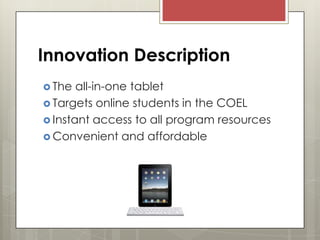
 The

all-in-one tablet
 Targets online students in the COEL
 Instant access to all program resources
 Convenient and affordable
Entrepreneurial Goals & Context
The Innovation Process
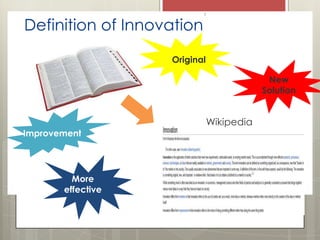
Definition of Innovation

5

Original
New
Solution

Wikipedia
Improvement

More
effective




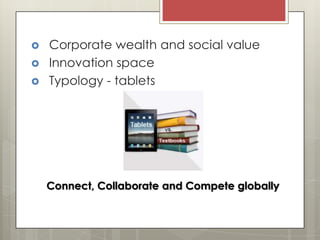
Corporate wealth and social value
Innovation space
Typology - tablets

Connect, Collaborate and Compete globally
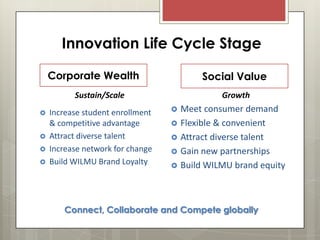
Innovation Life Cycle Stage
Corporate Wealth

Social Value

Sustain/Scale





Increase student enrollment
& competitive advantage
Attract diverse talent
Increase network for change
Build WILMU Brand Loyalty

Growth







Meet consumer demand
Flexible & convenient
Attract diverse talent
Gain new partnerships
Build WILMU brand equity

Connect, Collaborate and Compete globally
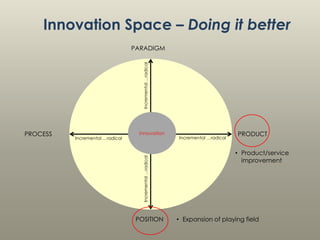
Innovation Space – Doing it better
Incremental …radical

PARADIGM

Incremental …radical

Innovation

Incremental …radical

PROCESS

POSITION

Incremental …radical

PRODUCT
• Product/service
improvement

• Expansion of playing field
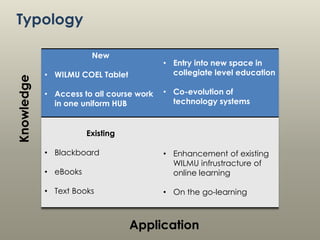
Typology

Knowledge

New
• WILMU COEL Tablet

• Entry into new space in
collegiate level education

• Access to all course work
in one uniform HUB

• Co-evolution of
technology systems

Existing

• Blackboard
• eBooks

• Enhancement of existing
WILMU infrustracture of
online learning

• Text Books

• On the go-learning

Application
Recognizing Opportunity
The Innovation Process
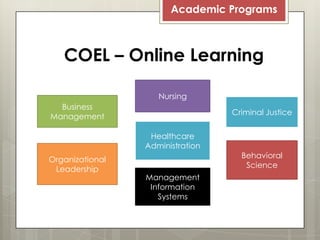
Academic Programs

COEL – Online Learning
Nursing

Business
Management

Criminal Justice
Healthcare
Administration

Organizational
Leadership

Behavioral
Science
Management
Information
Systems
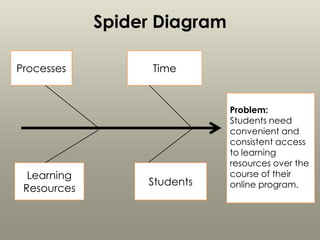
Spider Diagram
Processes

Learning
Resources

Time

Students

Problem:
Students need
convenient and
consistent access
to learning
resources over the
course of their
online program.
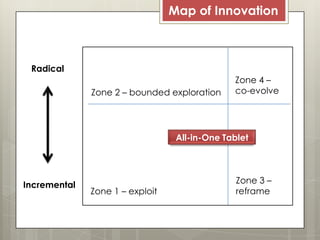
Map of Innovation

Radical

Zone 2 – bounded exploration

Zone 4 –
co-evolve

All-in-One Tablet

Incremental

Zone 1 – exploit

Zone 3 –
reframe
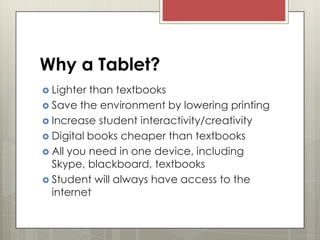
Why a Tablet?
 Lighter

than textbooks
 Save the environment by lowering printing
 Increase student interactivity/creativity
 Digital books cheaper than textbooks
 All you need in one device, including
Skype, blackboard, textbooks
 Student will always have access to the
internet
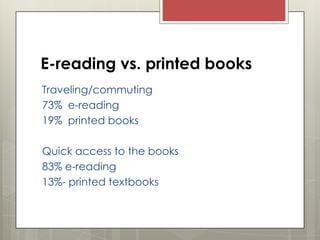
E-reading vs. printed books
Traveling/commuting
73% e-reading
19% printed books
Quick access to the books
83% e-reading
13%- printed textbooks
Assumptions
 Wilmington

University online students will
make this purchase
 Wilmington University has enough
resources to load information/maintain
tablet
 Wilmington University can support this
program at maximum capacity.
Exploiting Our Networks
 Using

the best resources (Apple)
 Path Dependency
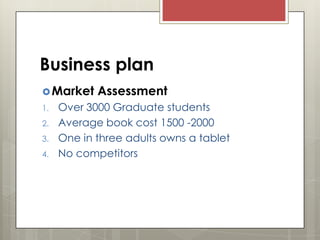
Business plan
 Market
1.
2.
3.
4.

Assessment

Over 3000 Graduate students
Average book cost 1500 -2000
One in three adults owns a tablet
No competitors
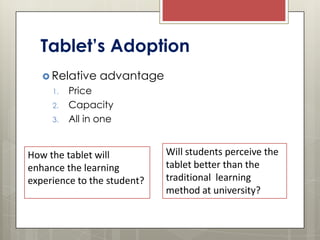
Tablet’s Adoption
 Relative
1.
2.
3.

advantage

Price
Capacity
All in one

How the tablet will
enhance the learning
experience to the student?

Will students perceive the
tablet better than the
traditional learning
method at university?
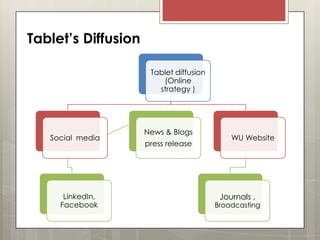
Tablet’s Diffusion
Tablet diffusion
(Online
strategy )

Social media

LinkedIn,
Facebook

News & Blogs
press release

WU Website

Journals ,

Broadcasting
Reducing Risk
 Monitor

market conditions
 Clear insights into customer wants and needs.
 Offer training and technical supports
 Strategic alliance
Recommendations & Summary

Managing innovation

Editor's Notes

  • #3 The purpose of this presentation is to examine and evaluate the All-in-One tablet using the various tools explored in the course. We’ll begin by providing an overview of the innovation. Next, we apply the tools learned throughout the course using the innovation process model. Finally, we draw conclusions and recommendations based on our analysis.
  • #4 The all-in-one tablet is an innovation that provides convenience and affordability to students enrolled in online classes through Wilmington University’s COEL. The table is designed to deliver to students all the learning resources provided over the course of their academic program including e-texts, publisher websites, software programs, the learning management system, Wilmington’s web portal, Skype, labs and simulations, databases, etc. Students enrolled in the program are given the option of renting the loaded tablet over the course of their program.
  • #12 For the purpose of this project, we have chosen to focus on creating and delivering an innovation to students enrolled in Wilmington University’s COEL. The All-in-One tablet targets students enrolled in online academic programs at Wilmington University who value convenience, affordability and flexibility.There are a variety of undergraduate and graduate programs in the areas of Business, Nursing, Criminal Justice, Homeland Security, Marketing and Organizational Behavior.
  • #13 Before recognizing opportunities, it’s critical to state the problem. In the case of our target audience, we recognize that in any given academic program students are required to purchase, download and access a variety of resources. We’ve identified three possible reasons for this problem. First as students move through their academic programs over time, they often detach from resources previously purchased, downloaded and accessed. Second, there is an assumption that all students have the motivation to purchase, download and access the required resources. There might be students who opt, for example, not to purchase the textbook, visit the publisher’s site or communicate with classmates online. Third, the required resources are voluminous and diverse. Each new course requires one to two new textbooks, workbooks, video lectures, audio lectures, etc. Fourth, the process for gathering the required resources is time-consuming. Many students who download textbooks are permitted access to publisher sites and e-texts, for example, for three short months. Collectively these unmet needs lead to the problem of student detachment from collective resources and knowledge.
  • #14 The all-in-one tablet floats between zones 1 and 3. Zone 1 relates to exploiting current knowledge assets. Because Wilmington University offers online courses, has an established technological infrastructure, and connects students to a variety of technology based products, the all-in-one is not a radical innovation. Zone 3 relates exploring a different way to frame elements in the environment. It relates to exploring different permutations of an established business model. The all-in-one involves reframing the way online students access, create and consume the learning resources in their academic program.
  • #16 Source: Pew Research Center's Internet & American Life Reading Habits Survey, "The Rise of E-Reading," libraries.pewinternet.org, Apr. 4, 2012Amazon announced in July 2010 that e-books were outselling paper books,July 2012 report by the Association of American Publishers showed that e-book revenue exceeded that of hardcover books for the first time ever. 80% of publishers now produce e-books. e-books sales rose 117% from 2010 to 2011,
  • #18 Path dependency, what happens in the past will play a strong role in what we do next