EXPLORING CONCEPTS AND
PRACTICES OF E-LEARNING MICRO-
INNOVATION
Fabio Nascimbeni, UNIR
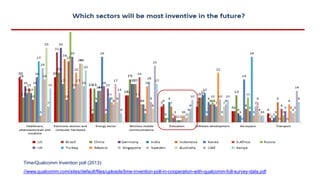
Time/Qualcomm Invention poll (2013):
//www.qualcomm.com/sites/default/files/uploads/time-invention-poll-in-cooperation-with-qualcomm-full-survey-data.pdf
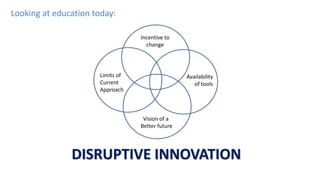
Limits of
Current
Approach
Availability
of tools
Vision of a
Better future
Incentive to
change
DISRUPTIVE INNOVATION
Looking at education today:
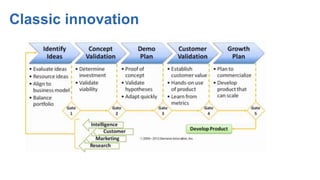
Classic innovation
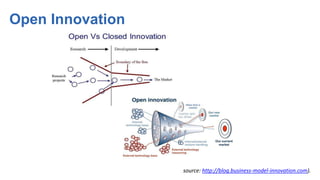
Open Innovation
source: http://blog.business-model-innovation.com).
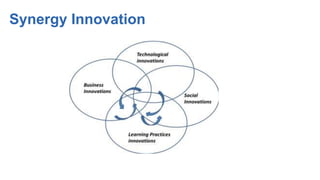
Synergy Innovation
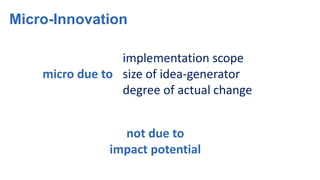
Micro-Innovation
micro due to
implementation scope
size of idea-generator
degree of actual change
not due to
impact potential
VISIR micro-innovations database
• 120 collected cases
• Reflecting 25+ trends
• Top 20 cases selected
Section
Heading
Five examples of VISIR
micro-innovation
practices
Micro-Innovations
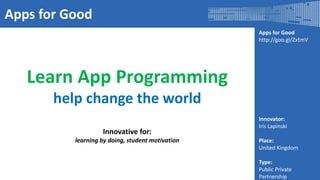
Apps for Good
http://goo.gl/ZxtmV
Innovator:
Iris Lapinski
Place:
United Kingdom
Type:
Public Private
Partnership
Apps for Good
Learn App Programming
help change the world
Innovative for:
learning by doing, student motivation
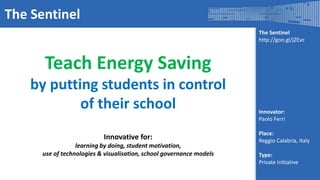
The Sentinel
http://goo.gl/jZEvc
Innovator:
Paolo Ferri
Place:
Reggio Calabria, Italy
Type:
Private Initiative
The Sentinel
Teach Energy Saving
by putting students in control
of their school
Innovative for:
learning by doing, student motivation,
use of technologies & visualisation, school governance models
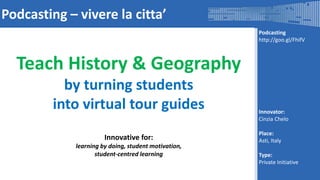
Podcasting
http://goo.gl/FhifV
Innovator:
Cinzia Chelo
Place:
Asti, Italy
Type:
Private Initiative
Podcasting – vivere la citta’
Teach History & Geography
by turning students
into virtual tour guides
Innovative for:
learning by doing, student motivation,
student-centred learning
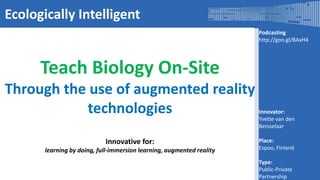
Podcasting
http://goo.gl/BAxH4
Innovator:
Yvette van den
Bersselaar
Place:
Espoo, Finland
Type:
Public-Private
Partnership
Ecologically Intelligent
Teach Biology On-Site
Through the use of augmented reality
technologies
Innovative for:
learning by doing, full-immersion learning, augmented reality
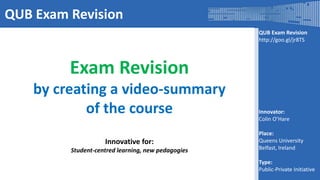
QUB Exam Revision
http://goo.gl/jr8TS
Innovator:
Colin O’Hare
Place:
Queens University
Belfast, Ireland
Type:
Public-Private Initiative
QUB Exam Revision
Exam Revision
by creating a video-summary
of the course
Innovative for:
Student-centred learning, new pedagogies
Section
Heading
Some emerging
observations
Observation 1
Innovators are
not replicating current approaches
Observation 2
Innovators are prizing
interactive approaches
Observation 3
Technology works as an enabler…
it is a means to an end
Observation 4
Public-Private Partnerships
encourage innovation
Observation 5
Many innovations arise
from integration
Observation 6
The lone inventor
is alive and well
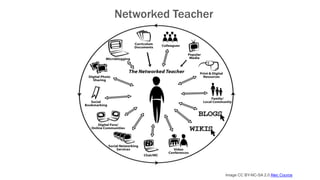
Image CC BY-NC-SA 2.0 Alec Couros
Networked Teacher
www.visir-network.eu

e-learning micro innovation

Editor's Notes

  • #11 Apps for Good is the brainchild of non-profit organisation CDI Europe (part of the CDI global network – CDI was founded with the vision to empower young people to use technology to change the world- ), in partnership with Dell and supported by people and businesses in the tech and creative world including O2, ThomsonReuters and Ogilvy. Apps for Good develops talented and employable young people in an industry with plenty of room for creativity, prosperity and employment. Apps for Good aims to: • Ignite a passion for technology and social enterprise in young people in the UK; • Encourage young people to use technology to tackle problems for social good; • Increase the entrepreneurial skills and confidence of young people; • Bridge the gap between young people and the business networks and knowledge that can help them; • Build a connected world of young people, business volunteers and educators, inspiring each other to solve problems and succeed through the wonders of mobile technology; During the Apps for Good course, students go through a kind of entrepreneurial process whereby they identify what is wrong with their world before designing a way of fixing it with a mobile app. We combine a broad range of areas in the course, giving young people a foundation in entrepreneurship, community involvement, problem-solving and team work, as well as design and some technical skills. - See more at: http://visir-network.eu/innovations/apps-for-good/#sthash.SLUFvgCR.dpuf
  • #12 Imagine a school where students are committed to reduce pollution… how comes? The sentinel is a real energy saving system which puts students in control. The sentinel is a monitoring system for gas, electricity and water, specifically designed for schools. It combines an innovative real-time reading of meters with an exciting training program for professors and students. Because a building can be ancient or modern, efficient or wasteful, primitive or hi-tech. But it is mainly frequented by PEOPLE. And their habits matter a lot. Especially if they are boys and girls, energy consumers of tomorrow. Sensors are based on an Arduino/Raspeberry-like motherboard. They can recognize a led blink (typical of many electricity meters) but can also “read” a mechanical meter (mainly used for gas and water) by means of a camera and an OCR system. They communicate via a dedicated SIM, so they don’t need access to the building LAN or wi-fi. Real-time data acquisition allows interactive session with students. Lights, heating, air conditioning systems can be turned on/off for few minutes at programmed time during the lesson, so students can immediately see the consumption curve changing. Data are visualized via web without any specific software (any internet browser is ok) thus reducing costs and increasing the chance of diffusion (visualization at home or via mobile devices). An Educational kit is provided, tailored on students’ age and level. The Educational kit is composed of 3 parts: Facts About Energy, Energy in My School, Let’s Save Energy!. The last one is achieved by a gaming approach that will engage different schools via social networks, and communication material like stickers, flyers (see video). Finally, data collected allow to detect major energy waste, micro-manage the energy use during the day (if possible) and choose the best (cheapest) energy tariff plan for the school. - See more at: http://visir-network.eu/innovations/the-sentinel/#sthash.sPPHMusS.dpuf
  • #13 The project, run in the framework of the Italian Ministry of Education CL@SSI 2.0 plan, deals with students producing audio/video podcast that describes the city of Asti. Students, by the slogan of “Know, live and tell your own city”, run a number of activities: • Production of audio and video podcasts related to geographical, historical, artistic, environmental and cultural aspects of the city; • Usage of the developed products to promote tourism • Dissemination of the products via “guidance totems” placed in strategic points of the city At the core of the project lied the observation of regular and casual use but often not really conscious of the technological tools by young people. The project aims to promote a strong learning culture able to foster the use of multimedia languages and communication technologies in school activities, with a critical and proactive attitude. The core idea is to integrate traditional knowledge transmission in classroom settings with new practices of shared collaboration and networking, going beyond the usual teaching activity, and to start a process of cultural mediation able to catch every learning occasion (formal and informal) putting young people at the centre main character of the learning process through the development of today required competences. - See more at: http://visir-network.eu/innovations/podcasting/#sthash.cM4p0Ni8.dpuf
  • #14 In the context of biology, a module had to be developed that could be used any time, anywhere and in particular in the school’s wetlands. Books were not an option, because books become dirty, the correct page will not lie open and they’re heavy. By working with Augmented Reality the right information is at the right spot within reach and easily retrievable. The student learns a lot by reading websites, a wiki supplement and viewing photographs, film material and animation. This material will also enable the student with more than just words and help in making practical assignments for hand in their learning platform. Using Layar technology the students are able to get all the different content (i.a. Wiki, photo, animation) they need and hand in assignments digitally in their learning platform. This all by just using a tablet. The students work with Layars, tablets, a wiki and QR tags. This means that the students don’t need books / materials outside and yet have all the information at hand. The learning effects are far greater, because the students can learn ‘on the place’ and are not attached to a classroom. Moreover, the learning module is about the two wetlands that are placed in the garden of the school. But the initiative can be easily used to develop other learning modules; the teachers are trained and the platform and guidance documents are available. - See more at: http://visir-network.eu/innovations/ecologically-intelligent/#sthash.xOJiAZRa.dpuf
  • #15 The aim of the project is to develop an online revision video to take students through the course in a 15 minute session giving them a tool through which they can identify the buzzwords and key points of a topic or module in preparation for the examination. Students use a variety of techniques through which to prepare for examination. The usual route in preparing for an exam is to read over and over the slides / notes for a module. This method ignores the valuable gains in learning via listening to material again and visually absorbing material through video. This tool aims to fill the gap. The video was developed using Camtasia screen capture and by highlighting the slides from the module across the whole semester in a shorter form. the idea was to produce a crisp clear audio and video product but without the visual lecturer / tutor. This could be improved upon by using a laptop with camera to include the lecturer enabling a more animated communication with the students if necessary.
  • #23 2006 diagram created by Alec Couros…. (when uptake of SM was much lower & mobile not as widespread).