The future of pedagogy?
A virtual learning
environment (VLE) is a
software system
designed to help
teachers by facilitating
the management of
educational courses for
their students,
especially by helping
teachers and learners
with course
administration.

Some examples:








usually run on servers, to serve the course to
students via multimedia and/or web pages
usually include templates for content pages,
discussion forums, chat, quizzes and exercises such
as multiple-choice, true/false and one-word-answer
sometimes also called Learning Management
System (LMS), Course Management System (CMS),
Learning Content Management System (LCMS),
Managed Learning Environment (MLE), Learning
Support System (LSS) or Learning Platform (LP)
is a computer program that facilitates computerized
learning or e-learning.









syllabus for the course
details of pre-requisites
and co-requisites, credit
information, and how to
get help
notice board for up-todate course information
student registration and
tracking facilities
basic teaching materials,
may be the complete
content of the course







additional resources,
including reading
materials, and links to
outside resources in
libraries and on the
Internet
self-assessment quizzes
which can be scored
automatically
automatic grading
procedures






communication support
including e-mail,
threaded discussions
and a chat room
differential access rights
for instructors and
students
documentation and
statistics on the course
for institutional
administration and
quality control







facilities are capable of
being hyperlinked
together
easy authoring tools for
creating documents
including the insertion
of hyperlinks
support for numerous
courses, so students and
instructors experience a
consistent interface
when moving from one
course to another




economize on the time
of teachers, especially
when they are also
involved in research,
extension and
administration
provide a service for
students who
increasingly look to the
internet as the natural
medium for finding
information and
resources





ensure that quality
control requirements
are met by providing a
standard vehicle for
collecting the required
information
facilitate the integration
of distance and campusbased learning or of
learning on different
campuses
The following are some
of the major VLEs today:
 Dokeos
 Moodle
 Sakai
 ATutor
 Blackboard
 Claroline
 WebCT

For those wishing to
deliver e-learning there
are many free open
source and proprietary
VLEs available for use.
Most VLEs are placed on
a web server, meaning
they can be accessed by a
web browser with
Internet connection.








Learning Management
System (LMS) software
partially owned by Microsoft
Popular software used
around the world
Licensed annually (HSU
pays approx. $8,600 each
year)
Used at HSU since 2001
Over $1 million spent each
year in the CSU on
Blackboard licenses







“Open source” (free!)
Learning Management
System (LMS) software
Customizable by
programming staff
Flexible for the instructor
and developer
Supported by programmers
world-wide

Question:
Can free software satisfactorily meet the needs of students, faculty, and
instructional technologists for online teaching and learning?











Facilitator's Feedback
Did Blackboard/Moodle
enhance instruction?
Received adequate technical
assistance?
Technology-based activities
developed problem-solving
skills?
Well organized instructional
materials?
Communication tools:
Interaction with classmates?










Communication tools:
Interaction with
instructor?
Web-based resources were
effective learning tools?
Discussion Boards were
easy to use?
Student Comments
Would like another
(Blackboard/Moodle)
course?
Which do you prefer,
Moodle or Blackboard?
PURPOSE OF THE STUDY






To collect and analyze preimplementation data on
course management system
use among University
System faculty.
To use this data to inform
development of support,
services, and training for
faculty to use WebCT Vista.
To use this data to inform
strategies for encouraging
faculty not currently using
CMS to try it.

KEY STUDY QUESTIONS









What is the extent of the
faculty use of CMS on each
campus and system wide?
What factors encourage
faculty to start using a CMS?
What factors determine
whether faculty increase or
decrease their use?
For what purposes are CMS
used?
What are the pedagogical
advantages of using a CMS?
What barriers prevent faculty
from using a CMS?
SURVEY DETAILS










Survey administered
online.
33 of 34 institutions
participated.
Between 25-80% of faculty
at each institution
responded.
Total number of responses
= 3,228
Approximately 37% of all
USG faculty participated.

DEMOGRAPHICS












58.0% of respondents were
tenured/tenure track faculty
16.7% of respondents were
non-tenure track
13.4% of respondents were
part-time faculty
19.6% of respondents were in
Arts/Humanities
13.1% of respondents were in
Social Sciences
10.4% of respondents were in
Math/Computer Science
KEY QUESTIONS






What is the extent of the
faculty use of CMS on
each campus and
system wide?
What factors encourage
faculty to start using a
CMS?
What factors determine
whether faculty increase
or decrease their use?










For what purposes are
CMS used?
What are the
pedagogical advantages
of using a CMS?
What barriers prevent
faculty from using a
CMS?
Conclusions
Future Studies
Go to http://cms.ilahas.com and
register as a new user
Send an email to pabs@ilahas.com and
request for Course Creator rights
State your school, college and/or
university in your request

Wait for a confirmation email
Moodle vs. Blackboard

Moodle vs. Blackboard

  • 1.
    The future ofpedagogy?
  • 2.
    A virtual learning environment(VLE) is a software system designed to help teachers by facilitating the management of educational courses for their students, especially by helping teachers and learners with course administration. Some examples:
  • 3.
        usually run onservers, to serve the course to students via multimedia and/or web pages usually include templates for content pages, discussion forums, chat, quizzes and exercises such as multiple-choice, true/false and one-word-answer sometimes also called Learning Management System (LMS), Course Management System (CMS), Learning Content Management System (LCMS), Managed Learning Environment (MLE), Learning Support System (LSS) or Learning Platform (LP) is a computer program that facilitates computerized learning or e-learning.
  • 4.
         syllabus for thecourse details of pre-requisites and co-requisites, credit information, and how to get help notice board for up-todate course information student registration and tracking facilities basic teaching materials, may be the complete content of the course    additional resources, including reading materials, and links to outside resources in libraries and on the Internet self-assessment quizzes which can be scored automatically automatic grading procedures
  • 5.
       communication support including e-mail, threadeddiscussions and a chat room differential access rights for instructors and students documentation and statistics on the course for institutional administration and quality control    facilities are capable of being hyperlinked together easy authoring tools for creating documents including the insertion of hyperlinks support for numerous courses, so students and instructors experience a consistent interface when moving from one course to another
  • 6.
      economize on thetime of teachers, especially when they are also involved in research, extension and administration provide a service for students who increasingly look to the internet as the natural medium for finding information and resources   ensure that quality control requirements are met by providing a standard vehicle for collecting the required information facilitate the integration of distance and campusbased learning or of learning on different campuses
  • 7.
    The following aresome of the major VLEs today:  Dokeos  Moodle  Sakai  ATutor  Blackboard  Claroline  WebCT For those wishing to deliver e-learning there are many free open source and proprietary VLEs available for use. Most VLEs are placed on a web server, meaning they can be accessed by a web browser with Internet connection.
  • 8.
         Learning Management System (LMS)software partially owned by Microsoft Popular software used around the world Licensed annually (HSU pays approx. $8,600 each year) Used at HSU since 2001 Over $1 million spent each year in the CSU on Blackboard licenses     “Open source” (free!) Learning Management System (LMS) software Customizable by programming staff Flexible for the instructor and developer Supported by programmers world-wide Question: Can free software satisfactorily meet the needs of students, faculty, and instructional technologists for online teaching and learning?
  • 9.
          Facilitator's Feedback Did Blackboard/Moodle enhanceinstruction? Received adequate technical assistance? Technology-based activities developed problem-solving skills? Well organized instructional materials? Communication tools: Interaction with classmates?       Communication tools: Interaction with instructor? Web-based resources were effective learning tools? Discussion Boards were easy to use? Student Comments Would like another (Blackboard/Moodle) course? Which do you prefer, Moodle or Blackboard?
  • 10.
    PURPOSE OF THESTUDY    To collect and analyze preimplementation data on course management system use among University System faculty. To use this data to inform development of support, services, and training for faculty to use WebCT Vista. To use this data to inform strategies for encouraging faculty not currently using CMS to try it. KEY STUDY QUESTIONS       What is the extent of the faculty use of CMS on each campus and system wide? What factors encourage faculty to start using a CMS? What factors determine whether faculty increase or decrease their use? For what purposes are CMS used? What are the pedagogical advantages of using a CMS? What barriers prevent faculty from using a CMS?
  • 11.
    SURVEY DETAILS      Survey administered online. 33of 34 institutions participated. Between 25-80% of faculty at each institution responded. Total number of responses = 3,228 Approximately 37% of all USG faculty participated. DEMOGRAPHICS       58.0% of respondents were tenured/tenure track faculty 16.7% of respondents were non-tenure track 13.4% of respondents were part-time faculty 19.6% of respondents were in Arts/Humanities 13.1% of respondents were in Social Sciences 10.4% of respondents were in Math/Computer Science
  • 12.
    KEY QUESTIONS    What isthe extent of the faculty use of CMS on each campus and system wide? What factors encourage faculty to start using a CMS? What factors determine whether faculty increase or decrease their use?      For what purposes are CMS used? What are the pedagogical advantages of using a CMS? What barriers prevent faculty from using a CMS? Conclusions Future Studies
  • 16.
    Go to http://cms.ilahas.comand register as a new user Send an email to pabs@ilahas.com and request for Course Creator rights State your school, college and/or university in your request Wait for a confirmation email

Editor's Notes

  • #13 The extent of the economy over traditional "talk-and-chalk" teaching is not yet clear, but using a VLE almost certainly absorbs less instructor time (and requires less expertise, while producing a more professional result) than creating a home-grown website for a course.
  • #23 A Comparison of Satisfaction with Online Teaching and Learning Tools, study conducted at Humboldt State University by Bert Bos, Kathy D. Munoz, Professor, Humboldt State University, and Joan Van Duzer, Instructional Technologist, Humboldt State University; 15 February 2005; HSU is the northernmost campus of the California State University system.
  • #42 Tracking Faculty Uses of Online Learning Tools: A Statewide PerspectiveAs part of the GeorgiaVIEW (Vista Implementation Enterprise Wide) project, a study of current faculty uses, experiences, and expectations regarding course management systems (CMS) was conducted.By H. Hilliard Gastfriend and Catherine Finnegan, both Board of Regents of the University System of Georgia.
  • #43 Tracking Faculty Uses of Online Learning Tools: A Statewide PerspectiveAs part of the GeorgiaVIEW (Vista Implementation Enterprise Wide) project, a study of current faculty uses, experiences, and expectations regarding course management systems (CMS) was conducted.By H. Hilliard Gastfriend and Catherine Finnegan, both Board of Regents of the University System of Georgia.
  • #44 Tracking Faculty Uses of Online Learning Tools: A Statewide PerspectiveAs part of the GeorgiaVIEW (Vista Implementation Enterprise Wide) project, a study of current faculty uses, experiences, and expectations regarding course management systems (CMS) was conducted.By H. Hilliard Gastfriend and Catherine Finnegan, both Board of Regents of the University System of Georgia.
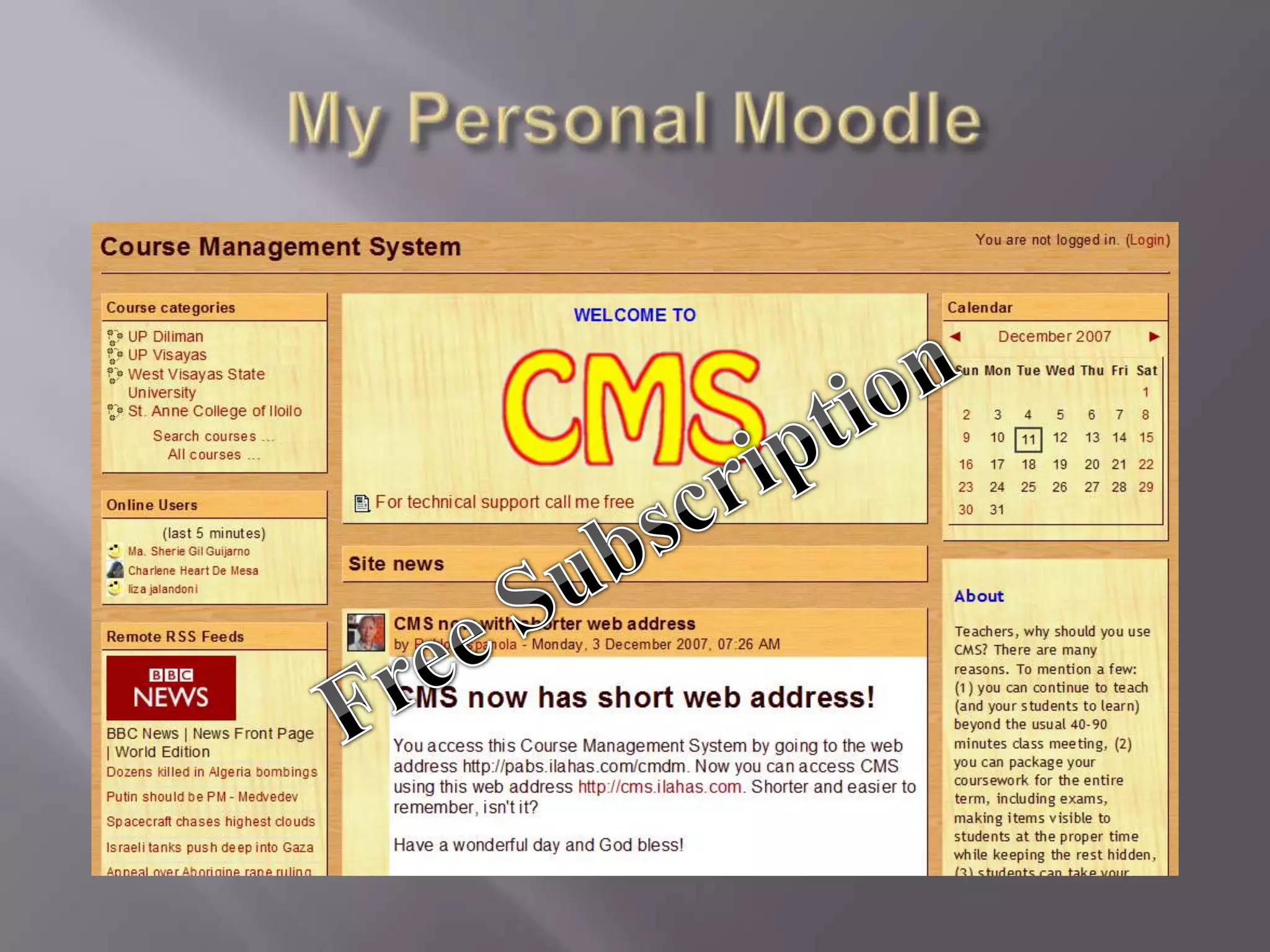
  • #53 This is a course management system that I installed and developed. I started using this in my graduate course in Management 286: Management of Information Systems and Technologies. Moodle was an exact fit for my course as it is in itself an example of Information System in action. However, I saw advantages and benefits in its use in other courses as well.