Management plans
A management plan is a blueprint for the
way the organization is to run, both day-to-
day and also over the long term.
It includes the standard methods for doing
various things -- handling money, dealing with
the actual work of the organization and
addressing the way people in the
organization do their jobs
Factors Influence
Management Plan
What is the organization trying to
accomplish?
What actually needs to get done day-to-day
to keep the organization running?
What are the resources available for
carrying out a management plan?
How does the management plan fit in with
the mission and philosophy of the
organization?
WHY DOES
ORGANIZATIO
N NEED A
MANAGEMENT
PLAN?
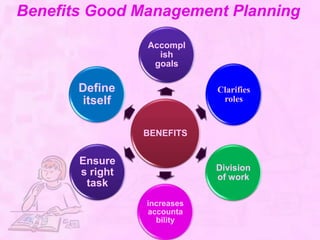
Benefits Good Management Planning
BENEFITS
Accompl
ish
goals
Clarifies
roles
Division
of work
increases
accounta
bility
Ensure
s right
task
Define
itself
Clarifies Roles
It clarifies the roles and responsibilities of
everyone in the organization so that everyone knows
what she and everyone else is supposed to do.
Staff members know whom they need to go to for
information, consultation, supervision, etc. They
also know what the boundaries of their own
positions are -- when they can do something without
checking with someone else, and when they can't.
Division Of Work
It divides the work of
the organization in
reasonable and
equitable ways, so
that everyone's job
is not only defined,
but feasible.
It increases accountability,
both internally (when
something doesn't get
done, it's obvious whose
responsibility it was) and
externally (the better the
management of the
organization, the better it
will serve the community).
Ensures Task
It ensures that necessary tasks are assigned
to the appropriate staff members, and
creates a time schedule to get them
accomplished.
E.G: Bills get paid on time, staff members are
where they're supposed to be to provide the
organization's services, funding proposals
get written and submitted, problems are dealt
with, and as a result the organization
functions smoothly
Define Itself
It helps the organization
define itself. By developing
a plan that's consistent with
its mission and philosophy,
an organization can be clear
on what it believes in and
communicate this with
clarity to its staff, its target
population, and the
community as a whole.
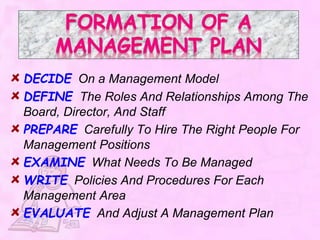
DECIDE On a Management Model
DEFINE The Roles And Relationships Among The
Board, Director, And Staff
PREPARE Carefully To Hire The Right People For
Management Positions
EXAMINE What Needs To Be Managed
WRITE Policies And Procedures For Each
Management Area
EVALUATE And Adjust A Management Plan
DECIDE On a Management
Model
The management philosophy of organization
defines how to view management and how the
organization need to function
If the organization is very small -- one or two
people -- this may simply not be an issue. But if
it's larger, what do you need and want?
It is important that the organization be open,
and that staff and others feel valued, also think
carefully about what kind of model is chosen.
Models of management plans
Classic hierarchy
Democratic
Hierarchy
Collaborative
Collective
DEFINE The Roles And Relationships
Among The Board, Director, And Staff
A classic problem in non-profit organizations
of all sorts is the struggle for power between
the director and the board
Good directors are usually strong individuals,
and good boards are usually made up of
strong individuals. If they all work together,
they can create a powerful organization; if
they wrestle for control, they can handicap, or
even destroy, an organization
PREPARE Carefully To Hire The Right
People For Management Positions
 If you hire an authoritarian as the director of a
collaborative organization, you will have serious
difficulties (no "may" or "might" here). By the same
token, if you hire someone who doesn't clearly
understand what kind of management philosophy
you have in mind, or who isn't capable of fostering
the relationships necessary to make your model
work, it won't work
 Hiring the right people is probably the most
important thing you can do to make sure that the
management plan you've devised is successfully
carried out.
EXAMINE What Needs To Be Managed
Whatever the management looks like, there is
usually some agreement about what in an
organization needs to be managed.
The broad categories are people; money;
supplies and equipment; activities; and
relationships with the outside world (funders,
the media, the community, target population,
etc.)
Each of these categories should have a set of
policies and procedures that addresses
whatever you can think of that might come up
in that area.
WRITE Policies And Procedures For
Each Management Area
Policies are the official rules, structures, and
philosophical principles that guide an
organization. Procedures are the actual ways
in which policies and the work of the
organization are carried out. (Equal
opportunity in hiring, particularly with regard
to minority candidates, might be a policy of an
organization
WRITE Policies And Procedures For
Each Management Area
Advertising in urban newspapers, adding "Minority
candidates encouraged to apply" to all job adds and
postings, and specifically searching out possible
minority candidates are procedures that carry out
this policy.)
It makes life in an organization much easier for
everyone -- and much less subject to legal and
other challenges -- if policies and procedures for
every aspect of its functioning are spelled out as
clearly as possible, and everyone has access to
them.
No plan of any sort is complete without a
mechanism for evaluating and improving on
it.
This is especially true for a management
plan, which may be the foundation for an
organization's success or failure.
 If a management plan works well in
practice, then it's likely that staff will be
reasonably happy and the organization's
work will get done well.
Management plans

Management plans

  • 1.
  • 2.
    A management planis a blueprint for the way the organization is to run, both day-to- day and also over the long term. It includes the standard methods for doing various things -- handling money, dealing with the actual work of the organization and addressing the way people in the organization do their jobs
  • 3.
    Factors Influence Management Plan Whatis the organization trying to accomplish? What actually needs to get done day-to-day to keep the organization running? What are the resources available for carrying out a management plan? How does the management plan fit in with the mission and philosophy of the organization?
  • 4.
    WHY DOES ORGANIZATIO N NEEDA MANAGEMENT PLAN?
  • 5.
    Benefits Good ManagementPlanning BENEFITS Accompl ish goals Clarifies roles Division of work increases accounta bility Ensure s right task Define itself
  • 6.
    Clarifies Roles It clarifiesthe roles and responsibilities of everyone in the organization so that everyone knows what she and everyone else is supposed to do. Staff members know whom they need to go to for information, consultation, supervision, etc. They also know what the boundaries of their own positions are -- when they can do something without checking with someone else, and when they can't.
  • 7.
    Division Of Work Itdivides the work of the organization in reasonable and equitable ways, so that everyone's job is not only defined, but feasible.
  • 8.
    It increases accountability, bothinternally (when something doesn't get done, it's obvious whose responsibility it was) and externally (the better the management of the organization, the better it will serve the community).
  • 9.
    Ensures Task It ensuresthat necessary tasks are assigned to the appropriate staff members, and creates a time schedule to get them accomplished. E.G: Bills get paid on time, staff members are where they're supposed to be to provide the organization's services, funding proposals get written and submitted, problems are dealt with, and as a result the organization functions smoothly
  • 10.
    Define Itself It helpsthe organization define itself. By developing a plan that's consistent with its mission and philosophy, an organization can be clear on what it believes in and communicate this with clarity to its staff, its target population, and the community as a whole.
  • 11.
    DECIDE On aManagement Model DEFINE The Roles And Relationships Among The Board, Director, And Staff PREPARE Carefully To Hire The Right People For Management Positions EXAMINE What Needs To Be Managed WRITE Policies And Procedures For Each Management Area EVALUATE And Adjust A Management Plan
  • 12.
    DECIDE On aManagement Model The management philosophy of organization defines how to view management and how the organization need to function If the organization is very small -- one or two people -- this may simply not be an issue. But if it's larger, what do you need and want? It is important that the organization be open, and that staff and others feel valued, also think carefully about what kind of model is chosen.
  • 13.
    Models of managementplans Classic hierarchy Democratic Hierarchy Collaborative Collective
  • 14.
    DEFINE The RolesAnd Relationships Among The Board, Director, And Staff A classic problem in non-profit organizations of all sorts is the struggle for power between the director and the board Good directors are usually strong individuals, and good boards are usually made up of strong individuals. If they all work together, they can create a powerful organization; if they wrestle for control, they can handicap, or even destroy, an organization
  • 15.
    PREPARE Carefully ToHire The Right People For Management Positions  If you hire an authoritarian as the director of a collaborative organization, you will have serious difficulties (no "may" or "might" here). By the same token, if you hire someone who doesn't clearly understand what kind of management philosophy you have in mind, or who isn't capable of fostering the relationships necessary to make your model work, it won't work  Hiring the right people is probably the most important thing you can do to make sure that the management plan you've devised is successfully carried out.
  • 16.
    EXAMINE What NeedsTo Be Managed Whatever the management looks like, there is usually some agreement about what in an organization needs to be managed. The broad categories are people; money; supplies and equipment; activities; and relationships with the outside world (funders, the media, the community, target population, etc.) Each of these categories should have a set of policies and procedures that addresses whatever you can think of that might come up in that area.
  • 17.
    WRITE Policies AndProcedures For Each Management Area Policies are the official rules, structures, and philosophical principles that guide an organization. Procedures are the actual ways in which policies and the work of the organization are carried out. (Equal opportunity in hiring, particularly with regard to minority candidates, might be a policy of an organization
  • 18.
    WRITE Policies AndProcedures For Each Management Area Advertising in urban newspapers, adding "Minority candidates encouraged to apply" to all job adds and postings, and specifically searching out possible minority candidates are procedures that carry out this policy.) It makes life in an organization much easier for everyone -- and much less subject to legal and other challenges -- if policies and procedures for every aspect of its functioning are spelled out as clearly as possible, and everyone has access to them.
  • 19.
    No plan ofany sort is complete without a mechanism for evaluating and improving on it. This is especially true for a management plan, which may be the foundation for an organization's success or failure.  If a management plan works well in practice, then it's likely that staff will be reasonably happy and the organization's work will get done well.