DR SHYAMA PRASAD MUKHERJEE
UNIVERSITY, RANCHI
DEPARTMENT OF FISHERIES SCIENCE
PRESENTATION ON
MANAGEMENT OF
ORNAMENTAL FISH FARM
PRESENTING TO:
PUJA MAM
NAMRATA MAM
PRESDENTED BY:
NAME: SAURABH KUMAR
ROLL NO: 22B20004
SEMESTER: 5TH
SESSION: 2022-25
FISH & FISHERIES DEPARTMENT
CONTENTS
 INTRODUCTION
TYPES OF PONDS
PARAMETERS FOR ORNAMNETAL FISH CULTURE
SITE SELECTION
DESIGN OF FISH FARM
WATER QUALITY
EQUIPMENTS FOR FARMS
SELECTION OF FISH SPECIES
FEED MANAGEMENT
FISH ADDITIVES
QUARANTINE POND
MONITORING OF ALL PARAMETERS
TOP TEN EXPORTER & IMPORTER COUNTRIES
PRESENT STATUS OF ORNAMENTAL FISH CULTURE IN INDIA
FUTURE EXPECTATIONS & WARNINGS
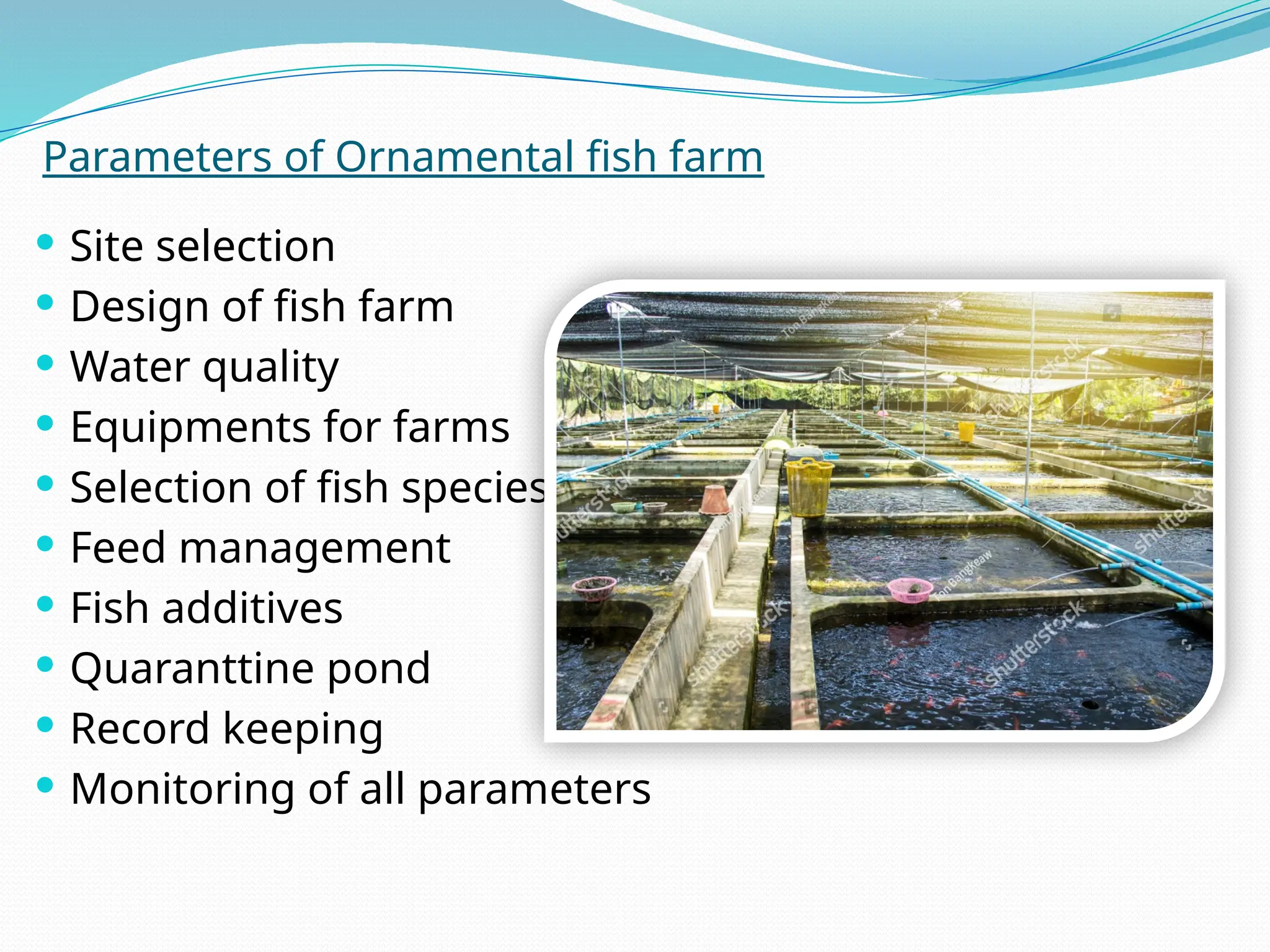
Parameters of Ornamental fish farm
 Site selection
 Design of fish farm
 Water quality
 Equipments for farms
 Selection of fish species
 Feed management
 Fish additives
 Quaranttine pond
 Record keeping
 Monitoring of all parameters
Ornamental fish farming involves the breeding and raising of
colorful, non-edible fish for the aquarium trade. It's a blend of
aquaculture and business, focused on producing and selling
aesthetically pleasing aquatic pets.
Management of fish farm is based on the purposes of farm
whether it is for fishing, wildlife,swimming or other purposes.
Fish farms are basically a three tier culture system where the
first step begins with the rearing of spawn up to fry stage in
nursery ponds followed by rearing pond before releasing
them into stocking ponds for growing up to table size fish.
Ponds are of three types:
Nursery Pond
Rearing Pond
Stocking Pond
INTRODUCTION
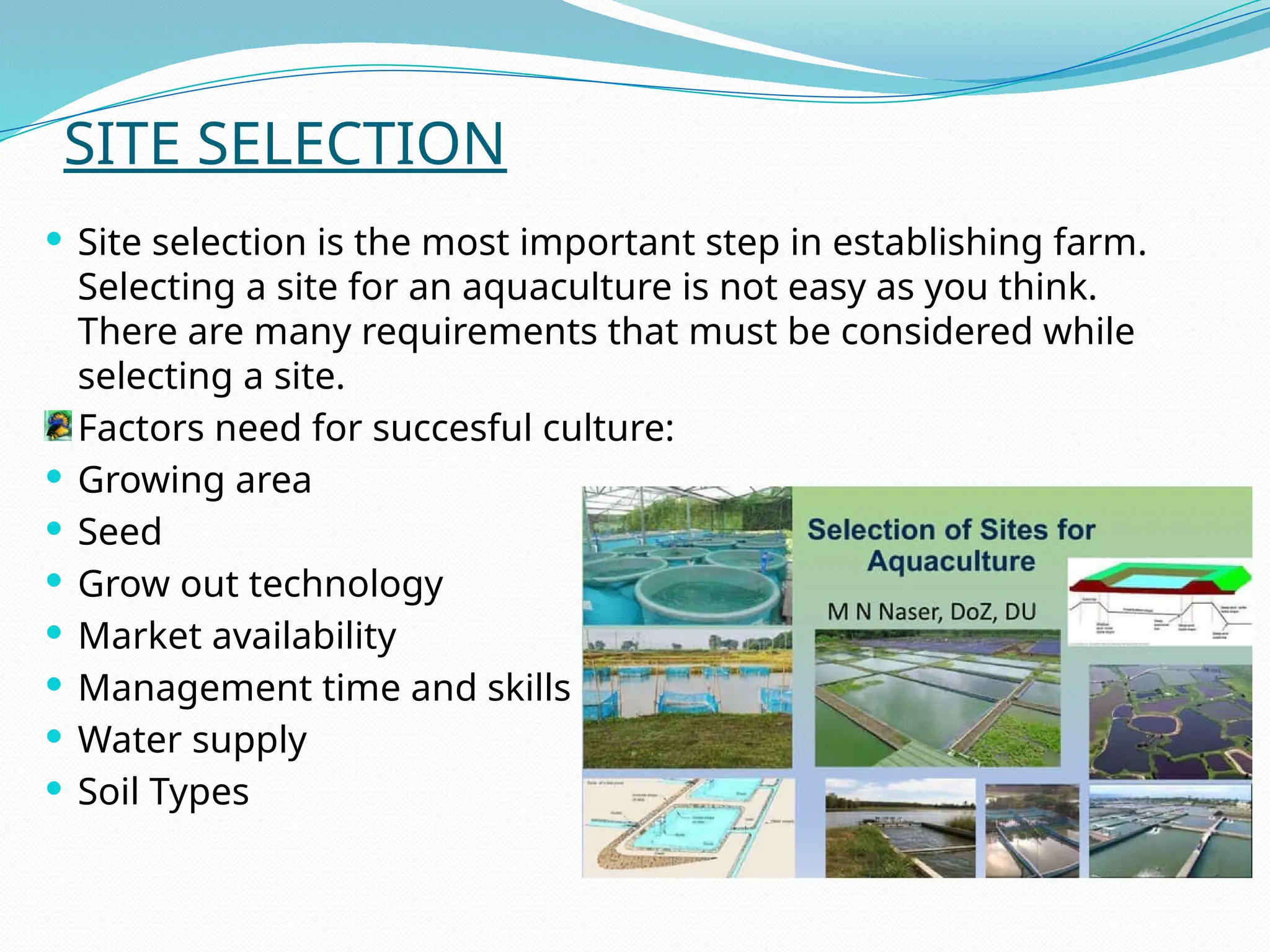
SITE SELECTION
 Site selection is the most important step in establishing farm.
Selecting a site for an aquaculture is not easy as you think.
There are many requirements that must be considered while
selecting a site.
Factors need for succesful culture:
 Growing area
 Seed
 Grow out technology
 Market availability
 Management time and skills
 Water supply
 Soil Types
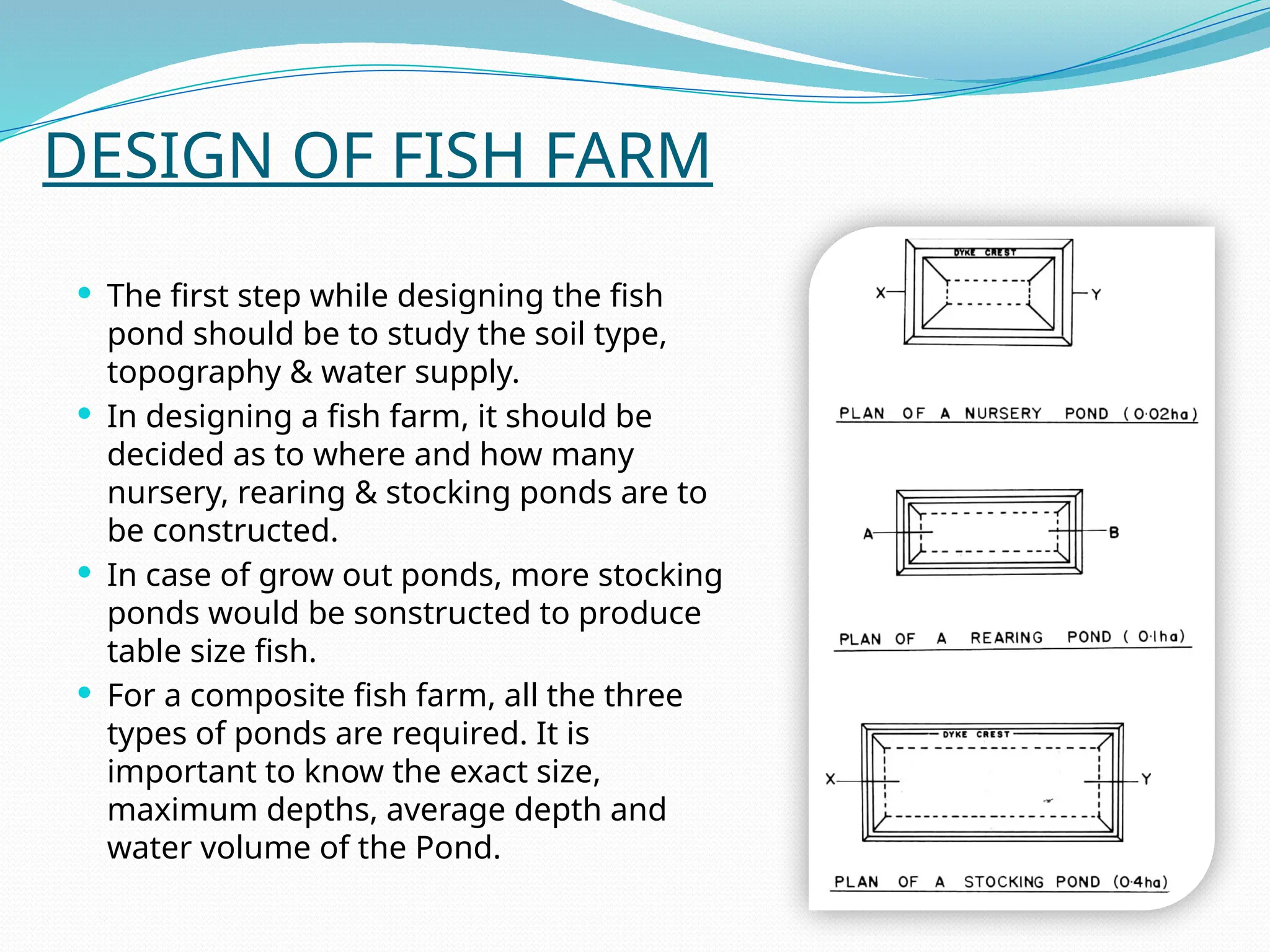
DESIGN OF FISH FARM
 The first step while designing the fish
pond should be to study the soil type,
topography & water supply.
 In designing a fish farm, it should be
decided as to where and how many
nursery, rearing & stocking ponds are to
be constructed.
 In case of grow out ponds, more stocking
ponds would be sonstructed to produce
table size fish.
 For a composite fish farm, all the three
types of ponds are required. It is
important to know the exact size,
maximum depths, average depth and
water volume of the Pond.
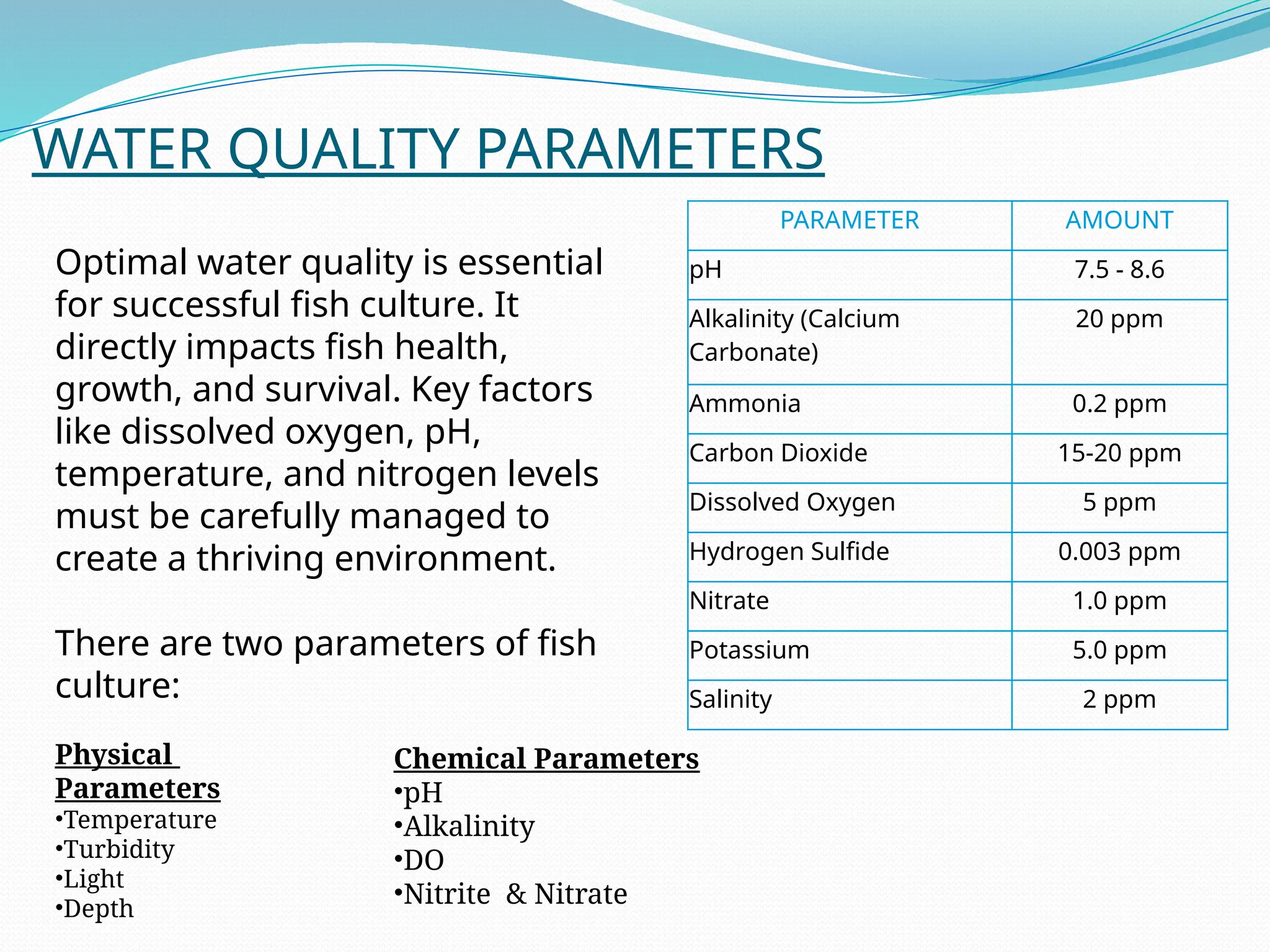
WATER QUALITY PARAMETERS
PARAMETER AMOUNT
pH 7.5 - 8.6
Alkalinity (Calcium
Carbonate)
20 ppm
Ammonia 0.2 ppm
Carbon Dioxide 15-20 ppm
Dissolved Oxygen 5 ppm
Hydrogen Sulfide 0.003 ppm
Nitrate 1.0 ppm
Potassium 5.0 ppm
Salinity 2 ppm
Optimal water quality is essential
for successful fish culture. It
directly impacts fish health,
growth, and survival. Key factors
like dissolved oxygen, pH,
temperature, and nitrogen levels
must be carefully managed to
create a thriving environment.
There are two parameters of fish
culture:
Physical
Parameters
•Temperature
•Turbidity
•Light
•Depth
Chemical Parameters
•pH
•Alkalinity
•DO
•Nitrite & Nitrate
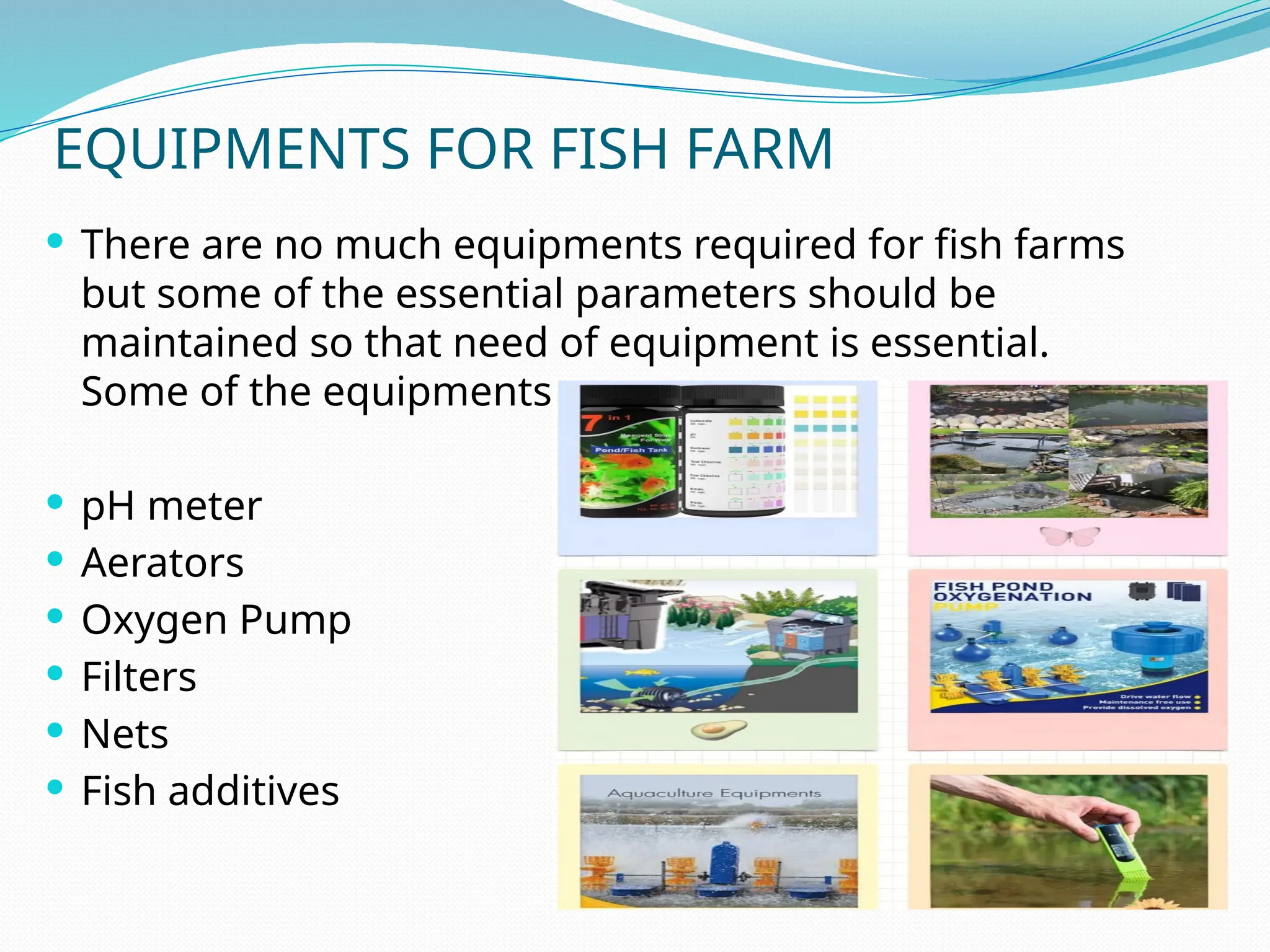
EQUIPMENTS FOR FISH FARM
 There are no much equipments required for fish farms
but some of the essential parameters should be
maintained so that need of equipment is essential.
Some of the equipments are:
 pH meter
 Aerators
 Oxygen Pump
 Filters
 Nets
 Fish additives
SELECTION OF FISH SPECIES
Selected species should be attractive and brightly
coloured.
Selected species should be compatible with each other.
They should be actively swimming.
Only 5-6 fish species should be cultured together.
Fishes introdued to the pond should be disease free and
should be collected from reliable source.
Fishes that are sluggish should be avoided.
Fish species should be of different feeding habit.
Should have fast growth rate.
Ability to feed on natural and artificial diet.
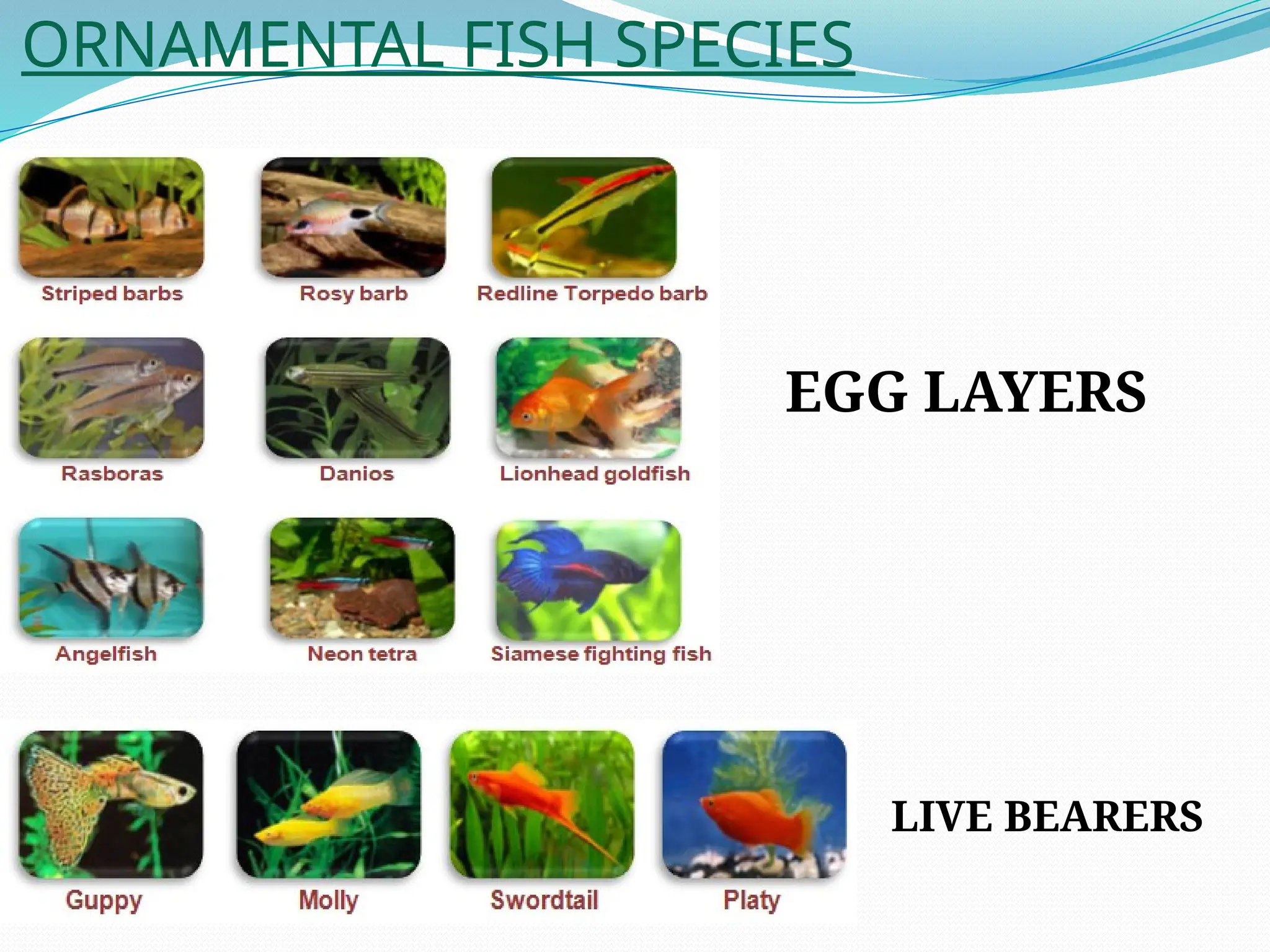
ORNAMENTAL FISH SPECIES
EGG LAYERS
LIVE BEARERS
FEED MANAGEMENT
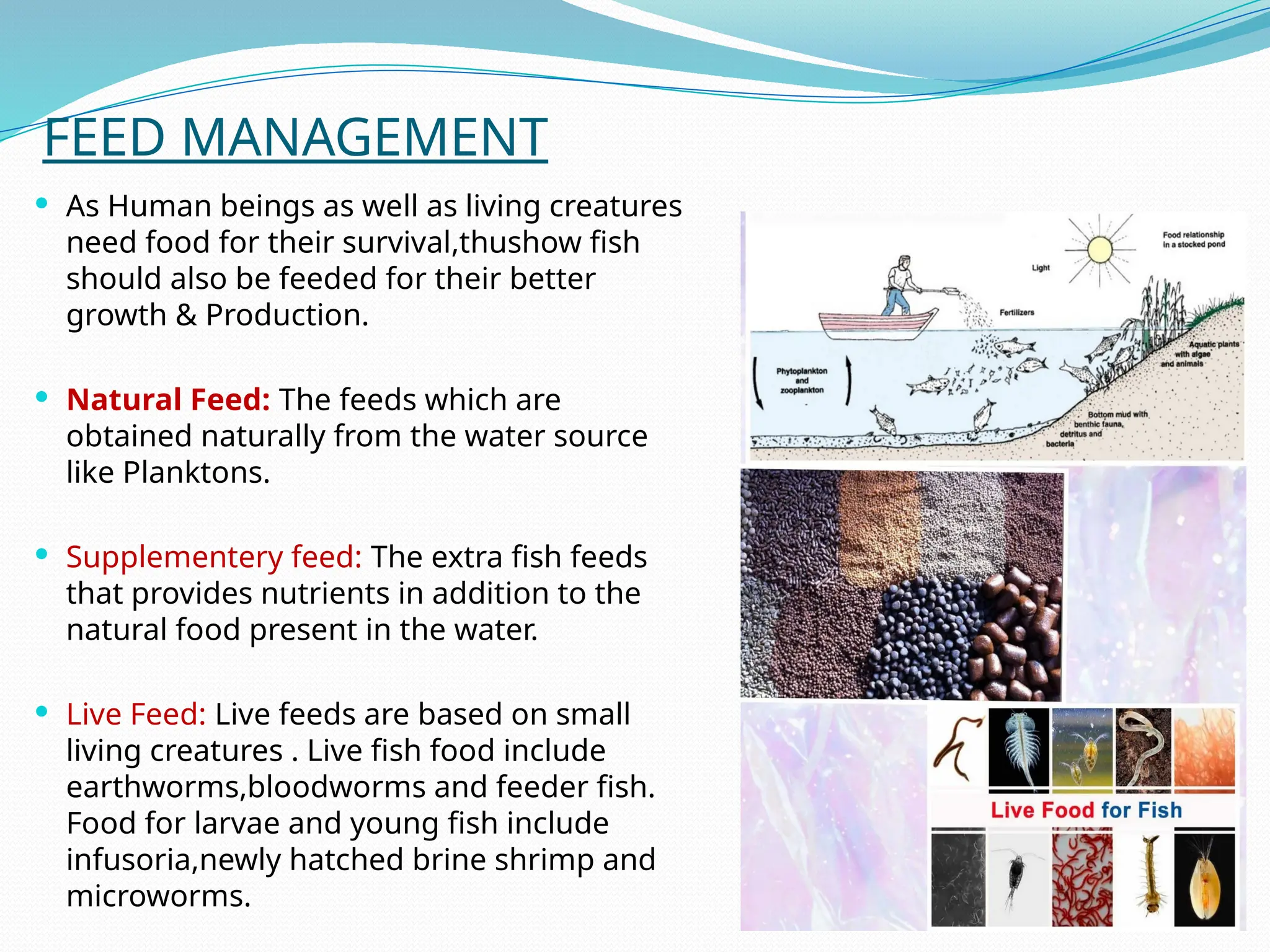
 As Human beings as well as living creatures
need food for their survival,thushow fish
should also be feeded for their better
growth & Production.
 Natural Feed: The feeds which are
obtained naturally from the water source
like Planktons.
 Supplementery feed: The extra fish feeds
that provides nutrients in addition to the
natural food present in the water.
 Live Feed: Live feeds are based on small
living creatures . Live fish food include
earthworms,bloodworms and feeder fish.
Food for larvae and young fish include
infusoria,newly hatched brine shrimp and
microworms.
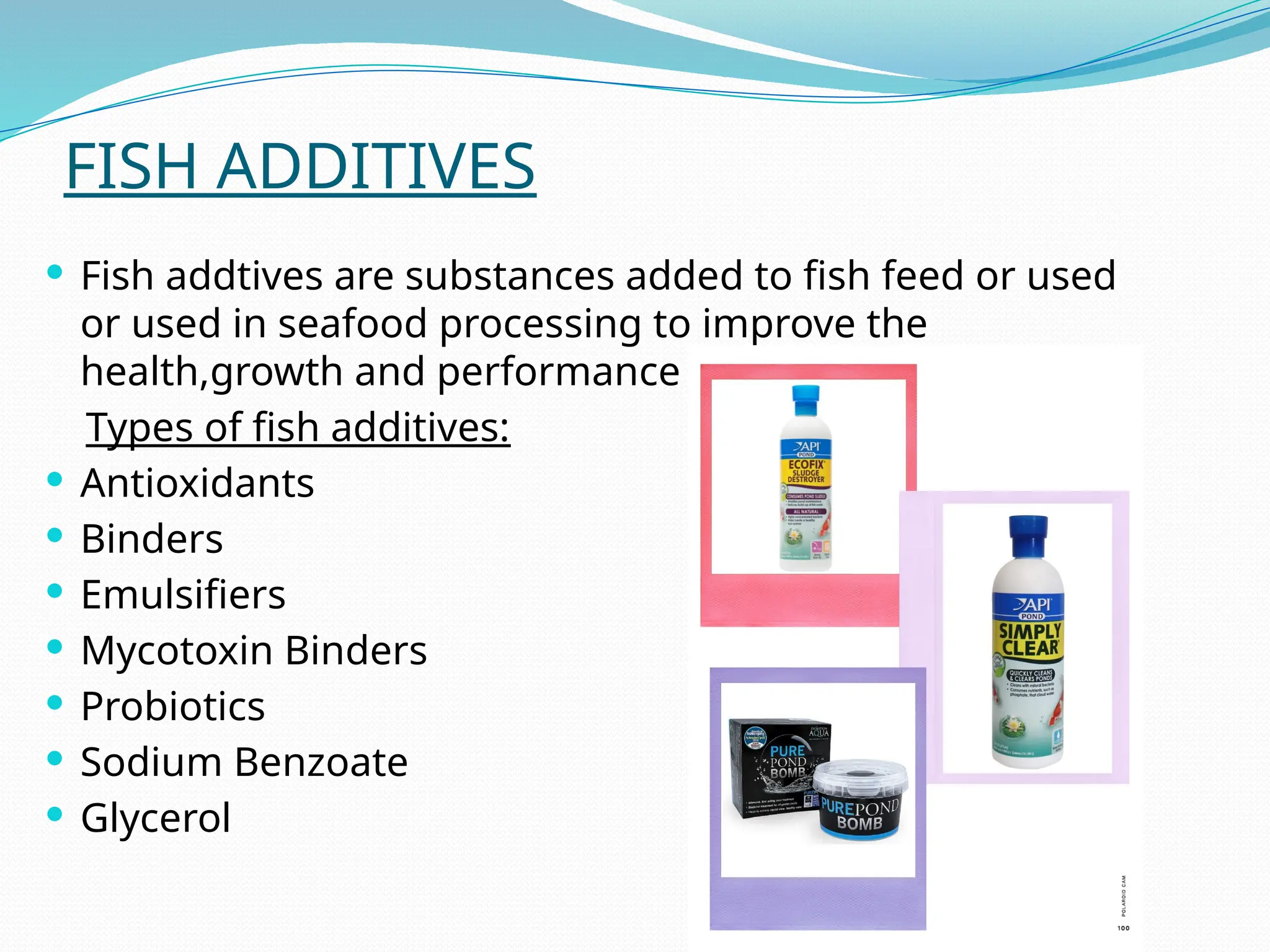
FISH ADDITIVES
 Fish addtives are substances added to fish feed or used
or used in seafood processing to improve the
health,growth and performance of fish.
Types of fish additives:
 Antioxidants
 Binders
 Emulsifiers
 Mycotoxin Binders
 Probiotics
 Sodium Benzoate
 Glycerol
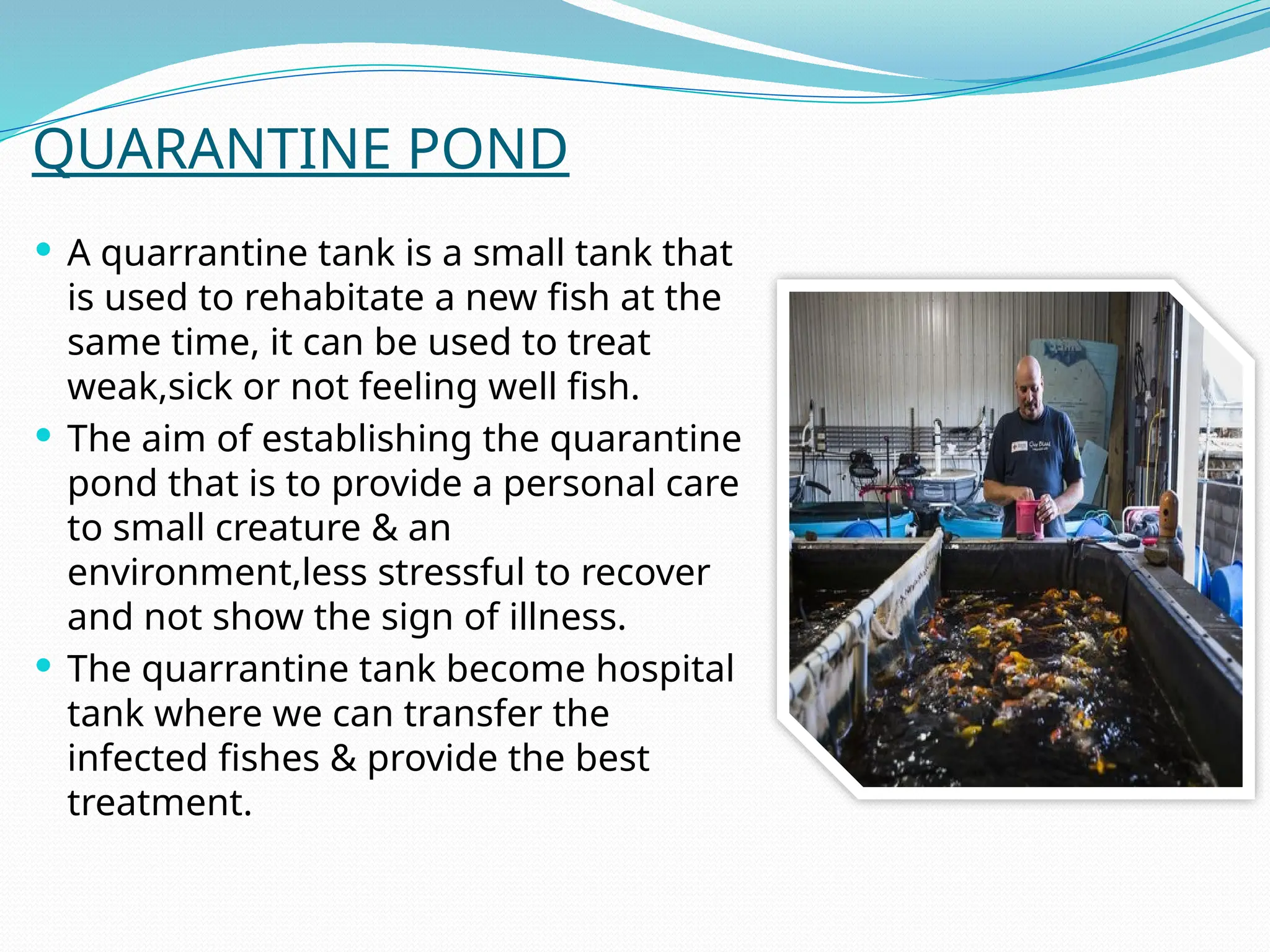
QUARANTINE POND
 A quarrantine tank is a small tank that
is used to rehabitate a new fish at the
same time, it can be used to treat
weak,sick or not feeling well fish.
 The aim of establishing the quarantine
pond that is to provide a personal care
to small creature & an
environment,less stressful to recover
and not show the sign of illness.
 The quarrantine tank become hospital
tank where we can transfer the
infected fishes & provide the best
treatment.
MONITORING OF ALL PARAMETERS
 Record keeping can help you track the fish health,
feeding and maintenance.
 It involves the regular & steady supply of nutrient for
sustained production of fish feed organisms,
The parameters should be monitored are:
 Nature of Pond
 Water Colour
 Water transparency
 Oxygen Level
 Feeding
 Disease identification
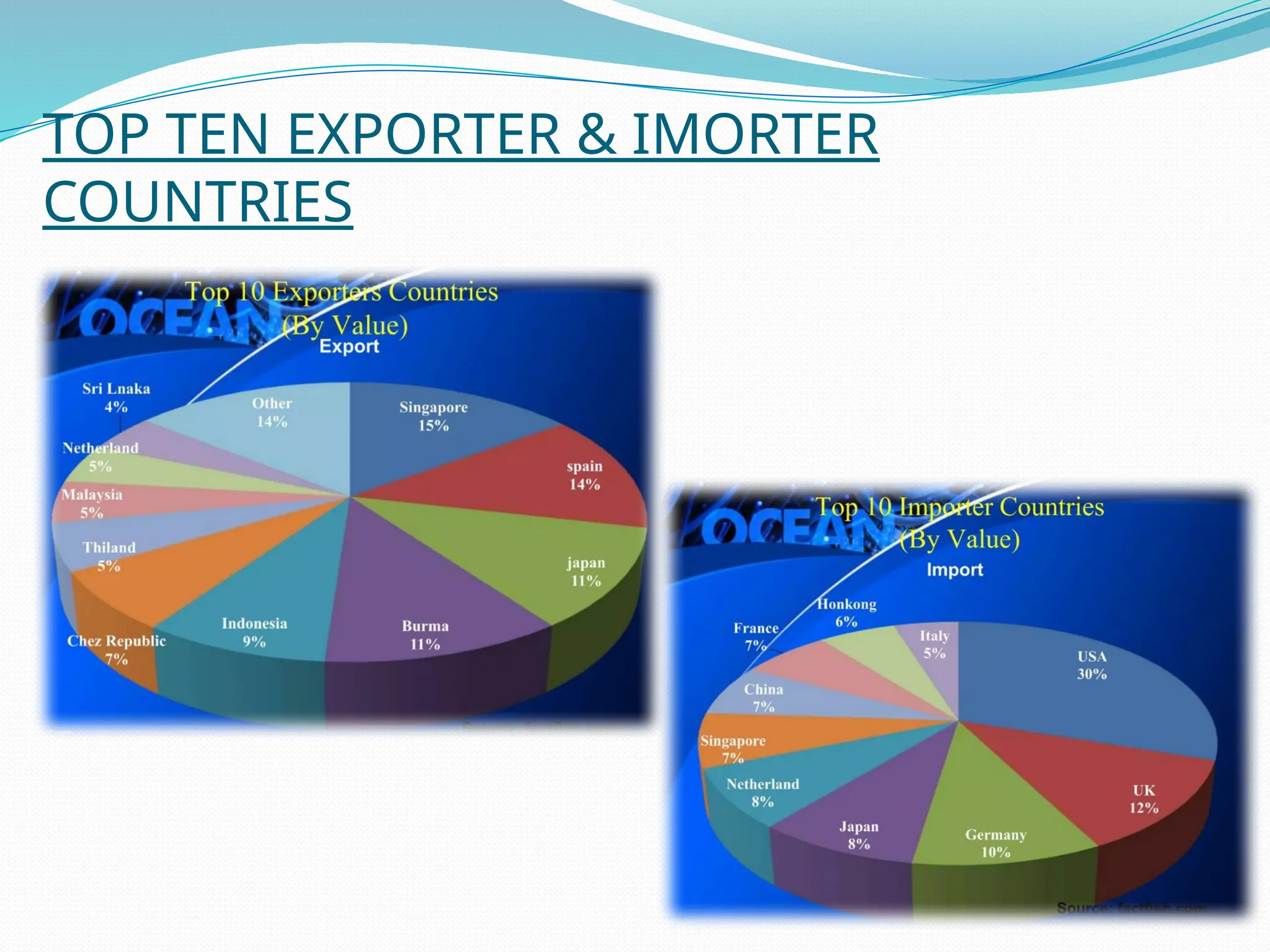
TOP TEN EXPORTER & IMORTER
COUNTRIES
FUTURE EXPECTATIONS & WARNING
 The market continues to grow and new markets
will come up.
 Increase variety and species of ornamental fishes.
 Install a good fish health management plan.
 Investment in bio-security becomes an obligation.
 Important to plan good welfare for all our aquatic
creatures.
PRESENT STATUS OF ORNAMNETAL FISH CULTURE IN
INDIA
 In India freshwater ornamental fish trade 98% are
cultured and 2% captured wild.
 Marine ornamental fish - 98% are capture and 2% from
cultured stock.
 There are around 600 varieties of fishes available in the
market with mollies, catfish, angel fish, giant gouramis
and Indian Golden fish, are the fast moving fishes
transported to Kolkata, Hyderabad, Kochi, and other
places in India, and also it's sold in the local markets.
 India ranked 66th in global import of ornamental fishery
and ranked 31th in export of ornamental fishes by value
(2017).
CONCLUSION
Ornamental fish farming demands a blend of
scientific knowledge, practical skills, and sound
business acumen. By prioritizing fish health,
maintaining optimal environmental conditions,
and implementing effective management
practices, farmers can create a thriving and
sustainable business. Continuous learning and
adaptation to new technologies and market
trends are also essential for long-term success…

THANK
YOU

Management Of Ornamental Fish Farming System

  • 2.
    DR SHYAMA PRASADMUKHERJEE UNIVERSITY, RANCHI DEPARTMENT OF FISHERIES SCIENCE PRESENTATION ON MANAGEMENT OF ORNAMENTAL FISH FARM PRESENTING TO: PUJA MAM NAMRATA MAM PRESDENTED BY: NAME: SAURABH KUMAR ROLL NO: 22B20004 SEMESTER: 5TH SESSION: 2022-25 FISH & FISHERIES DEPARTMENT
  • 3.
    CONTENTS  INTRODUCTION TYPES OFPONDS PARAMETERS FOR ORNAMNETAL FISH CULTURE SITE SELECTION DESIGN OF FISH FARM WATER QUALITY EQUIPMENTS FOR FARMS SELECTION OF FISH SPECIES FEED MANAGEMENT FISH ADDITIVES QUARANTINE POND MONITORING OF ALL PARAMETERS TOP TEN EXPORTER & IMPORTER COUNTRIES PRESENT STATUS OF ORNAMENTAL FISH CULTURE IN INDIA FUTURE EXPECTATIONS & WARNINGS
  • 4.
    Parameters of Ornamentalfish farm  Site selection  Design of fish farm  Water quality  Equipments for farms  Selection of fish species  Feed management  Fish additives  Quaranttine pond  Record keeping  Monitoring of all parameters
  • 5.
    Ornamental fish farminginvolves the breeding and raising of colorful, non-edible fish for the aquarium trade. It's a blend of aquaculture and business, focused on producing and selling aesthetically pleasing aquatic pets. Management of fish farm is based on the purposes of farm whether it is for fishing, wildlife,swimming or other purposes. Fish farms are basically a three tier culture system where the first step begins with the rearing of spawn up to fry stage in nursery ponds followed by rearing pond before releasing them into stocking ponds for growing up to table size fish. Ponds are of three types: Nursery Pond Rearing Pond Stocking Pond INTRODUCTION
  • 6.
    SITE SELECTION  Siteselection is the most important step in establishing farm. Selecting a site for an aquaculture is not easy as you think. There are many requirements that must be considered while selecting a site. Factors need for succesful culture:  Growing area  Seed  Grow out technology  Market availability  Management time and skills  Water supply  Soil Types
  • 7.
    DESIGN OF FISHFARM  The first step while designing the fish pond should be to study the soil type, topography & water supply.  In designing a fish farm, it should be decided as to where and how many nursery, rearing & stocking ponds are to be constructed.  In case of grow out ponds, more stocking ponds would be sonstructed to produce table size fish.  For a composite fish farm, all the three types of ponds are required. It is important to know the exact size, maximum depths, average depth and water volume of the Pond.
  • 8.
    WATER QUALITY PARAMETERS PARAMETERAMOUNT pH 7.5 - 8.6 Alkalinity (Calcium Carbonate) 20 ppm Ammonia 0.2 ppm Carbon Dioxide 15-20 ppm Dissolved Oxygen 5 ppm Hydrogen Sulfide 0.003 ppm Nitrate 1.0 ppm Potassium 5.0 ppm Salinity 2 ppm Optimal water quality is essential for successful fish culture. It directly impacts fish health, growth, and survival. Key factors like dissolved oxygen, pH, temperature, and nitrogen levels must be carefully managed to create a thriving environment. There are two parameters of fish culture: Physical Parameters •Temperature •Turbidity •Light •Depth Chemical Parameters •pH •Alkalinity •DO •Nitrite & Nitrate
  • 9.
    EQUIPMENTS FOR FISHFARM  There are no much equipments required for fish farms but some of the essential parameters should be maintained so that need of equipment is essential. Some of the equipments are:  pH meter  Aerators  Oxygen Pump  Filters  Nets  Fish additives
  • 10.
    SELECTION OF FISHSPECIES Selected species should be attractive and brightly coloured. Selected species should be compatible with each other. They should be actively swimming. Only 5-6 fish species should be cultured together. Fishes introdued to the pond should be disease free and should be collected from reliable source. Fishes that are sluggish should be avoided. Fish species should be of different feeding habit. Should have fast growth rate. Ability to feed on natural and artificial diet.
  • 11.
    ORNAMENTAL FISH SPECIES EGGLAYERS LIVE BEARERS
  • 12.
    FEED MANAGEMENT  AsHuman beings as well as living creatures need food for their survival,thushow fish should also be feeded for their better growth & Production.  Natural Feed: The feeds which are obtained naturally from the water source like Planktons.  Supplementery feed: The extra fish feeds that provides nutrients in addition to the natural food present in the water.  Live Feed: Live feeds are based on small living creatures . Live fish food include earthworms,bloodworms and feeder fish. Food for larvae and young fish include infusoria,newly hatched brine shrimp and microworms.
  • 13.
    FISH ADDITIVES  Fishaddtives are substances added to fish feed or used or used in seafood processing to improve the health,growth and performance of fish. Types of fish additives:  Antioxidants  Binders  Emulsifiers  Mycotoxin Binders  Probiotics  Sodium Benzoate  Glycerol
  • 14.
    QUARANTINE POND  Aquarrantine tank is a small tank that is used to rehabitate a new fish at the same time, it can be used to treat weak,sick or not feeling well fish.  The aim of establishing the quarantine pond that is to provide a personal care to small creature & an environment,less stressful to recover and not show the sign of illness.  The quarrantine tank become hospital tank where we can transfer the infected fishes & provide the best treatment.
  • 15.
    MONITORING OF ALLPARAMETERS  Record keeping can help you track the fish health, feeding and maintenance.  It involves the regular & steady supply of nutrient for sustained production of fish feed organisms, The parameters should be monitored are:  Nature of Pond  Water Colour  Water transparency  Oxygen Level  Feeding  Disease identification
  • 16.
    TOP TEN EXPORTER& IMORTER COUNTRIES
  • 17.
    FUTURE EXPECTATIONS &WARNING  The market continues to grow and new markets will come up.  Increase variety and species of ornamental fishes.  Install a good fish health management plan.  Investment in bio-security becomes an obligation.  Important to plan good welfare for all our aquatic creatures.
  • 18.
    PRESENT STATUS OFORNAMNETAL FISH CULTURE IN INDIA  In India freshwater ornamental fish trade 98% are cultured and 2% captured wild.  Marine ornamental fish - 98% are capture and 2% from cultured stock.  There are around 600 varieties of fishes available in the market with mollies, catfish, angel fish, giant gouramis and Indian Golden fish, are the fast moving fishes transported to Kolkata, Hyderabad, Kochi, and other places in India, and also it's sold in the local markets.  India ranked 66th in global import of ornamental fishery and ranked 31th in export of ornamental fishes by value (2017).
  • 19.
    CONCLUSION Ornamental fish farmingdemands a blend of scientific knowledge, practical skills, and sound business acumen. By prioritizing fish health, maintaining optimal environmental conditions, and implementing effective management practices, farmers can create a thriving and sustainable business. Continuous learning and adaptation to new technologies and market trends are also essential for long-term success…
  • 20.