NATURE AND SIGNIFICANCE
OF MANAGEMENT
Introduction
• Since primitive era of stone age, hunting, fishing etc. activities
• Maximum satisfaction using minimum resources
• Co-operation amongst team members
• Sole proprietorship, partnership firms, company…..
MEANING
• Management is the art of getting things done through others
Nature of Management
• Universal process
• Goal oriented activity
• Group activity
• Continuous process
• Human process
• Decision process
• Science, Art and Profession
Importance of Management
• Necessary in every field
• Optimum utilisation of resources
• Accomplishment of objectives
• Useful for the success of business
• Increase in job opportunities
• Increase in profit
• Social benefit
• National motive
Management as a science, an art and a
profession
• Science means systematic and specialised knowledge, rules and principles,
cause and effect relationship
• Art means employment of skill and expertise of an individual, require
theoretical knowledge
• Profession is an activity – specialised knowledge in specific field is acquired,
used for the welfare of the society
Characteristics of profession
• Requirement of specialised knowledge e.g. Degrees like MBA, MBBS
• Increase in knowledge and research : experience and training increases
knowledge and research
• Professional association
• Implementation of code of conduct
• Moral responsibility
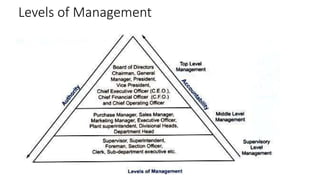
Levels of Management
Functions of top level management
• Lay down primary and subsidiary objectives of business
• Directors act as the trustees of business
• Select CEO, assign them authority and responsibility
• Sanction the budget
• Abide by law, take care of interest of stakeholders
• Take strategic decisions
• Analyse and resolve complex problems
• Plan for enterprise, implementation, supervise it
• Distribution of profit, dividend, reserve fund, re-investment of profit
• Analyse reports- give instructions accordingly
Functions of middle level management
• Implement the orders and instructions by CEO
• Prepare budget by each departmental head, present to top level
• Formulate policies to achieve enterprise objectives
• Take steps to increase efficiency, effectiveness of department
• Increase enthusiasm of employees of department
• Keep constant touch with officers of department, establish co-
ordination
• Focus on functioning of sub-divisions
• Supervise the working of department, get information, provide
directions, pass on information to top level
• Help the top level management in taking policy decisions
Functions of bottom level management
• Supervise the function of employees
• Discipline among employees, morale is boosted
• Plan for routine work of the department
• Functions like transfer, promotion, training etc.
• Get instructions, orders and programme from the department officers
regarding department functions
• Perform functions like layout, repairing and maintenance of machinery
• Make arrangement for necessary equipment, raw material etc.
• Solve the genuine problems of workers
• Implement decisions and policies decided by top level management
• Forward reports of bottom level, suggestions and complaints of employees
to middle level
FUNCTIONS OF MANAGEMENT
PLANNING
• “Even God cannot change the past, but men can change the future.”
• First step
• What work, who will do, when, how, to what extent and when work is
to be finished to achieve objectives
• Planning means, future forethought in the present
• It is base for other managerial functions
ORGANISING
• It is the structure for assigning of authority and responsibility to
individuals
• Organisation structure is formed while executing plan
• Business is divided in different sections- their authority and
responsibility
• Who will supervise, inter-relationship aong individuals, individual’s
authority and responsibility
• Planning is brain (intellectual), organising is its physical structure
(implementation)
STAFFING
• “Employees are arms and legs (limbs) of unit – Dr. George Terry
• “Staffing is concerned with availing and maintaining satisfactory man-power”
• Any organisation without staff is merely a skeleton
• Recruitment of employees for the right position, at the right time, in the right time, in
the right number, with the right qualification
• Selection, training, transfer, promotion, dismissal, retirement and welfare of employees
• Enthusiasm and zeal of employees are boosted if they are satisfied
• This function studies problem related to employees
• At present, it also includes man-power planning, HRD, evaluation of work, job analysis
etc.
• Satisfied staff is an invaluable asset of the business
DIRECTING
• To guide and supervise the employees for accomplishment of objectives
• All efforts become useless if the supervisor fail to provide proper direction
to employees or workers, other management are worthless without
direction
• Direct the subordinates, supervise them, gove orders and instructions, to
fix the work, to motivate the workers, to provide leadership, etc.
• It is a continuous process, it is required at every levels of management
CONTROLLING
• Control is the function of maintaining balance among efforts, result, resources
and objectives
• It is the last function
• To check whether all the business activities are done with the conformity of
planning or not
• Traditional – to have restriction on employees’ activities, provision of punishment
or fine if doing mistake , transfer, withholding of their promotion – it is negative
approach
• Modern time – it is positive approach, corrective activity, not to restrict their
activities but direct them in right direction , if not going as per planning
• Mistakes made in past are not repeated in future
CO-ORDINATION
• At every stage of management
• It is necessary from planning to controlling
• It gives sort assurance for the accomplishment of objectives
• No work remains incomplete,no work becomes easy
• To bring co-ordination and harmony among the different functions
carried out by different departments in the business unit is called co-
ordination
CO-ORDINATION
CHARACTERISTICS
• Required for all five activities, management process is not possible
without o-ordination
• Required at every level of management
• Success of it depends in effective communication
• It is not possible without co-operation
• Because of it, optimum utilisation of business resources is possible
• It is part of every activity of management so it is considered soul of
management
CO-ORDINATION
IMPORTANCE
• It makes management functions effective
• It makes possible, all the business activities in a easy manner
• Not leaves work incomplete and no possibility of the duplication of
work
• Maintains harmony among various department s of management
• Balance between order and time of business activities of different
departments
• Leads towards the accomplishment of pre-decided objectivews
FUNCTIONAL AREAS OF MANAGEMENT
MARKETING MANAGEMENT
• It is the activity of providing goods or services from producers to customers
• Exchange of goods with money and market research, distributive method,
sales promotion, storage, insurance etc
• It’s a process which decides the necessity of customers.
• Product
• Price
• Place (Distribution)
• Promotion
• HUMAN RESOURCE MANAGEMENT
• Employees are live assets, necessary to take care of them
• Success of the business depends on the employees
• Condusive environment , If employees are satisfied, business
objectives can easily achieve
• Enthusiasm, loyalty and feeling of oneness among employees develop
• HRM is the process which includes proficiency, knowledge,
intelligence, likes and dislikes, personal, necessity etc.
• CHARACTERISTICS
• Includes selection, training, promotion and direction to the employees
• It enables to accomplish business objectives by way of integrating them
with individual objectives and business objectives
• Basic function is to manage the employees as they are valuable assets of
the business
• It provides proper training and so develop personnel for the job
• It evaluates performance of employees and places them at right position
• Efficient mgt. can reduce labour turnover rate and can maintain skilful
employees for a longer period in company
• As a part of HRM, condusive atmosphere is provided to employees, which
boosts their enthusiasm and efficiency
• HUMAN RESOURCE MANAGEMENT
• Employees are live assets, necessary to take care of them
• Success of the business depends on the employees
• Condusive environment , If employees are satisfied, business
objectives can easily achieve
• Enthusiasm, loyalty and feeling of oneness among employees develop
• HRM is the process which includes proficiency, knowledge,
intelligence, likes and dislikes, personal, necessity etc.
• CHARACTERISTICS
• Includes selection, training, promotion and direction to the employees
• It enables to accomplish business objectives by way of integrating them
with individual objectives and business objectives
• Basic function is to manage the employees as they are valuable assets of
the business
• It provides proper training and so develop personnel for the job
• It evaluates performance of employees and places them at right position
• Efficient mgt. can reduce labour turnover rate and can maintain skilful
employees for a longer period in company
• As a part of HRM, condusive atmosphere is provided to employees, which
boosts their enthusiasm and efficiency
IMPORTANCE
• Efficiency of employees tend to increase
• Business profitability increases
• Business prestige is maintained
• Higher quality standards maintained
• Feeling of oneness is developed
• Maximum utilisation of factors of production
• Reduction in labour turnover
• Job satisfaction enhanced
• Job satisfaction leads to industrial peace
FINANCIAL MANAGEMENT
• Finance is lifeblood of business
• Require for establishment, development, expansion and modification
of a business
FUNCTIONS
• Estimate financial needs, financial plans from the point of view of
time, prepare budget, allocate funds,
• Decide capital structure, select sources of acquisition of capital, carry
out procedure for acquiring the finance, check whether funds are
properly utilised, control over financial activities, to form financial
policy, plan for taxes, make arrangement for assets
PRODUCTION MANAGEMENT
• Process of conversion of naturally available raw material into consumable
goods with the human efforts is known as production
• Production management produces goods and services, which are capable
to satisfy customers’ need
FUNCTIONS
• Decide production plan, undertake production research, select product
development as well as product-mix, select technology and machinery,
take decision regarding location as well as lay out
• Estimate, required material and other needs for production, production
control, quality control, undertake activities to control expenditure or cost
to increase productivity
• Introduce variation and simplification in production

B.a. ch. 1 part 1

  • 1.
  • 2.
    Introduction • Since primitiveera of stone age, hunting, fishing etc. activities • Maximum satisfaction using minimum resources • Co-operation amongst team members • Sole proprietorship, partnership firms, company….. MEANING • Management is the art of getting things done through others
  • 3.
    Nature of Management •Universal process • Goal oriented activity • Group activity • Continuous process • Human process • Decision process • Science, Art and Profession
  • 4.
    Importance of Management •Necessary in every field • Optimum utilisation of resources • Accomplishment of objectives • Useful for the success of business • Increase in job opportunities • Increase in profit • Social benefit • National motive
  • 5.
    Management as ascience, an art and a profession • Science means systematic and specialised knowledge, rules and principles, cause and effect relationship • Art means employment of skill and expertise of an individual, require theoretical knowledge • Profession is an activity – specialised knowledge in specific field is acquired, used for the welfare of the society Characteristics of profession • Requirement of specialised knowledge e.g. Degrees like MBA, MBBS • Increase in knowledge and research : experience and training increases knowledge and research • Professional association • Implementation of code of conduct • Moral responsibility
  • 6.
  • 7.
    Functions of toplevel management • Lay down primary and subsidiary objectives of business • Directors act as the trustees of business • Select CEO, assign them authority and responsibility • Sanction the budget • Abide by law, take care of interest of stakeholders • Take strategic decisions • Analyse and resolve complex problems • Plan for enterprise, implementation, supervise it • Distribution of profit, dividend, reserve fund, re-investment of profit • Analyse reports- give instructions accordingly
  • 8.
    Functions of middlelevel management • Implement the orders and instructions by CEO • Prepare budget by each departmental head, present to top level • Formulate policies to achieve enterprise objectives • Take steps to increase efficiency, effectiveness of department • Increase enthusiasm of employees of department • Keep constant touch with officers of department, establish co- ordination • Focus on functioning of sub-divisions • Supervise the working of department, get information, provide directions, pass on information to top level • Help the top level management in taking policy decisions
  • 9.
    Functions of bottomlevel management • Supervise the function of employees • Discipline among employees, morale is boosted • Plan for routine work of the department • Functions like transfer, promotion, training etc. • Get instructions, orders and programme from the department officers regarding department functions • Perform functions like layout, repairing and maintenance of machinery • Make arrangement for necessary equipment, raw material etc. • Solve the genuine problems of workers • Implement decisions and policies decided by top level management • Forward reports of bottom level, suggestions and complaints of employees to middle level
  • 10.
    FUNCTIONS OF MANAGEMENT PLANNING •“Even God cannot change the past, but men can change the future.” • First step • What work, who will do, when, how, to what extent and when work is to be finished to achieve objectives • Planning means, future forethought in the present • It is base for other managerial functions
  • 11.
    ORGANISING • It isthe structure for assigning of authority and responsibility to individuals • Organisation structure is formed while executing plan • Business is divided in different sections- their authority and responsibility • Who will supervise, inter-relationship aong individuals, individual’s authority and responsibility • Planning is brain (intellectual), organising is its physical structure (implementation)
  • 12.
    STAFFING • “Employees arearms and legs (limbs) of unit – Dr. George Terry • “Staffing is concerned with availing and maintaining satisfactory man-power” • Any organisation without staff is merely a skeleton • Recruitment of employees for the right position, at the right time, in the right time, in the right number, with the right qualification • Selection, training, transfer, promotion, dismissal, retirement and welfare of employees • Enthusiasm and zeal of employees are boosted if they are satisfied • This function studies problem related to employees • At present, it also includes man-power planning, HRD, evaluation of work, job analysis etc. • Satisfied staff is an invaluable asset of the business
  • 13.
    DIRECTING • To guideand supervise the employees for accomplishment of objectives • All efforts become useless if the supervisor fail to provide proper direction to employees or workers, other management are worthless without direction • Direct the subordinates, supervise them, gove orders and instructions, to fix the work, to motivate the workers, to provide leadership, etc. • It is a continuous process, it is required at every levels of management
  • 14.
    CONTROLLING • Control isthe function of maintaining balance among efforts, result, resources and objectives • It is the last function • To check whether all the business activities are done with the conformity of planning or not • Traditional – to have restriction on employees’ activities, provision of punishment or fine if doing mistake , transfer, withholding of their promotion – it is negative approach • Modern time – it is positive approach, corrective activity, not to restrict their activities but direct them in right direction , if not going as per planning • Mistakes made in past are not repeated in future
  • 15.
    CO-ORDINATION • At everystage of management • It is necessary from planning to controlling • It gives sort assurance for the accomplishment of objectives • No work remains incomplete,no work becomes easy • To bring co-ordination and harmony among the different functions carried out by different departments in the business unit is called co- ordination
  • 16.
    CO-ORDINATION CHARACTERISTICS • Required forall five activities, management process is not possible without o-ordination • Required at every level of management • Success of it depends in effective communication • It is not possible without co-operation • Because of it, optimum utilisation of business resources is possible • It is part of every activity of management so it is considered soul of management
  • 17.
    CO-ORDINATION IMPORTANCE • It makesmanagement functions effective • It makes possible, all the business activities in a easy manner • Not leaves work incomplete and no possibility of the duplication of work • Maintains harmony among various department s of management • Balance between order and time of business activities of different departments • Leads towards the accomplishment of pre-decided objectivews
  • 18.
    FUNCTIONAL AREAS OFMANAGEMENT MARKETING MANAGEMENT • It is the activity of providing goods or services from producers to customers • Exchange of goods with money and market research, distributive method, sales promotion, storage, insurance etc • It’s a process which decides the necessity of customers. • Product • Price • Place (Distribution) • Promotion
  • 19.
    • HUMAN RESOURCEMANAGEMENT • Employees are live assets, necessary to take care of them • Success of the business depends on the employees • Condusive environment , If employees are satisfied, business objectives can easily achieve • Enthusiasm, loyalty and feeling of oneness among employees develop • HRM is the process which includes proficiency, knowledge, intelligence, likes and dislikes, personal, necessity etc.
  • 20.
    • CHARACTERISTICS • Includesselection, training, promotion and direction to the employees • It enables to accomplish business objectives by way of integrating them with individual objectives and business objectives • Basic function is to manage the employees as they are valuable assets of the business • It provides proper training and so develop personnel for the job • It evaluates performance of employees and places them at right position • Efficient mgt. can reduce labour turnover rate and can maintain skilful employees for a longer period in company • As a part of HRM, condusive atmosphere is provided to employees, which boosts their enthusiasm and efficiency
  • 21.
    • HUMAN RESOURCEMANAGEMENT • Employees are live assets, necessary to take care of them • Success of the business depends on the employees • Condusive environment , If employees are satisfied, business objectives can easily achieve • Enthusiasm, loyalty and feeling of oneness among employees develop • HRM is the process which includes proficiency, knowledge, intelligence, likes and dislikes, personal, necessity etc.
  • 22.
    • CHARACTERISTICS • Includesselection, training, promotion and direction to the employees • It enables to accomplish business objectives by way of integrating them with individual objectives and business objectives • Basic function is to manage the employees as they are valuable assets of the business • It provides proper training and so develop personnel for the job • It evaluates performance of employees and places them at right position • Efficient mgt. can reduce labour turnover rate and can maintain skilful employees for a longer period in company • As a part of HRM, condusive atmosphere is provided to employees, which boosts their enthusiasm and efficiency
  • 23.
    IMPORTANCE • Efficiency ofemployees tend to increase • Business profitability increases • Business prestige is maintained • Higher quality standards maintained • Feeling of oneness is developed • Maximum utilisation of factors of production • Reduction in labour turnover • Job satisfaction enhanced • Job satisfaction leads to industrial peace
  • 24.
    FINANCIAL MANAGEMENT • Financeis lifeblood of business • Require for establishment, development, expansion and modification of a business FUNCTIONS • Estimate financial needs, financial plans from the point of view of time, prepare budget, allocate funds, • Decide capital structure, select sources of acquisition of capital, carry out procedure for acquiring the finance, check whether funds are properly utilised, control over financial activities, to form financial policy, plan for taxes, make arrangement for assets
  • 25.
    PRODUCTION MANAGEMENT • Processof conversion of naturally available raw material into consumable goods with the human efforts is known as production • Production management produces goods and services, which are capable to satisfy customers’ need FUNCTIONS • Decide production plan, undertake production research, select product development as well as product-mix, select technology and machinery, take decision regarding location as well as lay out • Estimate, required material and other needs for production, production control, quality control, undertake activities to control expenditure or cost to increase productivity • Introduce variation and simplification in production