o r g a n i z a t i o n a l b e h a v i o r
stephen p. robbins
el even t h edi ti on
© 2005 Prentice Hall Inc. All rights reserved. 2–1
After studying this chapter,
you should be able to:
1. Managing Workforce Diversity
2. Define the key biographical characteristics.
3. Identify two types of ability.
4. Shape the behavior of others.
5. Distinguish between the four schedules of
reinforcement.
6. Clarify the role of punishment in learning.
7. Practice self-management
L
E
A
R
N
I
N
G
O
B
J
E
C
T
I
V
E
S
Managing Workforce Diversity
 Workforce diversity acknowledges a workforce of women and
men; many racial and ethnic groups; individuals with a variety of
physical or psychological abilities; and people who differ in age
and sexual orientation. Managing this diversity is a global
concern.
 Demographics mostly reflect surface level diversity ,not
thoughts and feelings, and can lead employees to perceive one
another through stereotypes and assumptions. However,
evidence has shown that as people get to know one another,
they become less concerned about demographic differences if
they see themselves as sharing more important characteristics,
such as personality and values, that represent deep-level
diversity.
© 2005 Prentice Hall Inc. All rights reserved. 2–2
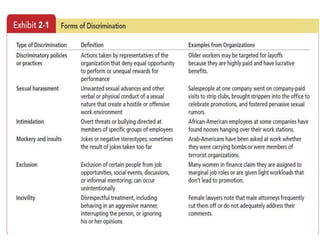
Discrimination
 Although diversity does present many opportunities
for organizations, effective diversity management
also means working to eliminate unfair
discrimination .
 To discriminate is to note a difference between
things, which in itself isn’t necessarily bad
 surface-level diversity Differences in easily
perceived characteristics, such as gender, race,
ethnicity, age, or disability, that do not necessarily
reflect the ways people think or feel but that may
activate certain stereotypes.
© 2005 Prentice Hall Inc. All rights reserved. 2–3
 Deep-level diversity Differences in values,
personality, and work preferences that become
progressively more important for determining
similarity as people get to know one another better.
 Discrimination Noting of a difference between
things; often we refer to unfair discrimination, which
means making judgments about individuals based on
stereotypes regarding their demographic group.
© 2005 Prentice Hall Inc. All rights reserved. 2–4
© 2005 Prentice Hall Inc. All rights reserved. 2–5
© 2005 Prentice Hall Inc. All rights reserved. 2–6
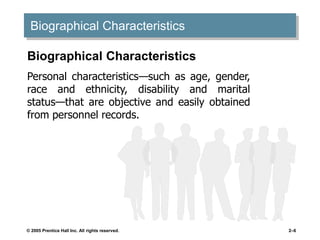
Biographical Characteristics
Personal characteristics—such as age, gender,
race and ethnicity, disability and marital
status—that are objective and easily obtained
from personnel records.
© 2005 Prentice Hall Inc. All rights reserved. 2–7
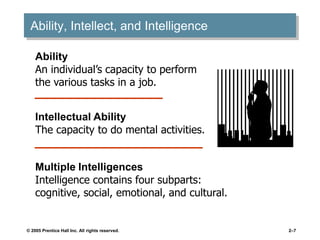
Ability, Intellect, and Intelligence
Ability
An individual’s capacity to perform
the various tasks in a job.
Intellectual Ability
The capacity to do mental activities.
Multiple Intelligences
Intelligence contains four subparts:
cognitive, social, emotional, and cultural.
© 2005 Prentice Hall Inc. All rights reserved. 2–8
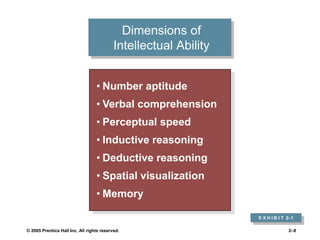
• Number aptitude
• Verbal comprehension
• Perceptual speed
• Inductive reasoning
• Deductive reasoning
• Spatial visualization
• Memory
Dimensions of
Intellectual Ability
E X H I B I T 2–1
© 2005 Prentice Hall Inc. All rights reserved. 2–9
Physical Abilities
Physical Abilities
The capacity to do tasks
demanding stamina, dexterity,
strength, and similar
characteristics.
© 2005 Prentice Hall Inc. All rights reserved. 2–10
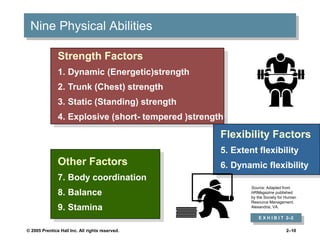
Other Factors
7. Body coordination
8. Balance
9. Stamina
Nine Physical Abilities
Strength Factors
1. Dynamic (Energetic)strength
2. Trunk (Chest) strength
3. Static (Standing) strength
4. Explosive (short- tempered )strength
Flexibility Factors
5. Extent flexibility
6. Dynamic flexibility
E X H I B I T 2–2
Source: Adapted from
HRMagazine published
by the Society for Human
Resource Management,
Alexandria, VA.
© 2005 Prentice Hall Inc. All rights reserved. 2–11
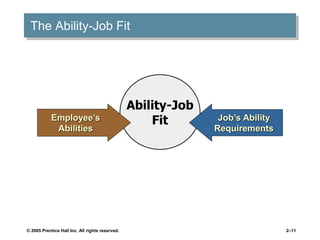
Ability-Job
Fit
The Ability-Job Fit
Employee’s
Abilities
Job’s Ability
Requirements
Implementing Diversity Management Strategies
Diversity management
makes everyone more aware of and sensitive to the
needs and differences of others. This definition
highlights the fact that diversity programs include and
are meant for everyone. Diversity is much more likely to
be successful when we see it as everyone’s business
than if we believe it helps only certain groups of
employees.
 Attracting, Selecting, Developing, and Retaining
Diverse Employees
 Diversity in Groups
 Effective Diversity Programs
© 2005 Prentice Hall Inc. All rights reserved. 2–12
Attracting, Selecting, Developing, and
Retaining Diverse Employees
The selection process is one of the most important
places to apply diversity efforts. Managers who hire
need to value fairness and objectivity in selecting
employees and focus on the productive potential of new
recruits. Fortunately, ensuring that hiring is bias-free
does appear to work. Where managers use a well-
defined protocol for assessing applicant talent and the
organization clearly prioritizes nondiscrimination
policies, qualifications become far more important in
determining who gets hired than demographic
characteristics. Organizations that do not discourage
discriminatory behavior are more likely to see problems.
© 2005 Prentice Hall Inc. All rights reserved. 2–13
Diversity in Groups
 Does diversity help or hurt group performance? The
answer is “yes.” In some cases, diversity in traits can
hurt team performance, whereas in others it can
facilitate it. Whether diverse or homogeneous teams
are more effective depends on the characteristic of
interest. Demographic diversity (in gender, race, and
ethnicity) does not appear to either help or hurt team
performance in general. On the other hand, teams of
individuals who are highly intelligent, conscientious,
and interested in working in team settings are more
effective.
© 2005 Prentice Hall Inc. All rights reserved. 2–14
Effective Diversity Programs
 First, they teach managers about the legal framework
for equal employment opportunity and encourage fair
treatment of all people regardless of their
demographic characteristics. Second, they teach
managers how a diverse workforce will be better able
to serve a diverse market of customers and clients.
Third, they foster personal development practices
that bring out the skills and abilities of all workers,
acknowledging how differences in perspective can be
a valuable way to improve performance for everyone.
© 2005 Prentice Hall Inc. All rights reserved. 2–15
© 2005 Prentice Hall Inc. All rights reserved. 2–16
Learning
Learning
• Involves change
• Is relatively permanent
• Is acquired through experience
Learning
Any relatively permanent change in behavior
that occurs as a result of experience.
© 2005 Prentice Hall Inc. All rights reserved. 2–17
Theories of Learning
Key Concepts
• Unconditioned stimulus
• Unconditioned response
• Conditioned stimulus
• Conditioned response
Classical Conditioning
A type of conditioning in which an individual
responds to some stimulus that would not
ordinarily produce such a response.
© 2005 Prentice Hall Inc. All rights reserved. 2–18
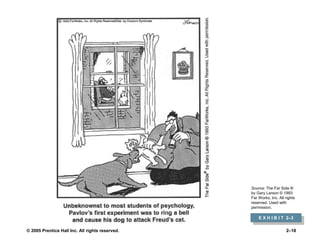
E X H I B I T 2–3
Source: The Far Side ®
by Gary Larson © 1993
Far Works, Inc. All rights
reserved. Used with
permission.
© 2005 Prentice Hall Inc. All rights reserved. 2–19
Theories of Learning (cont’d)
Key Concepts
• Reflexive (unlearned) behavior
• Conditioned (learned) behavior
• Reinforcement
Operant Conditioning
A type of conditioning in which desired voluntary
behavior leads to a reward or prevents a punishment.
© 2005 Prentice Hall Inc. All rights reserved. 2–20
Theories of Learning (cont’d)
Key Concepts
• Attentional processes
• Retention processes
• Motor reproduction processes
• Reinforcement processes
Social-Learning Theory
People can learn through observation
and direct experience.
© 2005 Prentice Hall Inc. All rights reserved. 2–21
Theories of Learning (cont’d)
Key Concepts
• Reinforcement is required to change behavior.
• Some rewards are more effective than others.
• The timing of reinforcement affects learning
speed and permanence.
Shaping Behavior
Systematically reinforcing each successive step that
moves an individual closer to the desired response.
© 2005 Prentice Hall Inc. All rights reserved. 2–22
Types of Reinforcement
 Positive reinforcement
– Providing a reward for a desired behavior.
 Negative reinforcement
– Removing an unpleasant consequence when the
desired behavior occurs.
 Punishment
– Applying an undesirable condition to eliminate an
undesirable behavior.
 Extinction
– Withholding reinforcement of a behavior to cause its
cessation.
© 2005 Prentice Hall Inc. All rights reserved. 2–23
Schedules of Reinforcement
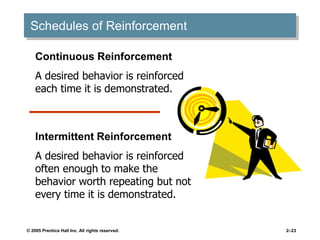
Continuous Reinforcement
A desired behavior is reinforced
each time it is demonstrated.
Intermittent Reinforcement
A desired behavior is reinforced
often enough to make the
behavior worth repeating but not
every time it is demonstrated.
© 2005 Prentice Hall Inc. All rights reserved. 2–24
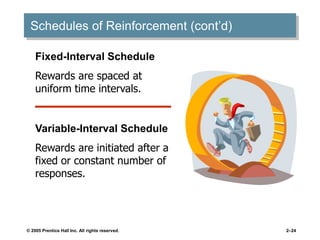
Schedules of Reinforcement (cont’d)
Fixed-Interval Schedule
Rewards are spaced at
uniform time intervals.
Variable-Interval Schedule
Rewards are initiated after a
fixed or constant number of
responses.
© 2005 Prentice Hall Inc. All rights reserved. 2–25
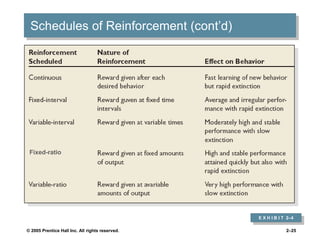
Schedules of Reinforcement (cont’d)
Fixed-ratio
E X H I B I T 2–4
© 2005 Prentice Hall Inc. All rights reserved. 2–26
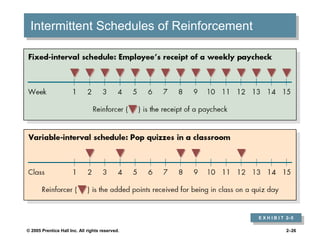
Intermittent Schedules of Reinforcement
E X H I B I T 2–5
© 2005 Prentice Hall Inc. All rights reserved. 2–27
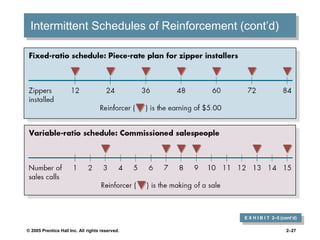
Intermittent Schedules of Reinforcement (cont’d)
E X H I B I T 2–5 (cont’d)
© 2005 Prentice Hall Inc. All rights reserved. 2–28
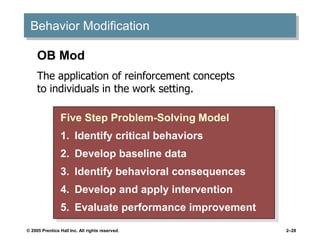
Behavior Modification
Five Step Problem-Solving Model
1. Identify critical behaviors
2. Develop baseline data
3. Identify behavioral consequences
4. Develop and apply intervention
5. Evaluate performance improvement
OB Mod
The application of reinforcement concepts
to individuals in the work setting.
© 2005 Prentice Hall Inc. All rights reserved. 2–29
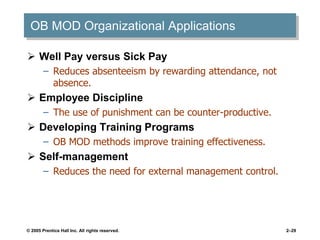
OB MOD Organizational Applications
 Well Pay versus Sick Pay
– Reduces absenteeism by rewarding attendance, not
absence.
 Employee Discipline
– The use of punishment can be counter-productive.
 Developing Training Programs
– OB MOD methods improve training effectiveness.
 Self-management
– Reduces the need for external management control.

Chapter 2

  • 1.
    o r ga n i z a t i o n a l b e h a v i o r stephen p. robbins el even t h edi ti on
  • 2.
    © 2005 PrenticeHall Inc. All rights reserved. 2–1 After studying this chapter, you should be able to: 1. Managing Workforce Diversity 2. Define the key biographical characteristics. 3. Identify two types of ability. 4. Shape the behavior of others. 5. Distinguish between the four schedules of reinforcement. 6. Clarify the role of punishment in learning. 7. Practice self-management L E A R N I N G O B J E C T I V E S
  • 3.
    Managing Workforce Diversity Workforce diversity acknowledges a workforce of women and men; many racial and ethnic groups; individuals with a variety of physical or psychological abilities; and people who differ in age and sexual orientation. Managing this diversity is a global concern.  Demographics mostly reflect surface level diversity ,not thoughts and feelings, and can lead employees to perceive one another through stereotypes and assumptions. However, evidence has shown that as people get to know one another, they become less concerned about demographic differences if they see themselves as sharing more important characteristics, such as personality and values, that represent deep-level diversity. © 2005 Prentice Hall Inc. All rights reserved. 2–2
  • 4.
    Discrimination  Although diversitydoes present many opportunities for organizations, effective diversity management also means working to eliminate unfair discrimination .  To discriminate is to note a difference between things, which in itself isn’t necessarily bad  surface-level diversity Differences in easily perceived characteristics, such as gender, race, ethnicity, age, or disability, that do not necessarily reflect the ways people think or feel but that may activate certain stereotypes. © 2005 Prentice Hall Inc. All rights reserved. 2–3
  • 5.
     Deep-level diversityDifferences in values, personality, and work preferences that become progressively more important for determining similarity as people get to know one another better.  Discrimination Noting of a difference between things; often we refer to unfair discrimination, which means making judgments about individuals based on stereotypes regarding their demographic group. © 2005 Prentice Hall Inc. All rights reserved. 2–4
  • 6.
    © 2005 PrenticeHall Inc. All rights reserved. 2–5
  • 7.
    © 2005 PrenticeHall Inc. All rights reserved. 2–6 Biographical Characteristics Biographical Characteristics Personal characteristics—such as age, gender, race and ethnicity, disability and marital status—that are objective and easily obtained from personnel records.
  • 8.
    © 2005 PrenticeHall Inc. All rights reserved. 2–7 Ability, Intellect, and Intelligence Ability An individual’s capacity to perform the various tasks in a job. Intellectual Ability The capacity to do mental activities. Multiple Intelligences Intelligence contains four subparts: cognitive, social, emotional, and cultural.
  • 9.
    © 2005 PrenticeHall Inc. All rights reserved. 2–8 • Number aptitude • Verbal comprehension • Perceptual speed • Inductive reasoning • Deductive reasoning • Spatial visualization • Memory Dimensions of Intellectual Ability E X H I B I T 2–1
  • 10.
    © 2005 PrenticeHall Inc. All rights reserved. 2–9 Physical Abilities Physical Abilities The capacity to do tasks demanding stamina, dexterity, strength, and similar characteristics.
  • 11.
    © 2005 PrenticeHall Inc. All rights reserved. 2–10 Other Factors 7. Body coordination 8. Balance 9. Stamina Nine Physical Abilities Strength Factors 1. Dynamic (Energetic)strength 2. Trunk (Chest) strength 3. Static (Standing) strength 4. Explosive (short- tempered )strength Flexibility Factors 5. Extent flexibility 6. Dynamic flexibility E X H I B I T 2–2 Source: Adapted from HRMagazine published by the Society for Human Resource Management, Alexandria, VA.
  • 12.
    © 2005 PrenticeHall Inc. All rights reserved. 2–11 Ability-Job Fit The Ability-Job Fit Employee’s Abilities Job’s Ability Requirements
  • 13.
    Implementing Diversity ManagementStrategies Diversity management makes everyone more aware of and sensitive to the needs and differences of others. This definition highlights the fact that diversity programs include and are meant for everyone. Diversity is much more likely to be successful when we see it as everyone’s business than if we believe it helps only certain groups of employees.  Attracting, Selecting, Developing, and Retaining Diverse Employees  Diversity in Groups  Effective Diversity Programs © 2005 Prentice Hall Inc. All rights reserved. 2–12
  • 14.
    Attracting, Selecting, Developing,and Retaining Diverse Employees The selection process is one of the most important places to apply diversity efforts. Managers who hire need to value fairness and objectivity in selecting employees and focus on the productive potential of new recruits. Fortunately, ensuring that hiring is bias-free does appear to work. Where managers use a well- defined protocol for assessing applicant talent and the organization clearly prioritizes nondiscrimination policies, qualifications become far more important in determining who gets hired than demographic characteristics. Organizations that do not discourage discriminatory behavior are more likely to see problems. © 2005 Prentice Hall Inc. All rights reserved. 2–13
  • 15.
    Diversity in Groups Does diversity help or hurt group performance? The answer is “yes.” In some cases, diversity in traits can hurt team performance, whereas in others it can facilitate it. Whether diverse or homogeneous teams are more effective depends on the characteristic of interest. Demographic diversity (in gender, race, and ethnicity) does not appear to either help or hurt team performance in general. On the other hand, teams of individuals who are highly intelligent, conscientious, and interested in working in team settings are more effective. © 2005 Prentice Hall Inc. All rights reserved. 2–14
  • 16.
    Effective Diversity Programs First, they teach managers about the legal framework for equal employment opportunity and encourage fair treatment of all people regardless of their demographic characteristics. Second, they teach managers how a diverse workforce will be better able to serve a diverse market of customers and clients. Third, they foster personal development practices that bring out the skills and abilities of all workers, acknowledging how differences in perspective can be a valuable way to improve performance for everyone. © 2005 Prentice Hall Inc. All rights reserved. 2–15
  • 17.
    © 2005 PrenticeHall Inc. All rights reserved. 2–16 Learning Learning • Involves change • Is relatively permanent • Is acquired through experience Learning Any relatively permanent change in behavior that occurs as a result of experience.
  • 18.
    © 2005 PrenticeHall Inc. All rights reserved. 2–17 Theories of Learning Key Concepts • Unconditioned stimulus • Unconditioned response • Conditioned stimulus • Conditioned response Classical Conditioning A type of conditioning in which an individual responds to some stimulus that would not ordinarily produce such a response.
  • 19.
    © 2005 PrenticeHall Inc. All rights reserved. 2–18 E X H I B I T 2–3 Source: The Far Side ® by Gary Larson © 1993 Far Works, Inc. All rights reserved. Used with permission.
  • 20.
    © 2005 PrenticeHall Inc. All rights reserved. 2–19 Theories of Learning (cont’d) Key Concepts • Reflexive (unlearned) behavior • Conditioned (learned) behavior • Reinforcement Operant Conditioning A type of conditioning in which desired voluntary behavior leads to a reward or prevents a punishment.
  • 21.
    © 2005 PrenticeHall Inc. All rights reserved. 2–20 Theories of Learning (cont’d) Key Concepts • Attentional processes • Retention processes • Motor reproduction processes • Reinforcement processes Social-Learning Theory People can learn through observation and direct experience.
  • 22.
    © 2005 PrenticeHall Inc. All rights reserved. 2–21 Theories of Learning (cont’d) Key Concepts • Reinforcement is required to change behavior. • Some rewards are more effective than others. • The timing of reinforcement affects learning speed and permanence. Shaping Behavior Systematically reinforcing each successive step that moves an individual closer to the desired response.
  • 23.
    © 2005 PrenticeHall Inc. All rights reserved. 2–22 Types of Reinforcement  Positive reinforcement – Providing a reward for a desired behavior.  Negative reinforcement – Removing an unpleasant consequence when the desired behavior occurs.  Punishment – Applying an undesirable condition to eliminate an undesirable behavior.  Extinction – Withholding reinforcement of a behavior to cause its cessation.
  • 24.
    © 2005 PrenticeHall Inc. All rights reserved. 2–23 Schedules of Reinforcement Continuous Reinforcement A desired behavior is reinforced each time it is demonstrated. Intermittent Reinforcement A desired behavior is reinforced often enough to make the behavior worth repeating but not every time it is demonstrated.
  • 25.
    © 2005 PrenticeHall Inc. All rights reserved. 2–24 Schedules of Reinforcement (cont’d) Fixed-Interval Schedule Rewards are spaced at uniform time intervals. Variable-Interval Schedule Rewards are initiated after a fixed or constant number of responses.
  • 26.
    © 2005 PrenticeHall Inc. All rights reserved. 2–25 Schedules of Reinforcement (cont’d) Fixed-ratio E X H I B I T 2–4
  • 27.
    © 2005 PrenticeHall Inc. All rights reserved. 2–26 Intermittent Schedules of Reinforcement E X H I B I T 2–5
  • 28.
    © 2005 PrenticeHall Inc. All rights reserved. 2–27 Intermittent Schedules of Reinforcement (cont’d) E X H I B I T 2–5 (cont’d)
  • 29.
    © 2005 PrenticeHall Inc. All rights reserved. 2–28 Behavior Modification Five Step Problem-Solving Model 1. Identify critical behaviors 2. Develop baseline data 3. Identify behavioral consequences 4. Develop and apply intervention 5. Evaluate performance improvement OB Mod The application of reinforcement concepts to individuals in the work setting.
  • 30.
    © 2005 PrenticeHall Inc. All rights reserved. 2–29 OB MOD Organizational Applications  Well Pay versus Sick Pay – Reduces absenteeism by rewarding attendance, not absence.  Employee Discipline – The use of punishment can be counter-productive.  Developing Training Programs – OB MOD methods improve training effectiveness.  Self-management – Reduces the need for external management control.