By: Mussa A.
February, 2017,
Mettu, Ethiopia
Chapter One: INTRODUCTION TO MANAGMENT: AN
OVERVIEW
 what is general management?
 Why is management important?
 What do managers do? And
 The Development of General Management
theories will be briefly explained.
Chapter One: INTRODUCTION TO MANAGMENT
Management is one of the most important
human activities.
Management is essential whenever human
efforts are to be undertaken collectively to
achieve specific goals.
No group activity can succeed without
management.
Organization is a group of two or more persons
that exists and operates to achieve clearly
stated, commonly held objectives.
1.1. Meaning and Definition of
There is no single and comprehensive meaning and
definition of management.
Meaning:
The word management has several meanings, the most
important of which are:
 Management refers to a group of people who are
responsible for guiding and controlling the organization
(managerial personnel).
Management is the process of running an organization
(planning, organizing, staffing, directing/leading and
controlling).
Management is a body of knowledge, a discipline.
cont.…
Defining Management:
According different authorities in the field
Management is the art of getting things done
through and with people in a formally organized
group.
Management is the process of coordinating all
resources through the five major functions of
planning, organizing, staffing, directing/leading and
and controlling to achieve organizational objective.
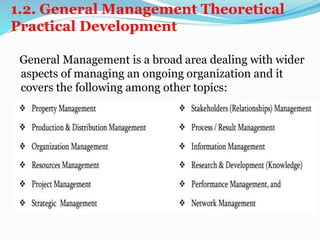
1.2. General Management Theoretical
Practical Development
General Management is a broad area dealing with wider
aspects of managing an ongoing organization and it
covers the following among other topics:
Cont.…
 With advancing technological and changing human
behavioral aspects, management is increasingly
becoming more complex and requires considerable
training, practical experience and updating on the latest
information of developments in the field.
Management Theory and Its Development
Management’s theoretical and applied contribution to the
world:
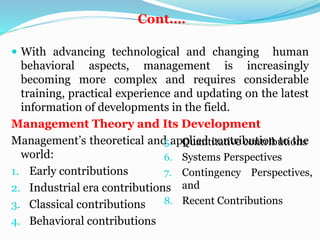
1. Early contributions
2. Industrial era contributions
3. Classical contributions
4. Behavioral contributions
5. Quantitative contributions
6. Systems Perspectives
7. Contingency Perspectives,
and
8. Recent Contributions
Management Theory and Its Development
Reading Assignment: Theories of Management
1.3. Managerial Functions
Functions of management can be described in four major
elements. These are:
I. Planning
II. Organizing
III. Implementing
IV. Monitoring and Evaluation
I. Planning
 Involves setting visions, missions and goals of
organizations or projects or programs together with the
activities to achieve them.
 All levels of managers develop goals that corresponds to
the efforts of the top management overall goals and
strategy.
 This requires operational plan aimed at administration
and coordination of Stakeholders, Processes and
cont.…
 Useful in that it makes better coordination, focuses on
forward thinking, and creates participatory work
environment and good for effective monitoring and feedback
systems.
II. Organizing
 It is the process of arranging people and physical resources
to carryout plans and accomplishes organizational
objectives.
 This helps how responsibilities of individuals ?
 who are required to execute the works are defined and
staffing and directing can be performed. Such things can
easily be shown by the use of Organization Chart.
 Makes sure the flow of information resources and tasks
cont.…
III. Implementing
It is the process where by the actual work is
executed.
This helps in executing the task defined in the
planning stage with proper organization system
together with monitoring quality, time and cost
of the works.
Proper inspection and supervision, recording data
of executed works, availing all necessary resources
at the right place and at the right time with their
proper coordination are necessary to achieve the
required goal efficiently and successfully.
cont.…
Leading is the act of motivating or causing people to
perform certain tasks intended to achieve specified
objectives.
Leading requires to understand the dynamics of
individual and group behaviors, motivation of employees,
effective visionary and effective communication
capabilities.
IV. Monitoring and Evaluation
Is the process by which executives and legislatives
determine or evaluate whether organizational objectives
are being achieved and actual operations are in consistent
with plans or not.
Such things are done against the planned data with the
help of communication in the form of reporting,
cont.….
Generally effective management can take place when
proper planning, organizing, implementing, continuous
communication, feed back for monitoring purpose and
future planning are carried out successfully.
1.4. Managerial Roles
According to Henry Mintzberg the are ten most
common managerial roles and which are classified into
three managerial role categories:
I. Interpersonal,
II. Informational and
III. Decision Making Roles
Cont.…
1. Interpersonal roles are roles that involve people
(subordinates and persons outside the
organization) and other duties that are ceremonial
ceremonial and symbolic in nature.
 The three interpersonal roles include being a
figurehead, leader, and liaison.
 The figurehead performs symbolic legal or social
social duties.
 The leader builds relationships with employees
and communicates with, motivates, and coaches
them. Also include mentoring, training and
motivating employees.
Cont.…
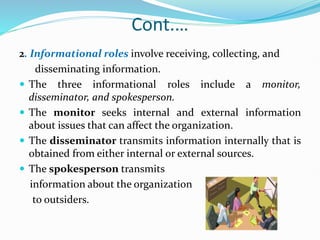
2. Informational roles involve receiving, collecting, and
disseminating information.
 The three informational roles include a monitor,
disseminator, and spokesperson.
 The monitor seeks internal and external information
about issues that can affect the organization.
 The disseminator transmits information internally that is
obtained from either internal or external sources.
 The spokesperson transmits
information about the organization
to outsiders.
Cont.….
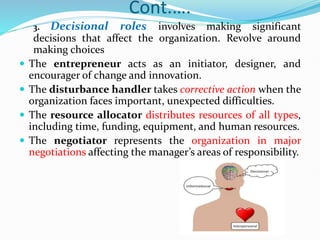
3. Decisional roles involves making significant
decisions that affect the organization. Revolve around
making choices
 The entrepreneur acts as an initiator, designer, and
encourager of change and innovation.
 The disturbance handler takes corrective action when the
organization faces important, unexpected difficulties.
 The resource allocator distributes resources of all types,
including time, funding, equipment, and human resources.
 The negotiator represents the organization in major
negotiations affecting the manager’s areas of responsibility.
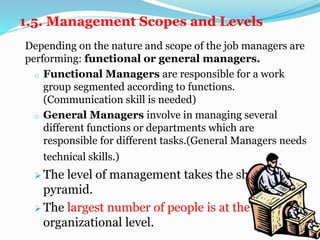
1.5. Management Scopes and Levels
Depending on the nature and scope of the job managers are
performing: functional or general managers.
o Functional Managers are responsible for a work
group segmented according to functions.
(Communication skill is needed)
o General Managers involve in managing several
different functions or departments which are
responsible for different tasks.(General Managers needs
technical skills.)
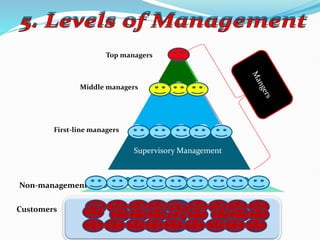
 The level of management takes the shape of a
pyramid.
 The largest number of people is at the bottom
organizational level.
Top managers
Middle managers
First-line managers
Non-management
Supervisory Management
Customers
Top Managers
 The relatively small group of executives who manage the
whole organization.
 They include board of directors, executive committee and
chief executives or presidents, general managers etc.
Middle Management
 A group of managers in organizations acting as
intermediary between the top and operating (first-line)
managers
 They are usually functional area heads such as marketing,
production operations, HRM, finance etc.
 They supervise and coordinate the activities of lower-
level managers.
First-Line Management/Managers
(Supervisors)
The last step of the ladder consisting of a group of
managers in organizations acting as intermediary
between the Middle level management and
operating employees (non-management)
 Frontline managers
 having the least authority and are at the lowest
level in the hierarchy of the organization.
 manage the work of non-managerial individuals
Resources used by
Managers
 Managers use four types of resources to
accomplish their purposes.
1. Human resources are the people needed to get the job
done
2. Financial resources are the money the manager and
the organization use to reach organizational goals
3. Physical resources are a firm’s tangible goods and
real estate, including raw materials, office space,
production facilities, office equipment, and vehicles.
4. Information resources are the data that the manager
and the organization use to get the job done.
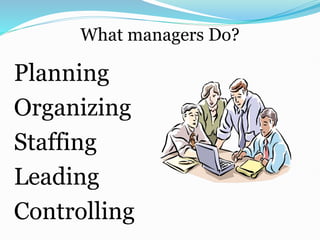
What managers Do?
Planning
Organizing
Staffing
Leading
Controlling
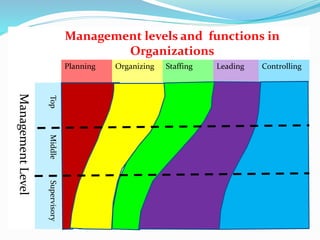
Management levels and functions in
Organizations
Management
Level
Planning Organizing Staffing Leading Controlling
Top
Middle
Supervisory
1. Technical skill, 2. Human relations skill
3. Conceptual Skill
Technical skill:
Necessary to accomplish or understand the specific
kind of work being done including:
 Knowledge about such things as Machines,
Methods, Processes, Procedures
 Ability to use tools, machines
 Ability to operate equipment
Technical skills are especially important for first line
managers.
Human Relations Skill
It refers to manager’s ability to work effectively as a
team member and to build cooperative effort in the
unit.
It is an ability to work with people
Interpersonal skills are more important than
technical skills in getting to the top.
Communication skills are an important component of
interpersonal skills.

It helps the managers to understand, communicate
and work with others.
It also helps the managers to lead, motivate and
develop team spirit.
Human relations skills are required by all managers
at all levels of management.
Conceptual skill
 It is the ability to see the organization as a total
entity.
 includes analytical, creative and initiative skills.
 involves recognizing how the various units of the
organization depend on one another and how
changes in any one part affect all the others.
 includes visualizing the relationship of the
individual business to the industry; the community;
and the political, social, and economic forces of the
nation as a whole.
 It helps to identify the causes of the problems and
to solve the problems
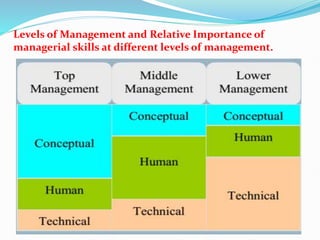
Levels of Management and Relative Importance of
managerial skills at different levels of management.
Cont.…
In General :
Technical skills are more important to lower
management levels;
Human skills are more important to middle
management levels and
 Conceptual skills are more important to top
management levels.
Chapter 1-ppt ba Construction Management

Chapter 1-ppt ba Construction Management

  • 1.
    By: Mussa A. February,2017, Mettu, Ethiopia
  • 2.
    Chapter One: INTRODUCTIONTO MANAGMENT: AN OVERVIEW  what is general management?  Why is management important?  What do managers do? And  The Development of General Management theories will be briefly explained.
  • 3.
    Chapter One: INTRODUCTIONTO MANAGMENT Management is one of the most important human activities. Management is essential whenever human efforts are to be undertaken collectively to achieve specific goals. No group activity can succeed without management. Organization is a group of two or more persons that exists and operates to achieve clearly stated, commonly held objectives.
  • 4.
    1.1. Meaning andDefinition of There is no single and comprehensive meaning and definition of management. Meaning: The word management has several meanings, the most important of which are:  Management refers to a group of people who are responsible for guiding and controlling the organization (managerial personnel). Management is the process of running an organization (planning, organizing, staffing, directing/leading and controlling). Management is a body of knowledge, a discipline.
  • 5.
    cont.… Defining Management: According differentauthorities in the field Management is the art of getting things done through and with people in a formally organized group. Management is the process of coordinating all resources through the five major functions of planning, organizing, staffing, directing/leading and and controlling to achieve organizational objective.
  • 6.
    1.2. General ManagementTheoretical Practical Development General Management is a broad area dealing with wider aspects of managing an ongoing organization and it covers the following among other topics:
  • 7.
    Cont.…  With advancingtechnological and changing human behavioral aspects, management is increasingly becoming more complex and requires considerable training, practical experience and updating on the latest information of developments in the field. Management Theory and Its Development Management’s theoretical and applied contribution to the world: 1. Early contributions 2. Industrial era contributions 3. Classical contributions 4. Behavioral contributions 5. Quantitative contributions 6. Systems Perspectives 7. Contingency Perspectives, and 8. Recent Contributions
  • 8.
    Management Theory andIts Development Reading Assignment: Theories of Management
  • 9.
    1.3. Managerial Functions Functionsof management can be described in four major elements. These are: I. Planning II. Organizing III. Implementing IV. Monitoring and Evaluation I. Planning  Involves setting visions, missions and goals of organizations or projects or programs together with the activities to achieve them.  All levels of managers develop goals that corresponds to the efforts of the top management overall goals and strategy.  This requires operational plan aimed at administration and coordination of Stakeholders, Processes and
  • 10.
    cont.…  Useful inthat it makes better coordination, focuses on forward thinking, and creates participatory work environment and good for effective monitoring and feedback systems. II. Organizing  It is the process of arranging people and physical resources to carryout plans and accomplishes organizational objectives.  This helps how responsibilities of individuals ?  who are required to execute the works are defined and staffing and directing can be performed. Such things can easily be shown by the use of Organization Chart.  Makes sure the flow of information resources and tasks
  • 11.
    cont.… III. Implementing It isthe process where by the actual work is executed. This helps in executing the task defined in the planning stage with proper organization system together with monitoring quality, time and cost of the works. Proper inspection and supervision, recording data of executed works, availing all necessary resources at the right place and at the right time with their proper coordination are necessary to achieve the required goal efficiently and successfully.
  • 12.
    cont.… Leading is theact of motivating or causing people to perform certain tasks intended to achieve specified objectives. Leading requires to understand the dynamics of individual and group behaviors, motivation of employees, effective visionary and effective communication capabilities. IV. Monitoring and Evaluation Is the process by which executives and legislatives determine or evaluate whether organizational objectives are being achieved and actual operations are in consistent with plans or not. Such things are done against the planned data with the help of communication in the form of reporting,
  • 13.
    cont.…. Generally effective managementcan take place when proper planning, organizing, implementing, continuous communication, feed back for monitoring purpose and future planning are carried out successfully. 1.4. Managerial Roles According to Henry Mintzberg the are ten most common managerial roles and which are classified into three managerial role categories: I. Interpersonal, II. Informational and III. Decision Making Roles
  • 14.
    Cont.… 1. Interpersonal rolesare roles that involve people (subordinates and persons outside the organization) and other duties that are ceremonial ceremonial and symbolic in nature.  The three interpersonal roles include being a figurehead, leader, and liaison.  The figurehead performs symbolic legal or social social duties.  The leader builds relationships with employees and communicates with, motivates, and coaches them. Also include mentoring, training and motivating employees.
  • 15.
    Cont.… 2. Informational rolesinvolve receiving, collecting, and disseminating information.  The three informational roles include a monitor, disseminator, and spokesperson.  The monitor seeks internal and external information about issues that can affect the organization.  The disseminator transmits information internally that is obtained from either internal or external sources.  The spokesperson transmits information about the organization to outsiders.
  • 16.
    Cont.…. 3. Decisional rolesinvolves making significant decisions that affect the organization. Revolve around making choices  The entrepreneur acts as an initiator, designer, and encourager of change and innovation.  The disturbance handler takes corrective action when the organization faces important, unexpected difficulties.  The resource allocator distributes resources of all types, including time, funding, equipment, and human resources.  The negotiator represents the organization in major negotiations affecting the manager’s areas of responsibility.
  • 17.
    1.5. Management Scopesand Levels Depending on the nature and scope of the job managers are performing: functional or general managers. o Functional Managers are responsible for a work group segmented according to functions. (Communication skill is needed) o General Managers involve in managing several different functions or departments which are responsible for different tasks.(General Managers needs technical skills.)  The level of management takes the shape of a pyramid.  The largest number of people is at the bottom organizational level.
  • 18.
    Top managers Middle managers First-linemanagers Non-management Supervisory Management Customers
  • 19.
    Top Managers  Therelatively small group of executives who manage the whole organization.  They include board of directors, executive committee and chief executives or presidents, general managers etc. Middle Management  A group of managers in organizations acting as intermediary between the top and operating (first-line) managers  They are usually functional area heads such as marketing, production operations, HRM, finance etc.  They supervise and coordinate the activities of lower- level managers.
  • 20.
    First-Line Management/Managers (Supervisors) The laststep of the ladder consisting of a group of managers in organizations acting as intermediary between the Middle level management and operating employees (non-management)  Frontline managers  having the least authority and are at the lowest level in the hierarchy of the organization.  manage the work of non-managerial individuals
  • 21.
    Resources used by Managers Managers use four types of resources to accomplish their purposes. 1. Human resources are the people needed to get the job done 2. Financial resources are the money the manager and the organization use to reach organizational goals 3. Physical resources are a firm’s tangible goods and real estate, including raw materials, office space, production facilities, office equipment, and vehicles. 4. Information resources are the data that the manager and the organization use to get the job done.
  • 22.
  • 23.
    Management levels andfunctions in Organizations Management Level Planning Organizing Staffing Leading Controlling Top Middle Supervisory
  • 24.
    1. Technical skill,2. Human relations skill 3. Conceptual Skill Technical skill: Necessary to accomplish or understand the specific kind of work being done including:  Knowledge about such things as Machines, Methods, Processes, Procedures  Ability to use tools, machines  Ability to operate equipment Technical skills are especially important for first line managers.
  • 25.
    Human Relations Skill Itrefers to manager’s ability to work effectively as a team member and to build cooperative effort in the unit. It is an ability to work with people Interpersonal skills are more important than technical skills in getting to the top. Communication skills are an important component of interpersonal skills. It helps the managers to understand, communicate and work with others. It also helps the managers to lead, motivate and develop team spirit. Human relations skills are required by all managers at all levels of management.
  • 26.
    Conceptual skill  Itis the ability to see the organization as a total entity.  includes analytical, creative and initiative skills.  involves recognizing how the various units of the organization depend on one another and how changes in any one part affect all the others.  includes visualizing the relationship of the individual business to the industry; the community; and the political, social, and economic forces of the nation as a whole.  It helps to identify the causes of the problems and to solve the problems
  • 27.
    Levels of Managementand Relative Importance of managerial skills at different levels of management.
  • 28.
    Cont.… In General : Technicalskills are more important to lower management levels; Human skills are more important to middle management levels and  Conceptual skills are more important to top management levels.