
INTRODUCTION TO MANAGEMENT
PRESENTED BY:
1. Bhanushali Shyam 1310401070 04
2. Soni Shirish 1310401070 40
3. Patel Akshay 1310401070 15
4. Patel Samarth 1310401070 27
GUIDED BY:
Prof. Ajay Mishra
TABLE OF CONTENT:
• What is management?
• Definitions of management.
• Management : science v/s art.
• Difference between Administration and Management.
• Model for management.
• Level of management.
• Who is Manager?
• Roles of manager.
• Management functions.
WHAT IS MANAGEMENT?
• Management is simply defined as a process of achieving organizational goals by getting
work done from the others.
• Management is the attainment of organizational goals in an effective and efficient manner
through planning, organizing, staffing, directing and controlling organizational resources.
• Organizational resources include men(human beings), money, machines and materials.
DEFINATION
“The use of people and other resources to accomplish objectives.”
- Louis E Boone & David L Kurtz
“The act of getting things done through people.”
- Mary Parker Follet
“Management is the art of knowing what you want to do in the best and cheapest way.”
-Frederick Taylor
“the process of desiging and maintaining an environment in which individual, working
together in groups efficiently to accomplish selected aims.”
-Herold and koontj
IS MANAGEMENT “SCIENCE” OR “ART”?
Management as an Art:
Art refers to the way of doing specific things. It indicates
how an objective can be achieved.
Management as a Science:
Science may be described as a systematized body of
knowledge based on proper findings and exact principles and is capable of verification.
DIFFERENCE BETWEEN MANAGEMENT &
ADMINISTRATION
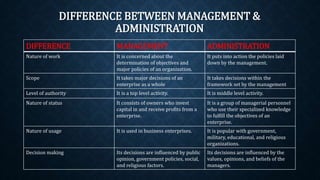
DIFFERENCE MANAGEMENT ADMINISTRATION
Nature of work It is concerned about the
determination of objectives and
major policies of an organization.
It puts into action the policies laid
down by the management.
Scope It takes major decisions of an
enterprise as a whole
It takes decisions within the
framework set by the management
Level of authority It is a top level activity. It is middle level activity.
Nature of status It consists of owners who invest
capital in and receive profits from a
enterprise.
It is a group of managerial personnel
who use their specialized knowledge
to fulfill the objectives of an
enterprise.
Nature of usage It is used in business enterprises. It is popular with government,
military, educational, and religious
organizations.
Decision making Its decisions are influenced by public
opinion, government policies, social,
and religious factors.
Its decisions are influenced by the
values, opinions, and beliefs of the
managers.
MODEL FOR MANAGEMENT
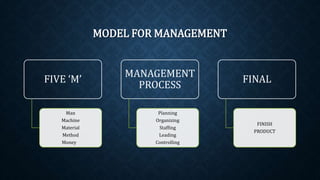
FIVE ‘M’
Man
Machine
Material
Method
Money
MANAGEMENT
PROCESS
Planning
Organizing
Staffing
Leading
Controlling
FINAL
FINISH
PRODUCT
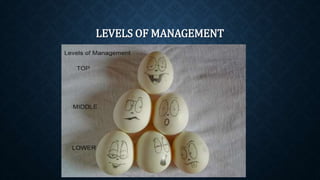
LEVELS OF MANAGEMENT
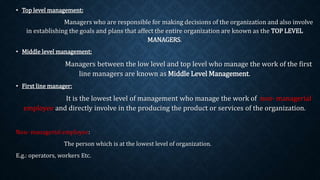
• Top level management:
Managers who are responsible for making decisions of the organization and also involve
in establishing the goals and plans that affect the entire organization are known as the TOP LEVEL
MANAGERS.
• Middle level management:
Managers between the low level and top level who manage the work of the first
line managers are known as Middle Level Management.
• First line manager:
It is the lowest level of management who manage the work of non- managerial
employee and directly involve in the producing the product or services of the organization.
Non- managerial employee:
The person which is at the lowest level of organization.
E.g.: operators, workers Etc.
WHO IS A MANAGER?
• A Manager is the person responsible for planning and directing the work of
a group of individuals, monitoring their work, and taking corrective action
when necessary.
ROLES OF MANAGER:-
• Roles of Managers are classified into 3 types:-
1. Interpersonal
2. Informational
3. Decisional
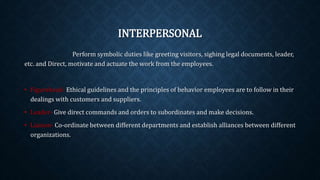
INTERPERSONAL
Perform symbolic duties like greeting visitors, sighing legal documents, leader,
etc. and Direct, motivate and actuate the work from the employees.
• Figurehead- Ethical guidelines and the principles of behavior employees are to follow in their
dealings with customers and suppliers.
• Leader- Give direct commands and orders to subordinates and make decisions.
• Liaison- Co-ordinate between different departments and establish alliances between different
organizations.
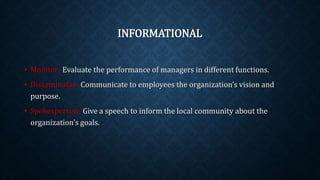
INFORMATIONAL
• Monitor- Evaluate the performance of managers in different functions.
• Disseminator- Communicate to employees the organization’s vision and
purpose.
• Spokesperson- Give a speech to inform the local community about the
organization’s goals.
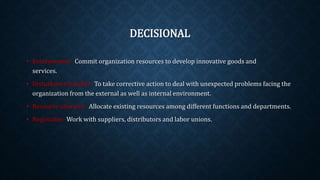
DECISIONAL
• Entrepreneur- Commit organization resources to develop innovative goods and
services.
• Disturbance handler- To take corrective action to deal with unexpected problems facing the
organization from the external as well as internal environment.
• Resource allocator- Allocate existing resources among different functions and departments.
• Negotiator- Work with suppliers, distributors and labor unions.
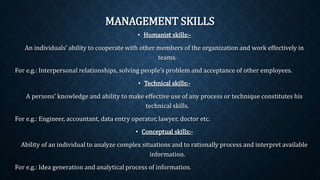
MANAGEMENT SKILLS
• Humanist skills:-
An individuals’ ability to cooperate with other members of the organization and work effectively in
teams.
For e.g.: Interpersonal relationships, solving people’s problem and acceptance of other employees.
• Technical skills:-
A persons’ knowledge and ability to make effective use of any process or technique constitutes his
technical skills.
For e.g.: Engineer, accountant, data entry operator, lawyer, doctor etc.
• Conceptual skills:-
Ability of an individual to analyze complex situations and to rationally process and interpret available
information.
For e.g.: Idea generation and analytical process of information.
MANAGEMENT FUNCTIONS
1. Planning
2. Organizing
3. Staffing
4. Leading
5. Controlling
PLANNING
It is a management function that involves defining the goals establishing strategy for
achieving that goals and developing plans for coordinating the activity.
ORGANIZING
When two or more person work together towards a common goal then authority and
responsibility are allocated and this is known as organizing.
STAFFING
It is the recruitment and training of personnel according to the organizational needs.
LEADING
After the three planning functions i.e. planning, organizing and staffing. The next step is to
actuate the work, and it is known as leading. Sometimes it is also known as motivating,
directing or implementing.
CONTROLLING
It is the process of comparing the actual performance with the standard performance and
taking necessary action if there is a deviation.
Introduction to management

Introduction to management

  • 1.
    INTRODUCTION TO MANAGEMENT PRESENTEDBY: 1. Bhanushali Shyam 1310401070 04 2. Soni Shirish 1310401070 40 3. Patel Akshay 1310401070 15 4. Patel Samarth 1310401070 27 GUIDED BY: Prof. Ajay Mishra
  • 2.
    TABLE OF CONTENT: •What is management? • Definitions of management. • Management : science v/s art. • Difference between Administration and Management. • Model for management. • Level of management. • Who is Manager? • Roles of manager. • Management functions.
  • 3.
    WHAT IS MANAGEMENT? •Management is simply defined as a process of achieving organizational goals by getting work done from the others. • Management is the attainment of organizational goals in an effective and efficient manner through planning, organizing, staffing, directing and controlling organizational resources. • Organizational resources include men(human beings), money, machines and materials.
  • 4.
    DEFINATION “The use ofpeople and other resources to accomplish objectives.” - Louis E Boone & David L Kurtz “The act of getting things done through people.” - Mary Parker Follet “Management is the art of knowing what you want to do in the best and cheapest way.” -Frederick Taylor “the process of desiging and maintaining an environment in which individual, working together in groups efficiently to accomplish selected aims.” -Herold and koontj
  • 5.
    IS MANAGEMENT “SCIENCE”OR “ART”? Management as an Art: Art refers to the way of doing specific things. It indicates how an objective can be achieved. Management as a Science: Science may be described as a systematized body of knowledge based on proper findings and exact principles and is capable of verification.
  • 6.
    DIFFERENCE BETWEEN MANAGEMENT& ADMINISTRATION DIFFERENCE MANAGEMENT ADMINISTRATION Nature of work It is concerned about the determination of objectives and major policies of an organization. It puts into action the policies laid down by the management. Scope It takes major decisions of an enterprise as a whole It takes decisions within the framework set by the management Level of authority It is a top level activity. It is middle level activity. Nature of status It consists of owners who invest capital in and receive profits from a enterprise. It is a group of managerial personnel who use their specialized knowledge to fulfill the objectives of an enterprise. Nature of usage It is used in business enterprises. It is popular with government, military, educational, and religious organizations. Decision making Its decisions are influenced by public opinion, government policies, social, and religious factors. Its decisions are influenced by the values, opinions, and beliefs of the managers.
  • 7.
    MODEL FOR MANAGEMENT FIVE‘M’ Man Machine Material Method Money MANAGEMENT PROCESS Planning Organizing Staffing Leading Controlling FINAL FINISH PRODUCT
  • 8.
  • 9.
    • Top levelmanagement: Managers who are responsible for making decisions of the organization and also involve in establishing the goals and plans that affect the entire organization are known as the TOP LEVEL MANAGERS. • Middle level management: Managers between the low level and top level who manage the work of the first line managers are known as Middle Level Management. • First line manager: It is the lowest level of management who manage the work of non- managerial employee and directly involve in the producing the product or services of the organization. Non- managerial employee: The person which is at the lowest level of organization. E.g.: operators, workers Etc.
  • 10.
    WHO IS AMANAGER? • A Manager is the person responsible for planning and directing the work of a group of individuals, monitoring their work, and taking corrective action when necessary.
  • 11.
    ROLES OF MANAGER:- •Roles of Managers are classified into 3 types:- 1. Interpersonal 2. Informational 3. Decisional
  • 12.
    INTERPERSONAL Perform symbolic dutieslike greeting visitors, sighing legal documents, leader, etc. and Direct, motivate and actuate the work from the employees. • Figurehead- Ethical guidelines and the principles of behavior employees are to follow in their dealings with customers and suppliers. • Leader- Give direct commands and orders to subordinates and make decisions. • Liaison- Co-ordinate between different departments and establish alliances between different organizations.
  • 13.
    INFORMATIONAL • Monitor- Evaluatethe performance of managers in different functions. • Disseminator- Communicate to employees the organization’s vision and purpose. • Spokesperson- Give a speech to inform the local community about the organization’s goals.
  • 14.
    DECISIONAL • Entrepreneur- Commitorganization resources to develop innovative goods and services. • Disturbance handler- To take corrective action to deal with unexpected problems facing the organization from the external as well as internal environment. • Resource allocator- Allocate existing resources among different functions and departments. • Negotiator- Work with suppliers, distributors and labor unions.
  • 15.
    MANAGEMENT SKILLS • Humanistskills:- An individuals’ ability to cooperate with other members of the organization and work effectively in teams. For e.g.: Interpersonal relationships, solving people’s problem and acceptance of other employees. • Technical skills:- A persons’ knowledge and ability to make effective use of any process or technique constitutes his technical skills. For e.g.: Engineer, accountant, data entry operator, lawyer, doctor etc. • Conceptual skills:- Ability of an individual to analyze complex situations and to rationally process and interpret available information. For e.g.: Idea generation and analytical process of information.
  • 16.
    MANAGEMENT FUNCTIONS 1. Planning 2.Organizing 3. Staffing 4. Leading 5. Controlling
  • 17.
    PLANNING It is amanagement function that involves defining the goals establishing strategy for achieving that goals and developing plans for coordinating the activity.
  • 18.
    ORGANIZING When two ormore person work together towards a common goal then authority and responsibility are allocated and this is known as organizing.
  • 19.
    STAFFING It is therecruitment and training of personnel according to the organizational needs.
  • 20.
    LEADING After the threeplanning functions i.e. planning, organizing and staffing. The next step is to actuate the work, and it is known as leading. Sometimes it is also known as motivating, directing or implementing.
  • 21.
    CONTROLLING It is theprocess of comparing the actual performance with the standard performance and taking necessary action if there is a deviation.