OSTEOSARCOMA &
CHONDROSARCOMA
Presenter: Dr. U. Karthikeyan
Moderator: Dr. K. Sivaprasad, Professor
BONE TUMOURS
Tissue of origin Benign Malignant
Bone forming
Osteoma
Osteoid osteoma
Osteoblastoma
Osteosarcoma
Cartilage forming
Chondroma
Osteochondroma
Chondroblastoma
Chondrosarcoma
Fibrous tissue Fibroma Fibrosarcoma
Giant-cell tumor Benign Osteoclastoma Malignant Osteoclastoma
Marrow tumors
Ewings sarcoma
Myeloma
Vascular Hemangioma Hemangiosarcoma
Other connective tissue
Fibrous histiocytoma
Lipoma
Malignant
fi
brous histiocytoma
Liposarcoma
Other tumors Neuro
fi
broma Adamantoma
OSTEOSARCOMA
De
fi
nition
Epidemiology
Pathogenesis
Skeletal distribution
Clinical presentation
Evaluation
Classi
fi
cations
Investigations
Treatment
Prognosis
OVERVIEW
Primary malignant tumour of bone which produce malignant osteoid
It is the m/c primary malignant tumour of bone
Incidence is m/c in 2nd decade of life and second peak in 5th decade
In younger population there is increased predisposition of males that decreases
with age (3:2)
Occurs in region of rapid bone turnover ie metaphysis
Mc location distal femur > proximal tibia > proximal humerus
ETIOLOGY
Previous radiation exposure
Pagets disease
Heriditary retinoblastoma
Li fraumeni syndrome
Bloom syndrome
CLASSIFICATION
Conventional classic osteosarcoma
Telengectatic OS
Small cell OS
High grade surface OS
Periosteal chongrogenic type
Low grade parosteal
CLINICAL FEATURES
Pain with or without swelling
Rest paint which worsens with activity
Local warmth, telangiectasia, dilated veins, skin stretched thin glossy,
Decreased range of motion of adjacent joint
Sudden increase in pain indicates haemorrhage in tumor, rapid growth,
pathological fracture
Respiratory
fi
nding with late stage mets
INVESTIGATIONS
X-RAY
MRI
Bone scan
CT scan
LABS. Sr. ALP
Biopsy
RADIOLOGICAL FEATURES
X-RAY
The radiologic changes maybe sclerotic(30%), osteolytic(25%), mixed(45%)
RADIOLOGICAL FEATURES
X-RAY
Classical is intermedullary combined lytic and sclerotic lesion
Usually seen around the metaphysis
Eccentric and outgrowing from medullary canal
Permeative growth, indistinctive margins and cortex erosion are signs of
aggressive growth
Sunburst appearance, Colman’s triangle
Amorphous
fl
u
ff
y bone formation in soft tissue is hallmark
RADIOLOGICAL FEATURES
X-RAY
Codman’s triangle Bone in soft tissue Sunburst appearance
RADIOLOGICAL FEATURES
MRI & PET scan
MRI is good for determining marrow extend thus helpful in deciding level of
resection
A post contrast image is used to di
ff
rentiate tumor from edema
Involvment of epiphysis and penetration of physeal cartilage can be seen
Also to see if disease is extended to capsule or ligaments nearby
Pre and post chemo MRI for analysing response and plan resection
Pet scan is used to identi
fi
cation of metastasis and prognosis of chemotherapy
RADIOLOGICAL FEATURES
MRI
GROSS APPEARANCE
Consistency varies from soft and gritty to bony hard
While epiphyseal plate is intact doesnt extend into epiphysis.
After closure may extend to epiphysis but articular cartilage stops extension into
joints
Color re
fl
ects its components
fi
brous - white osseous - yellowish white cartilagenous
- bluish white
Some have large vascular channels and hemorrage
Necrotic foci and area of disintegration cause cyst like cavity indicative of rapid
growing tumor
HISTOPATH
The characteristic of osteosarcoma is osteoid which is dense pink amorphous
material
Pleomorphic cells mostly with a combination of cell types
INVESTIGATIONS
Decrease of ALP and LDH have good prognostic signi
fi
cance
A NCCT chest is taken as lungs is m/c site of mets
A whole body bone scan to screen for bone metastasis which is 2nd m/c
PET CT occasionaly in heterogenous lesion for targetting a biopsy or staging with
lymph nodes and atypical mets sites
TREATMENT
For high grade surgical exision of primary tumor with chemotherapy
Mulitangent chemotherapy
Doxorubicin, cisplatin high dose methotreate, etoposide, ifosfamide
Neoadjuvant phase f/b surgey f/b adjuvant chemotherapy
Surgical procedures
Resection and arthrodesis ± bone lengthening
Mettalic endoprosthesis
Wide excision and autoclaved bone graft reconstruction
Resection and arthrodesis ± bone lengthening
Mettalic endoprosthesis
Wide excision and autoclaved bonegraft reconstruction
CHONDROSARCOMA
Malignant bone tumor where neoplastic cells produce hyaline cartilage
It presents with diverse morphological features as myxoid calci
fi
cation or
ossi
fi
cation
It occurs in population more than 20 years of age peak incidence from 50-70
years of age
Usually sporadic also malignant transformation of osteochondroma and
enchondroma
CLASSIFICATION
Chondrosarcoma
Conventional
Central
Peripheral
Periosteal
Uncommon variants
Clear cell
Myxoid
Mesenchymal
PRIMARY CHONDROSARCOMA
A malignant tumor arising centrally in a previously normal bone
3rd m/c primary malignancy of bone
90 % of chondrosarcomas are primary chondrosarcoma
IDH 1 &IDH2 mutations common in central chondrosarcomas
Age group is after 2nd decade of life peak incidence from 5th to 7th decades
Male to female ratio is 3:2
Pelvis>prox femur>prox humerus>Distal femur
CLINICAL FEATURES
Pain is the mc and mostly only presentation of patients
Pathologic fractures are rare its incidence increase with higher grades
Pain at rest
RADIOLOGICAL FEATURES
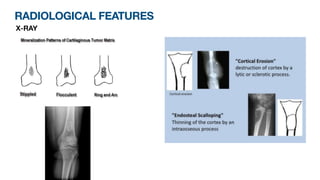
X-RAY
Expansion of medullary portion and thickening of cortex is seen
Periosteal reaction is scant or absent
Shows endosteal scalloping
annular punctate or comma shapes stippled calci
fi
cation
Enchondroma also shows similar features ddx by degree of these features
Endosteal scalloping >2/3 of the cortical thickness is s/o aggressive lesion
Cortical expansion and thickening adaptive signs
Cortical disruption and soft tissue masses are aggressive signs
RADIOLOGICAL FEATURES
X-RAY
RADIOLOGICAL FEATURES
X-RAY
RADIOLOGICAL FEATURES
MRI
Presence of edema in post contrast mri in marrow and soft tissue predict
chondrosarcoma
Localization of size > 5cm in axial skeleton predictor of malignancy
Appearance of lysis within previous calci
fi
ed area suggests tumor progression
Aggressive features of tubular bone of hand is an exception coz it is benign
enchondroma
Margins of lesions which are lobulated and intramedullary extent can be seen
with MRI
RADIOLOGICAL FEATURES
MRI & CT
NCCT shows rings and arc classi
fi
cation wothout any
associated periosteal reaction
MRI of humerus shows a
corresponding well-de
fi
ned lobulated lesion
internal hypointesities (Blue Arrow), consistent with regions
of calci
fi
cations within the chondroid matrix.
RADIOLOGY
CT & BONE SCAN
Ct may be helpful in detection and characterisation of lesions in anatomically
complex regions such a s sacrum and spine
Bone scan uptake is graded 1 to 3
1 being uptake less than asis 2 equal to that of asis and 3 indicating uptake
greater than asis
Even though enchondromas show some activity on bone scan a grade 3uptake is
m/c indicates chondrosarcoma
INVESTIGATIONS
Laboratory
fi
ndings are mostly non speci
fi
c
In high grade a ncct chest is acquired to rule out mets
A whole body scintiography screens for mets but its role is limited
Diagnosis of grade 2 and 3 can be done by cytologic and histologic features
Grade 1
fi
ndings are similar to those of enchondromas so anatomical location,
clinical behaviour and radiological
fi
ndings must be correlated
GROSS APPEARANCE
Tumor is a glistening translucent blue grey or blue white on cut surface with
nodular growth pattern
Cystic myxoid changes to chalky white calci
fi
cations can be seen
MICROSCOPIC APPEARANCE
Composed of irregular lobules of cartilage permeating bony trabeculae
Has a hyaline cartilaginous matrix
Chondrocytes present in lacunae with nuclear atypic
Treatment
These tumor is generally not sensitive to chemo or radio therapy
Surgery is only reliable treatment
A wide resection is done for grade 3 and grade 2 chondrosarcomas
Cartilagenous lesions of pelvis and sacrum recur after intralesional excision even
if histologic appearance is beningn so wide excision recommended
Radiotherapy though doesnt have a signi
fi
cant role has some use in unresectable
lesions and incomplete resections as palliative care
Treatment
Grade 1 with aggressive features wide resection is preferable but extended
intralesional curretage without in reading risk of recurrence or mets can be done
Thank you

OS image fin.pdf

  • 1.
    OSTEOSARCOMA & CHONDROSARCOMA Presenter: Dr.U. Karthikeyan Moderator: Dr. K. Sivaprasad, Professor
  • 2.
    BONE TUMOURS Tissue oforigin Benign Malignant Bone forming Osteoma Osteoid osteoma Osteoblastoma Osteosarcoma Cartilage forming Chondroma Osteochondroma Chondroblastoma Chondrosarcoma Fibrous tissue Fibroma Fibrosarcoma Giant-cell tumor Benign Osteoclastoma Malignant Osteoclastoma Marrow tumors Ewings sarcoma Myeloma Vascular Hemangioma Hemangiosarcoma Other connective tissue Fibrous histiocytoma Lipoma Malignant fi brous histiocytoma Liposarcoma Other tumors Neuro fi broma Adamantoma
  • 3.
  • 4.
  • 5.
    Primary malignant tumourof bone which produce malignant osteoid It is the m/c primary malignant tumour of bone Incidence is m/c in 2nd decade of life and second peak in 5th decade In younger population there is increased predisposition of males that decreases with age (3:2) Occurs in region of rapid bone turnover ie metaphysis Mc location distal femur > proximal tibia > proximal humerus
  • 6.
    ETIOLOGY Previous radiation exposure Pagetsdisease Heriditary retinoblastoma Li fraumeni syndrome Bloom syndrome
  • 7.
    CLASSIFICATION Conventional classic osteosarcoma TelengectaticOS Small cell OS High grade surface OS Periosteal chongrogenic type Low grade parosteal
  • 8.
    CLINICAL FEATURES Pain withor without swelling Rest paint which worsens with activity Local warmth, telangiectasia, dilated veins, skin stretched thin glossy, Decreased range of motion of adjacent joint Sudden increase in pain indicates haemorrhage in tumor, rapid growth, pathological fracture Respiratory fi nding with late stage mets
  • 9.
  • 10.
    RADIOLOGICAL FEATURES X-RAY The radiologicchanges maybe sclerotic(30%), osteolytic(25%), mixed(45%)
  • 11.
    RADIOLOGICAL FEATURES X-RAY Classical isintermedullary combined lytic and sclerotic lesion Usually seen around the metaphysis Eccentric and outgrowing from medullary canal Permeative growth, indistinctive margins and cortex erosion are signs of aggressive growth Sunburst appearance, Colman’s triangle Amorphous fl u ff y bone formation in soft tissue is hallmark
  • 12.
    RADIOLOGICAL FEATURES X-RAY Codman’s triangleBone in soft tissue Sunburst appearance
  • 13.
    RADIOLOGICAL FEATURES MRI &PET scan MRI is good for determining marrow extend thus helpful in deciding level of resection A post contrast image is used to di ff rentiate tumor from edema Involvment of epiphysis and penetration of physeal cartilage can be seen Also to see if disease is extended to capsule or ligaments nearby Pre and post chemo MRI for analysing response and plan resection Pet scan is used to identi fi cation of metastasis and prognosis of chemotherapy
  • 14.
  • 15.
    GROSS APPEARANCE Consistency variesfrom soft and gritty to bony hard While epiphyseal plate is intact doesnt extend into epiphysis. After closure may extend to epiphysis but articular cartilage stops extension into joints Color re fl ects its components fi brous - white osseous - yellowish white cartilagenous - bluish white Some have large vascular channels and hemorrage Necrotic foci and area of disintegration cause cyst like cavity indicative of rapid growing tumor
  • 16.
    HISTOPATH The characteristic ofosteosarcoma is osteoid which is dense pink amorphous material Pleomorphic cells mostly with a combination of cell types
  • 17.
    INVESTIGATIONS Decrease of ALPand LDH have good prognostic signi fi cance A NCCT chest is taken as lungs is m/c site of mets A whole body bone scan to screen for bone metastasis which is 2nd m/c PET CT occasionaly in heterogenous lesion for targetting a biopsy or staging with lymph nodes and atypical mets sites
  • 18.
    TREATMENT For high gradesurgical exision of primary tumor with chemotherapy Mulitangent chemotherapy Doxorubicin, cisplatin high dose methotreate, etoposide, ifosfamide Neoadjuvant phase f/b surgey f/b adjuvant chemotherapy
  • 19.
    Surgical procedures Resection andarthrodesis ± bone lengthening Mettalic endoprosthesis Wide excision and autoclaved bone graft reconstruction
  • 20.
    Resection and arthrodesis± bone lengthening
  • 21.
  • 22.
    Wide excision andautoclaved bonegraft reconstruction
  • 23.
  • 24.
    Malignant bone tumorwhere neoplastic cells produce hyaline cartilage It presents with diverse morphological features as myxoid calci fi cation or ossi fi cation It occurs in population more than 20 years of age peak incidence from 50-70 years of age Usually sporadic also malignant transformation of osteochondroma and enchondroma
  • 25.
  • 26.
  • 27.
    A malignant tumorarising centrally in a previously normal bone 3rd m/c primary malignancy of bone 90 % of chondrosarcomas are primary chondrosarcoma IDH 1 &IDH2 mutations common in central chondrosarcomas Age group is after 2nd decade of life peak incidence from 5th to 7th decades Male to female ratio is 3:2 Pelvis>prox femur>prox humerus>Distal femur
  • 28.
    CLINICAL FEATURES Pain isthe mc and mostly only presentation of patients Pathologic fractures are rare its incidence increase with higher grades Pain at rest
  • 29.
    RADIOLOGICAL FEATURES X-RAY Expansion ofmedullary portion and thickening of cortex is seen Periosteal reaction is scant or absent Shows endosteal scalloping annular punctate or comma shapes stippled calci fi cation Enchondroma also shows similar features ddx by degree of these features Endosteal scalloping >2/3 of the cortical thickness is s/o aggressive lesion Cortical expansion and thickening adaptive signs Cortical disruption and soft tissue masses are aggressive signs
  • 30.
  • 31.
  • 32.
    RADIOLOGICAL FEATURES MRI Presence ofedema in post contrast mri in marrow and soft tissue predict chondrosarcoma Localization of size > 5cm in axial skeleton predictor of malignancy Appearance of lysis within previous calci fi ed area suggests tumor progression Aggressive features of tubular bone of hand is an exception coz it is benign enchondroma Margins of lesions which are lobulated and intramedullary extent can be seen with MRI
  • 33.
    RADIOLOGICAL FEATURES MRI &CT NCCT shows rings and arc classi fi cation wothout any associated periosteal reaction MRI of humerus shows a corresponding well-de fi ned lobulated lesion internal hypointesities (Blue Arrow), consistent with regions of calci fi cations within the chondroid matrix.
  • 34.
    RADIOLOGY CT & BONESCAN Ct may be helpful in detection and characterisation of lesions in anatomically complex regions such a s sacrum and spine Bone scan uptake is graded 1 to 3 1 being uptake less than asis 2 equal to that of asis and 3 indicating uptake greater than asis Even though enchondromas show some activity on bone scan a grade 3uptake is m/c indicates chondrosarcoma
  • 35.
    INVESTIGATIONS Laboratory fi ndings are mostlynon speci fi c In high grade a ncct chest is acquired to rule out mets A whole body scintiography screens for mets but its role is limited Diagnosis of grade 2 and 3 can be done by cytologic and histologic features Grade 1 fi ndings are similar to those of enchondromas so anatomical location, clinical behaviour and radiological fi ndings must be correlated
  • 36.
    GROSS APPEARANCE Tumor isa glistening translucent blue grey or blue white on cut surface with nodular growth pattern Cystic myxoid changes to chalky white calci fi cations can be seen
  • 37.
    MICROSCOPIC APPEARANCE Composed ofirregular lobules of cartilage permeating bony trabeculae Has a hyaline cartilaginous matrix Chondrocytes present in lacunae with nuclear atypic
  • 38.
    Treatment These tumor isgenerally not sensitive to chemo or radio therapy Surgery is only reliable treatment A wide resection is done for grade 3 and grade 2 chondrosarcomas Cartilagenous lesions of pelvis and sacrum recur after intralesional excision even if histologic appearance is beningn so wide excision recommended Radiotherapy though doesnt have a signi fi cant role has some use in unresectable lesions and incomplete resections as palliative care
  • 39.
    Treatment Grade 1 withaggressive features wide resection is preferable but extended intralesional curretage without in reading risk of recurrence or mets can be done
  • 40.