1
EFFECT OF ECAP WITH HEAT
TREATMENT ON MECHANICAL
PROPERTIES OF ALUMINIUM ALLOY
(A356)
 Presented by : AKHIL PS
 Roll no : 165551
CONTENTS
2
 Severe plastic deformation(SPD)
 ECAP technology
 Aluminium alloy and it’s application
 Methodology
 Result
 Conclusion
INTRODUCTION
3
 It is a metal working technique
 Involves very large strain applied on metals
 Resulting in high defect density and equiaxed
ultrafine grains.
 dislocation-free and highly misoriented fine
grains
 High angle grain boundary and high grain
boundary area
 increased ductility and yield stress
SEVERE PLASTIC DEFORMATION (SPD)
INTRODUCTION
4
 High Pressure Torsion
 Twist Extrusion
 Accumulative Roll Bonding
 Equal Channel Angular Pressing (ECAP)
METHODS OF SPD
5
HIGH PRESSURE TORSION TWIST EXTRUSION
ECAP TECHNOLOGY
6
 ECAP is an extrusion process developed in 1973 in the Soviet Union.
 The technique is able to refine the microstructure of metals and alloys, thereby
improving their strength according to the Hall-Petch Relations
 The relation between yield stress and grain size is described mathematically by the
Hall–Petch equation
where,
 σy = yield stress
 σo = materials constant for the starting stress
 ky = strengthening coefficient
 d = average grain diameter
ECAP TECHNOLOGY
7
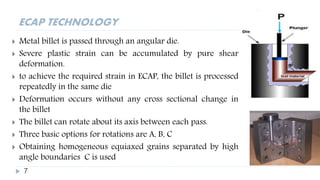
 Metal billet is passed through an angular die.
 Severe plastic strain can be accumulated by pure shear
deformation.
 to achieve the required strain in ECAP, the billet is processed
repeatedly in the same die
 Deformation occurs without any cross sectional change in
the billet
 The billet can rotate about its axis between each pass.
 Three basic options for rotations are A, B, C
 Obtaining homogeneous equiaxed grains separated by high
angle boundaries C is used
8
MECHANISM
9
 For route A, In the place of intersection of channels the grain takes a shape of
an ellipsoid, during first pass due to pure shear
 Following passes result in lengthening of axis 1 and the ellipsoid is elongated
 At the same time the direction of shear is turned around the axis
perpendicular to the longitudinal section of channels
 The repeat pass in the route B leads to a change in the direction of shear and
the shear plane is turned through the angle 120°
 During deformation by route C the repeat pass leads to shear in the same
plane but in the opposite direction . The grain again takes a spherical shape.
CONT.
10
 ECAP process should be done in a high temperature with applying low strain
rate or back pressure
 One of the reasons for the fracture failure and unsuccessful process is
attributed to the shear localization during SPD
Figure : ECAP samples; (a) Fracture failure;
(b)Successesful ECAP process
PROPERTIES OF Al A356
11
DENSITY : 2.685gm/cm³
TENSILE STRENGTH : 187MPa
% ELONGATION : 3.1%
BRINELL HARDNESS : 71 HB
COMPOSITION
ELEMENT WT%
Si 7.04
Fe 0.49
Mg 0.42
Cu 0.14
Al REM
METHODOLOGY
12
 Annealing process is carried out at 540◦c for 12 hours followed by
furnace cooling.
 The solution treatment is performed in the same condition as annealing
process, and then quenched in the water.
 Aging process is performed at 140◦c for 3 hours.
 For the pre/post ECAP aging treatments, the samples are aged before/after
ECAP.
RESULT
13
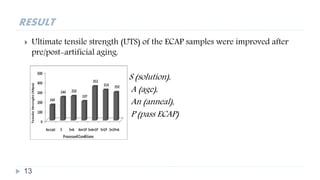
 Ultimate tensile strength (UTS) of the ECAP samples were improved after
pre/post-artificial aging.
S (solution),
A (age),
An (anneal),
P (pass ECAP)
CONTD.
14
 Ductility can also be improved by choosing suitable heat treatment.
S (solution),
A (age),
An (anneal), P
P (pass ECAP)
15
AS-CAST MICROSTRUCTURE
(a) Optical micrograph shows the dendritic
growth;
(b) SEM micrograph after solution treatment
shows the coarse Si particles
16
a. Optical micrograph shows the severely deformation of dendrite
b. SEM micrograph shows the distribution of Si particles
( a) ( b)
Improvement of mechanical properties is attributed
to the grain refinement and SI particles which
distributed in the matrix.
ECAP microstructure
ADVANTAGES DISADVANTAGES
17
 Grain refinement
 Hardness improvement
 Toughness, yield strength
improvement
 The cross section diameter or
diagonal of billet should not
exceed 20 mm
 Decrease in electrical
conductivity
 Fracture after some passes
 Low productivity
 Time taking process
CONCLUSIONS
18
 Best mechanical properties achieved after solution ageing plus
ECAP process which has a great increase in tensile strength from
160 MPa in the as-cast state to 352 MPa.
 The notable increase in ductility is obtained from 5% in the as-cast
state to 15% after aged+ ECAP
 Thus it can be concluded that improvement in mechanical properties
can be achieved by with suitable heat treatment.
REFERENCE
19
 “Improvement of mechanical properties of Al (A356) cast alloy
processed by ECAP with different heat treatments”
M. Moradi, M. Nili-Ahmadabadi, B. Heidarian
 “Microstructure and Mechanical Properties of EN AW 6082 Aluminium
Alloy Prepared by Equal-Channel Angular Pressing “
Martin FUJDA and Tibor Kvačkaj
 “Increasing strength, ductility and impact toughness of ultrafine-grained
6063 aluminium alloyby combining ECAP and a high-temperature short-
time aging”
L. W. Meyer , R. Schönherr , M. Hockauf
 “Bulk nanostructured materials from severe plastic deformation” R.Z.
Valiev, R.K. Islamgaliev, I.V. Alexandrov
20

Ecap akhil

  • 1.
    1 EFFECT OF ECAPWITH HEAT TREATMENT ON MECHANICAL PROPERTIES OF ALUMINIUM ALLOY (A356)  Presented by : AKHIL PS  Roll no : 165551
  • 2.
    CONTENTS 2  Severe plasticdeformation(SPD)  ECAP technology  Aluminium alloy and it’s application  Methodology  Result  Conclusion
  • 3.
    INTRODUCTION 3  It isa metal working technique  Involves very large strain applied on metals  Resulting in high defect density and equiaxed ultrafine grains.  dislocation-free and highly misoriented fine grains  High angle grain boundary and high grain boundary area  increased ductility and yield stress SEVERE PLASTIC DEFORMATION (SPD)
  • 4.
    INTRODUCTION 4  High PressureTorsion  Twist Extrusion  Accumulative Roll Bonding  Equal Channel Angular Pressing (ECAP) METHODS OF SPD
  • 5.
    5 HIGH PRESSURE TORSIONTWIST EXTRUSION
  • 6.
    ECAP TECHNOLOGY 6  ECAPis an extrusion process developed in 1973 in the Soviet Union.  The technique is able to refine the microstructure of metals and alloys, thereby improving their strength according to the Hall-Petch Relations  The relation between yield stress and grain size is described mathematically by the Hall–Petch equation where,  σy = yield stress  σo = materials constant for the starting stress  ky = strengthening coefficient  d = average grain diameter
  • 7.
    ECAP TECHNOLOGY 7  Metalbillet is passed through an angular die.  Severe plastic strain can be accumulated by pure shear deformation.  to achieve the required strain in ECAP, the billet is processed repeatedly in the same die  Deformation occurs without any cross sectional change in the billet  The billet can rotate about its axis between each pass.  Three basic options for rotations are A, B, C  Obtaining homogeneous equiaxed grains separated by high angle boundaries C is used
  • 8.
  • 9.
    MECHANISM 9  For routeA, In the place of intersection of channels the grain takes a shape of an ellipsoid, during first pass due to pure shear  Following passes result in lengthening of axis 1 and the ellipsoid is elongated  At the same time the direction of shear is turned around the axis perpendicular to the longitudinal section of channels  The repeat pass in the route B leads to a change in the direction of shear and the shear plane is turned through the angle 120°  During deformation by route C the repeat pass leads to shear in the same plane but in the opposite direction . The grain again takes a spherical shape.
  • 10.
    CONT. 10  ECAP processshould be done in a high temperature with applying low strain rate or back pressure  One of the reasons for the fracture failure and unsuccessful process is attributed to the shear localization during SPD Figure : ECAP samples; (a) Fracture failure; (b)Successesful ECAP process
  • 11.
    PROPERTIES OF AlA356 11 DENSITY : 2.685gm/cm³ TENSILE STRENGTH : 187MPa % ELONGATION : 3.1% BRINELL HARDNESS : 71 HB COMPOSITION ELEMENT WT% Si 7.04 Fe 0.49 Mg 0.42 Cu 0.14 Al REM
  • 12.
    METHODOLOGY 12  Annealing processis carried out at 540◦c for 12 hours followed by furnace cooling.  The solution treatment is performed in the same condition as annealing process, and then quenched in the water.  Aging process is performed at 140◦c for 3 hours.  For the pre/post ECAP aging treatments, the samples are aged before/after ECAP.
  • 13.
    RESULT 13  Ultimate tensilestrength (UTS) of the ECAP samples were improved after pre/post-artificial aging. S (solution), A (age), An (anneal), P (pass ECAP)
  • 14.
    CONTD. 14  Ductility canalso be improved by choosing suitable heat treatment. S (solution), A (age), An (anneal), P P (pass ECAP)
  • 15.
    15 AS-CAST MICROSTRUCTURE (a) Opticalmicrograph shows the dendritic growth; (b) SEM micrograph after solution treatment shows the coarse Si particles
  • 16.
    16 a. Optical micrographshows the severely deformation of dendrite b. SEM micrograph shows the distribution of Si particles ( a) ( b) Improvement of mechanical properties is attributed to the grain refinement and SI particles which distributed in the matrix. ECAP microstructure
  • 17.
    ADVANTAGES DISADVANTAGES 17  Grainrefinement  Hardness improvement  Toughness, yield strength improvement  The cross section diameter or diagonal of billet should not exceed 20 mm  Decrease in electrical conductivity  Fracture after some passes  Low productivity  Time taking process
  • 18.
    CONCLUSIONS 18  Best mechanicalproperties achieved after solution ageing plus ECAP process which has a great increase in tensile strength from 160 MPa in the as-cast state to 352 MPa.  The notable increase in ductility is obtained from 5% in the as-cast state to 15% after aged+ ECAP  Thus it can be concluded that improvement in mechanical properties can be achieved by with suitable heat treatment.
  • 19.
    REFERENCE 19  “Improvement ofmechanical properties of Al (A356) cast alloy processed by ECAP with different heat treatments” M. Moradi, M. Nili-Ahmadabadi, B. Heidarian  “Microstructure and Mechanical Properties of EN AW 6082 Aluminium Alloy Prepared by Equal-Channel Angular Pressing “ Martin FUJDA and Tibor Kvačkaj  “Increasing strength, ductility and impact toughness of ultrafine-grained 6063 aluminium alloyby combining ECAP and a high-temperature short- time aging” L. W. Meyer , R. Schönherr , M. Hockauf  “Bulk nanostructured materials from severe plastic deformation” R.Z. Valiev, R.K. Islamgaliev, I.V. Alexandrov
  • 20.