Making Work
Stations Work
A Quick Guide to Getting Literacy Work
Stations Up and Running
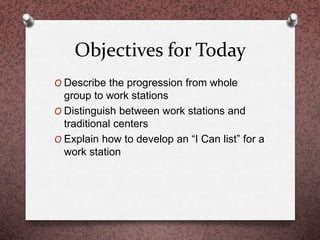
Objectives for Today
O Describe the progression from whole
group to work stations
O Distinguish between work stations and
traditional centers
O Explain how to develop an “I Can list” for a
work station
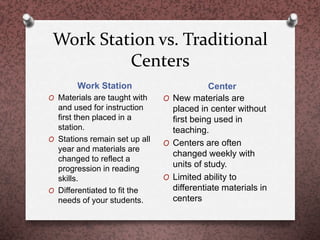
Work Station vs. Traditional
Centers
Work Station Center
O Materials are taught with
and used for instruction
first then placed in a
station.
O Stations remain set up all
year and materials are
changed to reflect a
progression in reading
skills.
O Differentiated to fit the
needs of your students.
O New materials are
placed in center without
first being used in
teaching.
O Centers are often
changed weekly with
units of study.
O Limited ability to
differentiate materials in
centers
Sorting Activity
O With a partner, take out your headings.
O Take turns reading each clue and place it
under the correct heading.
O Justify why you placed it under the
heading using the sentence stem:
I placed it under __________ because it
says _________and I know that means it is
characteristic of a__________.
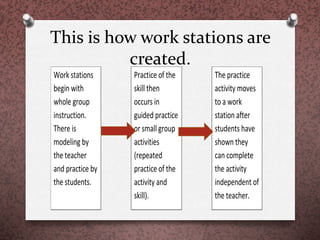
This is how work stations are
created.
Work stations
begin with
whole group
instruction.
There is
modeling by
the teacher
and practice by
the students.
Practice of the
skill then
occurs in
guided practice
or small group
activities
(repeated
practice of the
activity and
skill).
The practice
activity moves
to a work
station after
students have
shown they
can complete
the activity
independent of
the teacher.
Work Stations should:
O Be familiar activities that have been used in
whole group instruction.
O Not be activities, skills or materials that have
not been used in whole group instruction with
all students.
O Only have new activities added after they
have been introduced in whole group
instruction.
O Be established around concrete literacy skills
that students will need all year (think the 5
components of reading or writing).
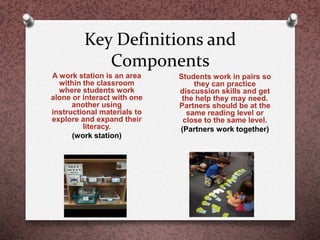
Key Definitions and
Components
A work station is an area
within the classroom
where students work
alone or interact with one
another using
instructional materials to
explore and expand their
literacy.
(work station)
Students work in pairs so
they can practice
discussion skills and get
the help they may need.
Partners should be at the
same reading level or
close to the same level.
(Partners work together)
Key Definitions and
Components
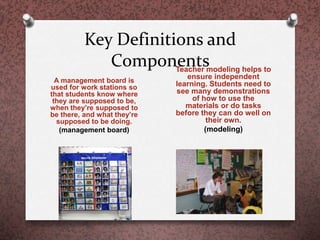
A management board is
used for work stations so
that students know where
they are supposed to be,
when they’re supposed to
be there, and what they’re
supposed to be doing.
(management board)
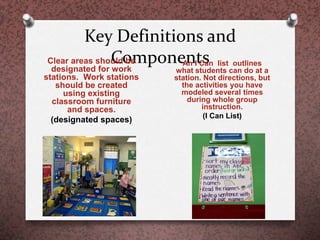
Teacher modeling helps to
ensure independent
learning. Students need to
see many demonstrations
of how to use the
materials or do tasks
before they can do well on
their own.
(modeling)
Key Definitions and
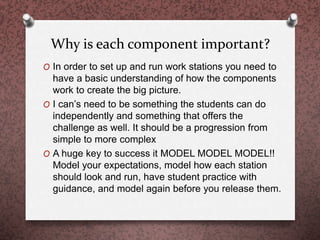
ComponentsClear areas should be
designated for work
stations. Work stations
should be created
using existing
classroom furniture
and spaces.
(designated spaces)
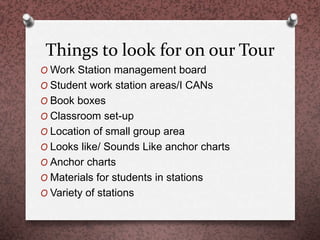
An I Can list outlines
what students can do at a
station. Not directions, but
the activities you have
modeled several times
during whole group
instruction.
(I Can List)
Why is each component important?
O In order to set up and run work stations you need to
have a basic understanding of how the components
work to create the big picture.
O I can’s need to be something the students can do
independently and something that offers the
challenge as well. It should be a progression from
simple to more complex
O A huge key to success it MODEL MODEL MODEL!!
Model your expectations, model how each station
should look and run, have student practice with
guidance, and model again before you release them.
Things to look for on our Tour
O Work Station management board
O Student work station areas/I CANs
O Book boxes
O Classroom set-up
O Location of small group area
O Looks like/ Sounds Like anchor charts
O Anchor charts
O Materials for students in stations
O Variety of stations
Tour
O Now that you have seen two classrooms
and how they are set up for work stations.
O Turn and talk at your table what are things
you notice? What did you like? What
would you change? Why?
O NOW- Think about your current
classroom- I want you to think of one thing
that you need to do Right Away to make
work stations work
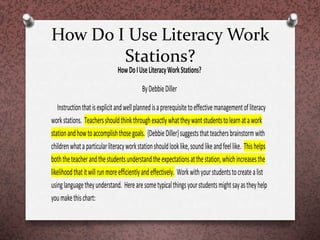
How Do I Use Literacy Work
Stations?
HowDoIUseLiteracyWorkStations?
ByDebbieDiller
Instructionthatisexplicitandwellplannedisaprerequisitetoeffectivemanagementofliteracy
workstations. Teachersshouldthinkthroughexactlywhattheywantstudentstolearnatawork
stationandhowtoaccomplishthosegoals. {DebbieDiller}suggeststhatteachersbrainstormwith
childrenwhataparticularliteracyworkstationshouldlooklike,soundlikeandfeellike. Thishelps
boththeteacherandthestudentsunderstandtheexpectationsatthestation,whichincreasesthe
likelihoodthatitwillrunmoreefficientlyandeffectively. Workwithyourstudentstocreatealist
usinglanguagetheyunderstand. Herearesometypicalthingsyourstudentsmightsayastheyhelp
youmakethischart:
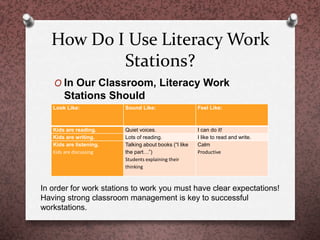
How Do I Use Literacy Work
Stations?
O In Our Classroom, Literacy Work
Stations Should
Look Like: Sound Like: Feel Like:
Kids are reading. Quiet voices. I can do it!
Kids are writing. Lots of reading. I like to read and write.
Kids are listening.
Kids are discussing
Talking about books (“I like
the part…”)
Students explaining their
thinking
Calm
Productive
In order for work stations to work you must have clear expectations!
Having strong classroom management is key to successful
workstations.
Buddy Reading Activity
O Read the passage together taking turns. An example one
partner reads the highlighted part the other reads the parts
that are not highlighted.
O Books should be at independent level for buddy reading
and each partner should have the same book in front of
them.
O The more you can place a structure around this the better.
O After reading, students will then together talk about the
book they read using question stems, topic choices
(characters, main idea, setting, authors purpose)- then they
should take that and do some type of written response.
O Talk cards are the best way to help structure their
responses as well as give them a frame for their
conversation.
I Can Lists
Are Are Not
O Lists that clearly outline
what students can do at a
station.
O Need to me modeled and
students need time to
practice how to use them
O Developed with students.
In student friendly
language
O Are posted at each
station- or can be taken
to the work space
O A list of directions,
rules or expectations
for behavior.
O Created by the
teacher and then
communicate to
students.
O Communicated orally
before station time
begins.
O Written in adult
language
Text Detective Activity
O Read the passage, Clear, Explicit
Expectations, silently.
O After reading, work with your partner to pick
out 10 words that are critical to understanding
the passage and write them down on your
notecard.
O We will do a whip around as a group when
everyone is finished.
O After coming up with a class list of ten words,
you will write a $1.50 summary of the passage
.
Wrap Up:
O Describe the progression from whole
group to work stations?
O How are work stations different from
traditional centers?
O Explain how to develop an “I Can list” for a
work station.

Making Work Stations Work

  • 1.
    Making Work Stations Work AQuick Guide to Getting Literacy Work Stations Up and Running
  • 2.
    Objectives for Today ODescribe the progression from whole group to work stations O Distinguish between work stations and traditional centers O Explain how to develop an “I Can list” for a work station
  • 3.
    Work Station vs.Traditional Centers Work Station Center O Materials are taught with and used for instruction first then placed in a station. O Stations remain set up all year and materials are changed to reflect a progression in reading skills. O Differentiated to fit the needs of your students. O New materials are placed in center without first being used in teaching. O Centers are often changed weekly with units of study. O Limited ability to differentiate materials in centers
  • 4.
    Sorting Activity O Witha partner, take out your headings. O Take turns reading each clue and place it under the correct heading. O Justify why you placed it under the heading using the sentence stem: I placed it under __________ because it says _________and I know that means it is characteristic of a__________.
  • 5.
    This is howwork stations are created. Work stations begin with whole group instruction. There is modeling by the teacher and practice by the students. Practice of the skill then occurs in guided practice or small group activities (repeated practice of the activity and skill). The practice activity moves to a work station after students have shown they can complete the activity independent of the teacher.
  • 6.
    Work Stations should: OBe familiar activities that have been used in whole group instruction. O Not be activities, skills or materials that have not been used in whole group instruction with all students. O Only have new activities added after they have been introduced in whole group instruction. O Be established around concrete literacy skills that students will need all year (think the 5 components of reading or writing).
  • 7.
    Key Definitions and Components Awork station is an area within the classroom where students work alone or interact with one another using instructional materials to explore and expand their literacy. (work station) Students work in pairs so they can practice discussion skills and get the help they may need. Partners should be at the same reading level or close to the same level. (Partners work together)
  • 8.
    Key Definitions and Components Amanagement board is used for work stations so that students know where they are supposed to be, when they’re supposed to be there, and what they’re supposed to be doing. (management board) Teacher modeling helps to ensure independent learning. Students need to see many demonstrations of how to use the materials or do tasks before they can do well on their own. (modeling)
  • 9.
    Key Definitions and ComponentsClearareas should be designated for work stations. Work stations should be created using existing classroom furniture and spaces. (designated spaces) An I Can list outlines what students can do at a station. Not directions, but the activities you have modeled several times during whole group instruction. (I Can List)
  • 10.
    Why is eachcomponent important? O In order to set up and run work stations you need to have a basic understanding of how the components work to create the big picture. O I can’s need to be something the students can do independently and something that offers the challenge as well. It should be a progression from simple to more complex O A huge key to success it MODEL MODEL MODEL!! Model your expectations, model how each station should look and run, have student practice with guidance, and model again before you release them.
  • 11.
    Things to lookfor on our Tour O Work Station management board O Student work station areas/I CANs O Book boxes O Classroom set-up O Location of small group area O Looks like/ Sounds Like anchor charts O Anchor charts O Materials for students in stations O Variety of stations
  • 12.
    Tour O Now thatyou have seen two classrooms and how they are set up for work stations. O Turn and talk at your table what are things you notice? What did you like? What would you change? Why? O NOW- Think about your current classroom- I want you to think of one thing that you need to do Right Away to make work stations work
  • 13.
    How Do IUse Literacy Work Stations? HowDoIUseLiteracyWorkStations? ByDebbieDiller Instructionthatisexplicitandwellplannedisaprerequisitetoeffectivemanagementofliteracy workstations. Teachersshouldthinkthroughexactlywhattheywantstudentstolearnatawork stationandhowtoaccomplishthosegoals. {DebbieDiller}suggeststhatteachersbrainstormwith childrenwhataparticularliteracyworkstationshouldlooklike,soundlikeandfeellike. Thishelps boththeteacherandthestudentsunderstandtheexpectationsatthestation,whichincreasesthe likelihoodthatitwillrunmoreefficientlyandeffectively. Workwithyourstudentstocreatealist usinglanguagetheyunderstand. Herearesometypicalthingsyourstudentsmightsayastheyhelp youmakethischart:
  • 14.
    How Do IUse Literacy Work Stations? O In Our Classroom, Literacy Work Stations Should Look Like: Sound Like: Feel Like: Kids are reading. Quiet voices. I can do it! Kids are writing. Lots of reading. I like to read and write. Kids are listening. Kids are discussing Talking about books (“I like the part…”) Students explaining their thinking Calm Productive In order for work stations to work you must have clear expectations! Having strong classroom management is key to successful workstations.
  • 15.
    Buddy Reading Activity ORead the passage together taking turns. An example one partner reads the highlighted part the other reads the parts that are not highlighted. O Books should be at independent level for buddy reading and each partner should have the same book in front of them. O The more you can place a structure around this the better. O After reading, students will then together talk about the book they read using question stems, topic choices (characters, main idea, setting, authors purpose)- then they should take that and do some type of written response. O Talk cards are the best way to help structure their responses as well as give them a frame for their conversation.
  • 16.
    I Can Lists AreAre Not O Lists that clearly outline what students can do at a station. O Need to me modeled and students need time to practice how to use them O Developed with students. In student friendly language O Are posted at each station- or can be taken to the work space O A list of directions, rules or expectations for behavior. O Created by the teacher and then communicate to students. O Communicated orally before station time begins. O Written in adult language
  • 17.
    Text Detective Activity ORead the passage, Clear, Explicit Expectations, silently. O After reading, work with your partner to pick out 10 words that are critical to understanding the passage and write them down on your notecard. O We will do a whip around as a group when everyone is finished. O After coming up with a class list of ten words, you will write a $1.50 summary of the passage .
  • 18.
    Wrap Up: O Describethe progression from whole group to work stations? O How are work stations different from traditional centers? O Explain how to develop an “I Can list” for a work station.