
STRATEGIES IN
TEACHING WRITING
Rona Pearl May Olano
GROUP 3
STRATEGIES IN TEACHING WRITING
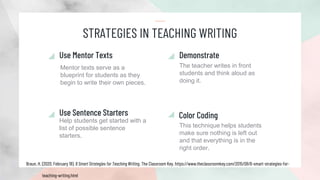
Use Mentor Texts
Mentor texts serve as a
blueprint for students as they
begin to write their own pieces.
Use Sentence Starters
Help students get started with a
list of possible sentence
starters.
Demonstrate
The teacher writes in front
students and think aloud as
doing it.
Color Coding
This technique helps students
make sure nothing is left out
and that everything is in the
right order.
Braun, H. (2020, February 18). 8 Smart Strategies for Teaching Writing. The Classroom Key. https://www.theclassroomkey.com/2015/08/8-smart-strategies-for-
teaching-writing.html
STRATEGIES IN TEACHING WRITING
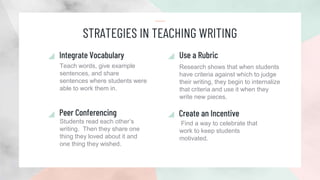
Integrate Vocabulary
Teach words, give example
sentences, and share
sentences where students were
able to work them in.
Peer Conferencing
Students read each other’s
writing. Then they share one
thing they loved about it and
one thing they wished.
Use a Rubric
Research shows that when students
have criteria against which to judge
their writing, they begin to internalize
that criteria and use it when they
write new pieces.
Create an Incentive
Find a way to celebrate that
work to keep students
motivated.
WRITING STRATEGIES
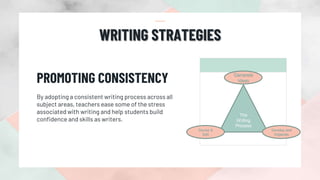
PROMOTING CONSISTENCY
By adopting a consistent writing process across all
subject areas, teachers ease some of the stress
associated with writing and help students build
confidence and skills as writers.
The
Writing
Process
Generate
Ideas
Develop and
Organize
Revise &
Edit
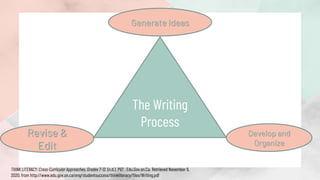
The Writing
Process
Generate Ideas
Develop and
Organize
Revise &
Edit
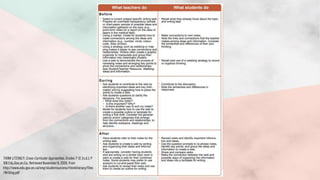
THINK LITERACY: Cross-Curricular Approaches, Grades 7-12. (n.d.). P97 . Edu.Gov.on.Ca. Retrieved November 9,
2020, from http://www.edu.gov.on.ca/eng/studentsuccess/thinkliteracy/files/Writing.pdf
Generating Ideas: Rapid Writing
Revising and Editing: Reorganizing Ideas
Developing and Organizing Ideas: Webbing and
Mapping
WRITING STRATEGIES
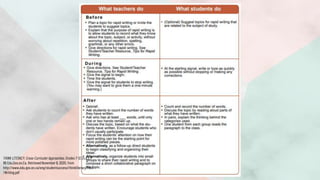
Generating Ideas: Rapid Writing
Help students to start writing and produce more
writing.
Encourage fluency in generationg ideas for writing
on any topic, in any subject area.
Help students begin organizing ideas.
THINK LITERACY: Cross-Curricular Approaches, Grades 7-12. (n.d.). P
99 Edu.Gov.on.Ca. RetrievedNovember 9, 2020, from
http://www.edu.gov.on.ca/eng/studentsuccess/thinkliteracy/files
/Writing.pdf
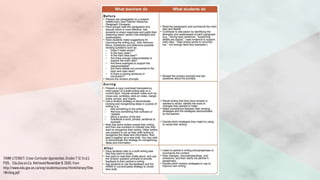
Revising and Editing: Reorganizing Ideas
Identify different strategies for reorganizing
content.
Examine and determine effectiveness of sentence
and paragraph order.
THINK LITERACY: Cross-Curricular Approaches, Grades 7-12. (n.d.).
P125. Edu.Gov.on.Ca. Retrieved November 9, 2020, from
http://www.edu.gov.on.ca/eng/studentsuccess/thinkliteracy/files
/Writing.pdf
Developing and Organizing Ideas: Webbing and Mapping
Identify relationships and make connections
among ideas and information.
Select ideas and information for possible
topics and subtopics.
THINK LITERACY: Cross-Curricular Approaches, Grades 7-12. (n.d.). P
109 Edu.Gov.on.Ca. Retrieved November 9, 2020, from
http://www.edu.gov.on.ca/eng/studentsuccess/thinkliteracy/files
/Writing.pdf
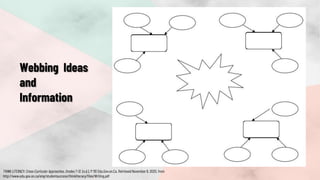
Webbing Ideas
and
Information
THINK LITERACY: Cross-Curricular Approaches, Grades 7-12. (n.d.). P 110 Edu.Gov.on.Ca. Retrieved November 9, 2020, from
http://www.edu.gov.on.ca/eng/studentsuccess/thinkliteracy/files/Writing.pdf
REFERENCES
● Braun, H. (2020, February 18). 8 Smart Strategies for Teaching Writing. The Classroom Key.
https://www.theclassroomkey.com/2015/08/8-smart-strategies-for-teaching-writing.html
● THINK LITERACY: Cross-Curricular Approaches, Grades 7-12. (n.d.). Edu.Gov.on.Ca. Retrieved November 9, 2020, from
http://www.edu.gov.on.ca/eng/studentsuccess/thinkliteracy/files/Writing.pdf
CREDITS: This presentation template was created by
Slidesgo, including icons by Flaticon, infographics &
images by Freepik
That would be all,
THANK YOU!

Strategies in Teaching Writing

  • 1.
    STRATEGIES IN TEACHING WRITING RonaPearl May Olano GROUP 3
  • 2.
    STRATEGIES IN TEACHINGWRITING Use Mentor Texts Mentor texts serve as a blueprint for students as they begin to write their own pieces. Use Sentence Starters Help students get started with a list of possible sentence starters. Demonstrate The teacher writes in front students and think aloud as doing it. Color Coding This technique helps students make sure nothing is left out and that everything is in the right order. Braun, H. (2020, February 18). 8 Smart Strategies for Teaching Writing. The Classroom Key. https://www.theclassroomkey.com/2015/08/8-smart-strategies-for- teaching-writing.html
  • 3.
    STRATEGIES IN TEACHINGWRITING Integrate Vocabulary Teach words, give example sentences, and share sentences where students were able to work them in. Peer Conferencing Students read each other’s writing. Then they share one thing they loved about it and one thing they wished. Use a Rubric Research shows that when students have criteria against which to judge their writing, they begin to internalize that criteria and use it when they write new pieces. Create an Incentive Find a way to celebrate that work to keep students motivated.
  • 4.
    WRITING STRATEGIES PROMOTING CONSISTENCY Byadopting a consistent writing process across all subject areas, teachers ease some of the stress associated with writing and help students build confidence and skills as writers. The Writing Process Generate Ideas Develop and Organize Revise & Edit
  • 5.
    The Writing Process Generate Ideas Developand Organize Revise & Edit THINK LITERACY: Cross-Curricular Approaches, Grades 7-12. (n.d.). P97 . Edu.Gov.on.Ca. Retrieved November 9, 2020, from http://www.edu.gov.on.ca/eng/studentsuccess/thinkliteracy/files/Writing.pdf
  • 6.
    Generating Ideas: RapidWriting Revising and Editing: Reorganizing Ideas Developing and Organizing Ideas: Webbing and Mapping WRITING STRATEGIES
  • 7.
    Generating Ideas: RapidWriting Help students to start writing and produce more writing. Encourage fluency in generationg ideas for writing on any topic, in any subject area. Help students begin organizing ideas.
  • 8.
    THINK LITERACY: Cross-CurricularApproaches, Grades 7-12. (n.d.). P 99 Edu.Gov.on.Ca. RetrievedNovember 9, 2020, from http://www.edu.gov.on.ca/eng/studentsuccess/thinkliteracy/files /Writing.pdf
  • 9.
    Revising and Editing:Reorganizing Ideas Identify different strategies for reorganizing content. Examine and determine effectiveness of sentence and paragraph order.
  • 10.
    THINK LITERACY: Cross-CurricularApproaches, Grades 7-12. (n.d.). P125. Edu.Gov.on.Ca. Retrieved November 9, 2020, from http://www.edu.gov.on.ca/eng/studentsuccess/thinkliteracy/files /Writing.pdf
  • 11.
    Developing and OrganizingIdeas: Webbing and Mapping Identify relationships and make connections among ideas and information. Select ideas and information for possible topics and subtopics.
  • 12.
    THINK LITERACY: Cross-CurricularApproaches, Grades 7-12. (n.d.). P 109 Edu.Gov.on.Ca. Retrieved November 9, 2020, from http://www.edu.gov.on.ca/eng/studentsuccess/thinkliteracy/files /Writing.pdf
  • 13.
    Webbing Ideas and Information THINK LITERACY:Cross-Curricular Approaches, Grades 7-12. (n.d.). P 110 Edu.Gov.on.Ca. Retrieved November 9, 2020, from http://www.edu.gov.on.ca/eng/studentsuccess/thinkliteracy/files/Writing.pdf
  • 14.
    REFERENCES ● Braun, H.(2020, February 18). 8 Smart Strategies for Teaching Writing. The Classroom Key. https://www.theclassroomkey.com/2015/08/8-smart-strategies-for-teaching-writing.html ● THINK LITERACY: Cross-Curricular Approaches, Grades 7-12. (n.d.). Edu.Gov.on.Ca. Retrieved November 9, 2020, from http://www.edu.gov.on.ca/eng/studentsuccess/thinkliteracy/files/Writing.pdf
  • 15.
    CREDITS: This presentationtemplate was created by Slidesgo, including icons by Flaticon, infographics & images by Freepik That would be all, THANK YOU!