Making the Move to an Enterprise
CTMS for Organizations of Any Size
August 23, 2012
Param Singh
Vice President of
Clinical Trial Management Solutions
BioPharm Systems, Inc.
Welcome & Introductions
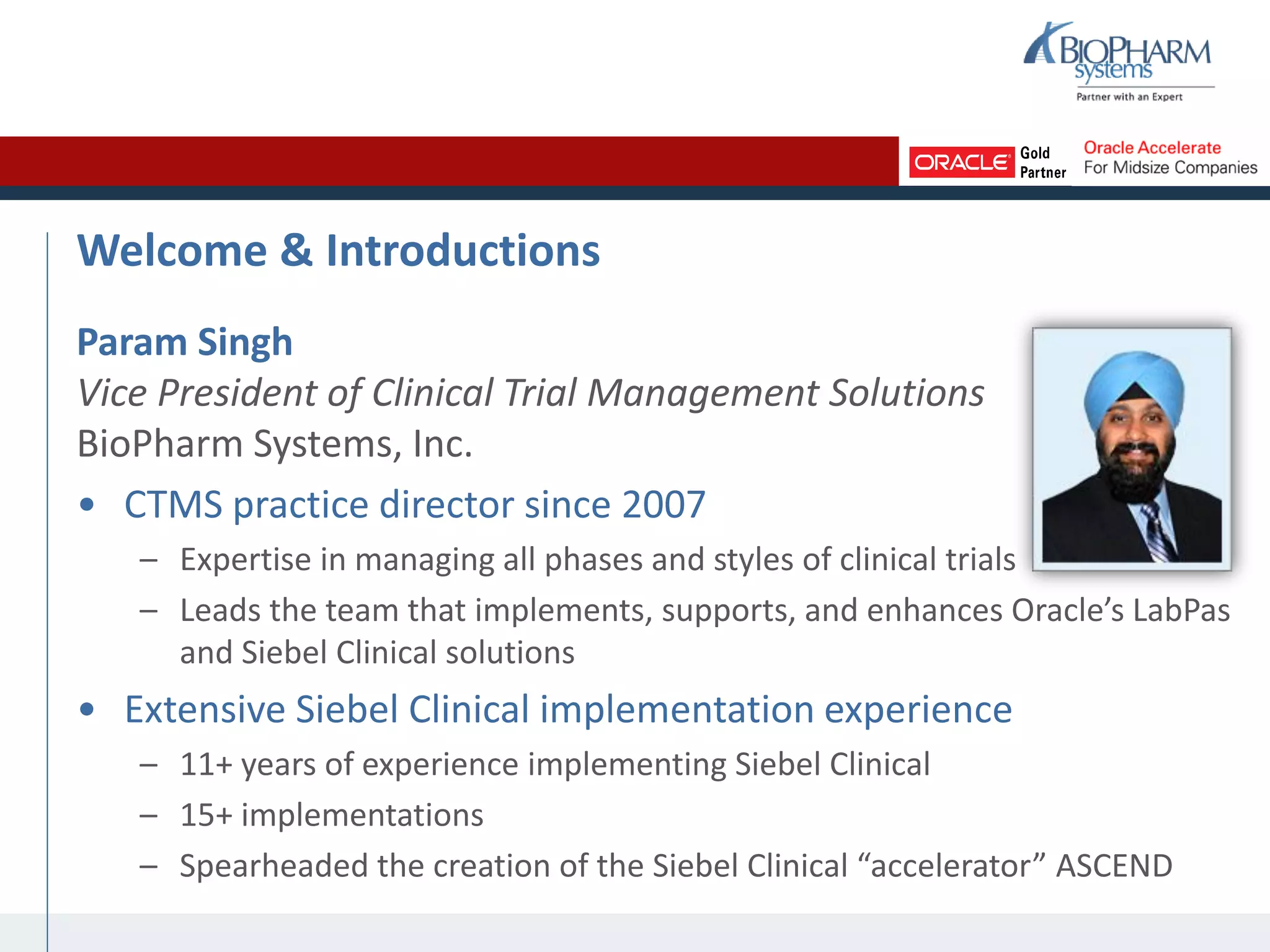
Param Singh
Vice President of Clinical Trial Management Solutions
BioPharm Systems, Inc.
• CTMS practice director since 2007
– Expertise in managing all phases and styles of clinical trials
– Leads the team that implements, supports, and enhances Oracle’s LabPas
and Siebel Clinical solutions
• Extensive Siebel Clinical implementation experience
– 11+ years of experience implementing Siebel Clinical
– 15+ implementations
– Spearheaded the creation of the Siebel Clinical “accelerator” ASCEND
Welcome & Introductions
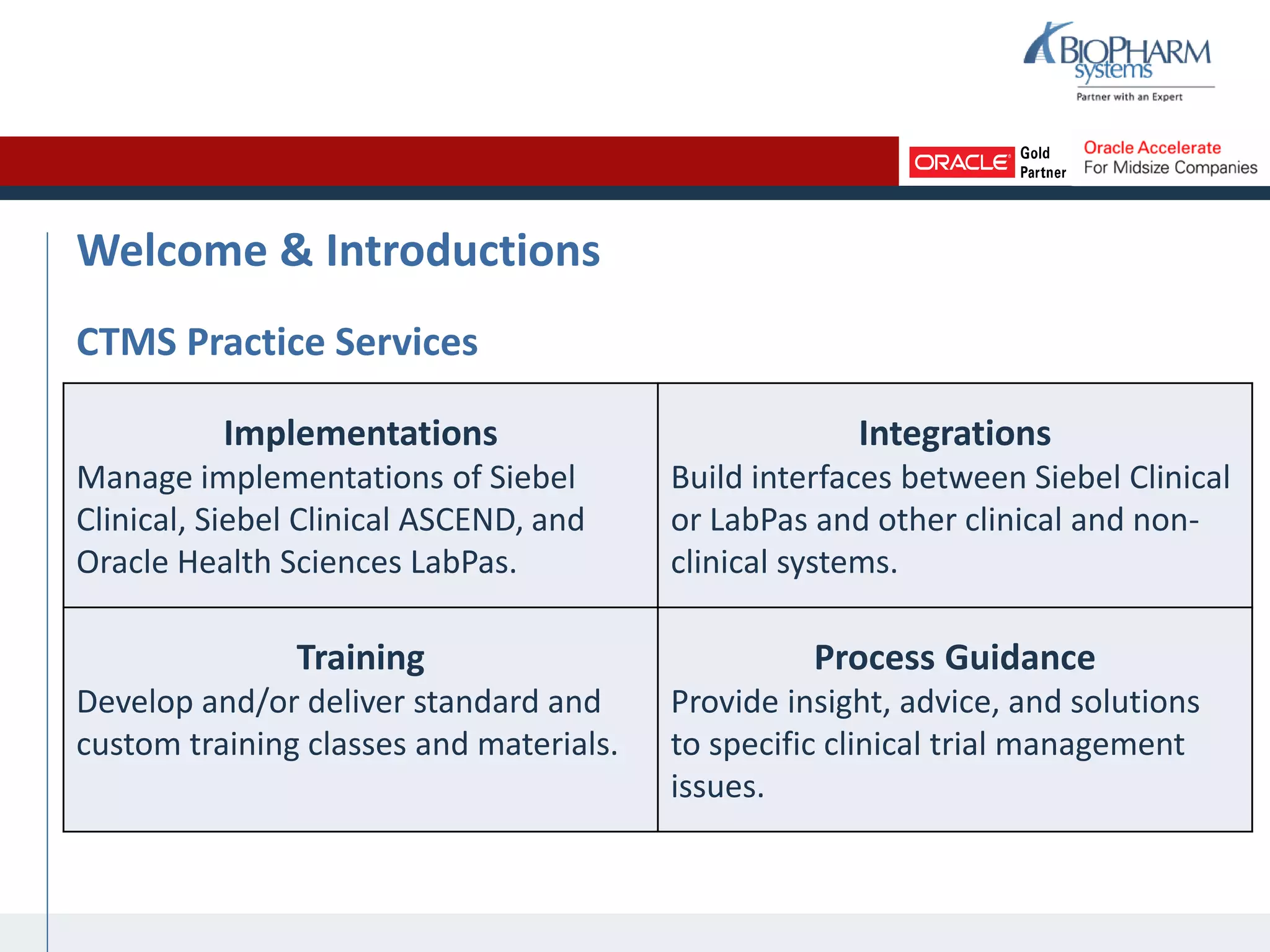
CTMS Practice Services
Implementations
Manage implementations of Siebel
Clinical, Siebel Clinical ASCEND, and
Oracle Health Sciences LabPas.
Integrations
Build interfaces between Siebel Clinical
or LabPas and other clinical and non-
clinical systems.
Training
Develop and/or deliver standard and
custom training classes and materials.
Process Guidance
Provide insight, advice, and solutions
to specific clinical trial management
issues.
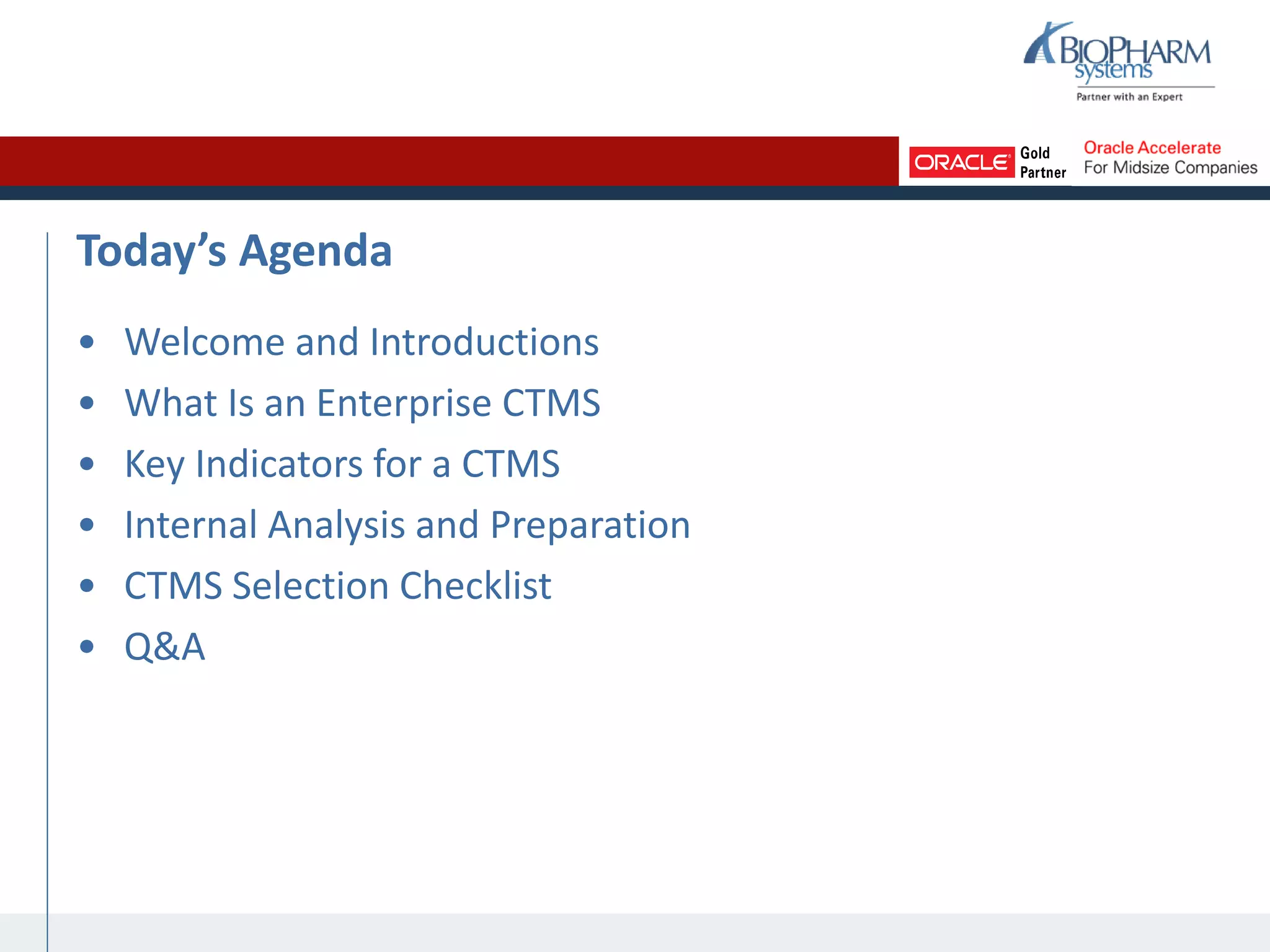
Today’s Agenda
• Welcome and Introductions
• What Is an Enterprise CTMS
• Key Indicators for a CTMS
• Internal Analysis and Preparation
• CTMS Selection Checklist
• Q&A
What Is an Enterprise CTMS?
• A single clinical trial management system that can be used by
multiple business units or clinical research divisions within a
company
– Beneficial for sponsors, CROs and academic medical centers
– Can be implemented organization-wide using a big bang approach or can
be rolled out using a phased approach
• A centralized system for the management of all clinical trials
– Eliminates disparate spreadsheets and databases across trials
– Provides access to clinical trial information in real-time
– Enforces consistency of administrative, operational and financial aspects
of trials across an organization
Could Your Company Benefit from an Enterprise CTMS?
• Key indicators that a CTMS is needed
– Rapid organizational growth
– Increased clinical trial pipeline
• Recent or planned merger of two organizations
• Increased number, size and/or complexity of trials
• Introduction or increased participation in global trials
– Increased need for real-time trial information and reporting
– Increased use of outsourcing to manage various trial activities
– Inability to compare similar trials due to disparate methods of study
tracking between trials
Could Your Company Benefit from an Enterprise CTMS?
• Key indicators that a CTMS is needed (cont.)
– Lack of a comprehensive investigator/site database with historical trial
participation information
– Desire to integrate trial management with other applications
• Internal customer master systems, document management systems, EDC,
IVRS, CDMS, safety, financial systems
• External vendor systems
– And much more…
Internal Analysis and Preparation
• Current Trial Management Processes
– Identify all divisions or business units currently performing
clinical trials
– Identify average number, size and length of on-going trials
– Review how trials are being managed within the same
division and across divisions
• What types of worksheets and databases utilized?
• Are standard management processes followed?
• What documentation and reporting methods are used?
• How are investigator and site payments tracked?
Internal Analysis and Preparation
• Identify Stakeholders
– What groups of individuals and functional areas will be
affected by the implementation of a CTMS?
– Identify key business and IT resources for the CTMS project
core team
– Document roles and responsibilities of each member of
the project team
– Make sure that each team member will be able to devote
the amount of time necessary to make the project
successful
– Develop good communication tools
Internal Analysis and Preparation
• Identify Critical Needs and System Requirements
– Develop a comprehensive list of requirements for the organization’s CTMS
• Solicit input from each group of stakeholders
– Prioritize each requirement
• Create a scorecard with each requirement listed as a 1, 2 or 3
• Identify ‘Needs’ and ‘Must Haves’ vs. ‘Wants’
Internal Analysis and Preparation
• Where Will the Money Come From?
– Create a business case for presentation to upper management and other
stakeholders
• Cost and time justifications
• Key benefits of a CTMS
• How the CTMS will be selected
• How the CTMS will be implemented
• An estimated timeline
• Post-implementation costs
– Obtain funding approval and management buy-in before moving forward
CTMS Selection Checklist
 System Identification
– Become familiar with basic CTMS functionality and terminology
• Internet search, webinars
– Make a list of potential vendors and research their CTMS
• Industry recommendations, conferences
• Vendor websites, product data sheets
– Narrow down the list of vendors
• Phone conversations, remote demos, feature comparisons
– Create and distribute an RFP
– Based on responses, invite top 2-3 vendors to demo on-site
CTMS Selection Checklist
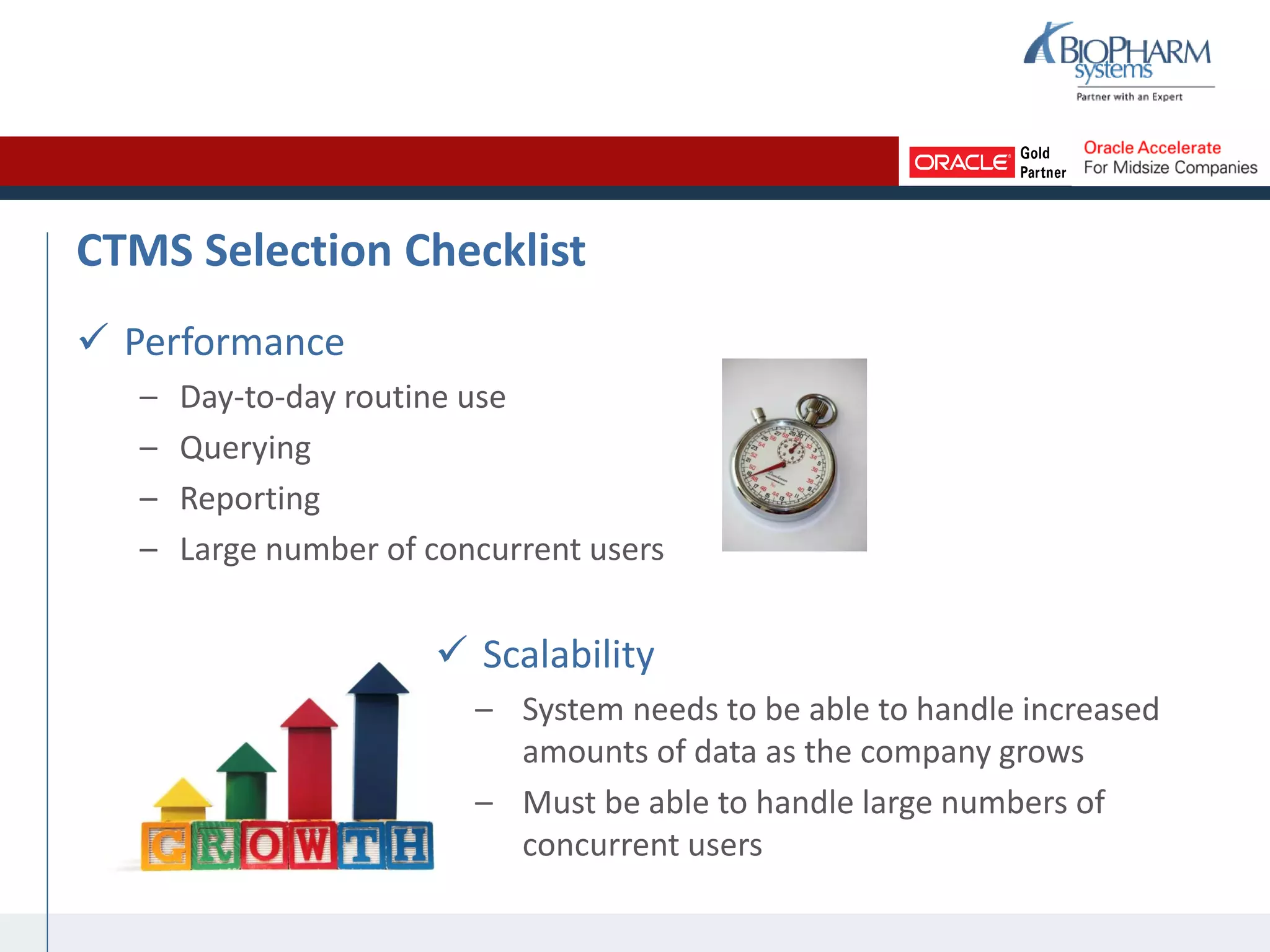
 Performance
– Day-to-day routine use
– Querying
– Reporting
– Large number of concurrent users
 Scalability
– System needs to be able to handle increased
amounts of data as the company grows
– Must be able to handle large numbers of
concurrent users
Key Considerations in Choosing a CTMS
 Robustness
– Select a CTMS with a wide range of capabilities that supports most if not
all study management tasks
 Customization Options
– Is the system an out-of-the box solution or can it be customized to meet
the company’s needs?
– What types of customizations or configurations are possible?
• New fields, label changes, workflows, additional functionality, etc.
– Weigh the pros and cons of any customization
↑ customization = ↑ cost
– Affect on implementation timeline
Key Considerations in Choosing a CTMS
 Technical Considerations
– Each CTMS vendor should be able to provide details regarding:
• Technical architecture
• Hardware and software specifications
• Database sizing
• Load balancing
• Use of server virtualization
• Performance tuning
• Server monitoring
• Database back-up and restore
• Disaster recovery
Key Considerations in Choosing a CTMS
 Implementation Options
– On-premises
– Dedicated hosting
– Shared hosting
– SaaS
 Data Migration Analysis
– Determine what data (if any) will be migrated from current systems or
spreadsheets
– Need for data cleansing
– Data standardization across multiple sources
– Cost analysis (programmatic migration vs. manual entry)
Key Considerations in Choosing a CTMS
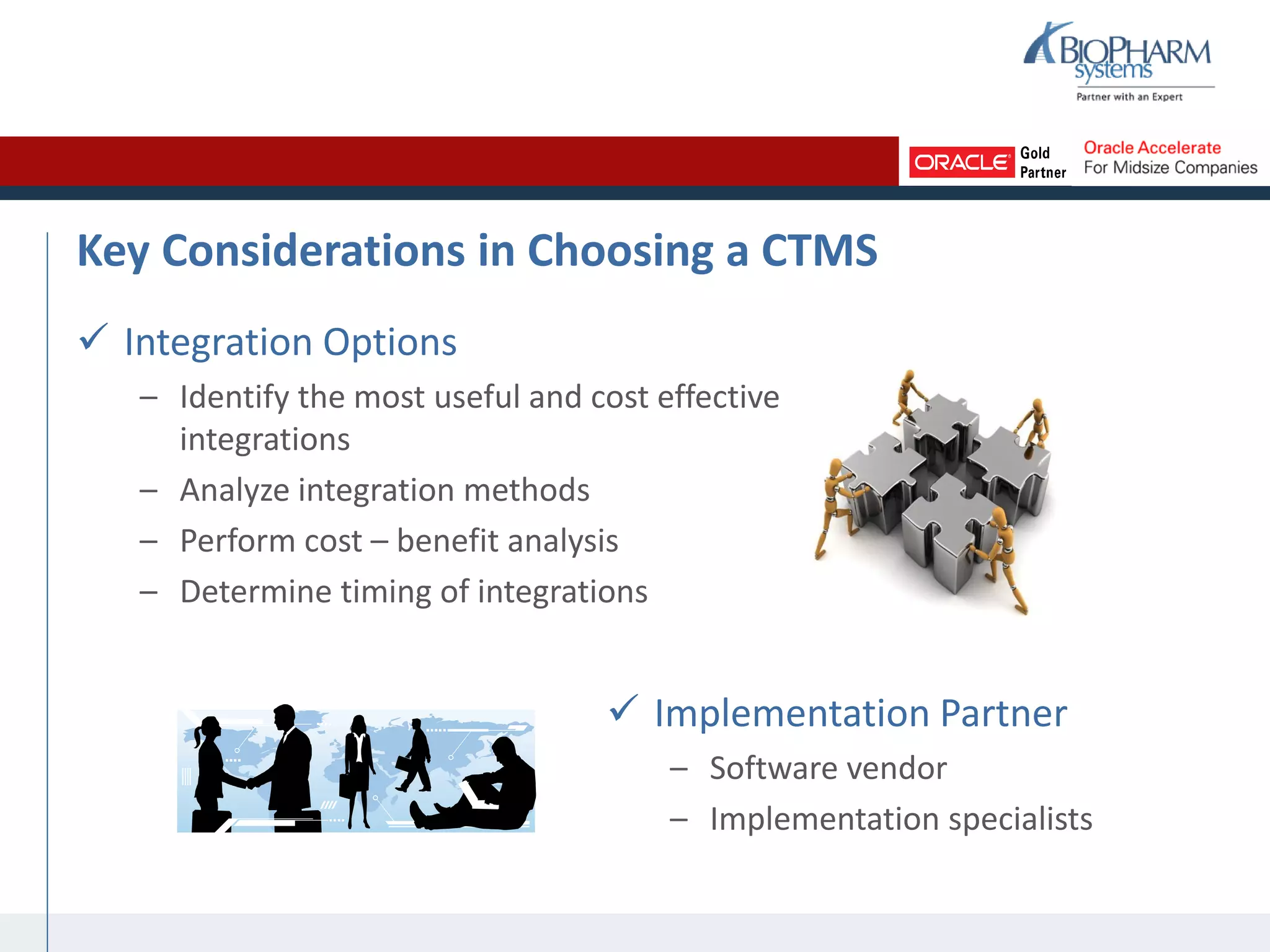
 Integration Options
– Identify the most useful and cost effective
integrations
– Analyze integration methods
– Perform cost – benefit analysis
– Determine timing of integrations
 Implementation Partner
– Software vendor
– Implementation specialists
Key Considerations in Choosing a CTMS
 Training
– Process/SOP revisions
– Application training
– Training tools
 Post-Implementation Support
– Phone and e-mail support
– Remote access
– Knowledge base
Enterprise CTMS Conclusions
• Key Indicators for a CTMS
– Rapid organizational growth and/or increased clinical trial pipeline
– Increased need for real-time trial information, a comprehensive
investigator database and the ability to compare similar trials
– Desire to integrate with other applications
• Internal Analysis and Preparation for a CTMS
– Analyze current trial management processes
– Identify critical needs and system requirements
– Present business case and obtain funding
Enterprise CTMS Conclusions (cont.)
• Considerations for CTMS Selection
– System identification
– Performance, scalability and robustness
– Customization options
– Technical considerations
– Implementation options
– Data migration analysis
– Integration options
– Implementation partner selection
– Training and post-implementation support
Q&A
Closing
Thank you for attending!
This webinar will be posted on
www.biopharm.com
within 24 hours
psingh@biopharm.com
+1 877-654-0033
+44 (0) 1865 910200

Making the Move to an Enterprise Clinical Trial Management System

  • 1.
    Making the Moveto an Enterprise CTMS for Organizations of Any Size August 23, 2012 Param Singh Vice President of Clinical Trial Management Solutions BioPharm Systems, Inc.
  • 2.
    Welcome & Introductions ParamSingh Vice President of Clinical Trial Management Solutions BioPharm Systems, Inc. • CTMS practice director since 2007 – Expertise in managing all phases and styles of clinical trials – Leads the team that implements, supports, and enhances Oracle’s LabPas and Siebel Clinical solutions • Extensive Siebel Clinical implementation experience – 11+ years of experience implementing Siebel Clinical – 15+ implementations – Spearheaded the creation of the Siebel Clinical “accelerator” ASCEND
  • 3.
    Welcome & Introductions CTMSPractice Services Implementations Manage implementations of Siebel Clinical, Siebel Clinical ASCEND, and Oracle Health Sciences LabPas. Integrations Build interfaces between Siebel Clinical or LabPas and other clinical and non- clinical systems. Training Develop and/or deliver standard and custom training classes and materials. Process Guidance Provide insight, advice, and solutions to specific clinical trial management issues.
  • 4.
    Today’s Agenda • Welcomeand Introductions • What Is an Enterprise CTMS • Key Indicators for a CTMS • Internal Analysis and Preparation • CTMS Selection Checklist • Q&A
  • 5.
    What Is anEnterprise CTMS? • A single clinical trial management system that can be used by multiple business units or clinical research divisions within a company – Beneficial for sponsors, CROs and academic medical centers – Can be implemented organization-wide using a big bang approach or can be rolled out using a phased approach • A centralized system for the management of all clinical trials – Eliminates disparate spreadsheets and databases across trials – Provides access to clinical trial information in real-time – Enforces consistency of administrative, operational and financial aspects of trials across an organization
  • 6.
    Could Your CompanyBenefit from an Enterprise CTMS? • Key indicators that a CTMS is needed – Rapid organizational growth – Increased clinical trial pipeline • Recent or planned merger of two organizations • Increased number, size and/or complexity of trials • Introduction or increased participation in global trials – Increased need for real-time trial information and reporting – Increased use of outsourcing to manage various trial activities – Inability to compare similar trials due to disparate methods of study tracking between trials
  • 7.
    Could Your CompanyBenefit from an Enterprise CTMS? • Key indicators that a CTMS is needed (cont.) – Lack of a comprehensive investigator/site database with historical trial participation information – Desire to integrate trial management with other applications • Internal customer master systems, document management systems, EDC, IVRS, CDMS, safety, financial systems • External vendor systems – And much more…
  • 8.
    Internal Analysis andPreparation • Current Trial Management Processes – Identify all divisions or business units currently performing clinical trials – Identify average number, size and length of on-going trials – Review how trials are being managed within the same division and across divisions • What types of worksheets and databases utilized? • Are standard management processes followed? • What documentation and reporting methods are used? • How are investigator and site payments tracked?
  • 9.
    Internal Analysis andPreparation • Identify Stakeholders – What groups of individuals and functional areas will be affected by the implementation of a CTMS? – Identify key business and IT resources for the CTMS project core team – Document roles and responsibilities of each member of the project team – Make sure that each team member will be able to devote the amount of time necessary to make the project successful – Develop good communication tools
  • 10.
    Internal Analysis andPreparation • Identify Critical Needs and System Requirements – Develop a comprehensive list of requirements for the organization’s CTMS • Solicit input from each group of stakeholders – Prioritize each requirement • Create a scorecard with each requirement listed as a 1, 2 or 3 • Identify ‘Needs’ and ‘Must Haves’ vs. ‘Wants’
  • 11.
    Internal Analysis andPreparation • Where Will the Money Come From? – Create a business case for presentation to upper management and other stakeholders • Cost and time justifications • Key benefits of a CTMS • How the CTMS will be selected • How the CTMS will be implemented • An estimated timeline • Post-implementation costs – Obtain funding approval and management buy-in before moving forward
  • 12.
    CTMS Selection Checklist System Identification – Become familiar with basic CTMS functionality and terminology • Internet search, webinars – Make a list of potential vendors and research their CTMS • Industry recommendations, conferences • Vendor websites, product data sheets – Narrow down the list of vendors • Phone conversations, remote demos, feature comparisons – Create and distribute an RFP – Based on responses, invite top 2-3 vendors to demo on-site
  • 13.
    CTMS Selection Checklist Performance – Day-to-day routine use – Querying – Reporting – Large number of concurrent users  Scalability – System needs to be able to handle increased amounts of data as the company grows – Must be able to handle large numbers of concurrent users
  • 14.
    Key Considerations inChoosing a CTMS  Robustness – Select a CTMS with a wide range of capabilities that supports most if not all study management tasks  Customization Options – Is the system an out-of-the box solution or can it be customized to meet the company’s needs? – What types of customizations or configurations are possible? • New fields, label changes, workflows, additional functionality, etc. – Weigh the pros and cons of any customization ↑ customization = ↑ cost – Affect on implementation timeline
  • 15.
    Key Considerations inChoosing a CTMS  Technical Considerations – Each CTMS vendor should be able to provide details regarding: • Technical architecture • Hardware and software specifications • Database sizing • Load balancing • Use of server virtualization • Performance tuning • Server monitoring • Database back-up and restore • Disaster recovery
  • 16.
    Key Considerations inChoosing a CTMS  Implementation Options – On-premises – Dedicated hosting – Shared hosting – SaaS  Data Migration Analysis – Determine what data (if any) will be migrated from current systems or spreadsheets – Need for data cleansing – Data standardization across multiple sources – Cost analysis (programmatic migration vs. manual entry)
  • 17.
    Key Considerations inChoosing a CTMS  Integration Options – Identify the most useful and cost effective integrations – Analyze integration methods – Perform cost – benefit analysis – Determine timing of integrations  Implementation Partner – Software vendor – Implementation specialists
  • 18.
    Key Considerations inChoosing a CTMS  Training – Process/SOP revisions – Application training – Training tools  Post-Implementation Support – Phone and e-mail support – Remote access – Knowledge base
  • 19.
    Enterprise CTMS Conclusions •Key Indicators for a CTMS – Rapid organizational growth and/or increased clinical trial pipeline – Increased need for real-time trial information, a comprehensive investigator database and the ability to compare similar trials – Desire to integrate with other applications • Internal Analysis and Preparation for a CTMS – Analyze current trial management processes – Identify critical needs and system requirements – Present business case and obtain funding
  • 20.
    Enterprise CTMS Conclusions(cont.) • Considerations for CTMS Selection – System identification – Performance, scalability and robustness – Customization options – Technical considerations – Implementation options – Data migration analysis – Integration options – Implementation partner selection – Training and post-implementation support
  • 21.
  • 22.
    Closing Thank you forattending! This webinar will be posted on www.biopharm.com within 24 hours psingh@biopharm.com +1 877-654-0033 +44 (0) 1865 910200