MakerKids: a Makerspace Just for Kids 
Andy Forest 
Co-executive Director (Learning) 
andy@makerkids.ca 
@Maker_Kids 
www.makerkids.ca
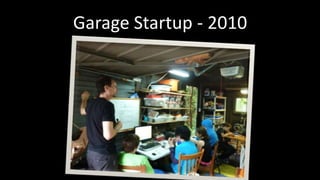
Garage Startup - 2010
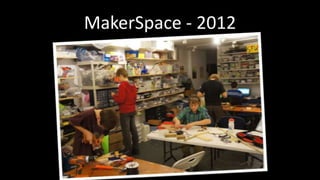
MakerSpace - 2012
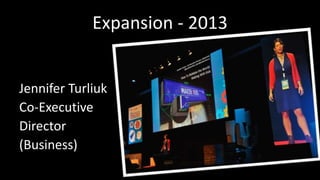
Expansion - 2013 
Jennifer Turliuk 
Co-Executive 
Director 
(Business)
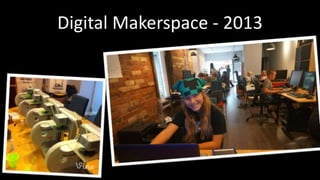
Digital Makerspace - 2013
Curriculum Development
What to Teach
What to Teach 
“Our education system goes back to ancient 
Messopotamia, with scribes learning to write. It’s 
top down, limited, authoritative and draconian. If 
you're not a round peg that fits in a round hole then 
you're a failure.” 
- James Burke 
SCHOOL
New Teaching Tools
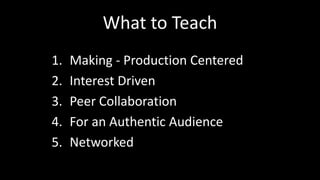
What to Teach 
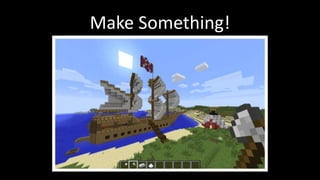
1. Making - Production Centered 
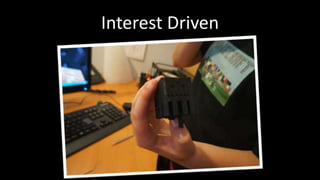
2. Interest Driven 
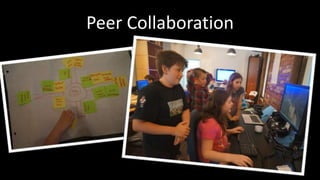
3. Peer Collaboration 
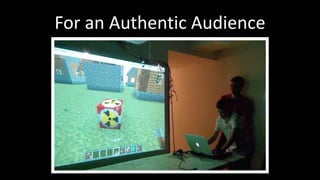
4. For an Authentic Audience 
5. Networked
What to Teach 
Learning to Learn in 
the 21st Century!
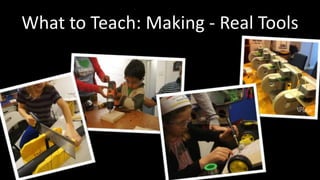
What to Teach: Making - Real Tools
Step by Step Skill Building?
Creativity over Skill Building
What to Teach: Interest Driven
Project Process 
1. Play 
2. Brainstorm 
3. Make a plan 
4. Identify unknowns, research solutions 
5. Build 
6. Fail – try something else 
7. Repeat 
8. Success!
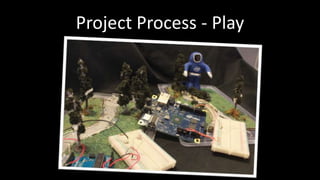
Project Process - Play
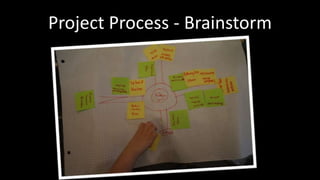
Project Process - Brainstorm
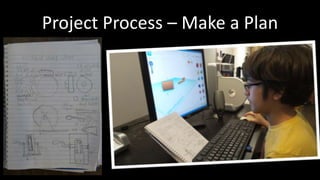
Project Process – Make a Plan
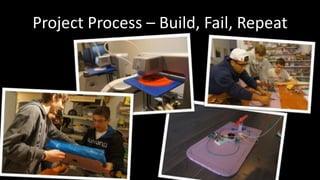
Project Process – Build, Fail, Repeat
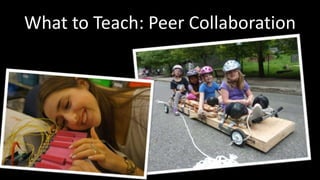
What to Teach: Peer Collaboration
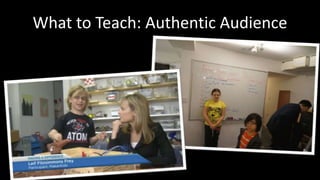
What to Teach: Authentic Audience
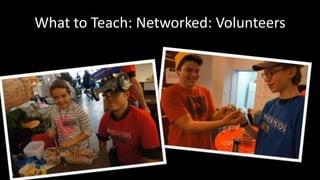
What to Teach: Networked: Volunteers
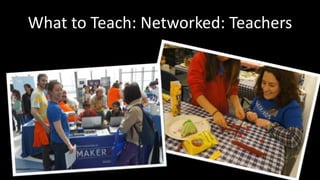
What to Teach: Networked: Teachers
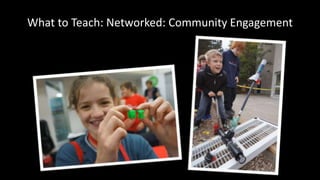
What to Teach: Networked: Community Engagement
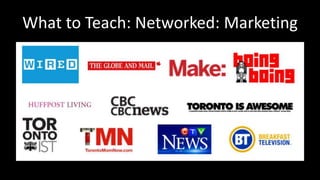
What to Teach: Networked: Marketing
Example: 
1. Making - Production Centered 
2. Interest Driven 
3. Peer Collaboration 
4. For an Authentic Audience 
5. Networked
Make Something!
Interest Driven
Peer Collaboration
For an Authentic Audience
Networked 
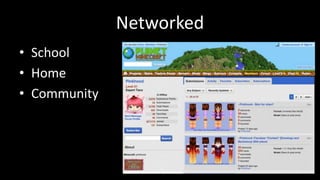
• School 
• Home 
• Community
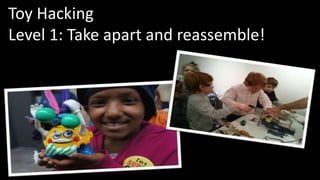
Toy Hacking 
Level 1: Take apart and reassemble!
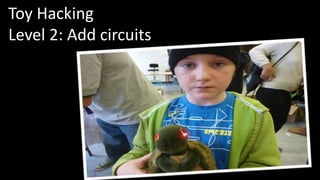
Toy Hacking 
Level 2: Add circuits
Robots 
Level 1: Wired control
Robots 
Level 2: Arduino
Programming 
Level 1: Hack the web - X-Ray Goggles
Programming 
Level 2: Build the web - Thimble
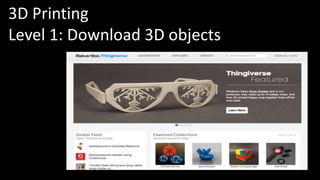
3D Printing 
Level 1: Download 3D objects
3D Printing 
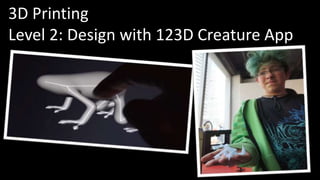
Level 2: Design with 123D Creature App
3D Printing 
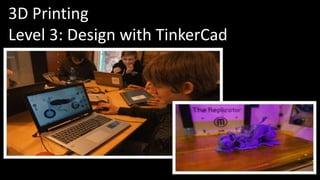
Level 3: Design with TinkerCad
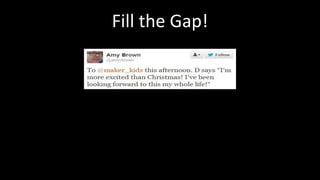
Fill the Gap!
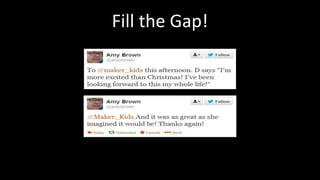
Fill the Gap!
Fill the Gap!
Questions 
Andy Forest 
Co-Executive Director (Learning) 
@codepoet127 
andy@makerkids.ca

Maker kids at Creative Making Conference at 2014

Editor's Notes

  • #3 My now wife Marianne and I started with a summer camp in our garage in 2010. I wasn’t a teacher, but I was a parent. I was a web developer, and have been a Maker since I was a kid. I knew I didn’t need to be an expert in everything, I could learn alongside the kids. I had basic woodworking and electronics tools so I outfitted the garage with these. There was no 3D printer, there was one computer. What I did have was a different attitude – the kids interests would define our projects, which in turn would define the skills they learned. Don't necessarily even need a space, maybe you just need a cart.  - Susan Considine Fayetteville Free Library Innisfil – equipment rotating around branches
  • #4 Kids loved the camps. In 2012, we started a permanent 1200 sq ft Makerspace. We used our wedding as a fundraiser and were able to get our first 3D printer. I knew we were on to a good thing when a girl from one of the camps who had been told about the space saw me walking in front of her house, and ran outside to ask me when it was opening.
  • #5 In the spring of 2013, we were doing everything we could handle on our own. Jenn came on board to help us grow to the next level. She coordinates, organizes, finds opportunities and partnerships. Since she came on board, we’ve literally grown 10x in terms of the number of kids that come through our programs every week.
  • #6 By the fall of 2013 we had grown enough to support another floor, so we opened our digital Makerspace. Jenn secured some key partners. Intel equipped us with laptops and 3D systems equipped us with 3D printers in exchange for activities and curriculum development. We now run about 10-20 different programs and activities every week, and had camps covering almost the whole summer. So you could say we’re doing very well.
  • #7 We’re working to spread kids Maker education as much as we can, we’ve developed curriculum modules for some great partners, and are looking for more.
  • #9 Not this. We live in the post information scarcity age of the Internet. Kids don’t need facts drilled into them.
  • #10 Schools use teaching tools from a past where we had extraordinarily limiting constraints. Now the tools are running away from us, faster than educational institutions can keep up. Kids need to learn how to learn - that is the most important thing. – James Burke
  • #11 We are primarily talking about learning based on actively designing, creating, producing. Interests are the best driver to foster learning We live in the best network humankind has ever seen – online and offline. Take advantage of that in your teaching Learning and creation thrives in an environment that is socially meaningful Studies have shown that when kids are producing for someone that cares about the results, they put much more effort in Ultimately our aim is to empower kids to be makers! Scatter and gather
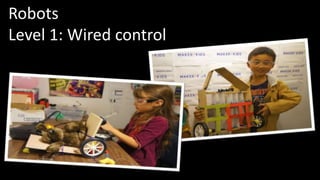
  • #12 We are primarily talking about learning based on actively designing, creating, producing. Interests are the best driver to foster learning We live in the best network humankind has ever seen – online and offline. Take advantage of that in your teaching Learning and creation thrives in an environment that is socially meaningful Studies have shown that when kids are producing for someone that cares about the results, they put much more effort in Ultimately our aim is to empower kids to be makers! Scatter and gather
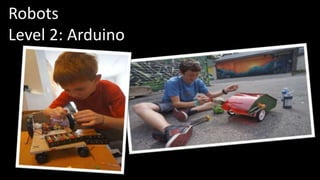

  • #13 Kids are capable of using real tools. We don’t have the Fisher price plastic toy drill set, we give 3 year olds real drills. Kids 8 and up come on their own. They have the dexterity and the self control and can learn to use real tools safely.
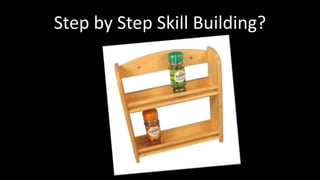
  • #14 Who built a spice rack in shop class? You followed the plans step by step, and everyone made the same thing. Lots of kids totally tuned out of that class, they had no interest in a spice rack. I took mine home, and it didn’t even fit any spice bottles. I told my shop teacher that the plans were wrong, and he said that he had shrunk them down to save wood. I was so mad! This is the state of a lot of tech education – step by step skill building. Many kids don’t even realize that technology can be creative. Step by step skill building does not create innovators.
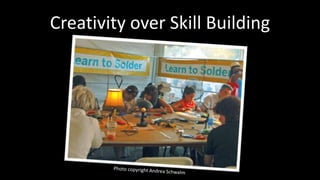
  • #15 Don’t get me wrong; this is awesome! But it illustrates one of the key differences between an adult makerspace and a kids makerspace. At an adults makerspace, the people are already engaged. You can teach a class solely on how to solder because they immediately recognize the possibilities that capability unlocks for them. They look forward to the things they can make with that skill. At a kids makerspace, they don’t always recognize that. If you just give them a skill to learn, they can tune out pretty quickly. So our activities always have a creative element.
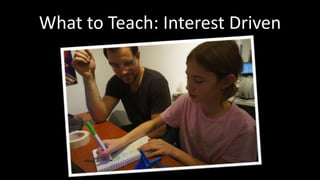
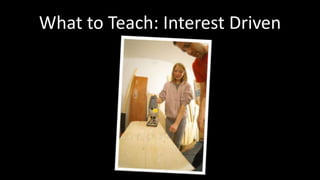
  • #16 Zoe bow and arrow example
  • #17 Zoe bow and arrow example Just in Time Learning Kids say things like – can you solder this for me? You’re better at it. Our standard response is “That’s why you should do it, to get better at it!”
  • #18 Play – In our Arduino class, we start off with a fully programmed mars base biodome. Brainstorm – Generate lots of ideas. Identify the awesome parts and cut away everything else. Expand the awesome part. Repeat. Make a plan – no cutting anything until you have plans with measurements and parts lists. Identify your unknowns, research solutions. This is one of the hardest parts for educators to accept. It’s ok for you to not be an expert in everything. Set a good model for the kids, and research with them. Build Fail – failure is an opportunity to learn! Edison - I have not failed. I've just found 10,000 ways that won't work.
  • #19 Play – In our Arduino class, we start off with a fully programmed mars base biodome.
  • #20 Brainstorm – Generate lots of ideas. Identify the awesome parts and cut away everything else. Expand the awesome part. Repeat.
  • #21 Make a plan – no cutting anything until you have plans with measurements and parts lists. Identify your unknowns, research solutions. This is one of the hardest parts for educators to accept. It’s ok for you to not be an expert in everything. Set a good model for the kids, and research with them.
  • #22 Example from a week-long class of grade 10 kids from last week: They worked through lunch, they stayed for extra time afterwards, and they got it done. Build Fail – failure is an opportunity to learn! Edison - I have not failed. I've just found 10,000 ways that won't work.
  • #23 Educators are always discussing how to get girls interested in Science, Technology, Engineering and Math. I went to a talk about this at SXSW in Austin in March. After the talk, I went back to our booth where we were teaching kids 3D design and having them print out their creations on the spot on our 3D printers. I looked around and realized that the majority of the kids who had been there all day were girls. Yes, girls are different. Every kid is different! Come up with open ended, creative, self directed, peer collaborative activities, and girls and boys will flock to them. And call them STEAM – add in an A for art. That said, we have found that girls really like group work and artistic projects. For example – soap box racers, 3D printed arduino keyboard.
  • #24 Exhibition helps to value kids efforts. It provides a sense of purpose when an authentic audience can see and respond to what they are doing. Exhibition can be online, too, we publish as much as we can on our web site and our Youtube channel. A local TV station came and did a segment on us and we got 15 kids to show up at 6am on a school day.
  • #25 People are eager to volunteer. Adults recognize that there is a shortage of this kind of education for kids, and they want to help. I can’t tell you how many people walk in our doors and say “I wish there was a place like this when I was a kid”. Connect with local hackerspaces, craft groups, etc. They will feed you volunteers. Teens will volunteer if they enjoy it. As well as being a job, we try and make it a social experience for them. Our Minecraft drop-in frequently has almost as many teenage volunteers as younger participants – they like hanging out together. We also have a volunteer night each week where we hang out and make our own projects. We provide a Volunteer Manual to teach them how our methods are different than the traditional school system as well as safety and other guidelines. After that, we do a training before their first class to reinforce key points.
  • #26 Finding and keeping good teachers can be a challenge. We always get our teachers to volunteer first so that they can see how we do things, and we can see how they work with the kids. When looking at their resumes, experiential learning like camp, other informal learning is better than just formal teaching training. Some of our best teachers are kids that have taken classes, then become volunteers and then teachers. They’ve gone through our process and know how we work. Matthew: started as a student, and is now teaching classes. Another teen teacher, Cole, was on a panel in Toronto about “Alternative Models of Education”.
  • #27 Connect with teachers. One teacher at a local school, Vicki, has sent so many kids our way. She tells parents of kids who she thinks are Makers to send them to us. Community events. Both for the Maker community like Maker Faire, museum events, tech conferences. Also the local community like street festivals and school fairs. I’ve had so many conversations with parents who are amazed at how engaged their kids are at our activities. “Buy them a Make magazine or come to one of our open make nights”. Some kids struggle with the traditional school system, and as soon as they have access to open ended, interest driven activities, they just thrive. We have many kids on the Autism spectrum and with other cognitive differences who love coming to our programs.
  • #28 PR is your best friend. This maker stuff is awesome, and people know it. Send out emails to all your local press describing what you do. TV news shows love to do segments on interesting local things like this. They’re all be happy to plug your programs.
  • #29 We are primarily talking about learning based on actively designing, creating, producing. Interests are the best driver to foster learning We live in the best network humankind has ever seen – online and offline. Take advantage of that in your teaching Learning and creation thrives in an environment that is socially meaningful Studies have shown that when kids are producing for someone that cares about the results, they put much more effort in Ultimately our aim is to empower kids to be makers! Scatter and gather
  • #31 More than making it entertaining, make it important to the.
  • #33 Stanford Study of Writing 189 students. Submitted all coursework writing, and as much “life writing” as they wanted students are writing more than ever before. Only 62% for classwork Outside of classwork writing had the longest length, and the highest richness and complexity http://news.stanford.edu/news/2009/october12/lunsford-writing-research-101209.html
  • #44 This is the huge gap – kids are thirsting for this kind of hands-on creative expression. I love this tweet. But it’s not actually about us, she hadn’t been to our space yet. This tweet is about you, about what all of you are going to do to fill this gap.
  • #45 This is the huge gap – kids are thirsting for this kind of hands-on creative expression. I love this tweet. But it’s not actually about us, she hadn’t been to our space yet. This tweet is about you, about what all of you are going to do to fill this gap.