Makerspaces and
Curriculum
By,
Rachel Stewart
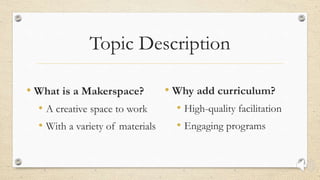
Topic Description
• What is a Makerspace?
• A creative space to work
• With a variety of materials
• Why add curriculum?
• High-quality facilitation
• Engaging programs
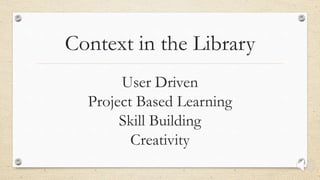
Context in the Library
User Driven
Project Based Learning
Skill Building
Creativity
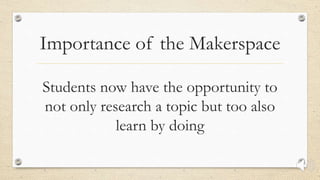
Importance of the Makerspace
Students now have the opportunity to
not only research a topic but too also
learn by doing
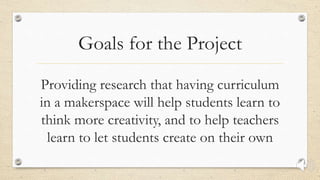
Goals for the Project
Providing research that having curriculum
in a makerspace will help students learn to
think more creativity, and to help teachers
learn to let students create on their own
Key Concepts
Curriculum Needs
• Guide Lessons
• Defines what the learner
will learn
• Develop conceptual
understanding
What to use
• Club or Camp Invention
• Pinterest
• Teachers Pay Teachers
Key Concepts
The way it looks
• Student led
• Adult mentor
• Centers
• Loops not lines
Coding
• Programming language
• Robots
• STEM/STEAM
• Variety of programs
Gaps in the Research
Non-curriculum based Spaces
Spaces that use websites and robotics as the main
focus instead of having the students create
something to fill a need
Conclusions
There is plenty of articles on
makerspaces but very little on
curriculum in makerspaces
Future Research
•Fab Lab
•Hackerspace
•Learning
Commons
•Students
•Testing
•Robots
Building on Existing Knowledge
•Understanding what teachers know
•What is considered curriculum
Join the
movement and
start creating
today!!
Amabile, T.M. ‘Componential Theory of Creativity.' 26/04/12.
DeRosa, M. S. (2016). Let the wild rumpus start!: Fostering creative thinking and expression
among diverse learners through a makerspace in an international school in china. (Ed.D.,
Northeastern University).
Fontichiaro, K. (2016). Help! My principal says I need to start a makerspace in my elementary
library! Teacher Librarian, 44(1), 49-51,63.
Holbert, N. (2016). The powerful ideas of making: Building beyond the curriculum. Journal of
Innovation and Entrepreneurship, 5(1), 1-7. doi:10.1186/s13731-016-0058-4
Kelley, T. R., & Knowles, J. G. (2016). A conceptual framework for integrated STEM education.
International Journal of STEM Education, 3(1), 1-11.
doi:http://libproxy.library.unt.edu:2126/10.1186/s40594-016-0046-z
Kim, M. S., & Ruters, J. (2016). Competency-based curriculum for digital fabrication and
makerspaces. Paper presented at the Proceedings of EdMedia: World Conference on Educational Media
and Technology 2016, pp. 1366-1369.
Kurti, R. S., Kurti, D. L., & Fleming, L. (2014). The philosophy of educational makerspaces part
1 of making an educational makerspace. Teacher Librarian, 41(5), 8-11.

5970 powerpoint

  • 1.
  • 2.
    Topic Description • Whatis a Makerspace? • A creative space to work • With a variety of materials • Why add curriculum? • High-quality facilitation • Engaging programs
  • 3.
    Context in theLibrary User Driven Project Based Learning Skill Building Creativity
  • 4.
    Importance of theMakerspace Students now have the opportunity to not only research a topic but too also learn by doing
  • 5.
    Goals for theProject Providing research that having curriculum in a makerspace will help students learn to think more creativity, and to help teachers learn to let students create on their own
  • 6.
    Key Concepts Curriculum Needs •Guide Lessons • Defines what the learner will learn • Develop conceptual understanding What to use • Club or Camp Invention • Pinterest • Teachers Pay Teachers
  • 7.
    Key Concepts The wayit looks • Student led • Adult mentor • Centers • Loops not lines Coding • Programming language • Robots • STEM/STEAM • Variety of programs
  • 8.
    Gaps in theResearch Non-curriculum based Spaces Spaces that use websites and robotics as the main focus instead of having the students create something to fill a need
  • 9.
    Conclusions There is plentyof articles on makerspaces but very little on curriculum in makerspaces
  • 10.
  • 11.
    Building on ExistingKnowledge •Understanding what teachers know •What is considered curriculum
  • 12.
  • 13.
    Amabile, T.M. ‘ComponentialTheory of Creativity.' 26/04/12. DeRosa, M. S. (2016). Let the wild rumpus start!: Fostering creative thinking and expression among diverse learners through a makerspace in an international school in china. (Ed.D., Northeastern University). Fontichiaro, K. (2016). Help! My principal says I need to start a makerspace in my elementary library! Teacher Librarian, 44(1), 49-51,63. Holbert, N. (2016). The powerful ideas of making: Building beyond the curriculum. Journal of Innovation and Entrepreneurship, 5(1), 1-7. doi:10.1186/s13731-016-0058-4 Kelley, T. R., & Knowles, J. G. (2016). A conceptual framework for integrated STEM education. International Journal of STEM Education, 3(1), 1-11. doi:http://libproxy.library.unt.edu:2126/10.1186/s40594-016-0046-z Kim, M. S., & Ruters, J. (2016). Competency-based curriculum for digital fabrication and makerspaces. Paper presented at the Proceedings of EdMedia: World Conference on Educational Media and Technology 2016, pp. 1366-1369. Kurti, R. S., Kurti, D. L., & Fleming, L. (2014). The philosophy of educational makerspaces part 1 of making an educational makerspace. Teacher Librarian, 41(5), 8-11.