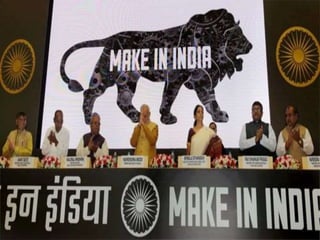
Make in India is an international marketing
campaigning slogan coined by the Prime
Minister of India, Narendra Modi to attract
businesses from around the world to invest and
manufacture in India.
Make in India campaign was launched on
25th of September in 2014 in the New Delhi at
Vigyan Bhawan. The aim of this campaign is to
give India an economic global recognition.
 7th Largest GDP.
 7.5% Growth Rate
 Services are main source of economic
growth.
 Pioneer in Information Technology.
India is third largest in Purchasing Power
Parity(PPP), newly industrialized country ,
one of the G-20 major economies, a member
of BRICS.
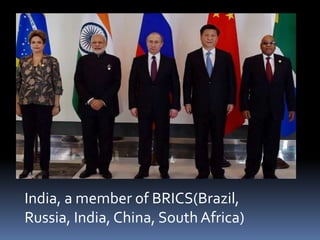
India, a member of BRICS(Brazil,
Russia, India, China, South Africa)
 Job creation
 Skill development
 Foster Innovation
 Attract capital and technological
investment in India.
 Protect Intellectual Property
Rights.
Make in India i.e. to manufacture in India was launched
with an objective to make India an independent country.
 Enhancing the literacy rate
 Develop the skills
 India has been importing goods , equipments and
machineries from other countries including those
related to defence sector. Instead of importing, if at
least someone begins to make in India:
• Goods become cheaper
• they will be readily available
• Less foreign exchange out go.
India’s ailing infrastructure scenario and defunct logistics
facilities make it difficult for the country to achieve an
elite status as a manufacturing hub.
Reason why India is not able to compete with
other countries:
 Lack of Robust Transport Networks
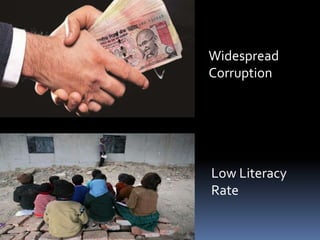
 Widespread Corruption
 Low Literacy Rate
 Outdated Infrastructure
Widespread
Corruption
Low Literacy
Rate
 Cost of manpower is relatively low.
 India has already marked its presence
as one of the fastest growing economies
of the world.
 Demographics of India are favorable.
 The country is expected to rank
amongst the world top three growth
economies.
Skilled Workforce
 Large Number of Young Blood eligible
for employment.
 Large Number of english speaking
population.
 Aims at high quality standards.
Low Level Infrastructure
 Lack of Modern Technologies
 India being ranked low on ‘ease of doing
business’ by world bank.
 Corporate Tax is higher as compared to other
nations i.e. 33%.
 Labour laws, land laws, Red Tags are the
major challenges.
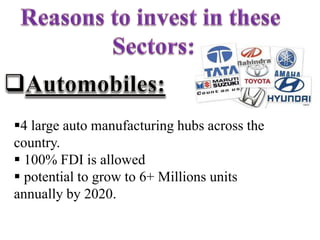
4 large auto manufacturing hubs across the
country.
 100% FDI is allowed
 potential to grow to 6+ Millions units
annually by 2020.
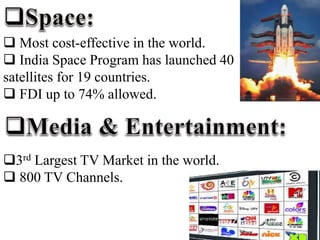
 Most cost-effective in the world.
 India Space Program has launched 40
satellites for 19 countries.
 FDI up to 74% allowed.
3rd Largest TV Market in the world.
 800 TV Channels.
Ease of business
Skill and jobs for the youth
 Making India a manufacturer
 100 smart cities
 Getting away with archaic laws
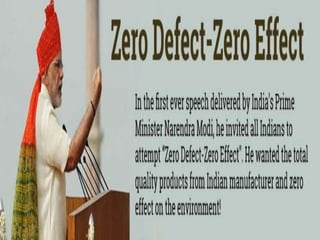
Prime Minister Narendra Modi pitched for
‘Make in India’ with ‘zero defect zero effect’
strategy giving a clear message that country
needs to manufacture quality products with
zero effect on the environment.
Our Manufacturing should have zero defect so
that our products should not be rejected on
global standards…
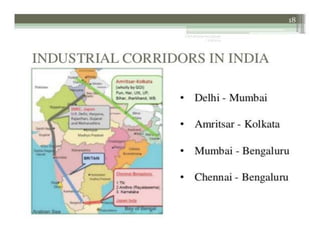
Five industrial corridor projects have been
identified, planned and launched by the
Government of India in the Union Budget of
2014-2015, to provide an impetus to
industrialization and planned urbanisation.
• Delhi-Mumbai Industrial Corridor
• Bengaluru Chennai corridor
• Chennai- Bengaluru Industrial Corridor
• Amritsar- Kolkata Industrial Corridor
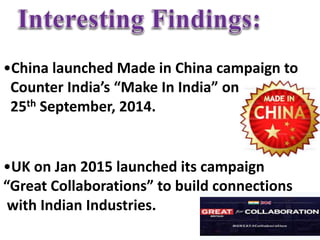
•China launched Made in China campaign to
Counter India’s “Make In India” on
25th September, 2014.
•UK on Jan 2015 launched its campaign
“Great Collaborations” to build connections
with Indian Industries.
 Increase in Manufacturing and Export
 Generation of more jobs
 Attract more FDI.
 High Tech Technology comes to India.
 Companies all over the world will start
business in India.
 Industry and government will work
together.
• Swachh Bharat Abhiyaan
• Pradhan Mantri Jan Dhan
Yojana
 Over 1000 training centers would
be opened across India.
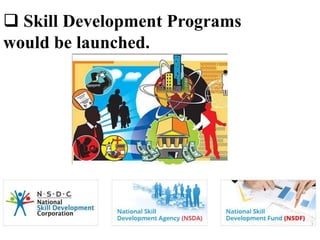
 Skill Development Programs
would be launched.
India is a country rich in natural resources.
Labour is a plenty and skilled labour is easily
available given the high rates of unemployment
among the educated class of the country.
Make in India was launched with an aim to:
Boost Investment
 Raise Technology Level
 Increase Economic Growth in country
Make in India is not a slogan but a mission to
be accomplished by a single minded
commitment about processes.

Make In India

  • 2.
    Make in Indiais an international marketing campaigning slogan coined by the Prime Minister of India, Narendra Modi to attract businesses from around the world to invest and manufacture in India. Make in India campaign was launched on 25th of September in 2014 in the New Delhi at Vigyan Bhawan. The aim of this campaign is to give India an economic global recognition.
  • 4.
     7th LargestGDP.  7.5% Growth Rate  Services are main source of economic growth.  Pioneer in Information Technology. India is third largest in Purchasing Power Parity(PPP), newly industrialized country , one of the G-20 major economies, a member of BRICS.
  • 5.
    India, a memberof BRICS(Brazil, Russia, India, China, South Africa)
  • 6.
     Job creation Skill development  Foster Innovation  Attract capital and technological investment in India.  Protect Intellectual Property Rights.
  • 7.
    Make in Indiai.e. to manufacture in India was launched with an objective to make India an independent country.  Enhancing the literacy rate  Develop the skills  India has been importing goods , equipments and machineries from other countries including those related to defence sector. Instead of importing, if at least someone begins to make in India: • Goods become cheaper • they will be readily available • Less foreign exchange out go.
  • 9.
    India’s ailing infrastructurescenario and defunct logistics facilities make it difficult for the country to achieve an elite status as a manufacturing hub. Reason why India is not able to compete with other countries:  Lack of Robust Transport Networks  Widespread Corruption  Low Literacy Rate  Outdated Infrastructure
  • 10.
  • 11.
     Cost ofmanpower is relatively low.  India has already marked its presence as one of the fastest growing economies of the world.  Demographics of India are favorable.  The country is expected to rank amongst the world top three growth economies.
  • 12.
    Skilled Workforce  LargeNumber of Young Blood eligible for employment.  Large Number of english speaking population.  Aims at high quality standards.
  • 13.
    Low Level Infrastructure Lack of Modern Technologies  India being ranked low on ‘ease of doing business’ by world bank.  Corporate Tax is higher as compared to other nations i.e. 33%.  Labour laws, land laws, Red Tags are the major challenges.
  • 15.
    4 large automanufacturing hubs across the country.  100% FDI is allowed  potential to grow to 6+ Millions units annually by 2020.
  • 16.
     Most cost-effectivein the world.  India Space Program has launched 40 satellites for 19 countries.  FDI up to 74% allowed. 3rd Largest TV Market in the world.  800 TV Channels.
  • 17.
    Ease of business Skilland jobs for the youth  Making India a manufacturer  100 smart cities  Getting away with archaic laws
  • 19.
    Prime Minister NarendraModi pitched for ‘Make in India’ with ‘zero defect zero effect’ strategy giving a clear message that country needs to manufacture quality products with zero effect on the environment. Our Manufacturing should have zero defect so that our products should not be rejected on global standards…
  • 21.
    Five industrial corridorprojects have been identified, planned and launched by the Government of India in the Union Budget of 2014-2015, to provide an impetus to industrialization and planned urbanisation. • Delhi-Mumbai Industrial Corridor • Bengaluru Chennai corridor • Chennai- Bengaluru Industrial Corridor • Amritsar- Kolkata Industrial Corridor
  • 24.
    •China launched Madein China campaign to Counter India’s “Make In India” on 25th September, 2014. •UK on Jan 2015 launched its campaign “Great Collaborations” to build connections with Indian Industries.
  • 25.
     Increase inManufacturing and Export  Generation of more jobs  Attract more FDI.  High Tech Technology comes to India.  Companies all over the world will start business in India.  Industry and government will work together.
  • 26.
    • Swachh BharatAbhiyaan • Pradhan Mantri Jan Dhan Yojana
  • 27.
     Over 1000training centers would be opened across India.
  • 28.
     Skill DevelopmentPrograms would be launched.
  • 29.
    India is acountry rich in natural resources. Labour is a plenty and skilled labour is easily available given the high rates of unemployment among the educated class of the country. Make in India was launched with an aim to: Boost Investment  Raise Technology Level  Increase Economic Growth in country Make in India is not a slogan but a mission to be accomplished by a single minded commitment about processes.